DEFINITION A gaming console is a system that is exclusively dedicated for gaming. It has been optimized for game playing as that is its core function. We can ply games on a PC or in a cell phone but these are not systems dedicated for gaming, so they are not gaming consoles.
HISTORY OF VIDEO GAMECONSOLES 1971-First commercial video game, Computer    Space by Nutting Associates
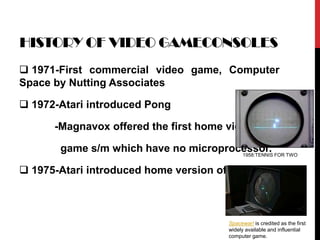
 1972-Atari introduced Pong            -Magnavox offered the first home video              game s/m which have no microprocessor.  1975-Atari introduced home version of Pong1958:TENNIS FOR TWOSpacewar! is credited as the first widely available and influential computer game.
BASIC COMPONENTS OF A VIDEO GAME CONSOLEThe core components are: User control interface
 CPU
 RAM
 Software kernel
 Storage medium for games
 Video output
 Audio output
 Power supplyCOMMON ELEMENTSControllers: Devices that allow the user to input information and interact with onscreen objects. They are like the keyboards and joysticks of personal computers.
Power supply: a power supply converts 100-240 volt AC utility power into direct current (DC) at the voltages needed by the electronics.
Console/Core Unit: The core unit in a video game console is the hub where the television, video game controllers, and game program connect. It usually contains a CPU, RAM, and an audiovisual coprocessor. Core units are similar to towers of personal computers.
Game Media: Most video game consoles have their programs stored on external media. They are the ROM of consoles.
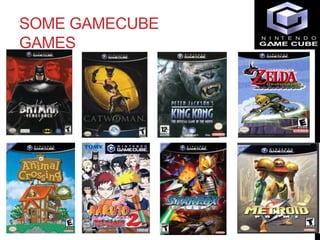
Memory Card: Some video game consoles, like the PlayStation and the Nintendo GameCube have memory cards to save, load, and delete files. Though recent consoles such as the Xbox, Xbox 360, PlayStation 3, and Wii all have – or can have installed – hard drives/internal memory which save the data on the console itself. Memory cards are like flash drives for consoles. PLAYSTATIONCentral processing unitR3051 MIPS R3000A-compatible 32bit RISC chip running at 33.8688 MHzThe chip is manufactured by LSI Logic Corp. with technology licensed from SGI. Features: Operating performance of 30 MIPSBus bandwidth132 MB/s4 KB Instruction Cache 1 KB non-associative SRAMData Cache2 MB of main RAMMOTHERBORD OF PS
PLAYSTATIONGraphics processing unitResolutions from 256x224 to 640x480
Adjustable frame buffer
Unlimited color lookup tables
Maximum of 4000 8x8 pixel sprites with individual scaling and rotation
Emulation of simultaneous backgrounds (for parallax scrolling)
Flat or Gouraud shading and texture mapping
1 MB of VRAM
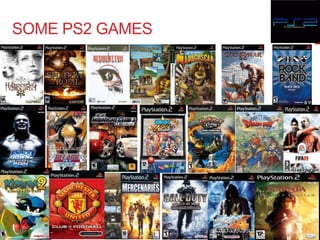
SOME PS2 GAMES
SUCCESSORS
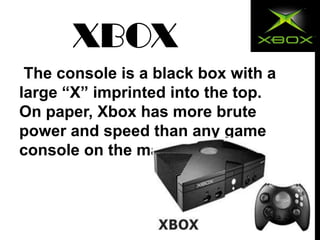
XBOX The console is a black box with a large “X” imprinted into the top. On paper, Xbox has more brute power and speed than any game console on the market.
XBOXCPU: 32-bit 733 MHz, Pentium III-based, custom Intel Coppermine-based processor in a Micro-PGA2 package (though soldered to the mainboard using BGA). 180 nm process.[9]
Storage media
2×–5× (2.6 MB/s–6.6 MB/s) CAVDVD-ROM
8 or 10 GB, 3.5 in, 5,400 RPMhard disk. Formatted to 8 GB. FATXfile system.
Optional 8 MB memory card for saved game file transfer. XBOX CONTROLERS
SUCCESSORS
SOME XBOX360 GAMES
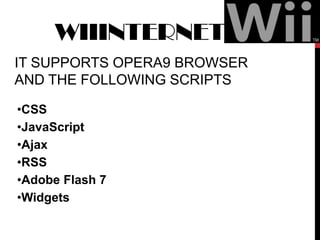
NINTENDOWii sounds like 'we', which emphasizes that the console is for everyone. Wii can easily be remembered by people around the world, no matter what language they speak. No confusion. No need to abbreviate. Just Wii
NENTENDOProcessors:CPU: PowerPC-based "Broadway" processor, made with a 90 nmSOICMOS process, reportedly† clocked at 729 MHzGPU: ATI"Hollywood" GPU made with a 90 nm CMOS process,reportedly† clocked at 243 MHzMemory:88 MBmain memory (24 MB "internal" 1T-SRAM integrated into graphics package, 64 MB "external" GDDR3 SDRAM)
3 MB embedded GPU texture memory and framebuffer. Power consumption:18 watts when switched on
9.6 watts in standby with WiiConnect24 standby connection

The Ultimate Gaming

  • 5.
    DEFINITION A gamingconsole is a system that is exclusively dedicated for gaming. It has been optimized for game playing as that is its core function. We can ply games on a PC or in a cell phone but these are not systems dedicated for gaming, so they are not gaming consoles.
  • 6.
    HISTORY OF VIDEOGAMECONSOLES 1971-First commercial video game, Computer Space by Nutting Associates
  • 7.
    1972-Atari introducedPong -Magnavox offered the first home video game s/m which have no microprocessor. 1975-Atari introduced home version of Pong1958:TENNIS FOR TWOSpacewar! is credited as the first widely available and influential computer game.
  • 8.
    BASIC COMPONENTS OFA VIDEO GAME CONSOLEThe core components are: User control interface
  • 9.
  • 10.
  • 11.
  • 12.
  • 13.
  • 14.
  • 15.
    Power supplyCOMMONELEMENTSControllers: Devices that allow the user to input information and interact with onscreen objects. They are like the keyboards and joysticks of personal computers.
  • 16.
    Power supply: apower supply converts 100-240 volt AC utility power into direct current (DC) at the voltages needed by the electronics.
  • 17.
    Console/Core Unit: Thecore unit in a video game console is the hub where the television, video game controllers, and game program connect. It usually contains a CPU, RAM, and an audiovisual coprocessor. Core units are similar to towers of personal computers.
  • 18.
    Game Media: Mostvideo game consoles have their programs stored on external media. They are the ROM of consoles.
  • 19.
    Memory Card: Somevideo game consoles, like the PlayStation and the Nintendo GameCube have memory cards to save, load, and delete files. Though recent consoles such as the Xbox, Xbox 360, PlayStation 3, and Wii all have – or can have installed – hard drives/internal memory which save the data on the console itself. Memory cards are like flash drives for consoles. PLAYSTATIONCentral processing unitR3051 MIPS R3000A-compatible 32bit RISC chip running at 33.8688 MHzThe chip is manufactured by LSI Logic Corp. with technology licensed from SGI. Features: Operating performance of 30 MIPSBus bandwidth132 MB/s4 KB Instruction Cache 1 KB non-associative SRAMData Cache2 MB of main RAMMOTHERBORD OF PS
  • 20.
  • 21.
  • 22.
  • 23.
    Maximum of 40008x8 pixel sprites with individual scaling and rotation
  • 24.
    Emulation of simultaneousbackgrounds (for parallax scrolling)
  • 25.
    Flat or Gouraudshading and texture mapping
  • 26.
  • 27.
  • 28.
  • 29.
    XBOX The consoleis a black box with a large “X” imprinted into the top. On paper, Xbox has more brute power and speed than any game console on the market.
  • 30.
    XBOXCPU: 32-bit 733MHz, Pentium III-based, custom Intel Coppermine-based processor in a Micro-PGA2 package (though soldered to the mainboard using BGA). 180 nm process.[9]
  • 31.
  • 32.
  • 33.
    8 or 10GB, 3.5 in, 5,400 RPMhard disk. Formatted to 8 GB. FATXfile system.
  • 34.
    Optional 8 MBmemory card for saved game file transfer. XBOX CONTROLERS
  • 35.
  • 36.
  • 37.
    NINTENDOWii sounds like'we', which emphasizes that the console is for everyone. Wii can easily be remembered by people around the world, no matter what language they speak. No confusion. No need to abbreviate. Just Wii
  • 38.
    NENTENDOProcessors:CPU: PowerPC-based "Broadway"processor, made with a 90 nmSOICMOS process, reportedly† clocked at 729 MHzGPU: ATI"Hollywood" GPU made with a 90 nm CMOS process,reportedly† clocked at 243 MHzMemory:88 MBmain memory (24 MB "internal" 1T-SRAM integrated into graphics package, 64 MB "external" GDDR3 SDRAM)
  • 39.
    3 MB embedded GPUtexture memory and framebuffer. Power consumption:18 watts when switched on
  • 40.
    9.6 watts instandby with WiiConnect24 standby connection