Video Game Console   By: Daniel Jack
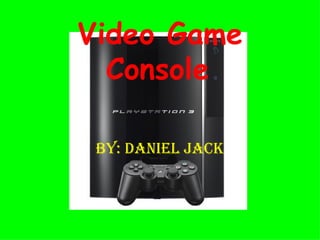
Video Game Console   A video game console is an  interactive entertainment computer or electronic device  that produces a  video display signal  which can be used with a display device (a  television ,  monitor , etc.) to display a  video game . The term "video game console" is used to distinguish a  machine  designed for  consumers  to buy and use solely for playing video games from a  personal computer , which has many other functions, or  arcade machines , which are designed for businesses that buy and then charge others to play.
The Term For Video Game Console   The first company to use the term "console" to officially refer to its video game system was Fairchild with the Video Entertainment System   (VES)   in 1976. Since then, definition has widened to include entire systems, as well as to describe alternate platforms such as handheld game consoles, TV games, and multimedia devices. In common usage a "console" is a specialized electronic device that connects to a standard television set or composite video monitor. A "handheld" gaming device is a self-contained electronic device that is portable and can be held in a user's hands.
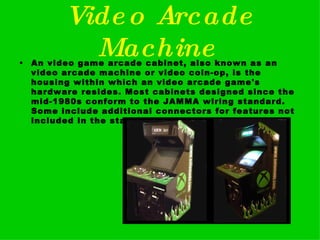
Video Arcade Machine   An video game arcade cabinet, also known as an video arcade machine or video coin-op, is the housing within which an video arcade game's hardware resides. Most cabinets designed since the mid-1980s conform to the JAMMA wiring standard. Some include additional connectors for features not included in the standard.
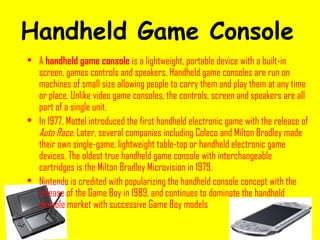
Handheld Game Console   A  handheld game console  is a lightweight, portable device with a built-in screen, games controls and speakers. Handheld game consoles are run on machines of small size allowing people to carry them and play them at any time or place. Unlike video game consoles, the controls, screen and speakers are all part of a single unit. In 1977, Mattel introduced the first handheld electronic game with the release of  Auto Race . Later, several companies including Coleco and Milton Bradley made their own single-game, lightweight table-top or handheld electronic game devices. The oldest true handheld game console with interchangeable cartridges is the Milton Bradley Microvision in 1979. Nintendo is credited with popularizing the handheld console concept with the release of the Game Boy in 1989, and continues to dominate the handheld console market with successive Game Boy models .
Common Elements Controllers:  Devices that allow the user to input information and interact with onscreen objects. They are like the keyboards and joysticks of personal computers.  Power supply: a power supply converts 100-240 volt AC utility power into direct current (DC) at the voltages needed by the electronics.  Console/Core Unit: The core unit in a video game console is the hub where the television, video game controllers, and game program connect. It usually contains a CPU, RAM, and an audiovisual coprocessor. Core units are similar to towers of personal computers.  Game Media : Most video game consoles have their programs stored on external media. They are the ROM of consoles.  Memory Card:  Some video game consoles, like the PlayStation and the Nintendo GameCube have memory cards to save, load, and delete files. Though recent consoles such as the Xbox, Xbox 360, PlayStation 3, and Wii all have – or can have installed – hard drives/internal memory which save the data on the console itself. Memory cards are like flash drives for consoles.
T H E   E N D

Video Game Console

  • 1.
    Video Game Console By: Daniel Jack
  • 2.
    Video Game Console A video game console is an interactive entertainment computer or electronic device that produces a video display signal which can be used with a display device (a television , monitor , etc.) to display a video game . The term "video game console" is used to distinguish a machine designed for consumers to buy and use solely for playing video games from a personal computer , which has many other functions, or arcade machines , which are designed for businesses that buy and then charge others to play.
  • 3.
    The Term ForVideo Game Console The first company to use the term "console" to officially refer to its video game system was Fairchild with the Video Entertainment System (VES) in 1976. Since then, definition has widened to include entire systems, as well as to describe alternate platforms such as handheld game consoles, TV games, and multimedia devices. In common usage a "console" is a specialized electronic device that connects to a standard television set or composite video monitor. A "handheld" gaming device is a self-contained electronic device that is portable and can be held in a user's hands.
  • 4.
    Video Arcade Machine An video game arcade cabinet, also known as an video arcade machine or video coin-op, is the housing within which an video arcade game's hardware resides. Most cabinets designed since the mid-1980s conform to the JAMMA wiring standard. Some include additional connectors for features not included in the standard.
  • 5.
    Handheld Game Console A handheld game console is a lightweight, portable device with a built-in screen, games controls and speakers. Handheld game consoles are run on machines of small size allowing people to carry them and play them at any time or place. Unlike video game consoles, the controls, screen and speakers are all part of a single unit. In 1977, Mattel introduced the first handheld electronic game with the release of Auto Race . Later, several companies including Coleco and Milton Bradley made their own single-game, lightweight table-top or handheld electronic game devices. The oldest true handheld game console with interchangeable cartridges is the Milton Bradley Microvision in 1979. Nintendo is credited with popularizing the handheld console concept with the release of the Game Boy in 1989, and continues to dominate the handheld console market with successive Game Boy models .
  • 6.
    Common Elements Controllers: Devices that allow the user to input information and interact with onscreen objects. They are like the keyboards and joysticks of personal computers. Power supply: a power supply converts 100-240 volt AC utility power into direct current (DC) at the voltages needed by the electronics. Console/Core Unit: The core unit in a video game console is the hub where the television, video game controllers, and game program connect. It usually contains a CPU, RAM, and an audiovisual coprocessor. Core units are similar to towers of personal computers. Game Media : Most video game consoles have their programs stored on external media. They are the ROM of consoles. Memory Card: Some video game consoles, like the PlayStation and the Nintendo GameCube have memory cards to save, load, and delete files. Though recent consoles such as the Xbox, Xbox 360, PlayStation 3, and Wii all have – or can have installed – hard drives/internal memory which save the data on the console itself. Memory cards are like flash drives for consoles.
  • 7.
    T H E E N D