Get up and go test, tendem walk test,forward stepping test.
 TIMED UP AND GO TEST:
The Timed Up and Go test (TUG) is a simple test used to assess a
person's mobility and requires both static and dynamic balance.
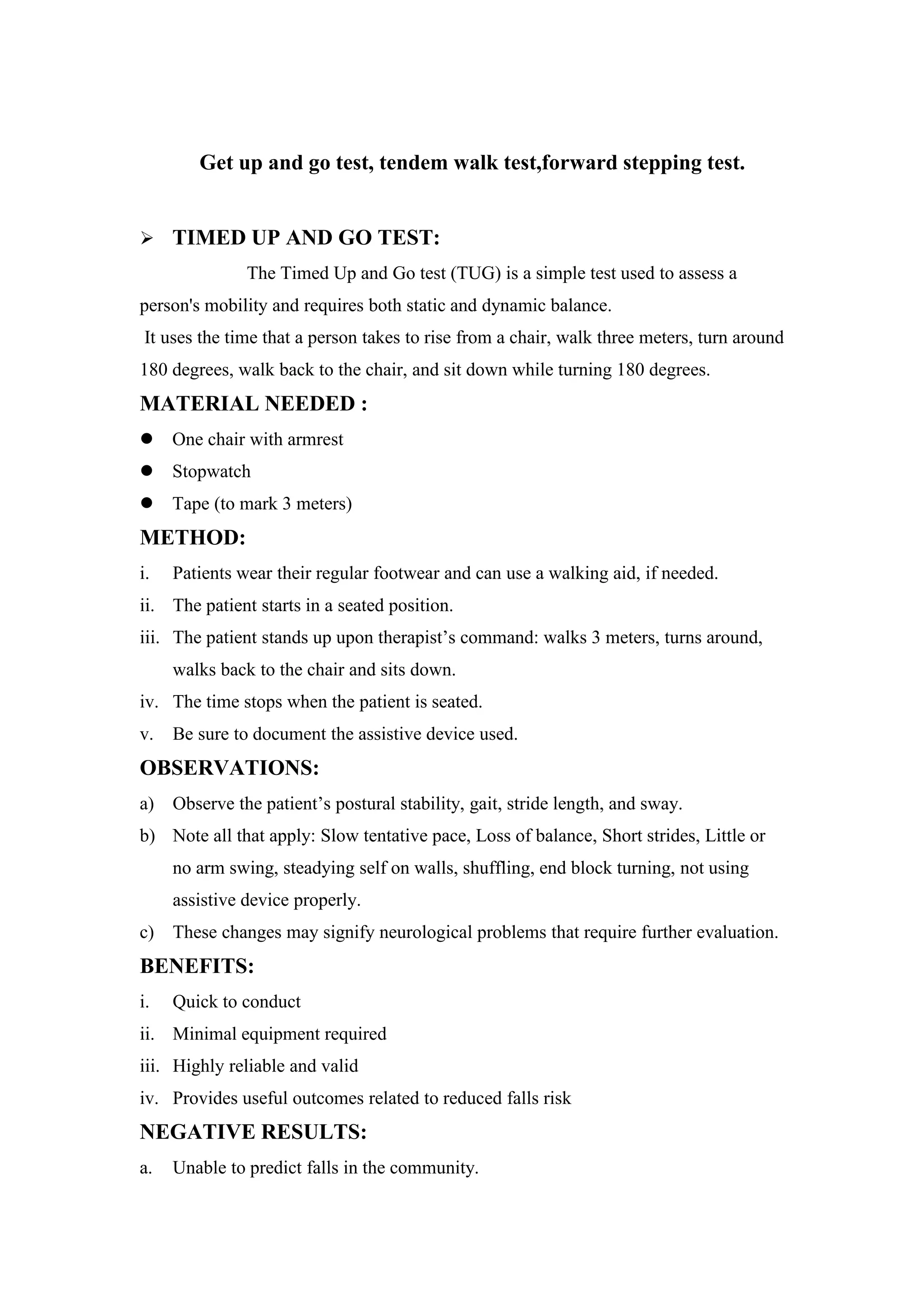
It uses the time that a person takes to rise from a chair, walk three meters, turn around
180 degrees, walk back to the chair, and sit down while turning 180 degrees.
MATERIAL NEEDED :
 One chair with armrest
 Stopwatch
 Tape (to mark 3 meters)
METHOD:
i. Patients wear their regular footwear and can use a walking aid, if needed.
ii. The patient starts in a seated position.
iii. The patient stands up upon therapist’s command: walks 3 meters, turns around,
walks back to the chair and sits down.
iv. The time stops when the patient is seated.
v. Be sure to document the assistive device used.
OBSERVATIONS:
a) Observe the patient’s postural stability, gait, stride length, and sway.
b) Note all that apply: Slow tentative pace, Loss of balance, Short strides, Little or
no arm swing, steadying self on walls, shuffling, end block turning, not using
assistive device properly.
c) These changes may signify neurological problems that require further evaluation.
BENEFITS:
i. Quick to conduct
ii. Minimal equipment required
iii. Highly reliable and valid
iv. Provides useful outcomes related to reduced falls risk
NEGATIVE RESULTS:
a. Unable to predict falls in the community.
b. Test re-test user error can be high.
c. Turning is only assessed in the patient's preferred direction.
Fig (a) TIMED UP AND GO TEST
 TENDEM WALK TEST:
Walking in a straight line with the front foot placed such that its heel touches
the toe of the standing foot.
PURPOSE:
i. Exacerbates all gait problems (especially those of vestibular in origin).
ii. Used to distinguish the subtypes of cerebellar disease.
iii. Used by law enforcement to test for intoxication.
METHOD:
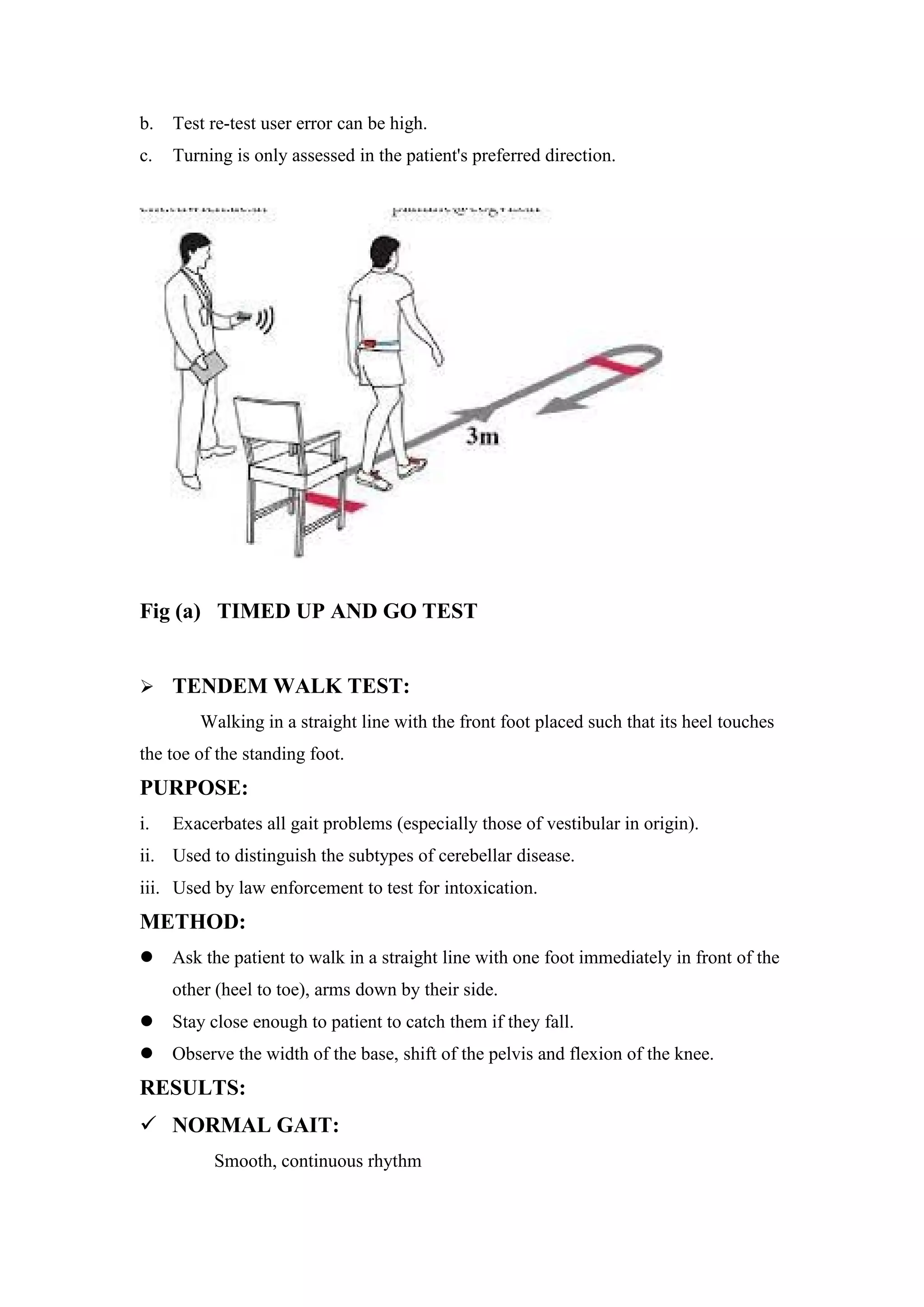
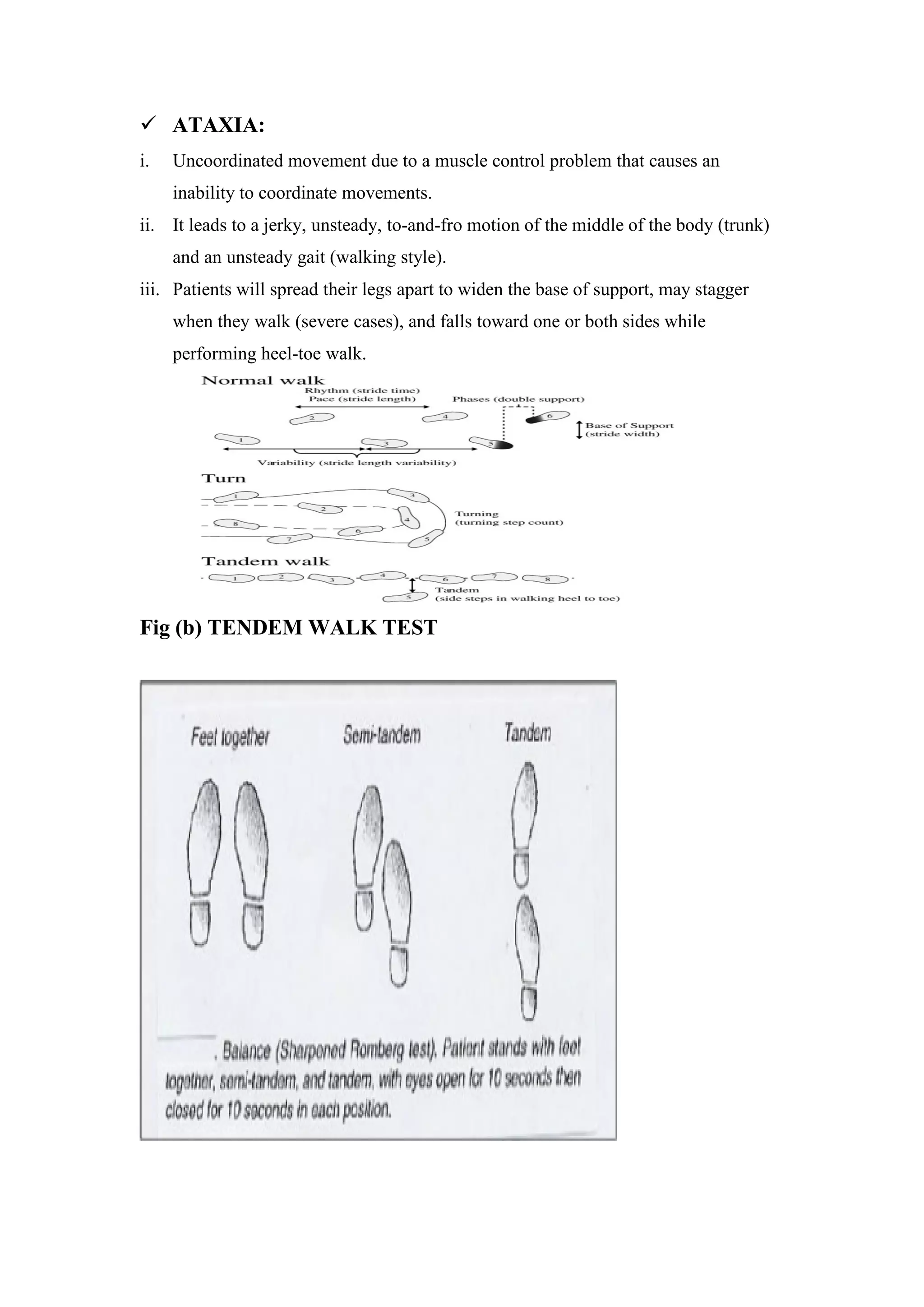
 Ask the patient to walk in a straight line with one foot immediately in front of the
other (heel to toe), arms down by their side.
 Stay close enough to patient to catch them if they fall.
 Observe the width of the base, shift of the pelvis and flexion of the knee.
RESULTS:
 NORMAL GAIT:
Smooth, continuous rhythm
 ATAXIA:
i. Uncoordinated movement due to a muscle control problem that causes an
inability to coordinate movements.
ii. It leads to a jerky, unsteady, to-and-fro motion of the middle of the body (trunk)
and an unsteady gait (walking style).
iii. Patients will spread their legs apart to widen the base of support, may stagger
when they walk (severe cases), and falls toward one or both sides while
performing heel-toe walk.
Fig (b) TENDEM WALK TEST
Fig (c ) TENDEM WALK STEPS
 FORWARD STEPPING TEST :
The Four Square Step Test (FSST) is used to assess dynamic
stability and the ability of the subject to step over low objects forward, sideways, and
backward.
INTENDED POPULATION:
i. Older adults/geriatrics
ii. Stroke
iii. Parkinson's Disease
iv. Vestibular Disorders
v. Limb Loss/Amputation
METHOD:
a. The subject is required to sequentially step over four canes set-up in a cross
configuration on the ground.
b. At the start of the test, the subject stands in Square 1 facing Square 2.
c. The aim is to step as fast as possible into each square with both feet in the
following sequence: Square 2, 3, 4, 1, 4, 3, 2, 1 (clockwise to counterclockwise).
d. Test procedure may be demonstrated, one practice trial is allowed prior to
administering the test.
e. Two trials are then performed, and the better time (in seconds) is taken as the
score.
f. Timing starts when the first foot contacts the floor in Square 2 and finishes when
the last foot comes back to touch the floor in Square 1.
g. Instructions: “Try to complete the sequence as fast and as safely as possible
without touching the sticks.
h. Both feet must make contact with the floor in each square. If possible, face
forward during the entire sequence.
EQUIPMENTS:
 Stopwatch
 4 canes/ rods (approximately 100cm in length and 2.5cm in diameter.
ADMINISTER TIME:
Less than five minutes
Get up & go test , tendem walk test

Get up & go test , tendem walk test

  • 1.
    Get up andgo test, tendem walk test,forward stepping test.  TIMED UP AND GO TEST: The Timed Up and Go test (TUG) is a simple test used to assess a person's mobility and requires both static and dynamic balance. It uses the time that a person takes to rise from a chair, walk three meters, turn around 180 degrees, walk back to the chair, and sit down while turning 180 degrees. MATERIAL NEEDED :  One chair with armrest  Stopwatch  Tape (to mark 3 meters) METHOD: i. Patients wear their regular footwear and can use a walking aid, if needed. ii. The patient starts in a seated position. iii. The patient stands up upon therapist’s command: walks 3 meters, turns around, walks back to the chair and sits down. iv. The time stops when the patient is seated. v. Be sure to document the assistive device used. OBSERVATIONS: a) Observe the patient’s postural stability, gait, stride length, and sway. b) Note all that apply: Slow tentative pace, Loss of balance, Short strides, Little or no arm swing, steadying self on walls, shuffling, end block turning, not using assistive device properly. c) These changes may signify neurological problems that require further evaluation. BENEFITS: i. Quick to conduct ii. Minimal equipment required iii. Highly reliable and valid iv. Provides useful outcomes related to reduced falls risk NEGATIVE RESULTS: a. Unable to predict falls in the community.
  • 2.
    b. Test re-testuser error can be high. c. Turning is only assessed in the patient's preferred direction. Fig (a) TIMED UP AND GO TEST  TENDEM WALK TEST: Walking in a straight line with the front foot placed such that its heel touches the toe of the standing foot. PURPOSE: i. Exacerbates all gait problems (especially those of vestibular in origin). ii. Used to distinguish the subtypes of cerebellar disease. iii. Used by law enforcement to test for intoxication. METHOD:  Ask the patient to walk in a straight line with one foot immediately in front of the other (heel to toe), arms down by their side.  Stay close enough to patient to catch them if they fall.  Observe the width of the base, shift of the pelvis and flexion of the knee. RESULTS:  NORMAL GAIT: Smooth, continuous rhythm
  • 3.
     ATAXIA: i. Uncoordinatedmovement due to a muscle control problem that causes an inability to coordinate movements. ii. It leads to a jerky, unsteady, to-and-fro motion of the middle of the body (trunk) and an unsteady gait (walking style). iii. Patients will spread their legs apart to widen the base of support, may stagger when they walk (severe cases), and falls toward one or both sides while performing heel-toe walk. Fig (b) TENDEM WALK TEST
  • 4.
    Fig (c )TENDEM WALK STEPS  FORWARD STEPPING TEST : The Four Square Step Test (FSST) is used to assess dynamic stability and the ability of the subject to step over low objects forward, sideways, and backward. INTENDED POPULATION: i. Older adults/geriatrics ii. Stroke iii. Parkinson's Disease iv. Vestibular Disorders v. Limb Loss/Amputation METHOD: a. The subject is required to sequentially step over four canes set-up in a cross configuration on the ground. b. At the start of the test, the subject stands in Square 1 facing Square 2. c. The aim is to step as fast as possible into each square with both feet in the following sequence: Square 2, 3, 4, 1, 4, 3, 2, 1 (clockwise to counterclockwise). d. Test procedure may be demonstrated, one practice trial is allowed prior to administering the test. e. Two trials are then performed, and the better time (in seconds) is taken as the score. f. Timing starts when the first foot contacts the floor in Square 2 and finishes when the last foot comes back to touch the floor in Square 1. g. Instructions: “Try to complete the sequence as fast and as safely as possible without touching the sticks. h. Both feet must make contact with the floor in each square. If possible, face forward during the entire sequence. EQUIPMENTS:  Stopwatch  4 canes/ rods (approximately 100cm in length and 2.5cm in diameter. ADMINISTER TIME: Less than five minutes