Detecting Deception
Who Lies? Everybody lies
“ Man was given a tongue with which to speak and words to hide his thoughts.” (Hungarian Proverb)
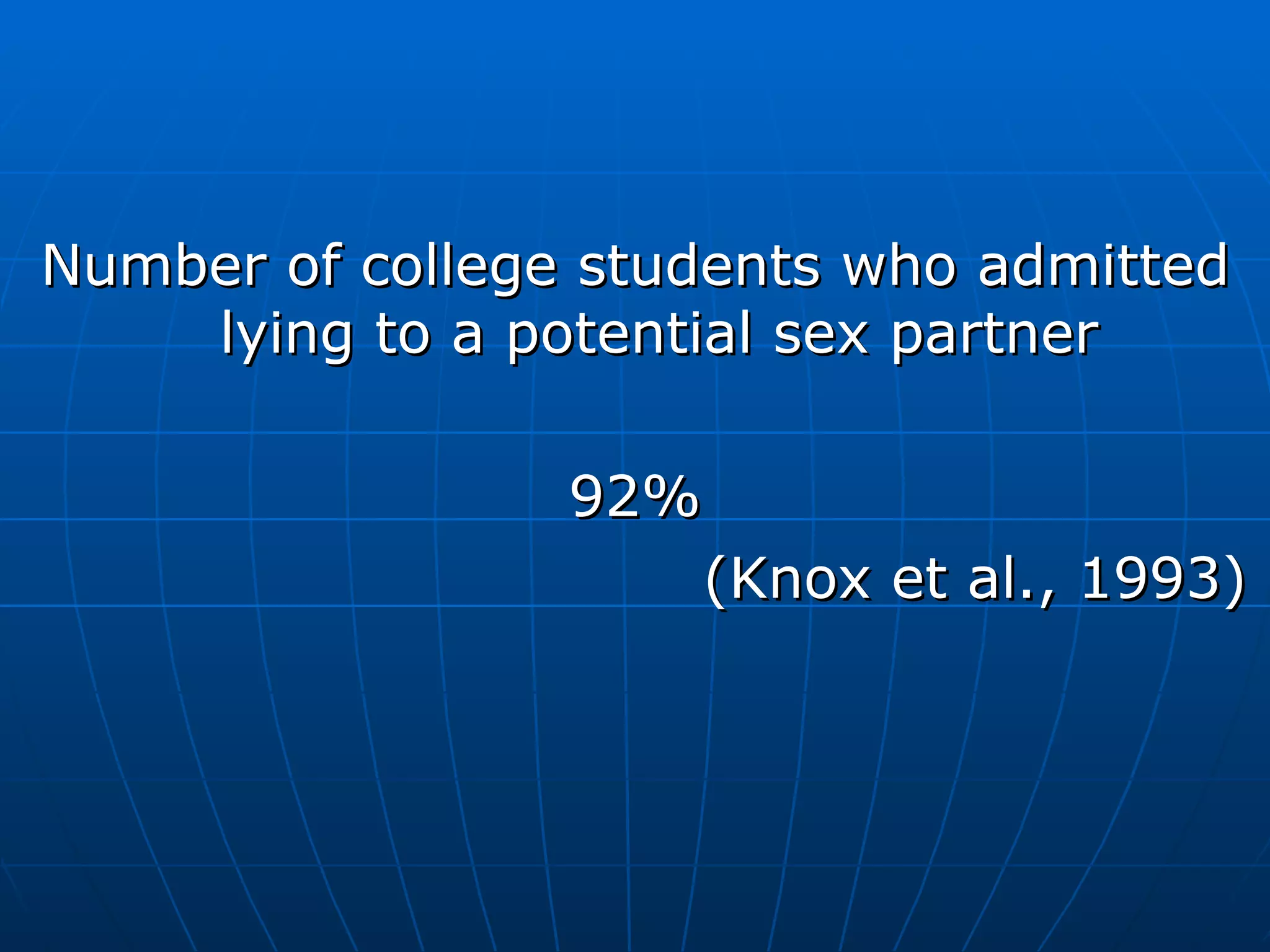
Number of college students who admitted lying to a potential sex partner 92% (Knox et al., 1993)
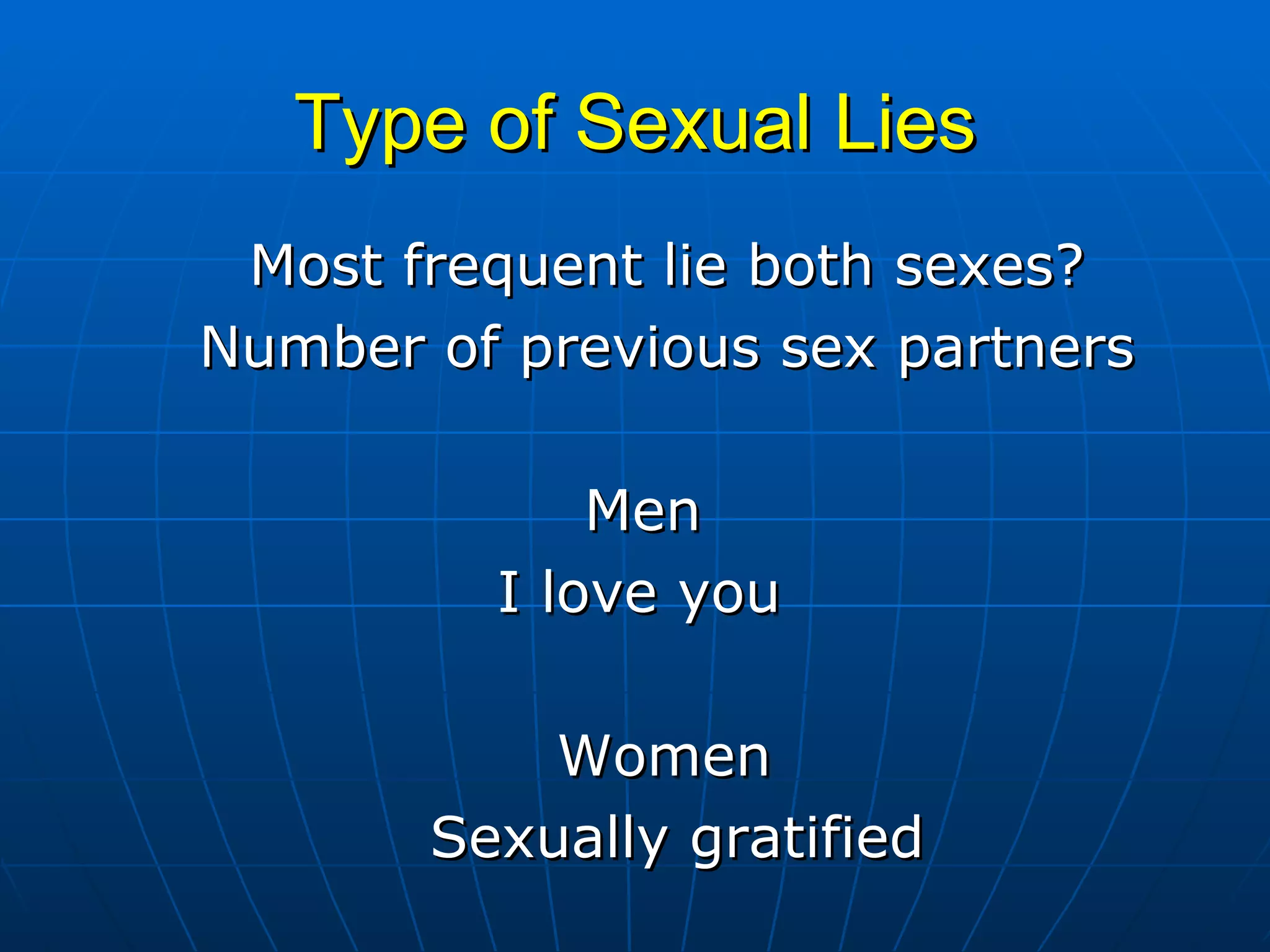
Type of Sexual Lies Most frequent lie both sexes? Number of previous sex partners Men   I love you   Women   Sexually gratified
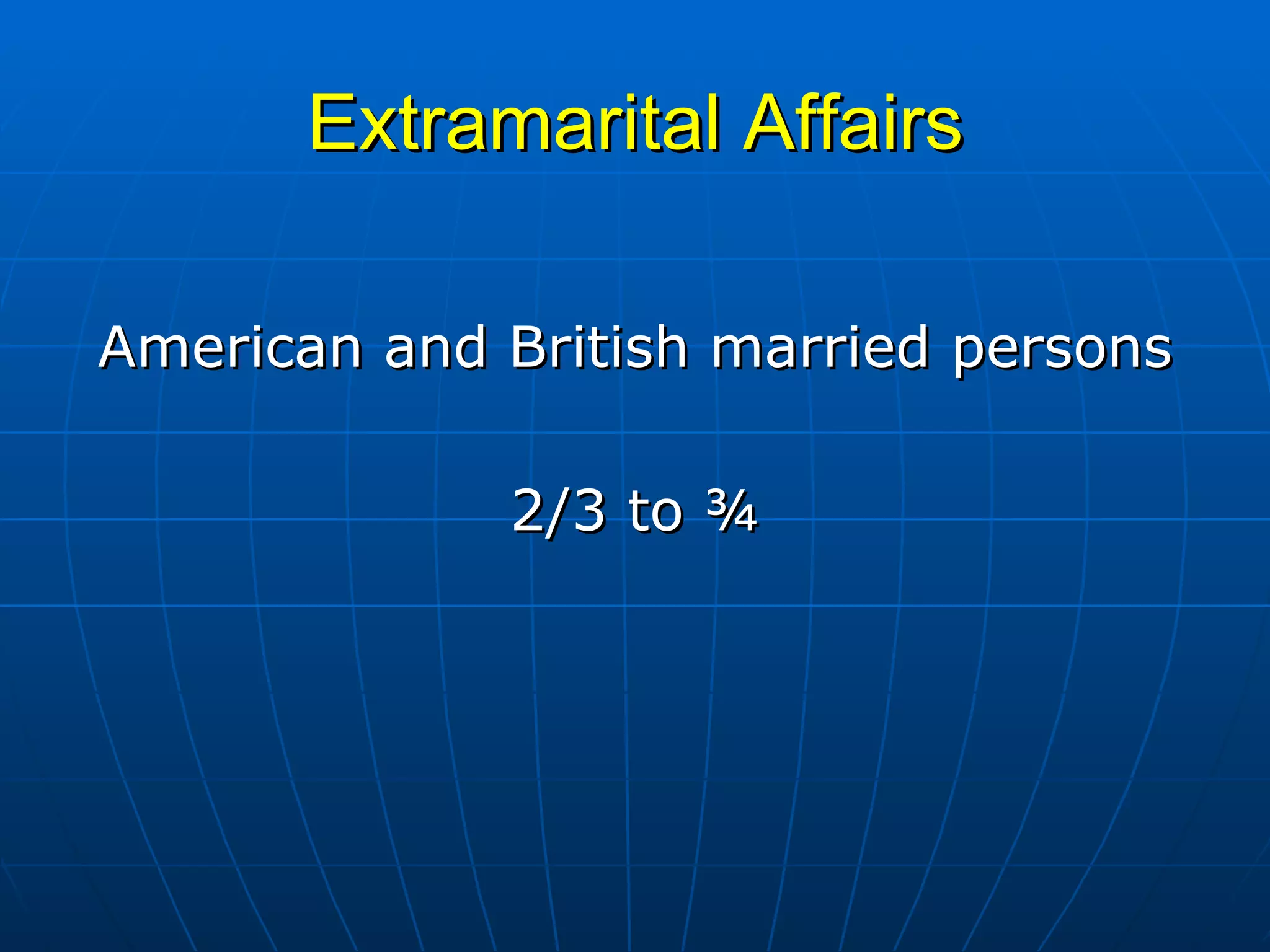
Extramarital Affairs American and British married persons 2/3 to ¾
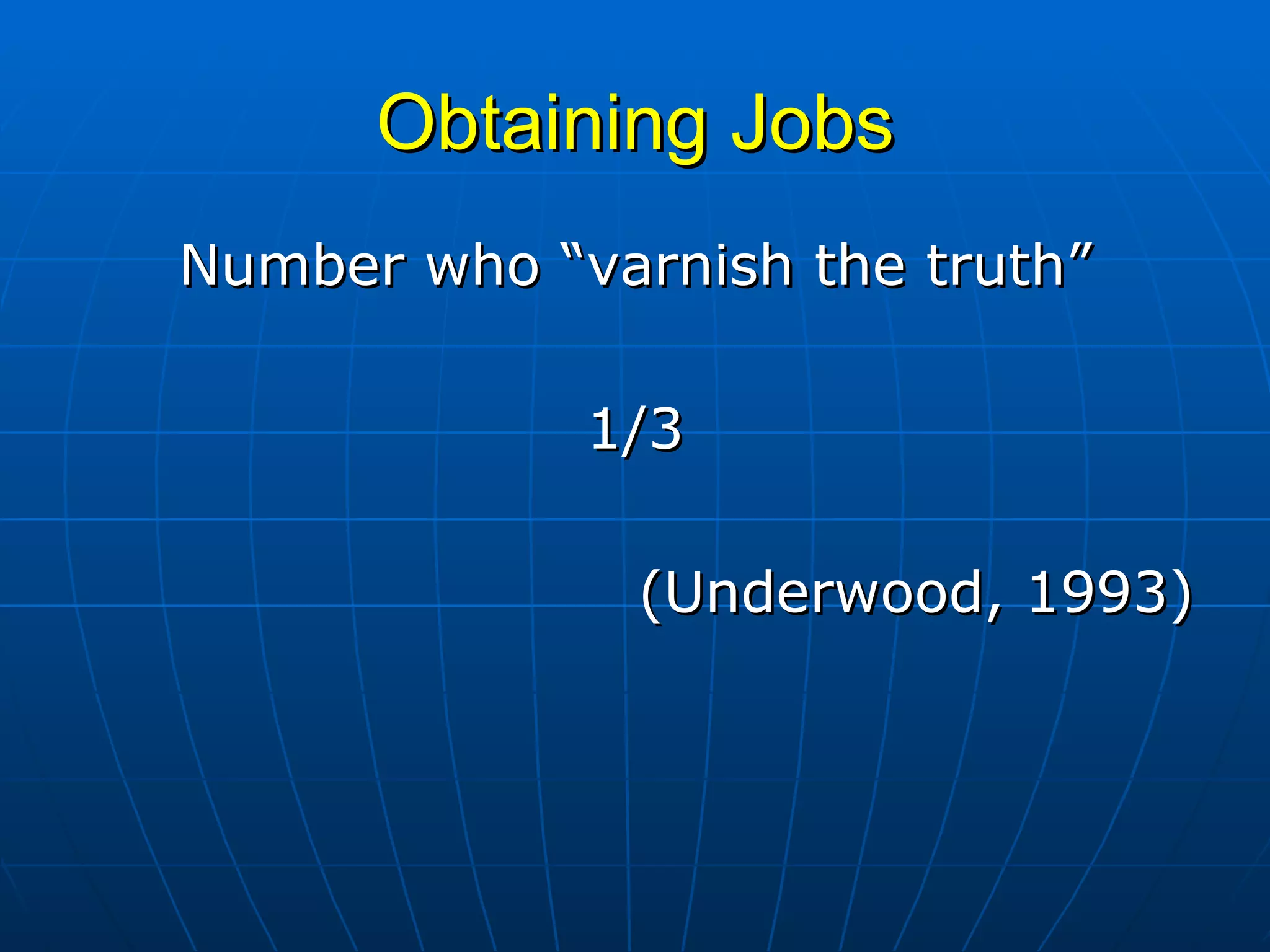
Obtaining Jobs Number who “varnish the truth” 1/3 (Underwood, 1993)
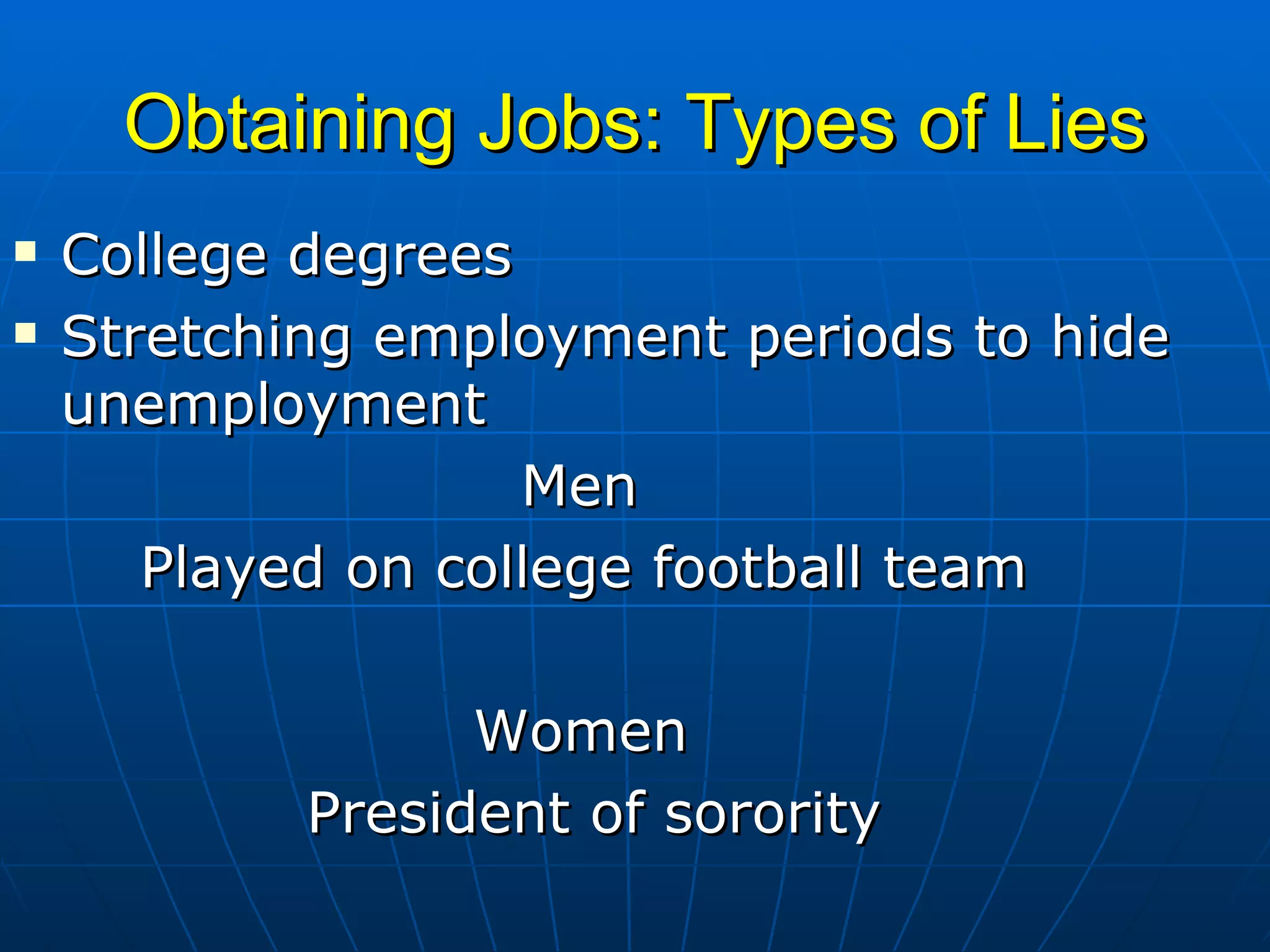
Obtaining Jobs: Types of Lies College degrees Stretching employment periods to hide unemployment Men  Played on college football team   Women   President of sorority
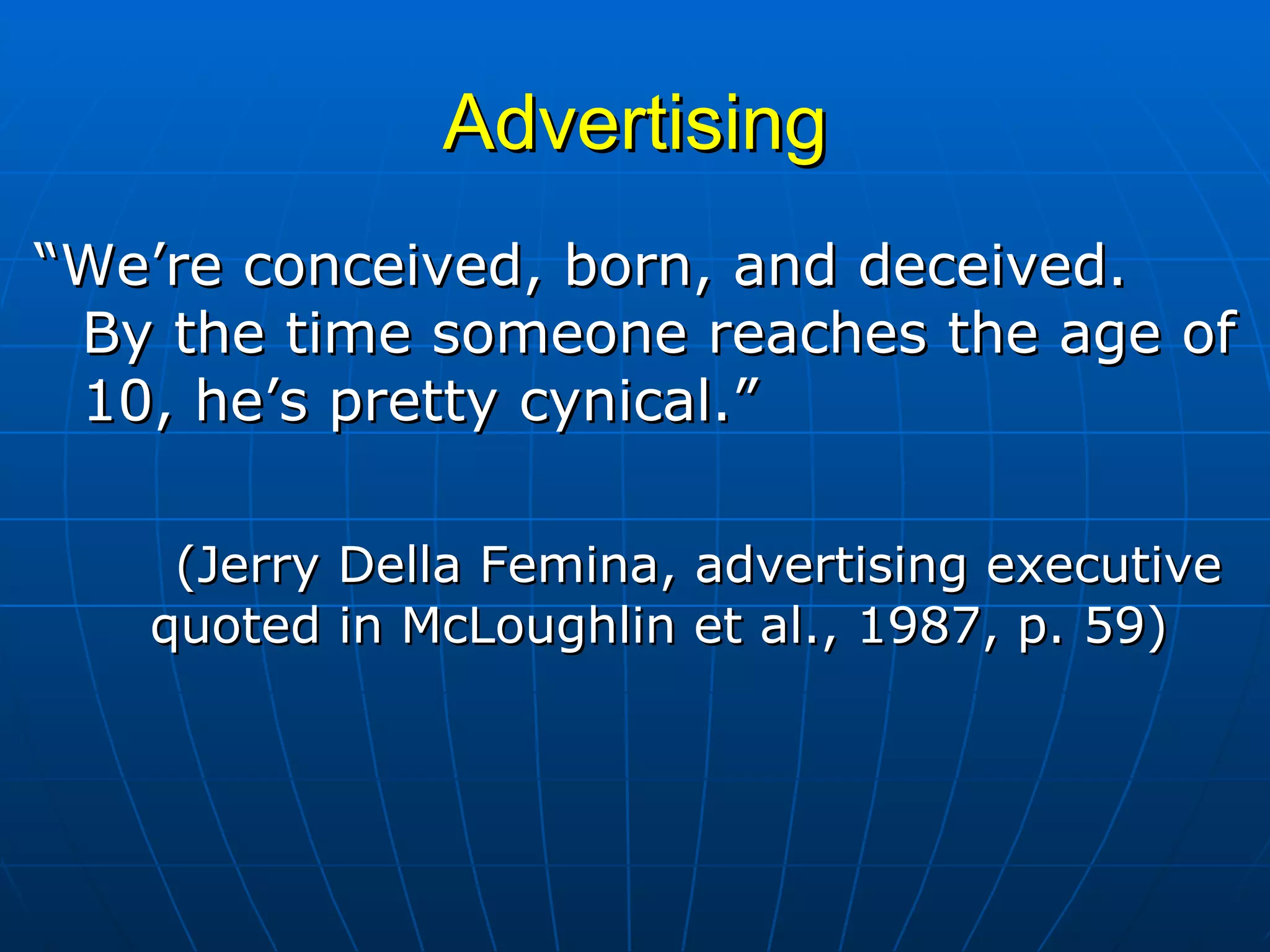
Advertising “ We’re conceived, born, and deceived.  By the time someone reaches the age of 10, he’s pretty cynical.” (Jerry Della Femina, advertising executive quoted in McLoughlin et al., 1987, p. 59)
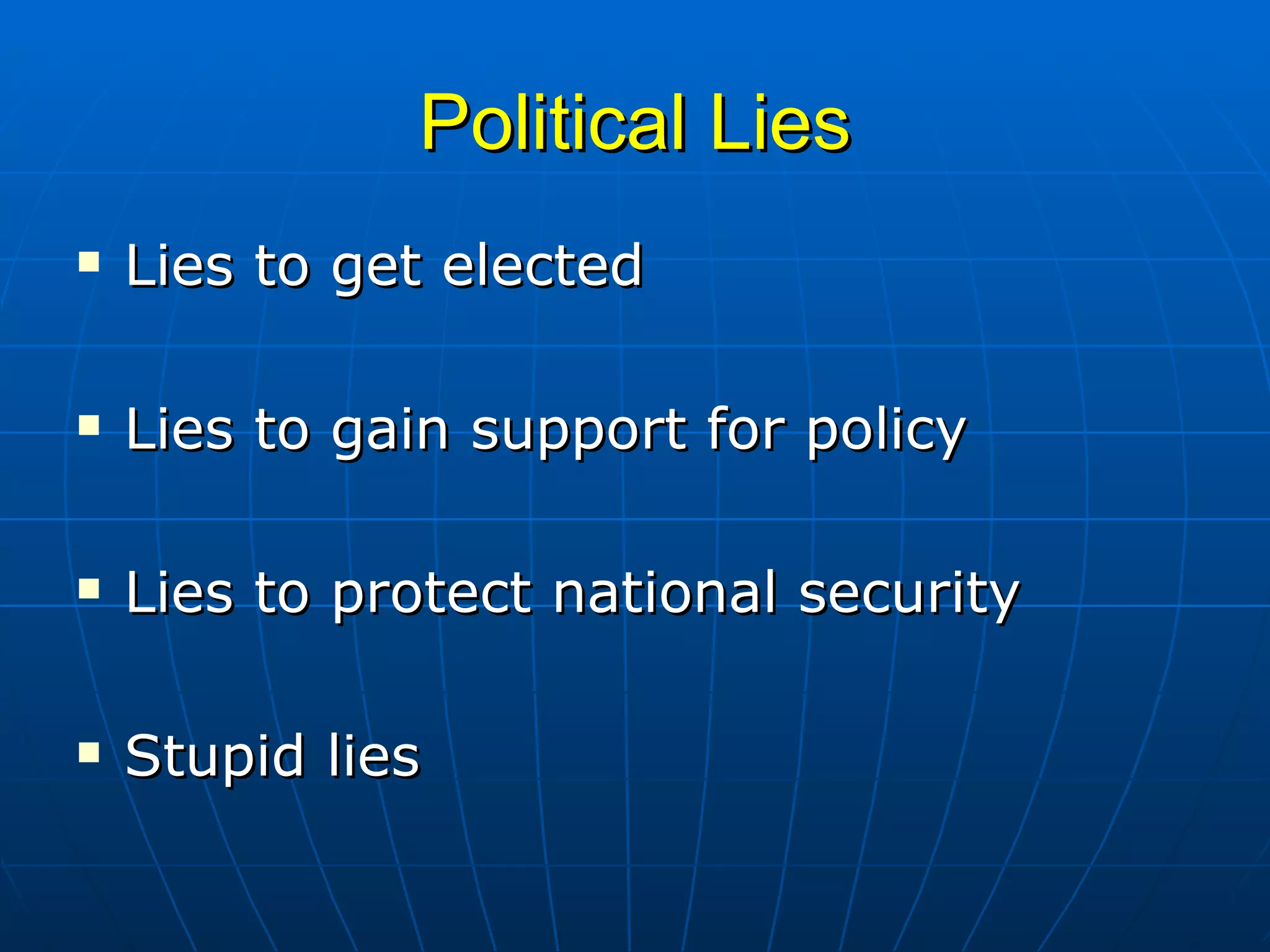
Political Lies Lies to get elected Lies to gain support for policy Lies to protect national security Stupid lies
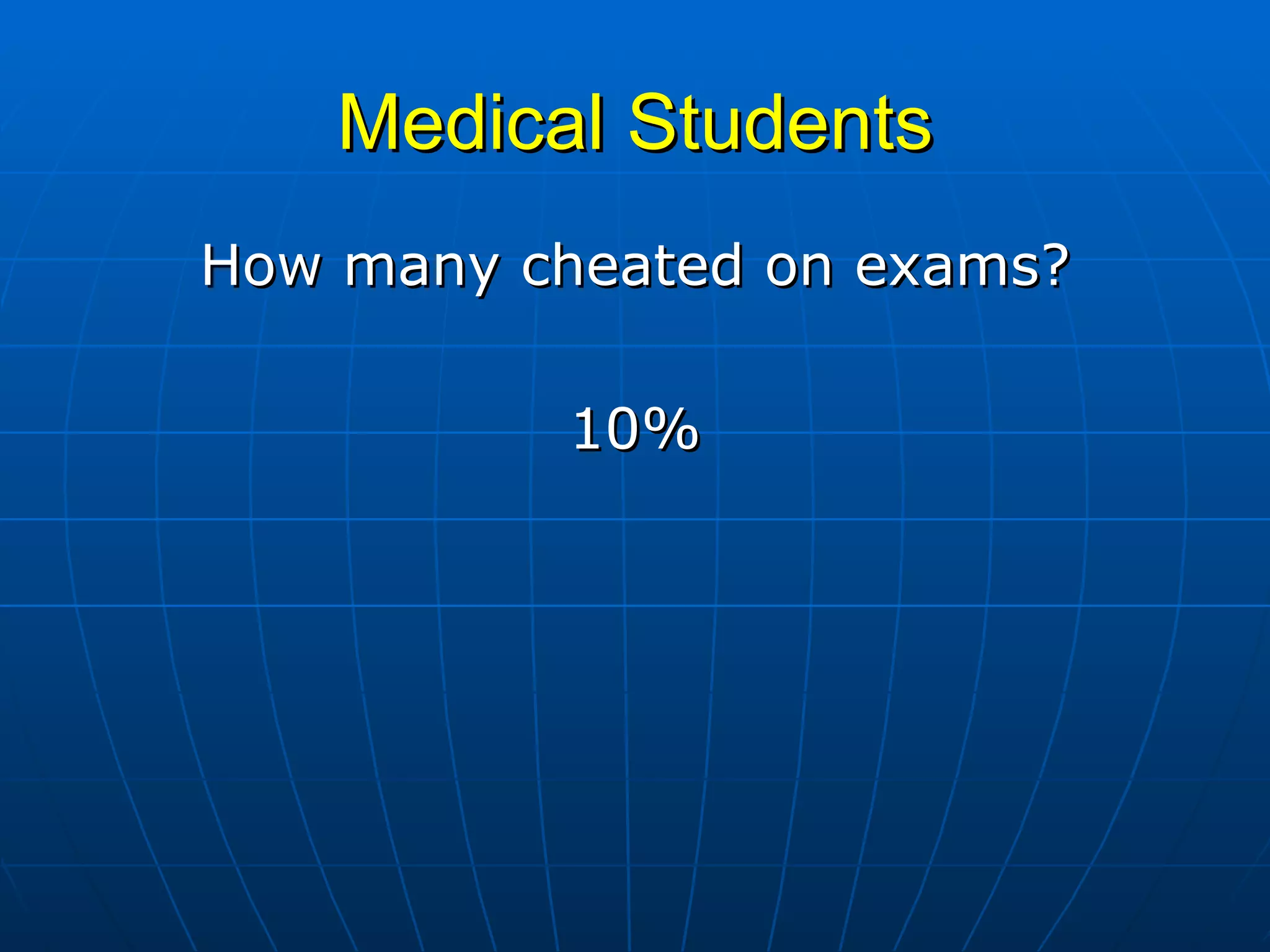
Medical Students How many cheated on exams? 10%
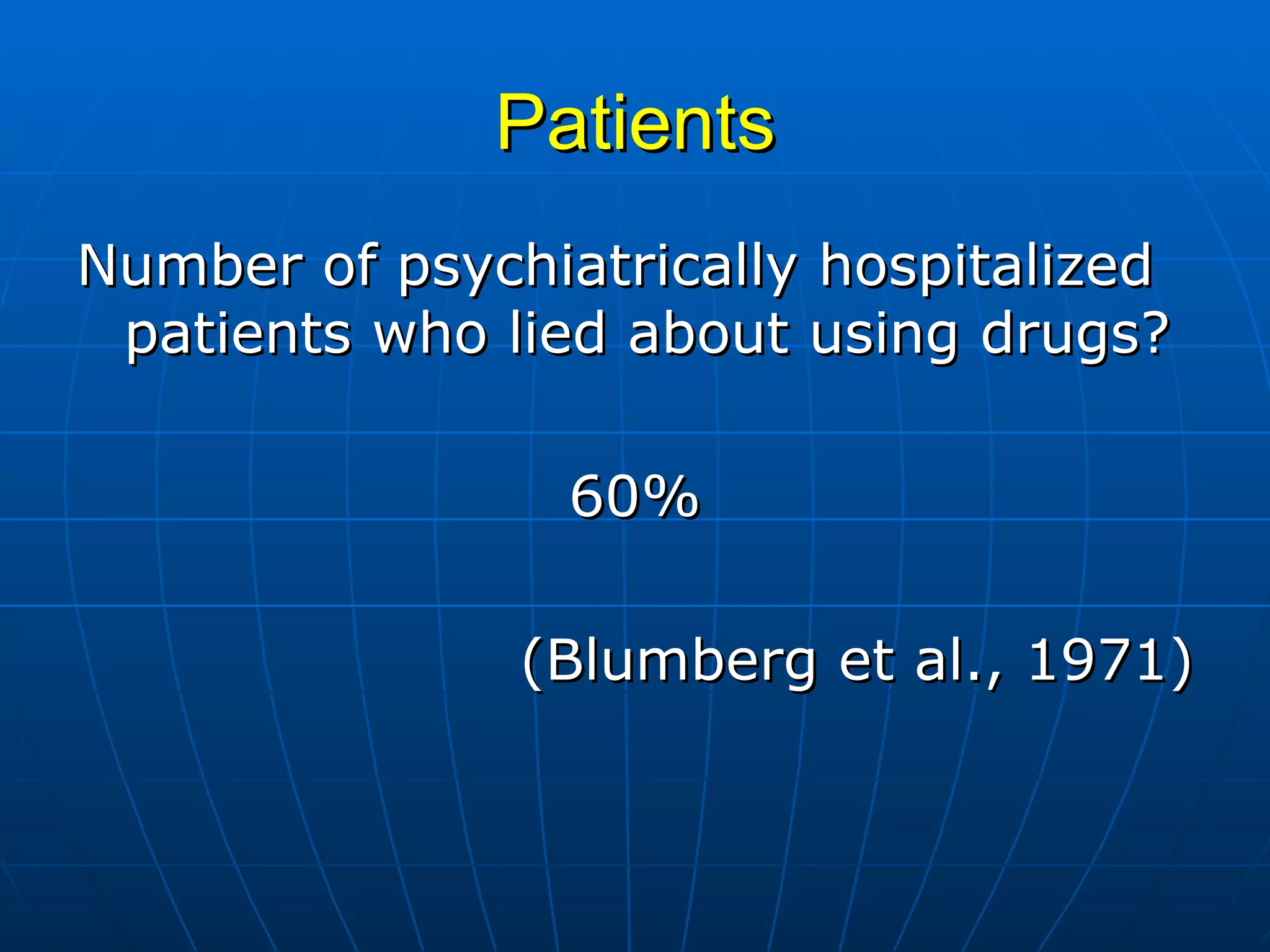
Patients Number of psychiatrically hospitalized patients who lied about using drugs? 60% (Blumberg et al., 1971)
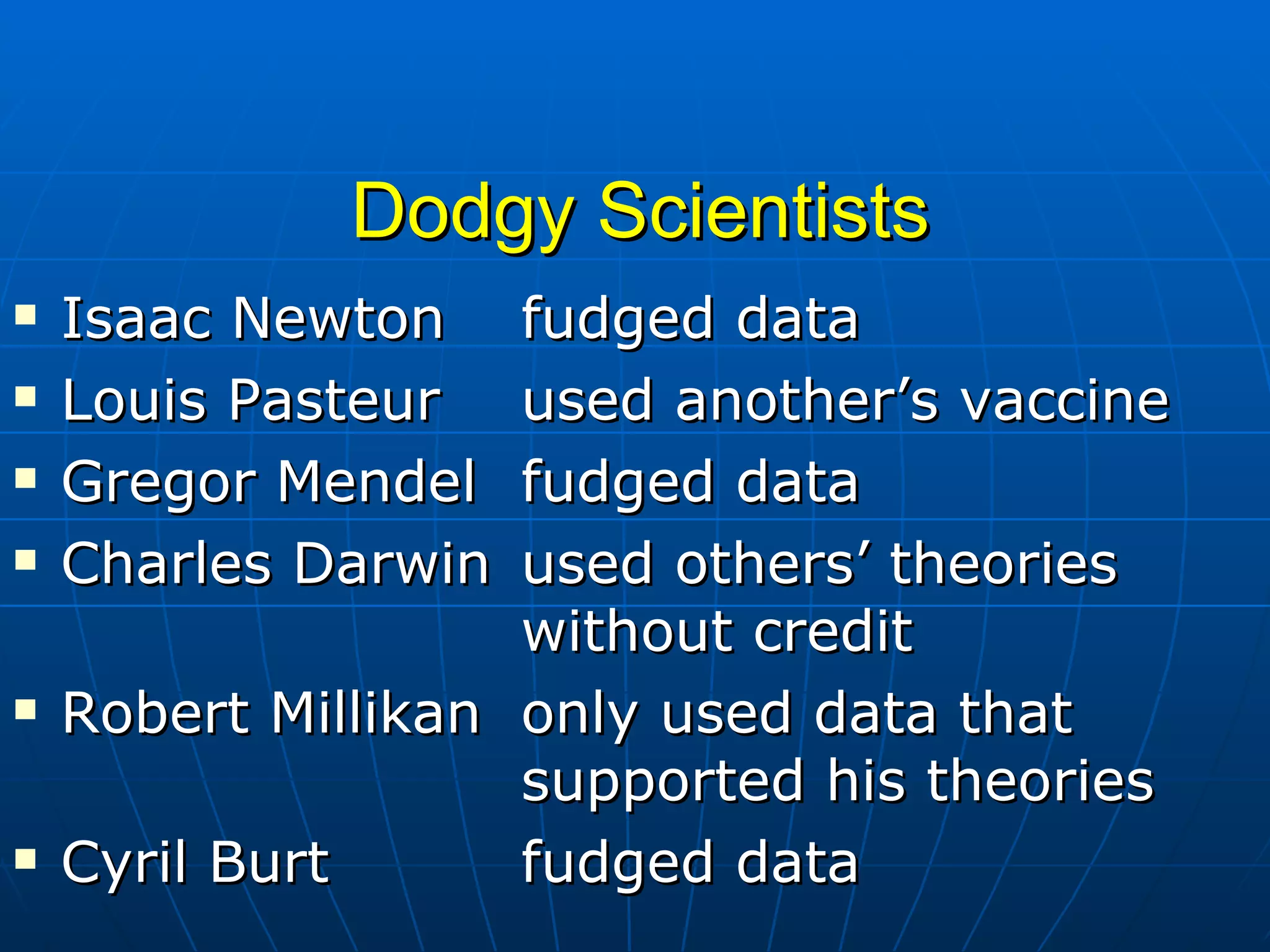
Dodgy Scientists Isaac Newton  fudged data Louis Pasteur  used another’s vaccine Gregor Mendel  fudged data Charles Darwin  used others’ theories  without credit  Robert Millikan only used data that  supported his theories Cyril Burt fudged data
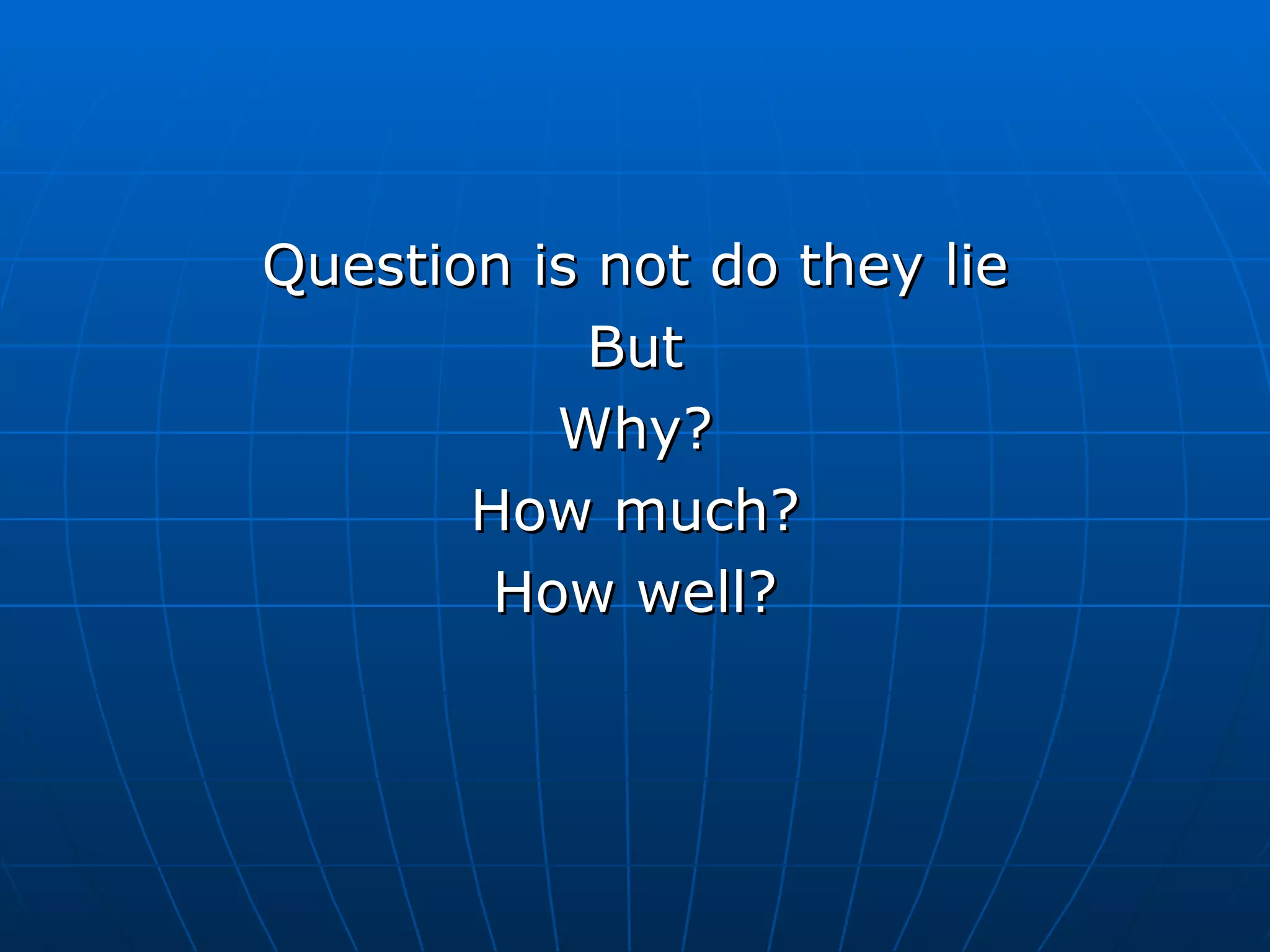
Question is not do they lie But Why? How much? How well?
Sex Offenders: Con Men or Liars?
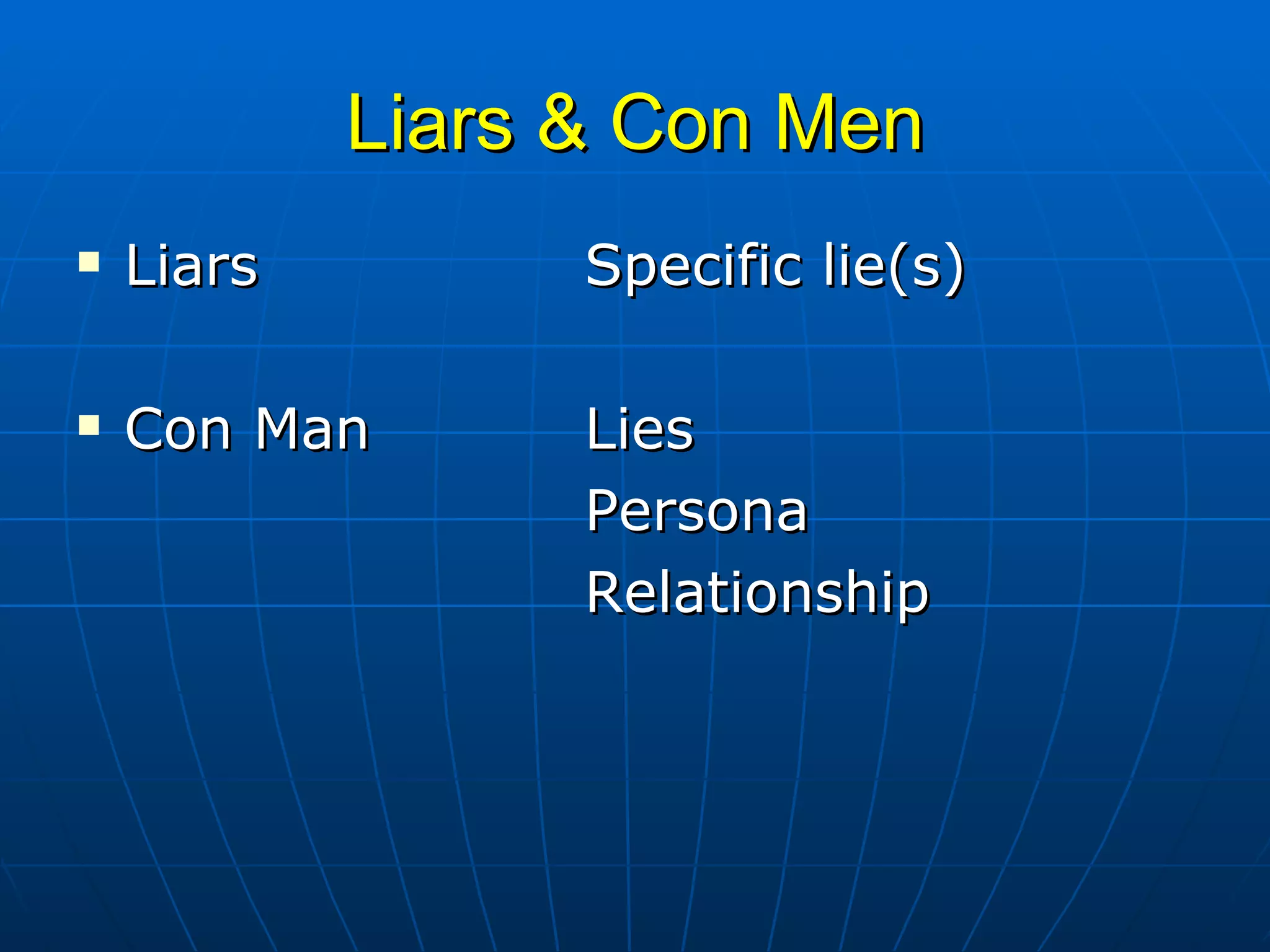
Liars & Con Men Liars Specific lie(s) Con Man Lies Persona Relationship
Ferdinand Demara Posed as Physician in Royal Canadian Navy Removed a bullet within half an inch of the heart  Removed a lung
Ferdinand Demara Posed as  Teacher Ph.D. in psychology College dean Assistant warden of a Texas prison Joined and deserted from US army & navy
“ I am a superior sort of liar.  I don’t tell any truth at all, so then my story has unity of parts, a structural integrity, and this sounds more like the truth than the truth itself.” (Con man Ferdinand Demara quoted in Crichton, 1968, p. 92)
Detecting Deception General Principles
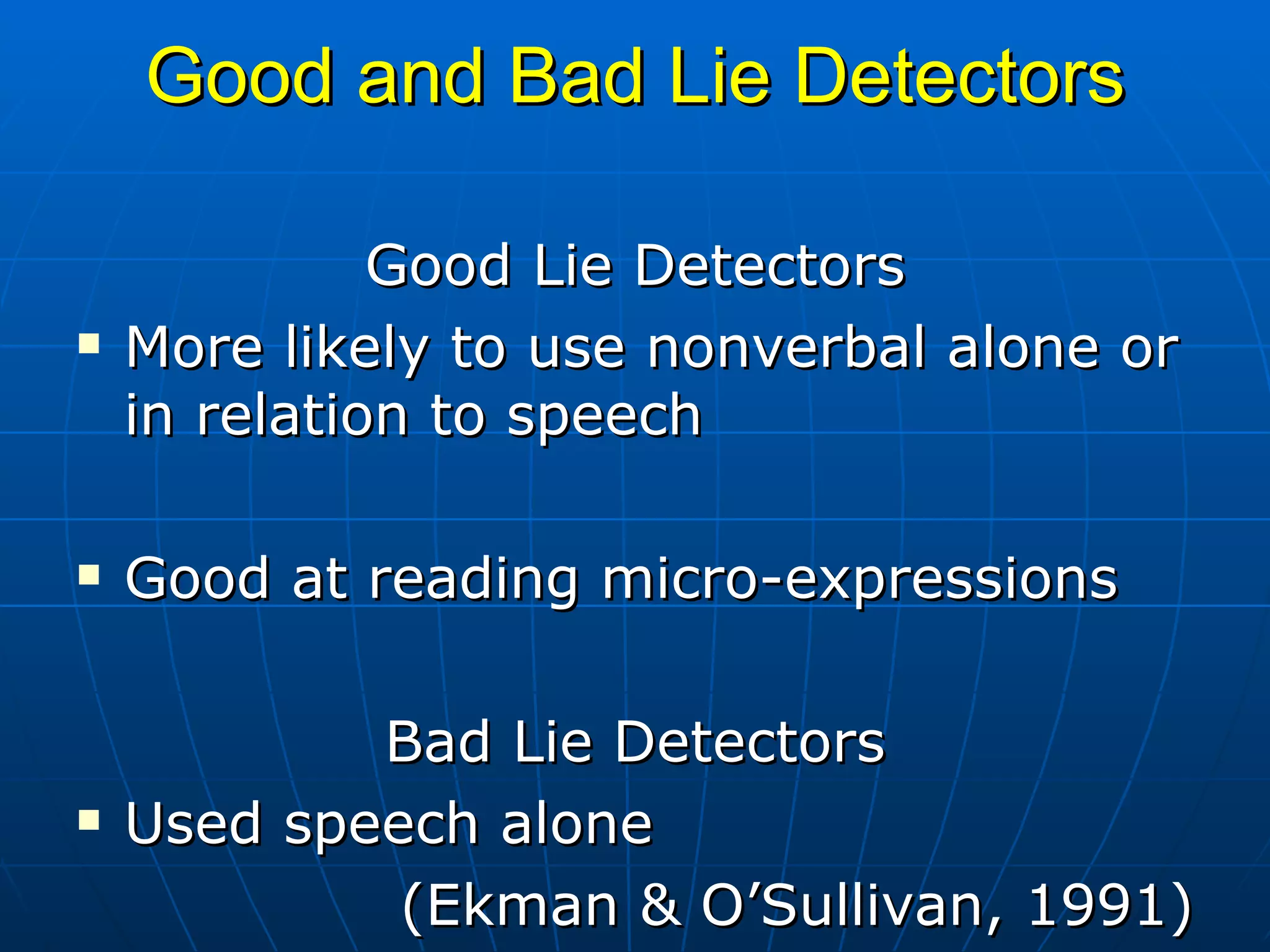
Good and Bad Lie Detectors Good Lie Detectors More likely to use nonverbal alone or in relation to speech Good at reading micro-expressions Bad Lie Detectors Used speech alone (Ekman & O’Sullivan, 1991)
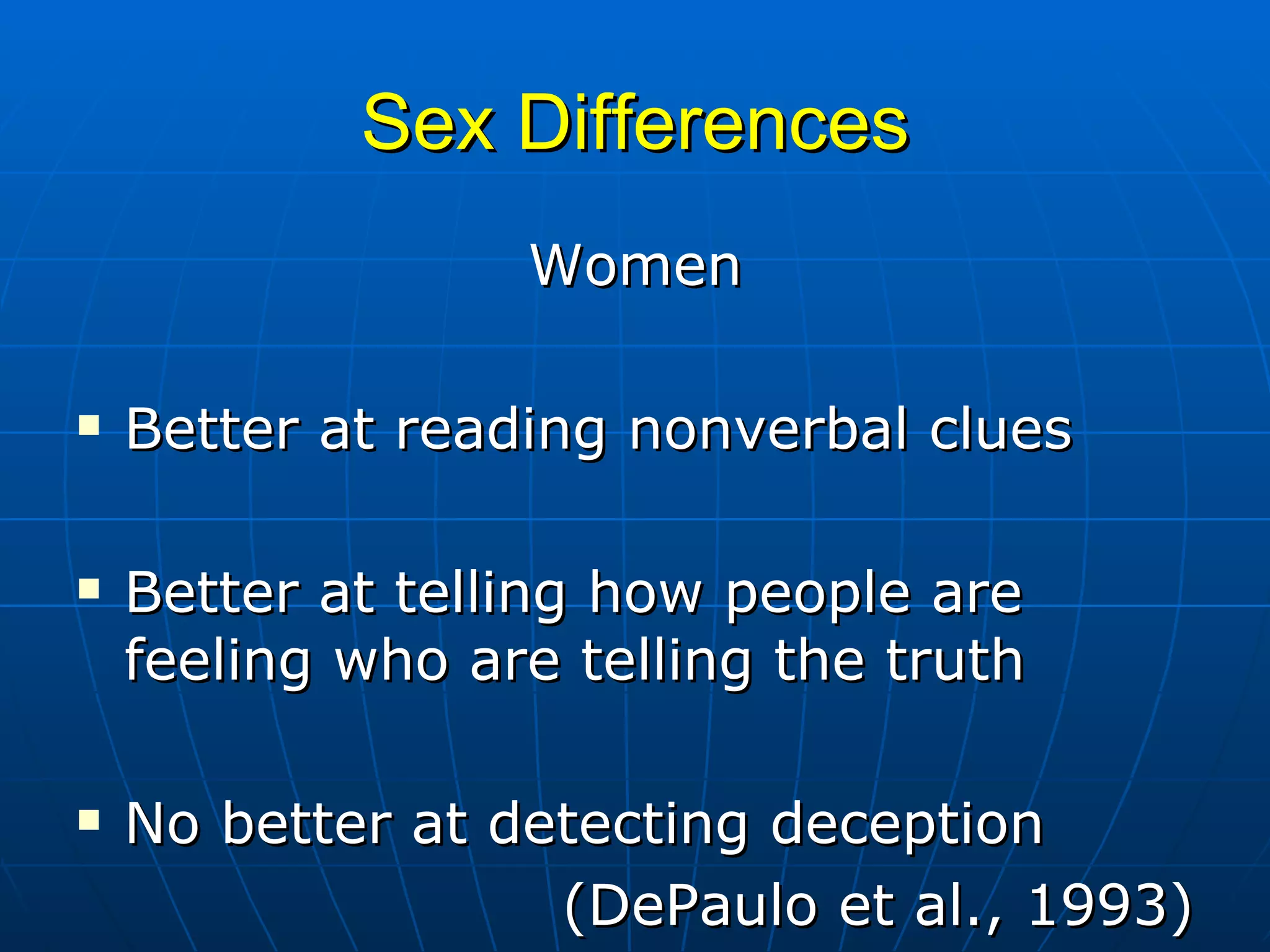
Sex Differences Women Better at reading nonverbal clues Better at telling how people are feeling who are telling the truth No better at detecting deception (DePaulo et al., 1993)
Good Liars Practiced Liars Natural Liars Psychopaths
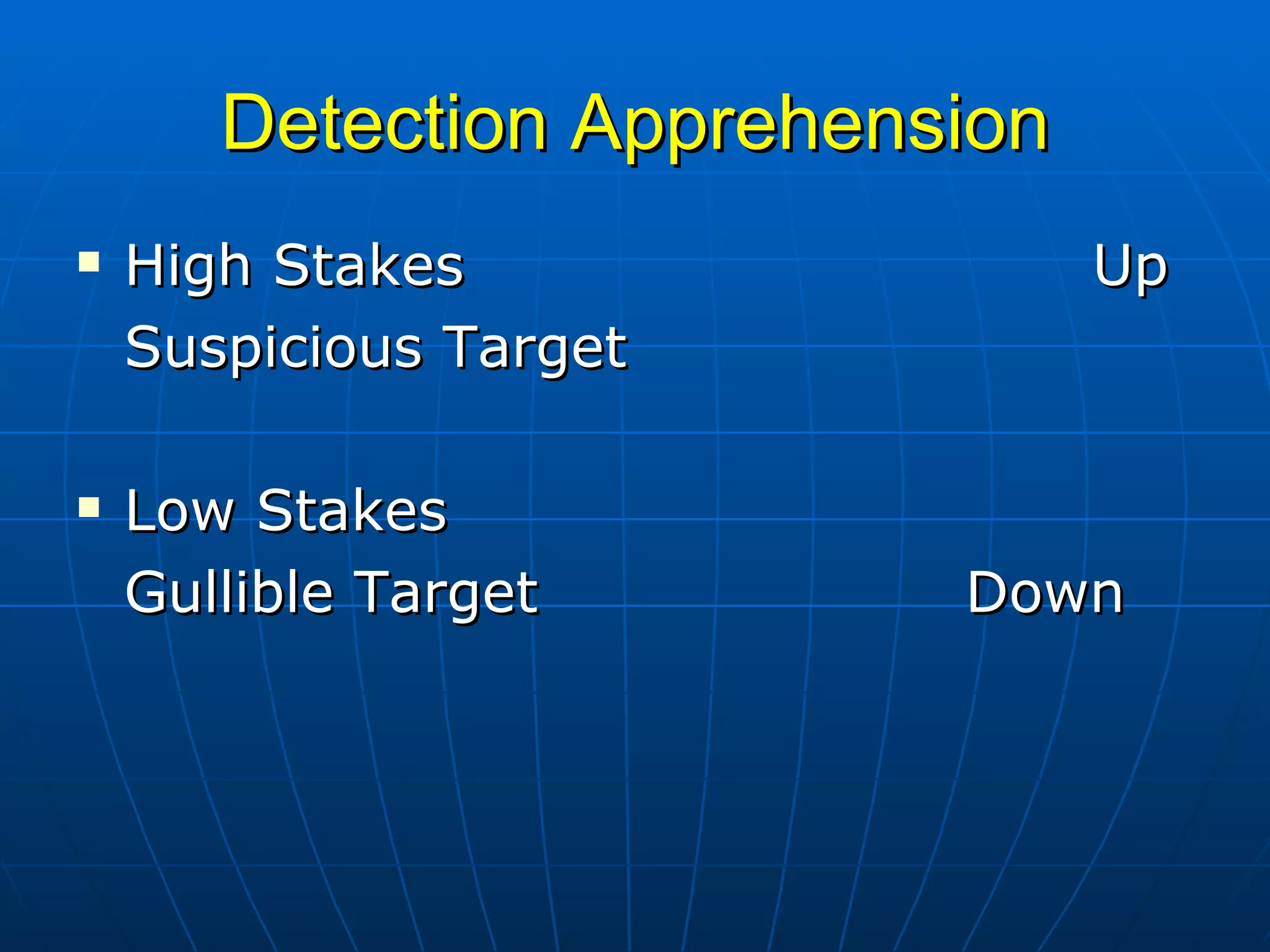
Detection Apprehension High Stakes Up Suspicious Target Low Stakes Gullible Target Down
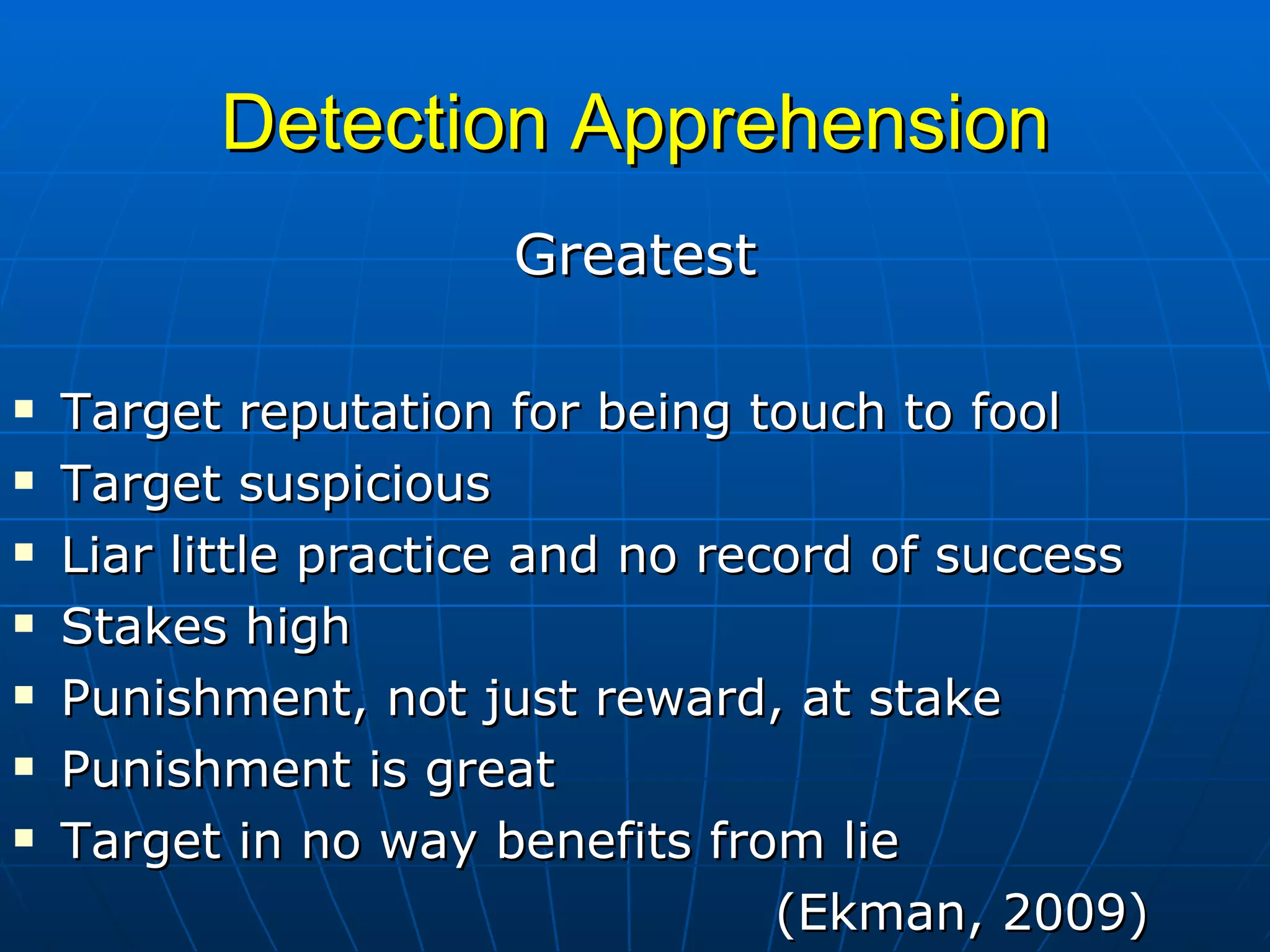
Detection Apprehension Greatest Target reputation for being touch to fool Target suspicious Liar little practice and no record of success Stakes high Punishment, not just reward, at stake Punishment is great Target in no way benefits from lie (Ekman, 2009)
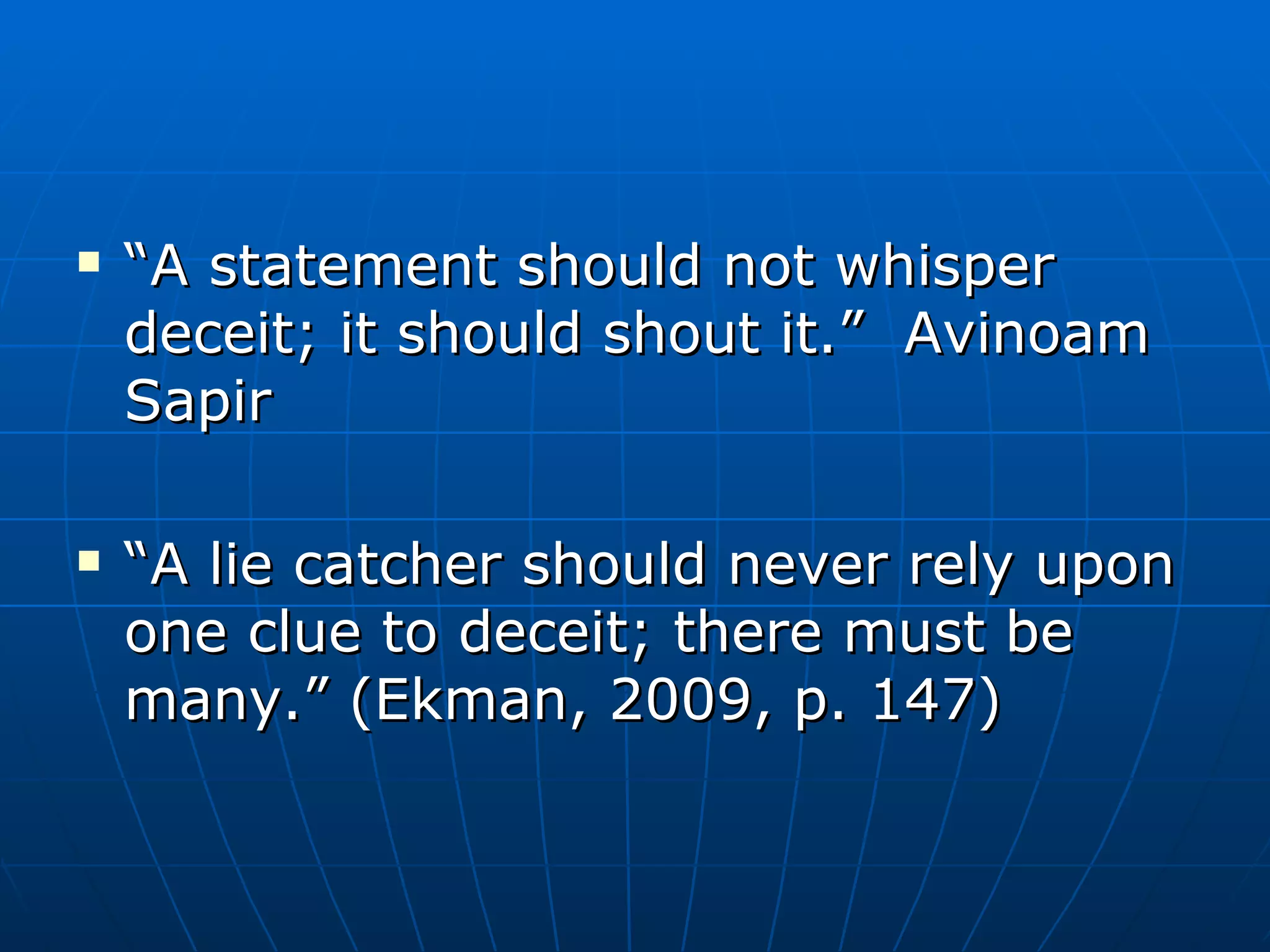
“ A statement should not whisper deceit; it should shout it.”  Avinoam Sapir “ A lie catcher should never rely upon one clue to deceit; there must be many.” (Ekman, 2009, p. 147)
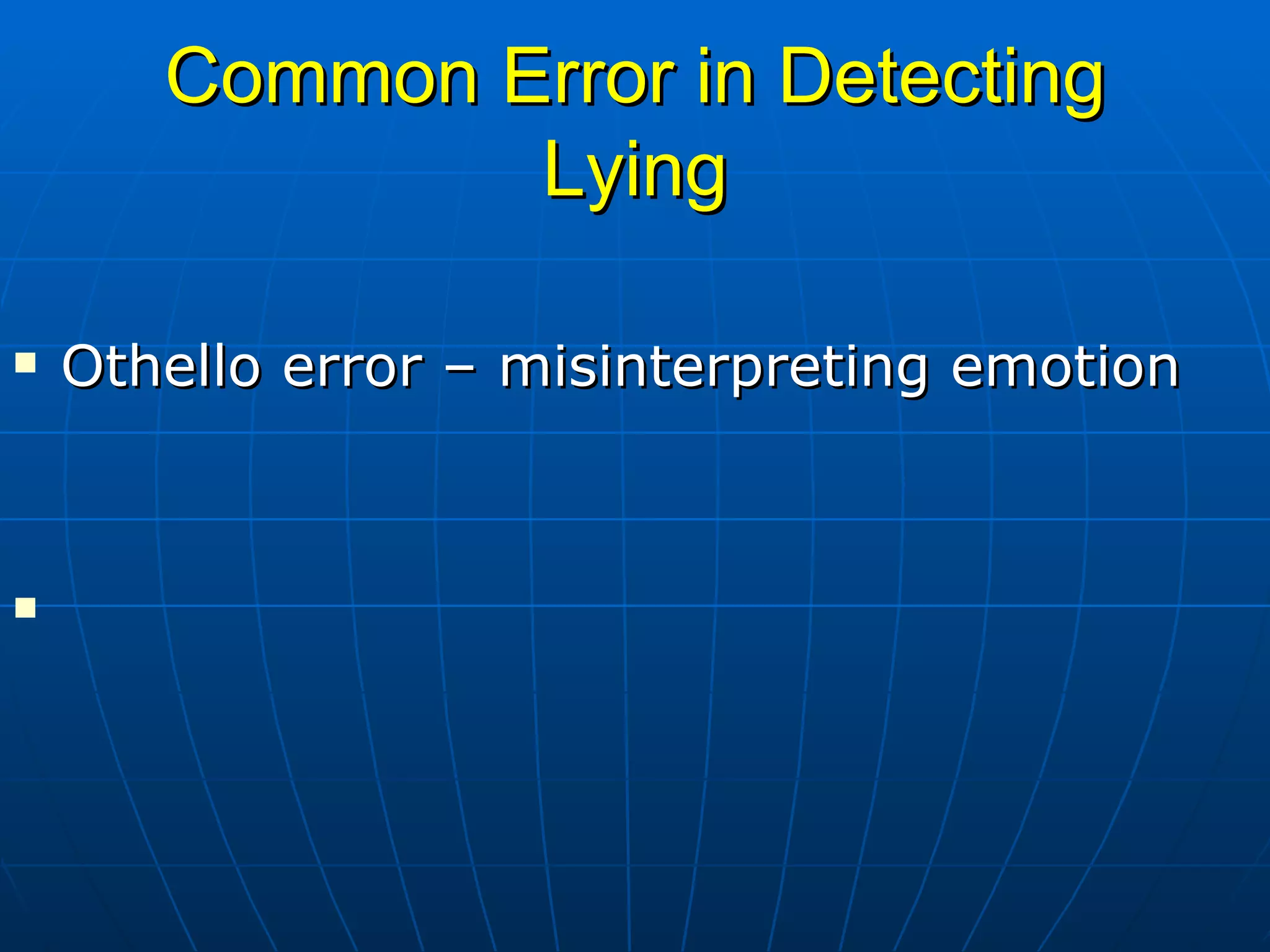
Common Error in Detecting Lying Othello error – misinterpreting emotion
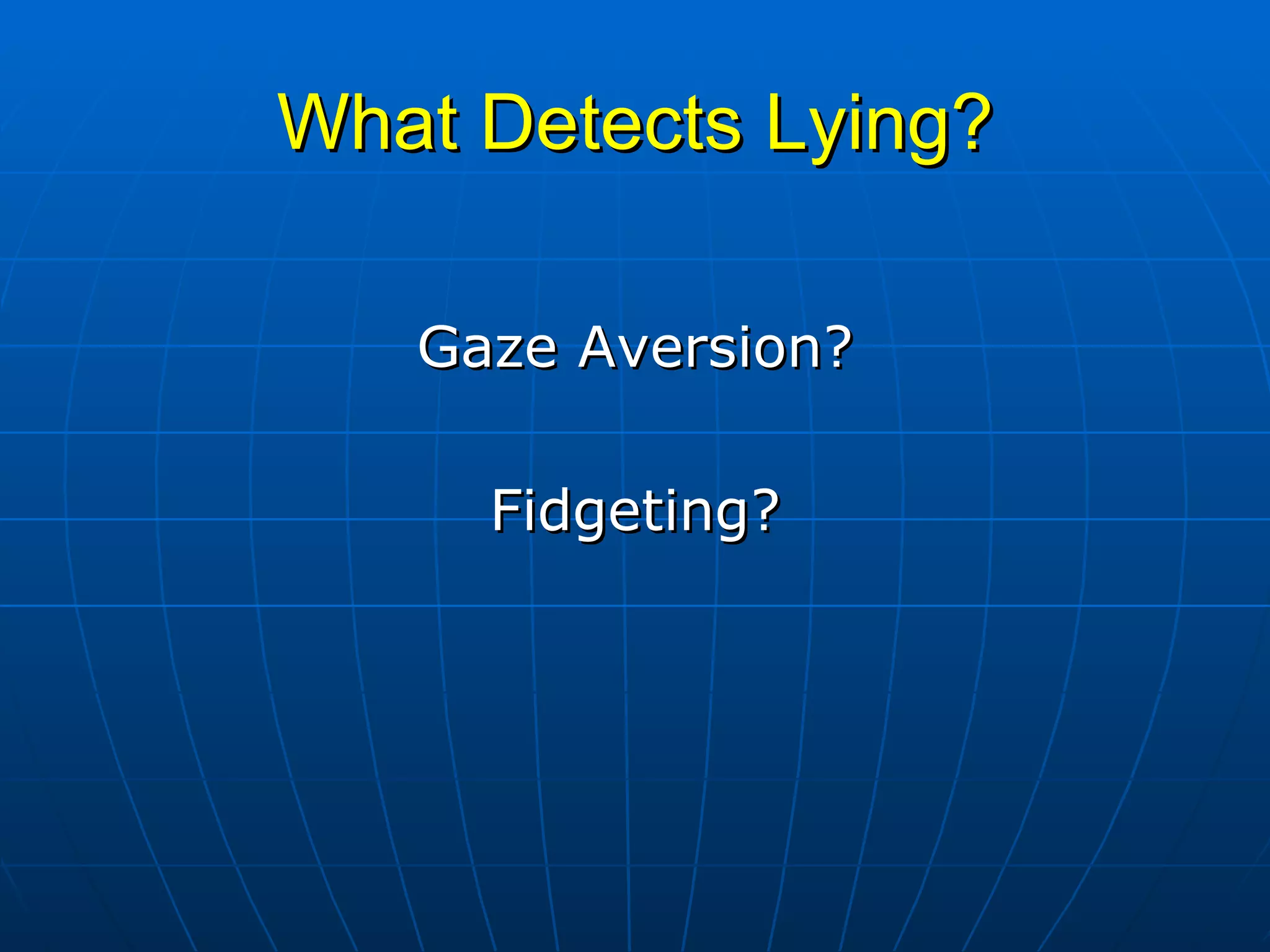
What Detects Lying? Gaze Aversion? Fidgeting?
Fidgeting Viewed as a sign lying
Gaze Aversion Sadness Nervousness Embarrassment Guilt Disgust
Gaze Aversion “ Even the guilty liar probably won’t avert his gaze much, since liars know that everyone expects to be able to detect deception in this way. . . Amazingly, people continue to be misled by liars skillful enough to not avert their gaze.”   (Ekman, 1992, p. 141)
“ At times there was a great amount of shame for being deceitful.  At times there was a great amount of pride: well, I pulled this one off again.  You’re a good one.  You’re very capable of doing this.  It works for you.  There were times when little old ladies would pat me on the back and say, ‘You’re one of the best young men that I ever have known.’  I would think back and think, ‘If you really knew me you wouldn’t say that.’”
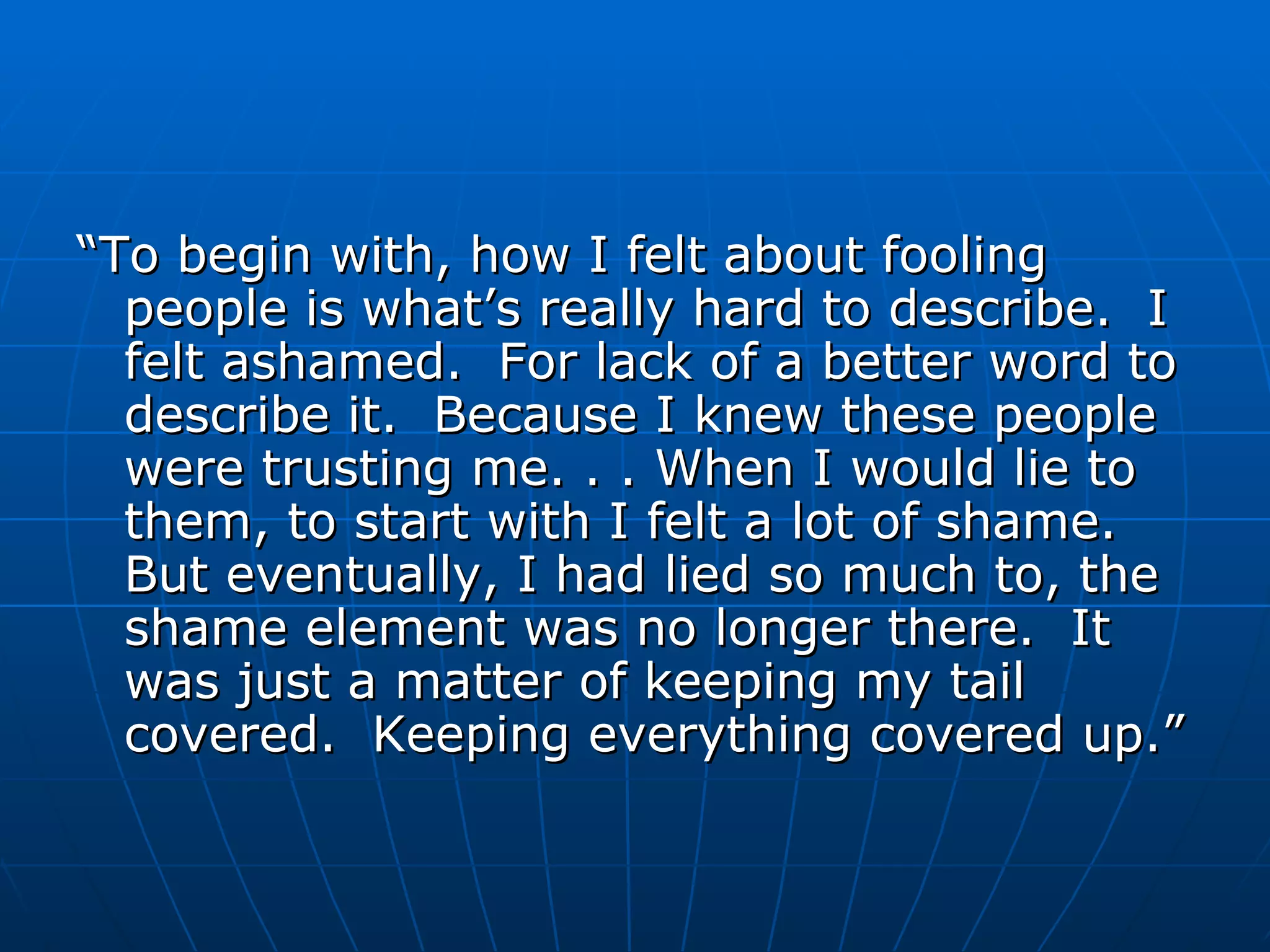
“ To begin with, how I felt about fooling people is what’s really hard to describe.  I felt ashamed.  For lack of a better word to describe it.  Because I knew these people were trusting me. . . When I would lie to them, to start with I felt a lot of shame.  But eventually, I had lied so much to, the shame element was no longer there.  It was just a matter of keeping my tail covered.  Keeping everything covered up.”
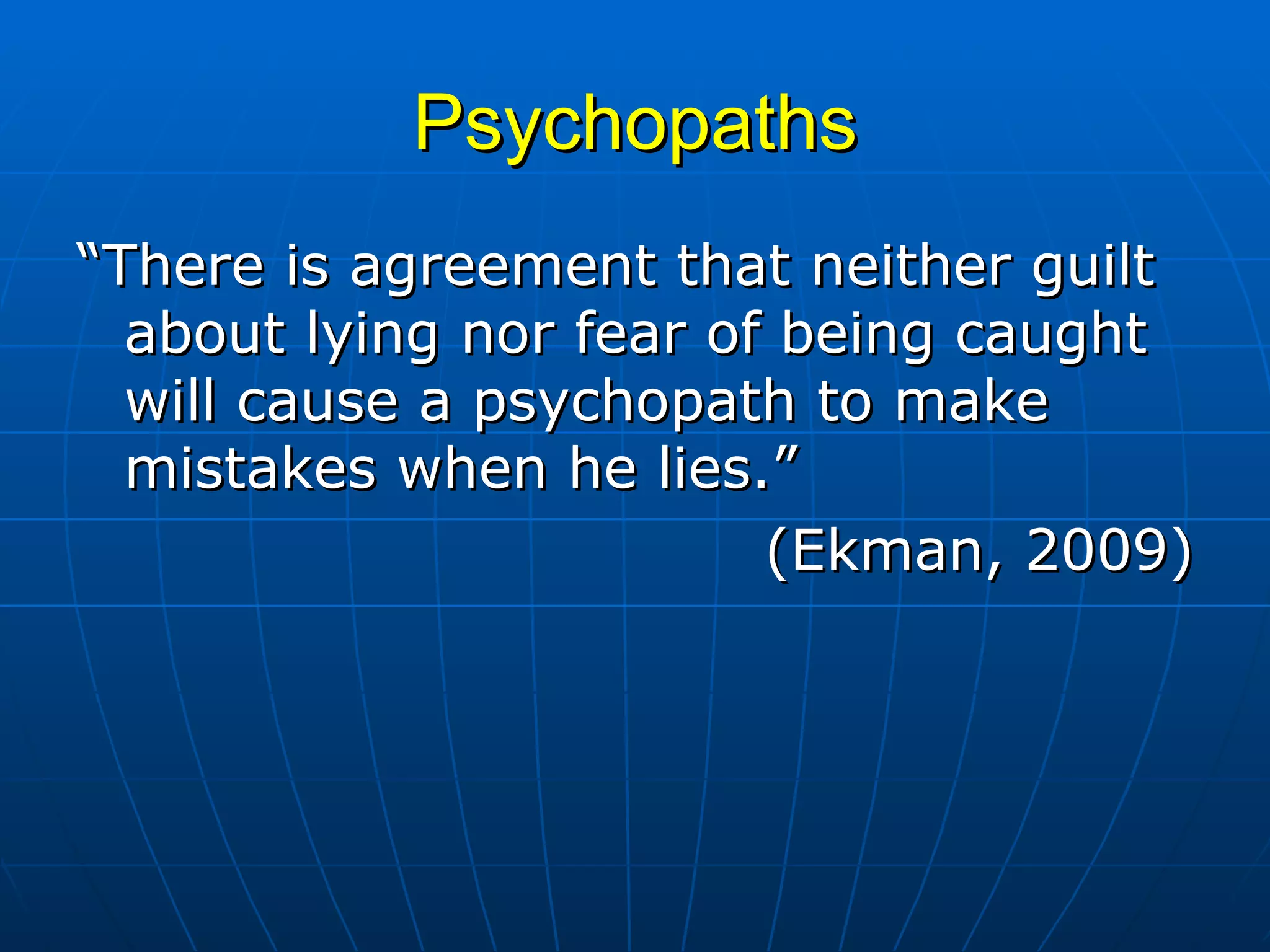
Psychopaths “ There is agreement that neither guilt about lying nor fear of being caught will cause a psychopath to make mistakes when he lies.” (Ekman, 2009)
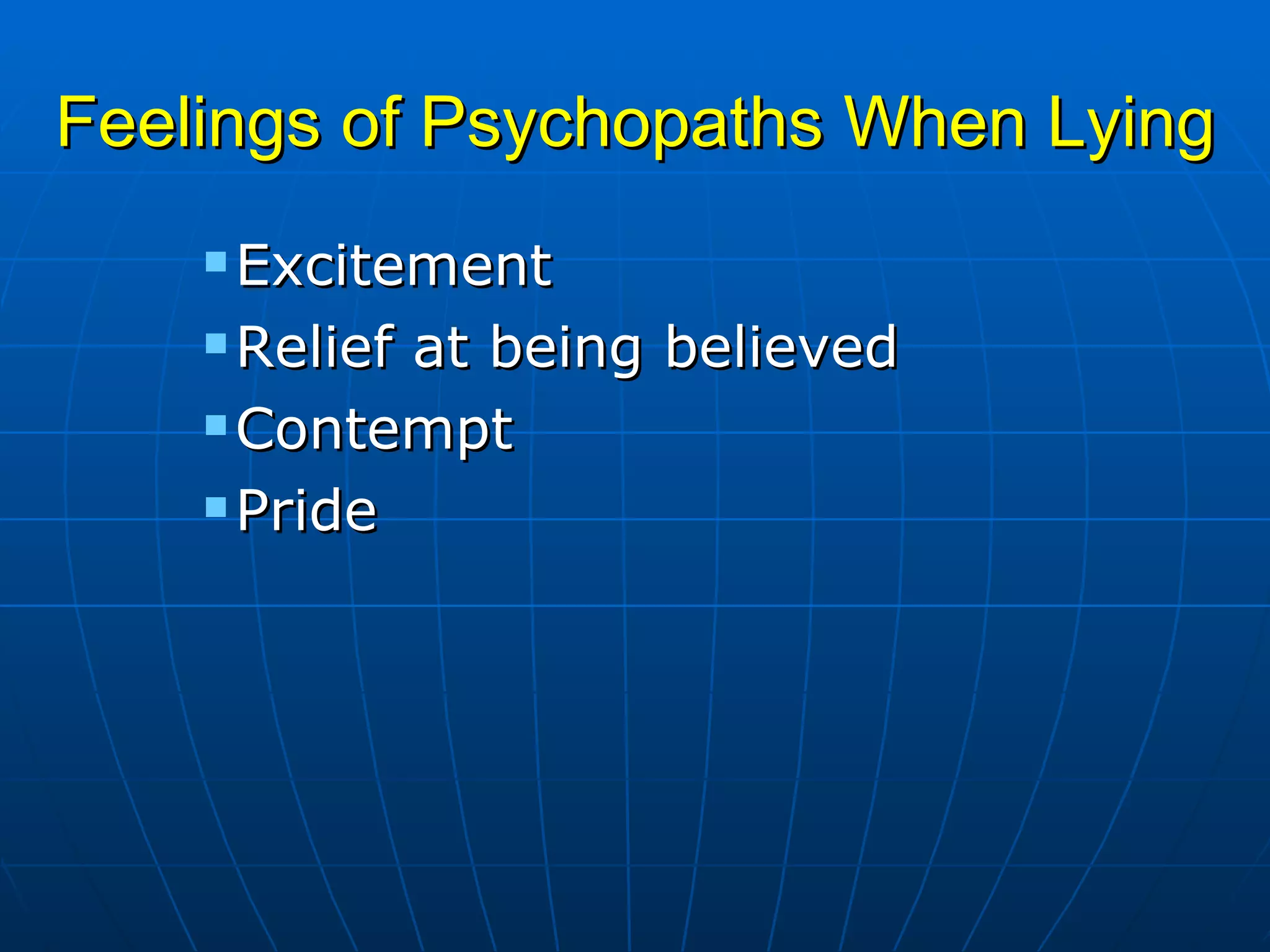
Feelings of Psychopaths When Lying Excitement Relief at being believed Contempt Pride
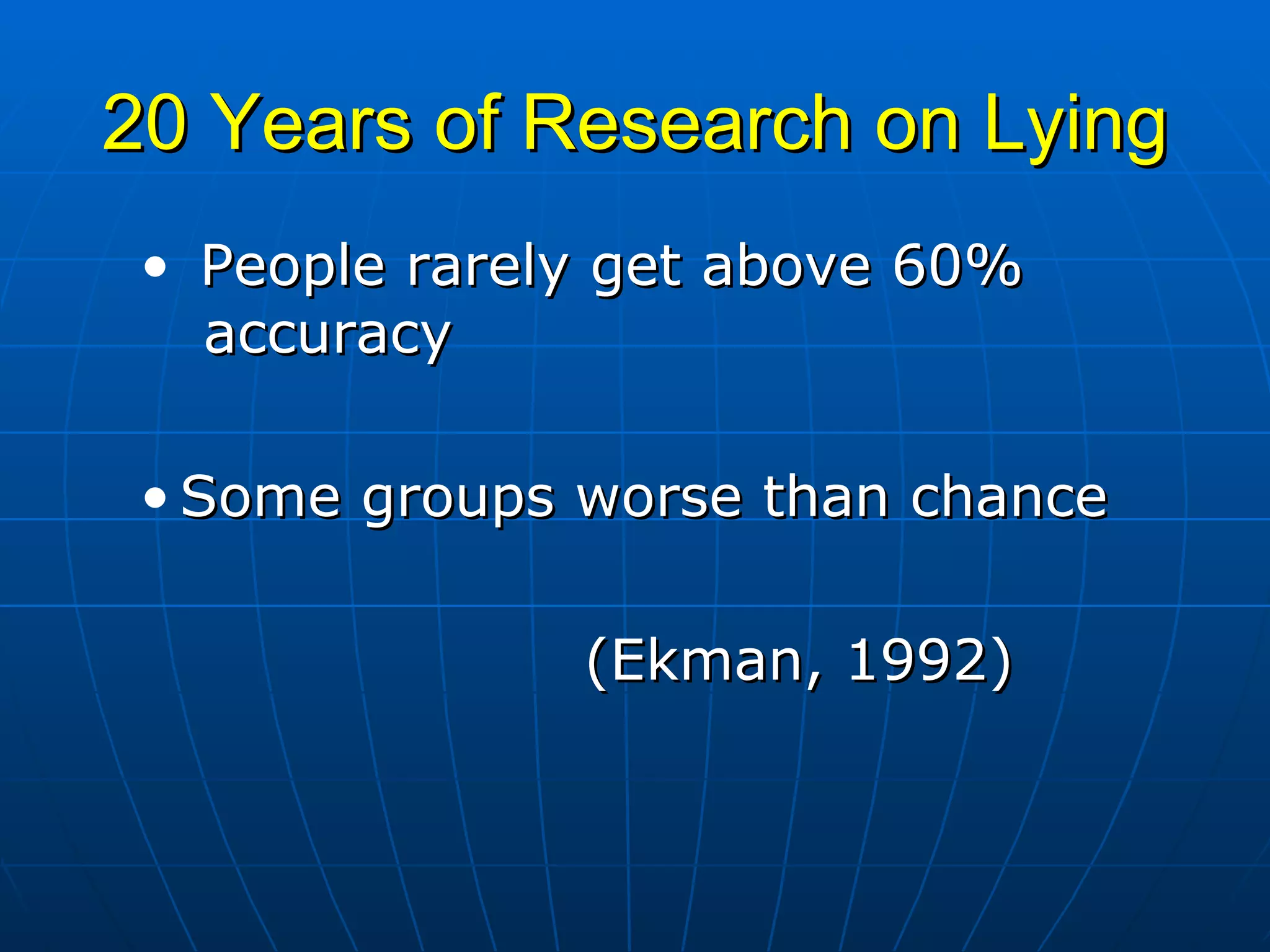
20 Years of Research on Lying People rarely get above 60%  accuracy Some groups worse than chance (Ekman, 1992)
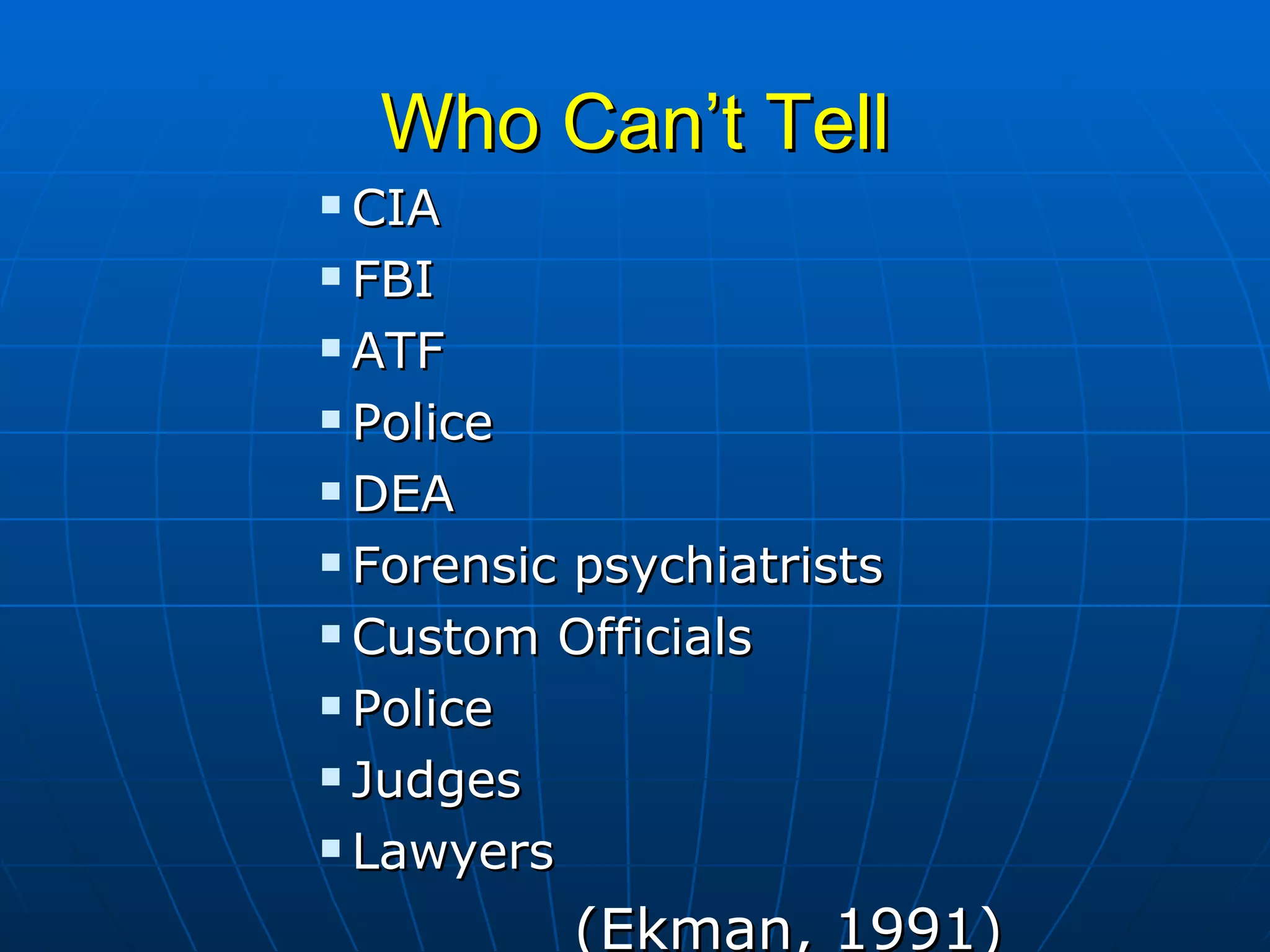
Who Can’t Tell CIA FBI ATF Police DEA Forensic psychiatrists Custom Officials Police Judges Lawyers (Ekman, 1991)
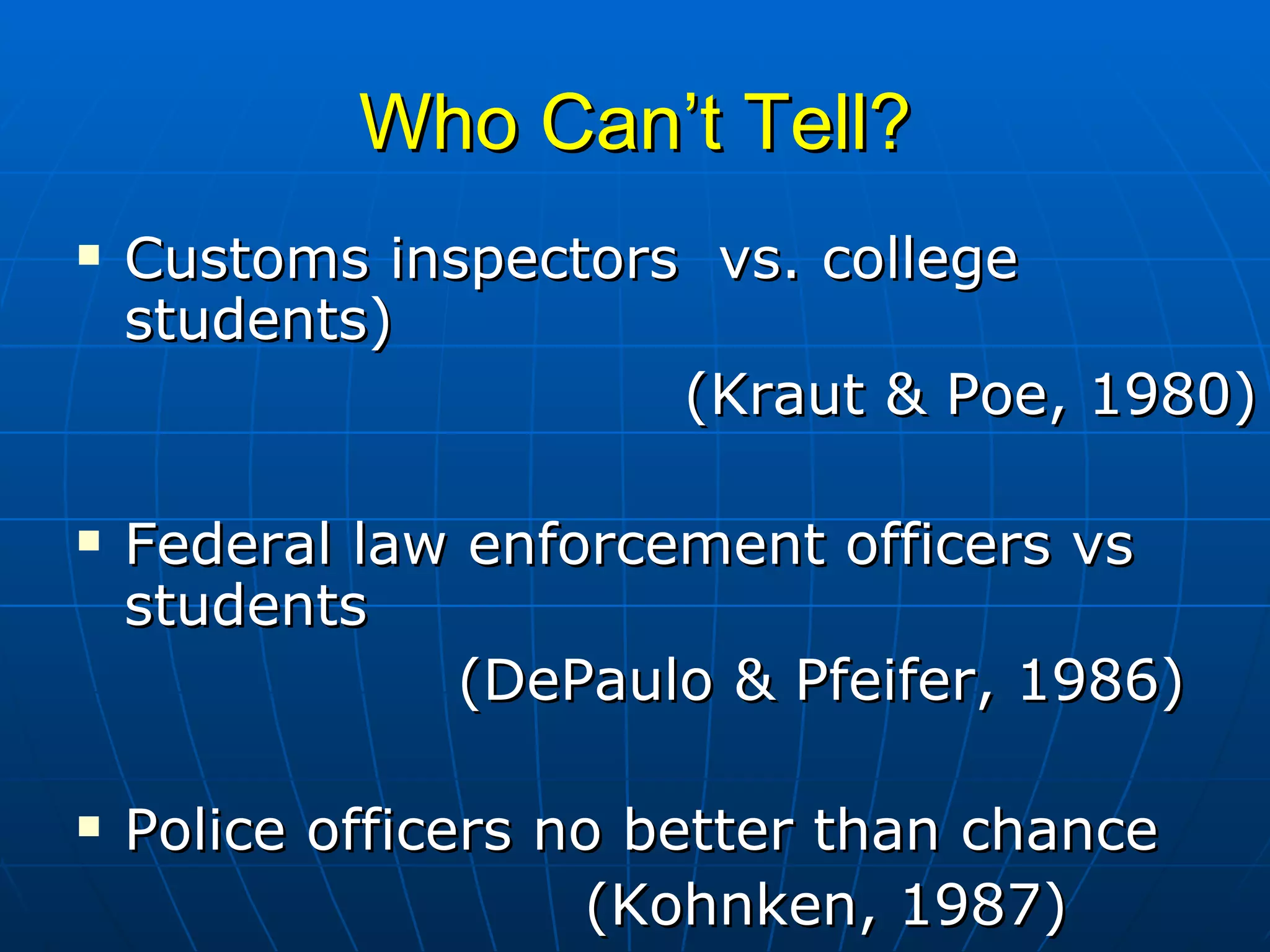
Who Can’t Tell? Customs inspectors  vs. college students) (Kraut & Poe, 1980) Federal law enforcement officers vs students (DePaulo & Pfeifer, 1986) Police officers no better than chance (Kohnken, 1987)
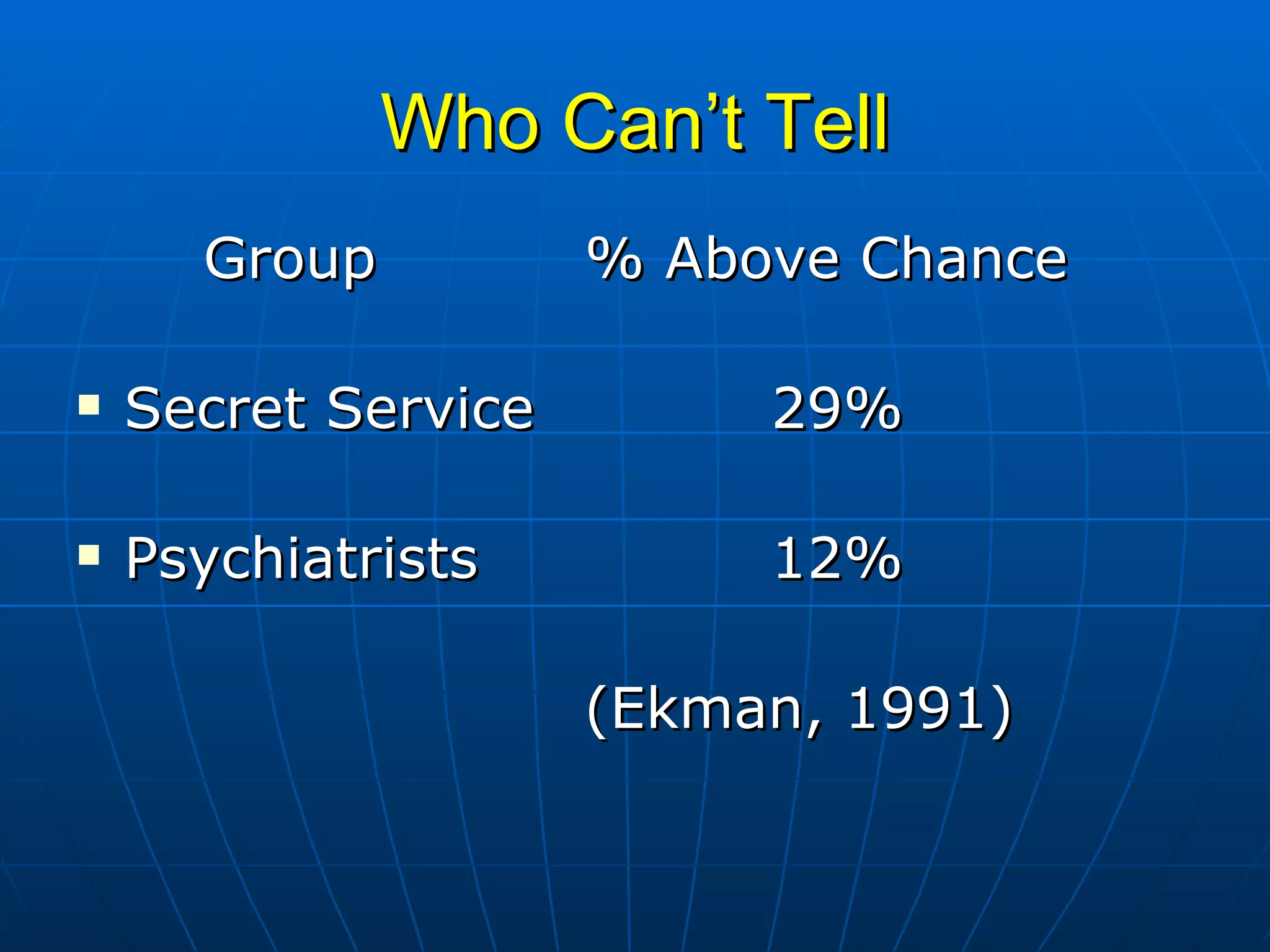
Who Can’t Tell Group % Above Chance Secret Service   29% Psychiatrists   12% (Ekman, 1991)
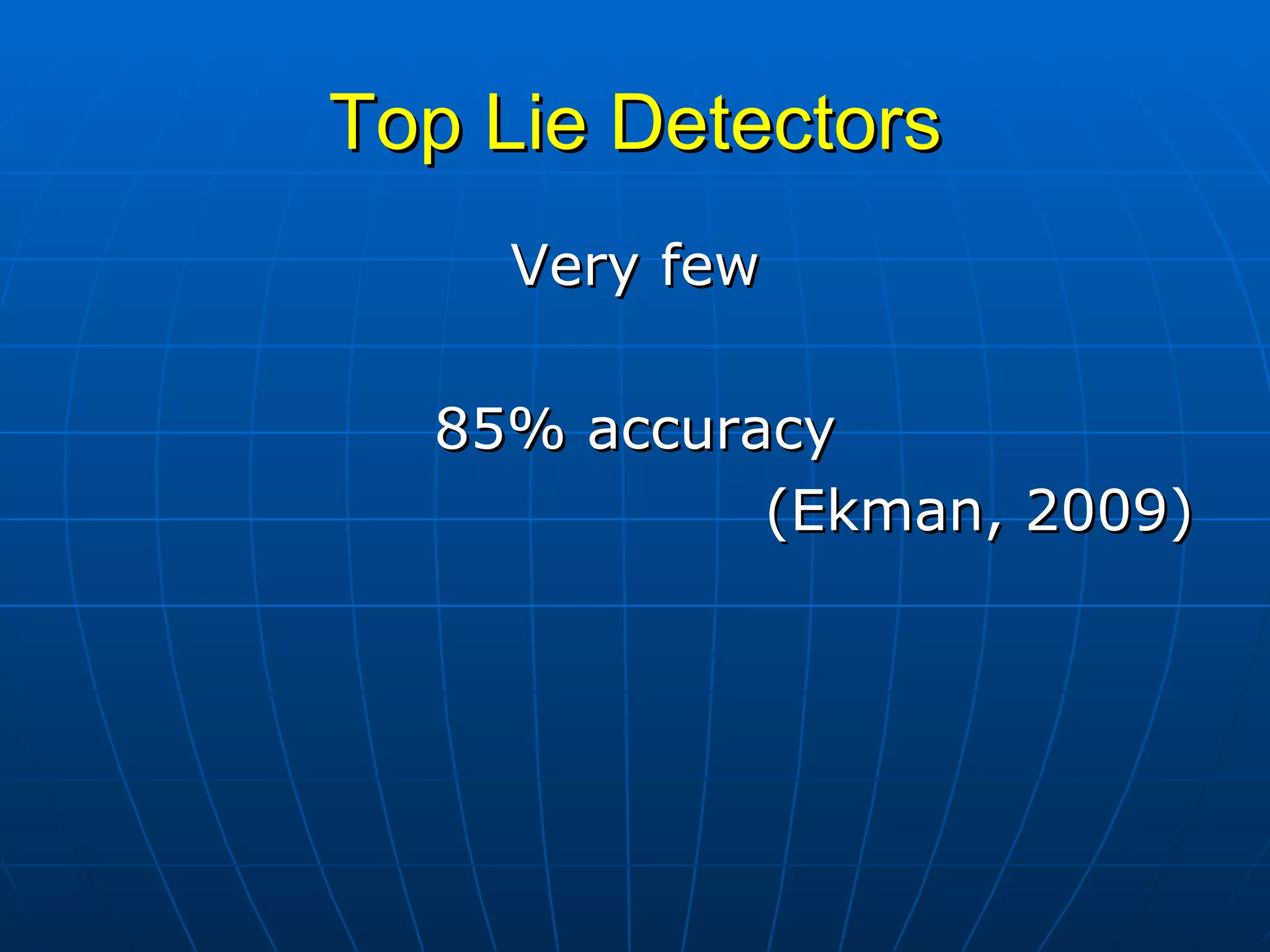
Top Lie Detectors Very few 85% accuracy (Ekman, 2009)
Federal law enforcement officers More Confident Than College Students No More Accurate (DePaulo & Pfeifer, 1986)
Accuracy What Didn’t Make a Difference Age Sex Years of Job Experience (Ekman, 1991)
Accuracy Polygraphers  & Secret Service Worse as Got Older (Ekman, 1991)
Which Signs of Deception Work? Signs the liar doesn’t know to fake Signs the liar can’t fake
What Are You Detecting? Deception? Emotional leakage?
“ There is no sign of deceit itself.” (Ekman, 2009,p. 80)
Emotions Involved in Lying Fear of being caught Guilt about lying Guilt about behavior Duping delight
Fear Fear of not being believed Fear of being caught
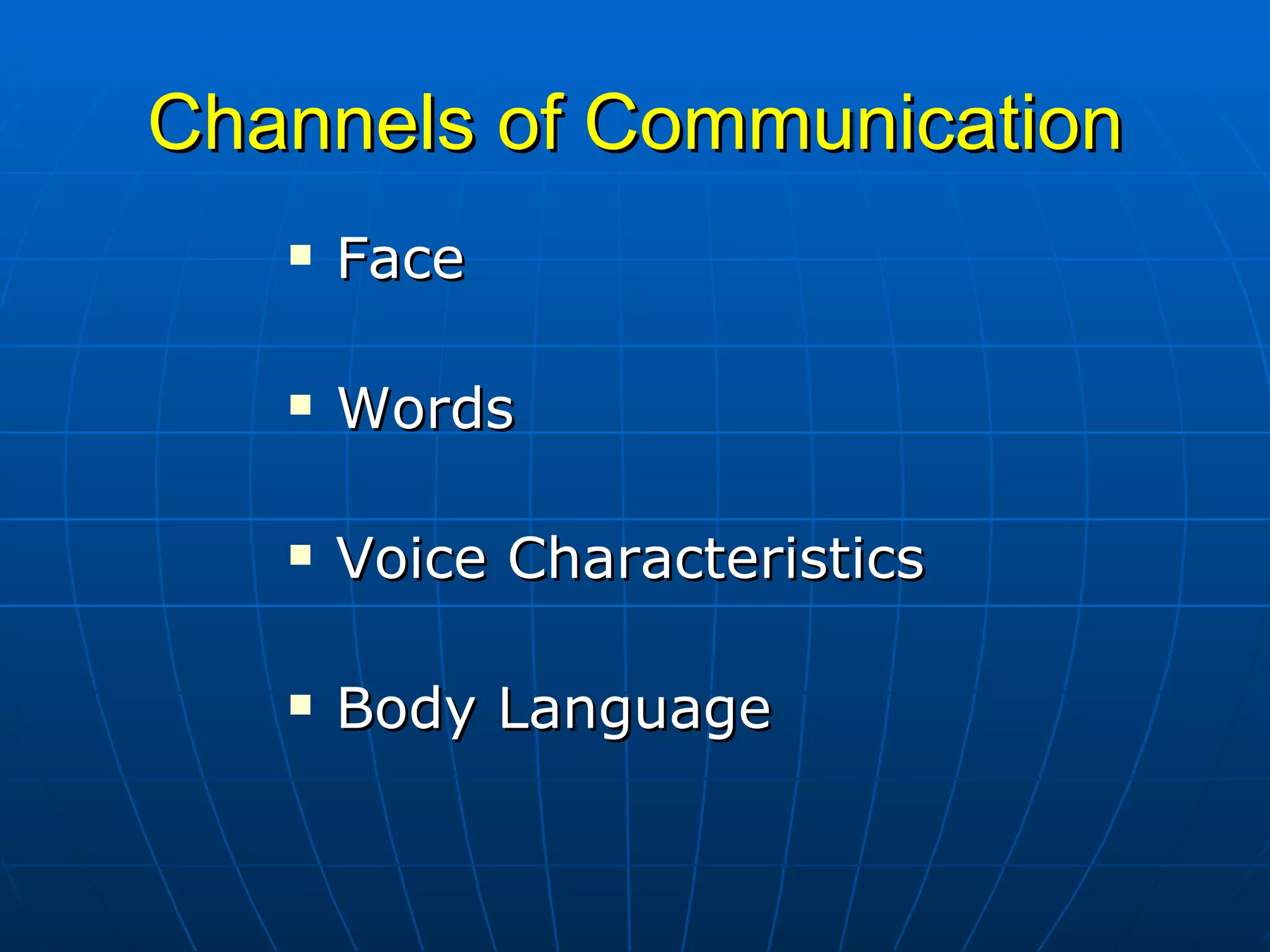
Channels of Communication Face Words Voice Characteristics Body Language
Facial Expressions Automatic Expressions
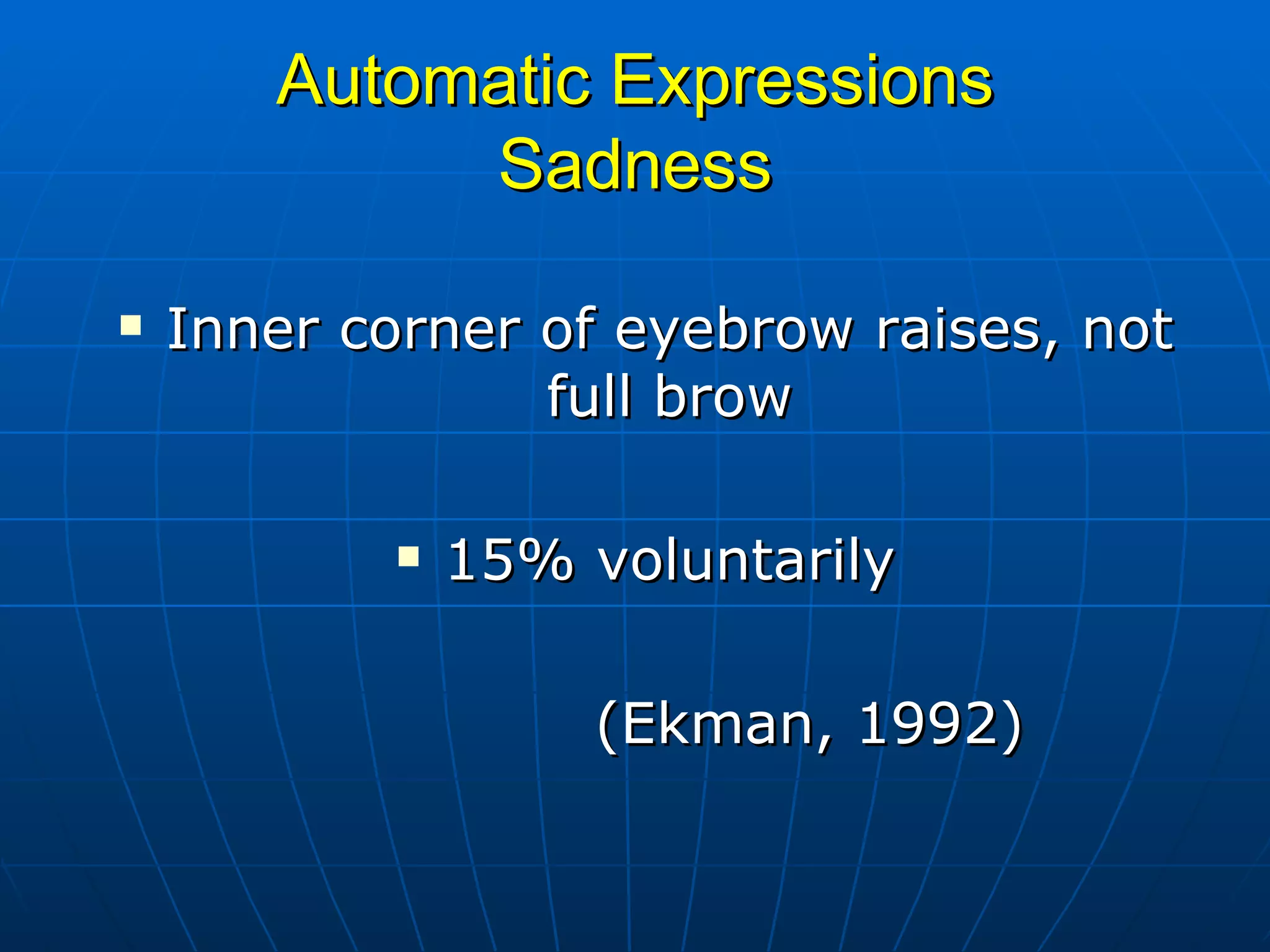
Automatic Expressions Sadness Inner corner of eyebrow raises, not full brow 15% voluntarily (Ekman, 1992)
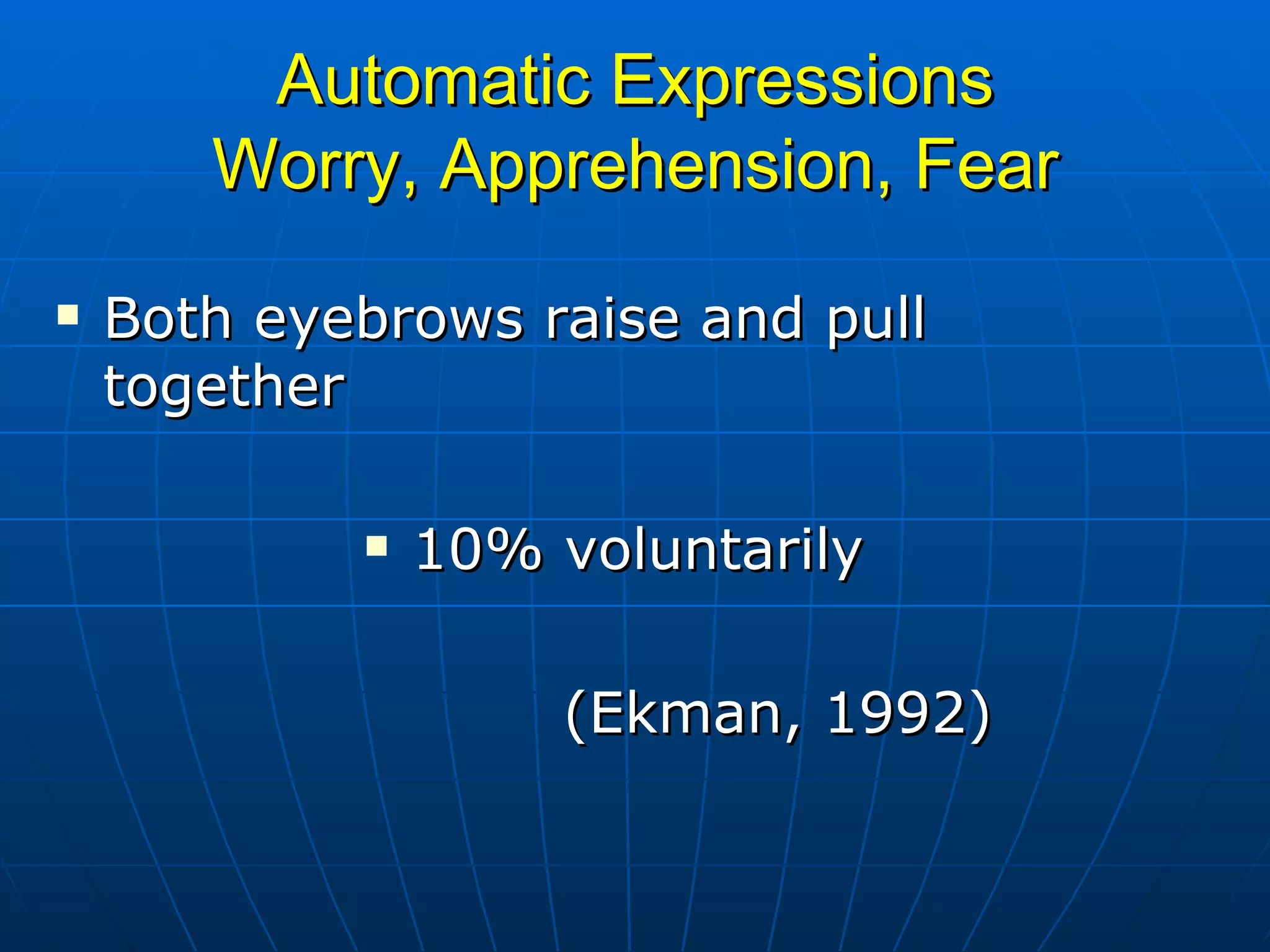
Automatic Expressions Worry, Apprehension, Fear Both eyebrows raise and pull together 10% voluntarily (Ekman, 1992)
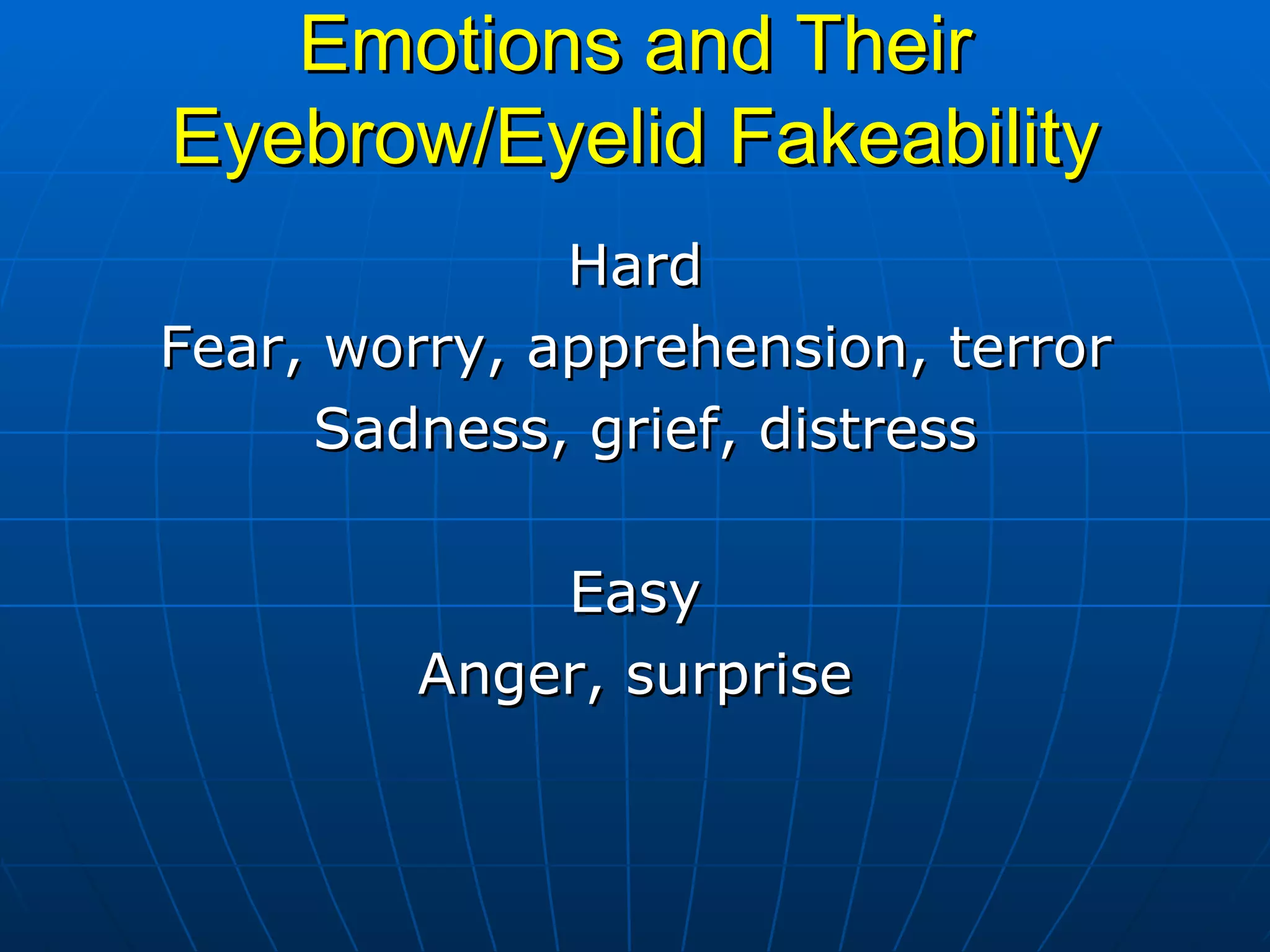
Emotions and Their Eyebrow/Eyelid Fakeability Hard Fear, worry, apprehension, terror Sadness, grief, distress Easy Anger, surprise
Most Reliable Facial Muscles Forehead
Anger Reliable:  Narrowing of lips
Facial Expressions Micro-Expressions -  1/25”
Micro Expression Training Tool http://www.mettonline.com/products.aspx
Facial Expressions Squelched Expressions
Facial Expressions Asymmetry
Asymmetry Voluntary Expressions Brow-lowering in anger stronger on left Nose-wrinkling in disgust stronger on right  Stretching of lips back towards ears in fear are stronger on right
Facial Expressions Timing
Which Emotion is Shortest? Surprise 1 second
Duration of Emotion 5 seconds Likely Phony 10 seconds Almost Definitely
Bad Timing Affect should be on face Before or at start of words
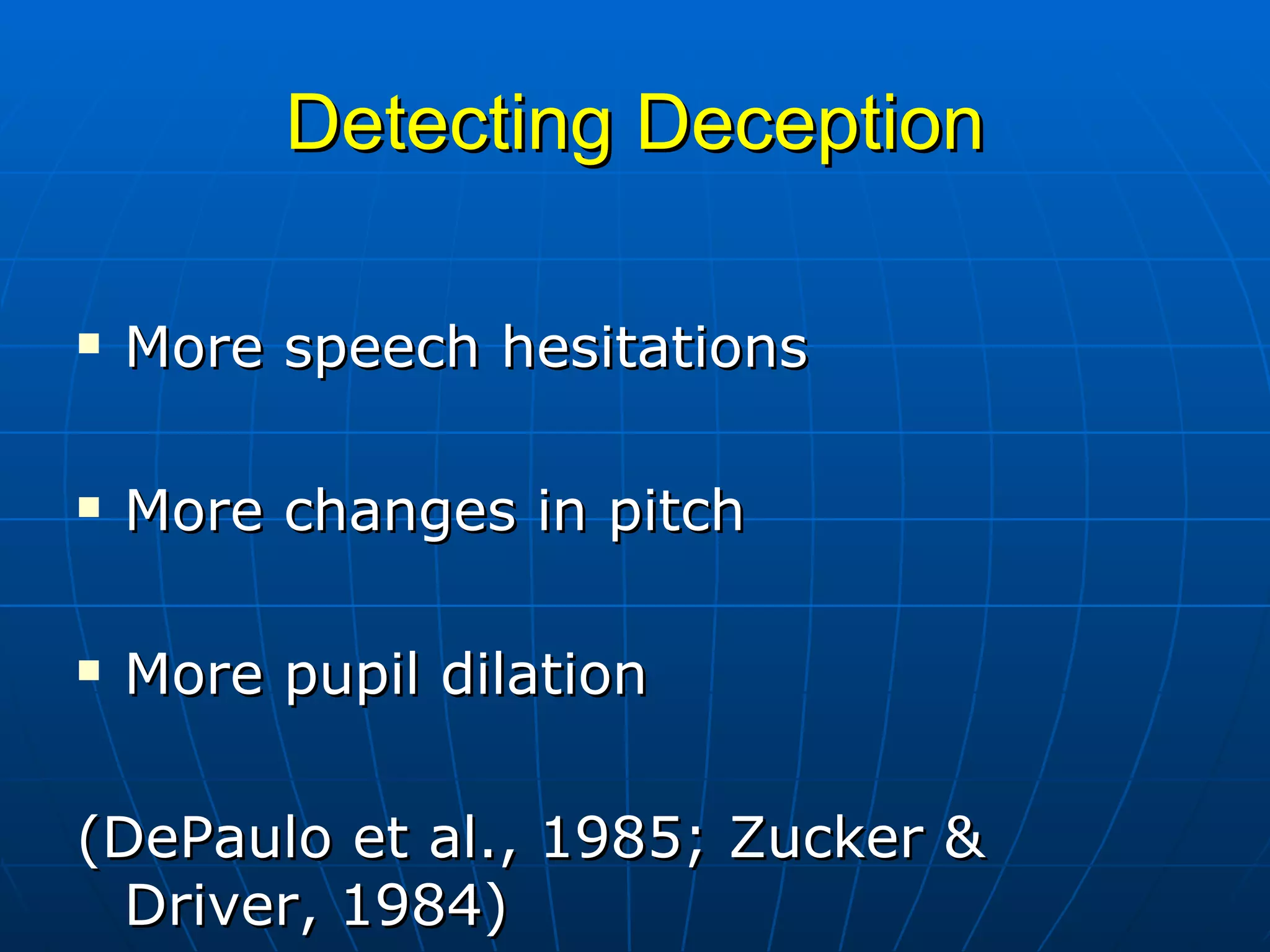
Detecting Deception More speech hesitations More changes in pitch More pupil dilation (DePaulo et al., 1985; Zucker & Driver, 1984)
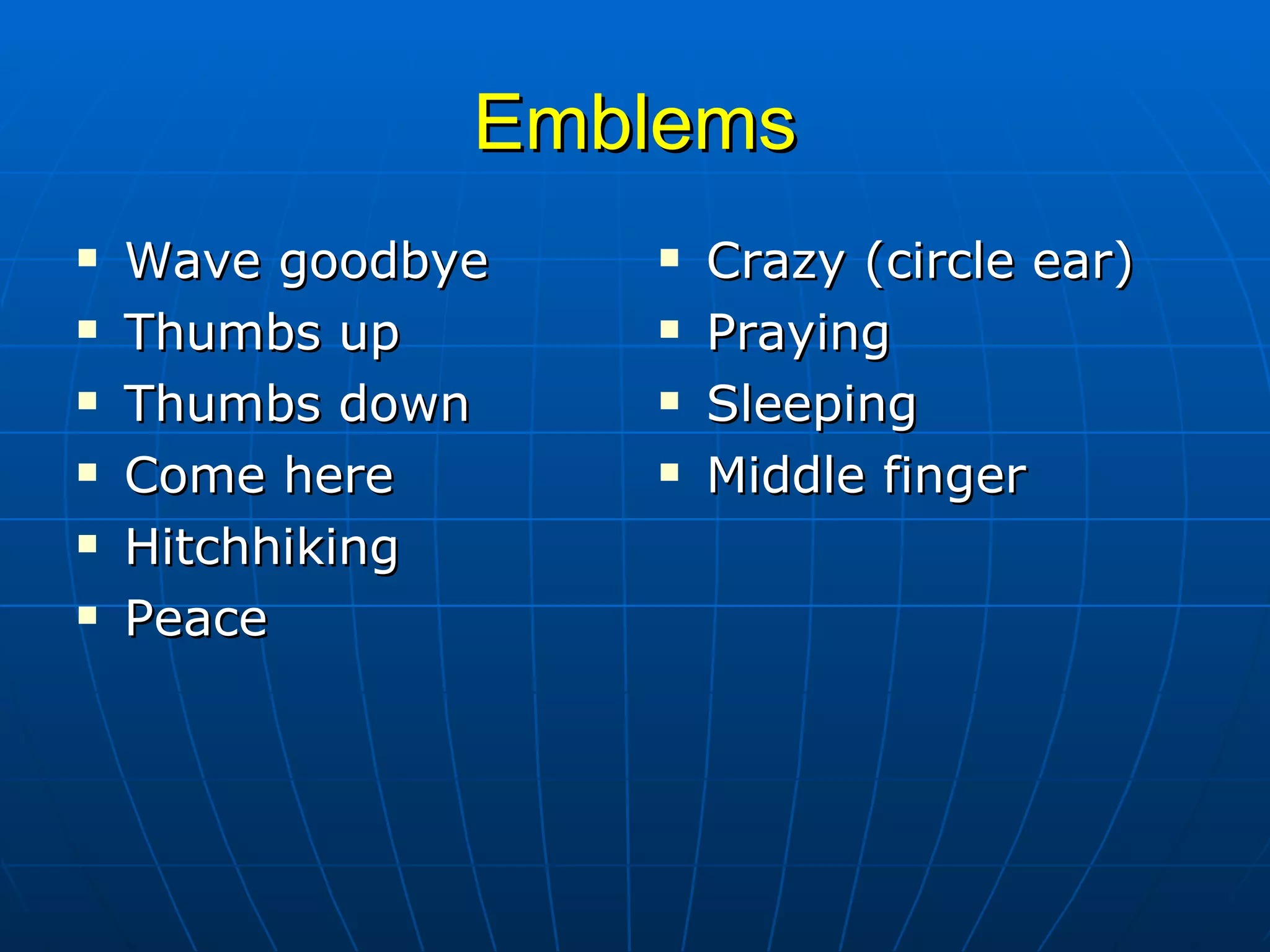
Emblems Wave goodbye Thumbs up Thumbs down Come here Hitchhiking  Peace Crazy (circle ear) Praying Sleeping Middle finger
Sex Offenders and Victims: Current Trends Anna C. Salter, Ph.D.
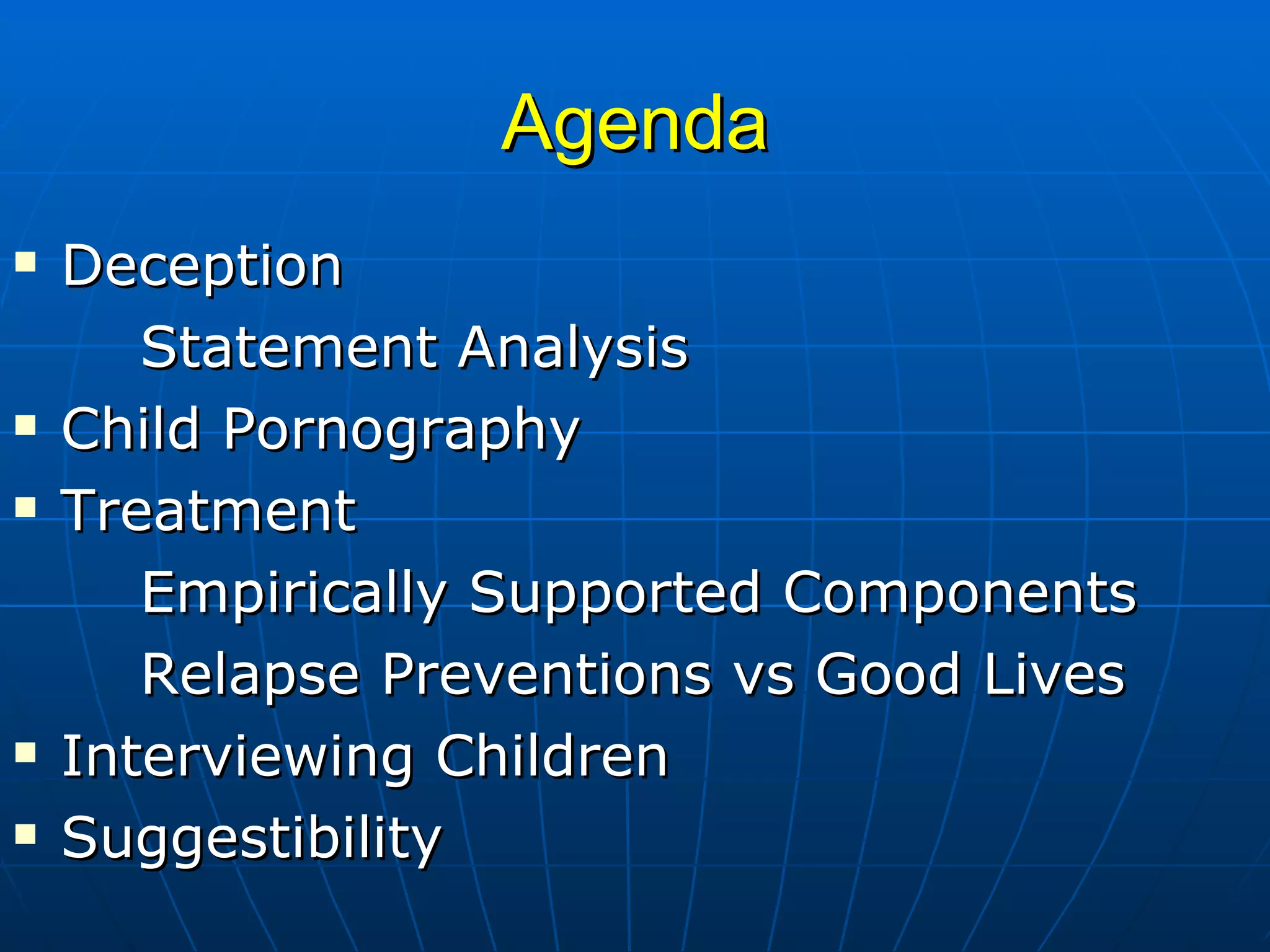
Agenda Deception Statement Analysis Child Pornography Treatment Empirically Supported Components Relapse Preventions vs Good Lives Interviewing Children Suggestibility
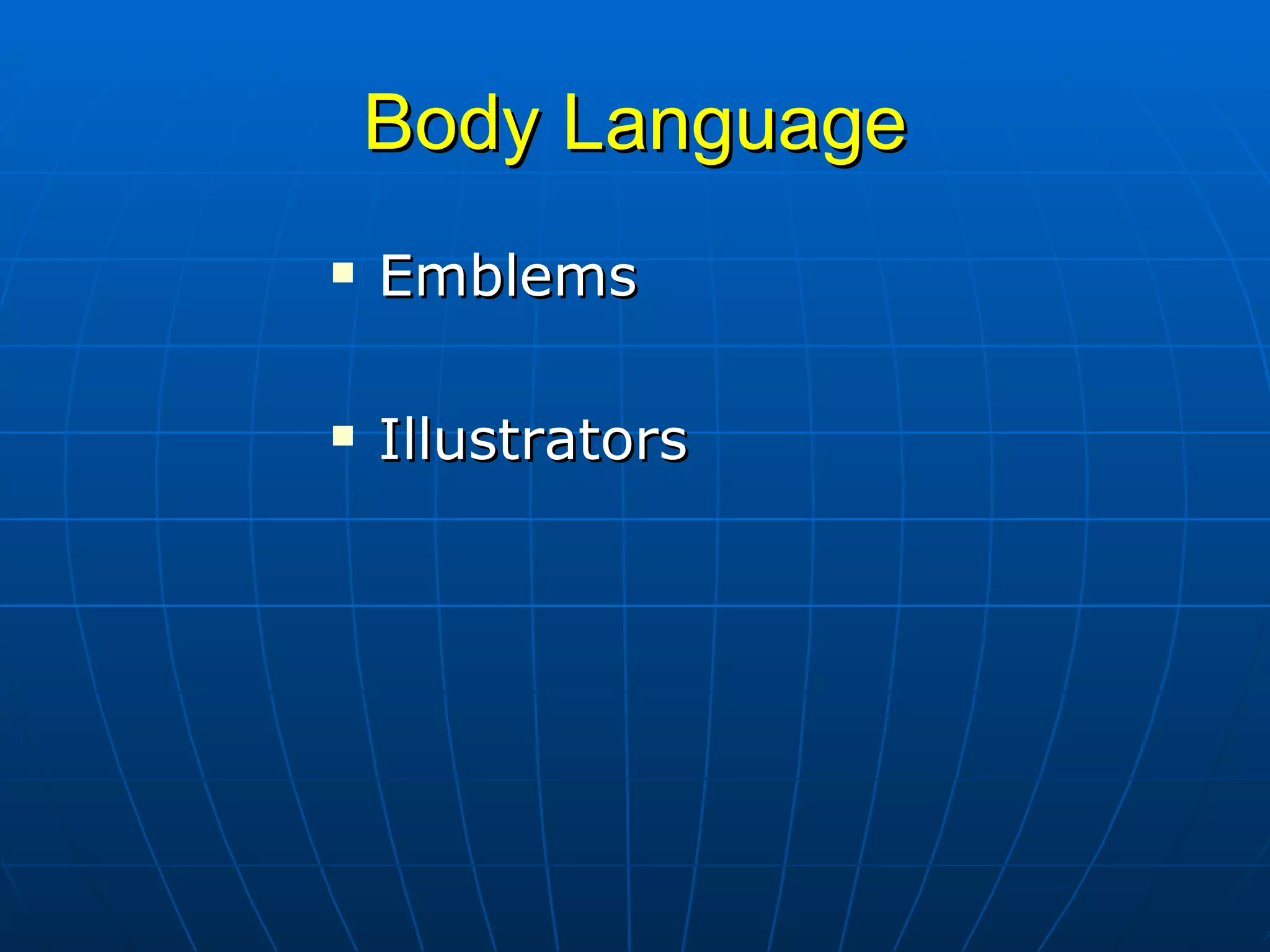
Body Language Emblems Illustrators
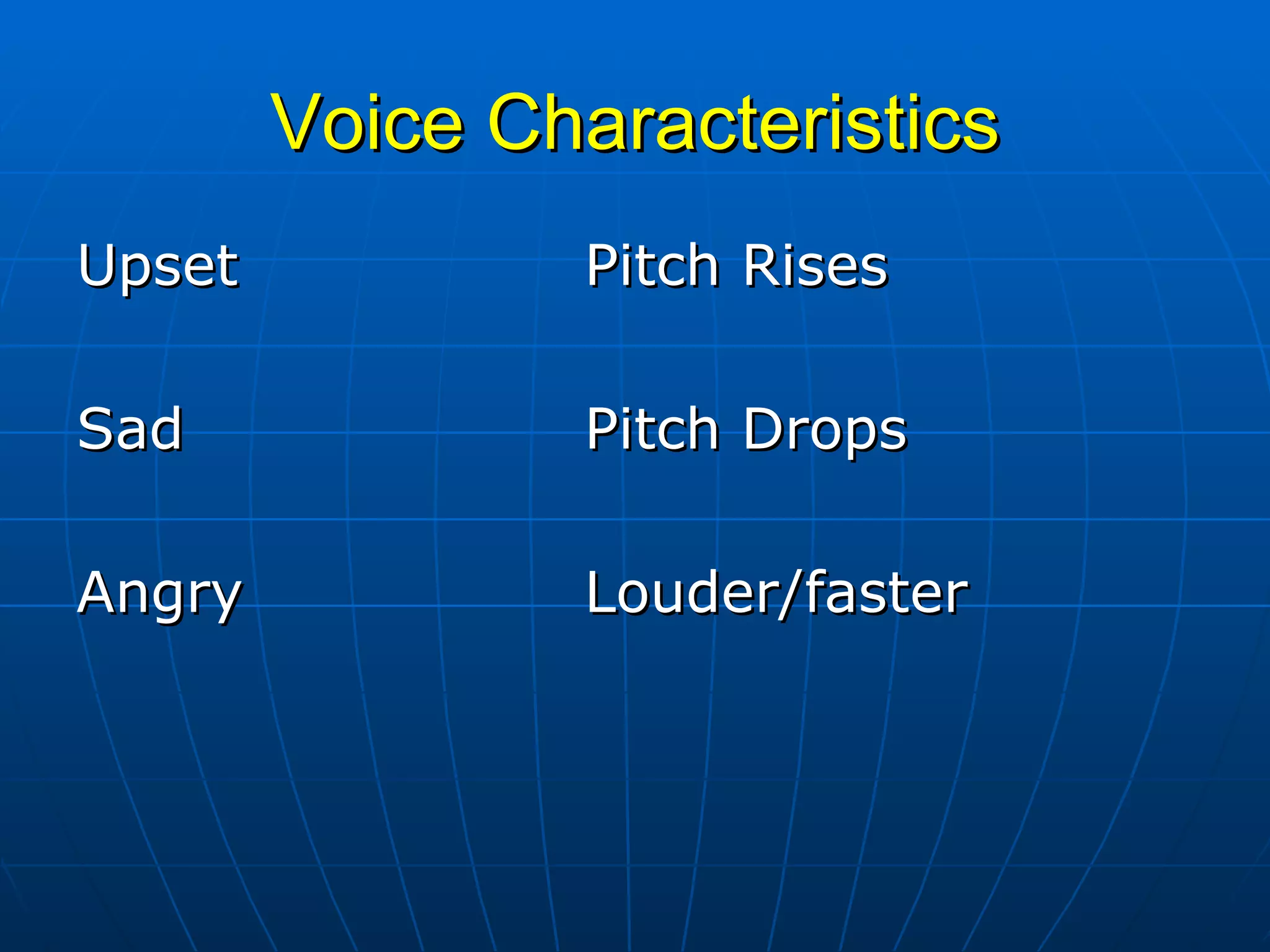
Voice Characteristics Upset Pitch Rises Sad Pitch Drops Angry Louder/faster
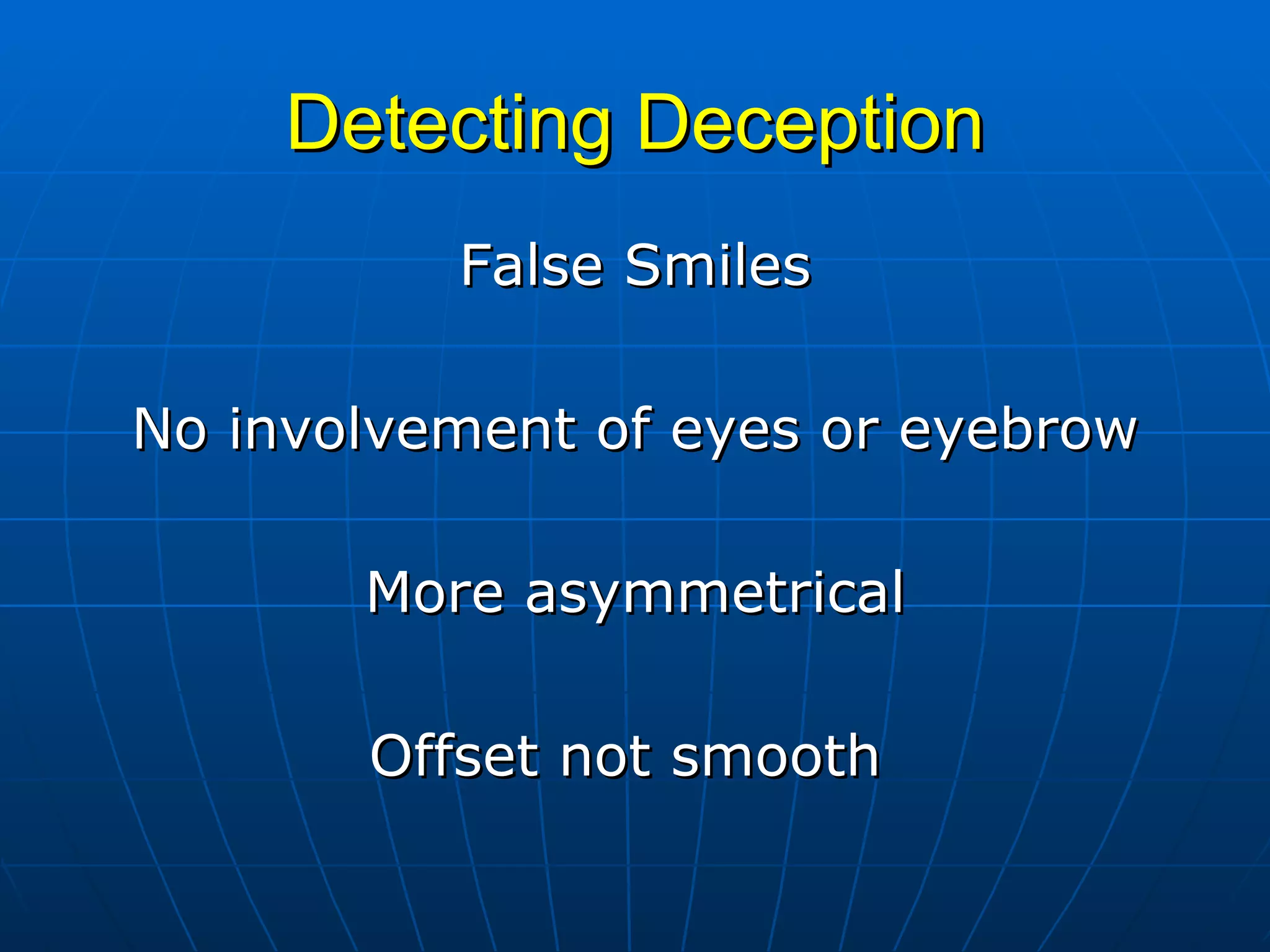
Detecting Deception False Smiles No involvement of eyes or eyebrow More asymmetrical Offset not smooth
Channels of Communication Face Words Voice Characteristics Body Language
Nurse Study Least Accurate Face Words
Nurse Study: Most Accurate Body Correct 65% of time
Nurse Study 96% accuracy Voice Characteristics: Rise in Pitch Face: Miserable Smiles
Facial Action Coding System (FACS) 44 Action Units 30 Contraction of Specific Muscles E.g.., Frontalis, pars medialis Inner Corner of Eyebrow Raised 13 Unspecified E.g.., Jaw Thrust 7000 Combinations Observed
Comprehensive Coding Systems for Emotional Recognition 10 Hours of Coding Time Per Minute of Behavior (Ekman, 1992)
Computerized Analysis of Facial Expressions 96.7% Accurate (Tian et al.,2000)
Pitt- CMU Au-Coded Face Expression Database N = 210 69% Female; 31% Male 81% Euro-Americans 13% Afro-American 6% Other Age 18 to 50 (Kanade et al., 2000)

4 deception new

  • 1.
  • 2.
  • 3.
    “ Man wasgiven a tongue with which to speak and words to hide his thoughts.” (Hungarian Proverb)
  • 4.
    Number of collegestudents who admitted lying to a potential sex partner 92% (Knox et al., 1993)
  • 5.
    Type of SexualLies Most frequent lie both sexes? Number of previous sex partners Men I love you Women Sexually gratified
  • 6.
    Extramarital Affairs Americanand British married persons 2/3 to ¾
  • 7.
    Obtaining Jobs Numberwho “varnish the truth” 1/3 (Underwood, 1993)
  • 8.
    Obtaining Jobs: Typesof Lies College degrees Stretching employment periods to hide unemployment Men Played on college football team Women President of sorority
  • 9.
    Advertising “ We’reconceived, born, and deceived. By the time someone reaches the age of 10, he’s pretty cynical.” (Jerry Della Femina, advertising executive quoted in McLoughlin et al., 1987, p. 59)
  • 10.
    Political Lies Liesto get elected Lies to gain support for policy Lies to protect national security Stupid lies
  • 11.
    Medical Students Howmany cheated on exams? 10%
  • 12.
    Patients Number ofpsychiatrically hospitalized patients who lied about using drugs? 60% (Blumberg et al., 1971)
  • 13.
    Dodgy Scientists IsaacNewton fudged data Louis Pasteur used another’s vaccine Gregor Mendel fudged data Charles Darwin used others’ theories without credit Robert Millikan only used data that supported his theories Cyril Burt fudged data
  • 14.
    Question is notdo they lie But Why? How much? How well?
  • 15.
    Sex Offenders: ConMen or Liars?
  • 16.
    Liars & ConMen Liars Specific lie(s) Con Man Lies Persona Relationship
  • 17.
    Ferdinand Demara Posedas Physician in Royal Canadian Navy Removed a bullet within half an inch of the heart Removed a lung
  • 18.
    Ferdinand Demara Posedas Teacher Ph.D. in psychology College dean Assistant warden of a Texas prison Joined and deserted from US army & navy
  • 19.
    “ I ama superior sort of liar. I don’t tell any truth at all, so then my story has unity of parts, a structural integrity, and this sounds more like the truth than the truth itself.” (Con man Ferdinand Demara quoted in Crichton, 1968, p. 92)
  • 20.
  • 21.
    Good and BadLie Detectors Good Lie Detectors More likely to use nonverbal alone or in relation to speech Good at reading micro-expressions Bad Lie Detectors Used speech alone (Ekman & O’Sullivan, 1991)
  • 22.
    Sex Differences WomenBetter at reading nonverbal clues Better at telling how people are feeling who are telling the truth No better at detecting deception (DePaulo et al., 1993)
  • 23.
    Good Liars PracticedLiars Natural Liars Psychopaths
  • 24.
    Detection Apprehension HighStakes Up Suspicious Target Low Stakes Gullible Target Down
  • 25.
    Detection Apprehension GreatestTarget reputation for being touch to fool Target suspicious Liar little practice and no record of success Stakes high Punishment, not just reward, at stake Punishment is great Target in no way benefits from lie (Ekman, 2009)
  • 26.
    “ A statementshould not whisper deceit; it should shout it.” Avinoam Sapir “ A lie catcher should never rely upon one clue to deceit; there must be many.” (Ekman, 2009, p. 147)
  • 27.
    Common Error inDetecting Lying Othello error – misinterpreting emotion
  • 28.
    What Detects Lying?Gaze Aversion? Fidgeting?
  • 29.
    Fidgeting Viewed asa sign lying
  • 30.
    Gaze Aversion SadnessNervousness Embarrassment Guilt Disgust
  • 31.
    Gaze Aversion “Even the guilty liar probably won’t avert his gaze much, since liars know that everyone expects to be able to detect deception in this way. . . Amazingly, people continue to be misled by liars skillful enough to not avert their gaze.”   (Ekman, 1992, p. 141)
  • 32.
    “ At timesthere was a great amount of shame for being deceitful. At times there was a great amount of pride: well, I pulled this one off again. You’re a good one. You’re very capable of doing this. It works for you. There were times when little old ladies would pat me on the back and say, ‘You’re one of the best young men that I ever have known.’ I would think back and think, ‘If you really knew me you wouldn’t say that.’”
  • 33.
    “ To beginwith, how I felt about fooling people is what’s really hard to describe. I felt ashamed. For lack of a better word to describe it. Because I knew these people were trusting me. . . When I would lie to them, to start with I felt a lot of shame. But eventually, I had lied so much to, the shame element was no longer there. It was just a matter of keeping my tail covered. Keeping everything covered up.”
  • 34.
    Psychopaths “ Thereis agreement that neither guilt about lying nor fear of being caught will cause a psychopath to make mistakes when he lies.” (Ekman, 2009)
  • 35.
    Feelings of PsychopathsWhen Lying Excitement Relief at being believed Contempt Pride
  • 36.
    20 Years ofResearch on Lying People rarely get above 60% accuracy Some groups worse than chance (Ekman, 1992)
  • 37.
    Who Can’t TellCIA FBI ATF Police DEA Forensic psychiatrists Custom Officials Police Judges Lawyers (Ekman, 1991)
  • 38.
    Who Can’t Tell?Customs inspectors vs. college students) (Kraut & Poe, 1980) Federal law enforcement officers vs students (DePaulo & Pfeifer, 1986) Police officers no better than chance (Kohnken, 1987)
  • 39.
    Who Can’t TellGroup % Above Chance Secret Service 29% Psychiatrists 12% (Ekman, 1991)
  • 40.
    Top Lie DetectorsVery few 85% accuracy (Ekman, 2009)
  • 41.
    Federal law enforcementofficers More Confident Than College Students No More Accurate (DePaulo & Pfeifer, 1986)
  • 42.
    Accuracy What Didn’tMake a Difference Age Sex Years of Job Experience (Ekman, 1991)
  • 43.
    Accuracy Polygraphers & Secret Service Worse as Got Older (Ekman, 1991)
  • 44.
    Which Signs ofDeception Work? Signs the liar doesn’t know to fake Signs the liar can’t fake
  • 45.
    What Are YouDetecting? Deception? Emotional leakage?
  • 46.
    “ There isno sign of deceit itself.” (Ekman, 2009,p. 80)
  • 47.
    Emotions Involved inLying Fear of being caught Guilt about lying Guilt about behavior Duping delight
  • 48.
    Fear Fear ofnot being believed Fear of being caught
  • 49.
    Channels of CommunicationFace Words Voice Characteristics Body Language
  • 50.
  • 51.
    Automatic Expressions SadnessInner corner of eyebrow raises, not full brow 15% voluntarily (Ekman, 1992)
  • 52.
    Automatic Expressions Worry,Apprehension, Fear Both eyebrows raise and pull together 10% voluntarily (Ekman, 1992)
  • 53.
    Emotions and TheirEyebrow/Eyelid Fakeability Hard Fear, worry, apprehension, terror Sadness, grief, distress Easy Anger, surprise
  • 54.
    Most Reliable FacialMuscles Forehead
  • 55.
    Anger Reliable: Narrowing of lips
  • 56.
  • 57.
    Micro Expression TrainingTool http://www.mettonline.com/products.aspx
  • 58.
  • 59.
  • 60.
    Asymmetry Voluntary ExpressionsBrow-lowering in anger stronger on left Nose-wrinkling in disgust stronger on right Stretching of lips back towards ears in fear are stronger on right
  • 61.
  • 62.
    Which Emotion isShortest? Surprise 1 second
  • 63.
    Duration of Emotion5 seconds Likely Phony 10 seconds Almost Definitely
  • 64.
    Bad Timing Affectshould be on face Before or at start of words
  • 65.
    Detecting Deception Morespeech hesitations More changes in pitch More pupil dilation (DePaulo et al., 1985; Zucker & Driver, 1984)
  • 66.
    Emblems Wave goodbyeThumbs up Thumbs down Come here Hitchhiking Peace Crazy (circle ear) Praying Sleeping Middle finger
  • 67.
    Sex Offenders andVictims: Current Trends Anna C. Salter, Ph.D.
  • 68.
    Agenda Deception StatementAnalysis Child Pornography Treatment Empirically Supported Components Relapse Preventions vs Good Lives Interviewing Children Suggestibility
  • 69.
  • 70.
    Voice Characteristics UpsetPitch Rises Sad Pitch Drops Angry Louder/faster
  • 71.
    Detecting Deception FalseSmiles No involvement of eyes or eyebrow More asymmetrical Offset not smooth
  • 72.
    Channels of CommunicationFace Words Voice Characteristics Body Language
  • 73.
    Nurse Study LeastAccurate Face Words
  • 74.
    Nurse Study: MostAccurate Body Correct 65% of time
  • 75.
    Nurse Study 96%accuracy Voice Characteristics: Rise in Pitch Face: Miserable Smiles
  • 76.
    Facial Action CodingSystem (FACS) 44 Action Units 30 Contraction of Specific Muscles E.g.., Frontalis, pars medialis Inner Corner of Eyebrow Raised 13 Unspecified E.g.., Jaw Thrust 7000 Combinations Observed
  • 77.
    Comprehensive Coding Systemsfor Emotional Recognition 10 Hours of Coding Time Per Minute of Behavior (Ekman, 1992)
  • 78.
    Computerized Analysis ofFacial Expressions 96.7% Accurate (Tian et al.,2000)
  • 79.
    Pitt- CMU Au-CodedFace Expression Database N = 210 69% Female; 31% Male 81% Euro-Americans 13% Afro-American 6% Other Age 18 to 50 (Kanade et al., 2000)