THORACIC AND
LUMBAR SPINE
Ballesteros, Victoria Nina
Mercado, Shannen Alyssa Marie
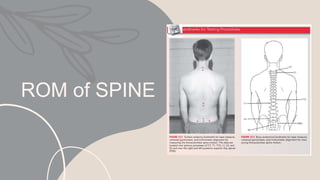
ROM of SPINE
• End Feel: FIRM
• Mark the spinous processes of the C7
and S2 vertebrae using a skin marking
pencil, with the subject in the standing
position. The chosen to use the spinous
process of S2 for a landmark as it is
easier identify than the spinous process of
S1, and there is no motion between S1
and S2.
• Align the tape measure between the two
spinous processes and record the
distance at the starting of the ROM.
• Hold the tape measure in place as the
subject performs flexion ROM.
• Record the distance at the end of the
ROM. The difference between the first
and the second measurements indicates
the amount of thoracolumbar flexion
ROM.
20XX 3
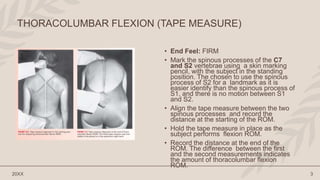
THORACOLUMBAR FLEXION (TAPE MEASURE)
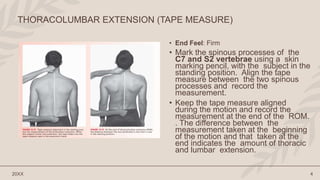
• End Feel: Firm
• Mark the spinous processes of the
C7 and S2 vertebrae using a skin
marking pencil, with the subject in the
standing position. Align the tape
measure between the two spinous
processes and record the
measurement.
• Keep the tape measure aligned
during the motion and record the
measurement at the end of the ROM.
. The difference between the
measurement taken at the beginning
of the motion and that taken at the
end indicates the amount of thoracic
and lumbar extension.
20XX 4
THORACOLUMBAR EXTENSION (TAPE MEASURE)
• NORMAL ROM: 0-35 degrees
• Fitzgerald and associates found that normal values
ranged from a mean of 37.6 degrees (in a group of
20 to 29 year olds) to 18.0 degrees (in a group of 70
to 79 year olds)
• Normal End-Feel: FIRM
• Procedure:
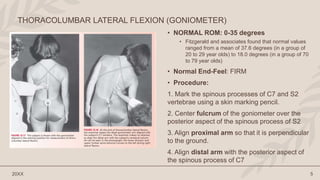
1. Mark the spinous processes of C7 and S2
vertebrae using a skin marking pencil.
2. Center fulcrum of the goniometer over the
posterior aspect of the spinous process of S2
3. Align proximal arm so that it is perpendicular
to the ground.
4. Align distal arm with the posterior aspect of
the spinous process of C7
20XX 5
THORACOLUMBAR LATERAL FLEXION (GONIOMETER)
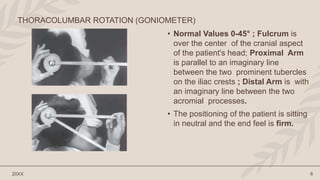
• Normal Values 0-45° ; Fulcrum is
over the center of the cranial aspect
of the patient's head; Proximal Arm
is parallel to an imaginary line
between the two prominent tubercles
on the iliac crests ; Distal Arm is with
an imaginary line between the two
acromial processes.
• The positioning of the patient is sitting
in neutral and the end feel is firm.
20XX 6
THORACOLUMBAR ROTATION (GONIOMETER)
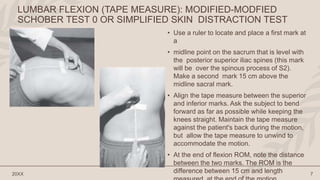
• Use a ruler to locate and place a first mark at
a
• midline point on the sacrum that is level with
the posterior superior iliac spines (this mark
will be over the spinous process of S2).
Make a second mark 15 cm above the
midline sacral mark.
• Align the tape measure between the superior
and inferior marks. Ask the subject to bend
forward as far as possible while keeping the
knees straight. Maintain the tape measure
against the patient's back during the motion,
but allow the tape measure to unwind to
accommodate the motion.
• At the end of flexion ROM, note the distance
between the two marks. The ROM is the
difference between 15 cm and length
20XX 7
LUMBAR FLEXION (TAPE MEASURE): MODIFIED-MODFIED
SCHOBER TEST 0 OR SIMPLIFIED SKIN DISTRACTION TEST
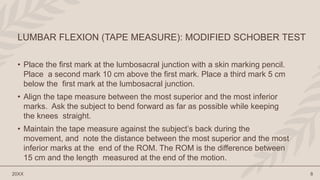
• Place the first mark at the lumbosacral junction with a skin marking pencil.
Place a second mark 10 cm above the first mark. Place a third mark 5 cm
below the first mark at the lumbosacral junction.
• Align the tape measure between the most superior and the most inferior
marks. Ask the subject to bend forward as far as possible while keeping
the knees straight.
• Maintain the tape measure against the subject’s back during the
movement, and note the distance between the most superior and the most
inferior marks at the end of the ROM. The ROM is the difference between
15 cm and the length measured at the end of the motion.
20XX 8
LUMBAR FLEXION (TAPE MEASURE): MODIFIED SCHOBER TEST
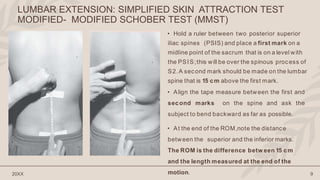
• Hold a ruler between two posterior superior
iliac spines (PSIS) and place a first mark on a
midline point of the sacrum that is on a level with
the PSIS;this will be over the spinous process of
S2.A second mark should be made on the lumbar
spine that is 15 cm above the first mark.
• Align the tape measure between the first and
second marks on the spine and ask the
subject to bend backward as far as possible.
• At the end of the ROM,note the distance
between the superior and the inferior marks.
The ROM is the difference betw een 15 cm
and the length measured at the end of the
motion.
20XX 9
LUMBAR EXTENSION: SIMPLIFIED SKIN ATTRACTION TEST
MODIFIED- MODIFIED SCHOBER TEST (MMST)
• Use a skin-marking pencil to place a first mark at the lumbosacral junction.
Place a second mark 10 cm above the first mark. Place a third mark 5 cm
below the first mark (lumbosacral junction).
• Align the tape measure between the most superior and the most inferior
marks.
• Ask the subject to put the hands on the buttocks and to bend backward as
far as possible.
• Note the distance between the most superior and the most inferior marks
at the end of the ROM, and subtract the final measurement from the initial
15 cm. The ROM is the difference between 15 cm and the length
measured at the end of the motion
20XX 10
LUMBAR EXTENSION: MODIFIED SCHOBER TEST
References:
Norkin, Cynthia C. (1995). Measurement
of joint motion : a guide to goniometry.
Philadelphia :F.A. Davis.

The Thoracolumbar Spine.pptx

  • 1.
    THORACIC AND LUMBAR SPINE Ballesteros,Victoria Nina Mercado, Shannen Alyssa Marie
  • 2.
  • 3.
    • End Feel:FIRM • Mark the spinous processes of the C7 and S2 vertebrae using a skin marking pencil, with the subject in the standing position. The chosen to use the spinous process of S2 for a landmark as it is easier identify than the spinous process of S1, and there is no motion between S1 and S2. • Align the tape measure between the two spinous processes and record the distance at the starting of the ROM. • Hold the tape measure in place as the subject performs flexion ROM. • Record the distance at the end of the ROM. The difference between the first and the second measurements indicates the amount of thoracolumbar flexion ROM. 20XX 3 THORACOLUMBAR FLEXION (TAPE MEASURE)
  • 4.
    • End Feel:Firm • Mark the spinous processes of the C7 and S2 vertebrae using a skin marking pencil, with the subject in the standing position. Align the tape measure between the two spinous processes and record the measurement. • Keep the tape measure aligned during the motion and record the measurement at the end of the ROM. . The difference between the measurement taken at the beginning of the motion and that taken at the end indicates the amount of thoracic and lumbar extension. 20XX 4 THORACOLUMBAR EXTENSION (TAPE MEASURE)
  • 5.
    • NORMAL ROM:0-35 degrees • Fitzgerald and associates found that normal values ranged from a mean of 37.6 degrees (in a group of 20 to 29 year olds) to 18.0 degrees (in a group of 70 to 79 year olds) • Normal End-Feel: FIRM • Procedure: 1. Mark the spinous processes of C7 and S2 vertebrae using a skin marking pencil. 2. Center fulcrum of the goniometer over the posterior aspect of the spinous process of S2 3. Align proximal arm so that it is perpendicular to the ground. 4. Align distal arm with the posterior aspect of the spinous process of C7 20XX 5 THORACOLUMBAR LATERAL FLEXION (GONIOMETER)
  • 6.
    • Normal Values0-45° ; Fulcrum is over the center of the cranial aspect of the patient's head; Proximal Arm is parallel to an imaginary line between the two prominent tubercles on the iliac crests ; Distal Arm is with an imaginary line between the two acromial processes. • The positioning of the patient is sitting in neutral and the end feel is firm. 20XX 6 THORACOLUMBAR ROTATION (GONIOMETER)
  • 7.
    • Use aruler to locate and place a first mark at a • midline point on the sacrum that is level with the posterior superior iliac spines (this mark will be over the spinous process of S2). Make a second mark 15 cm above the midline sacral mark. • Align the tape measure between the superior and inferior marks. Ask the subject to bend forward as far as possible while keeping the knees straight. Maintain the tape measure against the patient's back during the motion, but allow the tape measure to unwind to accommodate the motion. • At the end of flexion ROM, note the distance between the two marks. The ROM is the difference between 15 cm and length 20XX 7 LUMBAR FLEXION (TAPE MEASURE): MODIFIED-MODFIED SCHOBER TEST 0 OR SIMPLIFIED SKIN DISTRACTION TEST
  • 8.
    • Place thefirst mark at the lumbosacral junction with a skin marking pencil. Place a second mark 10 cm above the first mark. Place a third mark 5 cm below the first mark at the lumbosacral junction. • Align the tape measure between the most superior and the most inferior marks. Ask the subject to bend forward as far as possible while keeping the knees straight. • Maintain the tape measure against the subject’s back during the movement, and note the distance between the most superior and the most inferior marks at the end of the ROM. The ROM is the difference between 15 cm and the length measured at the end of the motion. 20XX 8 LUMBAR FLEXION (TAPE MEASURE): MODIFIED SCHOBER TEST
  • 9.
    • Hold aruler between two posterior superior iliac spines (PSIS) and place a first mark on a midline point of the sacrum that is on a level with the PSIS;this will be over the spinous process of S2.A second mark should be made on the lumbar spine that is 15 cm above the first mark. • Align the tape measure between the first and second marks on the spine and ask the subject to bend backward as far as possible. • At the end of the ROM,note the distance between the superior and the inferior marks. The ROM is the difference betw een 15 cm and the length measured at the end of the motion. 20XX 9 LUMBAR EXTENSION: SIMPLIFIED SKIN ATTRACTION TEST MODIFIED- MODIFIED SCHOBER TEST (MMST)
  • 10.
    • Use askin-marking pencil to place a first mark at the lumbosacral junction. Place a second mark 10 cm above the first mark. Place a third mark 5 cm below the first mark (lumbosacral junction). • Align the tape measure between the most superior and the most inferior marks. • Ask the subject to put the hands on the buttocks and to bend backward as far as possible. • Note the distance between the most superior and the most inferior marks at the end of the ROM, and subtract the final measurement from the initial 15 cm. The ROM is the difference between 15 cm and the length measured at the end of the motion 20XX 10 LUMBAR EXTENSION: MODIFIED SCHOBER TEST
  • 11.
    References: Norkin, Cynthia C.(1995). Measurement of joint motion : a guide to goniometry. Philadelphia :F.A. Davis.