THE SOLUTION FOR BIG DATA
NAME:SIVAKOTI TARAKA SATYA PHANINDRA
ROLL NO:15K81D5824
COURSE: CSE M.TECH/SEM-1
CONTENT:
Data – Trends in storing data.
BigData – Problems in IT industry
Why BigData ?
Introduction to HADOOP
HDFS (Hadoop Distributed File System)
 MapReduce
Prominent users of Hadoop.
Conclusion
Data – Trends in storing data
What is data--- Any real world symbol (character, numeric,
special character) or a of group of them is said to be data it
may be of the visual or audio or scriptural , images, etc​.,
File system
Databases
Cloud (internet)
BIG DATA:
What is big data—In IT, it is a collection of data sets so
large and complex data that it becomes difficult to process
using on-hand database management tools or traditional
data processing applications.
 As of 2016, limits on the size of data sets that are
feasible to process in reasonable time were on the order
of Exabyte of data.​(KBs MBs GBs TBs PB
ZB )
BIGDATA and problems with it.
 Daily about 0.8 Petabytes of updates are being made
into FACEBOOK including 50 millions photos.​
 Daily, YOUTUBE is loaded with videos that can be watched for one year
continuously​
 Limitations are encountered due to large data sets in many areas, including
meteorology, genomics, complex physics simulations, and biological and
environmental research.
 Also affect Internet search, finance and business informatics.
 The challenges include in capture, retrieval, storage, search, sharing, analysis,
and visualization.​
Why BIG DATA ?
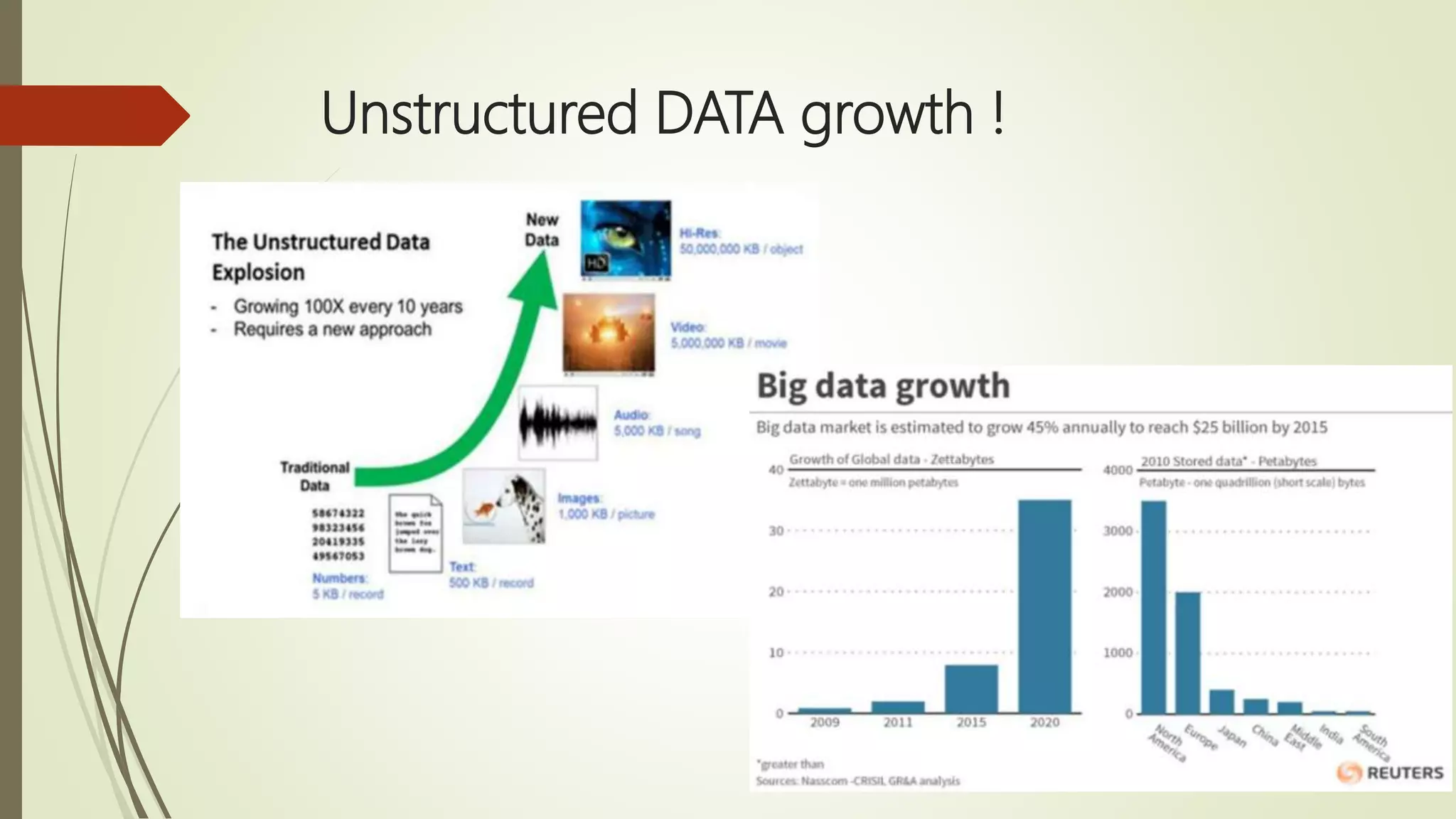
Unstructured DATA growth !
THEN WHAT COULD BE THE SOLUTION
FOR BIGDATA ?
Hadoop’s Developers:
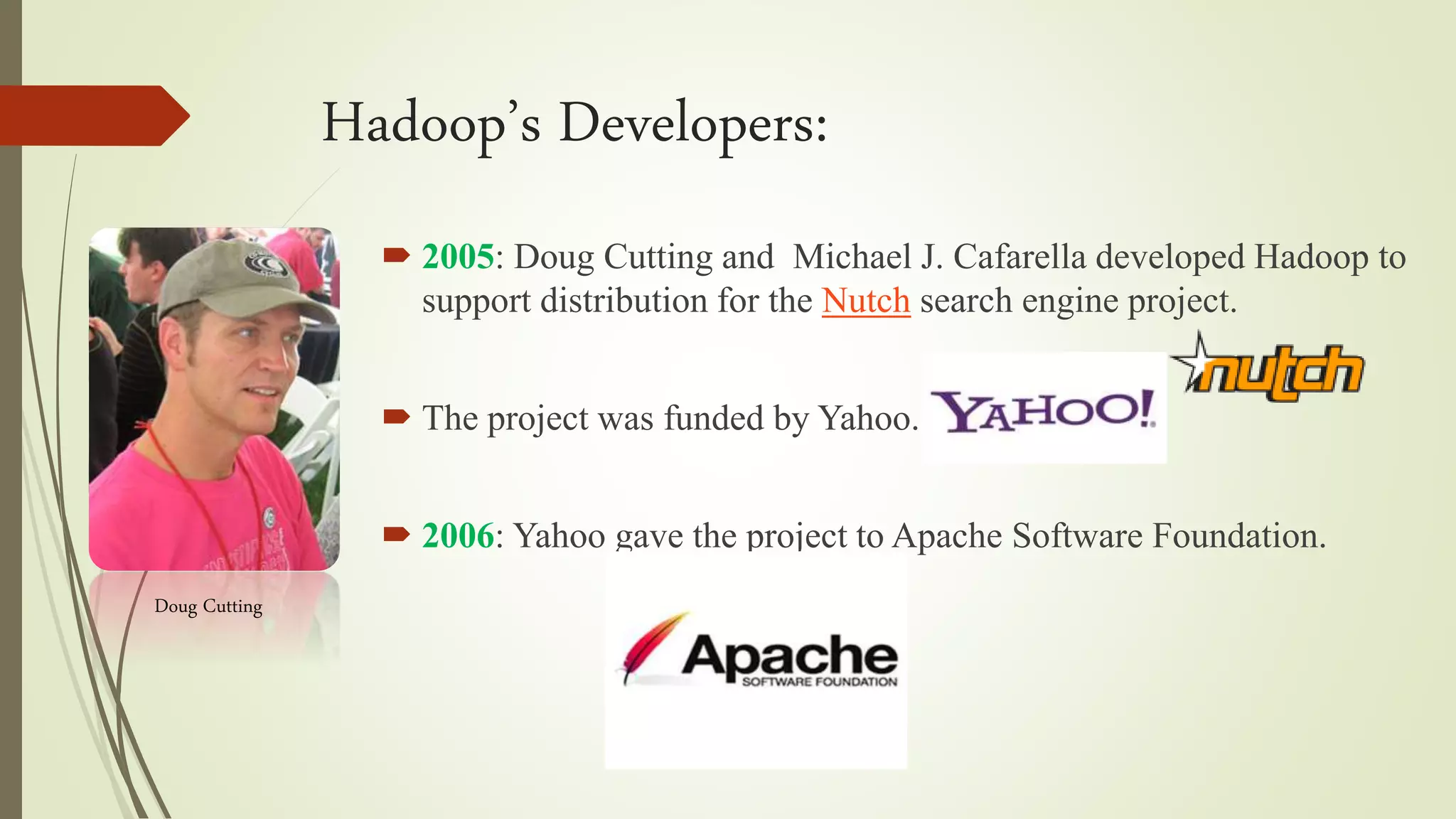
 2005: Doug Cutting and Michael J. Cafarella developed Hadoop to
support distribution for the Nutch search engine project.
 The project was funded by Yahoo.
 2006: Yahoo gave the project to Apache Software Foundation.
Doug Cutting
What is Hadoop?
 It is a open source software written in java
 Hadoop software library is a framework that allows for the
distributed processing of large data sets across clusters of
computers using simple programming models.
 It is designed to scale up from single servers to thousands of
machines, each offering local computation and storage.
• Apache top level project,
open-source
implementation of
frameworks for reliable,
scalable, distributed
computing and data
storage.
• It is a flexible and highly-
available architecture for
large scale computation and
data processing on a
network of commodity
hardware.
The project includes these modules:
Hadoop Common
Hadoop Distributed File System(HDFS)
Hadoop MapReduce
1.Hadoop Commons
 It provides access to the filesystems supported by Hadoop.
 The Hadoop Common package contains the necessary JAR
files and scripts needed to start Hadoop.
 The package also provides source code, documentation,
and a contribution section which includes projects from
the Hadoop Community (Avro, Cassandra, Chukwa, Hbase,
Hive, Mahout, Pig, ZooKeeper)
2. Hadoop Distributed File System
(HDFS):
 Hadoop uses HDFS, a distributed file system based on GFS (Google
File System), as its shared filesystem.
 HDFS architecture divides files into large chunks (~64MB)
distributed across data servers (this is configurable).
 It has a namenode and datanodes
What does a HDFS contain
 HDFS consists of a global namenodes or namespaces and they are
federated.
 The datanodes are used as common storage for blocks by all the
Namenodes.
 Each datanode registers with all the Namenodes in the cluster.
 Datanodes send periodic heartbeats and block reports and handles
commands from the Namenodes
Structure of Hadoop system:
Master Node :
Name Node
Secondary Name Node
Job Tracker
Slaves :
Data Node
Task Tracker
MASTER NODE:
 Master node
 Keeps track of namespace and metadata about items
 Keeps track of MapReduce jobs in the system
 Hadoop currently configured with centurion064 as the master
node
 Hadoop is locally installed in each system.
 Installed location is in /localtmp/hadoop/hadoop-0.15.3
SLAVE NODES:
 Slave nodes
 Manage blocks of data sent from master node
 In common, these are the chunkservers
 Currently centurion060, centurion064 are the two slave nodes being
used.
 Slave nodes store their data in /localtmp/hadoop/hadoop-dfs (this is
automatically created by the DFS)
 Once you use the DFS, relative paths are from /usr/{your usr id}
Advantages and Limitations of HDFS :
 Reduce traffic on job scheduling.
 File access can be achieved through the native Java or
language of the users' choice (C++, Java, Python, PHP, Ruby,
Erlang, Perl, Haskell, C#, Cocoa, Smalltalk, and OCaml),
 It cannot be directly mounted by an existing operating
system.
 It should be provided with UNIX or LUNIX system.
3.Hadoop MAPREDUCE SYSTEM:
 The Hadoop MapReduce framework harnesses a cluster of
machines and executes user defined MapReduce jobs across
the nodes in the cluster.
 A MapReduce computation has two phases
 a map phase and
 a reduce phase.
MAP AND REDUCE METHODS USAGE…
Map function
Reduce function
Run this program as a
MapReduce job
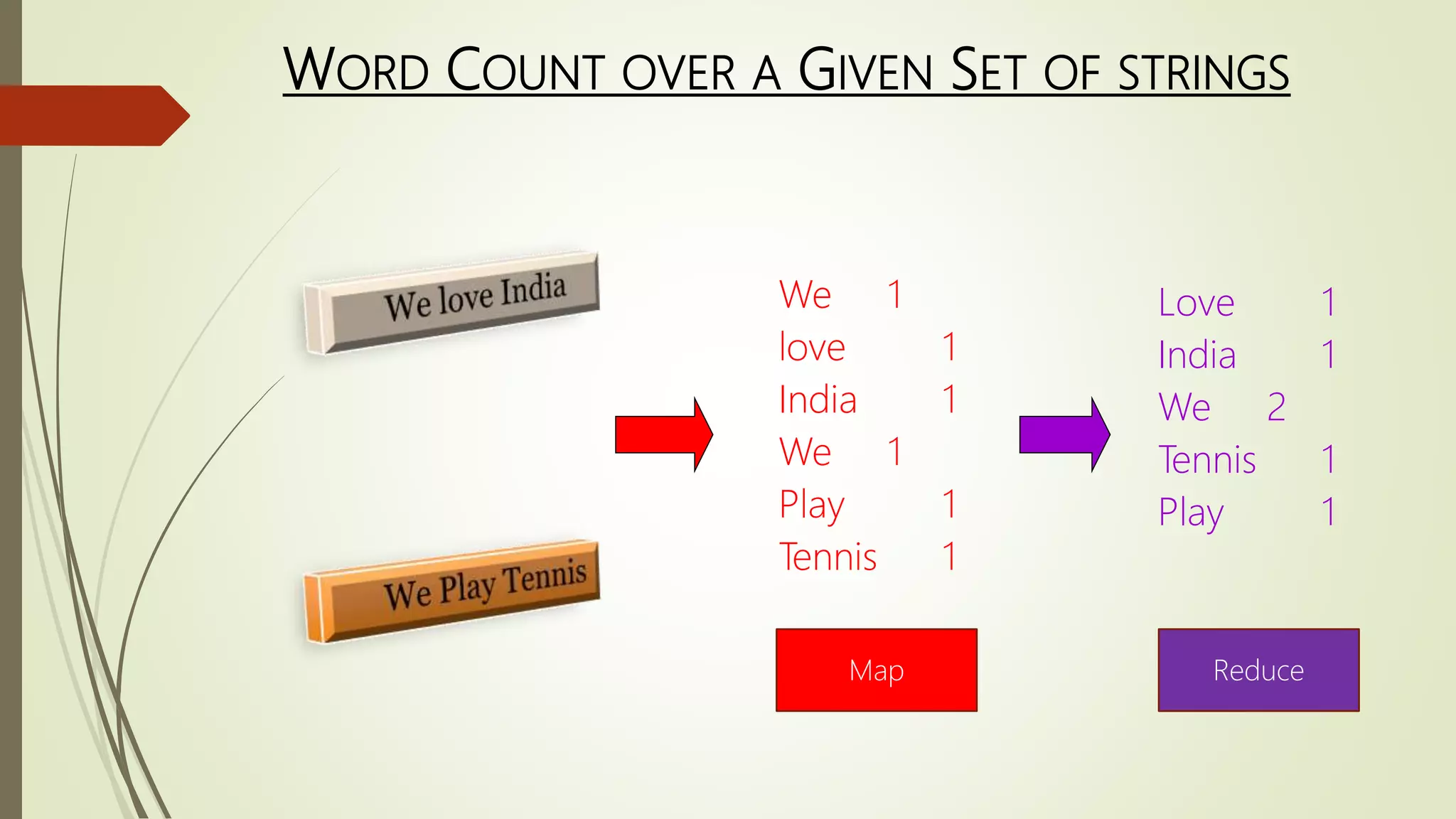
WORD COUNT OVER A GIVEN SET OF STRINGS
We 1
love 1
India 1
We 1
Play 1
Tennis 1
Love 1
India 1
We 2
Tennis 1
Play 1
Map Reduce
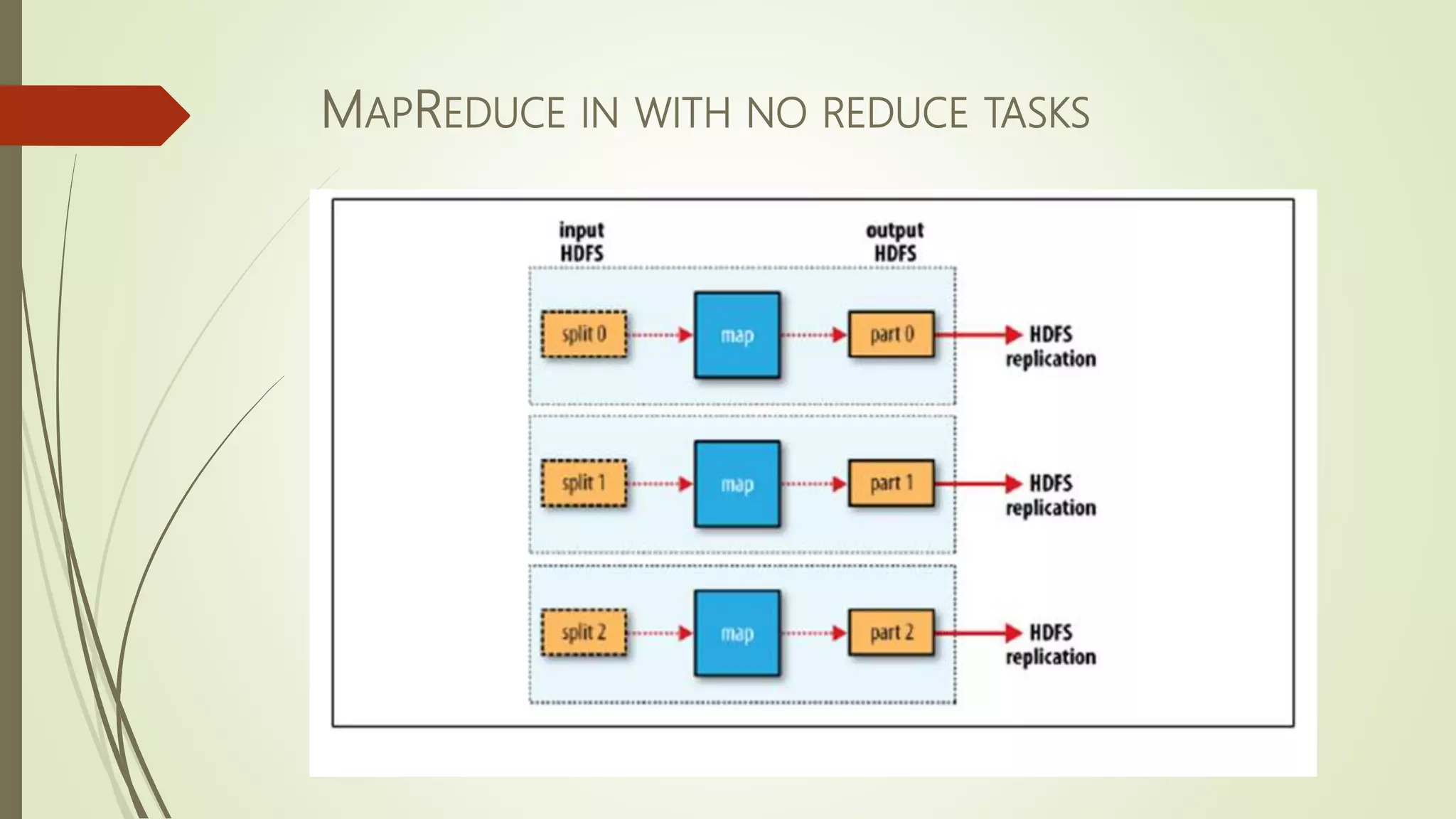
MAPREDUCE IN WITH NO REDUCE TASKS
MAPREDUCE WITH TWO REDUCE TASKS - AUTOMATIC
PARALLEL EXECUTION IN MAPREDUCE
Shuffle and sort in MapReduce with
multiple reduce tasks
Prominent users of HADOOP
 Amazon – 100 nodes
 Facebook – two clusters of 8000 and 3000 nodes
 Adobe – 80 node system
 EBay – 532 node cluster
 yahoo – cluster of about 4500 nodes
 IIIT Hyderabad – 30 node cluster
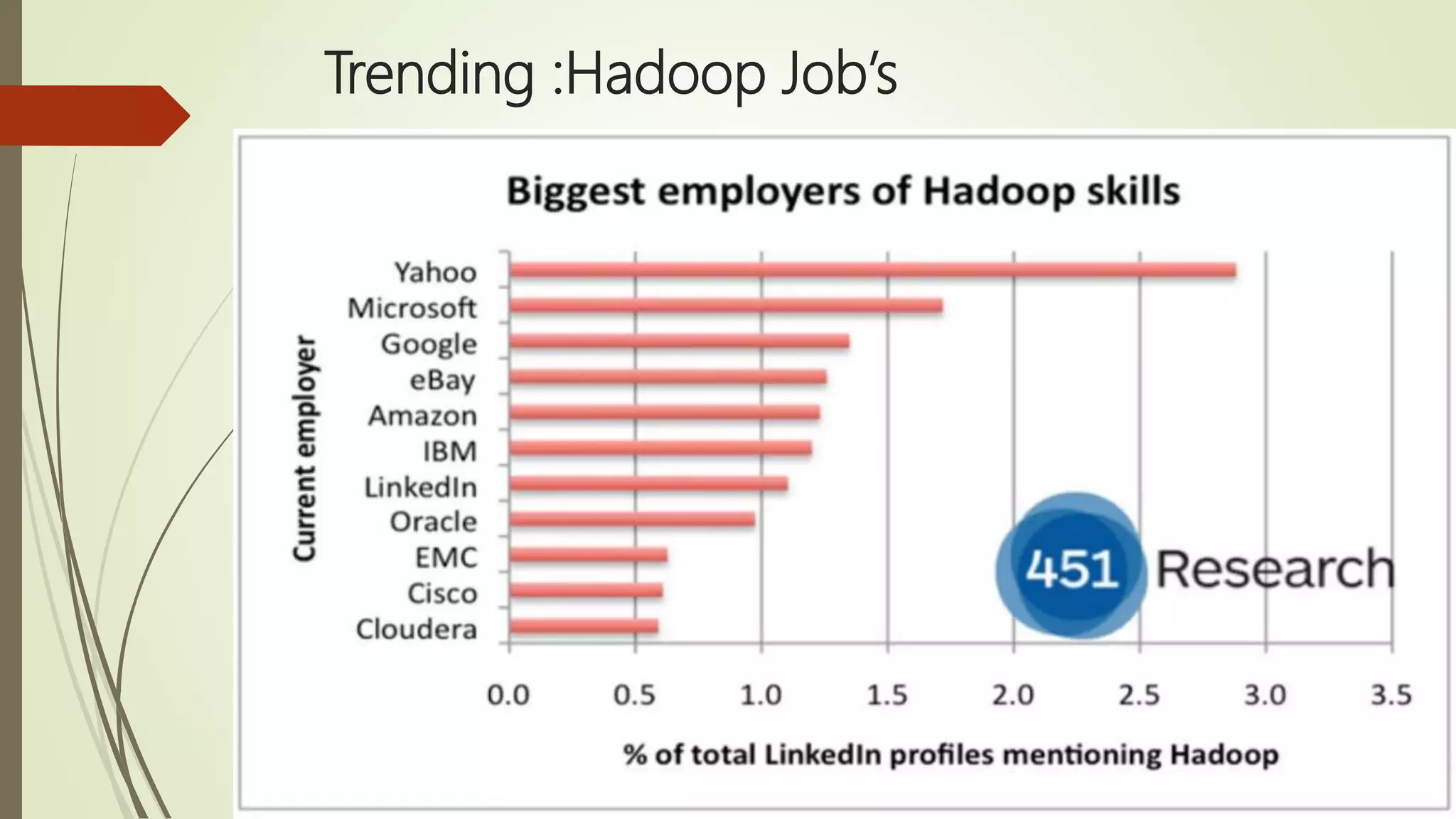
Trending :Hadoop Job’s
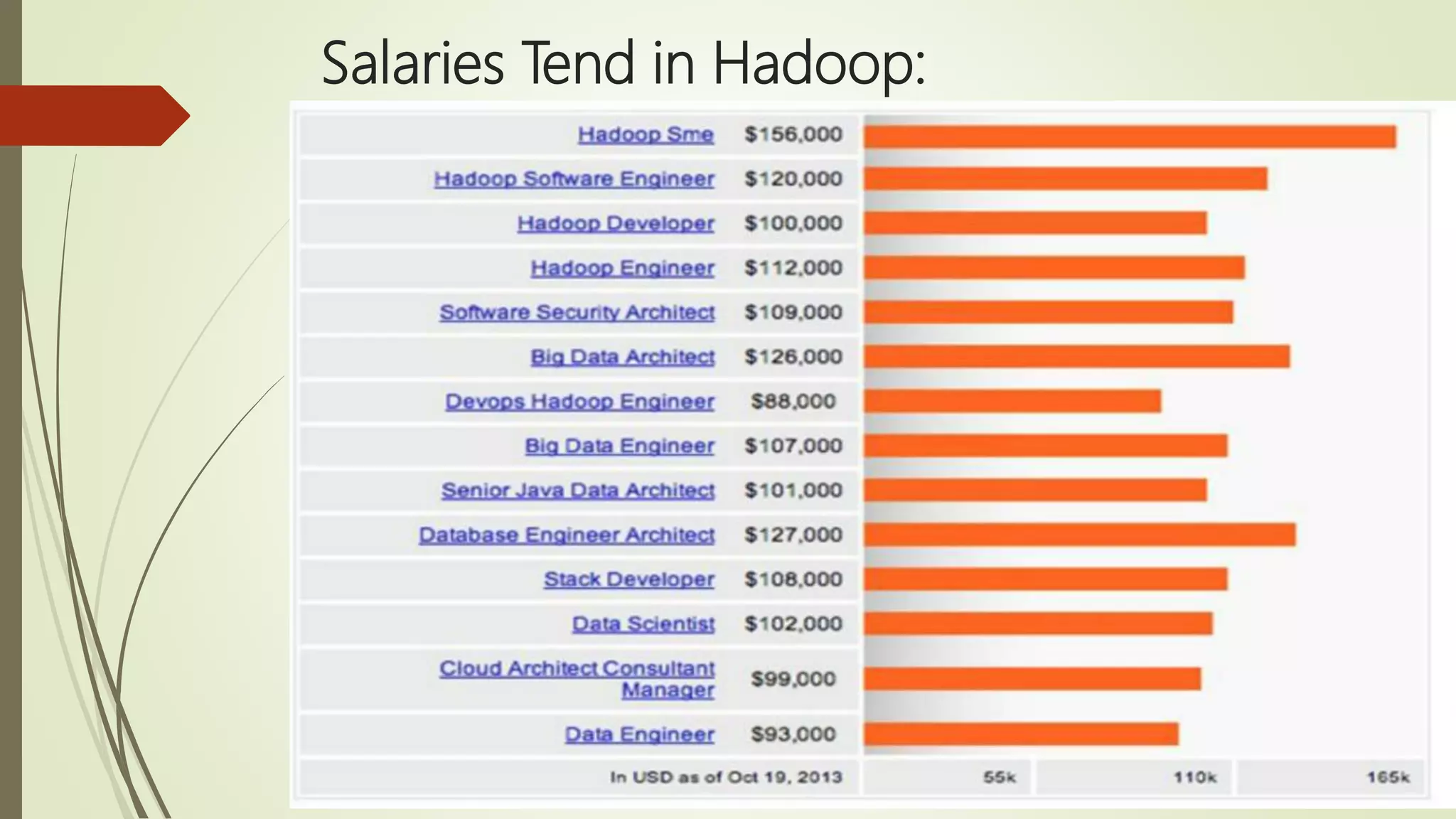
Salaries Tend in Hadoop:
Achievements :
 2008 - Hadoop Wins Terabyte Sort Benchmark (sorted 1 terabyte of data in 209
seconds, compared to previous record of 297 seconds)
 2009 - Avro and Chukwa became new members of Hadoop Framework family
 2010 - Hadoop's Hbase, Hive and Pig subprojects completed, adding more
computational power to Hadoop framework
 2011 - ZooKeeper Completed
 March 2011 - Apache Hadoop takes top prize at Media Guardian Innovation
Award
 2013 - Hadoop 1.1.2 and Hadoop 2.0.3 alpha.
- Ambari, Cassandra, Mahout have been added
Conclusion:
It reduce traffic on capture, storage, search, sharing, analysis, and
visualization.
A huge amount of data could be stored and large computations
could be done in a single compound with full safety and security
at cheap cost.
BIGDATA and BIGDATA-SOLUTIONS is one of the burning issues in
the present IT industry so, work on those will surely make you
more useful to that.
THE SOLUTION FOR BIG DATA

THE SOLUTION FOR BIG DATA

  • 1.
    THE SOLUTION FORBIG DATA NAME:SIVAKOTI TARAKA SATYA PHANINDRA ROLL NO:15K81D5824 COURSE: CSE M.TECH/SEM-1
  • 2.
    CONTENT: Data – Trendsin storing data. BigData – Problems in IT industry Why BigData ? Introduction to HADOOP HDFS (Hadoop Distributed File System)  MapReduce Prominent users of Hadoop. Conclusion
  • 3.
    Data – Trendsin storing data What is data--- Any real world symbol (character, numeric, special character) or a of group of them is said to be data it may be of the visual or audio or scriptural , images, etc​., File system Databases Cloud (internet)
  • 4.
    BIG DATA: What isbig data—In IT, it is a collection of data sets so large and complex data that it becomes difficult to process using on-hand database management tools or traditional data processing applications.  As of 2016, limits on the size of data sets that are feasible to process in reasonable time were on the order of Exabyte of data.​(KBs MBs GBs TBs PB ZB )

  • 6.
    BIGDATA and problemswith it.  Daily about 0.8 Petabytes of updates are being made into FACEBOOK including 50 millions photos.​  Daily, YOUTUBE is loaded with videos that can be watched for one year continuously​  Limitations are encountered due to large data sets in many areas, including meteorology, genomics, complex physics simulations, and biological and environmental research.  Also affect Internet search, finance and business informatics.  The challenges include in capture, retrieval, storage, search, sharing, analysis, and visualization.​
  • 7.
  • 8.
  • 9.
    THEN WHAT COULDBE THE SOLUTION FOR BIGDATA ?
  • 10.
    Hadoop’s Developers:  2005:Doug Cutting and Michael J. Cafarella developed Hadoop to support distribution for the Nutch search engine project.  The project was funded by Yahoo.  2006: Yahoo gave the project to Apache Software Foundation. Doug Cutting
  • 11.
    What is Hadoop? It is a open source software written in java  Hadoop software library is a framework that allows for the distributed processing of large data sets across clusters of computers using simple programming models.  It is designed to scale up from single servers to thousands of machines, each offering local computation and storage.
  • 12.
    • Apache toplevel project, open-source implementation of frameworks for reliable, scalable, distributed computing and data storage. • It is a flexible and highly- available architecture for large scale computation and data processing on a network of commodity hardware.
  • 14.
    The project includesthese modules: Hadoop Common Hadoop Distributed File System(HDFS) Hadoop MapReduce
  • 15.
    1.Hadoop Commons  Itprovides access to the filesystems supported by Hadoop.  The Hadoop Common package contains the necessary JAR files and scripts needed to start Hadoop.  The package also provides source code, documentation, and a contribution section which includes projects from the Hadoop Community (Avro, Cassandra, Chukwa, Hbase, Hive, Mahout, Pig, ZooKeeper)
  • 16.
    2. Hadoop DistributedFile System (HDFS):  Hadoop uses HDFS, a distributed file system based on GFS (Google File System), as its shared filesystem.  HDFS architecture divides files into large chunks (~64MB) distributed across data servers (this is configurable).  It has a namenode and datanodes
  • 17.
    What does aHDFS contain  HDFS consists of a global namenodes or namespaces and they are federated.  The datanodes are used as common storage for blocks by all the Namenodes.  Each datanode registers with all the Namenodes in the cluster.  Datanodes send periodic heartbeats and block reports and handles commands from the Namenodes
  • 18.
    Structure of Hadoopsystem: Master Node : Name Node Secondary Name Node Job Tracker Slaves : Data Node Task Tracker
  • 19.
    MASTER NODE:  Masternode  Keeps track of namespace and metadata about items  Keeps track of MapReduce jobs in the system  Hadoop currently configured with centurion064 as the master node  Hadoop is locally installed in each system.  Installed location is in /localtmp/hadoop/hadoop-0.15.3
  • 20.
    SLAVE NODES:  Slavenodes  Manage blocks of data sent from master node  In common, these are the chunkservers  Currently centurion060, centurion064 are the two slave nodes being used.  Slave nodes store their data in /localtmp/hadoop/hadoop-dfs (this is automatically created by the DFS)  Once you use the DFS, relative paths are from /usr/{your usr id}
  • 22.
    Advantages and Limitationsof HDFS :  Reduce traffic on job scheduling.  File access can be achieved through the native Java or language of the users' choice (C++, Java, Python, PHP, Ruby, Erlang, Perl, Haskell, C#, Cocoa, Smalltalk, and OCaml),  It cannot be directly mounted by an existing operating system.  It should be provided with UNIX or LUNIX system.
  • 23.
    3.Hadoop MAPREDUCE SYSTEM: The Hadoop MapReduce framework harnesses a cluster of machines and executes user defined MapReduce jobs across the nodes in the cluster.  A MapReduce computation has two phases  a map phase and  a reduce phase.
  • 24.
    MAP AND REDUCEMETHODS USAGE… Map function Reduce function Run this program as a MapReduce job
  • 25.
    WORD COUNT OVERA GIVEN SET OF STRINGS We 1 love 1 India 1 We 1 Play 1 Tennis 1 Love 1 India 1 We 2 Tennis 1 Play 1 Map Reduce
  • 26.
    MAPREDUCE IN WITHNO REDUCE TASKS
  • 27.
    MAPREDUCE WITH TWOREDUCE TASKS - AUTOMATIC PARALLEL EXECUTION IN MAPREDUCE
  • 28.
    Shuffle and sortin MapReduce with multiple reduce tasks
  • 32.
    Prominent users ofHADOOP  Amazon – 100 nodes  Facebook – two clusters of 8000 and 3000 nodes  Adobe – 80 node system  EBay – 532 node cluster  yahoo – cluster of about 4500 nodes  IIIT Hyderabad – 30 node cluster
  • 33.
  • 34.
  • 35.
    Achievements :  2008- Hadoop Wins Terabyte Sort Benchmark (sorted 1 terabyte of data in 209 seconds, compared to previous record of 297 seconds)  2009 - Avro and Chukwa became new members of Hadoop Framework family  2010 - Hadoop's Hbase, Hive and Pig subprojects completed, adding more computational power to Hadoop framework  2011 - ZooKeeper Completed  March 2011 - Apache Hadoop takes top prize at Media Guardian Innovation Award  2013 - Hadoop 1.1.2 and Hadoop 2.0.3 alpha. - Ambari, Cassandra, Mahout have been added
  • 36.
    Conclusion: It reduce trafficon capture, storage, search, sharing, analysis, and visualization. A huge amount of data could be stored and large computations could be done in a single compound with full safety and security at cheap cost. BIGDATA and BIGDATA-SOLUTIONS is one of the burning issues in the present IT industry so, work on those will surely make you more useful to that.