Online learning, sometimes referred to as e-learning, is a form of
distance education. Online courses are delivered over the Internet
and can be accessed from a computer with a Web browser (ex.
Internet Explorer).
Online courses can be
 Asynchronous - delivered at your convenience any time or place
 Synchronous - students are online at a specified time
What to Expect
Online courses are ideal for students whose work schedule or
family commitments don't allow them to attend classes on
campus. Distance education can provide you with the opportunity
to meet your educational goals.
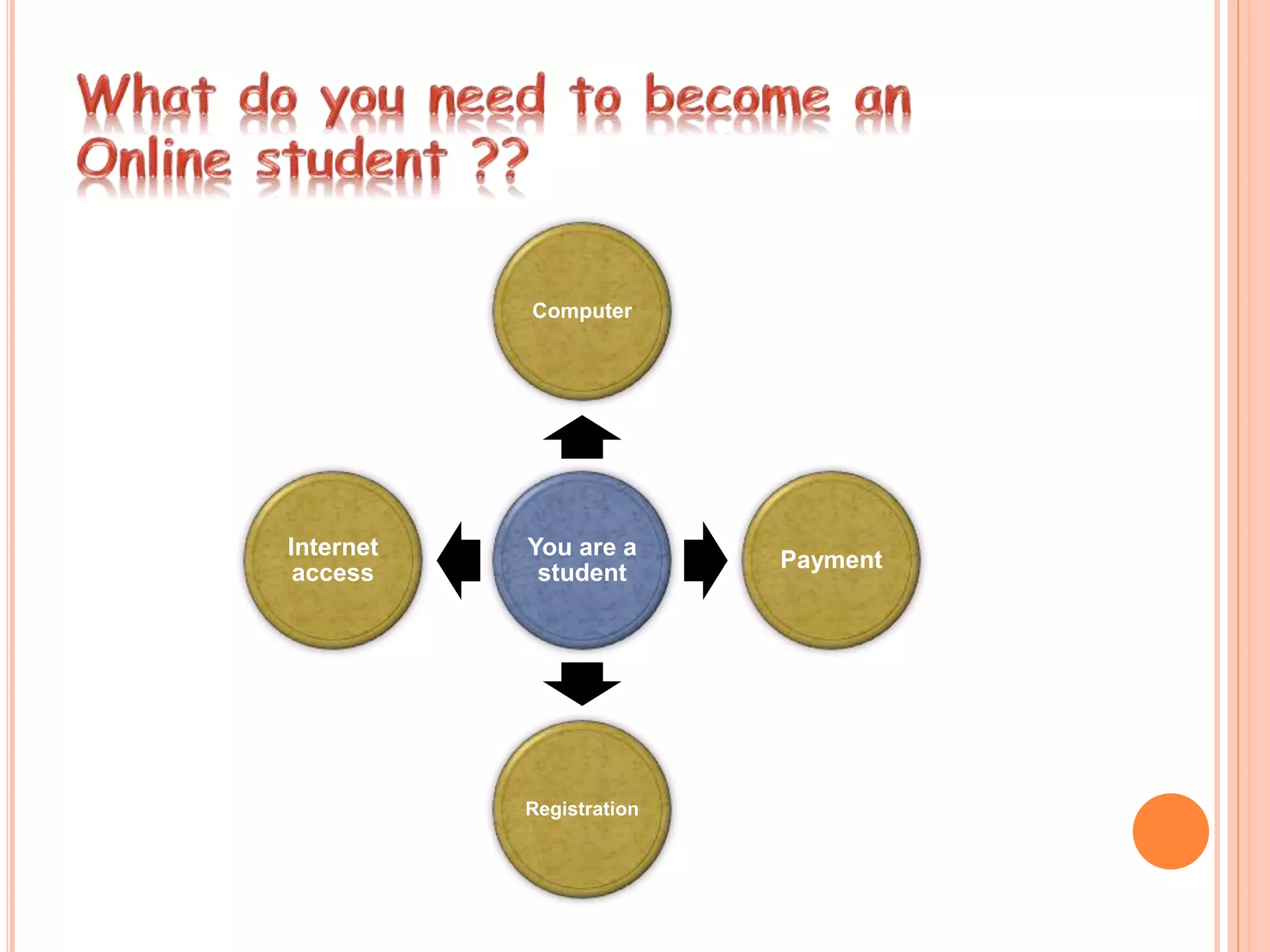
You are a
student
Computer
Payment
Registration
Internet
access
 A 2011 study by the Sloan Consortium found that
6 million students in the US are taking at least
one online course, nearly one third of all those
enrolled in higher education.
 In response, 65% of higher education
institutions now say that online learning is a
critical part of their long-term strategy.
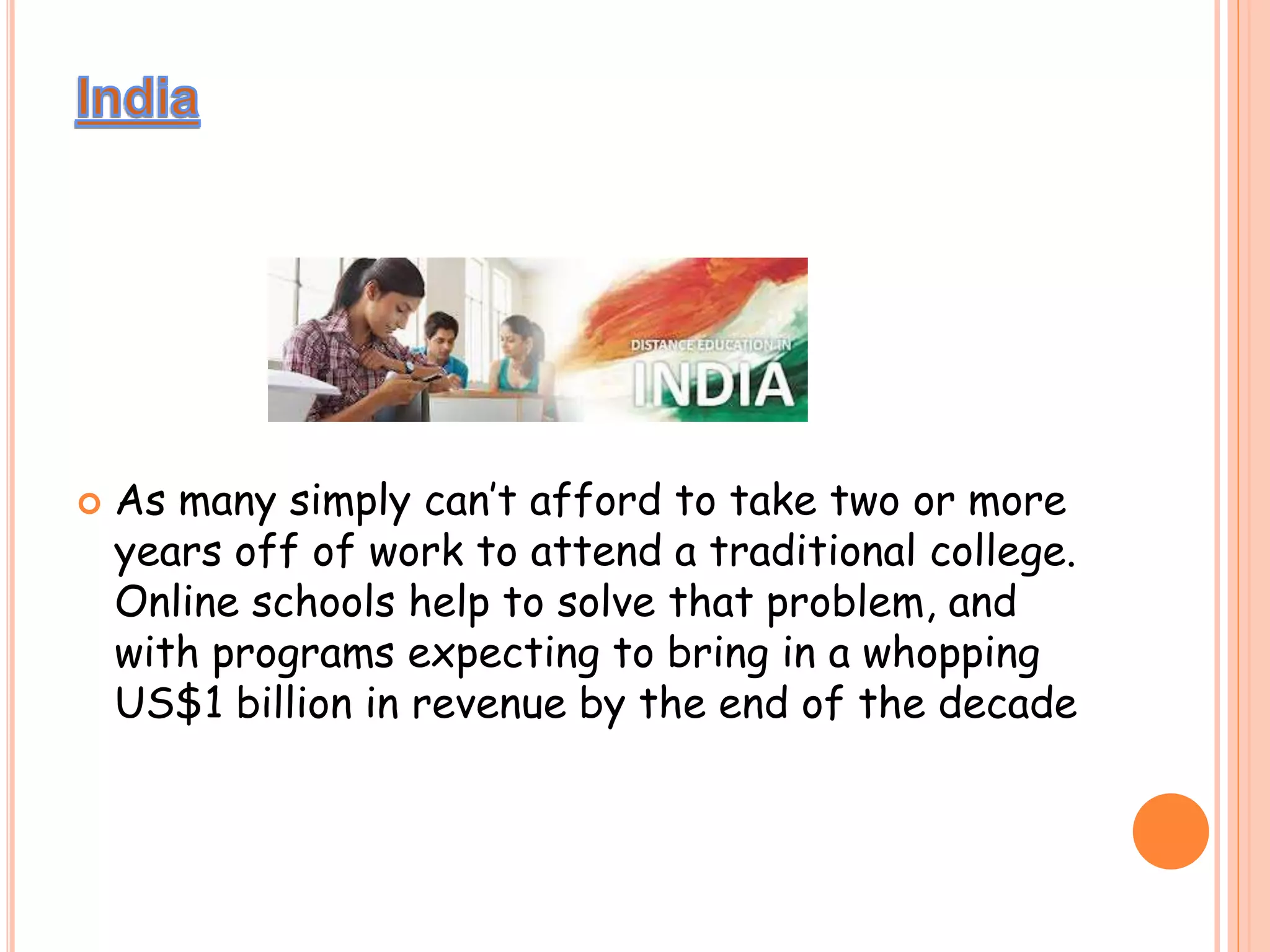
 As many simply can’t afford to take two or more
years off of work to attend a traditional college.
Online schools help to solve that problem, and
with programs expecting to bring in a whopping
US$1 billion in revenue by the end of the decade
 Currently, China is home to almost 70 different
online colleges, a number that will likely grow in
the coming years in order to meet the high
demand for online learning opportunities.
 The online learning industry is expected to grow
by leaps and bounds over the next few years, and
with steady growth since 2006, it’s looking to
meet all expectations.
 the country currently has 17 online colleges, all
of which boast state-of-the-art facilities and
software.
 They’re also working to encourage more Korean
students to enroll, pairing online courses with
non-virtual activities on campus or in social
settings. Time will tell whether or not the
investment pays off for this tech-focused
nation.
 Malaysia may not be the first place that comes
to mind when you think of online education, but
the small Asian nation is forging ahead at full
speed when it comes to opening up new
opportunities for learning online.
 While online education in Malaysia and Asia as a
whole still has a long way to go, it’s clear that
the country is going to be making waves in
distance education for some time to come.
The government’s Online Learning Task Force
recommended an investment of £100 million in
online education in order to help the nation build
its brand, develop better online educational
resources, and become a major international
player in the distance learning market.
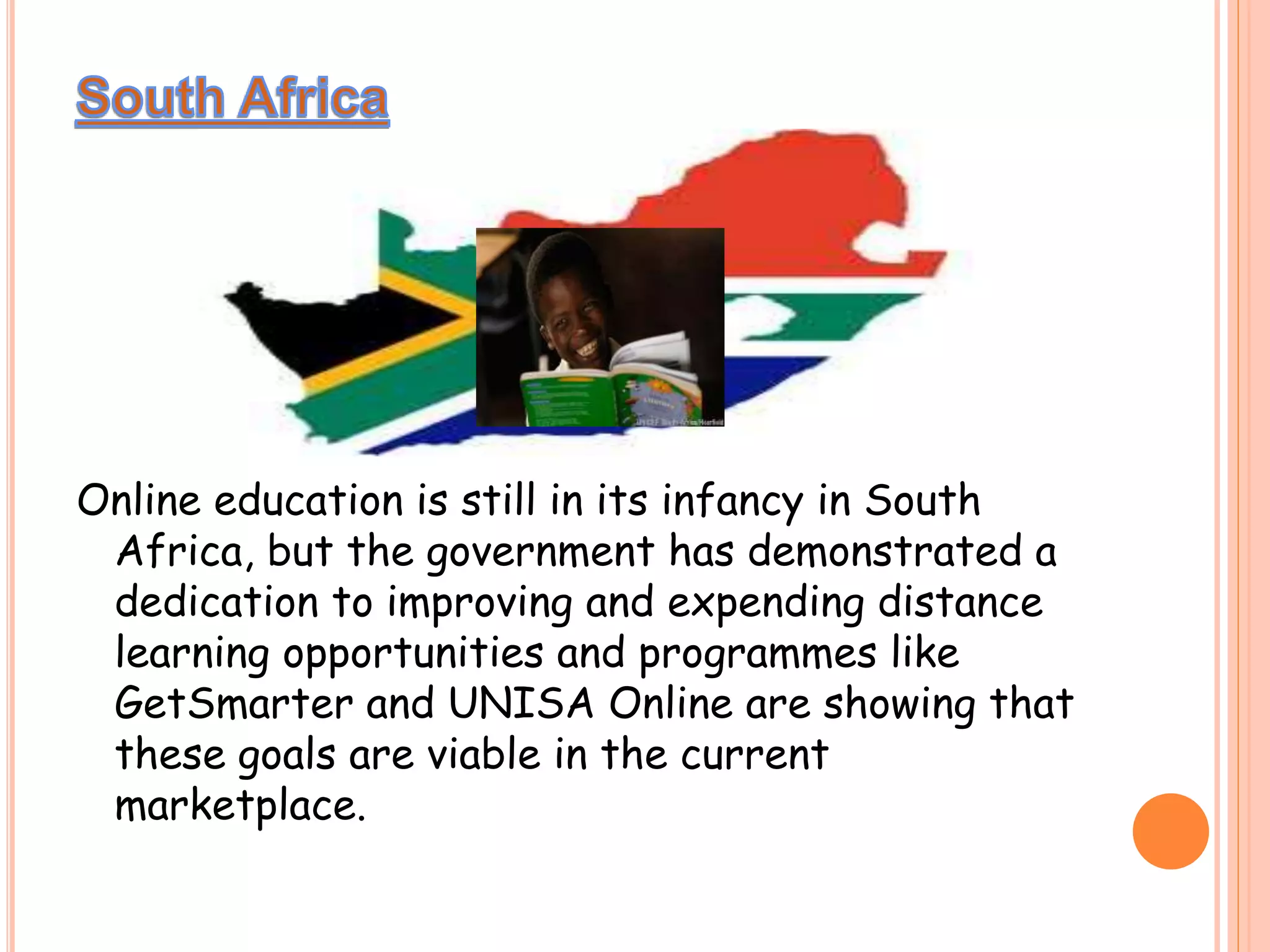
Online education is still in its infancy in South
Africa, but the government has demonstrated a
dedication to improving and expending distance
learning opportunities and programmes like
GetSmarter and UNISA Online are showing that
these goals are viable in the current
marketplace.
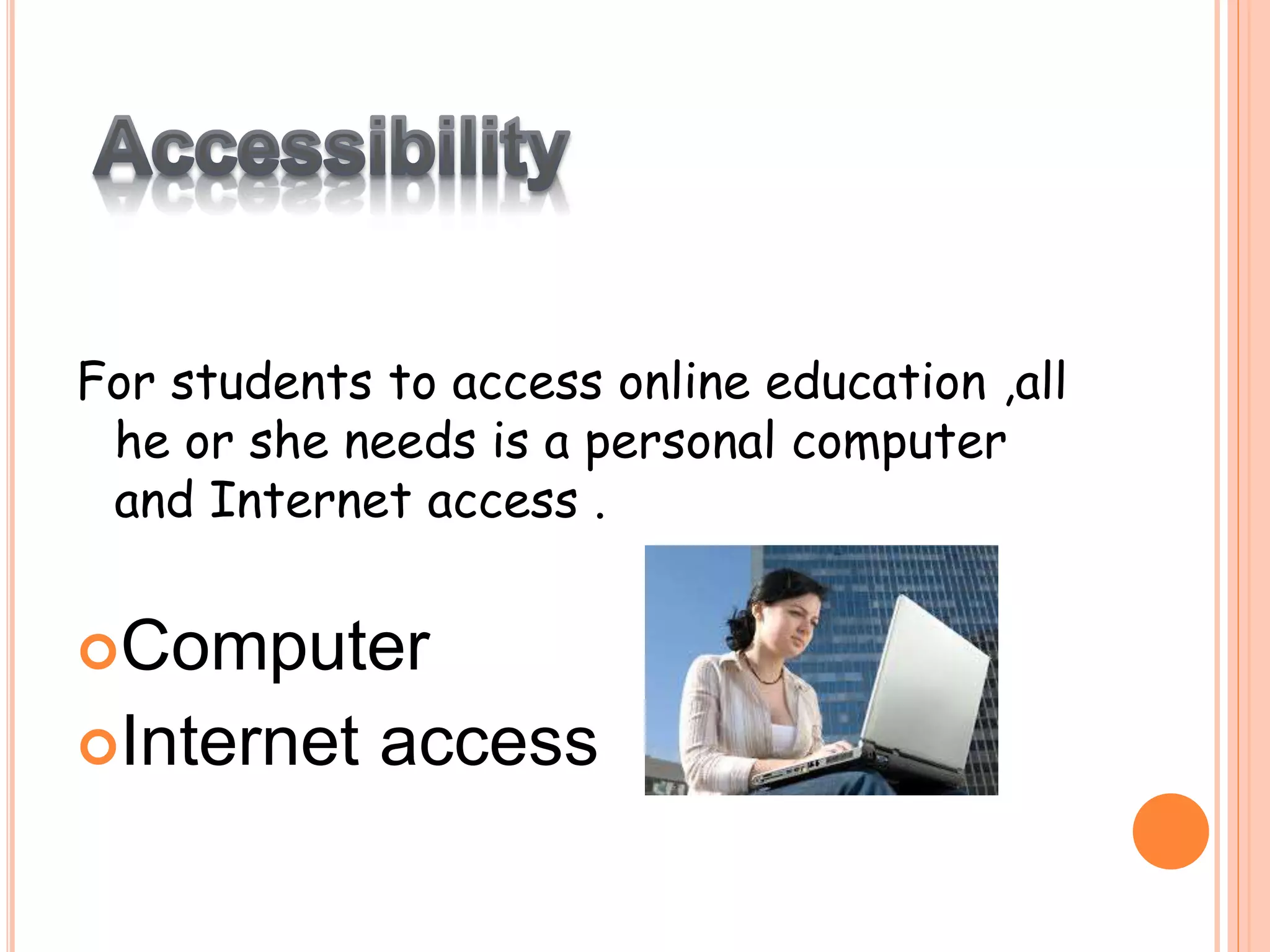
For students to access online education ,all
he or she needs is a personal computer
and Internet access .
Computer
Internet access
You have possibility to maintain a flexible
schedule in order to use your spare time
effectively .
You no longer have to be in any
particular location to take a class .
Come to class in your pyjamas or
as you want !!!
The instructor can easily program
multimedia learning aids into the
courses , including links to relevant
websites .
Some students hate to participate in
live class discussions , for them the
online environment can be less
intimidating .
Not many industries will
acknowledge online professional
degree
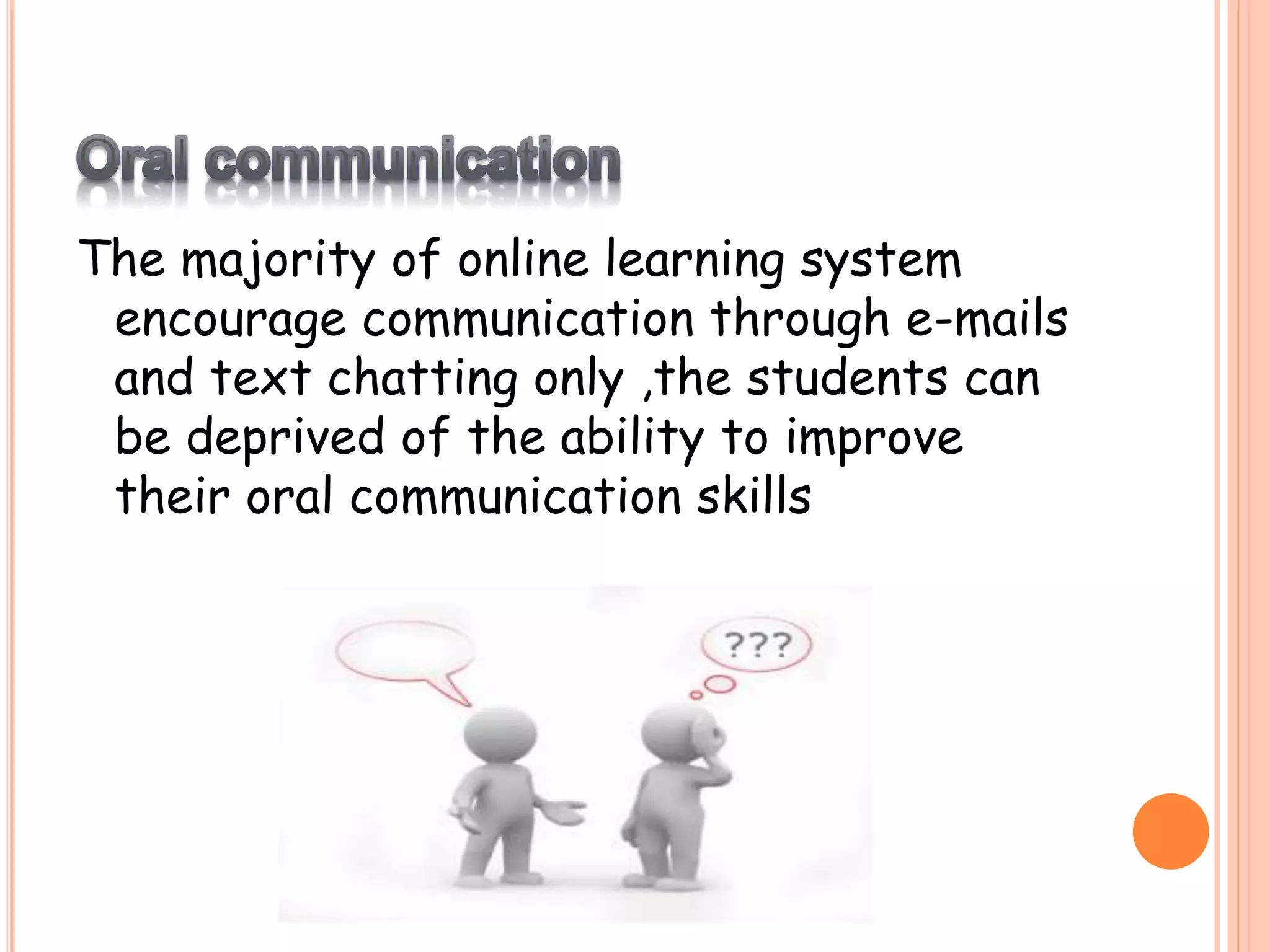
The majority of online learning system
encourage communication through e-mails
and text chatting only ,the students can
be deprived of the ability to improve
their oral communication skills
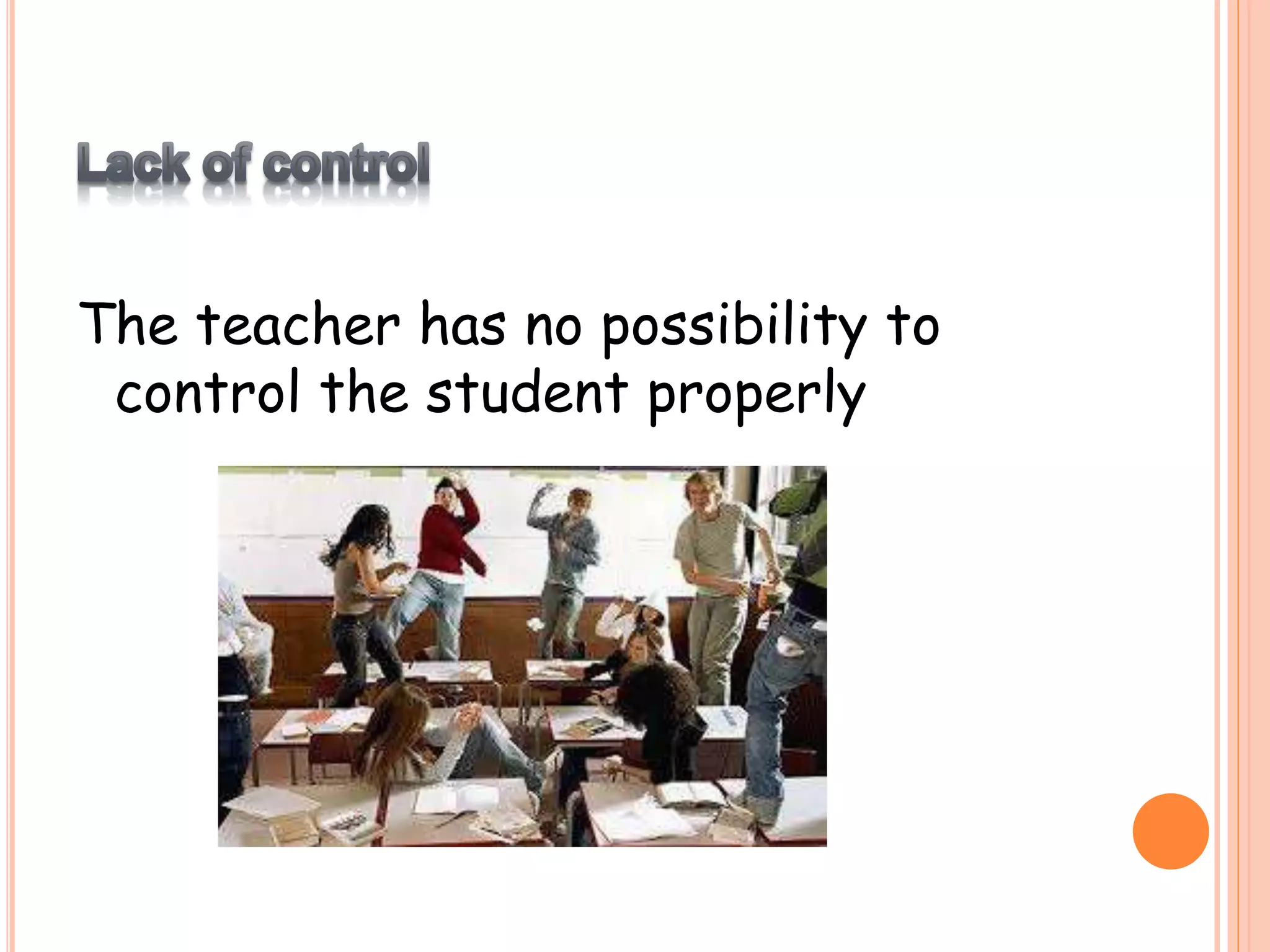
The teacher has no possibility to
control the student properly
A large number of online courses are
not accredited and hence are not
valid




E learning

E learning

  • 2.
    Online learning, sometimesreferred to as e-learning, is a form of distance education. Online courses are delivered over the Internet and can be accessed from a computer with a Web browser (ex. Internet Explorer). Online courses can be  Asynchronous - delivered at your convenience any time or place  Synchronous - students are online at a specified time What to Expect Online courses are ideal for students whose work schedule or family commitments don't allow them to attend classes on campus. Distance education can provide you with the opportunity to meet your educational goals.
  • 4.
  • 6.
     A 2011study by the Sloan Consortium found that 6 million students in the US are taking at least one online course, nearly one third of all those enrolled in higher education.  In response, 65% of higher education institutions now say that online learning is a critical part of their long-term strategy.
  • 7.
     As manysimply can’t afford to take two or more years off of work to attend a traditional college. Online schools help to solve that problem, and with programs expecting to bring in a whopping US$1 billion in revenue by the end of the decade
  • 8.
     Currently, Chinais home to almost 70 different online colleges, a number that will likely grow in the coming years in order to meet the high demand for online learning opportunities.  The online learning industry is expected to grow by leaps and bounds over the next few years, and with steady growth since 2006, it’s looking to meet all expectations.
  • 9.
     the countrycurrently has 17 online colleges, all of which boast state-of-the-art facilities and software.  They’re also working to encourage more Korean students to enroll, pairing online courses with non-virtual activities on campus or in social settings. Time will tell whether or not the investment pays off for this tech-focused nation.
  • 10.
     Malaysia maynot be the first place that comes to mind when you think of online education, but the small Asian nation is forging ahead at full speed when it comes to opening up new opportunities for learning online.  While online education in Malaysia and Asia as a whole still has a long way to go, it’s clear that the country is going to be making waves in distance education for some time to come.
  • 11.
    The government’s OnlineLearning Task Force recommended an investment of £100 million in online education in order to help the nation build its brand, develop better online educational resources, and become a major international player in the distance learning market.
  • 12.
    Online education isstill in its infancy in South Africa, but the government has demonstrated a dedication to improving and expending distance learning opportunities and programmes like GetSmarter and UNISA Online are showing that these goals are viable in the current marketplace.
  • 14.
    For students toaccess online education ,all he or she needs is a personal computer and Internet access . Computer Internet access
  • 15.
    You have possibilityto maintain a flexible schedule in order to use your spare time effectively .
  • 16.
    You no longerhave to be in any particular location to take a class .
  • 17.
    Come to classin your pyjamas or as you want !!!
  • 18.
    The instructor caneasily program multimedia learning aids into the courses , including links to relevant websites .
  • 19.
    Some students hateto participate in live class discussions , for them the online environment can be less intimidating .
  • 21.
    Not many industrieswill acknowledge online professional degree
  • 22.
    The majority ofonline learning system encourage communication through e-mails and text chatting only ,the students can be deprived of the ability to improve their oral communication skills
  • 23.
    The teacher hasno possibility to control the student properly
  • 24.
    A large numberof online courses are not accredited and hence are not valid
  • 26.
  • 27.
  • 28.
  • 29.