VARUN DHAKA INSITUTE OF EDUCATION
CHETAN
Course -B.Ed.
E.N0 -50317402116
 The Earthonwhich we live isone of nine worldcalled
planetsthatmove roundand roundthe sun. The Sun holds
its familyof planetsnear it by the pullof gravity. Gravity is
the force that attractsobjects and makes things fallto the
groundwhenyoudrop them. The Sun, Earthand other
planets(andthe Moon)all have their own gravity attracting
withdifferent strengths. Thegravitational pull onthe planets
by each other, andby the Sun keeps them all where they are.
 The Sun andits planets are calledthe Solar System.
SUN
MOON
PLANETS
STARS
ASTEROIDS
METEORS
COMENTS
 The Sun, thecentre of the Solar System, is too bright for us to
look at directly. Its diameter is over 100 timeswiderthanthe
Earth diameter,and its surface is 60 times as hot as boiling
water. To people on Earth, theSun is largest and most
important object in thesky. It gives us energy , light, and
warmth;without it , we could not live. But the sunis really
only a very small star. Millions of other stars are much bigger
thanthe Sun.
MOON
• The Moon is earth’s nearest neighbour. It
is the only body in space that astronauts
(space travellers from Earth) have yet
reached. The Moon is about one-quarter
the size of the Earth. It is tiny compared
with the Sun. It appears to be almost as
big as the Sun because the Sun is 400
times farther away from us. The Moon
shines brightly in the sky , but it has no
light of its own. Moonlight is only light
reflected on the Sun.
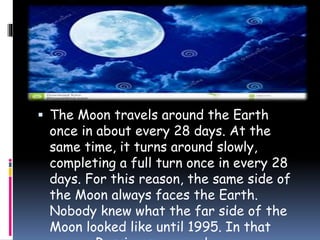
 The Moon travels around the Earth
once in about every 28 days. At the
same time, it turns around slowly,
completing a full turn once in every 28
days. For this reason, the same side of
the Moon always faces the Earth.
Nobody knew what the far side of the
Moon looked like until 1995. In that
There are EIGHT planets in
Solar System:-
 Mercury
 Venus
 Earth
 Mars
 Jupiter
 Saturn
 Uranus
 Neptune
MERCURY
The smallest planet, it seems to have a
surface like that of the Moon. It is the
nearest planet to the sun and is very
hot. It has no air or water, like the moon
VENUS
This is the nearest planet to the Earth.
It is usually the brightest light in the
sky, apart from the Sun And Moon. Its
surface is hidden under thick cloud.
EARTH
Life seems to exist only on this planet. It is at just
the right distance from the Sunto get thelight
and warmth thatliving thingsneed.
MARS
People call thisplanet theRed Planetbecause its
surface is covered withred, sandy deserts. It also
has mountains.
JUPITER
This is the biggest planet, and is
e swirling mixture of liquids and
gases. A large red spot can be
seen on its surface. This is a
rotating mass of cloud.
SATURN
Like Jupiter , this planet is made
of liquid and gases. Beautiful,
shimmering rings circle it. They
are made up of little pieces of
rock covered with frozen gas.
 URANUS and NEPTUNE These
planets are so far away that nobody
can tell for certain what they are made
of. They are probably made of liquid
and gases.
The solar-system1

The solar-system1

  • 1.
    VARUN DHAKA INSITUTEOF EDUCATION CHETAN Course -B.Ed. E.N0 -50317402116
  • 4.
     The Earthonwhichwe live isone of nine worldcalled planetsthatmove roundand roundthe sun. The Sun holds its familyof planetsnear it by the pullof gravity. Gravity is the force that attractsobjects and makes things fallto the groundwhenyoudrop them. The Sun, Earthand other planets(andthe Moon)all have their own gravity attracting withdifferent strengths. Thegravitational pull onthe planets by each other, andby the Sun keeps them all where they are.  The Sun andits planets are calledthe Solar System.
  • 5.
  • 6.
     The Sun,thecentre of the Solar System, is too bright for us to look at directly. Its diameter is over 100 timeswiderthanthe Earth diameter,and its surface is 60 times as hot as boiling water. To people on Earth, theSun is largest and most important object in thesky. It gives us energy , light, and warmth;without it , we could not live. But the sunis really only a very small star. Millions of other stars are much bigger thanthe Sun.
  • 7.
    MOON • The Moonis earth’s nearest neighbour. It is the only body in space that astronauts (space travellers from Earth) have yet reached. The Moon is about one-quarter the size of the Earth. It is tiny compared with the Sun. It appears to be almost as big as the Sun because the Sun is 400 times farther away from us. The Moon shines brightly in the sky , but it has no light of its own. Moonlight is only light reflected on the Sun.
  • 8.
     The Moontravels around the Earth once in about every 28 days. At the same time, it turns around slowly, completing a full turn once in every 28 days. For this reason, the same side of the Moon always faces the Earth. Nobody knew what the far side of the Moon looked like until 1995. In that
  • 9.
    There are EIGHTplanets in Solar System:-  Mercury  Venus  Earth  Mars  Jupiter  Saturn  Uranus  Neptune
  • 10.
    MERCURY The smallest planet,it seems to have a surface like that of the Moon. It is the nearest planet to the sun and is very hot. It has no air or water, like the moon VENUS This is the nearest planet to the Earth. It is usually the brightest light in the sky, apart from the Sun And Moon. Its surface is hidden under thick cloud.
  • 11.
    EARTH Life seems toexist only on this planet. It is at just the right distance from the Sunto get thelight and warmth thatliving thingsneed. MARS People call thisplanet theRed Planetbecause its surface is covered withred, sandy deserts. It also has mountains.
  • 12.
    JUPITER This is thebiggest planet, and is e swirling mixture of liquids and gases. A large red spot can be seen on its surface. This is a rotating mass of cloud. SATURN Like Jupiter , this planet is made of liquid and gases. Beautiful, shimmering rings circle it. They are made up of little pieces of rock covered with frozen gas.
  • 13.
     URANUS andNEPTUNE These planets are so far away that nobody can tell for certain what they are made of. They are probably made of liquid and gases.