THE
SOLAR SYSTEM
AND THE
PLANETS
Solar system
The Sun, its planets and all the objects moving around
them collectively are called Solar System.
The Solar System was formed approximately 4.6
billion years ago and consists of the Sun, planets, dwarf
planets and other astronomical objects bound in its orbit.
The Solar System is entirely dependent on Sun & the
only one which is self- luminous i.e. which has its own
light.
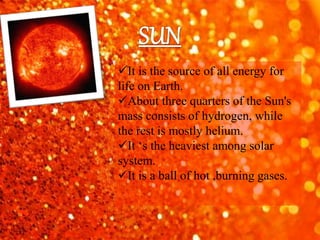
It is the source of all energy for
life on Earth.
About three quarters of the Sun's
mass consists of hydrogen, while
the rest is mostly helium.
It ‘s the heaviest among solar
system.
It is a ball of hot ,burning gases.
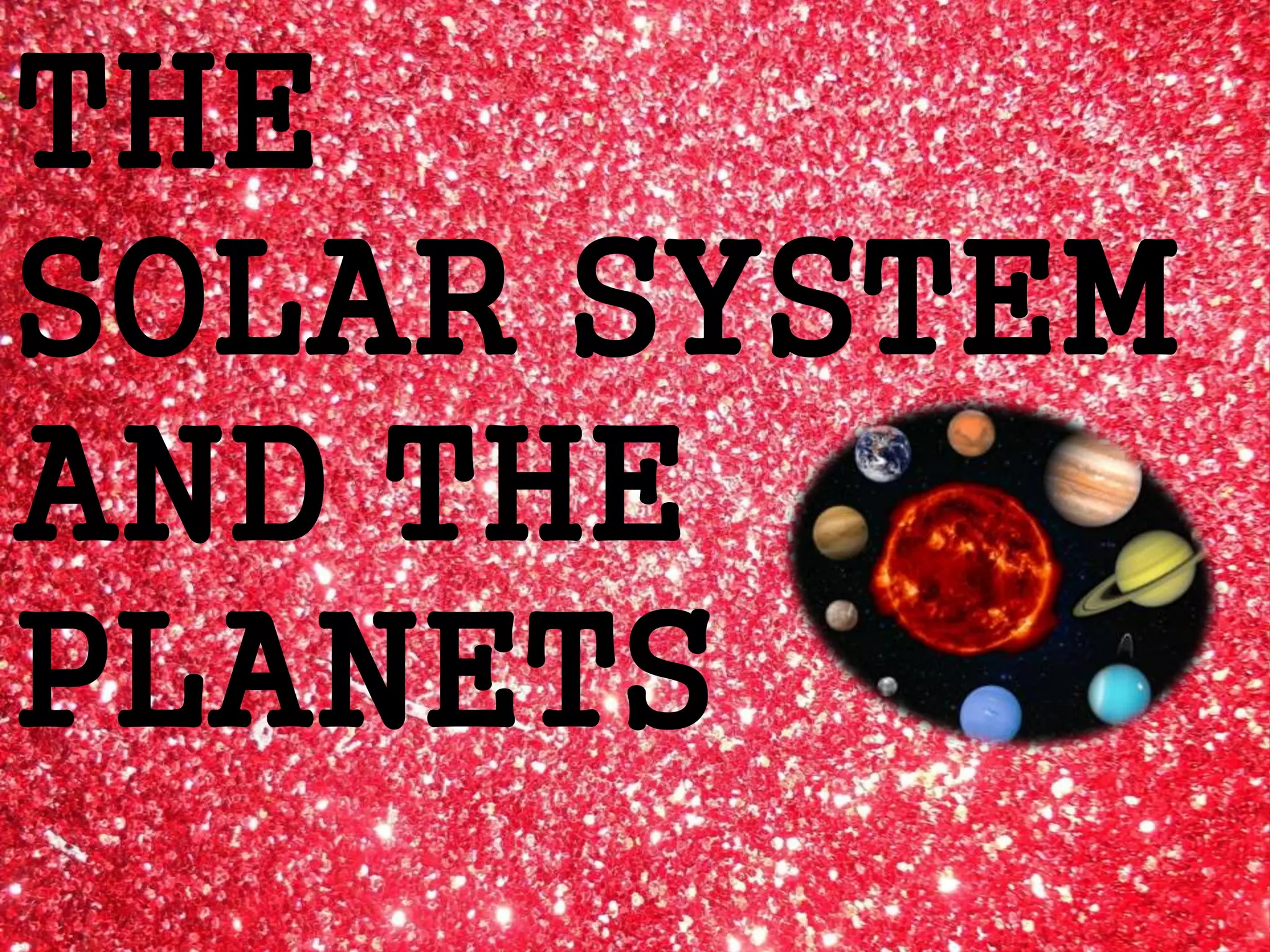
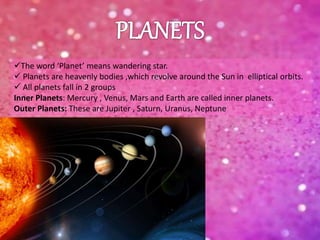
The word ‘Planet’ means wandering star.
 Planets are heavenly bodies ,which revolve around the Sun in elliptical orbits.
 All planets fall in 2 groups
Inner Planets: Mercury , Venus, Mars and Earth are called inner planets.
Outer Planets: These are Jupiter , Saturn, Uranus, Neptune
According to the IAU, there are eight planets in
the Solar System. In increasing distance from the Sun,
the planets are:
Mercury
Venus
Earth
Mars
Jupiter
Saturn
Uranus
Neptune
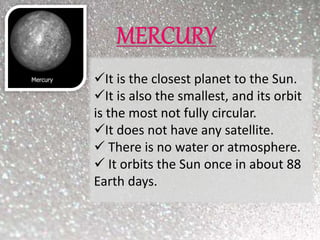
It is the closest planet to the Sun.
It is also the smallest, and its orbit
is the most not fully circular.
It does not have any satellite.
 There is no water or atmosphere.
 It orbits the Sun once in about 88
Earth days.
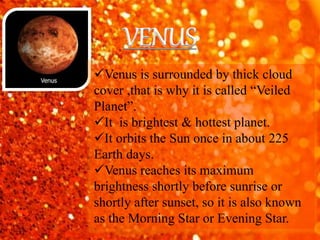
Venus is surrounded by thick cloud
cover ,that is why it is called “Veiled
Planet”.
It is brightest & hottest planet.
It orbits the Sun once in about 225
Earth days.
Venus reaches its maximum
brightness shortly before sunrise or
shortly after sunset, so it is also known
as the Morning Star or Evening Star.
VENUS
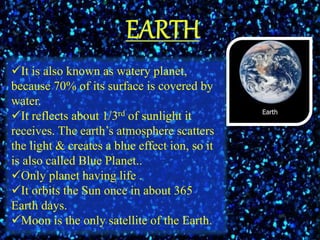
It is also known as watery planet,
because 70% of its surface is covered by
water.
It reflects about 1/3rd of sunlight it
receives. The earth’s atmosphere scatters
the light & creates a blue effect ion, so it
is also called Blue Planet..
Only planet having life .
It orbits the Sun once in about 365
Earth days.
Moon is the only satellite of the Earth.
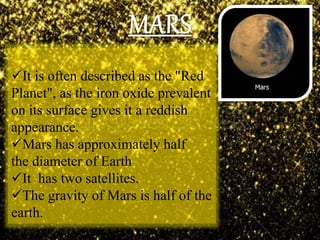
It is often described as the "Red
Planet", as the iron oxide prevalent
on its surface gives it a reddish
appearance.
Mars has approximately half
the diameter of Earth
It has two satellites.
The gravity of Mars is half of the
earth.
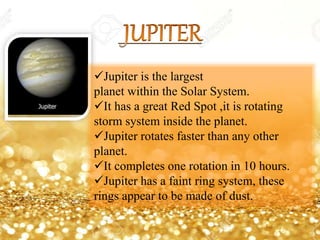
Jupiter is the largest
planet within the Solar System.
It has a great Red Spot ,it is rotating
storm system inside the planet.
Jupiter rotates faster than any other
planet.
It completes one rotation in 10 hours.
Jupiter has a faint ring system, these
rings appear to be made of dust.
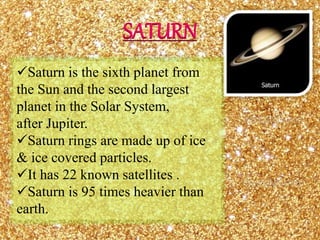
Saturn is the sixth planet from
the Sun and the second largest
planet in the Solar System,
after Jupiter.
Saturn rings are made up of ice
& ice covered particles.
It has 22 known satellites .
Saturn is 95 times heavier than
earth.
SATURN
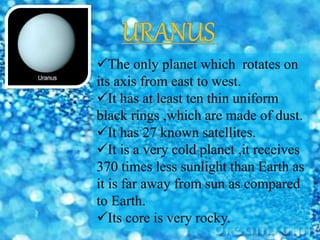
The only planet which rotates on
its axis from east to west.
It has at least ten thin uniform
black rings ,which are made of dust.
It has 27 known satellites.
It is a very cold planet ,it receives
370 times less sunlight than Earth as
it is far away from sun as compared
to Earth.
Its core is very rocky.
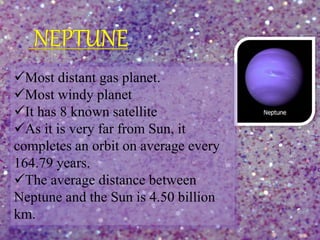
Most distant gas planet.
Most windy planet
It has 8 known satellite
As it is very far from Sun, it
completes an orbit on average every
164.79 years.
The average distance between
Neptune and the Sun is 4.50 billion
km.
Planent

Planent

  • 1.
  • 2.
    Solar system The Sun,its planets and all the objects moving around them collectively are called Solar System. The Solar System was formed approximately 4.6 billion years ago and consists of the Sun, planets, dwarf planets and other astronomical objects bound in its orbit. The Solar System is entirely dependent on Sun & the only one which is self- luminous i.e. which has its own light.
  • 3.
    It is thesource of all energy for life on Earth. About three quarters of the Sun's mass consists of hydrogen, while the rest is mostly helium. It ‘s the heaviest among solar system. It is a ball of hot ,burning gases.
  • 4.
    The word ‘Planet’means wandering star.  Planets are heavenly bodies ,which revolve around the Sun in elliptical orbits.  All planets fall in 2 groups Inner Planets: Mercury , Venus, Mars and Earth are called inner planets. Outer Planets: These are Jupiter , Saturn, Uranus, Neptune
  • 5.
    According to theIAU, there are eight planets in the Solar System. In increasing distance from the Sun, the planets are: Mercury Venus Earth Mars Jupiter Saturn Uranus Neptune
  • 6.
    It is theclosest planet to the Sun. It is also the smallest, and its orbit is the most not fully circular. It does not have any satellite.  There is no water or atmosphere.  It orbits the Sun once in about 88 Earth days.
  • 7.
    Venus is surroundedby thick cloud cover ,that is why it is called “Veiled Planet”. It is brightest & hottest planet. It orbits the Sun once in about 225 Earth days. Venus reaches its maximum brightness shortly before sunrise or shortly after sunset, so it is also known as the Morning Star or Evening Star. VENUS
  • 8.
    It is alsoknown as watery planet, because 70% of its surface is covered by water. It reflects about 1/3rd of sunlight it receives. The earth’s atmosphere scatters the light & creates a blue effect ion, so it is also called Blue Planet.. Only planet having life . It orbits the Sun once in about 365 Earth days. Moon is the only satellite of the Earth.
  • 9.
    It is oftendescribed as the "Red Planet", as the iron oxide prevalent on its surface gives it a reddish appearance. Mars has approximately half the diameter of Earth It has two satellites. The gravity of Mars is half of the earth.
  • 10.
    Jupiter is thelargest planet within the Solar System. It has a great Red Spot ,it is rotating storm system inside the planet. Jupiter rotates faster than any other planet. It completes one rotation in 10 hours. Jupiter has a faint ring system, these rings appear to be made of dust.
  • 11.
    Saturn is thesixth planet from the Sun and the second largest planet in the Solar System, after Jupiter. Saturn rings are made up of ice & ice covered particles. It has 22 known satellites . Saturn is 95 times heavier than earth. SATURN
  • 12.
    The only planetwhich rotates on its axis from east to west. It has at least ten thin uniform black rings ,which are made of dust. It has 27 known satellites. It is a very cold planet ,it receives 370 times less sunlight than Earth as it is far away from sun as compared to Earth. Its core is very rocky.
  • 13.
    Most distant gasplanet. Most windy planet It has 8 known satellite As it is very far from Sun, it completes an orbit on average every 164.79 years. The average distance between Neptune and the Sun is 4.50 billion km.