Multimedia Lesson
PLAN
Pupil teachername: - Geeta solanki(011) Class:- VIITH
Subject: - Social Science Section: - A
Topic: - Solar System Duration of Lesson: - 35 min
General objectives: -
• To impart the knowledge of solar system to the students.
• To develop the imaginative thinking of the students.
• To develop the understanding of the students towards solar system.
Behavioral objectives: -
 The students will be able to comprehend the concept of solar system.
 Tells the components of solar system.
 To analyze the features of solar system.
General Teaching Aids: -
Well-equipped classroom, white board, marker, duster.
Instructional Aids: -
PPT, videos, photos
Previous knowledge:-
Students are familiar with the terms stars, sky, sun and moon.
Announcement:-
Today we are going to discuss about the ‘SOLAR SYSTEM’.
Teaching
Points
PupilTeacher’s
Activities
Students’
Activities
Evaluation Multimedia
presentation
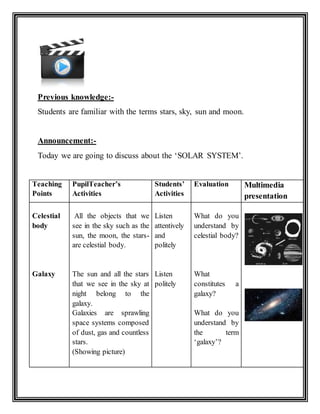
Celestial
body
Galaxy
All the objects that we
see in the sky such as the
sun, the moon, the stars-
are celestial body.
The sun and all the stars
that we see in the sky at
night belong to the
galaxy.
Galaxies are sprawling
space systems composed
of dust, gas and countless
stars.
(Showing picture)
Listen
attentively
and
politely
Listen
politely
What do you
understand by
celestial body?
What
constitutes a
galaxy?
What do you
understand by
the term
‘galaxy’?
Solar
system
Stars
The Sun
Planets
And some
facts
about it
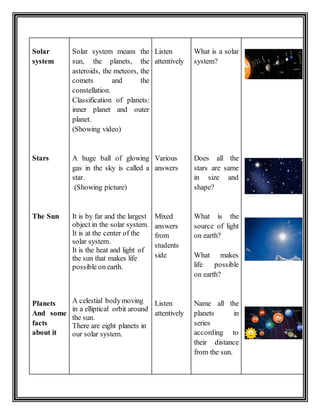
Solar system means the
sun, the planets, the
asteroids, the meteors, the
comets and the
constellation.
Classification of planets:
inner planet and outer
planet.
(Showing video)
A huge ball of glowing
gas in the sky is called a
star.
(Showing picture)
It is by far and the largest
object in the solar system.
It is at the center of the
solar system.
It is the heat and light of
the sun that makes life
possible on earth.
A celestial bodymoving
in a elliptical orbit around
the sun.
There are eight planets in
our solar system.
Listen
attentively
Various
answers
Mixed
answers
from
students
side
Listen
attentively
What is a solar
system?
Does all the
stars are same
in size and
shape?
What is the
source of light
on earth?
What makes
life possible
on earth?
Name all the
planets in
series
according to
their distance
from the sun.
Evaluation;-
Q1. What is solar system and what does it consists of?
Q2.Match the following
 Red planet milky way
 One revolution meteors
 Small pieces of rock mars
 Galaxy 365 days
Asteroid
belt
Meteors
Comets
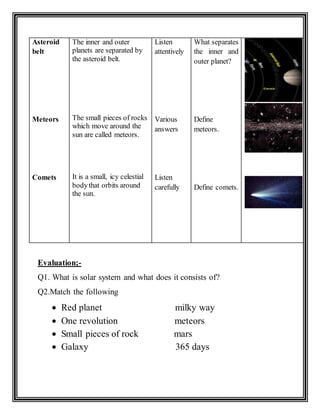
The inner and outer
planets are separated by
the asteroid belt.
The small pieces of rocks
which move around the
sun are called meteors.
It is a small, icy celestial
bodythat orbits around
the sun.
Listen
attentively
Various
answers
Listen
carefully
What separates
the inner and
outer planet?
Define
meteors.
Define comets.
Homework
Q.1 what is a galaxy?
Q.2 Define:-
a. Asteroid belt
b. Celestial body
c. stars

Multimedia lesson plan

  • 1.
    Multimedia Lesson PLAN Pupil teachername:- Geeta solanki(011) Class:- VIITH Subject: - Social Science Section: - A Topic: - Solar System Duration of Lesson: - 35 min General objectives: - • To impart the knowledge of solar system to the students. • To develop the imaginative thinking of the students. • To develop the understanding of the students towards solar system. Behavioral objectives: -  The students will be able to comprehend the concept of solar system.  Tells the components of solar system.  To analyze the features of solar system. General Teaching Aids: - Well-equipped classroom, white board, marker, duster. Instructional Aids: - PPT, videos, photos
  • 2.
    Previous knowledge:- Students arefamiliar with the terms stars, sky, sun and moon. Announcement:- Today we are going to discuss about the ‘SOLAR SYSTEM’. Teaching Points PupilTeacher’s Activities Students’ Activities Evaluation Multimedia presentation Celestial body Galaxy All the objects that we see in the sky such as the sun, the moon, the stars- are celestial body. The sun and all the stars that we see in the sky at night belong to the galaxy. Galaxies are sprawling space systems composed of dust, gas and countless stars. (Showing picture) Listen attentively and politely Listen politely What do you understand by celestial body? What constitutes a galaxy? What do you understand by the term ‘galaxy’?
  • 3.
    Solar system Stars The Sun Planets And some facts aboutit Solar system means the sun, the planets, the asteroids, the meteors, the comets and the constellation. Classification of planets: inner planet and outer planet. (Showing video) A huge ball of glowing gas in the sky is called a star. (Showing picture) It is by far and the largest object in the solar system. It is at the center of the solar system. It is the heat and light of the sun that makes life possible on earth. A celestial bodymoving in a elliptical orbit around the sun. There are eight planets in our solar system. Listen attentively Various answers Mixed answers from students side Listen attentively What is a solar system? Does all the stars are same in size and shape? What is the source of light on earth? What makes life possible on earth? Name all the planets in series according to their distance from the sun.
  • 4.
    Evaluation;- Q1. What issolar system and what does it consists of? Q2.Match the following  Red planet milky way  One revolution meteors  Small pieces of rock mars  Galaxy 365 days Asteroid belt Meteors Comets The inner and outer planets are separated by the asteroid belt. The small pieces of rocks which move around the sun are called meteors. It is a small, icy celestial bodythat orbits around the sun. Listen attentively Various answers Listen carefully What separates the inner and outer planet? Define meteors. Define comets.
  • 5.
    Homework Q.1 what isa galaxy? Q.2 Define:- a. Asteroid belt b. Celestial body c. stars