Supervisor:
Dr. Rania AbdelrahmanOsman
University of Bahri
College of Engineering and Architecture
Department of Architecture
Third Year-second Semester
(2021-2022)
Project name:
U of B - Faculty housing
Phase name:
Data Collection
Date: 13/06/2022
T. A. Tasneem Omer Mohammed Osman
2.
• Jihan Bakri
•Nyanbol Nyok
• Shimaa Idress
• Rafaa Mohammed
• Reem Abdelsamie
• Wamda Mansour
Students names:
3.
1/Introduction of theproject:
Include: definition, aim and objectives
of the project.
2/Cases studies:
Include: local, regional and
international case study.
3/Users
4/Site survey
5/Requirement
Table of Contents:
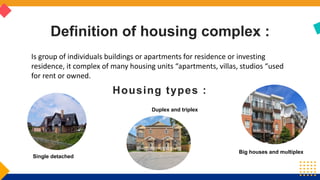
Single detached
Big housesand multiplex
Duplex and triplex
Definition of housing complex :
Housing types :
Is group of individuals buildings or apartments for residence or investing
residence, it complex of many housing units “apartments, villas, studios “used
for rent or owned.
Aim of project:
Planningand designing housing complexes for all university of Bahri
faculty and their families with putting in mind that this project should
meet studio themes of sustainability, accessibility, indigenous access
and support and skills training cause they are pillars of the university
plans
8.
Objectives :
• Servingthe various needs aspects
of the faculty staff, including: the
social aspect, the psychological
aspect, the environmental aspect,
the administrative aspect and the
economic aspect.
Sudan University Professors
HousingComplex
• Location: Jabra Square 19 next to the Zakat Office-Khartoum.
• Housing is for professor, assistant professor, lecturer, associate
professor, in addition to that it is intended only for families.
• The community consists of three buildings (A, B and C), each
building contains four floors in addition to the ground floor.
• Each building contains three types of apartments:
• First: apartments for small families (three rooms, hall, bathroom
and kitchen).
• The second: apartments for the average family (two rooms, a hall,
a salon, two bathrooms and a kitchen).
• Third: apartments for large families (three rooms, hall, salon, two
bathrooms and a kitchen).
11.
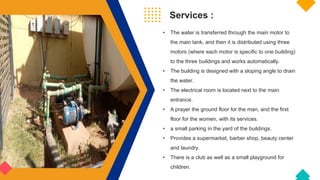
Services :
• Thewater is transferred through the main motor to
the main tank, and then it is distributed using three
motors (where each motor is specific to one building)
to the three buildings and works automatically.
• The building is designed with a sloping angle to drain
the water.
• The electrical room is located next to the main
entrance.
• A prayer the ground floor for the man, and the first
floor for the women, with its services.
• a small parking in the yard of the buildings.
• Provides a supermarket, barber shop, beauty center
and laundry.
• There is a club as well as a small playground for
children.
12.
Pictures of theparts of the complex:
The prayer Electric room
13.
Pictures of theparts of the complex:
The club with the play ground Parking
14.
Pictures of theparts of the complex:
The entrance for the buildings:
Advantages:
• The correctbounces of the buildings,
separated by 8 meters, where the
maximum benefit from the natural
ventilation, in addition to shading the
inner courtyard.
• Provides various services to the
complex.
• Diversity of apartments to
accommodate different sizes of
families.
17.
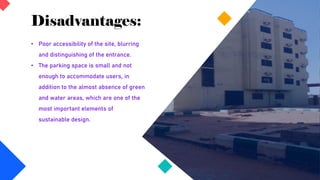
Disadvantages:
• Poor accessibilityof the site, blurring
and distinguishing of the entrance.
• The parking space is small and not
enough to accommodate users, in
addition to the almost absence of green
and water areas, which are one of the
most important elements of
sustainable design.
KING ABDULAZIZ UNIVERSITY
FACULTYHOUSING
• Project Location: Jeddah, Saudi Arabia
• Owner: King Abdul-Aziz University
• Architect/Landscape Arch: Innovators
Consulting Engineers
• MEP Engineering: RABYA General Contractors
• Constant. / Civil / Structural: RABYA Gen.
Contractors, Al Arab Construction Co.
• Sustainability Consultant: Green Technologies
FZCO
• Total area: (97,690) square meters.
20.
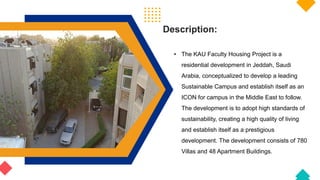
Description:
• The KAUFaculty Housing Project is a
residential development in Jeddah, Saudi
Arabia, conceptualized to develop a leading
Sustainable Campus and establish itself as an
ICON for campus in the Middle East to follow.
The development is to adopt high standards of
sustainability, creating a high quality of living
and establish itself as a prestigious
development. The development consists of 780
Villas and 48 Apartment Buildings.
21.
Contents:
• Buildings andResidential Units: The residential
complex contains 106 buildings, and each
building consists of three floors. Each building
contains (3) housing units, and the housing unit
consists of (3 bedrooms, 2 reception salons, 1
living room, 1 kitchen, 2 bathrooms).Total
housing units (318) housing units with a total
area of (97,690) square meters.
22.
Services and facilities:Two (2) mosques(4) playgrounds with an
area of (15236) m2 for various games such as football,
basketball and volleyball Number (6) children's gardens with an
area of (3493) m2Green areas with an area of (3448) m2 in
addition to the newly added green areas with an area of (11854)
m2.Car parking shaded with cloth in the form of a tent with an
area of (6367) m2Shaded car parking with cement concrete with
an area of (11532) m2Additional asphalt car parks with an area
of (5875) m2Number of street lights (85)Number of garden lights
(300)There are many services provided by the cooperative
society for university employees, such as: (gymnasium,
supermarket, teller machine, salon, events hall, rooms for
drivers) to serve the residents inside the residential complex.
The new residential complex - villas system (under
construction)Number of villas (780) villas.
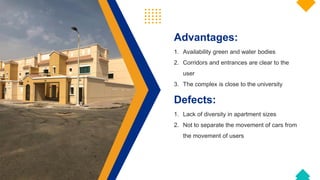
Advantages:
1. Availability greenand water bodies
2. Corridors and entrances are clear to the
user
3. The complex is close to the university
Defects:
1. Lack of diversity in apartment sizes
2. Not to separate the movement of cars from
the movement of users
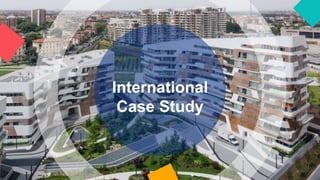
City life -residential
apartment
•Engineers: Zaha Hadid Architects
• Location: Italy. Milan
• Project manager: Gianluca Racana
• Project Architect: Maurizio Meossi
• Area: 38000.0 sq.m
• Project year: 2013
• Photographer: Simon Garcia
30.
Exterior claddings, fiber-concretepanels and natural
wood panels - emphasize volumetric movement
complexes.
At the same time give a special and homely quality
to the courtyard inside the residence.
The interior is open to the extensive terraces. All
apartments feature structural solutions and plants
that can be easily adapted to meet individual needs.
Each of the houses differs from the others in terms
of size, exposure and layout from two rooms to
large family apartments and penthouses on two
twin levels.
31.
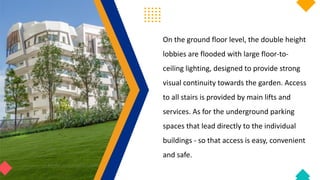
On the groundfloor level, the double height
lobbies are flooded with large floor-to-
ceiling lighting, designed to provide strong
visual continuity towards the garden. Access
to all stairs is provided by main lifts and
services. As for the underground parking
spaces that lead directly to the individual
buildings - so that access is easy, convenient
and safe.
32.
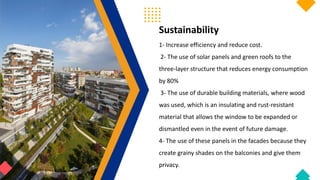
Sustainability
1- Increase efficiencyand reduce cost.
2- The use of solar panels and green roofs to the
three-layer structure that reduces energy consumption
by 80%
3- The use of durable building materials, where wood
was used, which is an insulating and rust-resistant
material that allows the window to be expanded or
dismantled even in the event of future damage.
4- The use of these panels in the facades because they
create grainy shades on the balconies and give them
privacy.
33.
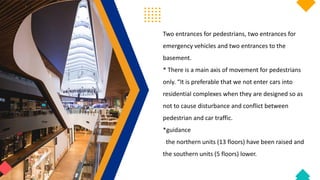
Two entrances forpedestrians, two entrances for
emergency vehicles and two entrances to the
basement.
* There is a main axis of movement for pedestrians
only. “It is preferable that we not enter cars into
residential complexes when they are designed so as
not to cause disturbance and conflict between
pedestrian and car traffic.
*guidance
the northern units (13 floors) have been raised and
the southern units (5 floors) lower.
Advantages:
• Use existingsustainable building
materials
• Separate the movement and get rid of
the movement of cars in order not to
cause disturbance and conflict
between the movement of pedestrians
and cars and to ensure the safety of
children
• A project that can be expanded by
repeating the unit “the unit” if
necessary in the future.
39.
'Nine Dragon' Housing
Complex/ YKH_LAB
• Architect: YKH_LAB Location: Liaoning Digital
Technology Industrial District, Suizhong City,
China Program: Apartments, Retail, Public
Plaza Status: In progress Partner-in-charge: Tae
Sun Hong, Won Jin Kim Team: Ki Wan Ahn, Eun
Jeong Kwon, Dong Hyun Ji, Ingrid Kong, Eun
Song Jung Site area: 26,177.30 SM Building
area: 10,620.50 SM Total floor area: 92,711.21 SM
40.
• As inour previous design of ‘Suizhong Apt-factory’, they
applied a permeable ‘mat hybrid’ format with differentiating
public outdoor courtyards in this site. By spreading linear bar-
type blocks in north-south & east-west directions, a ‘waffle-like’
base layer was created. We then extruded parts of the linear
block to meet the client’s density requirement; then we shifted
and adjusted levels to provide the best views possible for
residential units. The result is a next generation housing
typology that embraces (1) the courtyard apartment type (of
the famed Example district in Barcelona circa 1850s), (2) the
linear row housing type (still the preferable residential type in
Korea) and (3) the high-rise bar type apartment (prevalent in
Chicago’s residential development of the 1950s). This 362-unit
housing complex is an organized evolution that was generated
from a schematic combination of three apartment types with a
practical response to meet programmatic, economic, and
social needs.
41.
• Day lightingand Views: The tower heights
and angles are adjusted to benefit natural
lighting into the apartment and retail units.
After several iterations of shadow studies,
the heights of the towers were adjusted to
benefit the natural day-lighting into both
high and low residential apartments. The
horizontal angle rotation of the orthogonal
grid system shifts the volume to benefit the
occupants’ views and access to natural
indoor lighting.
42.
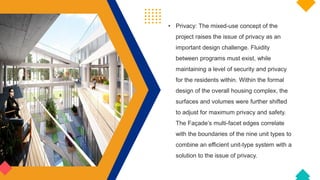
• Privacy: Themixed-use concept of the
project raises the issue of privacy as an
important design challenge. Fluidity
between programs must exist, while
maintaining a level of security and privacy
for the residents within. Within the formal
design of the overall housing complex, the
surfaces and volumes were further shifted
to adjust for maximum privacy and safety.
The Façade’s multi-facet edges correlate
with the boundaries of the nine unit types to
combine an efficient unit-type system with a
solution to the issue of privacy.
43.
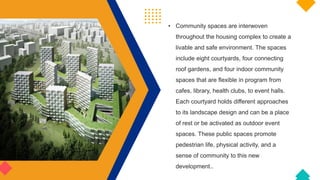
• Community spacesare interwoven
throughout the housing complex to create a
livable and safe environment. The spaces
include eight courtyards, four connecting
roof gardens, and four indoor community
spaces that are flexible in program from
cafes, library, health clubs, to event halls.
Each courtyard holds different approaches
to its landscape design and can be a place
of rest or be activated as outdoor event
spaces. These public spaces promote
pedestrian life, physical activity, and a
sense of community to this new
development..
Advantages:
• The manipulationof building levels with
alternating distribution, use of
courtyards and green spaces are
effective strategies for achieving
sustainable design.
• The tower heights and angles are
adjusted to benefit natural lighting into
the apartment and retail units. design
the courtyard by holds different
approaches to its landscape design and
can be a place of rest or be activated
as outdoor event spaces.
50.
Outcomes:
• Use Sustainabledesign principles include the ability to:
• optimize site potential;
• minimize non-renewable energy consumption.
• use environmentally preferable products.
• protect and conserve water.
• enhance indoor environmental quality; and.
• optimize operational and maintenance practices.
• When planning spaces, please take into account
privacy and the different types of housing, while
providing the necessary services for them according to
the project area.
51.
Outcomes:
• There aredifferent styles that can be used in
design, such as taking advantage of heritage,
or using modern design styles, provided that
privacy requirements are taken into account.
• The accessibility, entrances and internal road
n must be taken into account.
Number of Users:
Academicstatus Single Family Total
Professors 2 7 9
Associate professors 9 33 42
Assistant professors 34 122 156
Lecturers 22 79 101
Total 67 241 308
Female: 175.
Male: 158.
Average family members: 5 people.
Average age of the children: 0-20 years.
Total of users: 67+(241*5)=1272.
55.
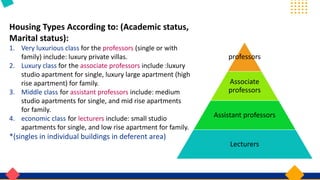
professors
Associate
professors
Assistant professors
Lecturers
Housing TypesAccording to: (Academic status,
Marital status):
1. Very luxurious class for the professors (single or with
family) include: luxury private villas.
2. Luxury class for the associate professors include :luxury
studio apartment for single, luxury large apartment (high
rise apartment) for family.
3. Middle class for assistant professors include: medium
studio apartments for single, and mid rise apartments
for family.
4. economic class for lecturers include: small studio
apartments for single, and low rise apartment for family.
*(singles in individual buildings in deferent area)
Entertainment
spaces
Public garden CaféRestaurant Play grounds Sport Club Green space
Service
spaces
Health
center
Pharmacy Daycare Mosque
Commercial
market
Parking
Location:
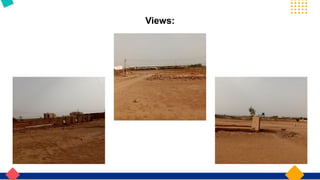
• Location: Africa,Sudan, Khartoum, Bahri,
Alkadaru, next to the campus of university of
Bahri, on land situated to the East of the campus.
• Lonigitude: 32.35’59”E
• Latitude: 15.45’14”N
• No services are located adjacent to the site.
• Neighborhoods: from the north Military camp,
from east stores for the university, from the south
sheds and from the west university campus.
• Total area: 50000m2
61.
Site area (PLOT):
•Soil type: agricultural clay soil.
• Electricity is available.
• There is annoying noise and smells
from the south direction.
• Quiet on all sides except the south
Accessibility:
By train:
• FromKhartoum north train station to
• Alkadaru train station is 13,740 m.
• From Halfaya Bridge train station to
• AlKadaroo train station is 3,390 m.
By car:
• From Bahri Alsouq – almaona street
• 19,800 m in about (40-45 min).
• From almaona street – Halfaya Bridge
• 7,000m in about (15-20 min).
By bicycle:
• From almaona street – Halfaya Bridge
• 7,000m in about (80-90 min).
• By feet:
• From almaona street – Halfaya Bridge
• 7,000m in about (150 min)
Site analysis:
Placing aplant barrier ad water bodies in
the direction of undesirable winds.
Sun movements:
Orientation of residential building to the
north and south to avoid direct sun light.
66.
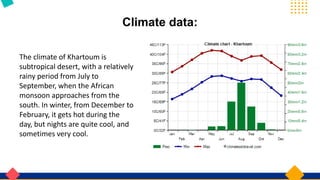
Climate data:
The climateof Khartoum is
subtropical desert, with a relatively
rainy period from July to
September, when the African
monsoon approaches from the
south. In winter, from December to
February, it gets hot during the
day, but nights are quite cool, and
sometimes very cool.
67.
Average temperature:
In Khartoum,the average
temperature of the coldest month
(January) is of 23.6 °C (74.4 °F), that of
the warmest months (May, June) is of
35.2 °C (95.4 °F). Here are the average
temperatures.
Environmental heat treatment:-
1. Increasing green spaces.
2. Use of heat-insulating building
materials.
3. Use light colors to paint surfaces.
4. Use of solar diffusers.
68.
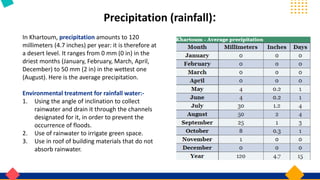
Precipitation (rainfall):
In Khartoum,precipitation amounts to 120
millimeters (4.7 inches) per year: it is therefore at
a desert level. It ranges from 0 mm (0 in) in the
driest months (January, February, March, April,
December) to 50 mm (2 in) in the wettest one
(August). Here is the average precipitation.
Environmental treatment for rainfall water:-
1. Using the angle of inclination to collect
rainwater and drain it through the channels
designated for it, in order to prevent the
occurrence of floods.
2. Use of rainwater to irrigate green space.
3. Use in roof of building materials that do not
absorb rainwater.
69.
Humidity:
The muggier periodof the year lasts for 3.5 months, from June 28 to October 13, during which time
the comfort level is muggy, oppressive, or miserable at least 17% of the time. The month with the
most muggy days in Khartoum is August, with 20.7 days that are muggy or worse.
The month with the fewest muggy days in Khartoum is January, with 0.0 days that are muggy or
worse.
Environmental treatment of
humidity:-
1. increasing green spaces.
2. Use of heat-insulating building
materials.
3. use of water bodies.
4. increase shaded area as much as
possible.
5. Increasing the high of the ceiling
which helps to cool the air.
Humidity Comfort Levels in Khartoum:
70.
Wind:
The windier partof the year lasts for 6.4 months, from October 29 to May 10, with average wind
speeds of more than 9.9 miles per hour. The windiest month of the year in Khartoum is February,
with an average hourly wind speed of 12.2 miles per hour.
The calmer time of year lasts for 5.6 months, from May 10 to October 29. The calmest month of the
year in Khartoum is September, with an average hourly wind speed of 8.0 miles per hour.
Environmental treatment of wind
speed :-
1. orientation of building in
proportion to the movement of
the wind.
2. Planting trees around the
residential complex.
3. use of windbreaker at the
entrance of building.
Average Wind Speed in Khartoum:
71.
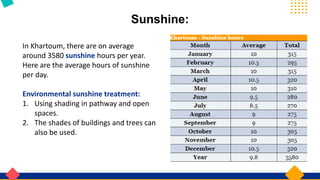
Sunshine:
In Khartoum, thereare on average
around 3580 sunshine hours per year.
Here are the average hours of sunshine
per day.
Environmental sunshine treatment:
1. Using shading in pathway and open
spaces.
2. The shades of buildings and trees can
also be used.
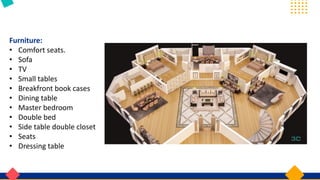
Furniture:
• Comfort seats.
•Sofa
• TV
• Small tables
• Breakfront book cases
• Dining table
• Master bedroom
• Double bed
• Side table double closet
• Seats
• Dressing table
75.
Furniture:
Bedroom:
• Bed
• Sidetable
• Closet
• Seat
• Study table +seat
Dining room:
• Chairs (2-6)
• Dining table
• Serving
Kitchen:
• Storage
• counter and working service
• Evacuee
• Range
• Sink
76.
Luxury studio apartment(large):
Containing:
• 2 bedrooms: 12+5*2
• Kitchen: 9m2
• Reception: 15m2
• Bathroom: 5m2
• Living and dining room: 10m2
• corn+ balcony: 15m2
Total area: 90m2
77.
High rise apartment:
Containing:
•Master bedroom +bathroom: 20+5=25m2
• 2 bedroom (large +mid): 12+9=21m2
• Reception: 30m2
• Office: 12m2
• Living +dining room: 24m2
• Kitchen: 12m2
• 2 bathrooms: 5+5=1m2
• Corridors +balcony: 20m2
Total area for one apartment: 160m2
Total area for the ground floor:
(160*2)+80=400m2
*the building containing two floors
78.
Medium studio apartments
Containing:
•2 bedrooms: 10*2+20m2
• Reception: 10m2
• Kitchen: 8m2
• Bathrooms: 5.5m2
• Living +dining room: 10m2
• Corridors +balcony: 10m2
Total area: 64m2
79.
Mid rise apartments:
Containing:
•Master bedroom: 20m2
• 2 bedrooms: 10+6=16m2
• Reception: 20m2
• Kitchen: 10m2
• 2 bathrooms: 5.5*2=11m2
• Living +dining room: 22m2
• Corridors +balcony:
5.5+4.6+10=20.1m2
Total area for one apartment: 120m2
Total area for ground floor:
(120*4)+48=528m2
*the building containing four floors.
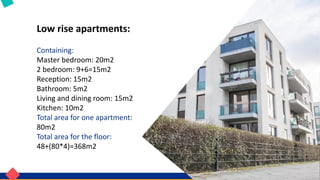
Low rise apartments:
Containing:
Masterbedroom: 20m2
2 bedroom: 9+6=15m2
Reception: 15m2
Bathroom: 5m2
Living and dining room: 15m2
Kitchen: 10m2
Total area for one apartment:
80m2
Total area for the floor:
48+(80*4)=368m2
82.
Play ground:
Planning principlesfor play ground:
1. Planning and design safety passage for
ensuring children access to site.
2. Should be inside housing complex its
include 4 main areas:
• First area: 400m2 include different games
and it serve 70 children.
• Second area: 4800m2 opening space for
playing
• Third area: 50m2 specific for setting and
quite playing it serve 15 children.
• Forth area: 250m2 include side paths for
bicycles ,scooters and walk paths.
• Basketball :14*26=364
• Volleyball: 18*9=162
• Tennis :23.7*10.7 =253.59
• Football :45*30 =1350
83.
Spaces table:
N. Spacename N. Of
users
Area
for one
person
Furniture Space requirements Area/mete
r square
Area for
ground
floor
N. Of
units
Total
ventilation lighting
1 Luxury private
villas
9 5m2 Comfort seats. ,Sofa
,TV ,Small tables
,Breakfront book
cases
Dining table
Natural and
artificial
Natural and
artificial
240m2 - 9 2160m2
2 Luxury studio
apartment
9 5m2 - Natural and
artificial
Natural and
artificial
90m2 - 9 810m2
3 High rise
apartment
33 5m2 - Natural and
artificial
Natural and
artificial
160m2 400m2 10 4000m2
4 Medium studio
apartment
34 5m2 - Natural and
artificial
Natural and
artificial
64m2 - 34 2176m2
5 Mid rise
apartment
122 5m2 - Natural and
artificial
Natural and
artificial
120m2 528m2 8 4224m2
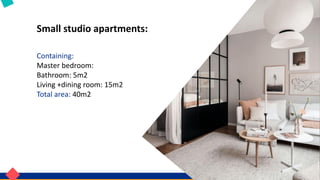
6 Small studio
apartment
22 5m2 - Natural and
artificial
Natural and
artificial
40m2 - 22 880m2
7 Law rise
apartment
79 5m2 - Natural and
artificial
Natural and
artificial
80m2 368m2 10 3680m2
84.
N. Space nameN. Of users Area
for one
person
Furniture Space requirements Area/me
ter
square
N. Of
units
Total
ventilation lighting
8 Security and
guarding
center
2 2.5m2 - Natural and
artificial
Natural and
artificial
30m2
+15m2
1 45m2
9 Administratio
n building
6 2,5m2 - Natural and
artificial
Natural and
artificial
88m2 1 88m2
10 Primary
School
222(17.5%) 1.2m2 - Natural and
artificial
Natural and
artificial
967m2 1 967m2
11 Kindergarten 7% N. of
users=89
1.2m2 - Natural and
artificial
Natural and
artificial
332m2 1 332m2
12 Daycare 152(7%) - - Natural and
artificial
Natural and
artificial
513m2 1 513m2
13 Library 308(24%) 1.2m2 - Natural and
artificial
Natural and
artificial
770m2 1 770m2
14 Search center
with Wi-Fi
308(24%) - - Natural and
artificial
Natural and
artificial
15 Café 33% N. of
users=420
- - Natural and
artificial
Natural and
artificial
630m2 1 630m2
85.
N. Space nameN. Of
users
Area for
one
person
Furniture Space requirements Area/me
ter
square
N. Of
units
Total
ventilation lighting
16 Restaurant 381(30%) - - Natural and
artificial
Natural and
artificial
572m2 1 572m2
17 Sport Club 318 - - Natural and
artificial
Natural and
artificial
1000m2 1 1000m2
18 Health
center
1272
(100%)
- - Natural and
artificial
Natural and
artificial
520m2 1 520m2
19 Mosque 1200 - - Natural and
artificial
Natural and
artificial
690m2 1 690m2
20 Pharmacy - Natural and
artificial
Natural and
artificial
12*5.8=
69.6m2
1 69.6m2
21 Commercial
market
954 2.5m2 - Natural and
artificial
Natural and
artificial
2385m2 1 2385m2
23 Parking 241 5m2 - Natural and
artificial
Natural and
artificial
1205m2 1 1205m2
86.
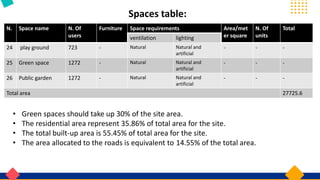
Spaces table:
N. Spacename N. Of
users
Furniture Space requirements Area/met
er square
N. Of
units
Total
ventilation lighting
24 play ground 723 - Natural Natural and
artificial
- - -
25 Green space 1272 - Natural Natural and
artificial
- - -
26 Public garden 1272 - Natural Natural and
artificial
- - -
Total area 27725.6
• Green spaces should take up 30% of the site area.
• The residential area represent 35.86% of total area for the site.
• The total built-up area is 55.45% of total area for the site.
• The area allocated to the roads is equivalent to 14.55% of the total area.
Circulation diagram:
Faculty singlesFaculty Family members
Service
Administration
Luxury private villas
High-rise apartment
(family)
Mid-rise apartment
(family)
Low-rise apartment
(family)
Medium studio
apartment
Luxury studio
apartment
small studio
apartment
Educational
Administration
Entrance
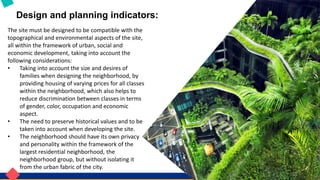
Design and planningindicators:
The site must be designed to be compatible with the
topographical and environmental aspects of the site,
all within the framework of urban, social and
economic development, taking into account the
following considerations:
• Taking into account the size and desires of
families when designing the neighborhood, by
providing housing of varying prices for all classes
within the neighborhood, which also helps to
reduce discrimination between classes in terms
of gender, color, occupation and economic
aspect.
• The need to preserve historical values and to be
taken into account when developing the site.
• The neighborhood should have its own privacy
and personality within the framework of the
largest residential neighborhood, the
neighborhood group, but without isolating it
from the urban fabric of the city.
96.
• Taking intoaccount the provision of ventilation,
insolation and open spaces necessary for the
population.
• Well planned site for vehicular and pedestrian traffic.
• Providing the necessary services for all, whether
those are inside the neighborhood, or those outside
it, while ensuring an appropriate distance between
the neighborhood and the services located outside it.
• Participation of the population in the decision-
making process for management, organization,
maintenance and various life activities.
• The use of sustainable design strategies in terms of
optimal use of vegetation cover to create a
harmonious and healthy environment.
97.
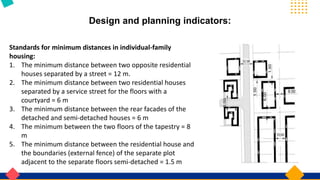
Design and planningindicators:
Standards for minimum distances in individual-family
housing:
1. The minimum distance between two opposite residential
houses separated by a street = 12 m.
2. The minimum distance between two residential houses
separated by a service street for the floors with a
courtyard = 6 m
3. The minimum distance between the rear facades of the
detached and semi-detached houses = 6 m
4. The minimum between the two floors of the tapestry = 8
m
5. The minimum distance between the residential house and
the boundaries (external fence) of the separate plot
adjacent to the separate floors semi-detached = 1.5 m
98.
Streets:
Planning principles forstreet:
1. The main street network should not
penetrate the residential block, but
should serve the outer area only.
2. The internal street network should be
designed on the basis of providing
safety and tranquility to the
neighboring residents.
3. The residents of the neighborhood
depend on a primary school service for
the child, so that the child is not
allowed to walk more than 800 meters
to school.
Design and planningindicators:
1. Planning residential units in the form of
zoning classified according to the academic
status and social status of the user.
2. Connecting the housing units with the road
network to give the residents a walking
opportunity.
3. The design of the residential units should be
characterized by flexibility, privacy and
security, taking into account the presence of
open green spaces.
101.
Design and planningindicators:
1. The center of the complex should be in the
middle, to facilitate the transition from all
sides.
2. Covering the southern facade with trees with
fallen leaves to provide shade in summer and
allow sunlight to pass in winter .
3. Reducing the size of the windows on the
eastern and western facades..
4. The use of thermal insulation is placed
between the inner and outer parts of the
walls















































![Presentation for Apartment [Autosaved].pptx](https://cdn.slidesharecdn.com/ss_thumbnails/presentationforapartmentautosaved-250706112108-98939c68-thumbnail.jpg?width=640&height=640&fit=bounds)


