
THE SOCIAL SUBSYSTEM
INSIDE THE
SCHOOLSYSTEM
Eloisa R. Anda
PhD. Ed M Student
In the School System
there exist formal Social
Structures which consist
mainly of the
communications and social
interactions among the
administrators, faculty and
students.
April 18, 2006LIS580- Spring 2006
3
WHAT IS ORGANIZING?
 Organizing
 Arranging the
activities of the
enterprise in such
a way that they
systematically
contribute to the
enterprise’s goals.
G.Dessler, 2003
April 18, 2006LIS580- Spring 2006
4
DEPICTING THE ORGANIZATION
 Organization Chart
 A chart that shows the
structure of the
organization including
the title of each
manager’s position
and, by means of
connecting lines, who
is accountable to
whom and who has
authority for each area.
G.Dessler, 2003
April 18, 2006LIS580- Spring 2006
5
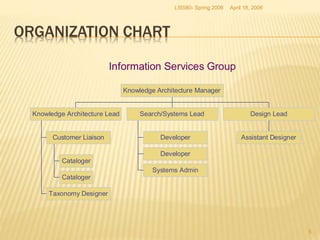
ORGANIZATION CHART
Information Services Group
Cataloger
Cataloger
Customer Liaison
Taxonomy Designer
Knowledge Architecture Lead
Developer
Developer
Systems Admin
Search/Systems Lead
Assistant Designer
Design Lead
Knowledge Architecture Manager
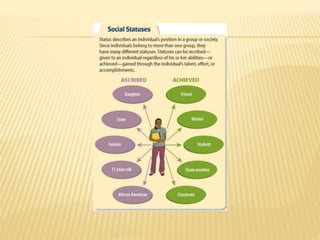
A social structure is a network of interrelated statuses and
roles that guide human behavior. A status is a socially
defined position, while a role is the behavior associated
with a status.
• Ascribed status is assigned
according to qualities beyond a
person’s control, such as age.
• Achieved status is acquired
through a person’s direct efforts,
such as education.
Ascribed and Achieved Statuses
Status
• Most people have many
statuses, but a master status is
the one that plays the greatest
role in a person’s life.
• It can be either ascribed or
achieved.
Master Status
Most of the formal structures
are defined in the corporation
papers or charter of the school
system, administrative
statutes, faculty handbook and
student handbook as they
contains the do’s and don’ts for
the persons involved in the
school system
Organizational
Structures- Determine
the hierarchy of the
communication and
social interaction within
the school system.
The rule to apply here will be
different according to whether the
school system is public or private.
 If it is public, Whether it is a state
college or university or a public
school.
 If it is private,whether it is a stock
corporation, a non- stock
corporation or a foundation.
 Organizational structure may also include
the relationship of the school system with
the parents-teachers association, student
government, faculty club or labor union.
 Social structures regulate the
communications and social interaction of
the administration with reference to other
administrators, faculty members and
students.
 They also regulates the communications
and social interactions of the students with
reference to administrators faculty and other
students
INFORMAL SOCIAL STRUCTURES
 The relationship among faculty
members with a doctorate degree,
masters degree or bachelor’s degree;
 The relationship between male or
female faculty member;
 The relationship among faculty
members in the colleges of Engineering
and of Human Sciences;
 The relationship between religious and
lay faculty member;
The relation between full-time
and part-time teachers;
The relation between faculty
members belonging to and not
belonging to the administration;
or
The relation between old faculty
members and new faculty
members.
WALTER SAYS:
As a social organism, the school shows an
organismic interdependence of its parts;it is not
possible to affect a part of it without affecting the
whole. As a social organism the school display a
differentiation of parts and specialization of
function. The organism as an entirely is nourished
by the community.
 Basic assumption:
A social human being is a reacting part of
the social school system. Self elicited activity
is rare and asocial.
This assumption is derived from the
interdependence between the individual and
other. Society exerts a marked influence upon
the individual.
The importance of this influence is such
that the individual becomes an
interdependent part of a system of human
interaction, rather than a separate and
completely unique individual in the
SCHOOL
 The two most important groups :
A. teacher-group
B. pupils-group
each of which has its own moral and
ethical code as well as its customary
attitudes towards members of the other
group
SCHEME OF THE MOST
IMPORTANT RELATIONSHIPS
ARISING IN THE SCHOOL AS A
SOCIAL SYSTEM
COMMUNITY-SCHOOL RELATIONSHIP
 Relation of the community to school in
general( mediated through tradition and
the political order of the community)
 Relation of the community to students
individually and in groups;
 The parental relation and the general
relation of the elders of the community
to the young;
 Relation of the community to teacher
 Relation of special groups in the
community to the school; ( the school
board, parents-teacher clubs, alumni
association, self-constituted advisort
group, etc.)
 Relation of special individuals in the
community to the school (patrons, ex-
teacher, patriarchs, hangers-on, etc)
PUPILS-TO-PUPILS RELATIONS AS NOT AFFECTED BY THE
PRESENCE OF TEACHER
 The pupils-to-pupils relationship.
 The pupils-to-pupils group
relationship.
 The pupils- group to-pupils group
relationship.
TEACHER-PUPILS RELATIONSHIP
( ALSO INCLUDING PUPIL-TO-PUPILS
RELATIONSHIP AS AFFECTED BY THE
PRESENCE OF TEACHERS)
 Teacher-to pupil relationship (the
customary classroom situation)
 Teacher-to pupil relationship
 Pupil-to-pupil relationship as affected by th
presence of the teacher.
TEACHER-TO-TEACHER REALATIONSHIP
 Relations of a teacher to another teacher.
 Teacher to teacher relationship as not affected
by the presence of students.
 Teacher-to-teacher relationship as affected by
the presence of students.
 Relation of teacher to teacher groups.
 Relation of teacher group to teacher group.
 Relation of teaching force to administrative
officer.
Administrator to administrator relationship
Administrator to teacher relationship
Administrator to students relationship
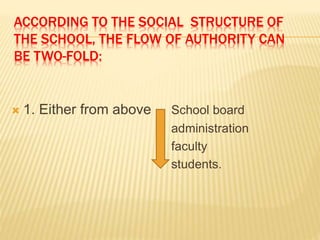
ACCORDING TO THE SOCIAL STRUCTURE OF
THE SCHOOL, THE FLOW OF AUTHORITY CAN
BE TWO-FOLD:
 1. Either from above School board
administration
faculty
students.
 2. or from below as
administrator
practiced in higher faculty
education in students
Latin America
CONCLUSION
In the social aspect, the school must
consider the socio-economic mobility of the
graduates that they would be able to move to a
higher status to lessen the social problems in
the community, and minimize social and
discriminating social stratification in the
community.
REFERENCES:
 Zwaennepoel, Paul P. (1997), System
Analysis in Education. Manila: UST Press.
 Systems Analysis in Educational
Management Module
THANK YOU!

The social subsystem inside the schoolsystem

  • 1.
    THE SOCIAL SUBSYSTEM INSIDETHE SCHOOLSYSTEM Eloisa R. Anda PhD. Ed M Student
  • 2.
    In the SchoolSystem there exist formal Social Structures which consist mainly of the communications and social interactions among the administrators, faculty and students.
  • 3.
    April 18, 2006LIS580-Spring 2006 3 WHAT IS ORGANIZING?  Organizing  Arranging the activities of the enterprise in such a way that they systematically contribute to the enterprise’s goals. G.Dessler, 2003
  • 4.
    April 18, 2006LIS580-Spring 2006 4 DEPICTING THE ORGANIZATION  Organization Chart  A chart that shows the structure of the organization including the title of each manager’s position and, by means of connecting lines, who is accountable to whom and who has authority for each area. G.Dessler, 2003
  • 5.
    April 18, 2006LIS580-Spring 2006 5 ORGANIZATION CHART Information Services Group Cataloger Cataloger Customer Liaison Taxonomy Designer Knowledge Architecture Lead Developer Developer Systems Admin Search/Systems Lead Assistant Designer Design Lead Knowledge Architecture Manager
  • 6.
    A social structureis a network of interrelated statuses and roles that guide human behavior. A status is a socially defined position, while a role is the behavior associated with a status. • Ascribed status is assigned according to qualities beyond a person’s control, such as age. • Achieved status is acquired through a person’s direct efforts, such as education. Ascribed and Achieved Statuses Status • Most people have many statuses, but a master status is the one that plays the greatest role in a person’s life. • It can be either ascribed or achieved. Master Status
  • 8.
    Most of theformal structures are defined in the corporation papers or charter of the school system, administrative statutes, faculty handbook and student handbook as they contains the do’s and don’ts for the persons involved in the school system
  • 9.
    Organizational Structures- Determine the hierarchyof the communication and social interaction within the school system.
  • 10.
    The rule toapply here will be different according to whether the school system is public or private.  If it is public, Whether it is a state college or university or a public school.  If it is private,whether it is a stock corporation, a non- stock corporation or a foundation.
  • 11.
     Organizational structuremay also include the relationship of the school system with the parents-teachers association, student government, faculty club or labor union.  Social structures regulate the communications and social interaction of the administration with reference to other administrators, faculty members and students.  They also regulates the communications and social interactions of the students with reference to administrators faculty and other students
  • 12.
    INFORMAL SOCIAL STRUCTURES The relationship among faculty members with a doctorate degree, masters degree or bachelor’s degree;  The relationship between male or female faculty member;  The relationship among faculty members in the colleges of Engineering and of Human Sciences;  The relationship between religious and lay faculty member;
  • 13.
    The relation betweenfull-time and part-time teachers; The relation between faculty members belonging to and not belonging to the administration; or The relation between old faculty members and new faculty members.
  • 14.
    WALTER SAYS: As asocial organism, the school shows an organismic interdependence of its parts;it is not possible to affect a part of it without affecting the whole. As a social organism the school display a differentiation of parts and specialization of function. The organism as an entirely is nourished by the community.
  • 15.
     Basic assumption: Asocial human being is a reacting part of the social school system. Self elicited activity is rare and asocial. This assumption is derived from the interdependence between the individual and other. Society exerts a marked influence upon the individual. The importance of this influence is such that the individual becomes an interdependent part of a system of human interaction, rather than a separate and completely unique individual in the
  • 16.
    SCHOOL  The twomost important groups : A. teacher-group B. pupils-group each of which has its own moral and ethical code as well as its customary attitudes towards members of the other group
  • 17.
    SCHEME OF THEMOST IMPORTANT RELATIONSHIPS ARISING IN THE SCHOOL AS A SOCIAL SYSTEM
  • 18.
    COMMUNITY-SCHOOL RELATIONSHIP  Relationof the community to school in general( mediated through tradition and the political order of the community)  Relation of the community to students individually and in groups;  The parental relation and the general relation of the elders of the community to the young;
  • 19.
     Relation ofthe community to teacher  Relation of special groups in the community to the school; ( the school board, parents-teacher clubs, alumni association, self-constituted advisort group, etc.)  Relation of special individuals in the community to the school (patrons, ex- teacher, patriarchs, hangers-on, etc)
  • 20.
    PUPILS-TO-PUPILS RELATIONS ASNOT AFFECTED BY THE PRESENCE OF TEACHER  The pupils-to-pupils relationship.  The pupils-to-pupils group relationship.  The pupils- group to-pupils group relationship.
  • 21.
    TEACHER-PUPILS RELATIONSHIP ( ALSOINCLUDING PUPIL-TO-PUPILS RELATIONSHIP AS AFFECTED BY THE PRESENCE OF TEACHERS)  Teacher-to pupil relationship (the customary classroom situation)  Teacher-to pupil relationship  Pupil-to-pupil relationship as affected by th presence of the teacher.
  • 22.
    TEACHER-TO-TEACHER REALATIONSHIP  Relationsof a teacher to another teacher.  Teacher to teacher relationship as not affected by the presence of students.  Teacher-to-teacher relationship as affected by the presence of students.  Relation of teacher to teacher groups.  Relation of teacher group to teacher group.  Relation of teaching force to administrative officer.
  • 23.
    Administrator to administratorrelationship Administrator to teacher relationship Administrator to students relationship
  • 24.
    ACCORDING TO THESOCIAL STRUCTURE OF THE SCHOOL, THE FLOW OF AUTHORITY CAN BE TWO-FOLD:  1. Either from above School board administration faculty students.
  • 25.
     2. orfrom below as administrator practiced in higher faculty education in students Latin America
  • 26.
    CONCLUSION In the socialaspect, the school must consider the socio-economic mobility of the graduates that they would be able to move to a higher status to lessen the social problems in the community, and minimize social and discriminating social stratification in the community.
  • 27.
    REFERENCES:  Zwaennepoel, PaulP. (1997), System Analysis in Education. Manila: UST Press.  Systems Analysis in Educational Management Module
  • 28.