










Leadership Development
       Program
         LDP

    The Leadership Network


                             1
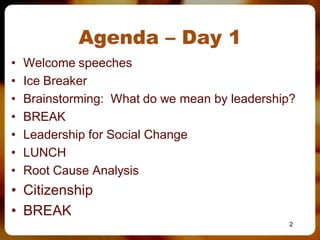
Agenda – Day 1
•   Welcome speeches
•   Ice Breaker
•   Brainstorming: What do we mean by leadership?
•   BREAK
•   Leadership for Social Change
•   LUNCH
•   Root Cause Analysis
• Citizenship
• BREAK
                                               2
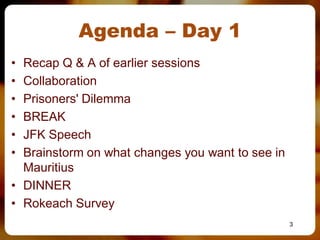
Agenda – Day 1
• Recap Q & A of earlier sessions
• Collaboration
• Prisoners' Dilemma
• BREAK
• JFK Speech
• Brainstorm on what changes you want to see in
  Mauritius
• DINNER
• Rokeach Survey
                                                  3
THE FACILITATORS


• Daden Venkatasawmy
 Managing Director, First Exec


• Rajendra Patil Hunma
 General Manager – HR, Currimjee Jeewanjee & Co. Ltd


                                                   4
Our Expectations

• Participate

• Read

• Think

• Take ‘Personal’ Notes
                          5
Brainstorming Session
•   Names that come to mind?
•   What is leadership?
•   What do we understand by social
    change?
•   What is the link between leadership for
    social change?

                                         6
Discussion

• What do we mean by leadership ?

• Do we have a common understanding?

• Who are the leaders?


                                    7
Discussion


• What are our values about people?


                                 8
Discussion

• Why are we interested in leadership?

• What about the role of followers?


                                      9
10
BREAK


        11
Current thinking
• Leadership is socially responsible.
• Leadership is collaborative.
• Leadership is a process, not a position.
• Leadership is inclusive and accessible to all
  people.
• Leadership is values-based.
• Community involvement is a powerful
  vehicle for leadership.
                                            12
OUR VISION

• Fostering social change through leadership
  development
• Providing opportunity to be part of a network,
  where other leaders share similar values and
  aspirations
• Networking individuals with a common
  understanding of leadership and … social
  change
                                           13
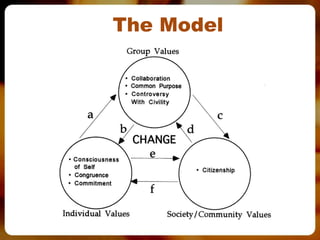
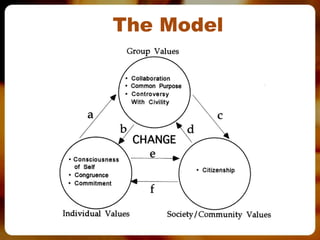
THE MODEL
• The Social Change Model was initially
  designed in the 90’s by a team of US
  researchers
• Currently used in a number of American
  universities.
• Adapted version run twice in Mauritius already
• “Leadership for a Better World”, written by
  Susan Komives et al. in 2009.
                                           14
Current thinking

• Leadership is not necessarily a
  position

• Leadership is not necessarily a status

• Leadership is different from authority
                                       15
Leadership v/s Authority

• Many people occupy positions of
  authority without ever mobilizing their
  organizations to address tough
  adaptive changes


                                        16
Leadership v/s Authority

• Authority, influence and power are
  critical tools

• But they do not define leadership

• When I become a leader, I shall …
                                       17
Democratization of
      Leadership - 1

• From an elitist paradigm in which
  leadership resided in a person, to a
  new one in which leadership is a
  collective process that is spread
  throughout networks of people.

                                     18
Democratization of
        Leadership - 2

• A future made up of complex, chaotic,
 volatile environments is less suited to
 the problem solving of lone, authority
 figures than it is to the distributed
 efforts of smart, flexible, dynamic
 leadership networks.
                                       19
Democratization of
         Leadership - 3

•   Shift of focus from LEADER to
    LEADERSHIP


                               20
Transformational
         Leadership

• Transformational leadership
  espouses a relationship between
  leaders and followers in which each
  transforms the other.


                                    21
Transformational
      Leadership

Leaders transform followers,
helping them to become leaders
themselves


                                 22
Transformational
           Leadership
• The aim of leadership is to transform
  leaders and followers into better, more
  self-actualized people

• The process involves leaders and
  followers raising one another to higher
  levels of motivation and morality
                                       23
Transformational
             v.s
  Transactional Leadership

• Transactional leadership involves power
  wielders engaged in a politics of
  exchange
     • more interested in satisfying their
       own purposes than in the aspirations
       of their followers              24
Leadership for social
          change

• Leadership is a relational and ethical
  process of people together attempting
  to accomplish positive change
   – focus on values
   – focus on authentic relationships

                                      25
Leadership for social
           change

Leadership is redundant if the goal
 is to maintain status quo.

Absence of required change is an
 evidence of leadership failure.
 –

                                       26
Leadership for social
          change

• Change is the ultimate goal of the
  creative process of leadership – to
  make a better society / a better world
  or simply to live a better life


                                      27
“If leaders are to be successful, they
  must first lead themselves.”

                       (John Maxwell)


                                         28
Leadership for social
          change

• Leadership requires an awareness
  that problems affect not only others
  but also ourselves directly or
  indirectly


                                         29
Ubuntu
 South African Concept

• My humanity is caught up, is
  inextricably bound up in yours – a
  person is a person through other
  persons – one belongs to a greater
  whole and is diminished when
  others are humiliated or diminished
                                    30
Leadership for social
          change

• Change should be preceded by an in-
  depth understanding of the underlying
  root / systemic causes

• Leadership implies intentionality – the
  change is not random
                                       31
Leadership for social
         change
Need to differentiate between

• Technical problems / solutions

• Adaptive challenges / solutions


                                    32
Leadership for social
         change

• Technical problems: solutions are
  known to the relevant experts /
  authorities

• No effort / participation required
  from those affected
                                       33
Leadership for social
          change

• Adaptive challenges: requiring
  collaborative and innovative
  approaches, and changes in people’s
  priorities, beliefs, lifestyles, learning
  AND effective leadership

  –With risks of failure / losses
  –No known / ready-made answers        34
Leadership for social
          change

• Leadership is a purposive process /
  activity that is inherently value-based

• What are some of these values?


                                       35
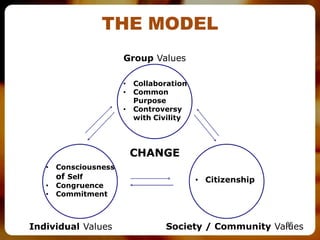
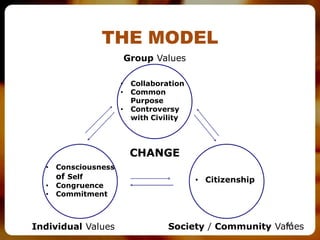
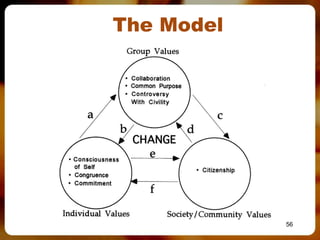
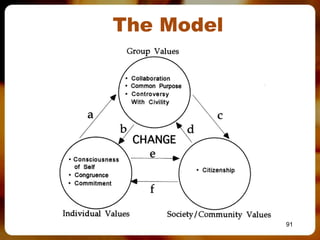
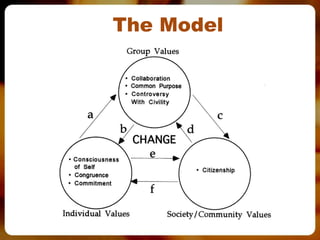
THE MODEL
                       Group Values

                       •   Collaboration
                       •   Common
                           Purpose
                       •   Controversy
                           with Civility


                           CHANGE
   •   Consciousness
       of Self                             • Citizenship
   •   Congruence
   •   Commitment


Individual Values                 Society / Community Values
                                                        36
Community Value
Citizenship
A process whereby an individual
 and/or group becomes responsibly
 connected to the community and to
 society through some activity.

Recognizing we have a responsibility
 for the welfare of others.
                                  37
Group Values - 1
Collaboration

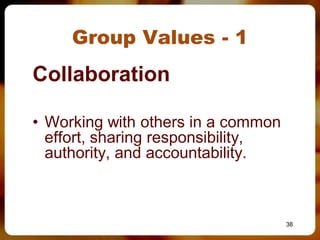
• Working with others in a common
  effort, sharing responsibility,
  authority, and accountability.


                                    38
Group Values - 2

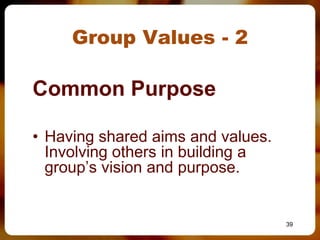
Common Purpose

• Having shared aims and values.
  Involving others in building a
  group’s vision and purpose.


                                   39
Group Values - 3
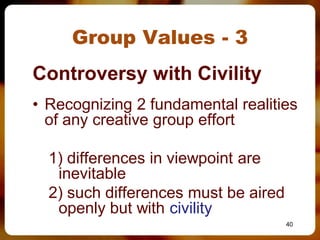
Controversy with Civility
• Recognizing 2 fundamental realities
  of any creative group effort

  1) differences in viewpoint are
   inevitable
  2) such differences must be aired
   openly but with civility
                                      40
Individual Values - 1
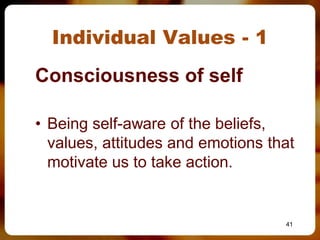
Consciousness of self

• Being self-aware of the beliefs,
  values, attitudes and emotions that
  motivate us to take action.


                                   41
Individual Values - 2
Congruence

• Acting in ways that are consistent
  our values and beliefs.


                                       42
Individual Values - 3
Commitment

• Having significant investment in an
  idea or person, both in terms of
  intensity and duration.


                                   43
THE MODEL
                          Group Values

                      •    Collaboration
                      •    Common
                           Purpose
                      •    Controversy
                           with Civility


                           CHANGE
  •   Consciousness
      of Self                              • Citizenship
  •   Congruence
  •   Commitment


Individual Values                   Society / Community Values
                                                          44
WHY DO WE NEED A
MODEL?
                   45
Why do we need a
          model?

• A guide

• A common understanding

• A yardstick

                           46
Leadership


• Reading about Leadership v/s
  ‘Doing’ Leadership
• We also need concrete experience
• Is experience enough?
• What else is required?

                                     47
Leadership cannot be taught …
but it can be learned…


                                48
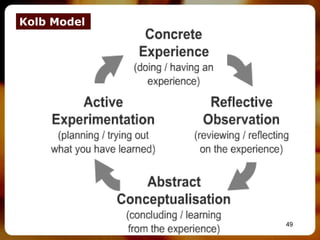
Kolb Model


             49
Relevance of the Kolb
        Model
• Leadership has to do with
  –Doing
  –Learning
  –Becoming
  –Being
• We need to be prepared to embark
  on an inner journey            50
Differences between
                                  –

Management and Leadership?


                             51
Management functions

• Planning

• Organising

• Staffing

• Controlling
                        52
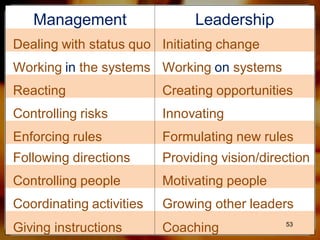
Management                  Leadership
Dealing with status quo Initiating change
Working in the systems Working on systems
Reacting                  Creating opportunities
Controlling risks         Innovating
Enforcing rules           Formulating new rules
Following directions      Providing vision/direction
Controlling people        Motivating people
Coordinating activities   Growing other leaders
                                               53
Giving instructions       Coaching
What is Social Change?

• Not charity and sporadic volunteerism
  –Charity - risk of creating dependencies
  –Focus on root causes of problems
  –Focus on building relationships and
   collaboration with others (including the
   ‘victims’)

                                       54
“Change will not come if we wait for
some other person or some other
time. We are the ones we've been
waiting for. We are the change that
we seek.”
                      Barack Obama


                                  55
The Model


            56
Quick Recap


              57
Quick Recap
•   Leadership as an ethical process
•   Leadership v/s authority or position
•   Democratization of leadership
•   Transformational leadership
•   Transactional leadership
•   Leading ourselves
•   Approach to change
•   Values-driven leadership model     58
REFLECTION QUESTIONS
• Can you remember a time when you
  thought about leadership differently
  from what you do now?

• How is your current understanding
  different?

                                      59
REFLECTION QUESTIONS
• What is your evaluation of leadership
  among people you know?

• Do they practice transformational or
  transactional leadership?

• Are they values-driven?
                                         60
Questions


            61
APPROACH TO CHANGE

    Root-Cause Analysis
THE FISHBONE DIAGRAM
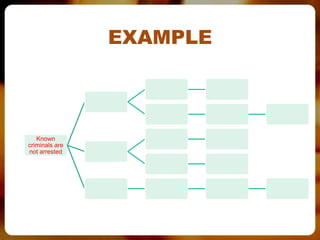
EXAMPLE


   Known
criminals are
not arrested
GROUP WORK:
ROOT CAUSE ANALYSIS
CITIZENSHIP


              67
Objectives of the Session
• By the end of this session
  participants will demonstrate a
  clear understanding of the
  following concepts:

  –Citizenship
  –Social capital
  –Bonding
  –Bridging                         68
WHAT IS CITIZENSHIP?


                       69
Citizenship


• Citizenship is a nebulous concept,
 often associated only with
 government, political parties, voting,
 and political organizations.

                                       70
Citizenship

• Citizenship involves working to make
  a difference in the civic life of our
  communities

• And developing the combination of
  knowledge, skills and values and
  motivation to make that difference
                                       71
Why do we get involved?
• Personal connection with the social
  issue

• Enjoying connection with others while
  working together

• Recognizing that helping others
  ultimately helps oneself
                                        72
Why do we get involved?


• Recognizing the interconnected
  nature of problems
  –a good education benefits
    individuals as well as society


                                     73
Ubuntu
 South African Concept

• My humanity is caught up, is
  inextricably bound up in yours – a
  person is a person through other
  persons – one belongs to a greater
  whole and is diminished when
  others are humiliated or diminished
                                    74
Why do we get involved?

• Experiencing a deep satisfaction from
  being involved in making a difference
  for something that truly matters


                                     75
Why do we get involved?

• Being involved in a purpose greater
  than self
   –being a teacher to help children,
   –being a lawyer to protect people’s
    rights,
   –being a journalist to reveal the
    truth.. .
                                         76
Citizenship


• Democracy refers to people working
 together so that communities can
 function


                                       77
Citizenship

• Citizenship means more than
 membership; it implies active
 engagement of the individual and of
 the leadership group in an effort to
 serve the community.
                                        78
Community

• What are the communities you feel
  part of?

• How can you be active citizens of
  these communities?


                                      79
Community


• A community is a group of people
 who have some defined trait or
 circumstance that binds them
 together

                                     80
Citizenship

• Passive or active?
• Citizenship centers on active
  community participation as a
  result of a sense of responsibility
  to the communities in which we
  live.

                                        81
Citizenship through
• direct service
• community research
• advocacy and education
• capacity building
• political involvement
• socially responsible personal
  and professional behavior
• philanthropic giving
• participation in associations …
                                82
Social Capital
• An essential component of citizenship

  –“networks, norms, and social trust
   that facilitate coordination and
   cooperation for mutual benefit”

                     –(Robert Putnam)
                                    83
Social Capital


• ‘Life is easier’ for those who live in
 communities that have worked to
 foster social capital


                                           84
Discussion

• Can you think of cases of
 destruction of communities and the
 consequences thereof?


                                  85
“Bonding” and “Bridging”

• Social capital is about the value of
 social networks,

• and involves bonding and

• bridging .


                                         86
“Bonding” and “Bridging”

• Bonding refers to social networks
  between people who are similar,

• Bridging refers to social networks
  among diverse people

                                       87
“Bonding” and “Bridging”

• Bonding is useful for getting by

• Bridging is what is needed to get
  ahead


                                      88
Recap
• Citizenship

• Community

• Social capital

• Bonding

• Bridging
                           89
Discussion

 What does citizenship have to do
         with leadership?

Why is citizenship one of key values
            of leadership?

                                  90
The Model


            91
COLLABORATION
OBJECTIVES OF SESSION 3
By the end of this session participants will be
 able to demonstrate a clear understanding of
 the following concepts as they apply to
 leadership in the Social Change Model (SCM)

  – Collaboration
  – Competition, Cooperation, Compromise
  – Effectiveness of Diversity
  – Pre-requisites for effective collaboration
  – Link with other C’s
The Model
WHAT IS
COLLABORATION?
COLLABORATION

Collaboration – The social change
model defines collaboration as:
• “working together toward common
  goals
• by sharing responsibility, authority,
  and accountability in achieving
  these goals.”
COLLABORATION
Not to be confused with…
• Competition
  – Work hard to do better than others
• Co-operation
  – helps each party to achieve its own
    individual goals, not common goals
• Compromise
  – involves a party losing something in
    order to accomplish goals
COLLABORATION

Is about…
• Common Aims, Vision
• Sharing Responsibility,
  Commitment
• Focusing on Talents, Synergy

…in order to DO something!
DIVERSITY

Diversity is an essential part of
collaboration and
• multiplies group effectiveness
• by taking advantage of multiple
  talents and points of view
• to generate innovative ideas and
  solutions.
DIVERSITY

• Individuals of diverse backgrounds
  bring unique values, learning
  styles, opinions and attitudes to
  a group.
• Although challenges may arise, the
  benefits outweigh them
  significantly.
MAKING IT WORK
• Personal Work

  –understanding one’s own values
   and beliefs as well as developing
   Consciousness of Self
MAKING IT WORK
• Building Trust
  – informal exploring (getting to know other
    people’s values and backgrounds),
  – sharing ownership (members must take
    control of the leadership process),
  – celebrating success (helps promote
    energy and renewal),
  – creating powerful, shared experiences to
    bolster group goals
MAKING IT WORK
• Communicating
  –Listening
  –Paying attention to what others
   have to say
  –Communicating Early and
   Clearly
  –Using Observations
COLLABORATION and
       CITIZENSHIP
•   Our destinies are Inter-related
•   We are ALL Responsible
•   We belong to many Communities
•   Social Capital
•   Bonding and Bridging
COLLABORATION and
    ADAPTIVE Leadership
•   Collaboration on Technical Issues
•   Collaboration on Adaptive Issues
•   Adapt your own behaviour
•   ‘Victims’ have to adapt too
•   Ongoing Communication
•   Trust
LINKS WITH THE 6 C’S
The Model
QUESTIONS
INTERACTIVE SESSION

    Prisoners’ Dilemma
Prisoners’ Dilemma


The purpose of the
game is for each team
to get a positive score


                          110
BREAK
JOHN F. KENNEDY
INAUGURAL ADDRESS - 1961


• Note instances of / references to:
  –Leadership
  –Citizenship
• What elements of the speech would
  YOU use in the local context?
JFK SPEECH (1/2)
• from this time and place
• to a new generation of Americans
• we shall pay any price
• Divided there is little we can do
• …help them help
  themselves…because it is right
• civility is not a sign of weakness
JFK SPEECH (2/2)
• explore what problems unite us
• All this will not be finished in the first
  one hundred days…But let us begin
• Will you join in that historic effort?
• I do not shrink from this responsibility, I
  welcome it.
• ask of us here the same high standards
  of strength and sacrifice which we ask
  of you
JFK SPEECH


• ask not what your country can do
  for you; ask what you can do for
  your country
The Model
Q&A
FEEDBACK
ROKEACH SURVEY

  Post Dinner Session

LDP Day 1 Slides

  • 1.
    Leadership Development Program LDP The Leadership Network 1
  • 2.
    Agenda – Day1 • Welcome speeches • Ice Breaker • Brainstorming: What do we mean by leadership? • BREAK • Leadership for Social Change • LUNCH • Root Cause Analysis • Citizenship • BREAK 2
  • 3.
    Agenda – Day1 • Recap Q & A of earlier sessions • Collaboration • Prisoners' Dilemma • BREAK • JFK Speech • Brainstorm on what changes you want to see in Mauritius • DINNER • Rokeach Survey 3
  • 4.
    THE FACILITATORS • DadenVenkatasawmy Managing Director, First Exec • Rajendra Patil Hunma General Manager – HR, Currimjee Jeewanjee & Co. Ltd 4
  • 5.
    Our Expectations • Participate •Read • Think • Take ‘Personal’ Notes 5
  • 6.
    Brainstorming Session • Names that come to mind? • What is leadership? • What do we understand by social change? • What is the link between leadership for social change? 6
  • 7.
    Discussion • What dowe mean by leadership ? • Do we have a common understanding? • Who are the leaders? 7
  • 8.
    Discussion • What areour values about people? 8
  • 9.
    Discussion • Why arewe interested in leadership? • What about the role of followers? 9
  • 10.
  • 11.
  • 12.
    Current thinking • Leadershipis socially responsible. • Leadership is collaborative. • Leadership is a process, not a position. • Leadership is inclusive and accessible to all people. • Leadership is values-based. • Community involvement is a powerful vehicle for leadership. 12
  • 13.
    OUR VISION • Fosteringsocial change through leadership development • Providing opportunity to be part of a network, where other leaders share similar values and aspirations • Networking individuals with a common understanding of leadership and … social change 13
  • 14.
    THE MODEL • TheSocial Change Model was initially designed in the 90’s by a team of US researchers • Currently used in a number of American universities. • Adapted version run twice in Mauritius already • “Leadership for a Better World”, written by Susan Komives et al. in 2009. 14
  • 15.
    Current thinking • Leadershipis not necessarily a position • Leadership is not necessarily a status • Leadership is different from authority 15
  • 16.
    Leadership v/s Authority •Many people occupy positions of authority without ever mobilizing their organizations to address tough adaptive changes 16
  • 17.
    Leadership v/s Authority •Authority, influence and power are critical tools • But they do not define leadership • When I become a leader, I shall … 17
  • 18.
    Democratization of Leadership - 1 • From an elitist paradigm in which leadership resided in a person, to a new one in which leadership is a collective process that is spread throughout networks of people. 18
  • 19.
    Democratization of Leadership - 2 • A future made up of complex, chaotic, volatile environments is less suited to the problem solving of lone, authority figures than it is to the distributed efforts of smart, flexible, dynamic leadership networks. 19
  • 20.
    Democratization of Leadership - 3 • Shift of focus from LEADER to LEADERSHIP 20
  • 21.
    Transformational Leadership • Transformational leadership espouses a relationship between leaders and followers in which each transforms the other. 21
  • 22.
    Transformational Leadership Leaders transform followers, helping them to become leaders themselves 22
  • 23.
    Transformational Leadership • The aim of leadership is to transform leaders and followers into better, more self-actualized people • The process involves leaders and followers raising one another to higher levels of motivation and morality 23
  • 24.
    Transformational v.s Transactional Leadership • Transactional leadership involves power wielders engaged in a politics of exchange • more interested in satisfying their own purposes than in the aspirations of their followers 24
  • 25.
    Leadership for social change • Leadership is a relational and ethical process of people together attempting to accomplish positive change – focus on values – focus on authentic relationships 25
  • 26.
    Leadership for social change Leadership is redundant if the goal is to maintain status quo. Absence of required change is an evidence of leadership failure. – 26
  • 27.
    Leadership for social change • Change is the ultimate goal of the creative process of leadership – to make a better society / a better world or simply to live a better life 27
  • 28.
    “If leaders areto be successful, they must first lead themselves.” (John Maxwell) 28
  • 29.
    Leadership for social change • Leadership requires an awareness that problems affect not only others but also ourselves directly or indirectly 29
  • 30.
    Ubuntu South AfricanConcept • My humanity is caught up, is inextricably bound up in yours – a person is a person through other persons – one belongs to a greater whole and is diminished when others are humiliated or diminished 30
  • 31.
    Leadership for social change • Change should be preceded by an in- depth understanding of the underlying root / systemic causes • Leadership implies intentionality – the change is not random 31
  • 32.
    Leadership for social change Need to differentiate between • Technical problems / solutions • Adaptive challenges / solutions 32
  • 33.
    Leadership for social change • Technical problems: solutions are known to the relevant experts / authorities • No effort / participation required from those affected 33
  • 34.
    Leadership for social change • Adaptive challenges: requiring collaborative and innovative approaches, and changes in people’s priorities, beliefs, lifestyles, learning AND effective leadership –With risks of failure / losses –No known / ready-made answers 34
  • 35.
    Leadership for social change • Leadership is a purposive process / activity that is inherently value-based • What are some of these values? 35
  • 36.
    THE MODEL Group Values • Collaboration • Common Purpose • Controversy with Civility CHANGE • Consciousness of Self • Citizenship • Congruence • Commitment Individual Values Society / Community Values 36
  • 37.
    Community Value Citizenship A processwhereby an individual and/or group becomes responsibly connected to the community and to society through some activity. Recognizing we have a responsibility for the welfare of others. 37
  • 38.
    Group Values -1 Collaboration • Working with others in a common effort, sharing responsibility, authority, and accountability. 38
  • 39.
    Group Values -2 Common Purpose • Having shared aims and values. Involving others in building a group’s vision and purpose. 39
  • 40.
    Group Values -3 Controversy with Civility • Recognizing 2 fundamental realities of any creative group effort 1) differences in viewpoint are inevitable 2) such differences must be aired openly but with civility 40
  • 41.
    Individual Values -1 Consciousness of self • Being self-aware of the beliefs, values, attitudes and emotions that motivate us to take action. 41
  • 42.
    Individual Values -2 Congruence • Acting in ways that are consistent our values and beliefs. 42
  • 43.
    Individual Values -3 Commitment • Having significant investment in an idea or person, both in terms of intensity and duration. 43
  • 44.
    THE MODEL Group Values • Collaboration • Common Purpose • Controversy with Civility CHANGE • Consciousness of Self • Citizenship • Congruence • Commitment Individual Values Society / Community Values 44
  • 45.
    WHY DO WENEED A MODEL? 45
  • 46.
    Why do weneed a model? • A guide • A common understanding • A yardstick 46
  • 47.
    Leadership • Reading aboutLeadership v/s ‘Doing’ Leadership • We also need concrete experience • Is experience enough? • What else is required? 47
  • 48.
    Leadership cannot betaught … but it can be learned… 48
  • 49.
  • 50.
    Relevance of theKolb Model • Leadership has to do with –Doing –Learning –Becoming –Being • We need to be prepared to embark on an inner journey 50
  • 51.
    Differences between – Management and Leadership? 51
  • 52.
    Management functions • Planning •Organising • Staffing • Controlling 52
  • 53.
    Management Leadership Dealing with status quo Initiating change Working in the systems Working on systems Reacting Creating opportunities Controlling risks Innovating Enforcing rules Formulating new rules Following directions Providing vision/direction Controlling people Motivating people Coordinating activities Growing other leaders 53 Giving instructions Coaching
  • 54.
    What is SocialChange? • Not charity and sporadic volunteerism –Charity - risk of creating dependencies –Focus on root causes of problems –Focus on building relationships and collaboration with others (including the ‘victims’) 54
  • 55.
    “Change will notcome if we wait for some other person or some other time. We are the ones we've been waiting for. We are the change that we seek.” Barack Obama 55
  • 56.
  • 57.
  • 58.
    Quick Recap • Leadership as an ethical process • Leadership v/s authority or position • Democratization of leadership • Transformational leadership • Transactional leadership • Leading ourselves • Approach to change • Values-driven leadership model 58
  • 59.
    REFLECTION QUESTIONS • Canyou remember a time when you thought about leadership differently from what you do now? • How is your current understanding different? 59
  • 60.
    REFLECTION QUESTIONS • Whatis your evaluation of leadership among people you know? • Do they practice transformational or transactional leadership? • Are they values-driven? 60
  • 61.
  • 62.
    APPROACH TO CHANGE Root-Cause Analysis
  • 63.
  • 64.
  • 65.
    EXAMPLE Known criminals are not arrested
  • 66.
  • 67.
  • 68.
    Objectives of theSession • By the end of this session participants will demonstrate a clear understanding of the following concepts: –Citizenship –Social capital –Bonding –Bridging 68
  • 69.
  • 70.
    Citizenship • Citizenship isa nebulous concept, often associated only with government, political parties, voting, and political organizations. 70
  • 71.
    Citizenship • Citizenship involvesworking to make a difference in the civic life of our communities • And developing the combination of knowledge, skills and values and motivation to make that difference 71
  • 72.
    Why do weget involved? • Personal connection with the social issue • Enjoying connection with others while working together • Recognizing that helping others ultimately helps oneself 72
  • 73.
    Why do weget involved? • Recognizing the interconnected nature of problems –a good education benefits individuals as well as society 73
  • 74.
    Ubuntu South AfricanConcept • My humanity is caught up, is inextricably bound up in yours – a person is a person through other persons – one belongs to a greater whole and is diminished when others are humiliated or diminished 74
  • 75.
    Why do weget involved? • Experiencing a deep satisfaction from being involved in making a difference for something that truly matters 75
  • 76.
    Why do weget involved? • Being involved in a purpose greater than self –being a teacher to help children, –being a lawyer to protect people’s rights, –being a journalist to reveal the truth.. . 76
  • 77.
    Citizenship • Democracy refersto people working together so that communities can function 77
  • 78.
    Citizenship • Citizenship meansmore than membership; it implies active engagement of the individual and of the leadership group in an effort to serve the community. 78
  • 79.
    Community • What arethe communities you feel part of? • How can you be active citizens of these communities? 79
  • 80.
    Community • A communityis a group of people who have some defined trait or circumstance that binds them together 80
  • 81.
    Citizenship • Passive oractive? • Citizenship centers on active community participation as a result of a sense of responsibility to the communities in which we live. 81
  • 82.
    Citizenship through • directservice • community research • advocacy and education • capacity building • political involvement • socially responsible personal and professional behavior • philanthropic giving • participation in associations … 82
  • 83.
    Social Capital • Anessential component of citizenship –“networks, norms, and social trust that facilitate coordination and cooperation for mutual benefit” –(Robert Putnam) 83
  • 84.
    Social Capital • ‘Lifeis easier’ for those who live in communities that have worked to foster social capital 84
  • 85.
    Discussion • Can youthink of cases of destruction of communities and the consequences thereof? 85
  • 86.
    “Bonding” and “Bridging” •Social capital is about the value of social networks, • and involves bonding and • bridging . 86
  • 87.
    “Bonding” and “Bridging” •Bonding refers to social networks between people who are similar, • Bridging refers to social networks among diverse people 87
  • 88.
    “Bonding” and “Bridging” •Bonding is useful for getting by • Bridging is what is needed to get ahead 88
  • 89.
    Recap • Citizenship • Community •Social capital • Bonding • Bridging 89
  • 90.
    Discussion What doescitizenship have to do with leadership? Why is citizenship one of key values of leadership? 90
  • 91.
  • 92.
  • 93.
    OBJECTIVES OF SESSION3 By the end of this session participants will be able to demonstrate a clear understanding of the following concepts as they apply to leadership in the Social Change Model (SCM) – Collaboration – Competition, Cooperation, Compromise – Effectiveness of Diversity – Pre-requisites for effective collaboration – Link with other C’s
  • 94.
  • 95.
  • 96.
    COLLABORATION Collaboration – Thesocial change model defines collaboration as: • “working together toward common goals • by sharing responsibility, authority, and accountability in achieving these goals.”
  • 97.
    COLLABORATION Not to beconfused with… • Competition – Work hard to do better than others • Co-operation – helps each party to achieve its own individual goals, not common goals • Compromise – involves a party losing something in order to accomplish goals
  • 98.
    COLLABORATION Is about… • CommonAims, Vision • Sharing Responsibility, Commitment • Focusing on Talents, Synergy …in order to DO something!
  • 99.
    DIVERSITY Diversity is anessential part of collaboration and • multiplies group effectiveness • by taking advantage of multiple talents and points of view • to generate innovative ideas and solutions.
  • 100.
    DIVERSITY • Individuals ofdiverse backgrounds bring unique values, learning styles, opinions and attitudes to a group. • Although challenges may arise, the benefits outweigh them significantly.
  • 101.
    MAKING IT WORK •Personal Work –understanding one’s own values and beliefs as well as developing Consciousness of Self
  • 102.
    MAKING IT WORK •Building Trust – informal exploring (getting to know other people’s values and backgrounds), – sharing ownership (members must take control of the leadership process), – celebrating success (helps promote energy and renewal), – creating powerful, shared experiences to bolster group goals
  • 103.
    MAKING IT WORK •Communicating –Listening –Paying attention to what others have to say –Communicating Early and Clearly –Using Observations
  • 104.
    COLLABORATION and CITIZENSHIP • Our destinies are Inter-related • We are ALL Responsible • We belong to many Communities • Social Capital • Bonding and Bridging
  • 105.
    COLLABORATION and ADAPTIVE Leadership • Collaboration on Technical Issues • Collaboration on Adaptive Issues • Adapt your own behaviour • ‘Victims’ have to adapt too • Ongoing Communication • Trust
  • 106.
  • 107.
  • 108.
  • 109.
    INTERACTIVE SESSION Prisoners’ Dilemma
  • 110.
    Prisoners’ Dilemma The purposeof the game is for each team to get a positive score 110
  • 111.
  • 112.
    JOHN F. KENNEDY INAUGURALADDRESS - 1961 • Note instances of / references to: –Leadership –Citizenship • What elements of the speech would YOU use in the local context?
  • 113.
    JFK SPEECH (1/2) •from this time and place • to a new generation of Americans • we shall pay any price • Divided there is little we can do • …help them help themselves…because it is right • civility is not a sign of weakness
  • 114.
    JFK SPEECH (2/2) •explore what problems unite us • All this will not be finished in the first one hundred days…But let us begin • Will you join in that historic effort? • I do not shrink from this responsibility, I welcome it. • ask of us here the same high standards of strength and sacrifice which we ask of you
  • 115.
    JFK SPEECH • asknot what your country can do for you; ask what you can do for your country
  • 116.
  • 117.
  • 118.
    ROKEACH SURVEY Post Dinner Session