THE SECURITY
CERTIFICATION AND
ACCREDITATION PROCESS
NAME: MONIKA A
REGISTER NUMBER: 2018503044
INTRODUCTION
THE SECURITY CERTIFICATION AND ACCREDITATION
PROCESS CONSISTS OF FOUR DISTINCT PHASES:
(i) AN INITIATION PHASE
(ii) A SECURITY CERTIFICATION PHASE
(iii) A SECURITY ACCREDITATION PHASE
(iv) A CONTINUOUS MONITORING PHASE.
Each phase consists of a set of well-defined tasks and
subtasks that are to be carried out by responsible
individuals such as,
• The chief information officer,
• Authorizing official,
• Authorizing official’s designated representative,
senior agency information security officer,
• Information system owner,
• Information owner,
• Information system security officer,
• Certification agent, and user representatives.
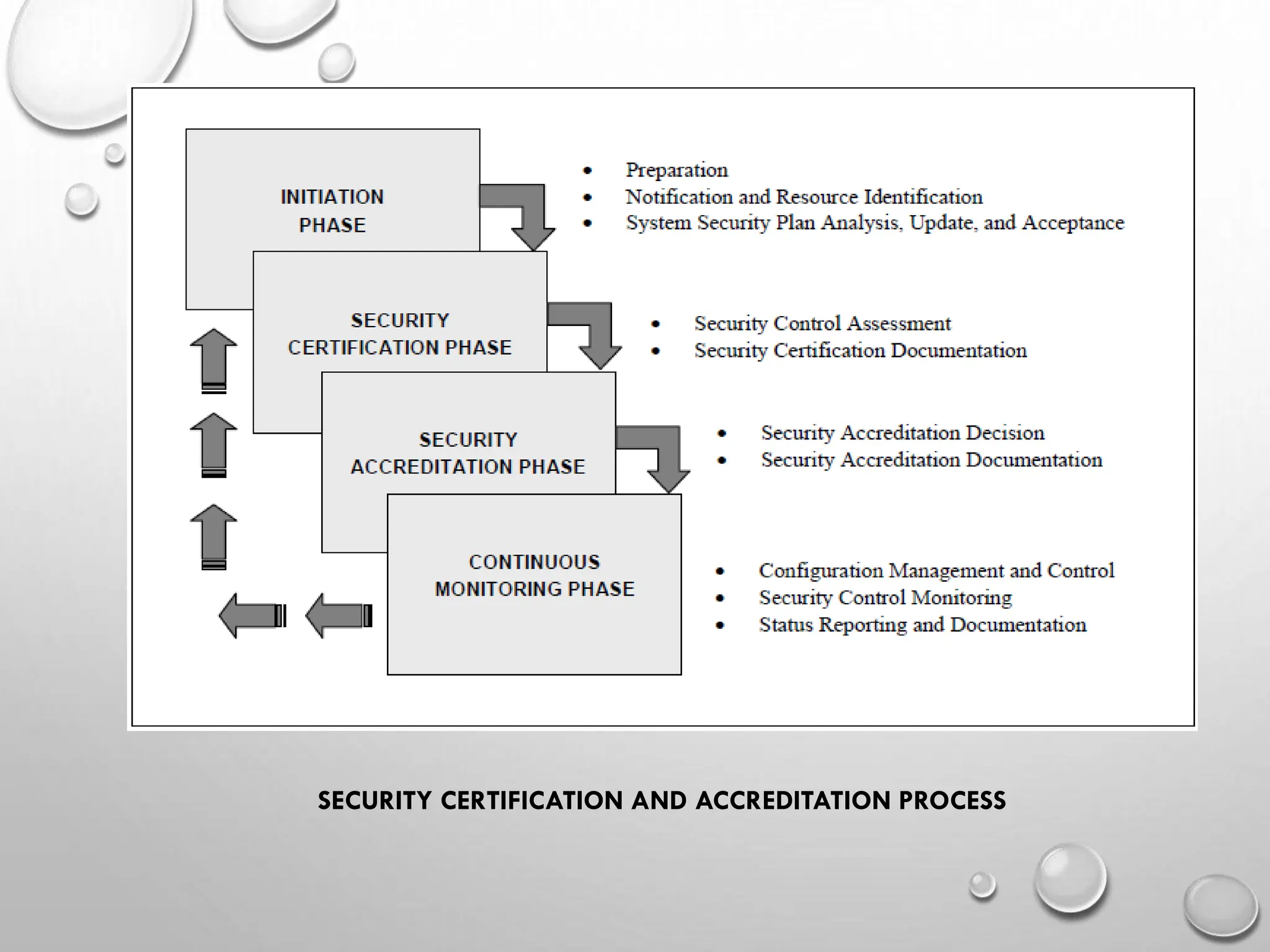
SECURITY CERTIFICATION AND ACCREDITATION PROCESS
INITIATION PHASE
THE INITIATION PHASE CONSISTS OF THREE TASKS:
(i) Preparation;
(ii) Notification and resource identification;
(iii) System security plan analysis, update, and acceptance.
PURPOSE OF THE PHASE :
To ensure that the authorizing official and senior agency
information security officer are in agreement with the contents of
the system security plan, including the system’s documented security
requirements, before the certification agent begins the assessment
of the security controls in the information system.
OBJECTIVE
Preparation:
To prepare documents by reviewing the system security plan and confirming
that the contents of the plan are consistent with an initial assessment of risk.
Notification and resource identification:
(i) To provide notification to all concerned agency officials
(ii) To determine the resources needed to carry out the effort
(iii) To prepare a plan of execution for the certification and accreditation
activities indicating the proposed schedule and key milestones.
System security plan analysis, update, and acceptance
(I) To Obtain an independent analysis of the system security
plan;
(II) To update the system security plan as needed based on
the results of the independent analysis
(III) To obtain acceptance of the system security plan by the
authorizing official and senior agency information security
officer prior to conducting an assessment of the security
controls in the information system.
SECURITY CERTIFICATION PHASE
THE SECURITY CERTIFICATION PHASE CONSISTS OF TWO
TASKS:
(i) security control assessment;
(ii) security certification documentation.
PURPOSE OF THE PHASE :
• To determine the extent to which the security controls in the information
system are implemented correctly, operating as intended, and producing the
desired outcome with respect to meeting the security requirements for the
system.
• This phase also addresses specific actions taken or planned to correct
deficiencies in the security controls and to reduce or eliminate known
vulnerabilities in the information system.
OBJECTIVE
Security control assessment :
(i) To prepare for the assessment of the security controls in the
information system
(ii) To conduct the assessment of the security controls
(iii) To document the results of the assessment.
• Preparation for security assessment involves gathering appropriate
planning and supporting materials, system requirements and design
documentation, security control implementation evidence, and results
from previous security assessments, security reviews, or audits.
• Preparation also involves developing specific methods and
procedures to assess the security controls in the information system.
Security certification documentation:
(i) To provide the certification findings and recommendations to the
information system owner
(ii) To update the system security plan as needed
(iii) To prepare the plan of action and milestones
(iv) To assemble the accreditation package.
• The completion of this task concludes the security certification
phase.
SECURITY ACCREDITATION PHASE
THE SECURITY ACCREDITATION PHASE CONSISTS OF TWO
TASKS:
(i) security accreditation decision
(ii) security accreditation documentation.
Purpose of the phase :
• To determine if the remaining known vulnerabilities in the
information system (after the implementation of an agreed-
upon set of security controls) exhibits an acceptable level of
risk to agency operations, agency assets, or individuals.
OBJECTIVE
Security accreditation decision:
(I) To determine the risk to agency operations, agency assets, or
individuals
(II) To determine if the agency-level risk is acceptable.
Security accreditation documentation
(i) To transmit the final security accreditation package to the
appropriate individuals and organizations.
(ii) To update the system security plan with the latest information
from the accreditation decision.
The completion of this task concludes the security accreditation phase
of the security certification and accreditation process.
CONTINUOUS MONITORING PHASE
THE CONTINUOUS MONITORING PHASE CONSISTS OF THREE
TASKS:
(i) configuration management and control;
(ii) security control monitoring;
(iii) status reporting and documentation.
Purpose of the phase :
• To provide oversight and monitoring of the security controls in the
information system on an on-going basis and to inform the
authorizing official when changes occur which may impact on the
security of the system.
OBJECTIVE
Configuration management and control :
(i) To document the proposed or actual changes to the information
system
(ii) To determine the impact of proposed or actual changes on the
security of the system.
Documenting information system changes and assessing the potential
impact on the security of the system on an on-going basis is an
essential aspect of maintaining the security accreditation.
Security control monitoring :
(i) To select an appropriate set of security controls in the information
system to be monitored
(ii) To assess the designated controls using methods and procedures
selected by the information system owner.
• The continuous monitoring of security controls helps to identify
potential security-related problems in the information system that
are not identified during the security impact analysis conducted as
part of the configuration management and control process.
Status reporting and documentation:
(i) To update the system security plan to reflect the proposed or
actual changes to the information system
(ii) To update the plan of action and milestones based on the
activities carried out during the continuous monitoring phase
(iii) To report the security status of the information system to the
authorizing official and senior agency information security
officer.
THANKYOU

The security certification and accreditation process.pptx

  • 1.
    THE SECURITY CERTIFICATION AND ACCREDITATIONPROCESS NAME: MONIKA A REGISTER NUMBER: 2018503044
  • 2.
    INTRODUCTION THE SECURITY CERTIFICATIONAND ACCREDITATION PROCESS CONSISTS OF FOUR DISTINCT PHASES: (i) AN INITIATION PHASE (ii) A SECURITY CERTIFICATION PHASE (iii) A SECURITY ACCREDITATION PHASE (iv) A CONTINUOUS MONITORING PHASE.
  • 3.
    Each phase consistsof a set of well-defined tasks and subtasks that are to be carried out by responsible individuals such as, • The chief information officer, • Authorizing official, • Authorizing official’s designated representative, senior agency information security officer, • Information system owner, • Information owner, • Information system security officer, • Certification agent, and user representatives.
  • 4.
    SECURITY CERTIFICATION ANDACCREDITATION PROCESS
  • 5.
    INITIATION PHASE THE INITIATIONPHASE CONSISTS OF THREE TASKS: (i) Preparation; (ii) Notification and resource identification; (iii) System security plan analysis, update, and acceptance. PURPOSE OF THE PHASE : To ensure that the authorizing official and senior agency information security officer are in agreement with the contents of the system security plan, including the system’s documented security requirements, before the certification agent begins the assessment of the security controls in the information system.
  • 6.
    OBJECTIVE Preparation: To prepare documentsby reviewing the system security plan and confirming that the contents of the plan are consistent with an initial assessment of risk. Notification and resource identification: (i) To provide notification to all concerned agency officials (ii) To determine the resources needed to carry out the effort (iii) To prepare a plan of execution for the certification and accreditation activities indicating the proposed schedule and key milestones.
  • 7.
    System security plananalysis, update, and acceptance (I) To Obtain an independent analysis of the system security plan; (II) To update the system security plan as needed based on the results of the independent analysis (III) To obtain acceptance of the system security plan by the authorizing official and senior agency information security officer prior to conducting an assessment of the security controls in the information system.
  • 8.
    SECURITY CERTIFICATION PHASE THESECURITY CERTIFICATION PHASE CONSISTS OF TWO TASKS: (i) security control assessment; (ii) security certification documentation. PURPOSE OF THE PHASE : • To determine the extent to which the security controls in the information system are implemented correctly, operating as intended, and producing the desired outcome with respect to meeting the security requirements for the system. • This phase also addresses specific actions taken or planned to correct deficiencies in the security controls and to reduce or eliminate known vulnerabilities in the information system.
  • 9.
    OBJECTIVE Security control assessment: (i) To prepare for the assessment of the security controls in the information system (ii) To conduct the assessment of the security controls (iii) To document the results of the assessment. • Preparation for security assessment involves gathering appropriate planning and supporting materials, system requirements and design documentation, security control implementation evidence, and results from previous security assessments, security reviews, or audits. • Preparation also involves developing specific methods and procedures to assess the security controls in the information system.
  • 10.
    Security certification documentation: (i)To provide the certification findings and recommendations to the information system owner (ii) To update the system security plan as needed (iii) To prepare the plan of action and milestones (iv) To assemble the accreditation package. • The completion of this task concludes the security certification phase.
  • 11.
    SECURITY ACCREDITATION PHASE THESECURITY ACCREDITATION PHASE CONSISTS OF TWO TASKS: (i) security accreditation decision (ii) security accreditation documentation. Purpose of the phase : • To determine if the remaining known vulnerabilities in the information system (after the implementation of an agreed- upon set of security controls) exhibits an acceptable level of risk to agency operations, agency assets, or individuals.
  • 12.
    OBJECTIVE Security accreditation decision: (I)To determine the risk to agency operations, agency assets, or individuals (II) To determine if the agency-level risk is acceptable. Security accreditation documentation (i) To transmit the final security accreditation package to the appropriate individuals and organizations. (ii) To update the system security plan with the latest information from the accreditation decision. The completion of this task concludes the security accreditation phase of the security certification and accreditation process.
  • 13.
    CONTINUOUS MONITORING PHASE THECONTINUOUS MONITORING PHASE CONSISTS OF THREE TASKS: (i) configuration management and control; (ii) security control monitoring; (iii) status reporting and documentation. Purpose of the phase : • To provide oversight and monitoring of the security controls in the information system on an on-going basis and to inform the authorizing official when changes occur which may impact on the security of the system.
  • 14.
    OBJECTIVE Configuration management andcontrol : (i) To document the proposed or actual changes to the information system (ii) To determine the impact of proposed or actual changes on the security of the system. Documenting information system changes and assessing the potential impact on the security of the system on an on-going basis is an essential aspect of maintaining the security accreditation.
  • 15.
    Security control monitoring: (i) To select an appropriate set of security controls in the information system to be monitored (ii) To assess the designated controls using methods and procedures selected by the information system owner. • The continuous monitoring of security controls helps to identify potential security-related problems in the information system that are not identified during the security impact analysis conducted as part of the configuration management and control process.
  • 16.
    Status reporting anddocumentation: (i) To update the system security plan to reflect the proposed or actual changes to the information system (ii) To update the plan of action and milestones based on the activities carried out during the continuous monitoring phase (iii) To report the security status of the information system to the authorizing official and senior agency information security officer.
  • 17.