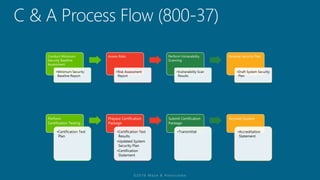
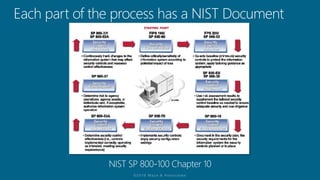
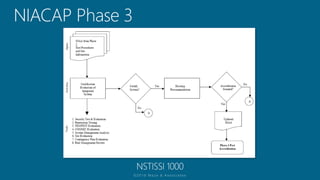
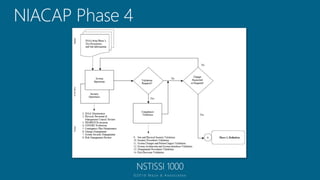
Conduct Minimum
Security Baseline
Assessment
•Minimum Security
Baseline Report
Assess Risks
•Risk Assessment
Report
Perform Vulnerability
Scanning
•Vulnerability Scan
Results
Develop Security Plan
•Draft System Security
Plan
Perform
Certification Testing
•Certification Test
Plan
Prepare Certification
Package
•Certification Test
Results
•Updated System
Security Plan
•Certification
Statement
Submit Certification
Package
•Transmittal
Accredit System
•Accreditation
Statement
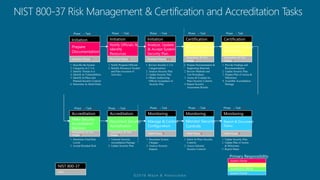
System Owner
Authorizing Official
Certification Agent
Prepare
Documentation
Initiation Phase 1
1. Describe the System
2. Categorize its C.I.A.
3. Identify Threats to it
4. Identify its Vulnerabilities
5. Identify In-Place and
Planned Security Controls
6. Determine its Initial Risks
Initiation
Notify Officials &
Identify
Resources
Planning Phase 3
1. Notify Program Officials
2. Identify Resources Needed
and Plan execution of
Activities
Initiation
Report & Document
Status
O&M Phase 9
1. Update Security Plan
2. Update Plan of Action
& Milestones
3. Report Status
Monitoring
Monitor Security
Controls
O&M Phase 9
1. Select In-Place Security
Controls
2. Assess Selected
Security Controls
Monitoring
Manage & Control
Configuration
O&M Phase 9
1. Document System
Changes
2. Analyze Security
Impacts
Monitoring
Analyze, Update
& Accept System
Security Plan
Multiple Phases 4-6
1. Review Security C.I.A.
Categorizations
2. Analyze Security Plan
3. Update Security Plan
4. Obtain Authorizing
Official Acceptance of
Security Plan
Initiation
Assess & Evaluate
Security Controls
Integration & Test
Phase 7
1. Prepare Documentation &
Supporting Materials
2. Review Methods and
Test Procedures
3. Assess & Evaluate In-
Place Security Controls
4. Report Security
Assessment Results
Certification
Document Security
Accreditation
Integration & Test
Phase 7
1. Transmit Security
Accreditation Package
2. Update Security Plan
Accreditation
Document Security
Certification
Integration & Test
Phase 7
1. Provide Findings and
Recommendations
2. Update Security Plan
3. Prepare Plan of Action &
Milestones
4. Assemble Accreditation
Package
Certification
Make Security
Accreditation
Decision
Integration & Test
Phase 7
1. Determine Final Risk
Levels
2. Accept Residual Risk
Accreditation
System Owner
Phase 1 – Task 1
Phase 3 – Task 6
Phase 1 – Task 2 Phase 1 – Task 3 Phase 2 – Task 4 Phase 2 – Task 5
Phase 3 – Task 7 Phase 4 – Task 8 Phase 4 – Task 9 Phase 4 – Task 10
Primary Responsibility
SDLC
NIST 800-37
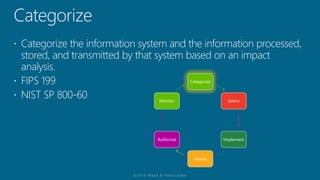
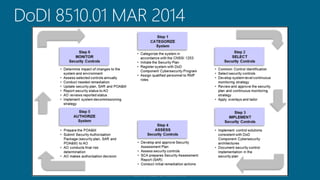
Categorize
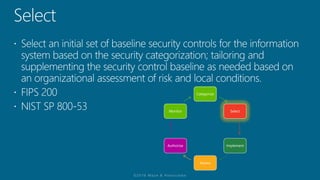
Select
Implement
Assess
Authorize
Monitor
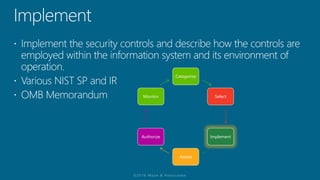
Categorize
Select
Implement
Assess
Authorize
Monitor
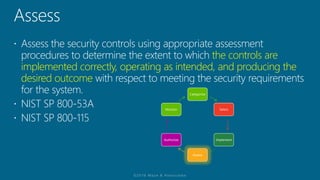
Categorize
Select
Implement
Assess
Authorize
Monitor
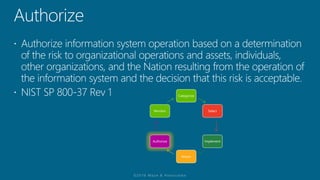
Categorize
Select
Implement
Assess
Authorize
Monitor
the controls are
implemented correctly, operating as intended, and producing the
desired outcome
Categorize
Select
Implement
Assess
Authorize
Monitor
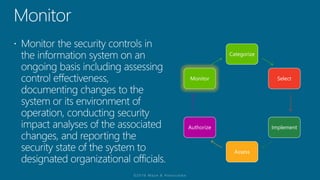
Categorize
Select
Implement
Assess
Authorize
Monitor
Categorize
Select
Implement
Assess
Authorize
Monitor
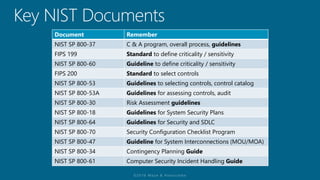
Document Remember
NIST SP 800-37 C & A program, overall process, guidelines
FIPS 199 Standard to define criticality / sensitivity
NIST SP 800-60 Guideline to define criticality / sensitivity
FIPS 200 Standard to select controls
NIST SP 800-53 Guidelines to selecting controls, control catalog
NIST SP 800-53A Guidelines for assessing controls, audit
NIST SP 800-30 Risk Assessment guidelines
NIST SP 800-18 Guidelines for System Security Plans
NIST SP 800-64 Guidelines for Security and SDLC
NIST SP 800-70 Security Configuration Checklist Program
NIST SP 800-47 Guideline for System Interconnections (MOU/MOA)
NIST SP 800-34 Contingency Planning Guide
NIST SP 800-61 Computer Security Incident Handling Guide
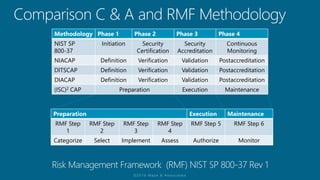
Methodology Phase 1 Phase 2 Phase 3 Phase 4
NIST SP
800-37
Initiation Security
Certification
Security
Accreditation
Continuous
Monitoring
NIACAP Definition Verification Validation Postaccreditation
DITSCAP Definition Verification Validation Postaccreditation
DIACAP Definition Verification Validation Postaccreditation
(ISC)2 CAP Preparation Execution Maintenance
Preparation Execution Maintenance
RMF Step
1
RMF Step
2
RMF Step
3
RMF Step
4
RMF Step 5 RMF Step 6
Categorize Select Implement Assess Authorize Monitor
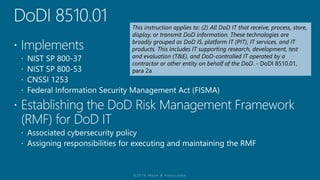
This instruction applies to: (2) All DoD IT that receive, process, store,
display, or transmit DoD information. These technologies are
broadly grouped as DoD IS, platform IT (PIT), IT services, and IT
products. This includes IT supporting research, development, test
and evaluation (T&E), and DoD-controlled IT operated by a
contractor or other entity on behalf of the DoD. - DoDI 8510.01,
para 2a
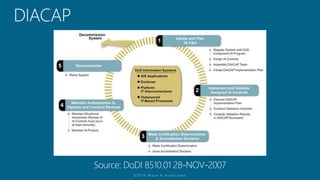
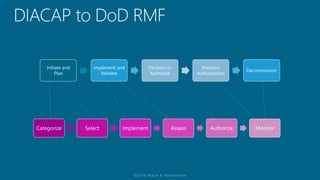
Initiate and
Plan
Implement and
Validate
Decision to
Authorize
Maintain
Authorization
Decommission
Categorize Select Implement Assess Authorize Monitor
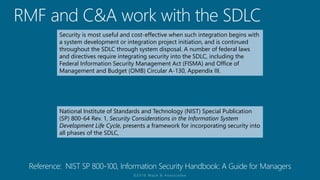
Security is most useful and cost-effective when such integration begins with
a system development or integration project initiation, and is continued
throughout the SDLC through system disposal. A number of federal laws
and directives require integrating security into the SDLC, including the
Federal Information Security Management Act (FISMA) and Office of
Management and Budget (OMB) Circular A-130, Appendix III.
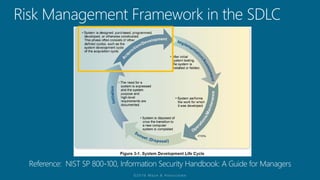
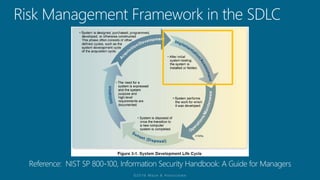
National Institute of Standards and Technology (NIST) Special Publication
(SP) 800-64 Rev. 1, Security Considerations in the Information System
Development Life Cycle, presents a framework for incorporating security into
all phases of the SDLC,
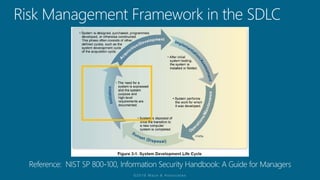
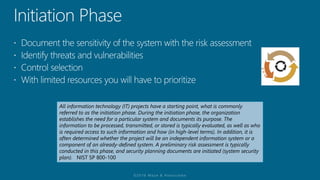
All information technology (IT) projects have a starting point, what is commonly
referred to as the initiation phase. During the initiation phase, the organization
establishes the need for a particular system and documents its purpose. The
information to be processed, transmitted, or stored is typically evaluated, as well as who
is required access to such information and how (in high-level terms). In addition, it is
often determined whether the project will be an independent information system or a
component of an already-defined system. A preliminary risk assessment is typically
conducted in this phase, and security planning documents are initiated (system security
plan). NIST SP 800-100
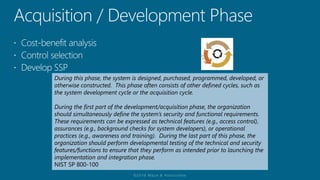
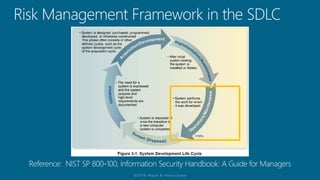
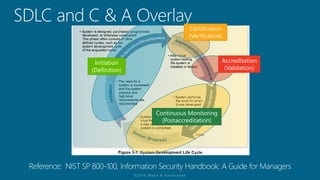
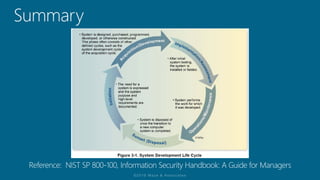
During this phase, the system is designed, purchased, programmed, developed, or
otherwise constructed. This phase often consists of other defined cycles, such as
the system development cycle or the acquisition cycle.
During the first part of the development/acquisition phase, the organization
should simultaneously define the system’s security and functional requirements.
These requirements can be expressed as technical features (e.g., access control),
assurances (e.g., background checks for system developers), or operational
practices (e.g., awareness and training). During the last part of this phase, the
organization should perform developmental testing of the technical and security
features/functions to ensure that they perform as intended prior to launching the
implementation and integration phase.
NIST SP 800-100
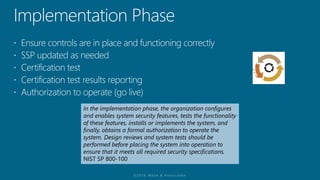
In the implementation phase, the organization configures
and enables system security features, tests the functionality
of these features, installs or implements the system, and
finally, obtains a formal authorization to operate the
system. Design reviews and system tests should be
performed before placing the system into operation to
ensure that it meets all required security specifications.
NIST SP 800-100
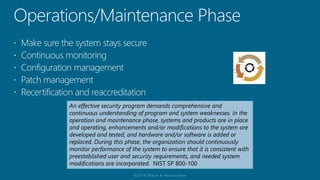
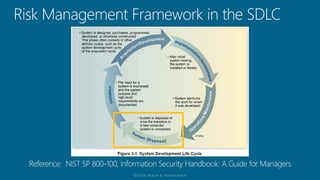
An effective security program demands comprehensive and
continuous understanding of program and system weaknesses. In the
operation and maintenance phase, systems and products are in place
and operating, enhancements and/or modifications to the system are
developed and tested, and hardware and/or software is added or
replaced. During this phase, the organization should continuously
monitor performance of the system to ensure that it is consistent with
preestablished user and security requirements, and needed system
modifications are incorporated. NIST SP 800-100
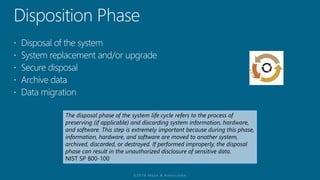
The disposal phase of the system life cycle refers to the process of
preserving (if applicable) and discarding system information, hardware,
and software. This step is extremely important because during this phase,
information, hardware, and software are moved to another system,
archived, discarded, or destroyed. If performed improperly, the disposal
phase can result in the unauthorized disclosure of sensitive data.
NIST SP 800-100
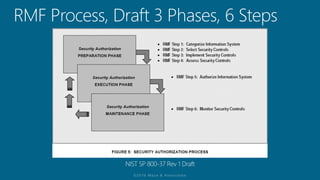
should be risk-based
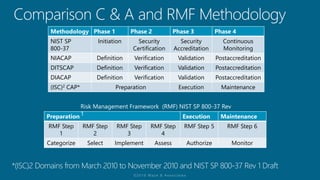
Methodology Phase 1 Phase 2 Phase 3 Phase 4
NIST SP
800-37
Initiation Security
Certification
Security
Accreditation
Continuous
Monitoring
NIACAP Definition Verification Validation Postaccreditation
DITSCAP Definition Verification Validation Postaccreditation
DIACAP Definition Verification Validation Postaccreditation
(ISC)2 CAP* Preparation Execution Maintenance
Preparation Execution Maintenance
RMF Step
1
RMF Step
2
RMF Step
3
RMF Step
4
RMF Step 5 RMF Step 6
Categorize Select Implement Assess Authorize Monitor
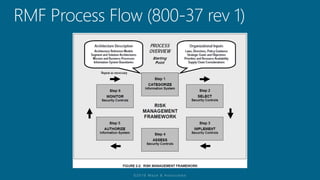
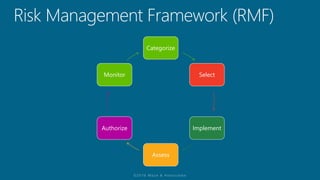
Risk Management Framework (RMF) NIST SP 800-37 Rev
1
Initiation
(Definition)
Certification
(Verification)
Accreditation
(Validation)
Continuous Monitoring
(Postaccreditation)
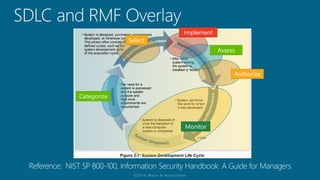
Categorize
Select
Implement
Assess
Authorize
Monitor
Understanding the Risk Management Framework & (ISC)2 CAP Module 4: Life Cycle

Understanding the Risk Management Framework & (ISC)2 CAP Module 4: Life Cycle

  • 3.
    Conduct Minimum Security Baseline Assessment •MinimumSecurity Baseline Report Assess Risks •Risk Assessment Report Perform Vulnerability Scanning •Vulnerability Scan Results Develop Security Plan •Draft System Security Plan Perform Certification Testing •Certification Test Plan Prepare Certification Package •Certification Test Results •Updated System Security Plan •Certification Statement Submit Certification Package •Transmittal Accredit System •Accreditation Statement
  • 4.
    System Owner Authorizing Official CertificationAgent Prepare Documentation Initiation Phase 1 1. Describe the System 2. Categorize its C.I.A. 3. Identify Threats to it 4. Identify its Vulnerabilities 5. Identify In-Place and Planned Security Controls 6. Determine its Initial Risks Initiation Notify Officials & Identify Resources Planning Phase 3 1. Notify Program Officials 2. Identify Resources Needed and Plan execution of Activities Initiation Report & Document Status O&M Phase 9 1. Update Security Plan 2. Update Plan of Action & Milestones 3. Report Status Monitoring Monitor Security Controls O&M Phase 9 1. Select In-Place Security Controls 2. Assess Selected Security Controls Monitoring Manage & Control Configuration O&M Phase 9 1. Document System Changes 2. Analyze Security Impacts Monitoring Analyze, Update & Accept System Security Plan Multiple Phases 4-6 1. Review Security C.I.A. Categorizations 2. Analyze Security Plan 3. Update Security Plan 4. Obtain Authorizing Official Acceptance of Security Plan Initiation Assess & Evaluate Security Controls Integration & Test Phase 7 1. Prepare Documentation & Supporting Materials 2. Review Methods and Test Procedures 3. Assess & Evaluate In- Place Security Controls 4. Report Security Assessment Results Certification Document Security Accreditation Integration & Test Phase 7 1. Transmit Security Accreditation Package 2. Update Security Plan Accreditation Document Security Certification Integration & Test Phase 7 1. Provide Findings and Recommendations 2. Update Security Plan 3. Prepare Plan of Action & Milestones 4. Assemble Accreditation Package Certification Make Security Accreditation Decision Integration & Test Phase 7 1. Determine Final Risk Levels 2. Accept Residual Risk Accreditation System Owner Phase 1 – Task 1 Phase 3 – Task 6 Phase 1 – Task 2 Phase 1 – Task 3 Phase 2 – Task 4 Phase 2 – Task 5 Phase 3 – Task 7 Phase 4 – Task 8 Phase 4 – Task 9 Phase 4 – Task 10 Primary Responsibility SDLC NIST 800-37
  • 7.
  • 8.
  • 9.
  • 10.
  • 11.
    the controls are implementedcorrectly, operating as intended, and producing the desired outcome Categorize Select Implement Assess Authorize Monitor
  • 12.
  • 13.
  • 15.
    Document Remember NIST SP800-37 C & A program, overall process, guidelines FIPS 199 Standard to define criticality / sensitivity NIST SP 800-60 Guideline to define criticality / sensitivity FIPS 200 Standard to select controls NIST SP 800-53 Guidelines to selecting controls, control catalog NIST SP 800-53A Guidelines for assessing controls, audit NIST SP 800-30 Risk Assessment guidelines NIST SP 800-18 Guidelines for System Security Plans NIST SP 800-64 Guidelines for Security and SDLC NIST SP 800-70 Security Configuration Checklist Program NIST SP 800-47 Guideline for System Interconnections (MOU/MOA) NIST SP 800-34 Contingency Planning Guide NIST SP 800-61 Computer Security Incident Handling Guide
  • 17.
    Methodology Phase 1Phase 2 Phase 3 Phase 4 NIST SP 800-37 Initiation Security Certification Security Accreditation Continuous Monitoring NIACAP Definition Verification Validation Postaccreditation DITSCAP Definition Verification Validation Postaccreditation DIACAP Definition Verification Validation Postaccreditation (ISC)2 CAP Preparation Execution Maintenance Preparation Execution Maintenance RMF Step 1 RMF Step 2 RMF Step 3 RMF Step 4 RMF Step 5 RMF Step 6 Categorize Select Implement Assess Authorize Monitor
  • 25.
    This instruction appliesto: (2) All DoD IT that receive, process, store, display, or transmit DoD information. These technologies are broadly grouped as DoD IS, platform IT (PIT), IT services, and IT products. This includes IT supporting research, development, test and evaluation (T&E), and DoD-controlled IT operated by a contractor or other entity on behalf of the DoD. - DoDI 8510.01, para 2a
  • 26.
    Initiate and Plan Implement and Validate Decisionto Authorize Maintain Authorization Decommission Categorize Select Implement Assess Authorize Monitor
  • 29.
    Security is mostuseful and cost-effective when such integration begins with a system development or integration project initiation, and is continued throughout the SDLC through system disposal. A number of federal laws and directives require integrating security into the SDLC, including the Federal Information Security Management Act (FISMA) and Office of Management and Budget (OMB) Circular A-130, Appendix III. National Institute of Standards and Technology (NIST) Special Publication (SP) 800-64 Rev. 1, Security Considerations in the Information System Development Life Cycle, presents a framework for incorporating security into all phases of the SDLC,
  • 31.
    All information technology(IT) projects have a starting point, what is commonly referred to as the initiation phase. During the initiation phase, the organization establishes the need for a particular system and documents its purpose. The information to be processed, transmitted, or stored is typically evaluated, as well as who is required access to such information and how (in high-level terms). In addition, it is often determined whether the project will be an independent information system or a component of an already-defined system. A preliminary risk assessment is typically conducted in this phase, and security planning documents are initiated (system security plan). NIST SP 800-100
  • 33.
    During this phase,the system is designed, purchased, programmed, developed, or otherwise constructed. This phase often consists of other defined cycles, such as the system development cycle or the acquisition cycle. During the first part of the development/acquisition phase, the organization should simultaneously define the system’s security and functional requirements. These requirements can be expressed as technical features (e.g., access control), assurances (e.g., background checks for system developers), or operational practices (e.g., awareness and training). During the last part of this phase, the organization should perform developmental testing of the technical and security features/functions to ensure that they perform as intended prior to launching the implementation and integration phase. NIST SP 800-100
  • 35.
    In the implementationphase, the organization configures and enables system security features, tests the functionality of these features, installs or implements the system, and finally, obtains a formal authorization to operate the system. Design reviews and system tests should be performed before placing the system into operation to ensure that it meets all required security specifications. NIST SP 800-100
  • 37.
    An effective securityprogram demands comprehensive and continuous understanding of program and system weaknesses. In the operation and maintenance phase, systems and products are in place and operating, enhancements and/or modifications to the system are developed and tested, and hardware and/or software is added or replaced. During this phase, the organization should continuously monitor performance of the system to ensure that it is consistent with preestablished user and security requirements, and needed system modifications are incorporated. NIST SP 800-100
  • 39.
    The disposal phaseof the system life cycle refers to the process of preserving (if applicable) and discarding system information, hardware, and software. This step is extremely important because during this phase, information, hardware, and software are moved to another system, archived, discarded, or destroyed. If performed improperly, the disposal phase can result in the unauthorized disclosure of sensitive data. NIST SP 800-100
  • 41.
  • 42.
    Methodology Phase 1Phase 2 Phase 3 Phase 4 NIST SP 800-37 Initiation Security Certification Security Accreditation Continuous Monitoring NIACAP Definition Verification Validation Postaccreditation DITSCAP Definition Verification Validation Postaccreditation DIACAP Definition Verification Validation Postaccreditation (ISC)2 CAP* Preparation Execution Maintenance Preparation Execution Maintenance RMF Step 1 RMF Step 2 RMF Step 3 RMF Step 4 RMF Step 5 RMF Step 6 Categorize Select Implement Assess Authorize Monitor Risk Management Framework (RMF) NIST SP 800-37 Rev 1
  • 43.
  • 44.