









Our School
District
Staff
Development
2009
Session One
THE
BULLY
Have you
witnessed
BULLYING
behavior?
There are several
types of
BULLYING
Relationships
Student
to
Student
Teacher
to
Student
Student
to
Teacher
Workplace
CYBER
BULLYING
is growing
BB
The National
Youth Violence
Prevention
Resource Center
Reports
5.7 million students
are involved as a
BULLY
or target of
BULLYING
In a recent
national
survey of
students
grade 6-10
13%
reported being a
target of
BULLYING
YY
BULLYING
is most likely to
occur
In schools that
lack adult
supervision
during breaks
YY
Where rules against
BULLYING are not
consistently enforced
INGING
And where teachers and
students are indifferent
to BULLYING behavior
The 3rd
highest rate of school
BULLYING in the U.S.
ILLINOIS
The American Justice
Department reports
this month
YY
1 out of every 4
youth
YY
Will be abused by
another student
1 of 5 students
Admit to being a
BULLY
8% of students
YY
Deal with their
fear of
BULLIES
INGING
By missing
1 day of class
per month
BULLYING
isn’t a problem
That one
TEACHER
can resolve
That one
SCHOOL
can resolve
An integrated effort by
SCHOOL
and
COMMUNITY
is required for results
BULLYING
is a worldwide
problem
We can learn from the
WORLD Community
but our
LOCAL Community
must work with us
44
Let’s work
TOGETHER
to UNDERSTAND and
ELIMINATE this problem
in our school district
YY
THE BULLY
Professional DevelopmentProfessional Development
PlanningPlanning
Bullying in our SchoolBullying in our School
Group WorkGroup Work
See the handout in your binder
ResearchResearch
Student to StudentStudent to Student
Bullying is not confined to country, religion,Bullying is not confined to country, religion,
ethno-cultural groupsethno-cultural groups
It is a world-wide predicamentIt is a world-wide predicament
(Levinson & Levinson, 2005)(Levinson & Levinson, 2005)
ResearchResearch
Student to StudentStudent to Student
Some general statsSome general stats::
• 1 in 4 are bullied monthly by peers1 in 4 are bullied monthly by peers
• 160,000 students skipped school for fear of160,000 students skipped school for fear of
being bulliedbeing bullied
• Teasing, being bullied, and rejection tops theTeasing, being bullied, and rejection tops the
list of triggers in childhood attemps at suicidelist of triggers in childhood attemps at suicide
(Levinson & Levinson, 2005)(Levinson & Levinson, 2005)
ResearchResearch
Student to StudentStudent to Student
General descriptions:General descriptions:
• The Bully- Individual who commits the actThe Bully- Individual who commits the act
• The Bullied- The person on the receiving endThe Bullied- The person on the receiving end
of the bullyingof the bullying
• The Bystander- The person who sees the actThe Bystander- The person who sees the act
and decides to act or notand decides to act or not
(Levinson & Levinson, 2005)(Levinson & Levinson, 2005)
ResearchResearch
Student to StudentStudent to Student
Why do they do what they do?Why do they do what they do?
• Research shows that they do what they doResearch shows that they do what they do
because of how they were treatedbecause of how they were treated
(Levinson & Levinson, 2005)(Levinson & Levinson, 2005)
ResearchResearch
Student to StudentStudent to Student
What are the three types?What are the three types?
1.1.Verbal (Precursor)Verbal (Precursor)
-Accounts for 70%-Accounts for 70%
-Acts: name calling, taunting, teasing,-Acts: name calling, taunting, teasing,
belittling, racist slurs, sexually abusivebelittling, racist slurs, sexually abusive
remarksremarks
(Levinson & Levinson, 2005)(Levinson & Levinson, 2005)
ResearchResearch
Student to StudentStudent to Student
What are the three types?What are the three types?
2. Physical bullying (Most visible)2. Physical bullying (Most visible)
-Accounts for less than 30%-Accounts for less than 30%
-Acts: punching, biting, kicking, choking,-Acts: punching, biting, kicking, choking,
scratching, spittingscratching, spitting
This type of bullying is the most troublesome ofThis type of bullying is the most troublesome of
them all because it may lead to the bullythem all because it may lead to the bully
becoming an adult criminalbecoming an adult criminal
(Levinson & Levinson, 2005)(Levinson & Levinson, 2005)
ResearchResearch
Student to StudentStudent to Student
What are the three types?What are the three types?
3. Relational Aggression3. Relational Aggression
–Objective is to destroy the self-esteem ofObjective is to destroy the self-esteem of
the bulliedthe bullied
–Ignore, isolate, exclude, taunt, gossip,Ignore, isolate, exclude, taunt, gossip,
writing notes, rumorswriting notes, rumors
(Levinson & Levinson, 2005)(Levinson & Levinson, 2005)
ResearchResearch
Student to StudentStudent to Student
Studies have shown that anyone can be aStudies have shown that anyone can be a
target and that over time thosetarget and that over time those
targeted change:targeted change:
EmotionallyEmotionally
PhysicallyPhysically
--Will become frail and insecure or bulliesWill become frail and insecure or bullies
(Levinson & Levinson, 2005)(Levinson & Levinson, 2005)
ResearchResearch
Student to StudentStudent to Student
BullycideBullycide
ColumbineColumbine
(Levinson & Levinson, 2005)(Levinson & Levinson, 2005)
ResearchResearch
Student to StudentStudent to Student
The BystanderThe Bystander
Ommission and commisionOmmission and commision
These individuals have abandonded ethicalThese individuals have abandonded ethical
and moral resposiblityand moral resposiblity
(Levinson & Levinson, 2005)(Levinson & Levinson, 2005)
Best PracticesBest Practices
Student to StudentStudent to Student
Olweus ModelOlweus Model
Four Step ApproachFour Step Approach
Our Professional Development Plan uses thisOur Professional Development Plan uses this
frameworkframework
(Levinson & Levinson, 2005)(Levinson & Levinson, 2005)
Best PracticesBest Practices
Student to StudentStudent to Student
Olweus ModelOlweus Model
Step One:Step One:
Create an environment in which childrenCreate an environment in which children
and adults feel secure to help both theand adults feel secure to help both the
bullied and bully by tellingbullied and bully by telling
(Levinson & Levinson, 2005)(Levinson & Levinson, 2005)
Best PracticesBest Practices
Student to StudentStudent to Student
Olweus ModelOlweus Model
Step Two:Step Two:
Replace the age old mentality of fight them orReplace the age old mentality of fight them or
ignore them with new dialogue that engagesignore them with new dialogue that engages
the bully and forces the individual to deal withthe bully and forces the individual to deal with
his interpersonal behaviors and skills in ahis interpersonal behaviors and skills in a
meaningful waymeaningful way
(Levinson & Levinson, 2005)(Levinson & Levinson, 2005)
Best PracticesBest Practices
Student to StudentStudent to Student
Olweus ModelOlweus Model
Step Three:Step Three:
Teach effective self managing/ angerTeach effective self managing/ anger
management techniques to children and adultsmanagement techniques to children and adults
(Levinson & Levinson, 2005)(Levinson & Levinson, 2005)
Best PracticesBest Practices
Student to StudentStudent to Student
Olweus ModelOlweus Model
Step Four:Step Four:
Provide empathy training for children andProvide empathy training for children and
adultsadults
(Levinson & Levinson, 2005)(Levinson & Levinson, 2005)
Best PracticesBest Practices
Student to StudentStudent to Student
Positive Behavior Intervention SupportsPositive Behavior Intervention Supports
Respect EducationRespect Education
Respect EnvironmentRespect Environment
Respect EveryoneRespect Everyone
Creating cool toolsCreating cool tools
(PBIS, 2008)(PBIS, 2008)
Best PracticesBest Practices
Student to StudentStudent to Student
Character CountsCharacter Counts
1.1.TrustworthinessTrustworthiness
2.2.RespectRespect
3.3.ResponsibilityResponsibility
4.4.FairnessFairness
5.5.CaringCaring
6.6.CitizenshipCitizenship
(charactercounts.org/sixpillars.html, 2008)(charactercounts.org/sixpillars.html, 2008)
THE FACULTY BULLYTHE FACULTY BULLY
ResearchResearch
Teacher to StudentTeacher to Student
• WhatWhat
• WhyWhy
• Cost to StudentCost to Student
ResearchResearch
Teacher to StudentTeacher to Student
• WhatWhat
• WhyWhy
• Cost to StudentCost to Student
• Climate AssessmentClimate Assessment
• Solution FindingSolution Finding
ResearchResearch
Teacher to StudentTeacher to Student
TARGET?TARGET?
(2005 Atlanta National Bullying Prevention(2005 Atlanta National Bullying Prevention
Conference)Conference)
• ½ student reported teacher½ student reported teacher
bullied whole classbullied whole class
• ½ students reported teacher½ students reported teacher
bullied 1-2 studentsbullied 1-2 students
Whole class= crazy teacherWhole class= crazy teacher
Sole Target= something wrong w/ meSole Target= something wrong w/ me
ResearchResearch
Teacher to StudentTeacher to Student
Negative Pedagogy . . .Negative Pedagogy . . .
Areas: Coercive misuse of powerAreas: Coercive misuse of power
1. discipline and student relationships1. discipline and student relationships
2. evaluation2. evaluation
3. student grouping3. student grouping
4. classroom/school procedures & rules4. classroom/school procedures & rules
5. instructional practices5. instructional practices
6. physical plant/resources6. physical plant/resources
PAUL & SMITH (2002)PAUL & SMITH (2002)
ResearchResearch
Teacher to StudentTeacher to Student
Devine, (1996), has pointed out that some teachers use the
“code of the streets” (tough language, four letter words,
intimidation, tough demeanor, and tough posturing), as a
way to exert power and authority.
Often children and even other teachers and principals
praise such teachers as being effective. They are
respected because they are people not to be messed with.
FEAR IMPAIRS THE CAPACITY TO LEARN
ResearchResearch
Teacher to StudentTeacher to Student
SOLUTION?SOLUTION?
• CODE OF CONDUCT FORCODE OF CONDUCT FOR
STAFFSTAFF
• REPORTING SYSTEM NOREPORTING SYSTEM NO
REPRISALSREPRISALS
• PEER GUIDANCE CODEPEER GUIDANCE CODE
PHRASEPHRASE
• PERIODIC CLIMATEPERIODIC CLIMATE
SURVEYSSURVEYS
ResearchResearch
Teacher to StudentTeacher to Student
http://www.endbullyingnow.blogspot.comhttp://www.endbullyingnow.blogspot.com
• Open source solution finding:Open source solution finding:
WORLDWIDEWORLDWIDE
• Platform for Local DiscussionPlatform for Local Discussion
• Reference ListReference List
• WeblinksWeblinks
• SurveysSurveys
• Local Research ResultsLocal Research Results
ResearchResearch
Teacher to StudentTeacher to Student
THE STUDENT TOTHE STUDENT TO
TEACHERTEACHER
BULLYBULLY
ResearchResearch
Student to TeacherStudent to Teacher
Research and Best PracticeResearch and Best Practice
Student to Teacher BullyingStudent to Teacher Bullying
•Under reported with little research baseUnder reported with little research base
•Often misrepresented as threatening behaviorOften misrepresented as threatening behavior
or other student discipline issuesor other student discipline issues
•Teacher victims are mostly inexperienced andTeacher victims are mostly inexperienced and
femalefemale
Usually results from the following:Usually results from the following:
• Uncomfortable in the teacherUncomfortable in the teacher
leadership roleleadership role
• Unprepared for the challenges ofUnprepared for the challenges of
student disciplinestudent discipline
• Unreported because it isUnreported because it is
professionally threateningprofessionally threatening
• Sometimes linked to a culture ofSometimes linked to a culture of
school violenceschool violence
Research and Best PracticeResearch and Best Practice
Student to Teacher BullyingStudent to Teacher Bullying
• 36% of teachers reported being bullied36% of teachers reported being bullied
by studentsby students
(Ontario Secondary Teachers)(Ontario Secondary Teachers)
• Blogging, posting, tweeting,Blogging, posting, tweeting,
cyberbullyingcyberbullying
• Video recording and Internet postingVideo recording and Internet posting
Research and Best PracticeResearch and Best Practice
Student to Teacher BullyingStudent to Teacher Bullying
• Establish support systems for new,Establish support systems for new,
inexperienced teachers.inexperienced teachers.
• Mentors, frequent classroom visits, openMentors, frequent classroom visits, open
culture can help young teachersculture can help young teachers
• Student discipline training must be a priorityStudent discipline training must be a priority
• Help young teachers grow and establishHelp young teachers grow and establish
themselves as classroom leadersthemselves as classroom leaders
Research and Best PracticeResearch and Best Practice
Student to Teacher BullyingStudent to Teacher Bullying
Sid Citrus, Bully-Asshole Boss
http://www.sidcitrus.com/Site/Episode_1.html
ResearchResearch
Workplace BullyingWorkplace Bullying
ResearchResearch
Workplace BullyingWorkplace Bullying
• 75% of all employees had been affected by75% of all employees had been affected by
workplace bullying (Blando,2008)workplace bullying (Blando,2008)
• 13% of U.S. emplyees currently being bullied,13% of U.S. emplyees currently being bullied,
24% have been bullied in the past (WBI-Zogby)24% have been bullied in the past (WBI-Zogby)
•Women appear to be at a greater risk 57%Women appear to be at a greater risk 57%
•Men are more likely to be bullies- 60%Men are more likely to be bullies- 60%
•Women bullies target other women- 71%Women bullies target other women- 71%
(Workplace Bullying Institute, 2007)(Workplace Bullying Institute, 2007)
ResearchResearch
Workplace BullyingWorkplace Bullying
•Race plays a roleRace plays a role
•Hispanics (52.1%)Hispanics (52.1%)
•African-Americans (46%)African-Americans (46%)
•Whites (33.5%)Whites (33.5%)
•Asian-Americans (30.6%)Asian-Americans (30.6%)
•Workplace Bullying Institute (2007)Workplace Bullying Institute (2007)
ResearchResearch
Workplace BullyingWorkplace Bullying
•Health EffectsHealth Effects
•StressStress
•Poor Mental HealthPoor Mental Health
•Poor Physical HealthPoor Physical Health
•Increase of use of sick daysIncrease of use of sick days
The Project for Wellness and Work-LifeThe Project for Wellness and Work-Life
Arizona State UniversityArizona State University
ResearchResearch
Workplace BullyingWorkplace Bullying
Witnesses of bullying suffer from:Witnesses of bullying suffer from:
• FearFear
• StressStress
• Emotional exhaustionEmotional exhaustion
The Project for Wellness and Work-LifeThe Project for Wellness and Work-Life
Arizona State UniversityArizona State University
ResearchResearch
Workplace BullyingWorkplace Bullying
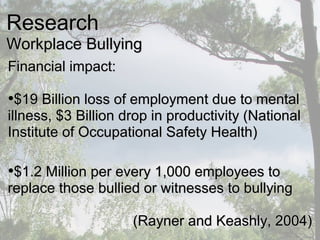
Financial impact:Financial impact:
•$19 Billion loss of employment due to mental$19 Billion loss of employment due to mental
illness, $3 Billion drop in productivity (Nationalillness, $3 Billion drop in productivity (National
Institute of Occupational Safety Health)Institute of Occupational Safety Health)
•$1.2 Million per every 1,000 employees to$1.2 Million per every 1,000 employees to
replace those bullied or witnesses to bullyingreplace those bullied or witnesses to bullying
(Rayner and Keashly, 2004)(Rayner and Keashly, 2004)
ResearchResearch
Workplace BullyingWorkplace Bullying
•False accusationsFalse accusations
•Nonverbal intimidationNonverbal intimidation
•Presumably uncontrollable mood swingsPresumably uncontrollable mood swings
•Making up own rules then not following themMaking up own rules then not following them
•Harsh and constant criticismHarsh and constant criticism
•Rumors or gossipRumors or gossip
•Singling out one personSingling out one person
•Public displays of gross, undignified behaviorPublic displays of gross, undignified behavior
•Yelling, screaming, throwing tantrumsYelling, screaming, throwing tantrums
•Lying about performancesLying about performances
Workplace Bullying Institute (2007)Workplace Bullying Institute (2007)
ResearchResearch
Workplace BullyingWorkplace Bullying
Components of the Plan - Phase 1Components of the Plan - Phase 1
Professional Development PlanningProfessional Development Planning
(Friend and Cook, 2007)(Friend and Cook, 2007)
• You are the plan!You are the plan!
o Staff experience and expertiseStaff experience and expertise
o We all benefit from the solutionWe all benefit from the solution
o Implementation, application, andImplementation, application, and
monitoringmonitoring
oYour data pointed to the problemYour data pointed to the problem
and will help guide our solutionand will help guide our solution
oSMART GoalsSMART Goals
Components of the Plan - Phase 2Components of the Plan - Phase 2
Professional Development PlanningProfessional Development Planning
• However...."best practice" is importantHowever...."best practice" is important
• Content expertise brings additionalContent expertise brings additional
knowledge and experienceknowledge and experience
• Use of research to determine whatUse of research to determine what
worksworks
• Learn from others who haveLearn from others who have
experienced similar issuesexperienced similar issues
Components of the Plan - Phase 3Components of the Plan - Phase 3
Professional Development PlanningProfessional Development Planning
• Post speaker small group workPost speaker small group work
oApplication in the school andApplication in the school and
classroomclassroom
oSupport teachers as colleaguesSupport teachers as colleagues
oMonitor our workMonitor our work
oRachet up accountabilityRachet up accountability
oBegin to change the cultureBegin to change the culture
Components of the Plan - Phase 4Components of the Plan - Phase 4
Professional Development PlanningProfessional Development Planning
• Guiding taskforce with representativesGuiding taskforce with representatives
from small groupsfrom small groups
o Review data, report small groupReview data, report small group
work, identify ongoing issues,work, identify ongoing issues,
monitor progressmonitor progress
o Continue to communicate vision,Continue to communicate vision,
encourage new culturalencourage new cultural
expectationsexpectations
Components of the Plan - Phase 5Components of the Plan - Phase 5
Professional Development PlanningProfessional Development Planning
• Evaluate our workEvaluate our work
• Revise and review goals and strategiesRevise and review goals and strategies
• Lead the effort to establish new cultureLead the effort to establish new culture
• Establish new prioritiesEstablish new priorities
Additional ResourcesAdditional Resources
The following information is included in the binder:The following information is included in the binder:
ReferencesReferences
Copies of ArticlesCopies of Articles
Internet ResourcesInternet Resources
Bob's BlogBob's Blog
Thank You!

The School Bully

  • 1.
  • 2.
  • 3.
  • 4.
  • 5.
    There are several typesof BULLYING Relationships
  • 6.
  • 7.
  • 8.
  • 9.
  • 10.
  • 11.
  • 12.
    5.7 million students areinvolved as a BULLY or target of BULLYING
  • 13.
    In a recent national surveyof students grade 6-10
  • 14.
  • 15.
  • 16.
    In schools that lackadult supervision during breaks
  • 17.
    YY Where rules against BULLYINGare not consistently enforced
  • 18.
    INGING And where teachersand students are indifferent to BULLYING behavior
  • 19.
    The 3rd highest rateof school BULLYING in the U.S.
  • 20.
  • 21.
  • 22.
    YY 1 out ofevery 4 youth
  • 23.
    YY Will be abusedby another student
  • 24.
    1 of 5students
  • 25.
  • 26.
  • 27.
  • 28.
    INGING By missing 1 dayof class per month
  • 29.
  • 30.
  • 31.
  • 32.
    An integrated effortby SCHOOL and COMMUNITY is required for results
  • 33.
  • 34.
    We can learnfrom the WORLD Community but our LOCAL Community must work with us
  • 35.
    44 Let’s work TOGETHER to UNDERSTANDand ELIMINATE this problem in our school district
  • 36.
  • 37.
  • 38.
    Group WorkGroup Work Seethe handout in your binder
  • 39.
    ResearchResearch Student to StudentStudentto Student Bullying is not confined to country, religion,Bullying is not confined to country, religion, ethno-cultural groupsethno-cultural groups It is a world-wide predicamentIt is a world-wide predicament (Levinson & Levinson, 2005)(Levinson & Levinson, 2005)
  • 40.
    ResearchResearch Student to StudentStudentto Student Some general statsSome general stats:: • 1 in 4 are bullied monthly by peers1 in 4 are bullied monthly by peers • 160,000 students skipped school for fear of160,000 students skipped school for fear of being bulliedbeing bullied • Teasing, being bullied, and rejection tops theTeasing, being bullied, and rejection tops the list of triggers in childhood attemps at suicidelist of triggers in childhood attemps at suicide (Levinson & Levinson, 2005)(Levinson & Levinson, 2005)
  • 41.
    ResearchResearch Student to StudentStudentto Student General descriptions:General descriptions: • The Bully- Individual who commits the actThe Bully- Individual who commits the act • The Bullied- The person on the receiving endThe Bullied- The person on the receiving end of the bullyingof the bullying • The Bystander- The person who sees the actThe Bystander- The person who sees the act and decides to act or notand decides to act or not (Levinson & Levinson, 2005)(Levinson & Levinson, 2005)
  • 42.
    ResearchResearch Student to StudentStudentto Student Why do they do what they do?Why do they do what they do? • Research shows that they do what they doResearch shows that they do what they do because of how they were treatedbecause of how they were treated (Levinson & Levinson, 2005)(Levinson & Levinson, 2005)
  • 43.
    ResearchResearch Student to StudentStudentto Student What are the three types?What are the three types? 1.1.Verbal (Precursor)Verbal (Precursor) -Accounts for 70%-Accounts for 70% -Acts: name calling, taunting, teasing,-Acts: name calling, taunting, teasing, belittling, racist slurs, sexually abusivebelittling, racist slurs, sexually abusive remarksremarks (Levinson & Levinson, 2005)(Levinson & Levinson, 2005)
  • 44.
    ResearchResearch Student to StudentStudentto Student What are the three types?What are the three types? 2. Physical bullying (Most visible)2. Physical bullying (Most visible) -Accounts for less than 30%-Accounts for less than 30% -Acts: punching, biting, kicking, choking,-Acts: punching, biting, kicking, choking, scratching, spittingscratching, spitting This type of bullying is the most troublesome ofThis type of bullying is the most troublesome of them all because it may lead to the bullythem all because it may lead to the bully becoming an adult criminalbecoming an adult criminal (Levinson & Levinson, 2005)(Levinson & Levinson, 2005)
  • 45.
    ResearchResearch Student to StudentStudentto Student What are the three types?What are the three types? 3. Relational Aggression3. Relational Aggression –Objective is to destroy the self-esteem ofObjective is to destroy the self-esteem of the bulliedthe bullied –Ignore, isolate, exclude, taunt, gossip,Ignore, isolate, exclude, taunt, gossip, writing notes, rumorswriting notes, rumors (Levinson & Levinson, 2005)(Levinson & Levinson, 2005)
  • 46.
    ResearchResearch Student to StudentStudentto Student Studies have shown that anyone can be aStudies have shown that anyone can be a target and that over time thosetarget and that over time those targeted change:targeted change: EmotionallyEmotionally PhysicallyPhysically --Will become frail and insecure or bulliesWill become frail and insecure or bullies (Levinson & Levinson, 2005)(Levinson & Levinson, 2005)
  • 47.
    ResearchResearch Student to StudentStudentto Student BullycideBullycide ColumbineColumbine (Levinson & Levinson, 2005)(Levinson & Levinson, 2005)
  • 48.
    ResearchResearch Student to StudentStudentto Student The BystanderThe Bystander Ommission and commisionOmmission and commision These individuals have abandonded ethicalThese individuals have abandonded ethical and moral resposiblityand moral resposiblity (Levinson & Levinson, 2005)(Levinson & Levinson, 2005)
  • 49.
    Best PracticesBest Practices Studentto StudentStudent to Student Olweus ModelOlweus Model Four Step ApproachFour Step Approach Our Professional Development Plan uses thisOur Professional Development Plan uses this frameworkframework (Levinson & Levinson, 2005)(Levinson & Levinson, 2005)
  • 50.
    Best PracticesBest Practices Studentto StudentStudent to Student Olweus ModelOlweus Model Step One:Step One: Create an environment in which childrenCreate an environment in which children and adults feel secure to help both theand adults feel secure to help both the bullied and bully by tellingbullied and bully by telling (Levinson & Levinson, 2005)(Levinson & Levinson, 2005)
  • 51.
    Best PracticesBest Practices Studentto StudentStudent to Student Olweus ModelOlweus Model Step Two:Step Two: Replace the age old mentality of fight them orReplace the age old mentality of fight them or ignore them with new dialogue that engagesignore them with new dialogue that engages the bully and forces the individual to deal withthe bully and forces the individual to deal with his interpersonal behaviors and skills in ahis interpersonal behaviors and skills in a meaningful waymeaningful way (Levinson & Levinson, 2005)(Levinson & Levinson, 2005)
  • 52.
    Best PracticesBest Practices Studentto StudentStudent to Student Olweus ModelOlweus Model Step Three:Step Three: Teach effective self managing/ angerTeach effective self managing/ anger management techniques to children and adultsmanagement techniques to children and adults (Levinson & Levinson, 2005)(Levinson & Levinson, 2005)
  • 53.
    Best PracticesBest Practices Studentto StudentStudent to Student Olweus ModelOlweus Model Step Four:Step Four: Provide empathy training for children andProvide empathy training for children and adultsadults (Levinson & Levinson, 2005)(Levinson & Levinson, 2005)
  • 54.
    Best PracticesBest Practices Studentto StudentStudent to Student Positive Behavior Intervention SupportsPositive Behavior Intervention Supports Respect EducationRespect Education Respect EnvironmentRespect Environment Respect EveryoneRespect Everyone Creating cool toolsCreating cool tools (PBIS, 2008)(PBIS, 2008)
  • 55.
    Best PracticesBest Practices Studentto StudentStudent to Student Character CountsCharacter Counts 1.1.TrustworthinessTrustworthiness 2.2.RespectRespect 3.3.ResponsibilityResponsibility 4.4.FairnessFairness 5.5.CaringCaring 6.6.CitizenshipCitizenship (charactercounts.org/sixpillars.html, 2008)(charactercounts.org/sixpillars.html, 2008)
  • 56.
    THE FACULTY BULLYTHEFACULTY BULLY ResearchResearch Teacher to StudentTeacher to Student
  • 57.
    • WhatWhat • WhyWhy •Cost to StudentCost to Student ResearchResearch Teacher to StudentTeacher to Student
  • 58.
    • WhatWhat • WhyWhy •Cost to StudentCost to Student • Climate AssessmentClimate Assessment • Solution FindingSolution Finding ResearchResearch Teacher to StudentTeacher to Student
  • 59.
    TARGET?TARGET? (2005 Atlanta NationalBullying Prevention(2005 Atlanta National Bullying Prevention Conference)Conference) • ½ student reported teacher½ student reported teacher bullied whole classbullied whole class • ½ students reported teacher½ students reported teacher bullied 1-2 studentsbullied 1-2 students Whole class= crazy teacherWhole class= crazy teacher Sole Target= something wrong w/ meSole Target= something wrong w/ me ResearchResearch Teacher to StudentTeacher to Student
  • 60.
    Negative Pedagogy .. .Negative Pedagogy . . . Areas: Coercive misuse of powerAreas: Coercive misuse of power 1. discipline and student relationships1. discipline and student relationships 2. evaluation2. evaluation 3. student grouping3. student grouping 4. classroom/school procedures & rules4. classroom/school procedures & rules 5. instructional practices5. instructional practices 6. physical plant/resources6. physical plant/resources PAUL & SMITH (2002)PAUL & SMITH (2002) ResearchResearch Teacher to StudentTeacher to Student
  • 61.
    Devine, (1996), haspointed out that some teachers use the “code of the streets” (tough language, four letter words, intimidation, tough demeanor, and tough posturing), as a way to exert power and authority. Often children and even other teachers and principals praise such teachers as being effective. They are respected because they are people not to be messed with. FEAR IMPAIRS THE CAPACITY TO LEARN ResearchResearch Teacher to StudentTeacher to Student
  • 62.
    SOLUTION?SOLUTION? • CODE OFCONDUCT FORCODE OF CONDUCT FOR STAFFSTAFF • REPORTING SYSTEM NOREPORTING SYSTEM NO REPRISALSREPRISALS • PEER GUIDANCE CODEPEER GUIDANCE CODE PHRASEPHRASE • PERIODIC CLIMATEPERIODIC CLIMATE SURVEYSSURVEYS ResearchResearch Teacher to StudentTeacher to Student
  • 63.
    http://www.endbullyingnow.blogspot.comhttp://www.endbullyingnow.blogspot.com • Open sourcesolution finding:Open source solution finding: WORLDWIDEWORLDWIDE • Platform for Local DiscussionPlatform for Local Discussion • Reference ListReference List • WeblinksWeblinks • SurveysSurveys • Local Research ResultsLocal Research Results ResearchResearch Teacher to StudentTeacher to Student
  • 64.
    THE STUDENT TOTHESTUDENT TO TEACHERTEACHER BULLYBULLY ResearchResearch Student to TeacherStudent to Teacher
  • 65.
    Research and BestPracticeResearch and Best Practice Student to Teacher BullyingStudent to Teacher Bullying •Under reported with little research baseUnder reported with little research base •Often misrepresented as threatening behaviorOften misrepresented as threatening behavior or other student discipline issuesor other student discipline issues •Teacher victims are mostly inexperienced andTeacher victims are mostly inexperienced and femalefemale
  • 66.
    Usually results fromthe following:Usually results from the following: • Uncomfortable in the teacherUncomfortable in the teacher leadership roleleadership role • Unprepared for the challenges ofUnprepared for the challenges of student disciplinestudent discipline • Unreported because it isUnreported because it is professionally threateningprofessionally threatening • Sometimes linked to a culture ofSometimes linked to a culture of school violenceschool violence Research and Best PracticeResearch and Best Practice Student to Teacher BullyingStudent to Teacher Bullying
  • 67.
    • 36% ofteachers reported being bullied36% of teachers reported being bullied by studentsby students (Ontario Secondary Teachers)(Ontario Secondary Teachers) • Blogging, posting, tweeting,Blogging, posting, tweeting, cyberbullyingcyberbullying • Video recording and Internet postingVideo recording and Internet posting Research and Best PracticeResearch and Best Practice Student to Teacher BullyingStudent to Teacher Bullying
  • 68.
    • Establish supportsystems for new,Establish support systems for new, inexperienced teachers.inexperienced teachers. • Mentors, frequent classroom visits, openMentors, frequent classroom visits, open culture can help young teachersculture can help young teachers • Student discipline training must be a priorityStudent discipline training must be a priority • Help young teachers grow and establishHelp young teachers grow and establish themselves as classroom leadersthemselves as classroom leaders Research and Best PracticeResearch and Best Practice Student to Teacher BullyingStudent to Teacher Bullying
  • 69.
    Sid Citrus, Bully-AssholeBoss http://www.sidcitrus.com/Site/Episode_1.html ResearchResearch Workplace BullyingWorkplace Bullying
  • 70.
    ResearchResearch Workplace BullyingWorkplace Bullying •75% of all employees had been affected by75% of all employees had been affected by workplace bullying (Blando,2008)workplace bullying (Blando,2008) • 13% of U.S. emplyees currently being bullied,13% of U.S. emplyees currently being bullied, 24% have been bullied in the past (WBI-Zogby)24% have been bullied in the past (WBI-Zogby)
  • 71.
    •Women appear tobe at a greater risk 57%Women appear to be at a greater risk 57% •Men are more likely to be bullies- 60%Men are more likely to be bullies- 60% •Women bullies target other women- 71%Women bullies target other women- 71% (Workplace Bullying Institute, 2007)(Workplace Bullying Institute, 2007) ResearchResearch Workplace BullyingWorkplace Bullying
  • 72.
    •Race plays aroleRace plays a role •Hispanics (52.1%)Hispanics (52.1%) •African-Americans (46%)African-Americans (46%) •Whites (33.5%)Whites (33.5%) •Asian-Americans (30.6%)Asian-Americans (30.6%) •Workplace Bullying Institute (2007)Workplace Bullying Institute (2007) ResearchResearch Workplace BullyingWorkplace Bullying
  • 73.
    •Health EffectsHealth Effects •StressStress •PoorMental HealthPoor Mental Health •Poor Physical HealthPoor Physical Health •Increase of use of sick daysIncrease of use of sick days The Project for Wellness and Work-LifeThe Project for Wellness and Work-Life Arizona State UniversityArizona State University ResearchResearch Workplace BullyingWorkplace Bullying
  • 74.
    Witnesses of bullyingsuffer from:Witnesses of bullying suffer from: • FearFear • StressStress • Emotional exhaustionEmotional exhaustion The Project for Wellness and Work-LifeThe Project for Wellness and Work-Life Arizona State UniversityArizona State University ResearchResearch Workplace BullyingWorkplace Bullying
  • 75.
    Financial impact:Financial impact: •$19Billion loss of employment due to mental$19 Billion loss of employment due to mental illness, $3 Billion drop in productivity (Nationalillness, $3 Billion drop in productivity (National Institute of Occupational Safety Health)Institute of Occupational Safety Health) •$1.2 Million per every 1,000 employees to$1.2 Million per every 1,000 employees to replace those bullied or witnesses to bullyingreplace those bullied or witnesses to bullying (Rayner and Keashly, 2004)(Rayner and Keashly, 2004) ResearchResearch Workplace BullyingWorkplace Bullying
  • 76.
    •False accusationsFalse accusations •NonverbalintimidationNonverbal intimidation •Presumably uncontrollable mood swingsPresumably uncontrollable mood swings •Making up own rules then not following themMaking up own rules then not following them •Harsh and constant criticismHarsh and constant criticism •Rumors or gossipRumors or gossip •Singling out one personSingling out one person •Public displays of gross, undignified behaviorPublic displays of gross, undignified behavior •Yelling, screaming, throwing tantrumsYelling, screaming, throwing tantrums •Lying about performancesLying about performances Workplace Bullying Institute (2007)Workplace Bullying Institute (2007) ResearchResearch Workplace BullyingWorkplace Bullying
  • 77.
    Components of thePlan - Phase 1Components of the Plan - Phase 1 Professional Development PlanningProfessional Development Planning (Friend and Cook, 2007)(Friend and Cook, 2007) • You are the plan!You are the plan! o Staff experience and expertiseStaff experience and expertise o We all benefit from the solutionWe all benefit from the solution o Implementation, application, andImplementation, application, and monitoringmonitoring oYour data pointed to the problemYour data pointed to the problem and will help guide our solutionand will help guide our solution oSMART GoalsSMART Goals
  • 78.
    Components of thePlan - Phase 2Components of the Plan - Phase 2 Professional Development PlanningProfessional Development Planning • However...."best practice" is importantHowever...."best practice" is important • Content expertise brings additionalContent expertise brings additional knowledge and experienceknowledge and experience • Use of research to determine whatUse of research to determine what worksworks • Learn from others who haveLearn from others who have experienced similar issuesexperienced similar issues
  • 79.
    Components of thePlan - Phase 3Components of the Plan - Phase 3 Professional Development PlanningProfessional Development Planning • Post speaker small group workPost speaker small group work oApplication in the school andApplication in the school and classroomclassroom oSupport teachers as colleaguesSupport teachers as colleagues oMonitor our workMonitor our work oRachet up accountabilityRachet up accountability oBegin to change the cultureBegin to change the culture
  • 80.
    Components of thePlan - Phase 4Components of the Plan - Phase 4 Professional Development PlanningProfessional Development Planning • Guiding taskforce with representativesGuiding taskforce with representatives from small groupsfrom small groups o Review data, report small groupReview data, report small group work, identify ongoing issues,work, identify ongoing issues, monitor progressmonitor progress o Continue to communicate vision,Continue to communicate vision, encourage new culturalencourage new cultural expectationsexpectations
  • 81.
    Components of thePlan - Phase 5Components of the Plan - Phase 5 Professional Development PlanningProfessional Development Planning • Evaluate our workEvaluate our work • Revise and review goals and strategiesRevise and review goals and strategies • Lead the effort to establish new cultureLead the effort to establish new culture • Establish new prioritiesEstablish new priorities
  • 82.
    Additional ResourcesAdditional Resources Thefollowing information is included in the binder:The following information is included in the binder: ReferencesReferences Copies of ArticlesCopies of Articles Internet ResourcesInternet Resources Bob's BlogBob's Blog
  • 83.