DED 100 Educational Psychology I: Problem Based LearningCase Scenario 1 (11 yr old Andy)
Azizah (2)Jasmin (5)Krish (9)Chor Bin (11)Peining (13)Xue Bing (25)
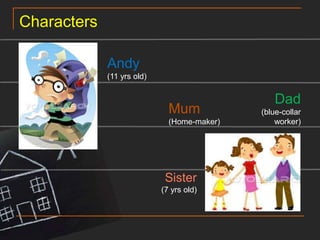
CharactersAndy(11 yrs old)Dad(blue-collar worker)Mum(Home-maker)Sister(7 yrs old)
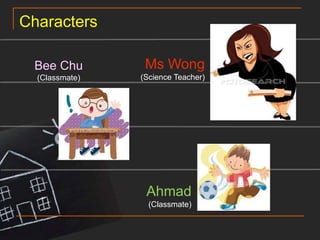
CharactersMs Wong(Science Teacher)Bee Chu(Classmate)Ahmad(Classmate)
overview"Factors leading to meaningful and successful learning involves motivation, self-efficacy and support"Failure drains confidence out of students and hampers their Learning progressWithout motivation as the fuel for learning, students learning capacity/performance will be negatively affectedSocial support, just like ammunition for battles, is essential for successful learning
"Factors leading to meaningful and successful learning involves motivation, self-efficacy and support"Problem statement
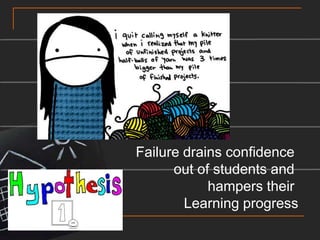
Failure drains confidence out of students and hampers their Learning progress
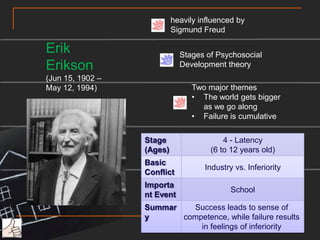
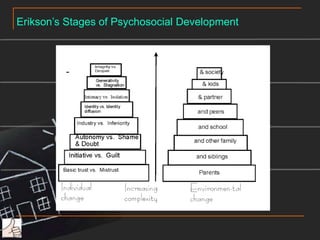
heavily influenced bySigmund FreudErik Erikson(Jun 15, 1902 – May 12, 1994)Stages of Psychosocial Development theoryTwo major themesThe world gets bigger 	as we go alongFailure is cumulativeErikson’s Stages of Psychosocial Development
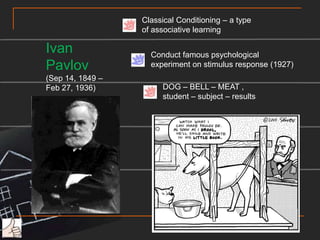
Classical Conditioning – a type of associative learningIvan Pavlov(Sep 14, 1849 – Feb 27, 1936)Conduct famous psychologicalexperiment on stimulus response (1927) DOG – BELL – MEAT ,student – subject – results
Originated from Chinese dictionary of idioms (《汉语成语大词典》)Failure – committing of mistake, rather than Poor achievementSuccess – chance for future excellence
Famous failures
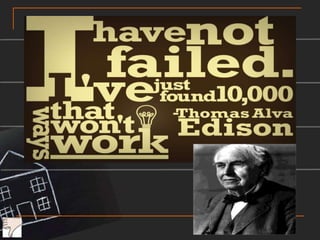
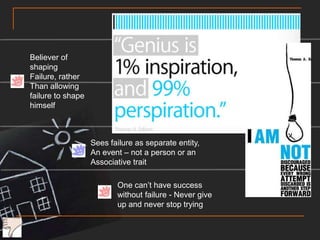
Believer of shapingFailure, rather Than allowing failure to shapehimselfSees failure as separate entity,An event – not a person or an Associative traitOne can’t have success without failure - Never give up and never stop trying
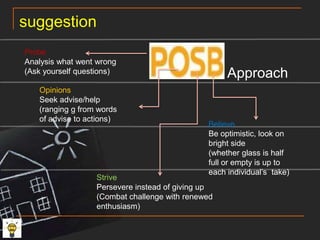
suggestionProbeAnalysis what went wrong(Ask yourself questions)ApproachOpinionsSeek advise/help (ranging g from words of advise to actions)BelieveBe optimistic, look on bright side(whether glass is half full or empty is up to each individual’s  take)StrivePersevere instead of giving up(Combat challenge with renewed enthusiasm)
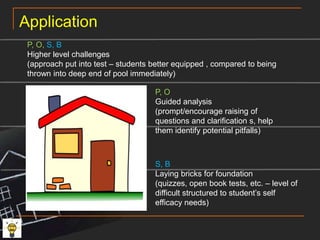
ApplicationP, O, S, BHigher level challenges(approach put into test – students better equipped , compared to being thrown into deep end of pool immediately)P, OGuided analysis(prompt/encourage raising of questions and clarification s, help them identify potential pitfalls)S, BLaying bricks for foundation(quizzes, open book tests, etc. – level of difficult structured to student’s self efficacy needs)
Social support, just like ammunition for battles, is essential for successful learning
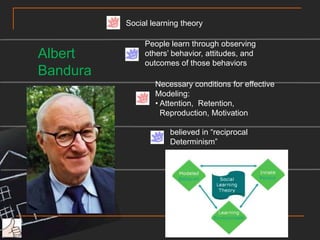
Social learning theoryPeople learn through observing others’ behavior, attitudes, and outcomes of those behaviorsAlbert BanduraNecessary conditions for effective Modeling: Attention,  Retention,    Reproduction, Motivation believed in “reciprocal Determinism”
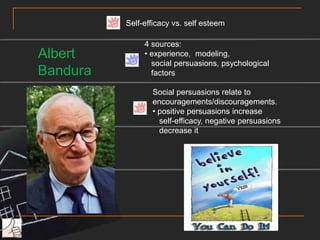
Self-efficacy vs. self esteem4 sources: experience,  modeling,     social persuasions, psychological    factorsAlbert BanduraSocial persuasions relate to encouragements/discouragements. positive persuasions increase    self-efficacy, negative persuasions    decrease it
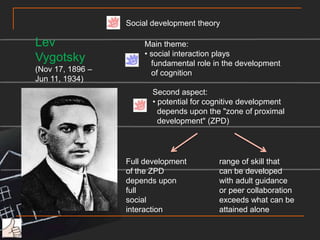
Social development theoryLev Vygotsky(Nov 17, 1896 – Jun 11, 1934)Main theme: social interaction plays     fundamental role in the development    of cognitionSecond aspect:  potential for cognitive development   depends upon the "zone of proximal   development" (ZPD)Full development of the ZPD depends upon full social interactionrange of skill that can be developed with adult guidance or peer collaboration exceeds what can be attained alone
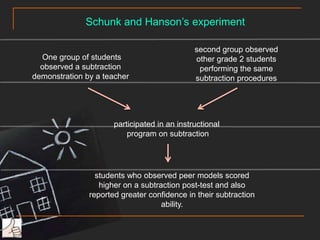
Schunk and Hanson’s experimentsecond group observed other grade 2 students performing the same subtraction procedures One group of studentsobserved a subtraction demonstration by a teacher participated in an instructional program on subtractionstudents who observed peer models scored higher on a subtraction post-test and also reported greater confidence in their subtraction ability.
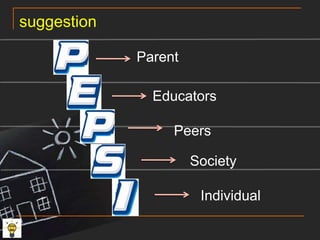
suggestionParentEducatorsPeersSocietyIndividual
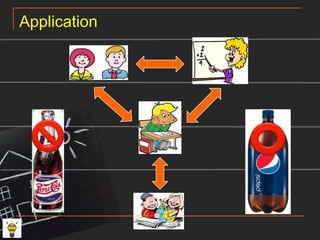
Application
Without motivation as the fuel for learning, students learning capacity/performance will be negatively affected
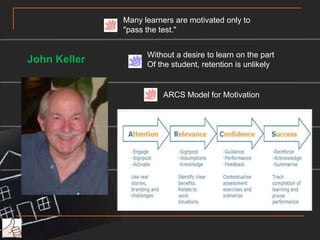
Many learners are motivated only to "pass the test."Without a desire to learn on the part Of the student, retention is unlikelyJohn KellerARCS Model for Motivation
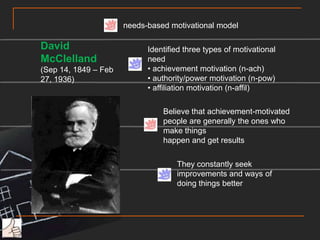
needs-based motivational modelDavid McClelland(Sep 14, 1849 – Feb 27, 1936)Identified three types of motivational need achievement motivation (n-ach)
 authority/power motivation (n-pow)
 affiliation motivation (n-affil)Believe that achievement-motivated people are generally the ones who make things happen and get resultsThey constantly seek improvements and ways of doing things better
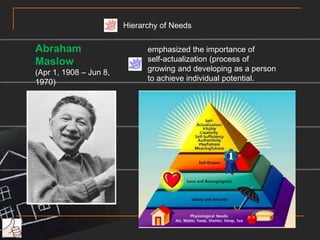
Hierarchy of NeedsAbraham Maslow(Apr 1, 1908 – Jun 8, 1970)emphasized the importance of self-actualization (process of growing and developing as a person to achieve individual potential.
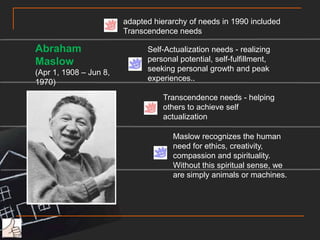
adapted hierarchy of needs in 1990 includedTranscendence needsAbraham Maslow(Apr 1, 1908 – Jun 8, 1970)Self-Actualization needs - realizing personal potential, self-fulfillment, seeking personal growth and peak experiences..Transcendence needs - helping others to achieve self actualizationMaslow recognizes the human need for ethics, creativity, compassion and spirituality. Without this spiritual sense, we are simply animals or machines.
The old man and the children A group of children were playing, loud and noisy, in front of an old man’s house. The old man after a while couldn’t stand any more. He walked out and handed 25 cents to each child and said, “you guys made my place not so lonely any more. I feelmuch younger. Take these as my gratitude.” The children were very happy and came back the next day. Playing loud as usual. The old man came out and handed each of them 15 cents. He explained, “I don’t Have much income.15 cents are not badat all.” The children were satisfied and left.The next day, he only gave them 5 cents each.The children were upset, “Only 5 cents?! Have You no idea how hard we were playing for you!” Then they swore they were never going to play for the old man again.
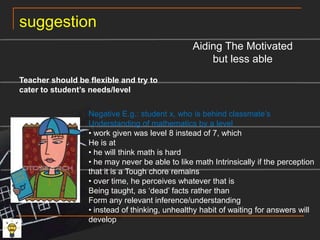
suggestionAiding The Motivated but less ableTeacher should be flexible and try to cater to student’s needs/level Negative E.g.: student x, who is behind classmate’sUnderstanding of mathematics by a level work given was level 8 instead of 7, which He is at he will think math is hard
 he may never be able to like math Intrinsically if the perception that it is a Tough chore remains
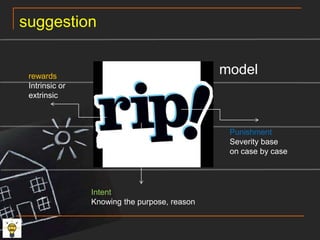
 over time, he perceives whatever that is Being taught, as ‘dead’ facts rather thanForm any relevant inference/understanding instead of thinking, unhealthy habit of waiting for answers will developsuggestionmodelrewardsIntrinsic orextrinsicPunishmentSeverity base on case by caseIntentKnowing the purpose, reason
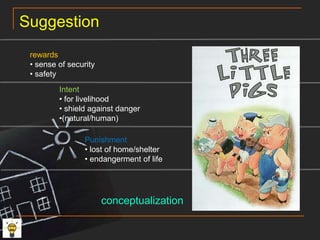
Suggestionrewards sense of security
 safetyIntent for livelihood
 shield against danger

Problem Based Learning

  • 1.
    DED 100 EducationalPsychology I: Problem Based LearningCase Scenario 1 (11 yr old Andy)
  • 2.
    Azizah (2)Jasmin (5)Krish(9)Chor Bin (11)Peining (13)Xue Bing (25)
  • 3.
    CharactersAndy(11 yrs old)Dad(blue-collarworker)Mum(Home-maker)Sister(7 yrs old)
  • 4.
    CharactersMs Wong(Science Teacher)BeeChu(Classmate)Ahmad(Classmate)
  • 5.
    overview"Factors leading tomeaningful and successful learning involves motivation, self-efficacy and support"Failure drains confidence out of students and hampers their Learning progressWithout motivation as the fuel for learning, students learning capacity/performance will be negatively affectedSocial support, just like ammunition for battles, is essential for successful learning
  • 6.
    "Factors leading tomeaningful and successful learning involves motivation, self-efficacy and support"Problem statement
  • 7.
    Failure drains confidenceout of students and hampers their Learning progress
  • 8.
    heavily influenced bySigmundFreudErik Erikson(Jun 15, 1902 – May 12, 1994)Stages of Psychosocial Development theoryTwo major themesThe world gets bigger as we go alongFailure is cumulativeErikson’s Stages of Psychosocial Development
  • 9.
    Classical Conditioning –a type of associative learningIvan Pavlov(Sep 14, 1849 – Feb 27, 1936)Conduct famous psychologicalexperiment on stimulus response (1927) DOG – BELL – MEAT ,student – subject – results
  • 10.
    Originated from Chinesedictionary of idioms (《汉语成语大词典》)Failure – committing of mistake, rather than Poor achievementSuccess – chance for future excellence
  • 11.
  • 13.
    Believer of shapingFailure,rather Than allowing failure to shapehimselfSees failure as separate entity,An event – not a person or an Associative traitOne can’t have success without failure - Never give up and never stop trying
  • 14.
    suggestionProbeAnalysis what wentwrong(Ask yourself questions)ApproachOpinionsSeek advise/help (ranging g from words of advise to actions)BelieveBe optimistic, look on bright side(whether glass is half full or empty is up to each individual’s take)StrivePersevere instead of giving up(Combat challenge with renewed enthusiasm)
  • 15.
    ApplicationP, O, S,BHigher level challenges(approach put into test – students better equipped , compared to being thrown into deep end of pool immediately)P, OGuided analysis(prompt/encourage raising of questions and clarification s, help them identify potential pitfalls)S, BLaying bricks for foundation(quizzes, open book tests, etc. – level of difficult structured to student’s self efficacy needs)
  • 16.
    Social support, justlike ammunition for battles, is essential for successful learning
  • 17.
    Social learning theoryPeoplelearn through observing others’ behavior, attitudes, and outcomes of those behaviorsAlbert BanduraNecessary conditions for effective Modeling: Attention, Retention, Reproduction, Motivation believed in “reciprocal Determinism”
  • 18.
    Self-efficacy vs. selfesteem4 sources: experience, modeling, social persuasions, psychological factorsAlbert BanduraSocial persuasions relate to encouragements/discouragements. positive persuasions increase self-efficacy, negative persuasions decrease it
  • 19.
    Social development theoryLevVygotsky(Nov 17, 1896 – Jun 11, 1934)Main theme: social interaction plays fundamental role in the development of cognitionSecond aspect: potential for cognitive development depends upon the "zone of proximal development" (ZPD)Full development of the ZPD depends upon full social interactionrange of skill that can be developed with adult guidance or peer collaboration exceeds what can be attained alone
  • 20.
    Schunk and Hanson’sexperimentsecond group observed other grade 2 students performing the same subtraction procedures One group of studentsobserved a subtraction demonstration by a teacher participated in an instructional program on subtractionstudents who observed peer models scored higher on a subtraction post-test and also reported greater confidence in their subtraction ability.
  • 21.
  • 22.
  • 23.
    Without motivation asthe fuel for learning, students learning capacity/performance will be negatively affected
  • 24.
    Many learners aremotivated only to "pass the test."Without a desire to learn on the part Of the student, retention is unlikelyJohn KellerARCS Model for Motivation
  • 25.
    needs-based motivational modelDavidMcClelland(Sep 14, 1849 – Feb 27, 1936)Identified three types of motivational need achievement motivation (n-ach)
  • 26.
  • 27.
    affiliation motivation(n-affil)Believe that achievement-motivated people are generally the ones who make things happen and get resultsThey constantly seek improvements and ways of doing things better
  • 28.
    Hierarchy of NeedsAbrahamMaslow(Apr 1, 1908 – Jun 8, 1970)emphasized the importance of self-actualization (process of growing and developing as a person to achieve individual potential.
  • 29.
    adapted hierarchy ofneeds in 1990 includedTranscendence needsAbraham Maslow(Apr 1, 1908 – Jun 8, 1970)Self-Actualization needs - realizing personal potential, self-fulfillment, seeking personal growth and peak experiences..Transcendence needs - helping others to achieve self actualizationMaslow recognizes the human need for ethics, creativity, compassion and spirituality. Without this spiritual sense, we are simply animals or machines.
  • 30.
    The old manand the children A group of children were playing, loud and noisy, in front of an old man’s house. The old man after a while couldn’t stand any more. He walked out and handed 25 cents to each child and said, “you guys made my place not so lonely any more. I feelmuch younger. Take these as my gratitude.” The children were very happy and came back the next day. Playing loud as usual. The old man came out and handed each of them 15 cents. He explained, “I don’t Have much income.15 cents are not badat all.” The children were satisfied and left.The next day, he only gave them 5 cents each.The children were upset, “Only 5 cents?! Have You no idea how hard we were playing for you!” Then they swore they were never going to play for the old man again.
  • 31.
    suggestionAiding The Motivatedbut less ableTeacher should be flexible and try to cater to student’s needs/level Negative E.g.: student x, who is behind classmate’sUnderstanding of mathematics by a level work given was level 8 instead of 7, which He is at he will think math is hard
  • 32.
    he maynever be able to like math Intrinsically if the perception that it is a Tough chore remains
  • 33.
    over time,he perceives whatever that is Being taught, as ‘dead’ facts rather thanForm any relevant inference/understanding instead of thinking, unhealthy habit of waiting for answers will developsuggestionmodelrewardsIntrinsic orextrinsicPunishmentSeverity base on case by caseIntentKnowing the purpose, reason
  • 34.
  • 35.
  • 36.