The Role of Perspective
in Machine Learning
ashokveda.com
• Introduction to Machine Learning
• Types of Perspectives in Machine Learning
• Theoretical Perspective
• Applied Perspective
• Supervised vs. Unsupervised Learning
• Ethical Considerations
• Future Directions
• Conclusion
Agenda
ashokveda.com
Introduction to
Machine Learning
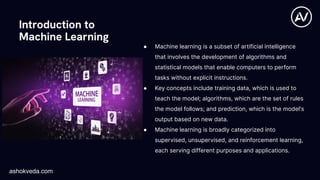
● Machine learning is a subset of artificial intelligence
that involves the development of algorithms and
statistical models that enable computers to perform
tasks without explicit instructions.
● Key concepts include training data, which is used to
teach the model; algorithms, which are the set of rules
the model follows; and prediction, which is the model's
output based on new data.
● Machine learning is broadly categorized into
supervised, unsupervised, and reinforcement learning,
each serving different purposes and applications.
ashokveda.com
Ethical Considerations
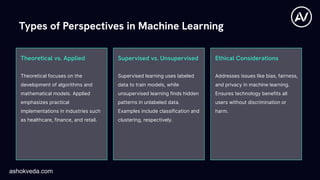
Theoretical focuses on the
development of algorithms and
mathematical models. Applied
emphasizes practical
implementations in industries such
as healthcare, finance, and retail.
Theoretical vs. Applied Supervised vs. Unsupervised
Types of Perspectives in Machine Learning
Supervised learning uses labeled
data to train models, while
unsupervised learning finds hidden
patterns in unlabeled data.
Examples include classification and
clustering, respectively.
Addresses issues like bias, fairness,
and privacy in machine learning.
Ensures technology benefits all
users without discrimination or
harm.
ashokveda.com
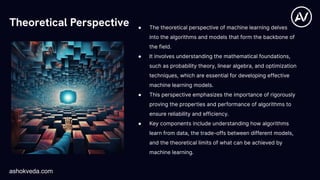
Theoretical Perspective ● The theoretical perspective of machine learning delves
into the algorithms and models that form the backbone of
the field.
● It involves understanding the mathematical foundations,
such as probability theory, linear algebra, and optimization
techniques, which are essential for developing effective
machine learning models.
● This perspective emphasizes the importance of rigorously
proving the properties and performance of algorithms to
ensure reliability and efficiency.
● Key components include understanding how algorithms
learn from data, the trade-offs between different models,
and the theoretical limits of what can be achieved by
machine learning.
ashokveda.com
Applied Perspective
● The applied perspective of machine learning emphasizes
its practical use in various industries to solve real-world
problems.
● For instance, in healthcare, machine learning algorithms
improve diagnostic accuracy and personalize treatment
plans. In finance, they enhance fraud detection and
automate trading.
● Retail businesses leverage machine learning for customer
segmentation and demand forecasting. Additionally, in the
field of transportation, machine learning is used for route
optimization and predictive maintenance.
● By focusing on tangible outcomes and industry-specific
solutions, the applied perspective bridges the gap
between theoretical models and practical implementations.
ashokveda.com
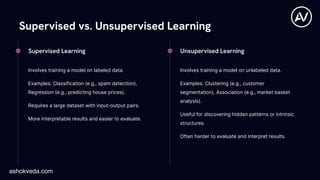
Supervised vs. Unsupervised Learning
● Involves training a model on labeled data.
● Examples: Classification (e.g., spam detection),
Regression (e.g., predicting house prices).
● Requires a large dataset with input-output pairs.
● More interpretable results and easier to evaluate.
● Involves training a model on unlabeled data.
● Examples: Clustering (e.g., customer
segmentation), Association (e.g., market basket
analysis).
● Useful for discovering hidden patterns or intrinsic
structures.
● Often harder to evaluate and interpret results.
Supervised Learning Unsupervised Learning
ashokveda.com
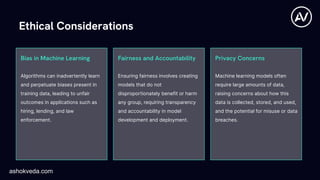
Privacy Concerns
Algorithms can inadvertently learn
and perpetuate biases present in
training data, leading to unfair
outcomes in applications such as
hiring, lending, and law
enforcement.
Bias in Machine Learning Fairness and Accountability
Ethical Considerations
Ensuring fairness involves creating
models that do not
disproportionately benefit or harm
any group, requiring transparency
and accountability in model
development and deployment.
Machine learning models often
require large amounts of data,
raising concerns about how this
data is collected, stored, and used,
and the potential for misuse or data
breaches.
ashokveda.com
Increased focus on explainable
AI to make machine learning
models more transparent and
understandable.
Advancements in ethical
frameworks will ensure fairer
and more responsible AI
systems.
Future Directions
Integration of machine learning
with quantum computing could
vastly accelerate computational
capabilities.
ashokveda.com
Conclusion
● Throughout this presentation, we have explored the multifaceted role
of perspective in machine learning.
● From understanding the theoretical foundations that drive algorithm
development to examining practical applications across industries, it
is clear that multiple viewpoints enrich our understanding of machine
learning.
● Additionally, we delved into the dichotomy of supervised and
unsupervised learning, highlighting their unique characteristics and
use cases.
● Ethical considerations, including bias and fairness, were also
discussed, emphasizing the need for responsible AI development.
● As we look to the future, it is evident that embracing diverse
perspectives will be crucial for innovation and ethical integrity in
machine learning.
ashokveda.com

The Role of Perspective in Machine Learning

  • 1.
    The Role ofPerspective in Machine Learning ashokveda.com
  • 2.
    • Introduction toMachine Learning • Types of Perspectives in Machine Learning • Theoretical Perspective • Applied Perspective • Supervised vs. Unsupervised Learning • Ethical Considerations • Future Directions • Conclusion Agenda ashokveda.com
  • 3.
    Introduction to Machine Learning ●Machine learning is a subset of artificial intelligence that involves the development of algorithms and statistical models that enable computers to perform tasks without explicit instructions. ● Key concepts include training data, which is used to teach the model; algorithms, which are the set of rules the model follows; and prediction, which is the model's output based on new data. ● Machine learning is broadly categorized into supervised, unsupervised, and reinforcement learning, each serving different purposes and applications. ashokveda.com
  • 4.
    Ethical Considerations Theoretical focuseson the development of algorithms and mathematical models. Applied emphasizes practical implementations in industries such as healthcare, finance, and retail. Theoretical vs. Applied Supervised vs. Unsupervised Types of Perspectives in Machine Learning Supervised learning uses labeled data to train models, while unsupervised learning finds hidden patterns in unlabeled data. Examples include classification and clustering, respectively. Addresses issues like bias, fairness, and privacy in machine learning. Ensures technology benefits all users without discrimination or harm. ashokveda.com
  • 5.
    Theoretical Perspective ●The theoretical perspective of machine learning delves into the algorithms and models that form the backbone of the field. ● It involves understanding the mathematical foundations, such as probability theory, linear algebra, and optimization techniques, which are essential for developing effective machine learning models. ● This perspective emphasizes the importance of rigorously proving the properties and performance of algorithms to ensure reliability and efficiency. ● Key components include understanding how algorithms learn from data, the trade-offs between different models, and the theoretical limits of what can be achieved by machine learning. ashokveda.com
  • 6.
    Applied Perspective ● Theapplied perspective of machine learning emphasizes its practical use in various industries to solve real-world problems. ● For instance, in healthcare, machine learning algorithms improve diagnostic accuracy and personalize treatment plans. In finance, they enhance fraud detection and automate trading. ● Retail businesses leverage machine learning for customer segmentation and demand forecasting. Additionally, in the field of transportation, machine learning is used for route optimization and predictive maintenance. ● By focusing on tangible outcomes and industry-specific solutions, the applied perspective bridges the gap between theoretical models and practical implementations. ashokveda.com
  • 7.
    Supervised vs. UnsupervisedLearning ● Involves training a model on labeled data. ● Examples: Classification (e.g., spam detection), Regression (e.g., predicting house prices). ● Requires a large dataset with input-output pairs. ● More interpretable results and easier to evaluate. ● Involves training a model on unlabeled data. ● Examples: Clustering (e.g., customer segmentation), Association (e.g., market basket analysis). ● Useful for discovering hidden patterns or intrinsic structures. ● Often harder to evaluate and interpret results. Supervised Learning Unsupervised Learning ashokveda.com
  • 8.
    Privacy Concerns Algorithms caninadvertently learn and perpetuate biases present in training data, leading to unfair outcomes in applications such as hiring, lending, and law enforcement. Bias in Machine Learning Fairness and Accountability Ethical Considerations Ensuring fairness involves creating models that do not disproportionately benefit or harm any group, requiring transparency and accountability in model development and deployment. Machine learning models often require large amounts of data, raising concerns about how this data is collected, stored, and used, and the potential for misuse or data breaches. ashokveda.com
  • 9.
    Increased focus onexplainable AI to make machine learning models more transparent and understandable. Advancements in ethical frameworks will ensure fairer and more responsible AI systems. Future Directions Integration of machine learning with quantum computing could vastly accelerate computational capabilities. ashokveda.com
  • 10.
    Conclusion ● Throughout thispresentation, we have explored the multifaceted role of perspective in machine learning. ● From understanding the theoretical foundations that drive algorithm development to examining practical applications across industries, it is clear that multiple viewpoints enrich our understanding of machine learning. ● Additionally, we delved into the dichotomy of supervised and unsupervised learning, highlighting their unique characteristics and use cases. ● Ethical considerations, including bias and fairness, were also discussed, emphasizing the need for responsible AI development. ● As we look to the future, it is evident that embracing diverse perspectives will be crucial for innovation and ethical integrity in machine learning. ashokveda.com