How Machine
Learning Algorithms
Work
ashokveda.com
Content
1. Understanding Machine Learning
2. Types of Machine Learning Algorithms
3. Applications of Machine Learning
of Machine Learning
s
ashokveda.com
Introduction to Machine Learning
Definition Training Data Human Involvement
Machine learning is a branch of
artificial intelligence that enables
systems to learn and improve from
experience without being
explicitly programmed. It involves
algorithms that learn from and
make predictions or decisions
based on data.
The machine learning process
begins with inputting training data
into the selected algorithm, which
can be known or unknown data to
train the model to make accurate
predictions.
Machines are trained by humans,
and human biases can be
incorporated into algorithms,
highlighting the importance of
ethical considerations in machine
learning.
ashokveda.com
Data Analysis
Learning Patterns
Minimal Human Intervention
Machine learning algorithms are trained to find relationships
and patterns in data, enabling them to make predictions,
classify data, and identify trends.
These algorithms learn patterns and relationships in the data
to make informed predictions, and they can be used to
identify and categorize different data types.
Machine learning involves minimal human intervention and
can be used for a wide range of tasks that involve data
analysis and prediction.
Working of Machine Learning
Algorithms
ashokveda.com
01 02 03
Benefits and Challenges
Benefits Challenges Real-world Examples
Machine learning algorithms
enable AI to imitate the way
humans learn, leading to
improved decision-making,
automation of complex tasks,
and the ability to process
large volumes of data
efficiently.
Incorporating human biases,
ethical considerations, and
the need for continuous
monitoring and updating of
algorithms to ensure accuracy
and fairness pose challenges
in machine learning.
Case studies demonstrating
the impact of machine
learning in various industries,
such as healthcare, finance,
and marketing, will be
explored to illustrate the
practical applications of
machine learning.
ashokveda.com
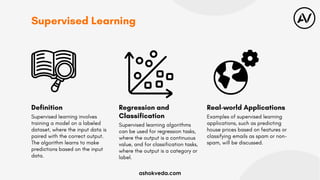
Supervised Learning
Definition Regression and
Classification
Real-world Applications
Supervised learning involves
training a model on a labeled
dataset, where the input data is
paired with the correct output.
The algorithm learns to make
predictions based on the input
data.
Supervised learning algorithms
can be used for regression tasks,
where the output is a continuous
value, and for classification tasks,
where the output is a category or
label.
Examples of supervised learning
applications, such as predicting
house prices based on features or
classifying emails as spam or non-
spam, will be discussed.
ashokveda.com
Clustering and Association
Anomaly Detection
Use Cases
Unsupervised learning algorithms are used to analyze and
cluster unlabeled data, identifying hidden patterns and
relationships. They can also be used for association rule
mining.
Unsupervised learning algorithms are effective in detecting
anomalies or outliers in data, which is valuable in fraud
detection and quality control.
Real-world examples of unsupervised learning, such as
customer segmentation and market basket analysis, will be
presented to showcase the practical applications of these
algorithms.
Unsupervised Learning
ashokveda.com
01 02 03
Reinforcement Learning
Learning from
Interaction
Dynamic
Environments
Success Stories
Reinforcement learning
involves an agent learning to
make decisions by interacting
with an environment to
achieve a goal. The agent
receives feedback in the form
of rewards or penalties.
These algorithms are suitable
for dynamic environments
where the optimal decision
may change over time, such
as in game playing and
robotics.
Case studies highlighting the
success of reinforcement
learning in training
autonomous vehicles and
optimizing resource allocation
in businesses will be explored.
ashokveda.com
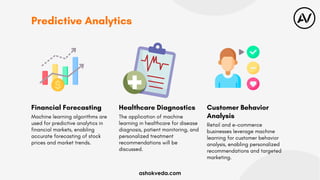
Predictive Analytics
Financial Forecasting Healthcare Diagnostics Customer Behavior
Analysis
Machine learning algorithms are
used for predictive analytics in
financial markets, enabling
accurate forecasting of stock
prices and market trends.
The application of machine
learning in healthcare for disease
diagnosis, patient monitoring, and
personalized treatment
recommendations will be
discussed.
Retail and e-commerce
businesses leverage machine
learning for customer behavior
analysis, enabling personalized
recommendations and targeted
marketing.
ashokveda.com
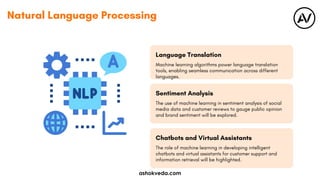
Language Translation
Sentiment Analysis
Chatbots and Virtual Assistants
Machine learning algorithms power language translation
tools, enabling seamless communication across different
languages.
The use of machine learning in sentiment analysis of social
media data and customer reviews to gauge public opinion
and brand sentiment will be explored.
The role of machine learning in developing intelligent
chatbots and virtual assistants for customer support and
information retrieval will be highlighted.
Natural Language Processing
ashokveda.com
01 02 03
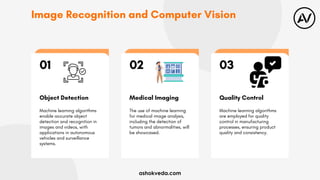
Image Recognition and Computer Vision
Object Detection Medical Imaging Quality Control
Machine learning algorithms
enable accurate object
detection and recognition in
images and videos, with
applications in autonomous
vehicles and surveillance
systems.
The use of machine learning
for medical image analysis,
including the detection of
tumors and abnormalities, will
be showcased.
Machine learning algorithms
are employed for quality
control in manufacturing
processes, ensuring product
quality and consistency.
ashokveda.com
Core Principles: Understanding machine learning algorithms
involves grasping supervised and unsupervised learning, model
training, and evaluation.
Versatile Techniques: Algorithms like neural networks and
decision trees are chosen based on specific task needs,
showcasing their versatility.
Real-World Impact: Mastering these algorithms enables
applications in various industries, solving complex problems
through predictive analytics and automation
Conclusion
ashokveda.com

How Machine Learning Algorithms Work | ashokveda.pdf

  • 1.
  • 2.
    Content 1. Understanding MachineLearning 2. Types of Machine Learning Algorithms 3. Applications of Machine Learning of Machine Learning s ashokveda.com
  • 3.
    Introduction to MachineLearning Definition Training Data Human Involvement Machine learning is a branch of artificial intelligence that enables systems to learn and improve from experience without being explicitly programmed. It involves algorithms that learn from and make predictions or decisions based on data. The machine learning process begins with inputting training data into the selected algorithm, which can be known or unknown data to train the model to make accurate predictions. Machines are trained by humans, and human biases can be incorporated into algorithms, highlighting the importance of ethical considerations in machine learning. ashokveda.com
  • 4.
    Data Analysis Learning Patterns MinimalHuman Intervention Machine learning algorithms are trained to find relationships and patterns in data, enabling them to make predictions, classify data, and identify trends. These algorithms learn patterns and relationships in the data to make informed predictions, and they can be used to identify and categorize different data types. Machine learning involves minimal human intervention and can be used for a wide range of tasks that involve data analysis and prediction. Working of Machine Learning Algorithms ashokveda.com
  • 5.
    01 02 03 Benefitsand Challenges Benefits Challenges Real-world Examples Machine learning algorithms enable AI to imitate the way humans learn, leading to improved decision-making, automation of complex tasks, and the ability to process large volumes of data efficiently. Incorporating human biases, ethical considerations, and the need for continuous monitoring and updating of algorithms to ensure accuracy and fairness pose challenges in machine learning. Case studies demonstrating the impact of machine learning in various industries, such as healthcare, finance, and marketing, will be explored to illustrate the practical applications of machine learning. ashokveda.com
  • 6.
    Supervised Learning Definition Regressionand Classification Real-world Applications Supervised learning involves training a model on a labeled dataset, where the input data is paired with the correct output. The algorithm learns to make predictions based on the input data. Supervised learning algorithms can be used for regression tasks, where the output is a continuous value, and for classification tasks, where the output is a category or label. Examples of supervised learning applications, such as predicting house prices based on features or classifying emails as spam or non- spam, will be discussed. ashokveda.com
  • 7.
    Clustering and Association AnomalyDetection Use Cases Unsupervised learning algorithms are used to analyze and cluster unlabeled data, identifying hidden patterns and relationships. They can also be used for association rule mining. Unsupervised learning algorithms are effective in detecting anomalies or outliers in data, which is valuable in fraud detection and quality control. Real-world examples of unsupervised learning, such as customer segmentation and market basket analysis, will be presented to showcase the practical applications of these algorithms. Unsupervised Learning ashokveda.com
  • 8.
    01 02 03 ReinforcementLearning Learning from Interaction Dynamic Environments Success Stories Reinforcement learning involves an agent learning to make decisions by interacting with an environment to achieve a goal. The agent receives feedback in the form of rewards or penalties. These algorithms are suitable for dynamic environments where the optimal decision may change over time, such as in game playing and robotics. Case studies highlighting the success of reinforcement learning in training autonomous vehicles and optimizing resource allocation in businesses will be explored. ashokveda.com
  • 9.
    Predictive Analytics Financial ForecastingHealthcare Diagnostics Customer Behavior Analysis Machine learning algorithms are used for predictive analytics in financial markets, enabling accurate forecasting of stock prices and market trends. The application of machine learning in healthcare for disease diagnosis, patient monitoring, and personalized treatment recommendations will be discussed. Retail and e-commerce businesses leverage machine learning for customer behavior analysis, enabling personalized recommendations and targeted marketing. ashokveda.com
  • 10.
    Language Translation Sentiment Analysis Chatbotsand Virtual Assistants Machine learning algorithms power language translation tools, enabling seamless communication across different languages. The use of machine learning in sentiment analysis of social media data and customer reviews to gauge public opinion and brand sentiment will be explored. The role of machine learning in developing intelligent chatbots and virtual assistants for customer support and information retrieval will be highlighted. Natural Language Processing ashokveda.com
  • 11.
    01 02 03 ImageRecognition and Computer Vision Object Detection Medical Imaging Quality Control Machine learning algorithms enable accurate object detection and recognition in images and videos, with applications in autonomous vehicles and surveillance systems. The use of machine learning for medical image analysis, including the detection of tumors and abnormalities, will be showcased. Machine learning algorithms are employed for quality control in manufacturing processes, ensuring product quality and consistency. ashokveda.com
  • 12.
    Core Principles: Understandingmachine learning algorithms involves grasping supervised and unsupervised learning, model training, and evaluation. Versatile Techniques: Algorithms like neural networks and decision trees are chosen based on specific task needs, showcasing their versatility. Real-World Impact: Mastering these algorithms enables applications in various industries, solving complex problems through predictive analytics and automation Conclusion ashokveda.com