Introduction to
Machine Learning
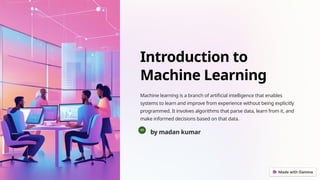
Machinelearning is a branch of artificial intelligence that enables
systems to learn and improve from experience without being explicitly
programmed. It involves algorithms that parse data, learn from it, and
make informed decisions based on that data.
by madan kumar
2.
What is MachineLearning?
1 Data-Centric
Machine learning
focuses on analyzing
and interpreting
patterns within data
to make predictions
or decisions.
2 Algorithm-Driven
It uses statistical
techniques and
algorithms to enable
systems to improve
their performance on
a specific task.
3 AI Subset
It's a subset of
artificial intelligence
that enables
machines to improve
and learn based on
experience.
3.
Types of MachineLearning Algorithms
Supervised Learning
Algorithms learn from
labeled training data to
make predictions or
decisions.
Unsupervised Learning
Algorithms detect patterns
or relationships in
unlabeled data.
Reinforcement Learning
Algorithms learn based on
a system of reward and
punishment.
4.
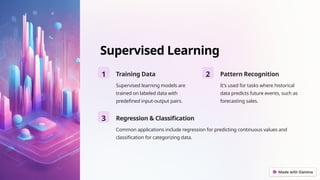
Supervised Learning
1 TrainingData
Supervised learning models are
trained on labeled data with
predefined input-output pairs.
2 Pattern Recognition
It's used for tasks where historical
data predicts future events, such as
forecasting sales.
3 Regression & Classification
Common applications include regression for predicting continuous values and
classification for categorizing data.
5.
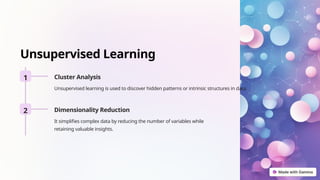
Unsupervised Learning
1 ClusterAnalysis
Unsupervised learning is used to discover hidden patterns or intrinsic structures in data.
2 Dimensionality Reduction
It simplifies complex data by reducing the number of variables while
retaining valuable insights.
6.
Reinforcement Learning
Dynamic Environments
Reinforcementlearning excels in
uncertain environments where it
learns from experience.
Reward Mechanism
It uses a system of rewards and
punishments to learn the best actions
to maximize the cumulative reward.
7.
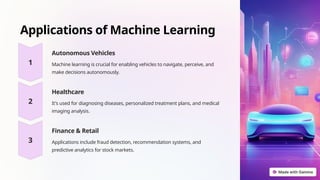
Applications of MachineLearning
Autonomous Vehicles
Machine learning is crucial for enabling vehicles to navigate, perceive, and
make decisions autonomously.
Healthcare
It's used for diagnosing diseases, personalized treatment plans, and medical
imaging analysis.
Finance & Retail
Applications include fraud detection, recommendation systems, and
predictive analytics for stock markets.
8.
Conclusion
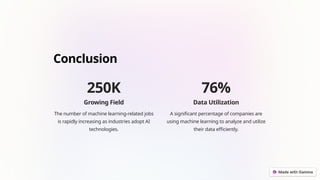
250K
Growing Field
The numberof machine learning-related jobs
is rapidly increasing as industries adopt AI
technologies.
76%
Data Utilization
A significant percentage of companies are
using machine learning to analyze and utilize
their data efficiently.