The rise of Victoria
Research base on .id Small Area Forecast information (SAFi)
September 2015
What will you learn about today?
Who are .id and how we can help
The Rise of Victoria – how we are changing
The Historical View: 1971-2001
The Turning Tide: 2001-2014
Three Growth Markets: 2011-2031
How you can apply this knowledge to individual locations
Forecasting demand - a quick case study
Some tools to help you
.id – the population experts
Australia’s largest team of demographers, spatial analysts, forecasters, urban
planners
We understand how cities are growing and changing
And quantify this knowledge into detailed population forecasts
Deliver analysis online in spatial tools so you can see relationships between supply
and demand
Our clients use this knowledge to confidently decide where and when to invest in
infrastructure, services and marketing effort
We provide the evidence-base for 300 councils Australia-wide – 68 in Victoria
We work across the education, property, retail, utilities, community, sports, aged care
and other sectors
The rise of Victoria
Population growth rate,
Victoria, 1972-2014
Source: ABS, Australian Demographic Statistics
0.0%
0.5%
1.0%
1.5%
2.0%
2.5%
Growthrate
Year
Victoria
Australia
What is driving this growth?
People coming from overseas?
Women having more babies?
People living longer?
People coming from interstate?
Different housing consumption patterns?
Increased residential building activity?
The historical view: 1971-2001
Source: State Library of
Victoria, Alan Jordan
Leicester Street, Fitzroy
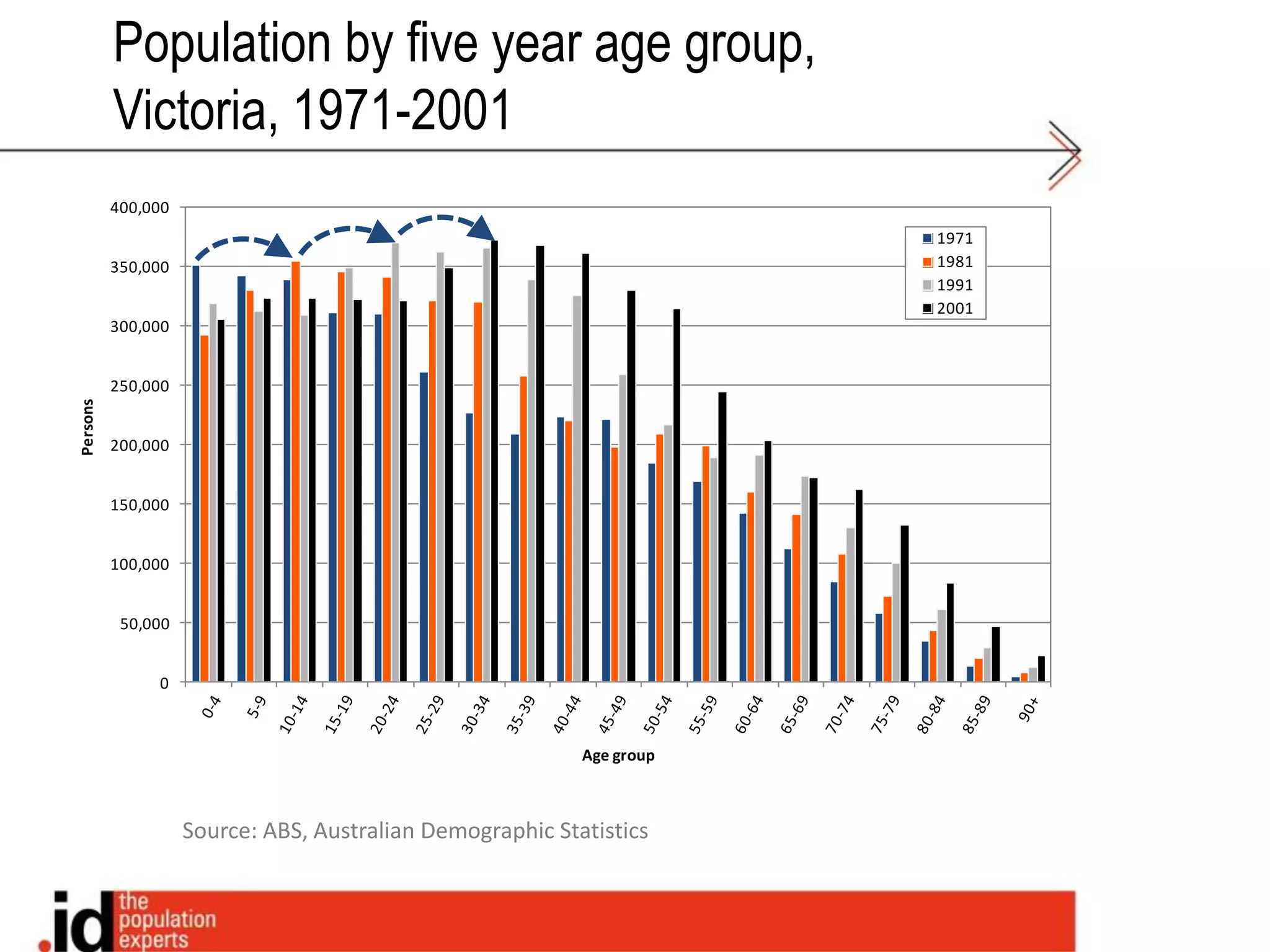
Population by five year age group,
Victoria, 1971-2001
0
50,000
100,000
150,000
200,000
250,000
300,000
350,000
400,000
Persons
Age group
1971
1981
1991
2001
Source: ABS, Australian Demographic Statistics
Pop. change by five year age group,
Victoria, 1971-2001
Source: ABS, Australian Demographic Statistics
-100,000
-50,000
0
50,000
100,000
150,000
200,000
Persons
Age group
The turning tide: 2001-2014
The changing face of Leicester Street, Fitzroy
Source: State Library of
Victoria, Alan Jordan
Source: .id
0.0%
5.0%
10.0%
15.0%
20.0%
25.0%
30.0%
35.0%
40.0%
0
10,000
20,000
30,000
40,000
50,000
60,000
70,000
80,000
90,000
ShareofAustralia
Netoverseasmigration
Year ending June 30
Net overseas migration Share of Australia
Source: ABS, Australian Demographic Statistics
Net overseas migration,
Victoria, 1976-2014
Source: .id – SAFi (historical population reconciliation)
0
10,000
20,000
30,000
40,000
50,000
60,000
70,000
80,000
Persons
Age group
Net overseas migration by age,
Victoria, 2006-2011
Source: ABS, Australian Demographic Statistics
0%
10%
20%
30%
40%
50%
60%
Shareofnetoverseasmigration
Year ending June 30
VIC
NSW
QLD
WA
SA
Share of net overseas migration,
Major States, 1976-2014
Source: ABS, Australian Demographic Statistics
-30,000
-25,000
-20,000
-15,000
-10,000
-5,000
0
5,000
10,000
15,000
1976 1981 1986 1991 1996 2001 2006 2011
Numberofpersons
Year
Net interstate migration
Victoria, 1972-2013
Impetus for growth - economic
Attractiveness of Australia to tertiary students and vocational training
Long period of sustained economic growth – GFC resilience
Comparatively poor performance of competitor countries such as US,
Canada and Western Europe, post 2008
Mining boom – investment hub
Growth in Chinese economy
Higher interest rates (relative to other OECD countries) encouraging foreign
investment
Source: ABS, Australian Historical Population Statistics, 2008
ABS, Australian Demographic Statistics
Fertility rates and number of births
Victoria, 1976-2014
0.00
0.50
1.00
1.50
2.00
2.50
0
10,000
20,000
30,000
40,000
50,000
60,000
70,000
80,000
90,000
Averagenumberofchildren
Births
Year
Births
FertilityRate
'Assumedtrend'
Impetus for growth - social
Higher fertility rates
More flexible work arrangements
Changing balance of power in labour relations (low unemployment and high
labour demand)
Improved access to child care and incentives for having children
Shared responsibility for children?
Source: ABS, Australian Demographic Statistics
Population growth by age,
Victoria, 2001-2011
0
10,000
20,000
30,000
40,000
50,000
60,000
70,000
80,000
90,000
100,000
Persons
Age group
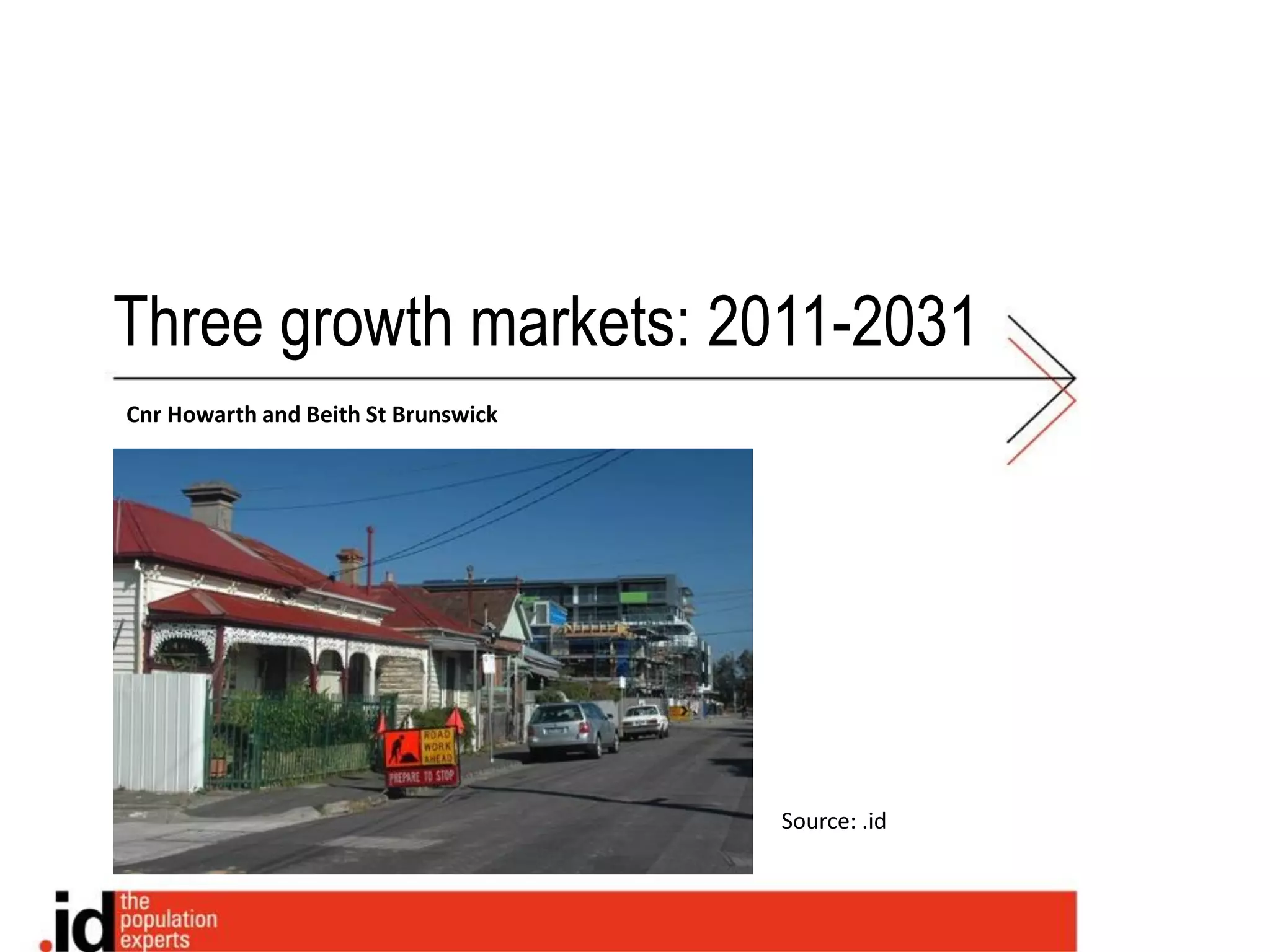
Three growth markets: 2011-2031
Cnr Howarth and Beith St Brunswick
Source: .id
0
20,000
40,000
60,000
80,000
100,000
120,000
140,000
160,000
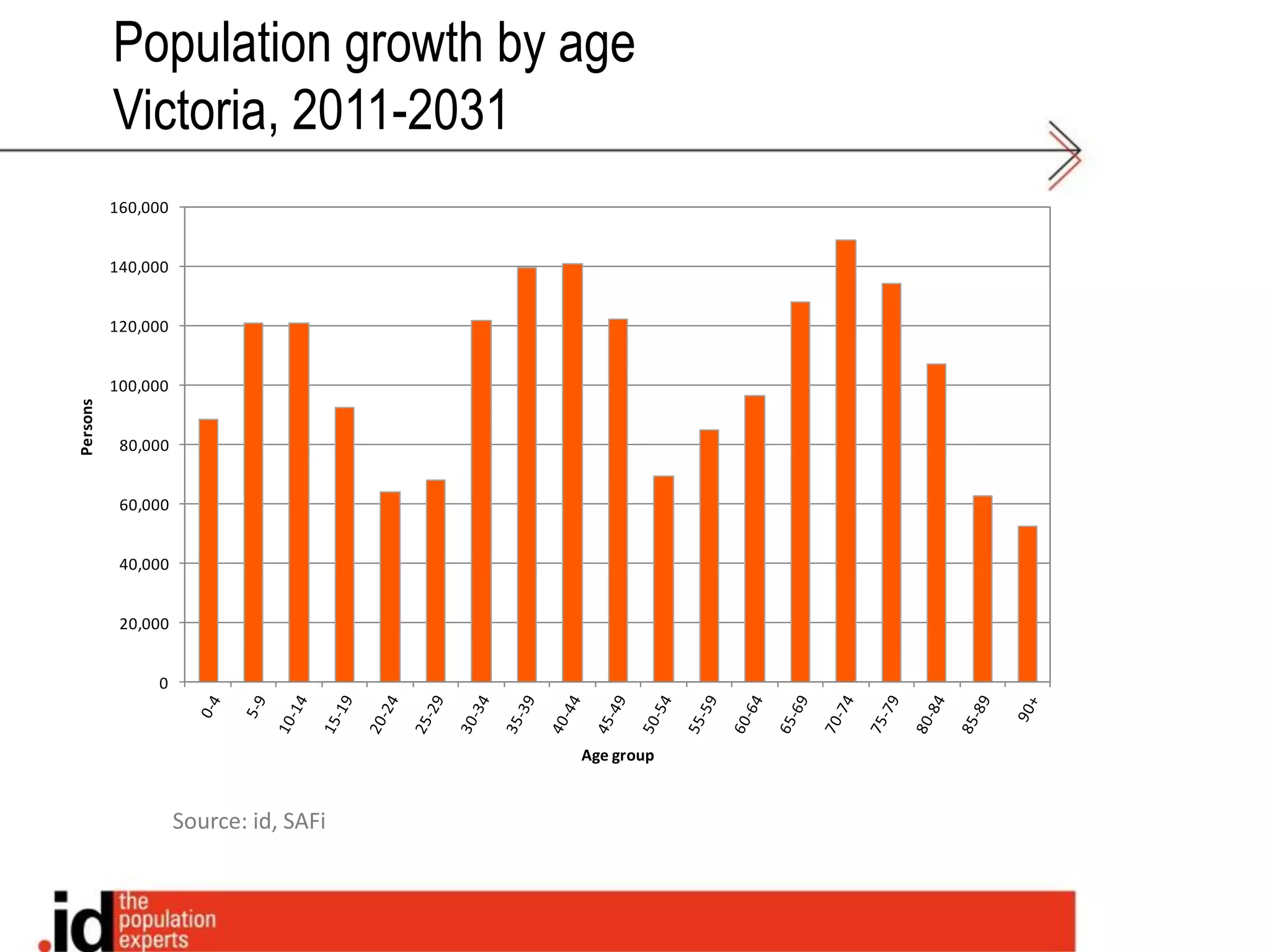
Persons
Age group
Population growth by age
Victoria, 2011-2031
Source: id, SAFi
0
100,000
200,000
300,000
400,000
500,000
600,000
Persons
Age group
2011
2021
2031
Population by age
Victoria, 2011, 2021 & 2031
Source: id, SAFi
0.0%
1.0%
2.0%
3.0%
4.0%
5.0%
6.0%
7.0%
8.0%
9.0%
Persons
Age group
Victoria
Australia
Canada
Japan
Age structure comparison
Selected states and countries, 2035
Source: id, SAFi; UN Population Division, World Population Prospects: The 2012
Revision: Medium Fertility Series
The changing urban landscape
0
20,000
40,000
60,000
80,000
100,000
120,000
140,000
Number
Year ending June 30
Population change
Building approvals
Source: ABS, Australian Demographic Statistics 2014;
ABS, Building Approvals Australia
Note: 2015 data based on 5 months of data
Population growth & building approvals,
Victoria, 1991-2015
2.20
2.25
2.30
2.35
2.40
2.45
2.50
2.55
2.60
2.65
2.70
2.75
1996 2001 2006 2011
Averagehouseholdsize
Year ending June 30
Victoria
Regional VIC
Greater Melbourne
Average household size
Victorian Regions, 1996-2011
Source: ABS, Census
Source: ABS, Census; id, SAFi
0
20,000
40,000
60,000
80,000
100,000
120,000
1991-96 1996-01 2001-06 2006-11 2011-16 2016-21 2021-26 2026-31 2031-36
Dwellinggrowth
Period
Established areas
Greenfield
Historical
Forecast
Dwelling growth, established versus
greenfield, Melbourne, 1991-2036
Evolution of the development industry
in Melbourne (1)
Introduction of developer contributions
Investment in and creation of ‘place’ in fringe developments
Smaller residential lots and developer emphasis on public open space
Build on as much of the lot as possible
Displacement of smaller and medium sized builder / developers to inner
and middle suburbs
Source: Nearmap
Development in Truganina, Wyndham, 2009
Source: Nearmap
Development in Truganina, Wyndham, 2010
Source: Nearmap
Development in Truganina, Wyndham, 2011
Source: Nearmap
Development in Truganina, Wyndham, 2012
Source: Nearmap
Development in Truganina, Wyndham, 2013
Source: Nearmap
Development in Truganina, Wyndham, 2014
Source: Nearmap
Evolution of the development industry
in Melbourne (2)
The great 1990s sell-off (school sites, utilities land)
De-industrialisation
Emphasis on place over housing (I want to live in this area!!)
Lack of investment in public transport, especially at the fringe
New development in established areas is providing housing variety -
opportunities for young to ‘enter’ market and old to ‘exit’
Created political issues for government (Save our suburbs & NIMBY) that
require good planning and design solutions
More development on smaller lots (minimum thresholds falling)
New format planning schemes
Inner and middle suburban residential
development - examples
Waverley Park, Mulgrave
Rusden, Notting Hill
Forrest Hill, South Yarra
Source: The Age (Eddie Jim)
Pier St, Altona
Pentridge, Coburg Albert St, Brunswick
(East Brunswick HS)
Inner and middle suburban residential
development – identified sites, 2011+
Conclusions
There has been a transformation of Victoria’s population prospects over the last
decade, driven by high rates of overseas migration and higher fertility
Population growth is now likely to be higher and more ‘youthful’ than previously
expected, but the challenge of ageing remains
Change is driven by economic factors as well as social components (higher birth
rates / more stable household size
Growth has increased rapidly in established parts of Melbourne in the past 5
years and there are vast numbers of sites in the pipeline.
Volatility means timely updates to forecasts are critical
.idplacemaker
Local implications…
What did we use for this analysis?
SAFi is …
Granular – 7185 areas
Regularly updated
Detailed – single year data
Accurate
Proven
Who is using SAFi?
More resources
Download the complete eBook
Watch the webinar recording
Subscribe to the blog.id.com.au
Feed your curiosity

The rise of Victoria. Population Booms in Victoria

  • 1.
    The rise ofVictoria Research base on .id Small Area Forecast information (SAFi) September 2015
  • 2.
    What will youlearn about today? Who are .id and how we can help The Rise of Victoria – how we are changing The Historical View: 1971-2001 The Turning Tide: 2001-2014 Three Growth Markets: 2011-2031 How you can apply this knowledge to individual locations Forecasting demand - a quick case study Some tools to help you
  • 3.
    .id – thepopulation experts Australia’s largest team of demographers, spatial analysts, forecasters, urban planners We understand how cities are growing and changing And quantify this knowledge into detailed population forecasts Deliver analysis online in spatial tools so you can see relationships between supply and demand Our clients use this knowledge to confidently decide where and when to invest in infrastructure, services and marketing effort We provide the evidence-base for 300 councils Australia-wide – 68 in Victoria We work across the education, property, retail, utilities, community, sports, aged care and other sectors
  • 4.
    The rise ofVictoria
  • 5.
    Population growth rate, Victoria,1972-2014 Source: ABS, Australian Demographic Statistics 0.0% 0.5% 1.0% 1.5% 2.0% 2.5% Growthrate Year Victoria Australia
  • 6.
    What is drivingthis growth? People coming from overseas? Women having more babies? People living longer? People coming from interstate? Different housing consumption patterns? Increased residential building activity?
  • 7.
    The historical view:1971-2001 Source: State Library of Victoria, Alan Jordan Leicester Street, Fitzroy
  • 8.
    Population by fiveyear age group, Victoria, 1971-2001 0 50,000 100,000 150,000 200,000 250,000 300,000 350,000 400,000 Persons Age group 1971 1981 1991 2001 Source: ABS, Australian Demographic Statistics
  • 9.
    Pop. change byfive year age group, Victoria, 1971-2001 Source: ABS, Australian Demographic Statistics -100,000 -50,000 0 50,000 100,000 150,000 200,000 Persons Age group
  • 10.
    The turning tide:2001-2014 The changing face of Leicester Street, Fitzroy Source: State Library of Victoria, Alan Jordan Source: .id
  • 11.
    0.0% 5.0% 10.0% 15.0% 20.0% 25.0% 30.0% 35.0% 40.0% 0 10,000 20,000 30,000 40,000 50,000 60,000 70,000 80,000 90,000 ShareofAustralia Netoverseasmigration Year ending June30 Net overseas migration Share of Australia Source: ABS, Australian Demographic Statistics Net overseas migration, Victoria, 1976-2014
  • 12.
    Source: .id –SAFi (historical population reconciliation) 0 10,000 20,000 30,000 40,000 50,000 60,000 70,000 80,000 Persons Age group Net overseas migration by age, Victoria, 2006-2011
  • 13.
    Source: ABS, AustralianDemographic Statistics 0% 10% 20% 30% 40% 50% 60% Shareofnetoverseasmigration Year ending June 30 VIC NSW QLD WA SA Share of net overseas migration, Major States, 1976-2014
  • 14.
    Source: ABS, AustralianDemographic Statistics -30,000 -25,000 -20,000 -15,000 -10,000 -5,000 0 5,000 10,000 15,000 1976 1981 1986 1991 1996 2001 2006 2011 Numberofpersons Year Net interstate migration Victoria, 1972-2013
  • 15.
    Impetus for growth- economic Attractiveness of Australia to tertiary students and vocational training Long period of sustained economic growth – GFC resilience Comparatively poor performance of competitor countries such as US, Canada and Western Europe, post 2008 Mining boom – investment hub Growth in Chinese economy Higher interest rates (relative to other OECD countries) encouraging foreign investment
  • 16.
    Source: ABS, AustralianHistorical Population Statistics, 2008 ABS, Australian Demographic Statistics Fertility rates and number of births Victoria, 1976-2014 0.00 0.50 1.00 1.50 2.00 2.50 0 10,000 20,000 30,000 40,000 50,000 60,000 70,000 80,000 90,000 Averagenumberofchildren Births Year Births FertilityRate 'Assumedtrend'
  • 17.
    Impetus for growth- social Higher fertility rates More flexible work arrangements Changing balance of power in labour relations (low unemployment and high labour demand) Improved access to child care and incentives for having children Shared responsibility for children?
  • 18.
    Source: ABS, AustralianDemographic Statistics Population growth by age, Victoria, 2001-2011 0 10,000 20,000 30,000 40,000 50,000 60,000 70,000 80,000 90,000 100,000 Persons Age group
  • 19.
    Three growth markets:2011-2031 Cnr Howarth and Beith St Brunswick Source: .id
  • 20.
  • 21.
  • 22.
    0.0% 1.0% 2.0% 3.0% 4.0% 5.0% 6.0% 7.0% 8.0% 9.0% Persons Age group Victoria Australia Canada Japan Age structurecomparison Selected states and countries, 2035 Source: id, SAFi; UN Population Division, World Population Prospects: The 2012 Revision: Medium Fertility Series
  • 23.
  • 24.
    0 20,000 40,000 60,000 80,000 100,000 120,000 140,000 Number Year ending June30 Population change Building approvals Source: ABS, Australian Demographic Statistics 2014; ABS, Building Approvals Australia Note: 2015 data based on 5 months of data Population growth & building approvals, Victoria, 1991-2015
  • 25.
    2.20 2.25 2.30 2.35 2.40 2.45 2.50 2.55 2.60 2.65 2.70 2.75 1996 2001 20062011 Averagehouseholdsize Year ending June 30 Victoria Regional VIC Greater Melbourne Average household size Victorian Regions, 1996-2011 Source: ABS, Census
  • 26.
    Source: ABS, Census;id, SAFi 0 20,000 40,000 60,000 80,000 100,000 120,000 1991-96 1996-01 2001-06 2006-11 2011-16 2016-21 2021-26 2026-31 2031-36 Dwellinggrowth Period Established areas Greenfield Historical Forecast Dwelling growth, established versus greenfield, Melbourne, 1991-2036
  • 27.
    Evolution of thedevelopment industry in Melbourne (1) Introduction of developer contributions Investment in and creation of ‘place’ in fringe developments Smaller residential lots and developer emphasis on public open space Build on as much of the lot as possible Displacement of smaller and medium sized builder / developers to inner and middle suburbs
  • 28.
    Source: Nearmap Development inTruganina, Wyndham, 2009
  • 29.
    Source: Nearmap Development inTruganina, Wyndham, 2010 Source: Nearmap
  • 30.
    Development in Truganina,Wyndham, 2011 Source: Nearmap
  • 31.
    Development in Truganina,Wyndham, 2012 Source: Nearmap
  • 32.
    Development in Truganina,Wyndham, 2013 Source: Nearmap
  • 33.
    Development in Truganina,Wyndham, 2014 Source: Nearmap
  • 34.
    Evolution of thedevelopment industry in Melbourne (2) The great 1990s sell-off (school sites, utilities land) De-industrialisation Emphasis on place over housing (I want to live in this area!!) Lack of investment in public transport, especially at the fringe New development in established areas is providing housing variety - opportunities for young to ‘enter’ market and old to ‘exit’ Created political issues for government (Save our suburbs & NIMBY) that require good planning and design solutions More development on smaller lots (minimum thresholds falling) New format planning schemes
  • 35.
    Inner and middlesuburban residential development - examples Waverley Park, Mulgrave Rusden, Notting Hill Forrest Hill, South Yarra Source: The Age (Eddie Jim) Pier St, Altona Pentridge, Coburg Albert St, Brunswick (East Brunswick HS)
  • 36.
    Inner and middlesuburban residential development – identified sites, 2011+
  • 37.
    Conclusions There has beena transformation of Victoria’s population prospects over the last decade, driven by high rates of overseas migration and higher fertility Population growth is now likely to be higher and more ‘youthful’ than previously expected, but the challenge of ageing remains Change is driven by economic factors as well as social components (higher birth rates / more stable household size Growth has increased rapidly in established parts of Melbourne in the past 5 years and there are vast numbers of sites in the pipeline. Volatility means timely updates to forecasts are critical
  • 38.
  • 39.
    What did weuse for this analysis?
  • 40.
    SAFi is … Granular– 7185 areas Regularly updated Detailed – single year data Accurate Proven
  • 41.
  • 42.
    More resources Download thecomplete eBook Watch the webinar recording Subscribe to the blog.id.com.au Feed your curiosity