Prepared and proposed by Ilyas Aden Gaboobe (Advanced teacher in biology ) page 1
`CHAPTER TWO
REPRODUCTION.
QUESTIONS AND ANSWERS
1. What is reproduction?
process by which living organisms give rise to new members of their own species
which resemble the parents
The process by which mature individuals produce offspring is called reproduction.
2. Why is reproduction important?
procreation for continuity of species/ to ensure survival of species
maintaining life of species
replace dead individuals
quality improvement
3. Name the types of reproduction.
sexual reproduction which involves fusion of male and female gametes
Asexual reproduction in which no gametes are involved but parts of a mature
organism develops into new individuals
4. What is cell division?
process by which cells are formed from pre-existing cells
5. What are chromosomes?
Threadlike structures found in nucleus of a cell.
The units called genes
Genes are factors that cause inheritance or determine characteristics of offspring
6. What is mitosis?
A type of cell division that occurs somatic cells lead to growth of an organism.
all cells maintain the same chromosome constitution i.e. the diploid state.
7. Describe the five stages of cell division
Interphase= wajiga isdiyaarinta
replication of organelles
duplication of DNA
production of energy (ATP) for cell division
Prophase = wajiga hore
stage of dehydration
chromosomes shorten and thicken
chromosome replicates into two chromatids
chromatids joined at centromere
formation of spindle fibers
Metaphase = wajiga dhexe
chromosomes move to equator (early metaphase)
chromosomes line up at the equator
homologous chromosomes do not associate
Anaphase= waji gabangabo
chromatids separate
move to opposite ends (poles) of the cell
Telophase=waji kala guur
chromatids reach the poles
Prepared and proposed by Ilyas Aden Gaboobe (Advanced teacher in biology ) page 2
formation of two daughter cells occurs i.e. cytoplasmic division
8. State the significance of mitosis
ensures each daughter cell has same number and kinds of chromosomes as daughter cells
gives rise to new cells (responsible for growth)
9. What is meiosis?
division of diploid cells to form gametes which are haploid
10 State the significance of meiosis
gives rise to gametes
source of variation
11 Give a summary of the stages of meiosis
First meiotic division
Interphase
cell is in non-dividing condition
chromosomes appear threadlike
Prophase I
chromatic material shorten and thicken
double stranded chromosomes appear (bivalent)
double stranded chromosomes pair and twist round each other (synapsis)
point of contact of chromosomes is called chiasma
Metaphase I
paired homologous chromosomes line up at the equator
Anaphase I
paired homologous chromosomes move to the poles
Telophase I
paired homologous chromosomes reach the poles
two new nuclei are formed
Second meiotic division
Prophase II
chromosomes shorten, thicken and become visible,
stage of dehydration
Metaphase II
movement of chromosomes to equator
Anaphase II
-chromatids of each chromosome separate to the poles
Telophase II
reach the poles
four haploid daughter cells are formed
12. What is asexual reproduction
formation of new individuals as a result of the fusion of two gametes
fusion is called fertilization
13. What is the significance of sexual reproduction in living organisms?
leads to genetic variation e.g. cross breeding which gives rise to hybrids
Prepared and proposed by Ilyas Aden Gaboobe (Advanced teacher in biology ) page 3
14. compae between meiosis and mitosis 
Meiosis Mitosis
1. Homologous chromosomes associate 1. Homologous chromosomes do not
with one another. associate with one another.
2. Takes place in two nuclear divisions 2. Takes place in one nuclear division
each having four stages. of four stages.
3. Produces four daughter cells, each 3. Produces two daughter cells, each
haploid. diploid.
4. Occurs in reproductive organs leading to 4. Occurs in somatic cells leading to
formation of gametes. growth.
5. Chiasma formation takes place and may 5. No chiasma formation therefore no
Lead to crossing-over hence variation. crossing-over hence no variation.
15. State the advantages of sexual reproduction
genetic variation
greater adaptability to environment by offspring
few bad or good traits inherited/retained
greater amount of dispersal is possible
may result in stronger offspring
16. Give the disadvantages of sexual reproduction
less certainty in egg and sperm meeting
low rate of survival
sex-linked diseases easily transmitted
17. What is asexual reproduction?
formation of new organisms without fusion of gametes
occurs with only one parent
parts of organism develop into new individual
18. State the advantages of asexual reproduction
Good qualities from the parents are retained in the offspring without any variation.
The new plants produced by asexual mature faster than those produced by sexually .
the plant depends on its own activity to reproduce asexually.
The new plants are able to obtain nourishment from their parent plants and so are able to
survive temporarily under unsuitable conditions.
19. Give the disadvantages of asexual reproduction
The new offspring being exactly similar to the parent, would carry even undesired
qualities from the parents. Since there are no variations, the offspring may not be able to
withstand changing environmental conditions
competition for resources due to overcrowding
20. distinguish between external and internal fertilization in animals
in external fertilization fusion of the male and female gametes takes place outside the
body of the female e.g. amphibians and fish
in internal fertilization union of gametes occurs inside the body of the female
21. State the advantages and disadvantages of external fertilization
Advantages
large numbers produced therefore many offspring per breeding season
Prepared and proposed by Ilyas Aden Gaboobe (Advanced teacher in biology ) page 4
female does not suffer gestation stress
mother does not need to care for the young except in a few species
the surviving individuals are highly selected for better survival
Disadvantages
many predators surround the eggs before and after fertilization
fewer chances of fertilization/a lot of gametes wasted
embryo development at mercy of environment
large numbers of female gametes are required therefore female gets much exhausted
22 State the advantages and disadvantages of internal fertilization
Disadvantages
number of gametes fewer hence less number of offspring
less adapted for sudden change of environment after birth
in mammals females suffer gestation stress
Advantages
more chances of fertilization
fewer predators of oval/fertilized egg protected in females body
fewer gametes required
23. Give a reason why it is necessary for frogs to lay many eggs
to increase chances of survival/fertilization
24.Compare external and internal fertilization
External Internal
occurs in water outside the bodies of animals
many eggs are laid
usually less contact between male and female
both fertilized eggs exposed to danger
occurs inside the body of the female animal
fewer eggs released from ovary
Fertilized eggs are enclosed hence highly protected inside females’ body.
25. Draw and label the human male reproductive system
26. Describe how the mammalian male reproductive systemis adapted to perform its
functions
Prepared and proposed by Ilyas Aden Gaboobe (Advanced teacher in biology ) page 5
Penis
is highly vascularised/spongy
has a sensitive glands
becomes erect to allow entry into the vagina
urethra in male
the function of urethra is to tansmits both urine and sperm cells but not at the same time
Scrotum
contains the testes outside the body on whose walls the process of spermatogenesis takes
place
the process is favored by lower temperature
it contains sertoli cells which nourish sperms until they are mature
Epididymis
long and coiled for the purpose of sperm storage
Vas deferens
muscular upon contraction pushes sperms out and allows ejaculation
male Gametes
sperm cells
produced in large numbers to increase chances of fertilization
the sperms have a tail for swimming/large number of mitochondria to provide
energy/allow swimming to reach the egg
sperm cells consist of the
head
short neck
middle piece
tail
Accessoryglands
are seminal vesicle, Cowper’s gland and prostate gland
they produce seminal fluid to provide a medium/ nutrients for sperms to swim
27 How is the sperm adapted to perform its function?
acrosomes contain enzymes to digest egg membrane
nucleus contains genetic material
mitochondria produce energy to move the tail back and forth
the lashing movement of the tail enables the sperm to move/propulsion in fluid medium
Towards the egg .
it is streamlined for faster/easier movement/swimming to meet the egg
28. Draw and label the human female reproductive system
Prepared and proposed by Ilyas Aden Gaboobe (Advanced teacher in biology ) page 6
29. Describe how the various structures of the human female reproductive systemare
adapted to their function
Ovaries
have several graafian follicles that develop and burst open to releasproduce mature ova
secretes sex hormones)oestrogen) which initiate/control development of secondary sexual
characteristics
produce hormones oestrogen and progesterone which prepare the uterus for implantation
and subsequent nourishment of the embryo.
Oviducts (fallopian tube)
are thin narrow and tubular to increase flowing speed of semen containing sperms
are funnel shaped on the end next to ovary which enables them to receive the ovum
their lining contains cilia which propel the ovum towards the uterus
has peristaltic muscles that enable movement of zygote/ovum to the uterus for
female gamete
ovum/ egg cells
ovulation/ oogenesis = sameysanka ugxanta dumarka
the grafian follicle brusts open and release a mature ovum surrounded by a layers of
fillicle cells. .
implantation=
the attachment of the blastocyst to the wall of the uterus speciall endometrium by villi
Uterus= ila galeenka
is muscular for protection of developing embryo
has elastic wall that allows growth and development of foetus/embryo
has a highly vascularised endometrium that provides nutrients/gaseous exchange to
developing embryo
Cervix = qoorta ila galeenka
has valves that close the lower end of the uterus to ensure continued pregnancy during
gestation period
is capable of dilating
has narrow entrance/neck-like entrance to uterus that enables quick swimming of sperms
to uterus
has suction mechanism that draws up/pulls sperms into uterus
has a “W” shape that fits well with the glands of the penis to ensure sperms are deposited
at the right point
Vagina
is elastic and muscular to enable good accommodation or penetration of the penis thus
proper deposition of sperms and for easy parturition
allows menstrual flow
has sensitive labial walls which secrete/produce lubricating substances that
ensure/enable/facilitate good coition.
capable of considerable enlargement, due to elastic muscles, to accommodate baby
during parturition.
Clitoris
has sensitive cells for orgasm
30 . Explain how the ovum is adapted to its function
Prepared and proposed by Ilyas Aden Gaboobe (Advanced teacher in biology ) page 7
• nucleus contains genetic material
• ventelline membrane encloses plasma membrane which encloses yolky cytoplasm
31. Explain the process of fertilization
a process whereby the egg and sperm are brought together and fuse to form a zygote
occurs in the fallopian tube after copulation
sperm head penetrates the outer coat of the ovum while the tail remains outside
penetration is due to reaction of acrosome
acrosome digests the vitelline membrane
thereafter a zygote is formed
zygote which is diploid undergoes rapid cell division to form a mass of cells called
blastocyst after fertilization a membrane forms around the ovum to prevent further entry of
sperms blastocyst eventually develops into an embryo
32. Explain the process of implantation
• this is the embedding and attaching of the embryo in the uterine wall/endometrium
• implantation marks the beginning of pregnancy
• sometimes implantation occurs in the oviduct wall which is abnormal and results in
ectopic pregnancy which is fatal
33. State the functions of umbilical cord
it contains blood vessels umbilical artery, iliac arteries and umbilical veins)
it joins the placenta to the embryo
passage for nutrients from the mother
passage of excretory substances from foetus to mother for final discharge
gaseous exchange
passage of antibodies from mother to foetus, for protection of foetus against diseases
34. State the role of placenta
It is a point of close association between the maternal and foetal circulations and facilitates
the transfer of nutrients, and metabolic waste products between the foetus and mother.
exchange of gases between mother and foetus
exchange of nutrients and nitrogenous wastes
anchorage/attachment of foetus
produces hormones (oestrogen and progesterone)
35. What is gestation period?
gestation is the period between conception implantation and birth time
36. distingiush between the following terms
A. Miscarriage
B. Premature birth
C. Obortion
If birth occurs before the completion of six months the baby will not survive and this is
referred to as miscarriage.
if birth occurs after the seven month but before full term, such is referred to as a
premature birth.
In the case where foetal development is interfered with either chemically or physically
such that the foetus is expelled the condition is called abortion.
37. Explain the functions of the membranes associatedwith placenta
Chorion
surrounds the embryo
Prepared and proposed by Ilyas Aden Gaboobe (Advanced teacher in biology ) page 8
has fingerlike projections that attach embryo to the uterus
Amnion
contains amniotic fluid
fluid surrounds embryo
protects embryo from mechanical injury by acting as shock absorbers
fluid also protects embryo from dehydration
distributes pressure equally over embryo
Allantois
present only for a short time
removes and store waste material
it eventually becomes the umbilical cord
38. Explain the events that take place to facilitate parturition
near birth the placenta produces less progesterone
oxytocin hormone is produced by posterior lobe of pituitary gland
because progesterone level has decreased the uterus becomes sensitive to oxytocin
oxytocin causes the contraction of the uterus (myometrium)
these contractions are called labour pains
just before parturition the head turns downwards
the contractions eventually push the baby through the vagina
amnion breaks and amniotic fluid is released
oxytocin dilates the cervix
foetus is expelled through cervix with head coming out first
39. What are secondary sexual characteristics
Characteristics (physiological and anatomical) that start developing at puberty due to the
influence of male and female hormones
40. State the main secondary changes in Boys and girls
Boys
deepening of the voice
growth of hair on face, pubic part, chest, legs and pubic part and armpts
penis and testes become bigger
muscular development
sperm production begins at puberty and may continue throughout life
Girls
growth of hair on pubic part and armpits
widening/enlargement of hips
development of breasts
menstrual cycle starts as ovaries mature
body acquires extra fat
41. Describe the role of hormones in secondary sexual characteristics in
Boys
Follicle stimulation hormone (FSH) from pituitary
stimulates production of androgens(male hormones) mainly testosterone by testis
Testosterone
secondary sexual characteristics in males
Girls
FHS from pituitary
Prepared and proposed by Ilyas Aden Gaboobe (Advanced teacher in biology ) page 9
development of follicles
stimulates oestrogen production by ovary
LH
from pituitary
ovulation
stimulates release of progesterone by ovary
Oestrogen
stimulates release of LH
secondary sexual characteristics in female
Progesterone
also from placenta
sustains pregnancy as it inhibits prolactin and oxytocin during pregnancy
Prolactin
milk formation
Oxytocin
parturition birth
milk ejection
42. What is menstruation?
vaginal discharge due to disintegration of endometrium
43. Describe the role of hormones in the human menstrual cycle
it is controlled by sex hormones which are responsible for the onset of secondary
sexual characteristics and also control of the menstrual cycle.
the onset is signaled by discharge of blood/menses 14 days following the start of
menstruation
anterior lobe of pituitary gland secretes follicle stimulating hormone(FSH)
Follicle stimulating hormone causes graafian follicle to develop in the ovary. It
also stimulates tissues of the ovary/wall (theca) to secrete oestrogen
oestrogen causes repair/healing of uterine wall
oestrogen stimulates anterior lobe of pituitary to produce luteinising hormonge
(LH)
LH causes ovulation. It also causes graafian follicle to change into corpus luteum.
LH stimulates corpus luteum to secrete progesterone
Progesterone causes proliferation/thickening of uterine wall
Oesterogen/progesterone inhibits the production of FSH by anterior lobe of
pituitary, thus no more follicles develop and oestrogen production reduces
In the next two weeks progesterone level rises and inhibits production of LH from
anterior lobe of pituitary
The corpus lutetium stops secreting progesterone and menstruation occurs when
the level of progesterone drops
Anterior lobe of pituitary starts secreting FSH again.
44. What is menopause?
end of ovulation or stop ovulation in women that means stop menstruation
occurs after age of 45 years
does not occur in males
45. Explain how reproduction occurs by the following methods of asexual reproduction
Sporulation
Prepared and proposed by Ilyas Aden Gaboobe (Advanced teacher in biology ) page 10
formation of spores
spores are small haploid cells produced by plants
spores give rise to new haploid organisms
includes moulds, ferns, bryophytes, pteridophytes
Budding
where an outgrowth arises from a parent and drops off to develop into a new organisms
hereditary material in the daughter cell and parent are exactly the same
occurs in organisms such as hydra, jelly fish, sea anemones, yeast and some fungi
Binary fission
a cell splits into two new cells of equal size
each daughter cell grows into anew organism
Occurs in organisms such as amoeba, euglena, paramecium, some fungi and bacteria.
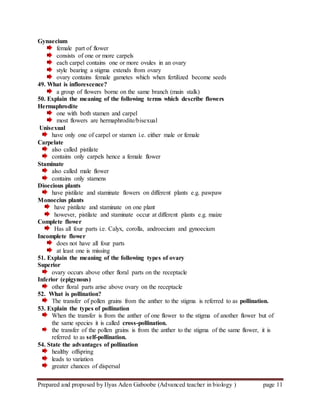
46. What is a flower?
this is the reproductive structure which bears the reproductive parts of a plant
it produces seeds and fruits
47. Draw a longitudinal section of a labeled diagram of a flower
48. Give the functions of the parts of a flower
Receptacle
expanded end of stalk which bears floral parts
Calyx
consists of sepals
usually green
protect flower in bud
Corolla
consist of petals
often colored or scented to attract insects
Androecium
male part of flower
consist of stamens
each stamen consists of an anther containing pollen sacs
anther produces pollen grains which contain male gametes
Prepared and proposed by Ilyas Aden Gaboobe (Advanced teacher in biology ) page 11
Gynaecium
female part of flower
consists of one or more carpels
each carpel contains one or more ovules in an ovary
style bearing a stigma extends from ovary
ovary contains female gametes which when fertilized become seeds
49. What is inflorescence?
a group of flowers borne on the same branch (main stalk)
50. Explain the meaning of the following terms which describe flowers
Hermaphrodite
one with both stamen and carpel
most flowers are hermaphrodite/bisexual
Unisexual
have only one of carpel or stamen i.e. either male or female
Carpelate
also called pistilate
contains only carpels hence a female flower
Staminate
also called male flower
contains only stamens
Dioecious plants
have pistilate and staminate flowers on different plants e.g. pawpaw
Monoecius plants
have pistilate and staminate on one plant
however, pistilate and staminate occur at different plants e.g. maize
Complete flower
Has all four parts i.e. Calyx, corolla, androecium and gynoecium
Incomplete flower
does not have all four parts
at least one is missing
51. Explain the meaning of the following types of ovary
Superior
ovary occurs above other floral parts on the receptacle
Inferior (epigynous)
other floral parts arise above ovary on the receptacle
52. What is pollination?
The transfer of pollen grains from the anther to the stigma is referred to as pollination.
53. Explain the types of pollination
When the transfer is from the anther of one flower to the stigma of another flower but of
the same species it is called cross-pollination.
the transfer of the pollen grains is from the anther to the stigma of the same flower, it is
referred to as self-pollination.
54. State the advantages of pollination
healthy offspring
leads to variation
greater chances of dispersal
Prepared and proposed by Ilyas Aden Gaboobe (Advanced teacher in biology ) page 12
55. List the agents of pollination
wind
water
insects
56. How are flowers adapted to wind and insect pollination?
Insect pollinated flowers (entomophilus)
are scented to attract insects
have stick stigma for pollen grains to stick on
are brightly coloured to attract insects
presence of nectar to attract insects
Wind pollinated flower (anemophilus)
anthers/stigma hang outside the flower to increase chances of pollination
the style/filament is long to expose stigma/anthers
stigma is hairy/feathery/branched to increase surface area over which pollen grains
land/to trap pollen grains
pollen grains are smooth/dry/light/small to be easily carried by wind
58. What is fertilization?
Fusion of male and female gametes to form a zygote
59. Describe how fertilization takes place in a flower
this follows pollination
pollen grain is deposited on the stigma
pollen grain sticks to the surface of the stigma
the surface of the stigma produces a chemical substance which stimulates the
pollen grain to produce a pollen tube/to germinate
the pollen tube grows through the style tissues on which it feeds until it enters the
ovary
the generative nucleus divides into two giving two male nuclei
embryo sac contains eight nuclei i.e. two synergids, egg cell, two polar nuclei and
three
antipodal cells
the pollen tube enters the embryo sac through the micropyle and one of the male
nucleus
fuses with the egg cell/ovum to form a zygote
the other male nucleus fuses with the two polar nuclei to form the triploid
nuclei/endosperm)food storage used by developing embryo)
the pollen tube nucleus in the pollen tube disintergrates soon afterwards
this process is referred to as double fertilization
zygote grows into an embryo containing plumule, radicle and cotyledons
60. What is double fertilization?
there are two male nuclei entering embryo sac
one fuses with the ovum to form a zygote, while the other fuses with the polar nuclei to
form a triploid primary endosperm nucleus
therefore there are two fusions at fertilization
61. the changes that Occur in a flower after fertilization
petals, stamen, calyx and style wither
ovary wall changes into pericarp
Prepared and proposed by Ilyas Aden Gaboobe (Advanced teacher in biology ) page 13
intergument changes into seed coat/testa
zygote changes into embryo (by mitosis)
primary endosperm nucleus changes into endosperm
whole ovule changes into seed
ovary develops and grows into fruit(under the influence of gibberrellic hormone)
62. Distinguish between a fruit and a seed
• a fruit is a fertilized ovary and has two scars
• a seed is a fertilized ovule and has one scar
63. How is a seedformed?
after fertilization, zygote grows into an embryo, primary endosperm nucleus developed
into endosperm, interguments harden to form testa, hence the whole ovule becomes the
seed
the seed loses water to become drier
the seed has plumule, radicle, seed leaves called cotyledons, a microphyle and a scar
64. Describe the main parts of a seed
Testa
also called seed coat
a tough outer covering which protects the seed from insects, bacteria etc
segment is the membrane inside the testa
Hilum
a scar
spot where the seed was attached to the fruit or pod
Micropyle
small hole through which water and air enter the seed
Radicle
embryonic root
grows into the shoot system
Cotyledons
embryonic leaves
store food for the germinating seed i.e. for plumule and radicle
when plumule and radicle grow, they use food stored in the cotyledon
in some seeds food is stored in the endosperm
65. How is a fruit formed?
one of the organs that remains on the plant after pollination and fertilization is the ovary
within the ovary, the developing embryo produces special chemical substances that
stimulate the young ovary
these substances also signal the start of the formation of the fruit, which is a mature ovary
the fruit may contain one or more seeds
during fruit formation the ovary increases in size while ripening or maturing
a true fruit is formed from the ovary of a flower after fertilization
it has two scars(style scar and stalk scar) and contains seeds
some seeds are not formed from the ovary of a flower
some other parts of a flower develop to form a fruit
such fruits are called false fruits
66. State the differences between a seedand fruit
SeedFruit
Prepared and proposed by Ilyas Aden Gaboobe (Advanced teacher in biology ) page 14
fertilized ovule
attached to placenta through funicle
one scar called hilum
has seed coat/testa
seed wall undifferentiated
fertilized ovary
attached to branch through a stalk
two scars (style scar and stalk scar)
has fruit wall/pericarp
fruit wall is differentiated
67. What is seeddormancy?
A state where a viable seed is incapable of germinating when all conditions are
favourable.
68. State the biological importance of seeddormancy
gives embryo time to reach maturity
gives time for dispersal
allows plant to survive adverse conditions
69. State the factors which cause seeddormancy
Internal factors
presence of abscisic acid/ABA/ presence of germination inhibitors
embryo not fully developed
absence of hormones/enzymes/inactivity of hormones/enzymes/gibberellins/cytokinins
impermeability of seed coat
External factors
unsuitable temperature
absence of light
lack of oxygen
lack of oxygen
lack of water
70. What is seedgermination?
process by which a seed develops in a seedling
71. Name and describe the types of germination
Epigeal
cotyledons are brought above the ground level during germination due to elongation of
hypocotyls
Hypogeal
the cotyledons remain below the surface during germination due to elongation of epicotyl
e.g. maize
72. What are the types of dispersal of fruits and seeds and describe each 

Questions and answers bio

  • 1.
    Prepared and proposedby Ilyas Aden Gaboobe (Advanced teacher in biology ) page 1 `CHAPTER TWO REPRODUCTION. QUESTIONS AND ANSWERS 1. What is reproduction? process by which living organisms give rise to new members of their own species which resemble the parents The process by which mature individuals produce offspring is called reproduction. 2. Why is reproduction important? procreation for continuity of species/ to ensure survival of species maintaining life of species replace dead individuals quality improvement 3. Name the types of reproduction. sexual reproduction which involves fusion of male and female gametes Asexual reproduction in which no gametes are involved but parts of a mature organism develops into new individuals 4. What is cell division? process by which cells are formed from pre-existing cells 5. What are chromosomes? Threadlike structures found in nucleus of a cell. The units called genes Genes are factors that cause inheritance or determine characteristics of offspring 6. What is mitosis? A type of cell division that occurs somatic cells lead to growth of an organism. all cells maintain the same chromosome constitution i.e. the diploid state. 7. Describe the five stages of cell division Interphase= wajiga isdiyaarinta replication of organelles duplication of DNA production of energy (ATP) for cell division Prophase = wajiga hore stage of dehydration chromosomes shorten and thicken chromosome replicates into two chromatids chromatids joined at centromere formation of spindle fibers Metaphase = wajiga dhexe chromosomes move to equator (early metaphase) chromosomes line up at the equator homologous chromosomes do not associate Anaphase= waji gabangabo chromatids separate move to opposite ends (poles) of the cell Telophase=waji kala guur chromatids reach the poles
  • 2.
    Prepared and proposedby Ilyas Aden Gaboobe (Advanced teacher in biology ) page 2 formation of two daughter cells occurs i.e. cytoplasmic division 8. State the significance of mitosis ensures each daughter cell has same number and kinds of chromosomes as daughter cells gives rise to new cells (responsible for growth) 9. What is meiosis? division of diploid cells to form gametes which are haploid 10 State the significance of meiosis gives rise to gametes source of variation 11 Give a summary of the stages of meiosis First meiotic division Interphase cell is in non-dividing condition chromosomes appear threadlike Prophase I chromatic material shorten and thicken double stranded chromosomes appear (bivalent) double stranded chromosomes pair and twist round each other (synapsis) point of contact of chromosomes is called chiasma Metaphase I paired homologous chromosomes line up at the equator Anaphase I paired homologous chromosomes move to the poles Telophase I paired homologous chromosomes reach the poles two new nuclei are formed Second meiotic division Prophase II chromosomes shorten, thicken and become visible, stage of dehydration Metaphase II movement of chromosomes to equator Anaphase II -chromatids of each chromosome separate to the poles Telophase II reach the poles four haploid daughter cells are formed 12. What is asexual reproduction formation of new individuals as a result of the fusion of two gametes fusion is called fertilization 13. What is the significance of sexual reproduction in living organisms? leads to genetic variation e.g. cross breeding which gives rise to hybrids
  • 3.
    Prepared and proposedby Ilyas Aden Gaboobe (Advanced teacher in biology ) page 3 14. compae between meiosis and mitosis  Meiosis Mitosis 1. Homologous chromosomes associate 1. Homologous chromosomes do not with one another. associate with one another. 2. Takes place in two nuclear divisions 2. Takes place in one nuclear division each having four stages. of four stages. 3. Produces four daughter cells, each 3. Produces two daughter cells, each haploid. diploid. 4. Occurs in reproductive organs leading to 4. Occurs in somatic cells leading to formation of gametes. growth. 5. Chiasma formation takes place and may 5. No chiasma formation therefore no Lead to crossing-over hence variation. crossing-over hence no variation. 15. State the advantages of sexual reproduction genetic variation greater adaptability to environment by offspring few bad or good traits inherited/retained greater amount of dispersal is possible may result in stronger offspring 16. Give the disadvantages of sexual reproduction less certainty in egg and sperm meeting low rate of survival sex-linked diseases easily transmitted 17. What is asexual reproduction? formation of new organisms without fusion of gametes occurs with only one parent parts of organism develop into new individual 18. State the advantages of asexual reproduction Good qualities from the parents are retained in the offspring without any variation. The new plants produced by asexual mature faster than those produced by sexually . the plant depends on its own activity to reproduce asexually. The new plants are able to obtain nourishment from their parent plants and so are able to survive temporarily under unsuitable conditions. 19. Give the disadvantages of asexual reproduction The new offspring being exactly similar to the parent, would carry even undesired qualities from the parents. Since there are no variations, the offspring may not be able to withstand changing environmental conditions competition for resources due to overcrowding 20. distinguish between external and internal fertilization in animals in external fertilization fusion of the male and female gametes takes place outside the body of the female e.g. amphibians and fish in internal fertilization union of gametes occurs inside the body of the female 21. State the advantages and disadvantages of external fertilization Advantages large numbers produced therefore many offspring per breeding season
  • 4.
    Prepared and proposedby Ilyas Aden Gaboobe (Advanced teacher in biology ) page 4 female does not suffer gestation stress mother does not need to care for the young except in a few species the surviving individuals are highly selected for better survival Disadvantages many predators surround the eggs before and after fertilization fewer chances of fertilization/a lot of gametes wasted embryo development at mercy of environment large numbers of female gametes are required therefore female gets much exhausted 22 State the advantages and disadvantages of internal fertilization Disadvantages number of gametes fewer hence less number of offspring less adapted for sudden change of environment after birth in mammals females suffer gestation stress Advantages more chances of fertilization fewer predators of oval/fertilized egg protected in females body fewer gametes required 23. Give a reason why it is necessary for frogs to lay many eggs to increase chances of survival/fertilization 24.Compare external and internal fertilization External Internal occurs in water outside the bodies of animals many eggs are laid usually less contact between male and female both fertilized eggs exposed to danger occurs inside the body of the female animal fewer eggs released from ovary Fertilized eggs are enclosed hence highly protected inside females’ body. 25. Draw and label the human male reproductive system 26. Describe how the mammalian male reproductive systemis adapted to perform its functions
  • 5.
    Prepared and proposedby Ilyas Aden Gaboobe (Advanced teacher in biology ) page 5 Penis is highly vascularised/spongy has a sensitive glands becomes erect to allow entry into the vagina urethra in male the function of urethra is to tansmits both urine and sperm cells but not at the same time Scrotum contains the testes outside the body on whose walls the process of spermatogenesis takes place the process is favored by lower temperature it contains sertoli cells which nourish sperms until they are mature Epididymis long and coiled for the purpose of sperm storage Vas deferens muscular upon contraction pushes sperms out and allows ejaculation male Gametes sperm cells produced in large numbers to increase chances of fertilization the sperms have a tail for swimming/large number of mitochondria to provide energy/allow swimming to reach the egg sperm cells consist of the head short neck middle piece tail Accessoryglands are seminal vesicle, Cowper’s gland and prostate gland they produce seminal fluid to provide a medium/ nutrients for sperms to swim 27 How is the sperm adapted to perform its function? acrosomes contain enzymes to digest egg membrane nucleus contains genetic material mitochondria produce energy to move the tail back and forth the lashing movement of the tail enables the sperm to move/propulsion in fluid medium Towards the egg . it is streamlined for faster/easier movement/swimming to meet the egg 28. Draw and label the human female reproductive system
  • 6.
    Prepared and proposedby Ilyas Aden Gaboobe (Advanced teacher in biology ) page 6 29. Describe how the various structures of the human female reproductive systemare adapted to their function Ovaries have several graafian follicles that develop and burst open to releasproduce mature ova secretes sex hormones)oestrogen) which initiate/control development of secondary sexual characteristics produce hormones oestrogen and progesterone which prepare the uterus for implantation and subsequent nourishment of the embryo. Oviducts (fallopian tube) are thin narrow and tubular to increase flowing speed of semen containing sperms are funnel shaped on the end next to ovary which enables them to receive the ovum their lining contains cilia which propel the ovum towards the uterus has peristaltic muscles that enable movement of zygote/ovum to the uterus for female gamete ovum/ egg cells ovulation/ oogenesis = sameysanka ugxanta dumarka the grafian follicle brusts open and release a mature ovum surrounded by a layers of fillicle cells. . implantation= the attachment of the blastocyst to the wall of the uterus speciall endometrium by villi Uterus= ila galeenka is muscular for protection of developing embryo has elastic wall that allows growth and development of foetus/embryo has a highly vascularised endometrium that provides nutrients/gaseous exchange to developing embryo Cervix = qoorta ila galeenka has valves that close the lower end of the uterus to ensure continued pregnancy during gestation period is capable of dilating has narrow entrance/neck-like entrance to uterus that enables quick swimming of sperms to uterus has suction mechanism that draws up/pulls sperms into uterus has a “W” shape that fits well with the glands of the penis to ensure sperms are deposited at the right point Vagina is elastic and muscular to enable good accommodation or penetration of the penis thus proper deposition of sperms and for easy parturition allows menstrual flow has sensitive labial walls which secrete/produce lubricating substances that ensure/enable/facilitate good coition. capable of considerable enlargement, due to elastic muscles, to accommodate baby during parturition. Clitoris has sensitive cells for orgasm 30 . Explain how the ovum is adapted to its function
  • 7.
    Prepared and proposedby Ilyas Aden Gaboobe (Advanced teacher in biology ) page 7 • nucleus contains genetic material • ventelline membrane encloses plasma membrane which encloses yolky cytoplasm 31. Explain the process of fertilization a process whereby the egg and sperm are brought together and fuse to form a zygote occurs in the fallopian tube after copulation sperm head penetrates the outer coat of the ovum while the tail remains outside penetration is due to reaction of acrosome acrosome digests the vitelline membrane thereafter a zygote is formed zygote which is diploid undergoes rapid cell division to form a mass of cells called blastocyst after fertilization a membrane forms around the ovum to prevent further entry of sperms blastocyst eventually develops into an embryo 32. Explain the process of implantation • this is the embedding and attaching of the embryo in the uterine wall/endometrium • implantation marks the beginning of pregnancy • sometimes implantation occurs in the oviduct wall which is abnormal and results in ectopic pregnancy which is fatal 33. State the functions of umbilical cord it contains blood vessels umbilical artery, iliac arteries and umbilical veins) it joins the placenta to the embryo passage for nutrients from the mother passage of excretory substances from foetus to mother for final discharge gaseous exchange passage of antibodies from mother to foetus, for protection of foetus against diseases 34. State the role of placenta It is a point of close association between the maternal and foetal circulations and facilitates the transfer of nutrients, and metabolic waste products between the foetus and mother. exchange of gases between mother and foetus exchange of nutrients and nitrogenous wastes anchorage/attachment of foetus produces hormones (oestrogen and progesterone) 35. What is gestation period? gestation is the period between conception implantation and birth time 36. distingiush between the following terms A. Miscarriage B. Premature birth C. Obortion If birth occurs before the completion of six months the baby will not survive and this is referred to as miscarriage. if birth occurs after the seven month but before full term, such is referred to as a premature birth. In the case where foetal development is interfered with either chemically or physically such that the foetus is expelled the condition is called abortion. 37. Explain the functions of the membranes associatedwith placenta Chorion surrounds the embryo
  • 8.
    Prepared and proposedby Ilyas Aden Gaboobe (Advanced teacher in biology ) page 8 has fingerlike projections that attach embryo to the uterus Amnion contains amniotic fluid fluid surrounds embryo protects embryo from mechanical injury by acting as shock absorbers fluid also protects embryo from dehydration distributes pressure equally over embryo Allantois present only for a short time removes and store waste material it eventually becomes the umbilical cord 38. Explain the events that take place to facilitate parturition near birth the placenta produces less progesterone oxytocin hormone is produced by posterior lobe of pituitary gland because progesterone level has decreased the uterus becomes sensitive to oxytocin oxytocin causes the contraction of the uterus (myometrium) these contractions are called labour pains just before parturition the head turns downwards the contractions eventually push the baby through the vagina amnion breaks and amniotic fluid is released oxytocin dilates the cervix foetus is expelled through cervix with head coming out first 39. What are secondary sexual characteristics Characteristics (physiological and anatomical) that start developing at puberty due to the influence of male and female hormones 40. State the main secondary changes in Boys and girls Boys deepening of the voice growth of hair on face, pubic part, chest, legs and pubic part and armpts penis and testes become bigger muscular development sperm production begins at puberty and may continue throughout life Girls growth of hair on pubic part and armpits widening/enlargement of hips development of breasts menstrual cycle starts as ovaries mature body acquires extra fat 41. Describe the role of hormones in secondary sexual characteristics in Boys Follicle stimulation hormone (FSH) from pituitary stimulates production of androgens(male hormones) mainly testosterone by testis Testosterone secondary sexual characteristics in males Girls FHS from pituitary
  • 9.
    Prepared and proposedby Ilyas Aden Gaboobe (Advanced teacher in biology ) page 9 development of follicles stimulates oestrogen production by ovary LH from pituitary ovulation stimulates release of progesterone by ovary Oestrogen stimulates release of LH secondary sexual characteristics in female Progesterone also from placenta sustains pregnancy as it inhibits prolactin and oxytocin during pregnancy Prolactin milk formation Oxytocin parturition birth milk ejection 42. What is menstruation? vaginal discharge due to disintegration of endometrium 43. Describe the role of hormones in the human menstrual cycle it is controlled by sex hormones which are responsible for the onset of secondary sexual characteristics and also control of the menstrual cycle. the onset is signaled by discharge of blood/menses 14 days following the start of menstruation anterior lobe of pituitary gland secretes follicle stimulating hormone(FSH) Follicle stimulating hormone causes graafian follicle to develop in the ovary. It also stimulates tissues of the ovary/wall (theca) to secrete oestrogen oestrogen causes repair/healing of uterine wall oestrogen stimulates anterior lobe of pituitary to produce luteinising hormonge (LH) LH causes ovulation. It also causes graafian follicle to change into corpus luteum. LH stimulates corpus luteum to secrete progesterone Progesterone causes proliferation/thickening of uterine wall Oesterogen/progesterone inhibits the production of FSH by anterior lobe of pituitary, thus no more follicles develop and oestrogen production reduces In the next two weeks progesterone level rises and inhibits production of LH from anterior lobe of pituitary The corpus lutetium stops secreting progesterone and menstruation occurs when the level of progesterone drops Anterior lobe of pituitary starts secreting FSH again. 44. What is menopause? end of ovulation or stop ovulation in women that means stop menstruation occurs after age of 45 years does not occur in males 45. Explain how reproduction occurs by the following methods of asexual reproduction Sporulation
  • 10.
    Prepared and proposedby Ilyas Aden Gaboobe (Advanced teacher in biology ) page 10 formation of spores spores are small haploid cells produced by plants spores give rise to new haploid organisms includes moulds, ferns, bryophytes, pteridophytes Budding where an outgrowth arises from a parent and drops off to develop into a new organisms hereditary material in the daughter cell and parent are exactly the same occurs in organisms such as hydra, jelly fish, sea anemones, yeast and some fungi Binary fission a cell splits into two new cells of equal size each daughter cell grows into anew organism Occurs in organisms such as amoeba, euglena, paramecium, some fungi and bacteria. 46. What is a flower? this is the reproductive structure which bears the reproductive parts of a plant it produces seeds and fruits 47. Draw a longitudinal section of a labeled diagram of a flower 48. Give the functions of the parts of a flower Receptacle expanded end of stalk which bears floral parts Calyx consists of sepals usually green protect flower in bud Corolla consist of petals often colored or scented to attract insects Androecium male part of flower consist of stamens each stamen consists of an anther containing pollen sacs anther produces pollen grains which contain male gametes
  • 11.
    Prepared and proposedby Ilyas Aden Gaboobe (Advanced teacher in biology ) page 11 Gynaecium female part of flower consists of one or more carpels each carpel contains one or more ovules in an ovary style bearing a stigma extends from ovary ovary contains female gametes which when fertilized become seeds 49. What is inflorescence? a group of flowers borne on the same branch (main stalk) 50. Explain the meaning of the following terms which describe flowers Hermaphrodite one with both stamen and carpel most flowers are hermaphrodite/bisexual Unisexual have only one of carpel or stamen i.e. either male or female Carpelate also called pistilate contains only carpels hence a female flower Staminate also called male flower contains only stamens Dioecious plants have pistilate and staminate flowers on different plants e.g. pawpaw Monoecius plants have pistilate and staminate on one plant however, pistilate and staminate occur at different plants e.g. maize Complete flower Has all four parts i.e. Calyx, corolla, androecium and gynoecium Incomplete flower does not have all four parts at least one is missing 51. Explain the meaning of the following types of ovary Superior ovary occurs above other floral parts on the receptacle Inferior (epigynous) other floral parts arise above ovary on the receptacle 52. What is pollination? The transfer of pollen grains from the anther to the stigma is referred to as pollination. 53. Explain the types of pollination When the transfer is from the anther of one flower to the stigma of another flower but of the same species it is called cross-pollination. the transfer of the pollen grains is from the anther to the stigma of the same flower, it is referred to as self-pollination. 54. State the advantages of pollination healthy offspring leads to variation greater chances of dispersal
  • 12.
    Prepared and proposedby Ilyas Aden Gaboobe (Advanced teacher in biology ) page 12 55. List the agents of pollination wind water insects 56. How are flowers adapted to wind and insect pollination? Insect pollinated flowers (entomophilus) are scented to attract insects have stick stigma for pollen grains to stick on are brightly coloured to attract insects presence of nectar to attract insects Wind pollinated flower (anemophilus) anthers/stigma hang outside the flower to increase chances of pollination the style/filament is long to expose stigma/anthers stigma is hairy/feathery/branched to increase surface area over which pollen grains land/to trap pollen grains pollen grains are smooth/dry/light/small to be easily carried by wind 58. What is fertilization? Fusion of male and female gametes to form a zygote 59. Describe how fertilization takes place in a flower this follows pollination pollen grain is deposited on the stigma pollen grain sticks to the surface of the stigma the surface of the stigma produces a chemical substance which stimulates the pollen grain to produce a pollen tube/to germinate the pollen tube grows through the style tissues on which it feeds until it enters the ovary the generative nucleus divides into two giving two male nuclei embryo sac contains eight nuclei i.e. two synergids, egg cell, two polar nuclei and three antipodal cells the pollen tube enters the embryo sac through the micropyle and one of the male nucleus fuses with the egg cell/ovum to form a zygote the other male nucleus fuses with the two polar nuclei to form the triploid nuclei/endosperm)food storage used by developing embryo) the pollen tube nucleus in the pollen tube disintergrates soon afterwards this process is referred to as double fertilization zygote grows into an embryo containing plumule, radicle and cotyledons 60. What is double fertilization? there are two male nuclei entering embryo sac one fuses with the ovum to form a zygote, while the other fuses with the polar nuclei to form a triploid primary endosperm nucleus therefore there are two fusions at fertilization 61. the changes that Occur in a flower after fertilization petals, stamen, calyx and style wither ovary wall changes into pericarp
  • 13.
    Prepared and proposedby Ilyas Aden Gaboobe (Advanced teacher in biology ) page 13 intergument changes into seed coat/testa zygote changes into embryo (by mitosis) primary endosperm nucleus changes into endosperm whole ovule changes into seed ovary develops and grows into fruit(under the influence of gibberrellic hormone) 62. Distinguish between a fruit and a seed • a fruit is a fertilized ovary and has two scars • a seed is a fertilized ovule and has one scar 63. How is a seedformed? after fertilization, zygote grows into an embryo, primary endosperm nucleus developed into endosperm, interguments harden to form testa, hence the whole ovule becomes the seed the seed loses water to become drier the seed has plumule, radicle, seed leaves called cotyledons, a microphyle and a scar 64. Describe the main parts of a seed Testa also called seed coat a tough outer covering which protects the seed from insects, bacteria etc segment is the membrane inside the testa Hilum a scar spot where the seed was attached to the fruit or pod Micropyle small hole through which water and air enter the seed Radicle embryonic root grows into the shoot system Cotyledons embryonic leaves store food for the germinating seed i.e. for plumule and radicle when plumule and radicle grow, they use food stored in the cotyledon in some seeds food is stored in the endosperm 65. How is a fruit formed? one of the organs that remains on the plant after pollination and fertilization is the ovary within the ovary, the developing embryo produces special chemical substances that stimulate the young ovary these substances also signal the start of the formation of the fruit, which is a mature ovary the fruit may contain one or more seeds during fruit formation the ovary increases in size while ripening or maturing a true fruit is formed from the ovary of a flower after fertilization it has two scars(style scar and stalk scar) and contains seeds some seeds are not formed from the ovary of a flower some other parts of a flower develop to form a fruit such fruits are called false fruits 66. State the differences between a seedand fruit SeedFruit
  • 14.
    Prepared and proposedby Ilyas Aden Gaboobe (Advanced teacher in biology ) page 14 fertilized ovule attached to placenta through funicle one scar called hilum has seed coat/testa seed wall undifferentiated fertilized ovary attached to branch through a stalk two scars (style scar and stalk scar) has fruit wall/pericarp fruit wall is differentiated 67. What is seeddormancy? A state where a viable seed is incapable of germinating when all conditions are favourable. 68. State the biological importance of seeddormancy gives embryo time to reach maturity gives time for dispersal allows plant to survive adverse conditions 69. State the factors which cause seeddormancy Internal factors presence of abscisic acid/ABA/ presence of germination inhibitors embryo not fully developed absence of hormones/enzymes/inactivity of hormones/enzymes/gibberellins/cytokinins impermeability of seed coat External factors unsuitable temperature absence of light lack of oxygen lack of oxygen lack of water 70. What is seedgermination? process by which a seed develops in a seedling 71. Name and describe the types of germination Epigeal cotyledons are brought above the ground level during germination due to elongation of hypocotyls Hypogeal the cotyledons remain below the surface during germination due to elongation of epicotyl e.g. maize 72. What are the types of dispersal of fruits and seeds and describe each 