1
The Relationshipbetween
Management and Engineering
By: Second year students
In the year: 2018-2019
Supervised by: Lecturer Kafi
Al-NahrainUniversity
Collegeof Engineering
Departmentof ArchitectureEngineering
2
Contents
Definitions.................................................................................3
Engineering management.......................................................4
Managementengineering consulting ...................................5
Why StudyEngineering Management?.................................9
Architecturalmanagement ...................................................15
Development..........................................................................15
3
Definitions
Management
(or managing)istheadministration of an organization,whether it isa business, a not-for-profit
organization,or government body. Management includes the activitiesof setting the strategy of
an organizationand coordinating the efforts of itsemployees (or of volunteers) to accomplish
itsobjectives through the application of availableresources, such asfinancial,natural,
technological,and humanresources.
Views on the definition andscope of management include:
According to Henri Fayol, "to manageis to forecast andto plan,to organize,to command, toco-
ordinate andtocontrol."
Fredmund Malik defines it as"the transformation ofresources into utility."
Management included as one of thefactors of production – along with machines,materials
andmoney.
Ghislain Deslandes defines it as “avulnerable force,
under pressure to achieveresults andendowed with the
triple power of constraint, imitation andimagination,
operating on subjective, interpersonal, institutionaland
environmental levels”.
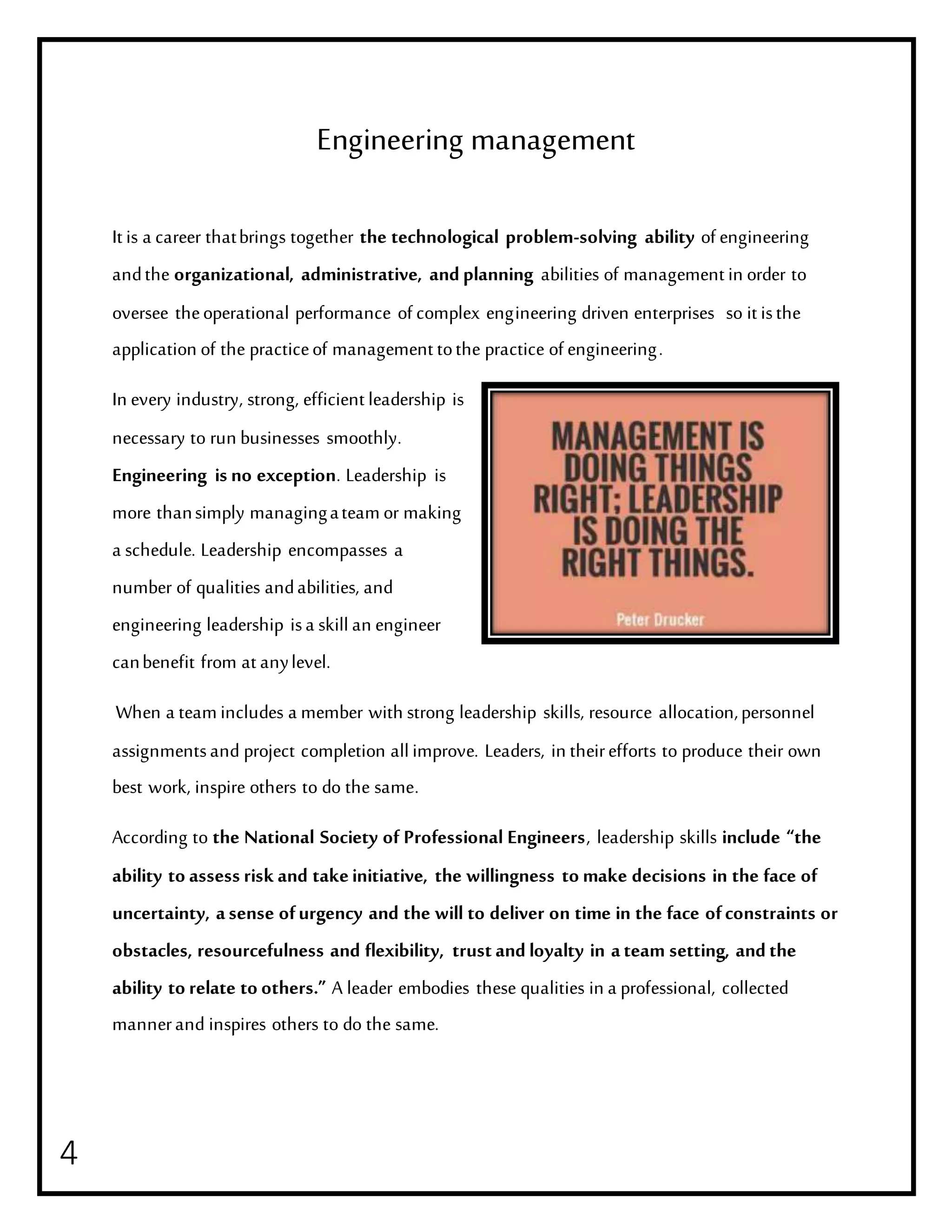
Peter Drucker (1909–2005)sawthebasic task of management astwofold: marketing and
innovation.Nevertheless, innovation isalso linked tomarketing (product innovation isa central
strategic marketing issue). Peter Drucker identifies marketing asa key essence for business
success, but management andmarketing are generally understood[by whom?] astwodifferent
branches of business administration knowledge.
"Management is,above all,
a practice where art,
science, and craftmeet"
-Henry Mintzberg
4
Engineering management
It is a career thatbrings together the technological problem-solving ability of engineering
andthe organizational, administrative, andplanning abilities of management in order to
oversee theoperational performance of complex engineering driven enterprises so it isthe
application of the practiceof management tothe practice of engineering.
In every industry, strong, efficient leadership is
necessary to run businesses smoothly.
Engineering is no exception. Leadership is
more thansimply managingateamor making
a schedule. Leadership encompasses a
number of qualities andabilities, and
engineering leadership isa skillan engineer
canbenefit from at anylevel.
When a teamincludes a member with strong leadership skills, resource allocation,personnel
assignmentsand project completion allimprove. Leaders, in theirefforts to produce their own
best work, inspire others to do the same.
According to the National Society of Professional Engineers, leadership skills include “the
ability to assess risk and takeinitiative, the willingness to make decisions in the face of
uncertainty, asense ofurgency and the will to deliver on time in the face ofconstraints or
obstacles, resourcefulness and flexibility, trustandloyalty in ateam setting, andthe
ability to relate to others.” A leader embodies these qualities in a professional, collected
mannerand inspires others to do the same.
5
Both engineering managersandproject managersrequire managerialskills, but the groups they
manageandmethod they use are different. An engineering managertypicallyholds
responsibility for managinga group ofemployees who work solely for him. A project
managertypicallymanagesa project, and notpeople directly.
Managementengineering consulting
Large andsmallengineering driven firmsoften require theexpertise of external management
consultantsthatspecialize in companies where engineering practice andproduct development
are key drivers of value.Most engineering management consultants willhaveasa minimuma
professional engineering qualification.Butusually they willalsohavegraduate degrees in
engineering andor business or a management consulting designation. It involves providing
management consultingservice thatis specific toprofessional engineering practice or to the
engineering industry sector.
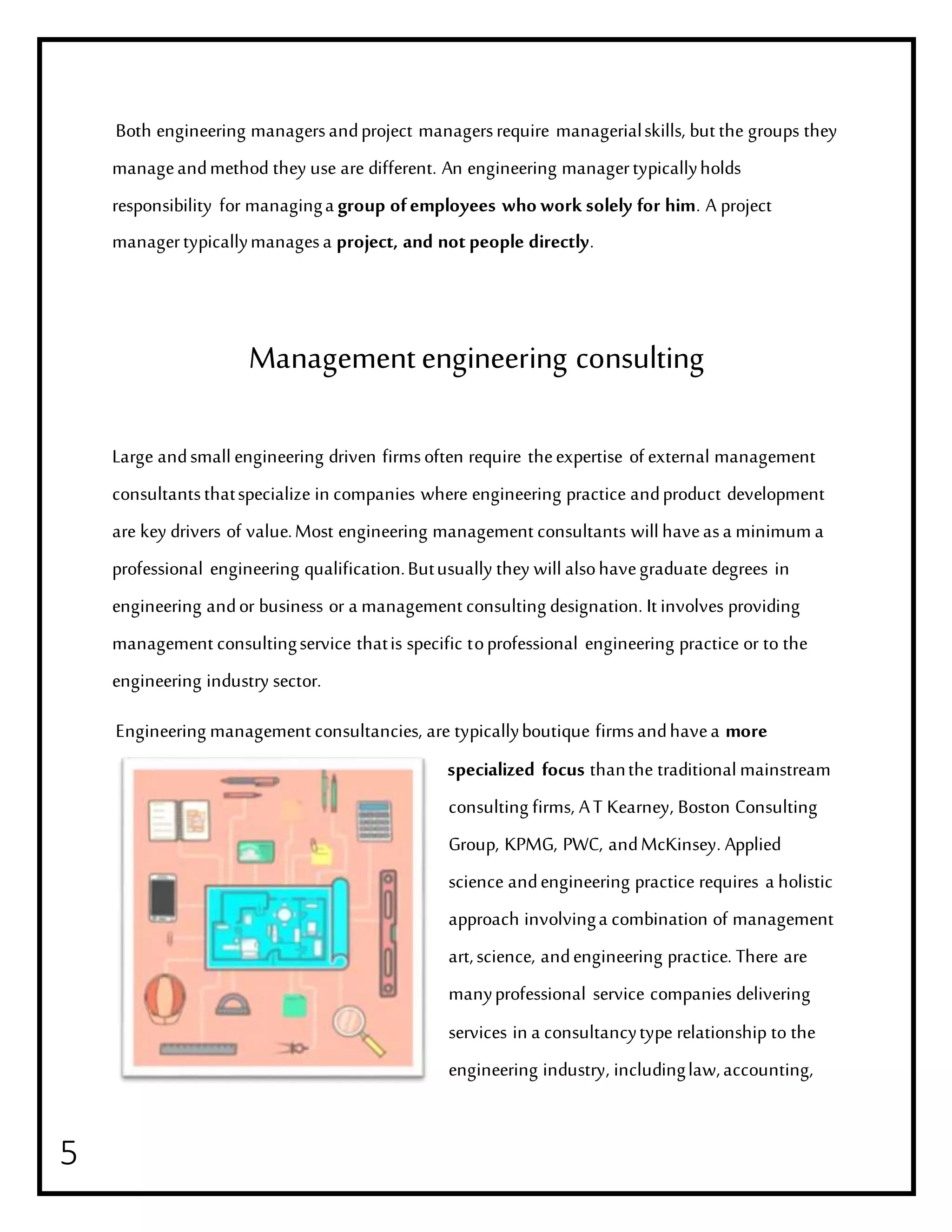
Engineering management consultancies, are typicallyboutique firmsandhavea more
specialized focus thanthe traditionalmainstream
consulting firms, AT Kearney, Boston Consulting
Group, KPMG, PWC, andMcKinsey. Applied
science andengineering practice requires a holistic
approach involvinga combination of management
art,science, andengineering practice. There are
manyprofessional service companies delivering
services in a consultancytype relationship to the
engineering industry, includinglaw,accounting,
6
humanresources, marketing,politics, economics, finance,public affairs,and communication.
Commonly, engineering management consultantsare used when firmsrequire a combination
of special technicalknowledge, andmanagement know how, to enhanceknowledge or
transform organizationalperformance andalso keep any intellectualproperty developed
confidential.
Engineering management consulting isconcerned with thedevelopment, improvement,
implementation andevaluation of integrated systems of organizations,people, money,
knowledge, information, equipment, energy, materialsand/or processes. Management
Engineering Consultantsstrive toimprove upon existing organizations,processes, products or
systems. Engineering management consultingdraws upon the principles andmethods of
engineering analysisand synthesis, aswellas themathematical,physicalandsocial sciences
together with the principles andmethods of engineering design tospecify, predict, and evaluate
theresults tobe obtained from suchsystems or processes. Engineering management consulting
canfocus on thesocialimpact of the product, process or system that isbeing analysed. There is
7
also anoverlap between engineering management consulting andmanagement science in
services thatrequire theadoption of more analyticalapproaches to problem solving.
Examples of where engineering management consultingmight be used includedeveloping and
leading a companywide business transformation initiative,or designing and implementing a
new product development process, designing andimplementing a manufacturingengineering
process, includingan automated assembly workstation. Management engineers may specialize
in theacquisition andimplementation of Computer aided design (CAD), Computer-aided
manufacturing(CAM) andComputer-aided engineering (CAE) applications. Services may
include strategizingfor various operational logistics, new product introductions, or consulting
asan efficiency expert. It may include using
management science techniques to develop a
new financialalgorithmor loan system for a
bank,streamlining operation and emergency
room location or usagein a hospital,
planningcomplex distribution schemes for
materials or products (referred to asSupply
Chain Management),andshortening lines (or
queues) at a bank,hospital, or a theme park.
Management engineering consultants
typicallyuse computer simulation (especially
discrete event simulation),along with
extensive mathematicaltools andmodelling
andcomputationalmethods for system
analysis,evaluation,andoptimization.
8
9
Why Study Engineering Management?
“The ideal engineer is a composite… He isnot a scientist,he isnot a mathematician,heis not a
sociologist or a writer; but he mayuse theknowledge andtechniques of anyor allof these
disciplines in solving engineering problems.”
LearntoManage Projectsand People
Companies andorganizationsare invested in hiringengineers who canintegrate technical
expertise, savvybusiness acumen,andeffective interpersonal communication skills. Those who
cando thisare prime candidates for positions in management. Successfulengineering managers
understand that they must takean integrated view of management in order to streamline
operational activities,meet deliverables on time,and achieveorganization goals.
10
The first step in understanding management isto be aware of the fivebasic functionsof
management whichare planning,organizing,staffing,leading,andcontrolling:
Planning
In order toreach a goal,a plan must be put intoplace. Deciding whichsteps are a part of the
plan is themanager’sduty. Conceiving a plan and communicatingitclearly isessential.
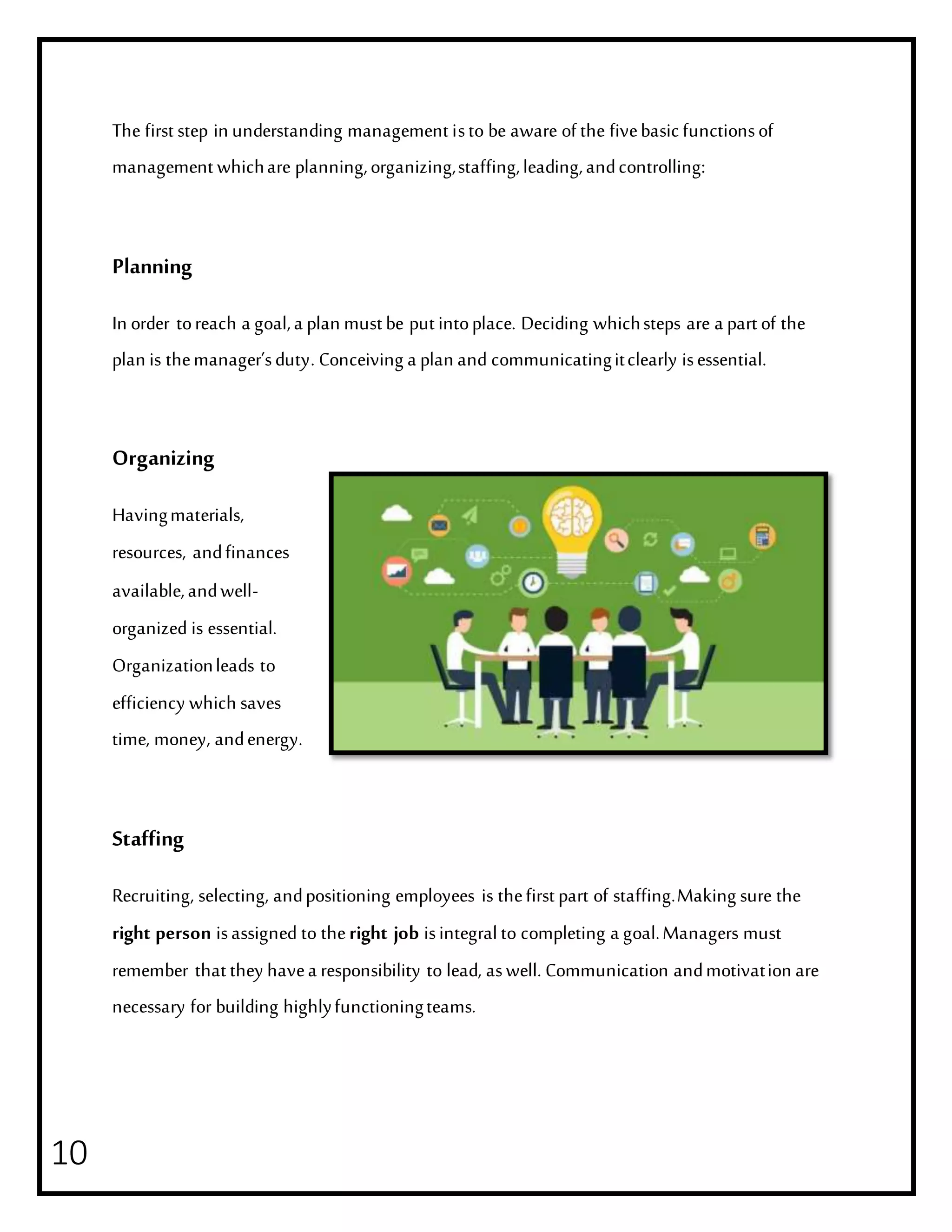
Organizing
Havingmaterials,
resources, andfinances
available,andwell-
organized is essential.
Organizationleads to
efficiency which saves
time, money, andenergy.
Staffing
Recruiting, selecting, andpositioning employees is thefirst part of staffing.Making sure the
right person isassigned to theright job isintegralto completing a goal.Managers must
remember that they havea responsibility to lead, aswell. Communication andmotivation are
necessary for building highlyfunctioningteams.
11
Leading
It is common knowledge that not allmanagersare leaders andallleaders are not managers.It is
incumbent upon managersto learn andpractice solid effective leadership skills. Being authentic
andconnecting with people on an individualbasis are first steps in being an effective leader.
Controlling
Effectiveengineering managerslook for constantimprovement. Controlling costs, schedules,
andproduction plans areallessential to managing aproject well andfinishingwithin or under
budget. Controlling thatwhich canbe controlled, andresponding quickly andefficiently,to
those thingsthatdo not goaccording toplan, are allwithin thepurview of an engineering
manager.
12
LearnNew Skills
Engineering managersare skilled in theirtechnicalarea of expertise, aswell as,business, law,
ethics, technology,and leading teams.
Below is a partiallist of whatengineer managersactuallydo:
Drive decisions based on a working knowledge of stocks andbonds in capitalmarkets
Maintaina working knowledge of domestic and foreign industry trends
Employ technologicaltools of thetrade suchas enterprise resource planning,customer
relationship management and supply chainmanagement software
Demonstrate a holistic view of theorganization includingrelationships with suppliers and
customers andwork towards using those to achievecompany goals
Engineering Managers Are In Demand
According to geteducted.com thefield of
engineering management isexpected togrow
ninepercent through 2020.We canmost likely
see increases in research anddevelopment,
architecturalengineering, biomedical, and
environmental engineering. Competition willbe highfor acquiring these positions so it islikely
thatcompanies willplace a higherpriority on candidates with advancedtechnicalknowledge,
excellent interpersonal communicationskills, andexpert business management andfinancial
skills. Jessica McKellar, successful start-upfounder andsoftware engineer writes:
“Goodmanagement is the artof
making problems so interesting and
their solutions so constructive that
everyone wants to get to work and
deal with them.” – Paul Hawken
13
"When engineering management is done right,you're focusingon three big things. You're
directly supporting thepeople on yourteam; you're managingexecution and coordination
across teams; and you're stepping back to observe andevolve the broader organizationand its
processes asit grows."
Those studyingto become engineering managers learn how to effectively utilizetechnical,
financial,andhumanresources. They also hone their conceptualskills suchas criticalthinking,
analyticalthinking,andproblem-solving. Engineering managersin trainingare not only
advancingtheir career, they are contributing to thegoals of their organization in waysthatare
both sustainable andimpactfulto theclients they serve andthepopulation atlarge.
14
15
Architecturalmanagement
Architectural managementfallsinto twodistinct parts, office management andproject
management.Office management provides an overall framework within whichindividual
projects are commissioned, designed andcompleted. Both parts havethesame objectives but
are typicallyaddressed by separate management systems. Office management involves the
allocation andfinancingof resources, principally premises, trained staff andcomputer systems,
andon establishing andchargingappropriate fees for theservices rendered. Project
management focuses on timescales, developing a design from initialconcept toworking
drawings, andmanagingtheconstruction process.
Development
Standard managementtechniques andtools, borrowed mainlyfrom repetitive industrial
processes, havenot alwaysfittedcomfortably withthe imageof the architect asa creative
individual,rather thana professional member of a
business team. The term ‘architectural
management’ hasbeen in use sincethe 1960sas
building construction became more complex,
because of a shift from standard traditional
construction details, toinnovation and
experimentation. Architecturalpractices generally employ an office managerwhomay haveat
16
their disposal anadministration assistant or team of assistants.Project management is
increasingly a role played by anindependent consultant,especially during theconstruction
phase. Project managers are typicallyfrom one of the surveying disciplines, leaving only the
architecturalelements tobe managedin-house by the architects.
“The FourKeys ofGreat Managers: (1)When selecting someone, they select
for talent … notsimply experience, intelligence ordetermination. (2)When
setting expectations, they define the right outcomes …not theright steps.
(3)When motivating someone, they focus on strengths … notonweaknesses.
and (4)When developing someone, they help him find theright fit … not
simply thenext rung onthe ladder.” -Marcus Buckingham

The relationship beetwen management and engineering

  • 1.
    1 The Relationshipbetween Management andEngineering By: Second year students In the year: 2018-2019 Supervised by: Lecturer Kafi Al-NahrainUniversity Collegeof Engineering Departmentof ArchitectureEngineering
  • 2.
    2 Contents Definitions.................................................................................3 Engineering management.......................................................4 Managementengineering consulting...................................5 Why StudyEngineering Management?.................................9 Architecturalmanagement ...................................................15 Development..........................................................................15
  • 3.
    3 Definitions Management (or managing)istheadministration ofan organization,whether it isa business, a not-for-profit organization,or government body. Management includes the activitiesof setting the strategy of an organizationand coordinating the efforts of itsemployees (or of volunteers) to accomplish itsobjectives through the application of availableresources, such asfinancial,natural, technological,and humanresources. Views on the definition andscope of management include: According to Henri Fayol, "to manageis to forecast andto plan,to organize,to command, toco- ordinate andtocontrol." Fredmund Malik defines it as"the transformation ofresources into utility." Management included as one of thefactors of production – along with machines,materials andmoney. Ghislain Deslandes defines it as “avulnerable force, under pressure to achieveresults andendowed with the triple power of constraint, imitation andimagination, operating on subjective, interpersonal, institutionaland environmental levels”. Peter Drucker (1909–2005)sawthebasic task of management astwofold: marketing and innovation.Nevertheless, innovation isalso linked tomarketing (product innovation isa central strategic marketing issue). Peter Drucker identifies marketing asa key essence for business success, but management andmarketing are generally understood[by whom?] astwodifferent branches of business administration knowledge. "Management is,above all, a practice where art, science, and craftmeet" -Henry Mintzberg
  • 4.
    4 Engineering management It isa career thatbrings together the technological problem-solving ability of engineering andthe organizational, administrative, andplanning abilities of management in order to oversee theoperational performance of complex engineering driven enterprises so it isthe application of the practiceof management tothe practice of engineering. In every industry, strong, efficient leadership is necessary to run businesses smoothly. Engineering is no exception. Leadership is more thansimply managingateamor making a schedule. Leadership encompasses a number of qualities andabilities, and engineering leadership isa skillan engineer canbenefit from at anylevel. When a teamincludes a member with strong leadership skills, resource allocation,personnel assignmentsand project completion allimprove. Leaders, in theirefforts to produce their own best work, inspire others to do the same. According to the National Society of Professional Engineers, leadership skills include “the ability to assess risk and takeinitiative, the willingness to make decisions in the face of uncertainty, asense ofurgency and the will to deliver on time in the face ofconstraints or obstacles, resourcefulness and flexibility, trustandloyalty in ateam setting, andthe ability to relate to others.” A leader embodies these qualities in a professional, collected mannerand inspires others to do the same.
  • 5.
    5 Both engineering managersandprojectmanagersrequire managerialskills, but the groups they manageandmethod they use are different. An engineering managertypicallyholds responsibility for managinga group ofemployees who work solely for him. A project managertypicallymanagesa project, and notpeople directly. Managementengineering consulting Large andsmallengineering driven firmsoften require theexpertise of external management consultantsthatspecialize in companies where engineering practice andproduct development are key drivers of value.Most engineering management consultants willhaveasa minimuma professional engineering qualification.Butusually they willalsohavegraduate degrees in engineering andor business or a management consulting designation. It involves providing management consultingservice thatis specific toprofessional engineering practice or to the engineering industry sector. Engineering management consultancies, are typicallyboutique firmsandhavea more specialized focus thanthe traditionalmainstream consulting firms, AT Kearney, Boston Consulting Group, KPMG, PWC, andMcKinsey. Applied science andengineering practice requires a holistic approach involvinga combination of management art,science, andengineering practice. There are manyprofessional service companies delivering services in a consultancytype relationship to the engineering industry, includinglaw,accounting,
  • 6.
    6 humanresources, marketing,politics, economics,finance,public affairs,and communication. Commonly, engineering management consultantsare used when firmsrequire a combination of special technicalknowledge, andmanagement know how, to enhanceknowledge or transform organizationalperformance andalso keep any intellectualproperty developed confidential. Engineering management consulting isconcerned with thedevelopment, improvement, implementation andevaluation of integrated systems of organizations,people, money, knowledge, information, equipment, energy, materialsand/or processes. Management Engineering Consultantsstrive toimprove upon existing organizations,processes, products or systems. Engineering management consultingdraws upon the principles andmethods of engineering analysisand synthesis, aswellas themathematical,physicalandsocial sciences together with the principles andmethods of engineering design tospecify, predict, and evaluate theresults tobe obtained from suchsystems or processes. Engineering management consulting canfocus on thesocialimpact of the product, process or system that isbeing analysed. There is
  • 7.
    7 also anoverlap betweenengineering management consulting andmanagement science in services thatrequire theadoption of more analyticalapproaches to problem solving. Examples of where engineering management consultingmight be used includedeveloping and leading a companywide business transformation initiative,or designing and implementing a new product development process, designing andimplementing a manufacturingengineering process, includingan automated assembly workstation. Management engineers may specialize in theacquisition andimplementation of Computer aided design (CAD), Computer-aided manufacturing(CAM) andComputer-aided engineering (CAE) applications. Services may include strategizingfor various operational logistics, new product introductions, or consulting asan efficiency expert. It may include using management science techniques to develop a new financialalgorithmor loan system for a bank,streamlining operation and emergency room location or usagein a hospital, planningcomplex distribution schemes for materials or products (referred to asSupply Chain Management),andshortening lines (or queues) at a bank,hospital, or a theme park. Management engineering consultants typicallyuse computer simulation (especially discrete event simulation),along with extensive mathematicaltools andmodelling andcomputationalmethods for system analysis,evaluation,andoptimization.
  • 8.
  • 9.
    9 Why Study EngineeringManagement? “The ideal engineer is a composite… He isnot a scientist,he isnot a mathematician,heis not a sociologist or a writer; but he mayuse theknowledge andtechniques of anyor allof these disciplines in solving engineering problems.” LearntoManage Projectsand People Companies andorganizationsare invested in hiringengineers who canintegrate technical expertise, savvybusiness acumen,andeffective interpersonal communication skills. Those who cando thisare prime candidates for positions in management. Successfulengineering managers understand that they must takean integrated view of management in order to streamline operational activities,meet deliverables on time,and achieveorganization goals.
  • 10.
    10 The first stepin understanding management isto be aware of the fivebasic functionsof management whichare planning,organizing,staffing,leading,andcontrolling: Planning In order toreach a goal,a plan must be put intoplace. Deciding whichsteps are a part of the plan is themanager’sduty. Conceiving a plan and communicatingitclearly isessential. Organizing Havingmaterials, resources, andfinances available,andwell- organized is essential. Organizationleads to efficiency which saves time, money, andenergy. Staffing Recruiting, selecting, andpositioning employees is thefirst part of staffing.Making sure the right person isassigned to theright job isintegralto completing a goal.Managers must remember that they havea responsibility to lead, aswell. Communication andmotivation are necessary for building highlyfunctioningteams.
  • 11.
    11 Leading It is commonknowledge that not allmanagersare leaders andallleaders are not managers.It is incumbent upon managersto learn andpractice solid effective leadership skills. Being authentic andconnecting with people on an individualbasis are first steps in being an effective leader. Controlling Effectiveengineering managerslook for constantimprovement. Controlling costs, schedules, andproduction plans areallessential to managing aproject well andfinishingwithin or under budget. Controlling thatwhich canbe controlled, andresponding quickly andefficiently,to those thingsthatdo not goaccording toplan, are allwithin thepurview of an engineering manager.
  • 12.
    12 LearnNew Skills Engineering managersareskilled in theirtechnicalarea of expertise, aswell as,business, law, ethics, technology,and leading teams. Below is a partiallist of whatengineer managersactuallydo: Drive decisions based on a working knowledge of stocks andbonds in capitalmarkets Maintaina working knowledge of domestic and foreign industry trends Employ technologicaltools of thetrade suchas enterprise resource planning,customer relationship management and supply chainmanagement software Demonstrate a holistic view of theorganization includingrelationships with suppliers and customers andwork towards using those to achievecompany goals Engineering Managers Are In Demand According to geteducted.com thefield of engineering management isexpected togrow ninepercent through 2020.We canmost likely see increases in research anddevelopment, architecturalengineering, biomedical, and environmental engineering. Competition willbe highfor acquiring these positions so it islikely thatcompanies willplace a higherpriority on candidates with advancedtechnicalknowledge, excellent interpersonal communicationskills, andexpert business management andfinancial skills. Jessica McKellar, successful start-upfounder andsoftware engineer writes: “Goodmanagement is the artof making problems so interesting and their solutions so constructive that everyone wants to get to work and deal with them.” – Paul Hawken
  • 13.
    13 "When engineering managementis done right,you're focusingon three big things. You're directly supporting thepeople on yourteam; you're managingexecution and coordination across teams; and you're stepping back to observe andevolve the broader organizationand its processes asit grows." Those studyingto become engineering managers learn how to effectively utilizetechnical, financial,andhumanresources. They also hone their conceptualskills suchas criticalthinking, analyticalthinking,andproblem-solving. Engineering managersin trainingare not only advancingtheir career, they are contributing to thegoals of their organization in waysthatare both sustainable andimpactfulto theclients they serve andthepopulation atlarge.
  • 14.
  • 15.
    15 Architecturalmanagement Architectural managementfallsinto twodistinctparts, office management andproject management.Office management provides an overall framework within whichindividual projects are commissioned, designed andcompleted. Both parts havethesame objectives but are typicallyaddressed by separate management systems. Office management involves the allocation andfinancingof resources, principally premises, trained staff andcomputer systems, andon establishing andchargingappropriate fees for theservices rendered. Project management focuses on timescales, developing a design from initialconcept toworking drawings, andmanagingtheconstruction process. Development Standard managementtechniques andtools, borrowed mainlyfrom repetitive industrial processes, havenot alwaysfittedcomfortably withthe imageof the architect asa creative individual,rather thana professional member of a business team. The term ‘architectural management’ hasbeen in use sincethe 1960sas building construction became more complex, because of a shift from standard traditional construction details, toinnovation and experimentation. Architecturalpractices generally employ an office managerwhomay haveat
  • 16.
    16 their disposal anadministrationassistant or team of assistants.Project management is increasingly a role played by anindependent consultant,especially during theconstruction phase. Project managers are typicallyfrom one of the surveying disciplines, leaving only the architecturalelements tobe managedin-house by the architects. “The FourKeys ofGreat Managers: (1)When selecting someone, they select for talent … notsimply experience, intelligence ordetermination. (2)When setting expectations, they define the right outcomes …not theright steps. (3)When motivating someone, they focus on strengths … notonweaknesses. and (4)When developing someone, they help him find theright fit … not simply thenext rung onthe ladder.” -Marcus Buckingham