ENGINEERING
MANAGEMENT
Prepared by: Engr. Floradel S. Relucio
COURSE DESCRIPTION
Decision making; the functions of
management; managing production and
service operations; managing the
marketing function; and managing the
finance function.
CREDIT UNITS: 3 units
TIME DURATION: 54 hours
GENERAL OBJECTIVE
After completing the course, the
student must be able to:
• understand the field of
engineering management;
• know and apply the different
functions of management.
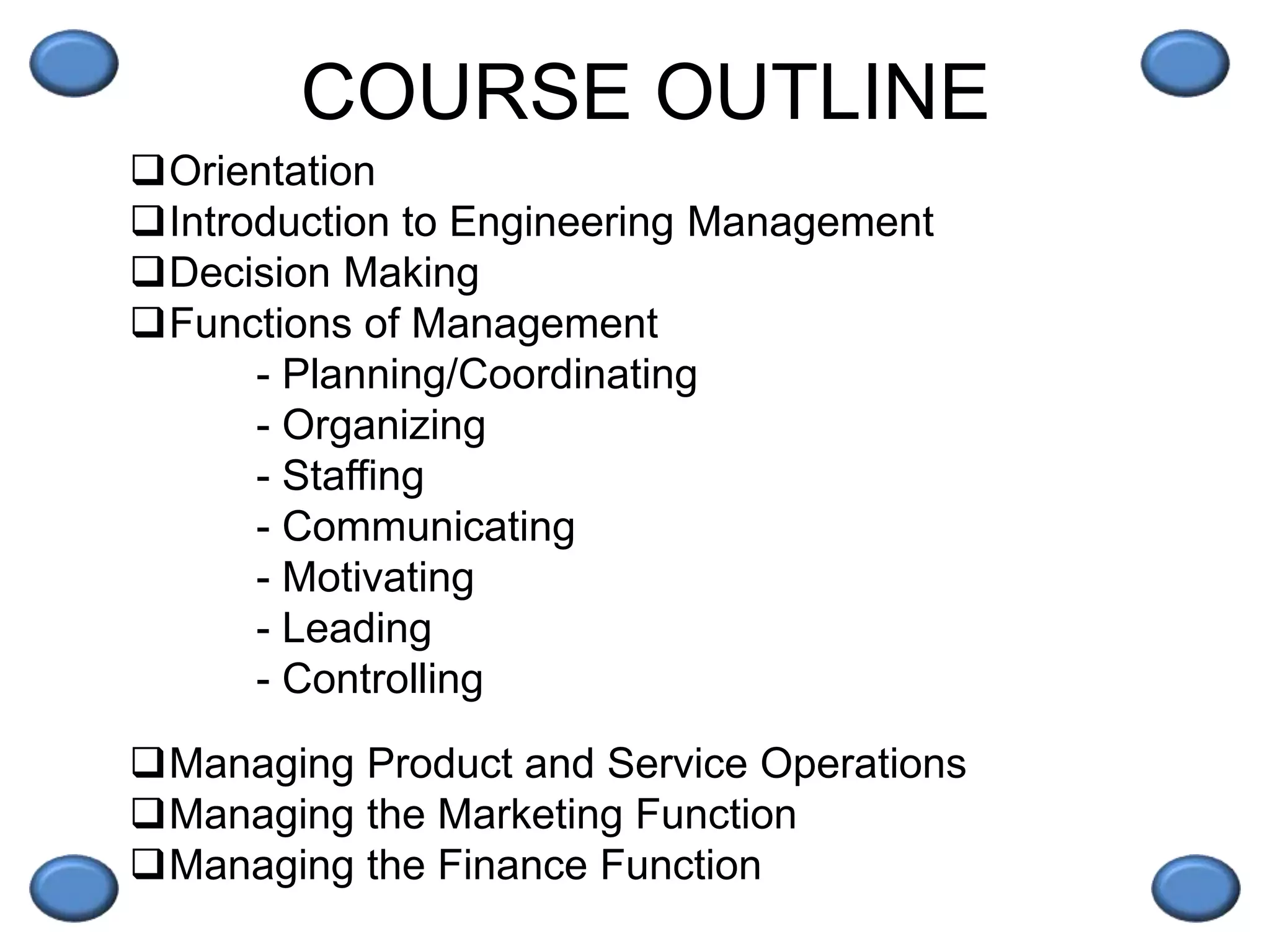
COURSE OUTLINE
Orientation
Introduction to Engineering Management
Decision Making
Functions of Management
- Planning/Coordinating
- Organizing
- Staffing
- Communicating
- Motivating
- Leading
- Controlling
Managing Product and Service Operations
Managing the Marketing Function
Managing the Finance Function
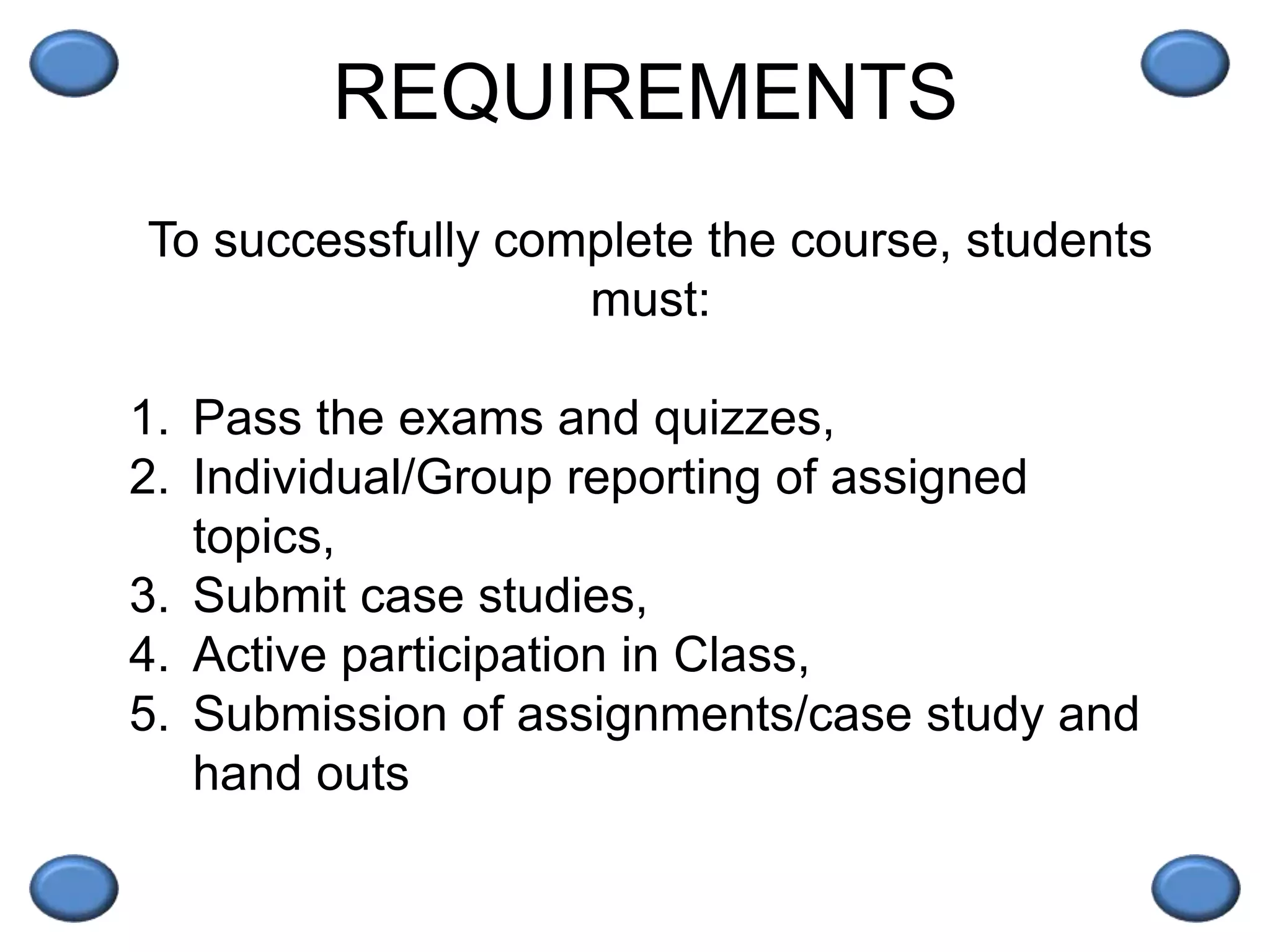
REQUIREMENTS
To successfully complete the course, students
must:
1. Pass the exams and quizzes,
2. Individual/Group reporting of assigned
topics,
3. Submit case studies,
4. Active participation in Class,
5. Submission of assignments/case study and
hand outs
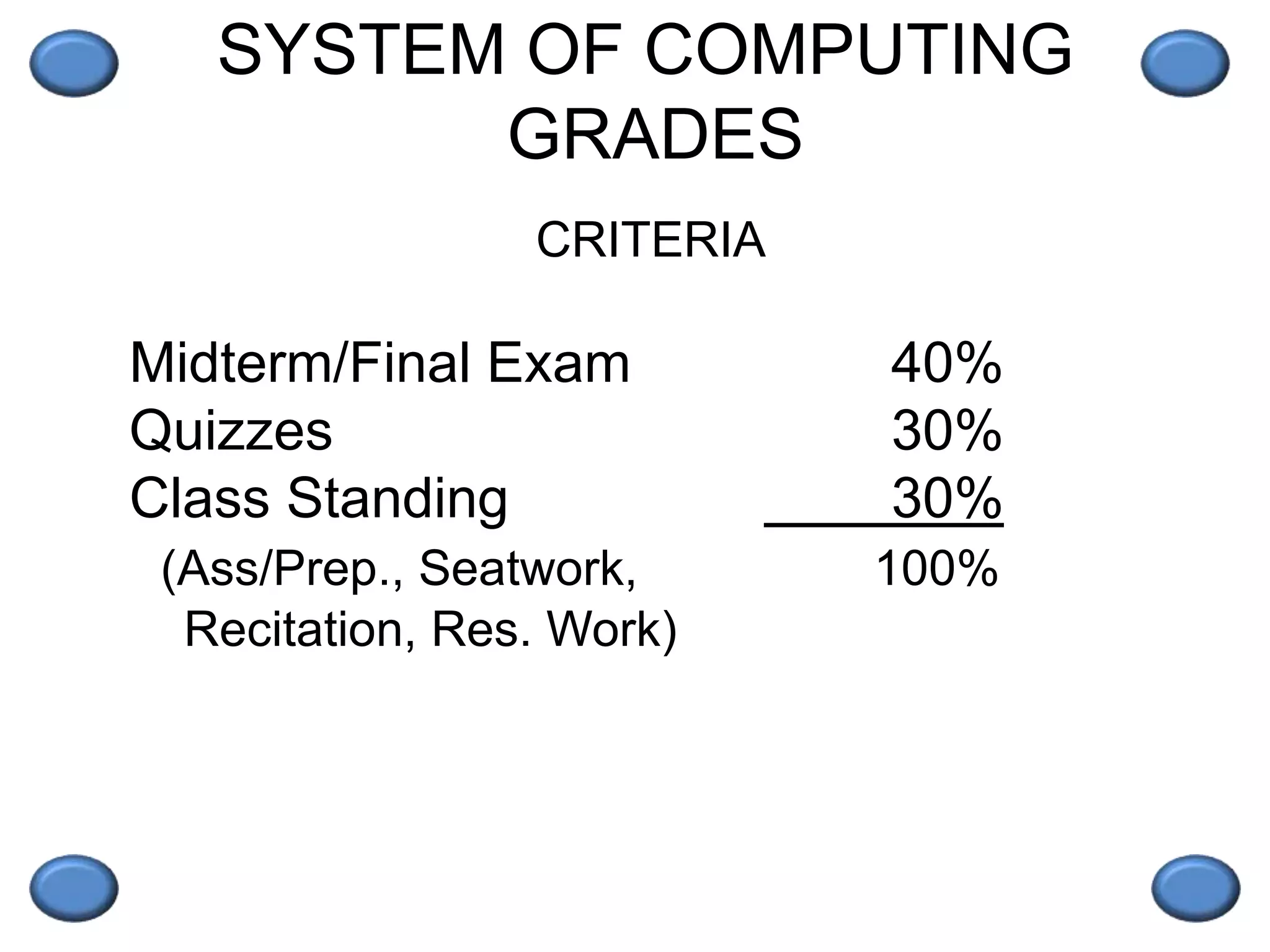
SYSTEM OF COMPUTING
GRADES
CRITERIA
Midterm/Final Exam 40%
Quizzes 30%
Class Standing 30%
(Ass/Prep., Seatwork, 100%
Recitation, Res. Work)

CHAPTER 1
FIELD OF ENGINEERING
MANAGEMENT
 It is important to the engineer that he knows what
is expected of him so that he may be able to
perform his job effectively and efficiently.
 Identify the skills required.
Engineering
Is the discipline, art and profession of
acquiring and applying technical, scientific,
and mathematical knowledge to design and
implement materials, structures, machines,
devices, systems, and processes that safely
realize a desired objective or invention.
Management is defined
Management in all business areas
and organizational activities are the
acts of getting people together to
accomplish desired goals and
objectives.
Management
comprises planning, organizing,
staffing, leading or directing,
and controlling an organization (a group of
one or more people or entities) or effort for
the purpose of accomplishing a goal.
Engineering Management
Is the field concerned with the
application of engineering principles to the
planning and operational management of
industrial and manufacturing operations
Is a term that is used to describe a
specialized form of management that is
required to successfully
lead engineering personnel and projects
Is a unique discipline that uses
engineering skills and knowledge in
managing large scale projects. It links
all other types of engineers from civil and
mechanical to chemical and electrical in
accomplishing organizational results
through the leadership of knowledge-
workers and the appropriate application
of technology.
Functions of the Engineer
• The production of more food for a fast growing
world population
• The elimination of air and water pollution
• Solid waste disposal and materials recycling
• The reduction of noise in various forms
Engineers are responsible for:
Functions of the Engineer
• Supplying the increasing demand for energy
• Supplying the increasing demand for mobility
• Preventing and solving crimes; and
• Meeting the increasing demand for
communication facilities
Engineers are responsible for:
Functions of the Engineer
• Research - where the engineer is engaged in the
process of learning about nature and codifying this
knowledge into usable theories.
• Design and development - where the engineer
undertakes the activity of turning a product concept
to a finished physical item.
• Testing – where the engineer works in a unit where
new products or parts are tested for workability.
Areas where functions of engineering encompass
Functions of the Engineer
• Manufacturing – where the engineer is directly in
charge of production personnel or assumes
responsibility for the product.
• Sales – where the engineer assists the company’s
costumer to meet their needs, especially those
that require technical expertise.
• Construction – this is where the construction
engineer (civil engineer) is either directly in-charge of
the construction personnel or may have responsibility
for the quality of the construction process.
Areas where functions of engineering encompass
• Consulting – where the engineer works as
consultant of any individual or organization
requiring his/her services.
• Government – where the engineer may find
employment in the government performing any
of the various tasks in regulating, monitoring,
and controlling the activities of various
institutions, public or private.
• Teaching – where the engineer gets
employment in a school and is assigned as a
teacher of engineering courses.
• Management – where the engineer is assigned
to manage groups of people performing specific
tasks.
Engineer in various types of
organization
1. Level One – those with minimal engineering jobs
like retailing firms
2. Level Two – those with a moderate degree of
engineering jobs like transportation companies.
3. Level Three – those with a high degree of
engineering jobs like construction firms.
Degree of engineering jobs
WHAT IS ENGINEERING
MANAGEMENT ?
• Activity combining “technical knowledge with the
ability to organize & coordinate worker power,
materials, machinery, and money”.
• Lead his group into producing a certain output
consistent with the required specifications.
• Pure management courses be well understood by
the engineer manager.
Process of Management
• Must seek to find out the objectives of
the organization
• Think of ways on how to achieve them
• Decide on the ways to be adapted and
the material resources to be used
Process of Management
• Determine the human requirements of the
total job
• Assign specific tasks to specific persons
• Motivate those persons and
• Provide means to make sure that the
activities are in the right direction.
Requirements for the Engineer
Manager’s Job
 A bachelor’s degree in engineering
from a reputable school: In some
cases, a master’s degree in
engineering or business management
is required;
 A few years experience in a pure
engineering job
 Training in supervision
 Special training in engineering
management
Engineering Management
Organizations
There are a number of societies and
organizations dedicated to the field of
engineering management
• American Society of Engineering
Management founded in 1979 by a group
of 20 engineering managers from industry
• The Master of Engineering Management
Programs Consortium- is a newly formed
consortium of prominent universities
intended to raise the value and visibility of
the MEM degree
• The Engineering Management
Certification International- is a part
of American Society of Mechanical
Engineers, provides a very
comprehensive guide on Engineering
Management, known as EMC-BOK
Guide
“Successful
Engineer
Manager”
How?
Ability
Motivation to manage
Opportunity
Managerial ability refers to the capacity of an
engineer manager to achieve organizational objectives
effectively and efficiently.
Ability
Effectiveness, according to Higgins
refers to a description of “whether
objectives are accomplished”
Effectiveness
Efficiency is a description of the relative
amount of resources used in obtaining
effectiveness
Efficiency
The test is anchored to the following
dimensions:
1. Favorable attitude toward those in positions of
authority, such as superiors.
2. Desire to engage in games or sport competition
with peers
3. Desire to engage in occupational or work-
related competition with peers
Motivation to Manage
John B. Miner: a management researcher that developed a
psychometric instrument to measure objectively an
individual’s motivation to manage
4. Desire to assert oneself and take charge
5. Desire to exercise power and authority
over others
6. Desire to behave in a distinctive way,
which includes standing out from the
crowd
7. Sense of responsibility in carrying out the
routine duties associated with managerial
work.
Successful manager become possible
only if those having the ability and motivation
are given the opportunity to manage. The
opportunity for successful management has
two requirements:
Obtaining a suitable
managerial job and
Finding a supportive climate
once on the job.
Opportunity
Required Skills and Disciplines
Successful engineering managers typically
require training and experience in both
general management (which may
include business administration) and the
specific engineering disciplines that will be
used by the engineering team to be
managed.
But additionally, the successful
engineering manager must understand that
the factors that cause certain individuals to
pursue careers in engineering are often
quite different than those for individuals
who are driven by purely entrepreneurial
thinking.
end
Prepared by: Engr. Floradel S. Relucio

1-field of engineering management.pptx

  • 1.
  • 2.
    COURSE DESCRIPTION Decision making;the functions of management; managing production and service operations; managing the marketing function; and managing the finance function. CREDIT UNITS: 3 units TIME DURATION: 54 hours
  • 3.
    GENERAL OBJECTIVE After completingthe course, the student must be able to: • understand the field of engineering management; • know and apply the different functions of management.
  • 4.
    COURSE OUTLINE Orientation Introduction toEngineering Management Decision Making Functions of Management - Planning/Coordinating - Organizing - Staffing - Communicating - Motivating - Leading - Controlling Managing Product and Service Operations Managing the Marketing Function Managing the Finance Function
  • 5.
    REQUIREMENTS To successfully completethe course, students must: 1. Pass the exams and quizzes, 2. Individual/Group reporting of assigned topics, 3. Submit case studies, 4. Active participation in Class, 5. Submission of assignments/case study and hand outs
  • 6.
    SYSTEM OF COMPUTING GRADES CRITERIA Midterm/FinalExam 40% Quizzes 30% Class Standing 30% (Ass/Prep., Seatwork, 100% Recitation, Res. Work)
  • 7.
  • 8.
    FIELD OF ENGINEERING MANAGEMENT It is important to the engineer that he knows what is expected of him so that he may be able to perform his job effectively and efficiently.  Identify the skills required.
  • 9.
    Engineering Is the discipline,art and profession of acquiring and applying technical, scientific, and mathematical knowledge to design and implement materials, structures, machines, devices, systems, and processes that safely realize a desired objective or invention.
  • 10.
    Management is defined Managementin all business areas and organizational activities are the acts of getting people together to accomplish desired goals and objectives.
  • 11.
    Management comprises planning, organizing, staffing,leading or directing, and controlling an organization (a group of one or more people or entities) or effort for the purpose of accomplishing a goal.
  • 12.
    Engineering Management Is thefield concerned with the application of engineering principles to the planning and operational management of industrial and manufacturing operations
  • 13.
    Is a termthat is used to describe a specialized form of management that is required to successfully lead engineering personnel and projects
  • 14.
    Is a uniquediscipline that uses engineering skills and knowledge in managing large scale projects. It links all other types of engineers from civil and mechanical to chemical and electrical in accomplishing organizational results through the leadership of knowledge- workers and the appropriate application of technology.
  • 15.
    Functions of theEngineer • The production of more food for a fast growing world population • The elimination of air and water pollution • Solid waste disposal and materials recycling • The reduction of noise in various forms Engineers are responsible for:
  • 16.
    Functions of theEngineer • Supplying the increasing demand for energy • Supplying the increasing demand for mobility • Preventing and solving crimes; and • Meeting the increasing demand for communication facilities Engineers are responsible for:
  • 17.
    Functions of theEngineer • Research - where the engineer is engaged in the process of learning about nature and codifying this knowledge into usable theories. • Design and development - where the engineer undertakes the activity of turning a product concept to a finished physical item. • Testing – where the engineer works in a unit where new products or parts are tested for workability. Areas where functions of engineering encompass
  • 18.
    Functions of theEngineer • Manufacturing – where the engineer is directly in charge of production personnel or assumes responsibility for the product. • Sales – where the engineer assists the company’s costumer to meet their needs, especially those that require technical expertise. • Construction – this is where the construction engineer (civil engineer) is either directly in-charge of the construction personnel or may have responsibility for the quality of the construction process. Areas where functions of engineering encompass
  • 19.
    • Consulting –where the engineer works as consultant of any individual or organization requiring his/her services. • Government – where the engineer may find employment in the government performing any of the various tasks in regulating, monitoring, and controlling the activities of various institutions, public or private. • Teaching – where the engineer gets employment in a school and is assigned as a teacher of engineering courses. • Management – where the engineer is assigned to manage groups of people performing specific tasks.
  • 20.
    Engineer in varioustypes of organization 1. Level One – those with minimal engineering jobs like retailing firms 2. Level Two – those with a moderate degree of engineering jobs like transportation companies. 3. Level Three – those with a high degree of engineering jobs like construction firms. Degree of engineering jobs
  • 21.
    WHAT IS ENGINEERING MANAGEMENT? • Activity combining “technical knowledge with the ability to organize & coordinate worker power, materials, machinery, and money”. • Lead his group into producing a certain output consistent with the required specifications. • Pure management courses be well understood by the engineer manager.
  • 22.
    Process of Management •Must seek to find out the objectives of the organization • Think of ways on how to achieve them • Decide on the ways to be adapted and the material resources to be used
  • 23.
    Process of Management •Determine the human requirements of the total job • Assign specific tasks to specific persons • Motivate those persons and • Provide means to make sure that the activities are in the right direction.
  • 24.
    Requirements for theEngineer Manager’s Job  A bachelor’s degree in engineering from a reputable school: In some cases, a master’s degree in engineering or business management is required;  A few years experience in a pure engineering job  Training in supervision  Special training in engineering management
  • 25.
    Engineering Management Organizations There area number of societies and organizations dedicated to the field of engineering management
  • 26.
    • American Societyof Engineering Management founded in 1979 by a group of 20 engineering managers from industry • The Master of Engineering Management Programs Consortium- is a newly formed consortium of prominent universities intended to raise the value and visibility of the MEM degree
  • 27.
    • The EngineeringManagement Certification International- is a part of American Society of Mechanical Engineers, provides a very comprehensive guide on Engineering Management, known as EMC-BOK Guide
  • 28.
  • 29.
  • 30.
    Managerial ability refersto the capacity of an engineer manager to achieve organizational objectives effectively and efficiently. Ability
  • 31.
    Effectiveness, according toHiggins refers to a description of “whether objectives are accomplished” Effectiveness Efficiency is a description of the relative amount of resources used in obtaining effectiveness Efficiency
  • 32.
    The test isanchored to the following dimensions: 1. Favorable attitude toward those in positions of authority, such as superiors. 2. Desire to engage in games or sport competition with peers 3. Desire to engage in occupational or work- related competition with peers Motivation to Manage John B. Miner: a management researcher that developed a psychometric instrument to measure objectively an individual’s motivation to manage
  • 33.
    4. Desire toassert oneself and take charge 5. Desire to exercise power and authority over others 6. Desire to behave in a distinctive way, which includes standing out from the crowd 7. Sense of responsibility in carrying out the routine duties associated with managerial work.
  • 34.
    Successful manager becomepossible only if those having the ability and motivation are given the opportunity to manage. The opportunity for successful management has two requirements: Obtaining a suitable managerial job and Finding a supportive climate once on the job. Opportunity
  • 35.
    Required Skills andDisciplines Successful engineering managers typically require training and experience in both general management (which may include business administration) and the specific engineering disciplines that will be used by the engineering team to be managed.
  • 36.
    But additionally, thesuccessful engineering manager must understand that the factors that cause certain individuals to pursue careers in engineering are often quite different than those for individuals who are driven by purely entrepreneurial thinking.
  • 37.
    end Prepared by: Engr.Floradel S. Relucio