Minimalism in architecture
Durgham Haider
Ahmad Hassan
Hussein Azher
Al Nahrain Uni.
Architecture Dep.
Fourth year
2020-2021
Minimalist architecture
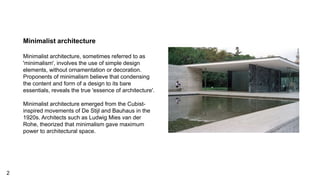
Minimalist architecture, sometimes referred to as
'minimalism', involves the use of simple design
elements, without ornamentation or decoration.
Proponents of minimalism believe that condensing
the content and form of a design to its bare
essentials, reveals the true 'essence of architecture'.
Minimalist architecture emerged from the Cubist-
inspired movements of De Stijl and Bauhaus in the
1920s. Architects such as Ludwig Mies van der
Rohe, theorized that minimalism gave maximum
power to architectural space.
2
Importance And Characteristics
One of the crucial minimalism issues is: How
much is it possible to rationalize, simplify and
reduce the form subtracting from its shaped
character, without the form losing its
and identity?
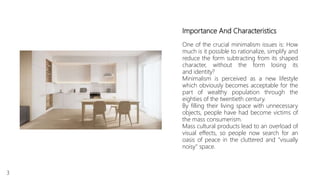
Minimalism is perceived as a new lifestyle
which obviously becomes acceptable for the
part of wealthy population through the
eighties of the twentieth century.
By filling their living space with unnecessary
objects, people have had become victims of
the mass consumerism.
Mass cultural products lead to an overload of
visual effects, so people now search for an
oasis of peace in the cluttered and "visually
noisy" space.
3
Industrial development, which has had enormous influence in
the middle of the twentieth century, could be considered as a
basis or the new aesthetic architectural expression. One of the
reasons why today's minimalism is purest than ever before, is
actually in technology and material innovation and
development. Minimalist aesthetics could be also considered
as suitable for other commercial purposes. Minimalist ideas in
art and architecture could be understood as a new way of
thinking and a new lifestyle. This movement tends to neglect
non-essential elements .
French writer Antoine de Saint Exupéry, in his description of
perfection says: "Perfection is achieved not when there is
nothing more to add, but when there is nothing left to
away.“
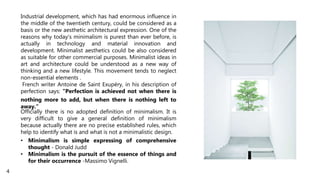
Officially there is no adopted definition of minimalism. It is
very difficult to give a general definition of minimalism
because actually there are no precise established rules, which
help to identify what is and what is not a minimalistic design.
• Minimalism is simple expressing of comprehensive
thought - Donald Judd
• Minimalism is the pursuit of the essence of things and
for their occurrence -Massimo Vignelli.
4
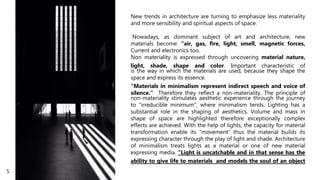
New trends in architecture are turning to emphasize less materiality
and more sensibility and spiritual aspects of space.
Nowadays, as dominant subject of art and architecture, new
materials become: “air, gas, fire, light, smell, magnetic forces,
Current and electronics too.
Non materiality is expressed through uncovering material nature,
light, shade, shape and color. Important characteristic of
is the way in which the materials are used, because they shape the
space and express its essence.
"Materials in minimalism represent indirect speech and voice of
silence." Therefore they reflect a non-materiality. The principle of
non-materiality stimulates aesthetic experience through the journey
to “irreducible minimum”, where minimalism tends. Lighting has a
substantial role in the shaping of aesthetics. Volume and mass in
shape of space are highlighted therefore exceptionally complex
effects are achieved. With the help of lights, the capacity for material
transformation enable its “movement“ thus the material builds its
expressing character through the play of light and shade. Architecture
of minimalism treats lights as a material or one of new material
expressing media. “Light is uncatchable and in that sense has the
ability to give life to materials and models the soul of an object
5
Ian Moore said: “The most important aspects for the place where we
live in, is the light, space and ventilation“. Usage of elementary
shapes is the base of minimalist composition, therefore only one basic
shape or a few similar as well as orthogonal forms are in use. Basically,
shapes character of the form. Hue-range language is expressed through
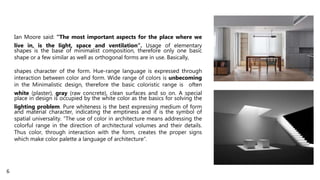
interaction between color and form. Wide range of colors is unbecoming
in the Minimalistic design, therefore the basic coloristic range is often
white (plaster), gray (raw concrete), clean surfaces and so on. A special
place in design is occupied by the white color as the basics for solving the
lighting problem. Pure whiteness is the best expressing medium of form
and material character, indicating the emptiness and it is the symbol of
spatial universality. “The use of color in architecture means addressing the
colorful range in the direction of architectural volumes and their details.
Thus color, through interaction with the form, creates the proper signs
which make color palette a language of architecture”.
6
Although minimalism implies order, control and discipline, we
cannot say
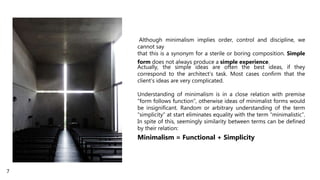
that this is a synonym for a sterile or boring composition. Simple
form does not always produce a simple experience.
Actually, the simple ideas are often the best ideas, if they
correspond to the architect’s task. Most cases confirm that the
client’s ideas are very complicated.
Understanding of minimalism is in a close relation with premise
“form follows function”, otherwise ideas of minimalist forms would
be insignificant. Random or arbitrary understanding of the term
“simplicity” at start eliminates equality with the term “minimalistic”.
In spite of this, seemingly similarity between terms can be defined
by their relation:
Minimalism = Functional + Simplicity
7
Sources
https://www.designingbuildings.co.uk/wiki/Minimalist_architecture#:~:text=Minimalist%20architecture%2C%20sometimes%20ref
rred%20to,elements%2C%20without%20ornamentation%20or%20decoration.&text=Common%20characteristics%20of%20mini
alist%20architecture,Pure%20geometric%20forms.
D. Vasilski, Minimalizam kao civilizacijska paradigma na početku XXI veka, Arhitektura i urnabizam, no. 22-23, 2008.
D.Vasilski, Japanska kultura kao paradigma u formiranju minimalizma u arhitekturi, Arhitektura i urnabizam, no. 30, 2010.
D. Vasilski (2015): On Minimalism in Architecture: To Think Means to Build, On Architecture – Reworking the City Through New
Architecture, Conference Proceedings, Strand - Sustainable Urban Society Association, Belgrade, 2015. pp. 195-203
V. Stevanović, Teorije minimalizma u arhitekturi: Post Scriptum, Arhitektura i urnanizam, br. 35, 2012.
J.Pawson, Pause for thought, Madrid, El Croquis, 2005.
V.Stevanović, Konstruktivni period teoretizacije minimalizma u arhitekturi, Arhitektura i urnabizam, no. 34, 2012.
F. Bertoni, Minimalist Architecture, Birkhauser, Basel Boston Berlin, 2002.
J. Hill, Immaterial architecture, Routledge, New York, 2006.
B. Tschumi, Arhitektura i disjunkcija, AGM, Zagreb, 2004.
D.Vasilski, Minimalism in Architecture: Materials as Instruments of Immaterial Reality Perception (Minimalizam u arhitekturi:
materijali kao instrumenti percepcije nematerijalne realnosti), Arhitektura i urnabizam no. 37, 2013. (text in English and in
8

Minimalism in architecture

  • 1.
    Minimalism in architecture DurghamHaider Ahmad Hassan Hussein Azher Al Nahrain Uni. Architecture Dep. Fourth year 2020-2021
  • 2.
    Minimalist architecture Minimalist architecture,sometimes referred to as 'minimalism', involves the use of simple design elements, without ornamentation or decoration. Proponents of minimalism believe that condensing the content and form of a design to its bare essentials, reveals the true 'essence of architecture'. Minimalist architecture emerged from the Cubist- inspired movements of De Stijl and Bauhaus in the 1920s. Architects such as Ludwig Mies van der Rohe, theorized that minimalism gave maximum power to architectural space. 2
  • 3.
    Importance And Characteristics Oneof the crucial minimalism issues is: How much is it possible to rationalize, simplify and reduce the form subtracting from its shaped character, without the form losing its and identity? Minimalism is perceived as a new lifestyle which obviously becomes acceptable for the part of wealthy population through the eighties of the twentieth century. By filling their living space with unnecessary objects, people have had become victims of the mass consumerism. Mass cultural products lead to an overload of visual effects, so people now search for an oasis of peace in the cluttered and "visually noisy" space. 3
  • 4.
    Industrial development, whichhas had enormous influence in the middle of the twentieth century, could be considered as a basis or the new aesthetic architectural expression. One of the reasons why today's minimalism is purest than ever before, is actually in technology and material innovation and development. Minimalist aesthetics could be also considered as suitable for other commercial purposes. Minimalist ideas in art and architecture could be understood as a new way of thinking and a new lifestyle. This movement tends to neglect non-essential elements . French writer Antoine de Saint Exupéry, in his description of perfection says: "Perfection is achieved not when there is nothing more to add, but when there is nothing left to away.“ Officially there is no adopted definition of minimalism. It is very difficult to give a general definition of minimalism because actually there are no precise established rules, which help to identify what is and what is not a minimalistic design. • Minimalism is simple expressing of comprehensive thought - Donald Judd • Minimalism is the pursuit of the essence of things and for their occurrence -Massimo Vignelli. 4
  • 5.
    New trends inarchitecture are turning to emphasize less materiality and more sensibility and spiritual aspects of space. Nowadays, as dominant subject of art and architecture, new materials become: “air, gas, fire, light, smell, magnetic forces, Current and electronics too. Non materiality is expressed through uncovering material nature, light, shade, shape and color. Important characteristic of is the way in which the materials are used, because they shape the space and express its essence. "Materials in minimalism represent indirect speech and voice of silence." Therefore they reflect a non-materiality. The principle of non-materiality stimulates aesthetic experience through the journey to “irreducible minimum”, where minimalism tends. Lighting has a substantial role in the shaping of aesthetics. Volume and mass in shape of space are highlighted therefore exceptionally complex effects are achieved. With the help of lights, the capacity for material transformation enable its “movement“ thus the material builds its expressing character through the play of light and shade. Architecture of minimalism treats lights as a material or one of new material expressing media. “Light is uncatchable and in that sense has the ability to give life to materials and models the soul of an object 5
  • 6.
    Ian Moore said:“The most important aspects for the place where we live in, is the light, space and ventilation“. Usage of elementary shapes is the base of minimalist composition, therefore only one basic shape or a few similar as well as orthogonal forms are in use. Basically, shapes character of the form. Hue-range language is expressed through interaction between color and form. Wide range of colors is unbecoming in the Minimalistic design, therefore the basic coloristic range is often white (plaster), gray (raw concrete), clean surfaces and so on. A special place in design is occupied by the white color as the basics for solving the lighting problem. Pure whiteness is the best expressing medium of form and material character, indicating the emptiness and it is the symbol of spatial universality. “The use of color in architecture means addressing the colorful range in the direction of architectural volumes and their details. Thus color, through interaction with the form, creates the proper signs which make color palette a language of architecture”. 6
  • 7.
    Although minimalism impliesorder, control and discipline, we cannot say that this is a synonym for a sterile or boring composition. Simple form does not always produce a simple experience. Actually, the simple ideas are often the best ideas, if they correspond to the architect’s task. Most cases confirm that the client’s ideas are very complicated. Understanding of minimalism is in a close relation with premise “form follows function”, otherwise ideas of minimalist forms would be insignificant. Random or arbitrary understanding of the term “simplicity” at start eliminates equality with the term “minimalistic”. In spite of this, seemingly similarity between terms can be defined by their relation: Minimalism = Functional + Simplicity 7
  • 8.
    Sources https://www.designingbuildings.co.uk/wiki/Minimalist_architecture#:~:text=Minimalist%20architecture%2C%20sometimes%20ref rred%20to,elements%2C%20without%20ornamentation%20or%20decoration.&text=Common%20characteristics%20of%20mini alist%20architecture,Pure%20geometric%20forms. D. Vasilski, Minimalizamkao civilizacijska paradigma na početku XXI veka, Arhitektura i urnabizam, no. 22-23, 2008. D.Vasilski, Japanska kultura kao paradigma u formiranju minimalizma u arhitekturi, Arhitektura i urnabizam, no. 30, 2010. D. Vasilski (2015): On Minimalism in Architecture: To Think Means to Build, On Architecture – Reworking the City Through New Architecture, Conference Proceedings, Strand - Sustainable Urban Society Association, Belgrade, 2015. pp. 195-203 V. Stevanović, Teorije minimalizma u arhitekturi: Post Scriptum, Arhitektura i urnanizam, br. 35, 2012. J.Pawson, Pause for thought, Madrid, El Croquis, 2005. V.Stevanović, Konstruktivni period teoretizacije minimalizma u arhitekturi, Arhitektura i urnabizam, no. 34, 2012. F. Bertoni, Minimalist Architecture, Birkhauser, Basel Boston Berlin, 2002. J. Hill, Immaterial architecture, Routledge, New York, 2006. B. Tschumi, Arhitektura i disjunkcija, AGM, Zagreb, 2004. D.Vasilski, Minimalism in Architecture: Materials as Instruments of Immaterial Reality Perception (Minimalizam u arhitekturi: materijali kao instrumenti percepcije nematerijalne realnosti), Arhitektura i urnabizam no. 37, 2013. (text in English and in 8