Engineering Management
KP Gwachha (M.Phil) 1
Class Rules
• Come in time
• No disturbance during lecture
• Bring your text book, class notes, note book, pen
and Calculator
• DO NOT MISS YOUR QUIZ AND MID EXAM
• No cell phone calls, No SMS
• Copying of assignment is strictly prohibited
• Meet the deadlines of assignments
• Maintain your attendance
KP Gwachha (M.Phil) 2
Engineering Management
• Subject Code: MGTS 403
• Internal Assessment Marks: 25%
• Final University Exam: 75%
• Text Book: Managing Engineering and Technology
• (Daniel L. Babcock, Lucy C. Morse)
3
KP Gwachha (M.Phil)
Units to be covered
• Unit 1: Introduction to Engineering Management (6 hrs)
• Unit 2: Functions of Technology Management (17 hrs)
• Unit 3: Managing Technology through the product life
cycle (8 hrs)
• Unit 4: Managing Projects (4 hrs)
• Unit5: Managing your Engineering Career ( 4 hrs)
• Unit6: Special Topics in Engineering Management
(6hrs)
4
KP Gwachha (M.Phil)
Guidance to Engineering Career
• Types of career
• Operational Career
• Research & Design
• Entrepreneurial career
• Engineering Management Career
• Consulting career
• Writing Career
• Academic Career
• Other Career ( entirely different)
5
KP Gwachha (M.Phil)
Chapter 1
Engineering and Management
KP Gwachha (M.Phil) 6
• Origins of Engineering
• Engineering as a Profession
• Roles of Engineers
• Management Levels and Skills
• Roles and Functions of Managers
• Engineering Management
Chapter Outline
KP Gwachha (M.Phil) 7
Origin of Engineering
“Engineer”& “Ingenious” stem from Latin word
“ingenium”
• Skillful, Talent, natural capacity
• Clever invention
KP Gwachha (M.Phil) 8
Engineering: Definition
1. En -gi – neer- ing: the art of managing engines
2. The application of science , mathematics and
economics by which the properties of matter and
the source of energy in nature made useful to
man in structures, machines, products, systems
and processes
9
KP Gwachha (M.Phil)
What Engineers Do?
• Engineer: A person applying his mathematical and
science knowledge properly for mankind.
• Engineers apply the theories and principles of
science and mathematics to the economical
solution of practical technical problems.
• Engineers design machinery, products, systems,
and processes for efficient and economical
performance.
--U.S. Bureau of Labor Statistics
KP Gwachha (M.Phil) 10
Types of Engineers
• Civil Engineers
• Agricultural Engineers
• Mechanical Engineers
• Electrical Engineers
• Industrial Engineers
• Chemical Engineers
• Aerospace Engineers
• Computer Engineers
• Software Engineers
• Biomedical Engineers
KP Gwachha (M.Phil) 11
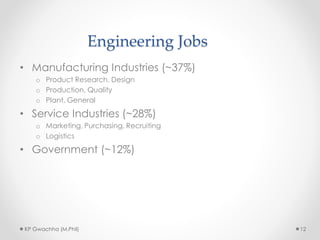
Engineering Jobs
• Manufacturing Industries (~37%)
o Product Research, Design
o Production, Quality
o Plant, General
• Service Industries (~28%)
o Marketing, Purchasing, Recruiting
o Logistics
• Government (~12%)
KP Gwachha (M.Phil) 12
Management
Manage: “to handle”
Management: “the process for managing, training,
or directing”
KP Gwachha (M.Phil) 13
What is Management?
• Directing the actions of a group to achieve a goal
in most efficient manner
• Getting things done through other people
• Process of achieving organizational goals by
working with and through people and
organizational resources
KP Gwachha (M.Phil) 14
Definition
• F.W . Taylor
o “Management is a process consisting of planning ,
organizing, actuating , and controlling performed to
determine and accomplish the objectives by the use of
people and recourse”
• Henry Fayol
o To manage is to forecast and plan , to organize, to
command, to coordinate and to control
• George R. Terry
o Management is the knowing exactly what you want
people to do and then seeing that they do it in the best
and cheapest way
KP Gwachha (M.Phil) 15
Management Levels
• First-line managers
o Foreman, supervisor, section chief
• Middle managers
o Plant manger, division head, chief engineer, operations manager
• Top managers
o Chair of board, president, executive vice president, CEO, CFO
KP Gwachha (M.Phil) 16
First-line management:
• Directly supervise non-managers.
• Carry out the plans and objectives of higher
management using the personnel & other resources
assigned to them.
• Short-range operating plans governing what will be
done tomorrow or next week, assign tasks to their
workers, supervise the work that is done and
evaluate the performance of workers.
KP Gwachha (M.Phil) 17
Middle-level management:
• Manage through other managers,
• Make plans of intermediate range to achieve the
long-range goals set by top management,
• Establish departmental policies, evaluate the
performance of subordinate work units & their
managers,
• Provide; Integrating and coordinating function,
• Orchestrate the decisions & activities of first-line
management.
KP Gwachha (M.Phil) 18
Top-level management:
• Represent the whole enterprise,
• Responsible for defining the character, mission and
objectives of the enterprise
• Establish & review criteria's for long-range plans.
• Evaluate the performance of major departments
KP Gwachha (M.Phil) 19
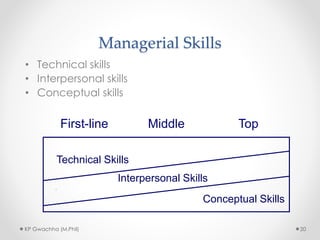
Managerial Skills
• Technical skills
• Interpersonal skills
• Conceptual skills
First-line Middle Top
Technical Skills
Interpersonal Skills
Conceptual Skills
KP Gwachha (M.Phil) 20
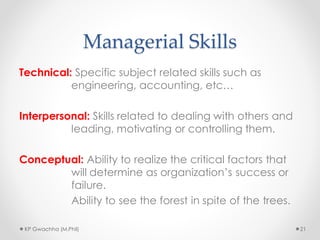
Managerial Skills
Technical: Specific subject related skills such as
engineering, accounting, etc…
Interpersonal: Skills related to dealing with others and
leading, motivating or controlling them.
Conceptual: Ability to realize the critical factors that
will determine as organization’s success or
failure.
Ability to see the forest in spite of the trees.
KP Gwachha (M.Phil) 21
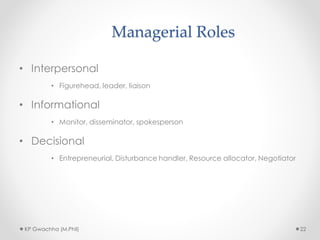
Managerial Roles
• Interpersonal
• Figurehead, leader, liaison
• Informational
• Monitor, disseminator, spokesperson
• Decisional
• Entrepreneurial, Disturbance handler, Resource allocator, Negotiator
KP Gwachha (M.Phil) 22
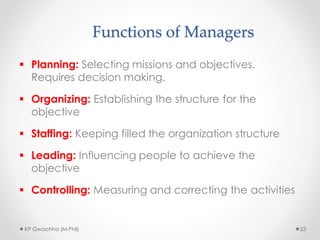
Functions of Managers
 Planning: Selecting missions and objectives.
Requires decision making.
 Organizing: Establishing the structure for the
objective
 Staffing: Keeping filled the organization structure
 Leading: Influencing people to achieve the
objective
 Controlling: Measuring and correcting the activities
KP Gwachha (M.Phil) 23
KP Gwachha (M.Phil) 24
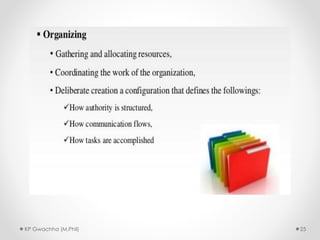
KP Gwachha (M.Phil) 25
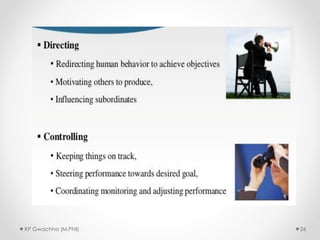
KP Gwachha (M.Phil) 26
Engineering Management:
A Synthesis
• Engineering Management is the art and science of
planning, organizing, allocating resources, and
directing and controlling activities which have a
technological component. –ASEM
• Engineering management is a field that bridges the
gap between engineering and management.
Engineering management involves the overall
management of organizations with an orientation to
manufacturing, construction, engineering,
technology or production. -- Wikipedia
KP Gwachha (M.Phil) 27
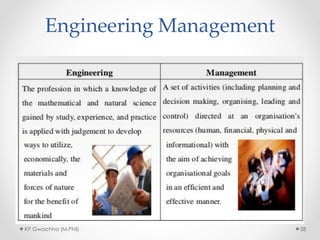
Engineering Management
KP Gwachha (M.Phil) 28
“Ordinary Managers vs. Engineering
Managers”
• The engineering manager is distinguished from
other managers because he/she possesses both an
ability to apply engineering principles and a skill in
organizing and directing people and projects.
• He/she is uniquely qualified for two types of jobs:
the management of technical functions (such as
design or production) in almost any enterprise, or
the management of broader functions (such as
marketing or top management) in a high-
technology enterprise.
KP Gwachha (M.Phil) 29
Engineering Managers
Nature of the Work
• Plan, coordinate, and direct research,
design, and production activities.
• Supervise engineers, scientists, and
technicians, along with support personnel.
• Apply knowledge of administrative
procedures,
• Use communication skills extensively.
--Bureau of Labor Statistics
KP Gwachha (M.Phil) 30
Need for Engineering Managers
• High-tech nature of business
• Technical, mathematical & natural science talents
• Extensive planning
• Uncertainties in products and processes
• Recruitment and evaluation of technical personnel
• Leadership and motivation of technical personnel
KP Gwachha (M.Phil) 31
Management and Engineering Career
• Engineering and sciences managers held about
228,000 jobs in 2006.
• Manufacturing industries employed 38% of
engineering and sciences managers.
• Another 31% worked in services industries.
• Other large employers include Federal, State, and
local government agencies.
• Employment of engineering and sciences
managers is expected to grow 8 percent over the
2006-16 decade, about as fast as the average for
all occupations.
--Bureau of Labor Statistics
KP Gwachha (M.Phil) 32
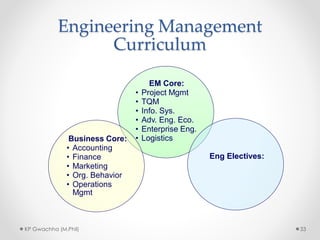
Engineering Management
Curriculum
EM Core:
• Project Mgmt
• TQM
• Info. Sys.
• Adv. Eng. Eco.
• Enterprise Eng.
• Logistics
Business Core:
• Accounting
• Finance
• Marketing
• Org. Behavior
• Operations
Mgmt
Eng Electives:
KP Gwachha (M.Phil) 33
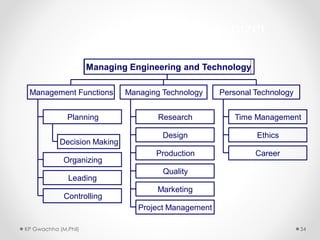
Advanced Organizer
Decision Making
Planning
Organizing
Leading
Controlling
Research
Design
Production
Quality
Marketing
Project Management
Time Management
Ethics
Career
Management Functions Managing Technology Personal Technology
Managing Engineering and Technology
KP Gwachha (M.Phil) 34
Discussion Questions
1. What is your background? (Major, Level of
study, country of origin, job title…)
2. Why do you take this course?
3. What is your expectation from this class?
4. Could you find out the trend in engineering
enrollment (at college level) in U.S.?
5. Could you find out the trend in business
enrollment (at college level) in U.S.?
KP Gwachha (M.Phil) 35

Engineering Management.pdf

  • 1.
  • 2.
    Class Rules • Comein time • No disturbance during lecture • Bring your text book, class notes, note book, pen and Calculator • DO NOT MISS YOUR QUIZ AND MID EXAM • No cell phone calls, No SMS • Copying of assignment is strictly prohibited • Meet the deadlines of assignments • Maintain your attendance KP Gwachha (M.Phil) 2
  • 3.
    Engineering Management • SubjectCode: MGTS 403 • Internal Assessment Marks: 25% • Final University Exam: 75% • Text Book: Managing Engineering and Technology • (Daniel L. Babcock, Lucy C. Morse) 3 KP Gwachha (M.Phil)
  • 4.
    Units to becovered • Unit 1: Introduction to Engineering Management (6 hrs) • Unit 2: Functions of Technology Management (17 hrs) • Unit 3: Managing Technology through the product life cycle (8 hrs) • Unit 4: Managing Projects (4 hrs) • Unit5: Managing your Engineering Career ( 4 hrs) • Unit6: Special Topics in Engineering Management (6hrs) 4 KP Gwachha (M.Phil)
  • 5.
    Guidance to EngineeringCareer • Types of career • Operational Career • Research & Design • Entrepreneurial career • Engineering Management Career • Consulting career • Writing Career • Academic Career • Other Career ( entirely different) 5 KP Gwachha (M.Phil)
  • 6.
    Chapter 1 Engineering andManagement KP Gwachha (M.Phil) 6
  • 7.
    • Origins ofEngineering • Engineering as a Profession • Roles of Engineers • Management Levels and Skills • Roles and Functions of Managers • Engineering Management Chapter Outline KP Gwachha (M.Phil) 7
  • 8.
    Origin of Engineering “Engineer”&“Ingenious” stem from Latin word “ingenium” • Skillful, Talent, natural capacity • Clever invention KP Gwachha (M.Phil) 8
  • 9.
    Engineering: Definition 1. En-gi – neer- ing: the art of managing engines 2. The application of science , mathematics and economics by which the properties of matter and the source of energy in nature made useful to man in structures, machines, products, systems and processes 9 KP Gwachha (M.Phil)
  • 10.
    What Engineers Do? •Engineer: A person applying his mathematical and science knowledge properly for mankind. • Engineers apply the theories and principles of science and mathematics to the economical solution of practical technical problems. • Engineers design machinery, products, systems, and processes for efficient and economical performance. --U.S. Bureau of Labor Statistics KP Gwachha (M.Phil) 10
  • 11.
    Types of Engineers •Civil Engineers • Agricultural Engineers • Mechanical Engineers • Electrical Engineers • Industrial Engineers • Chemical Engineers • Aerospace Engineers • Computer Engineers • Software Engineers • Biomedical Engineers KP Gwachha (M.Phil) 11
  • 12.
    Engineering Jobs • ManufacturingIndustries (~37%) o Product Research, Design o Production, Quality o Plant, General • Service Industries (~28%) o Marketing, Purchasing, Recruiting o Logistics • Government (~12%) KP Gwachha (M.Phil) 12
  • 13.
    Management Manage: “to handle” Management:“the process for managing, training, or directing” KP Gwachha (M.Phil) 13
  • 14.
    What is Management? •Directing the actions of a group to achieve a goal in most efficient manner • Getting things done through other people • Process of achieving organizational goals by working with and through people and organizational resources KP Gwachha (M.Phil) 14
  • 15.
    Definition • F.W .Taylor o “Management is a process consisting of planning , organizing, actuating , and controlling performed to determine and accomplish the objectives by the use of people and recourse” • Henry Fayol o To manage is to forecast and plan , to organize, to command, to coordinate and to control • George R. Terry o Management is the knowing exactly what you want people to do and then seeing that they do it in the best and cheapest way KP Gwachha (M.Phil) 15
  • 16.
    Management Levels • First-linemanagers o Foreman, supervisor, section chief • Middle managers o Plant manger, division head, chief engineer, operations manager • Top managers o Chair of board, president, executive vice president, CEO, CFO KP Gwachha (M.Phil) 16
  • 17.
    First-line management: • Directlysupervise non-managers. • Carry out the plans and objectives of higher management using the personnel & other resources assigned to them. • Short-range operating plans governing what will be done tomorrow or next week, assign tasks to their workers, supervise the work that is done and evaluate the performance of workers. KP Gwachha (M.Phil) 17
  • 18.
    Middle-level management: • Managethrough other managers, • Make plans of intermediate range to achieve the long-range goals set by top management, • Establish departmental policies, evaluate the performance of subordinate work units & their managers, • Provide; Integrating and coordinating function, • Orchestrate the decisions & activities of first-line management. KP Gwachha (M.Phil) 18
  • 19.
    Top-level management: • Representthe whole enterprise, • Responsible for defining the character, mission and objectives of the enterprise • Establish & review criteria's for long-range plans. • Evaluate the performance of major departments KP Gwachha (M.Phil) 19
  • 20.
    Managerial Skills • Technicalskills • Interpersonal skills • Conceptual skills First-line Middle Top Technical Skills Interpersonal Skills Conceptual Skills KP Gwachha (M.Phil) 20
  • 21.
    Managerial Skills Technical: Specificsubject related skills such as engineering, accounting, etc… Interpersonal: Skills related to dealing with others and leading, motivating or controlling them. Conceptual: Ability to realize the critical factors that will determine as organization’s success or failure. Ability to see the forest in spite of the trees. KP Gwachha (M.Phil) 21
  • 22.
    Managerial Roles • Interpersonal •Figurehead, leader, liaison • Informational • Monitor, disseminator, spokesperson • Decisional • Entrepreneurial, Disturbance handler, Resource allocator, Negotiator KP Gwachha (M.Phil) 22
  • 23.
    Functions of Managers Planning: Selecting missions and objectives. Requires decision making.  Organizing: Establishing the structure for the objective  Staffing: Keeping filled the organization structure  Leading: Influencing people to achieve the objective  Controlling: Measuring and correcting the activities KP Gwachha (M.Phil) 23
  • 24.
  • 25.
  • 26.
  • 27.
    Engineering Management: A Synthesis •Engineering Management is the art and science of planning, organizing, allocating resources, and directing and controlling activities which have a technological component. –ASEM • Engineering management is a field that bridges the gap between engineering and management. Engineering management involves the overall management of organizations with an orientation to manufacturing, construction, engineering, technology or production. -- Wikipedia KP Gwachha (M.Phil) 27
  • 28.
  • 29.
    “Ordinary Managers vs.Engineering Managers” • The engineering manager is distinguished from other managers because he/she possesses both an ability to apply engineering principles and a skill in organizing and directing people and projects. • He/she is uniquely qualified for two types of jobs: the management of technical functions (such as design or production) in almost any enterprise, or the management of broader functions (such as marketing or top management) in a high- technology enterprise. KP Gwachha (M.Phil) 29
  • 30.
    Engineering Managers Nature ofthe Work • Plan, coordinate, and direct research, design, and production activities. • Supervise engineers, scientists, and technicians, along with support personnel. • Apply knowledge of administrative procedures, • Use communication skills extensively. --Bureau of Labor Statistics KP Gwachha (M.Phil) 30
  • 31.
    Need for EngineeringManagers • High-tech nature of business • Technical, mathematical & natural science talents • Extensive planning • Uncertainties in products and processes • Recruitment and evaluation of technical personnel • Leadership and motivation of technical personnel KP Gwachha (M.Phil) 31
  • 32.
    Management and EngineeringCareer • Engineering and sciences managers held about 228,000 jobs in 2006. • Manufacturing industries employed 38% of engineering and sciences managers. • Another 31% worked in services industries. • Other large employers include Federal, State, and local government agencies. • Employment of engineering and sciences managers is expected to grow 8 percent over the 2006-16 decade, about as fast as the average for all occupations. --Bureau of Labor Statistics KP Gwachha (M.Phil) 32
  • 33.
    Engineering Management Curriculum EM Core: •Project Mgmt • TQM • Info. Sys. • Adv. Eng. Eco. • Enterprise Eng. • Logistics Business Core: • Accounting • Finance • Marketing • Org. Behavior • Operations Mgmt Eng Electives: KP Gwachha (M.Phil) 33
  • 34.
    Advanced Organizer Decision Making Planning Organizing Leading Controlling Research Design Production Quality Marketing ProjectManagement Time Management Ethics Career Management Functions Managing Technology Personal Technology Managing Engineering and Technology KP Gwachha (M.Phil) 34
  • 35.
    Discussion Questions 1. Whatis your background? (Major, Level of study, country of origin, job title…) 2. Why do you take this course? 3. What is your expectation from this class? 4. Could you find out the trend in engineering enrollment (at college level) in U.S.? 5. Could you find out the trend in business enrollment (at college level) in U.S.? KP Gwachha (M.Phil) 35