Ch. 1 Section 3 
THE REFORMATION
In the beginning… 
 The Reformation began in Germany where 
Renaissance ideals of the secular and 
individual helped weaken the authority of the 
church. Northern European rulers also 
resented the pope’s authority. However, 
because Germany was divided into many 
smaller competing states, it was difficult for 
the pope or emperor to impose control.
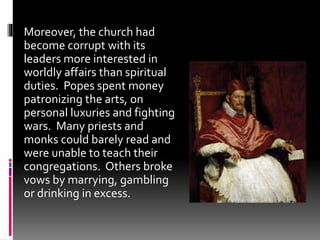
Moreover, the church had 
become corrupt with its 
leaders more interested in 
worldly affairs than spiritual 
duties. Popes spent money 
patronizing the arts, on 
personal luxuries and fighting 
wars. Many priests and 
monks could barely read and 
were unable to teach their 
congregations. Others broke 
vows by marrying, gambling 
or drinking in excess.
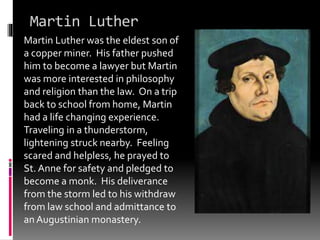
Martin Luther 
Martin Luther was the eldest son of 
a copper miner. His father pushed 
him to become a lawyer but Martin 
was more interested in philosophy 
and religion than the law. On a trip 
back to school from home, Martin 
had a life changing experience. 
Traveling in a thunderstorm, 
lightening struck nearby. Feeling 
scared and helpless, he prayed to 
St. Anne for safety and pledged to 
become a monk. His deliverance 
from the storm led to his withdraw 
from law school and admittance to 
an Augustinian monastery.
 Luther witnessed the corruption of 
the church first hand and was 
particularly upset with the selling of 
indulgences or pardons for sins. 
Johanna Tetzel sold these in an effort 
to raise money to rebuild St. Peter’s 
Cathedral in Rome. Tetzel and his 
priests gave people the impression 
that by buying indulgences, they 
could buy their way into heaven.
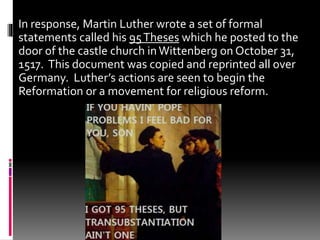
In response, Martin Luther wrote a set of formal 
statements called his 95 Theses which he posted to the 
door of the castle church in Wittenberg on October 31, 
1517. This document was copied and reprinted all over 
Germany. Luther’s actions are seen to begin the 
Reformation or a movement for religious reform.
Luther’s 3 main ideas: 
 People win salvation only by faith in God’s gift 
of forgiveness. The Church taught that faith 
and “good works” were needed for salvation. 
 All Church teachings should be clearly based 
on the words of the Bible. The pope and 
church traditions were false authorities. 
 All people with faith were equal. Therefore, 
people did not need priests to interpret the 
Bible for them.
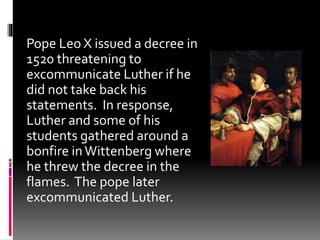
Pope Leo X issued a decree in 
1520 threatening to 
excommunicate Luther if he 
did not take back his 
statements. In response, 
Luther and some of his 
students gathered around a 
bonfire in Wittenberg where 
he threw the decree in the 
flames. The pope later 
excommunicated Luther.
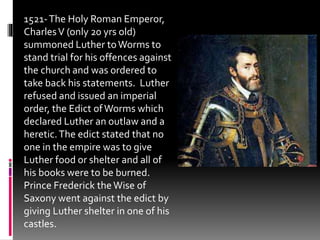
1521-The Holy Roman Emperor, 
Charles V (only 20 yrs old) 
summoned Luther to Worms to 
stand trial for his offences against 
the church and was ordered to 
take back his statements. Luther 
refused and issued an imperial 
order, the Edict of Worms which 
declared Luther an outlaw and a 
heretic. The edict stated that no 
one in the empire was to give 
Luther food or shelter and all of 
his books were to be burned. 
Prince Frederick the Wise of 
Saxony went against the edict by 
giving Luther shelter in one of his 
castles.
 1522- Luther returned to 
Wittenberg to find that many of his 
teachings had been put into 
practice by the local clergy. 
Sermons in German and married 
“ministers” made Luther and his 
followers a separate religious group 
called the Lutherans.
 1529- Many German princes supported 
Luther and factions supporting each side 
began hostilities. Princes who supported 
Luther signed a protest against the Catholic 
princes. These protesting princes came to 
be known as Protestants. Eventually, the 
term Protestant was applied to Christians 
who belonged to non-Catholic churches. 
Charles V goes to war against these 
Protestant princes and defeated them in 
1547.

The reformation 1.3

  • 1.
    Ch. 1 Section3 THE REFORMATION
  • 2.
    In the beginning…  The Reformation began in Germany where Renaissance ideals of the secular and individual helped weaken the authority of the church. Northern European rulers also resented the pope’s authority. However, because Germany was divided into many smaller competing states, it was difficult for the pope or emperor to impose control.
  • 3.
    Moreover, the churchhad become corrupt with its leaders more interested in worldly affairs than spiritual duties. Popes spent money patronizing the arts, on personal luxuries and fighting wars. Many priests and monks could barely read and were unable to teach their congregations. Others broke vows by marrying, gambling or drinking in excess.
  • 4.
    Martin Luther MartinLuther was the eldest son of a copper miner. His father pushed him to become a lawyer but Martin was more interested in philosophy and religion than the law. On a trip back to school from home, Martin had a life changing experience. Traveling in a thunderstorm, lightening struck nearby. Feeling scared and helpless, he prayed to St. Anne for safety and pledged to become a monk. His deliverance from the storm led to his withdraw from law school and admittance to an Augustinian monastery.
  • 5.
     Luther witnessedthe corruption of the church first hand and was particularly upset with the selling of indulgences or pardons for sins. Johanna Tetzel sold these in an effort to raise money to rebuild St. Peter’s Cathedral in Rome. Tetzel and his priests gave people the impression that by buying indulgences, they could buy their way into heaven.
  • 6.
    In response, MartinLuther wrote a set of formal statements called his 95 Theses which he posted to the door of the castle church in Wittenberg on October 31, 1517. This document was copied and reprinted all over Germany. Luther’s actions are seen to begin the Reformation or a movement for religious reform.
  • 7.
    Luther’s 3 mainideas:  People win salvation only by faith in God’s gift of forgiveness. The Church taught that faith and “good works” were needed for salvation.  All Church teachings should be clearly based on the words of the Bible. The pope and church traditions were false authorities.  All people with faith were equal. Therefore, people did not need priests to interpret the Bible for them.
  • 8.
    Pope Leo Xissued a decree in 1520 threatening to excommunicate Luther if he did not take back his statements. In response, Luther and some of his students gathered around a bonfire in Wittenberg where he threw the decree in the flames. The pope later excommunicated Luther.
  • 9.
    1521-The Holy RomanEmperor, Charles V (only 20 yrs old) summoned Luther to Worms to stand trial for his offences against the church and was ordered to take back his statements. Luther refused and issued an imperial order, the Edict of Worms which declared Luther an outlaw and a heretic. The edict stated that no one in the empire was to give Luther food or shelter and all of his books were to be burned. Prince Frederick the Wise of Saxony went against the edict by giving Luther shelter in one of his castles.
  • 10.
     1522- Lutherreturned to Wittenberg to find that many of his teachings had been put into practice by the local clergy. Sermons in German and married “ministers” made Luther and his followers a separate religious group called the Lutherans.
  • 11.
     1529- ManyGerman princes supported Luther and factions supporting each side began hostilities. Princes who supported Luther signed a protest against the Catholic princes. These protesting princes came to be known as Protestants. Eventually, the term Protestant was applied to Christians who belonged to non-Catholic churches. Charles V goes to war against these Protestant princes and defeated them in 1547.