The Progressive Era A time of Change
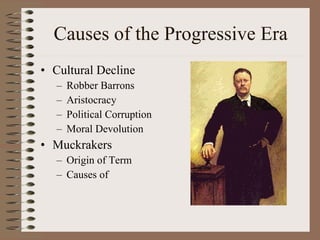
Causes of the Progressive Era Cultural Decline Robber Barrons Aristocracy Political Corruption Moral Devolution Muckrakers Origin of Term Causes of
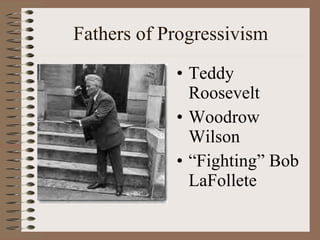
Fathers of Progressivism Teddy Roosevelt Woodrow Wilson “ Fighting” Bob LaFollete                                                                                                  
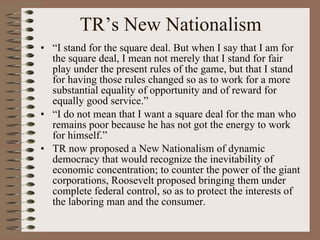
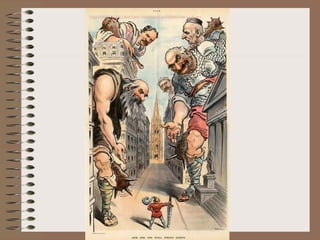
TR’s New Nationalism “ I stand for the square deal. But when I say that I am for the square deal, I mean not merely that I stand for fair play under the present rules of the game, but that I stand for having those rules changed so as to work for a more substantial equality of opportunity and of reward for equally good service.” “ I do not mean that I want a square deal for the man who remains poor because he has not got the energy to work for himself.” TR now proposed a New Nationalism of dynamic democracy that would recognize the inevitability of economic concentration; to counter the power of the giant corporations, Roosevelt proposed bringing them under complete federal control, so as to protect the interests of the laboring man and the consumer.
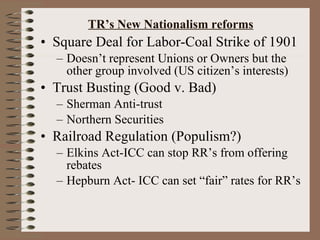
TR’s New Nationalism reforms Square Deal for Labor-Coal Strike of 1901 Doesn’t represent Unions or Owners but the other group involved (US citizen’s interests) Trust Busting (Good v. Bad) Sherman Anti-trust Northern Securities Railroad Regulation (Populism?) Elkins Act-ICC can stop RR’s from offering rebates Hepburn Act- ICC can set “fair” rates for RR’s
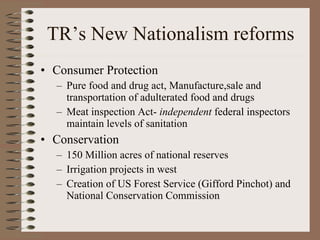
TR’s New Nationalism reforms Consumer Protection Pure food and drug act, Manufacture,sale and transportation of adulterated food and drugs Meat inspection Act-  independent  federal inspectors maintain levels of sanitation Conservation 150 Million acres of national reserves Irrigation projects in west Creation of US Forest Service (Gifford Pinchot) and National Conservation Commission
 
Woodrow Wilson-New freedom  “ The great Government we loved has too often been made use of for private and selfish purposes, and those who used it had forgotten the people.” “ The Nation has been deeply stirred, stirred by solemn passion, stirred by the knowledge of wrong, of ideals lost, of government too often debauched and made an instrument of evil.”  “ I summon all honest men, all patriotic, all forward-looking men, to my side. God helping me, I will not fail them, if they will but counsel and sustain me!”
Wilson New Freedom Reforms Underwood Tariff-First lowering of Tariffs since the civil war- Free trade benefits the people not businesses Federal Trade Act- Set up FTC or Federal Trade Commission to investigate and halt unfair and illegal business practices. The FTC could put a halt to these illegal business practices by issuing what is known as a "cease and desist order.“
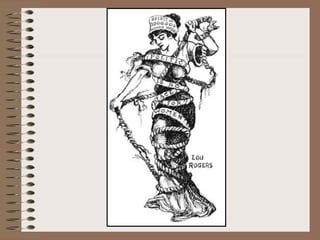
Clayton Anti-Trust Act- Declared certain businesses illegal (interlocking directorates, trusts, horizontal mergers) Unions and the Grange were not subject to antitrust laws. This made unions legal! Strikes, boycotts, picketing and the collection of strike benefit funds ruled legal Federal Reserve System- Federal Reserve Banks in 12 districts would print and coin money as well as set interest rates. In this way the "Fed," as it was called, could control the money supply and effect the value of currency Federal Farm Loan Act set up Farm Loan Banks to support farmers.

Robert M. LaFollette Wisconsin, Governor and US Senator  Wisconsin was the first state to adopt the primary for nominations for state offices.   A new law taxed railroads on the value of their property, ending an inequity   A railroad commission was created to regulate rates   Funding for education was increased.   A civil-service law was adopted   This legislation was drafted by political and social scientists and economists, a feature of the "Wisconsin Idea."
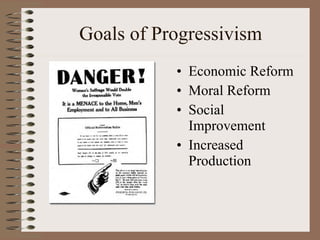
Goals of Progressivism Economic Reform Moral Reform Social Improvement Increased Production
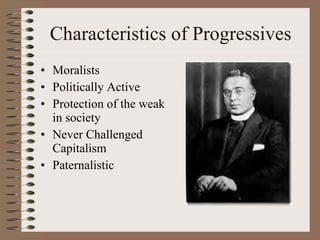
Characteristics of Progressives Moralists Politically Active Protection of the weak in society Never Challenged Capitalism Paternalistic                                 
Economic Reform Trust Busting Working Conditions Ages, Wages, and Hours. Rise of Socialism Laissez Faire theory in decline
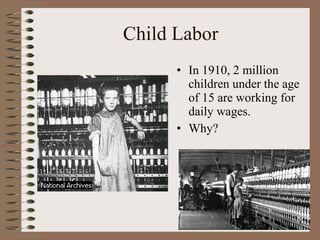
Child Labor In 1910, 2 million children under the age of 15 are working for daily wages. Why?
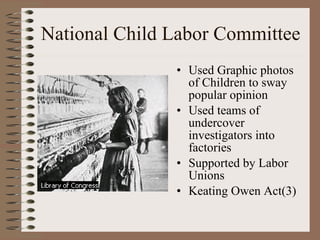
National Child Labor Committee Used Graphic photos of Children to sway popular opinion Used teams of undercover investigators into factories Supported by Labor Unions Keating Owen Act(3)
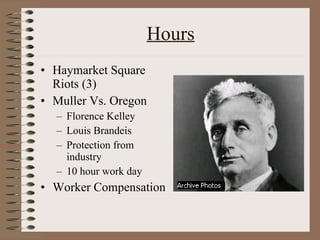
Hours Haymarket Square Riots (3) Muller Vs. Oregon Florence Kelley Louis Brandeis Protection from industry 10 hour work day Worker Compensation
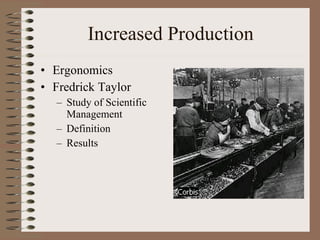
Increased Production Ergonomics Fredrick Taylor Study of Scientific Management Definition Results
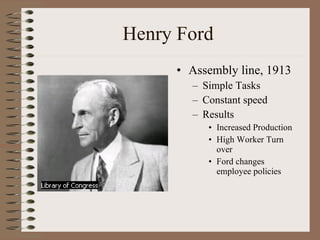
Henry Ford Assembly line, 1913 Simple Tasks Constant speed Results Increased Production High Worker Turn over Ford changes employee policies
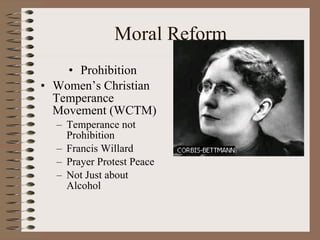
Moral Reform Prohibition Women’s Christian Temperance Movement (WCTM) Temperance not Prohibition  Francis Willard Prayer Protest Peace Not Just about Alcohol
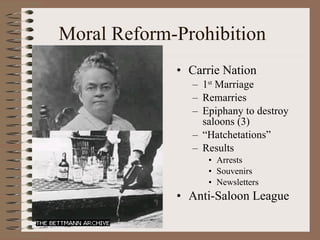
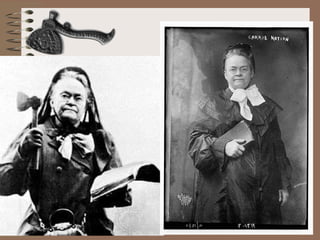
Moral Reform-Prohibition Carrie Nation 1 st  Marriage Remarries Epiphany to destroy saloons (3) “ Hatchetations” Results Arrests Souvenirs  Newsletters Anti-Saloon League
 
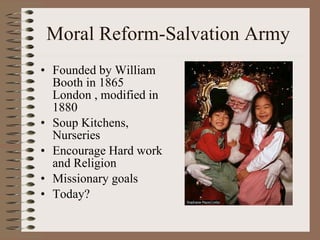
Moral Reform-Salvation Army  Founded by William Booth in 1865 London , modified in 1880 Soup Kitchens, Nurseries  Encourage Hard work and Religion Missionary goals Today?
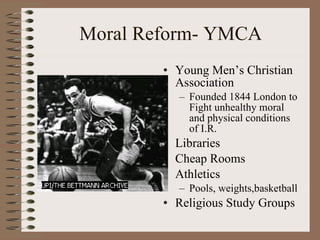
Moral Reform- YMCA Young Men’s Christian Association Founded 1844 London to Fight unhealthy moral and physical conditions of I.R. Libraries Cheap Rooms Athletics Pools, weights,basketball  Religious Study Groups
Political Reform State/Local Councils vs. Commissioners  Reform Politicians Fightin’ Bob Toledo’s Samuel “Golden Rule” Jones Charles Evans Hughes Election Reform Australian Ballot Initiative Referendum Recall Direct Primary 17 th  Amendment
Progressive Amendments 16 th  Amend - Income tax 17 th  Amendment -Direct election of Senators “ The Senate of the United States shall be composed of two Senators from each State, elected by the people thereof ” 18 th  Amendment -Prohibition -”the manufacture, sale, or transportation of intoxicating liquors is hereby prohibited.” 19 th  Amendment - “ The right of citizens of the United States to vote shall not be denied or abridged by the United States or by any State on account of sex. “
The Progressive Woman Women Traditional Role? Home? Work? Political? Women’s Modern Role? Home? Work? Political?
WOMEN LEAD REFORM Many of the leading progressive reformers were women Middle and upper class women also entered the public sphere as reformers Many of these women had graduated from new  women’s colleges Colleges like Vassar and Smith allowed women to excel
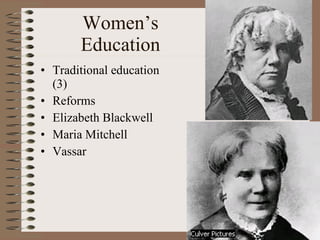
Women’s Education Traditional education (3) Reforms Elizabeth Blackwell Maria Mitchell Vassar
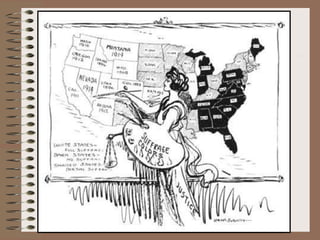
WOMEN AND REFORM Women reformers strove to improve conditions at work and home NAWSA was created to join women together to fight for equal rights (voting).. It excluded black women In 1896, black women formed the National Association of Colored Women (NACW) Suffrage was another important issue for women
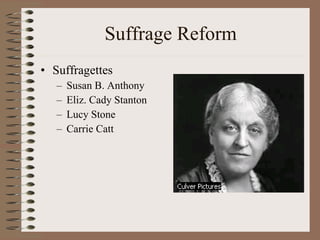
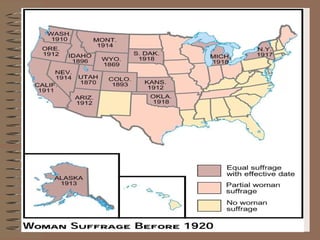
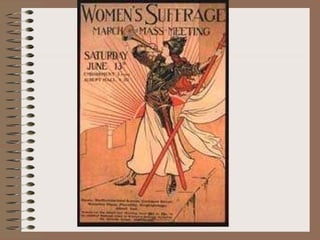
Suffrage Reform Suffragettes Susan B. Anthony Eliz. Cady Stanton Lucy Stone Carrie Catt
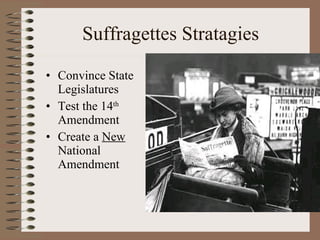
Suffragettes Stratagies Convince State Legislatures Test the 14 th  Amendment Create a  New  National Amendment
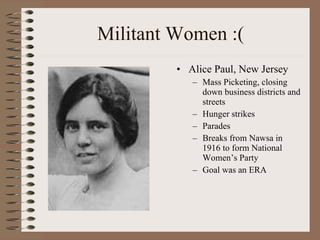
Militant Women :( Alice Paul, New Jersey Mass Picketing, closing down business districts and streets Hunger strikes Parades Breaks from Nawsa in 1916 to form National Women’s Party Goal was an ERA


Emmeline Pankhurst
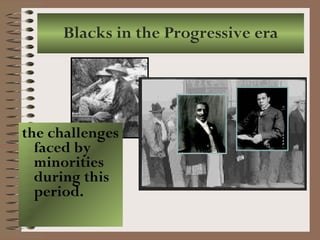
Blacks in the Progressive era the challenges faced by minorities during this period.
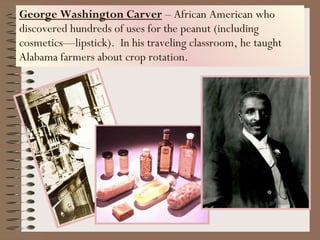
George Washington Carver  – African American who discovered hundreds of uses for the peanut (including cosmetics—lipstick).  In his traveling classroom, he taught Alabama farmers about crop rotation.
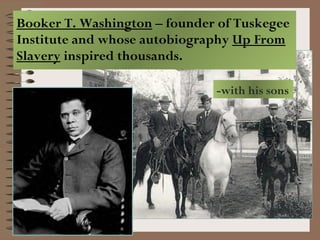
Booker T. Washington  – founder of Tuskegee Institute and whose autobiography  Up From Slavery  inspired thousands. -with his sons
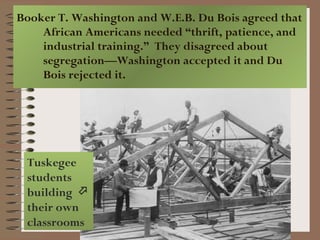
Booker T. Washington and W.E.B. Du Bois agreed that African Americans needed “thrift, patience, and industrial training.”  They disagreed about segregation—Washington accepted it and Du Bois rejected it. Tuskegee students building    their own classrooms
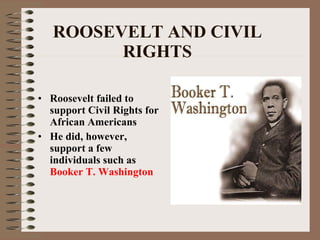
ROOSEVELT AND CIVIL RIGHTS Roosevelt failed to support Civil Rights for African Americans He did, however, support a few individuals such as  Booker T. Washington
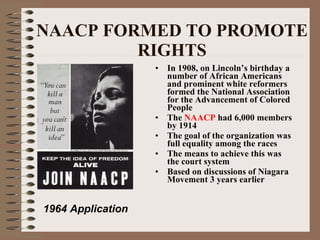
NAACP FORMED TO PROMOTE RIGHTS In 1908, on Lincoln’s birthday a number of African Americans and prominent white reformers formed the National Association for the Advancement of Colored People   The  NAACP  had 6,000 members by 1914  The goal of the organization was full equality among the races The means to achieve this was the court system Based on discussions of Niagara Movement 3 years earlier 1964 Application
Great Migration To be discussed with WWI
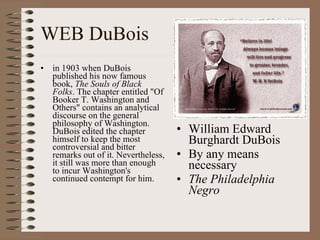
WEB DuBois in 1903 when DuBois published his now famous book,  The Souls of Black Folks . The chapter entitled "Of Booker T. Washington and Others" contains an analytical discourse on the general philosophy of Washington. DuBois edited the chapter himself to keep the most controversial and bitter remarks out of it. Nevertheless, it still was more than enough to incur Washington's continued contempt for him.  William Edward Burghardt DuBois  By any means necessary The Philadelphia Negro

The progressive era

  • 1.
    The Progressive EraA time of Change
  • 2.
    Causes of theProgressive Era Cultural Decline Robber Barrons Aristocracy Political Corruption Moral Devolution Muckrakers Origin of Term Causes of
  • 3.
    Fathers of ProgressivismTeddy Roosevelt Woodrow Wilson “ Fighting” Bob LaFollete                                                                                                
  • 4.
    TR’s New Nationalism“ I stand for the square deal. But when I say that I am for the square deal, I mean not merely that I stand for fair play under the present rules of the game, but that I stand for having those rules changed so as to work for a more substantial equality of opportunity and of reward for equally good service.” “ I do not mean that I want a square deal for the man who remains poor because he has not got the energy to work for himself.” TR now proposed a New Nationalism of dynamic democracy that would recognize the inevitability of economic concentration; to counter the power of the giant corporations, Roosevelt proposed bringing them under complete federal control, so as to protect the interests of the laboring man and the consumer.
  • 5.
    TR’s New Nationalismreforms Square Deal for Labor-Coal Strike of 1901 Doesn’t represent Unions or Owners but the other group involved (US citizen’s interests) Trust Busting (Good v. Bad) Sherman Anti-trust Northern Securities Railroad Regulation (Populism?) Elkins Act-ICC can stop RR’s from offering rebates Hepburn Act- ICC can set “fair” rates for RR’s
  • 6.
    TR’s New Nationalismreforms Consumer Protection Pure food and drug act, Manufacture,sale and transportation of adulterated food and drugs Meat inspection Act- independent federal inspectors maintain levels of sanitation Conservation 150 Million acres of national reserves Irrigation projects in west Creation of US Forest Service (Gifford Pinchot) and National Conservation Commission
  • 7.
  • 8.
    Woodrow Wilson-New freedom “ The great Government we loved has too often been made use of for private and selfish purposes, and those who used it had forgotten the people.” “ The Nation has been deeply stirred, stirred by solemn passion, stirred by the knowledge of wrong, of ideals lost, of government too often debauched and made an instrument of evil.” “ I summon all honest men, all patriotic, all forward-looking men, to my side. God helping me, I will not fail them, if they will but counsel and sustain me!”
  • 9.
    Wilson New FreedomReforms Underwood Tariff-First lowering of Tariffs since the civil war- Free trade benefits the people not businesses Federal Trade Act- Set up FTC or Federal Trade Commission to investigate and halt unfair and illegal business practices. The FTC could put a halt to these illegal business practices by issuing what is known as a "cease and desist order.“
  • 10.
    Clayton Anti-Trust Act-Declared certain businesses illegal (interlocking directorates, trusts, horizontal mergers) Unions and the Grange were not subject to antitrust laws. This made unions legal! Strikes, boycotts, picketing and the collection of strike benefit funds ruled legal Federal Reserve System- Federal Reserve Banks in 12 districts would print and coin money as well as set interest rates. In this way the "Fed," as it was called, could control the money supply and effect the value of currency Federal Farm Loan Act set up Farm Loan Banks to support farmers.
  • 11.
    Robert M. LaFolletteWisconsin, Governor and US Senator Wisconsin was the first state to adopt the primary for nominations for state offices. A new law taxed railroads on the value of their property, ending an inequity A railroad commission was created to regulate rates Funding for education was increased. A civil-service law was adopted This legislation was drafted by political and social scientists and economists, a feature of the "Wisconsin Idea."
  • 12.
    Goals of ProgressivismEconomic Reform Moral Reform Social Improvement Increased Production
  • 13.
    Characteristics of ProgressivesMoralists Politically Active Protection of the weak in society Never Challenged Capitalism Paternalistic                                 
  • 14.
    Economic Reform TrustBusting Working Conditions Ages, Wages, and Hours. Rise of Socialism Laissez Faire theory in decline
  • 15.
    Child Labor In1910, 2 million children under the age of 15 are working for daily wages. Why?
  • 16.
    National Child LaborCommittee Used Graphic photos of Children to sway popular opinion Used teams of undercover investigators into factories Supported by Labor Unions Keating Owen Act(3)
  • 17.
    Hours Haymarket SquareRiots (3) Muller Vs. Oregon Florence Kelley Louis Brandeis Protection from industry 10 hour work day Worker Compensation
  • 18.
    Increased Production ErgonomicsFredrick Taylor Study of Scientific Management Definition Results
  • 19.
    Henry Ford Assemblyline, 1913 Simple Tasks Constant speed Results Increased Production High Worker Turn over Ford changes employee policies
  • 20.
    Moral Reform ProhibitionWomen’s Christian Temperance Movement (WCTM) Temperance not Prohibition Francis Willard Prayer Protest Peace Not Just about Alcohol
  • 21.
    Moral Reform-Prohibition CarrieNation 1 st Marriage Remarries Epiphany to destroy saloons (3) “ Hatchetations” Results Arrests Souvenirs Newsletters Anti-Saloon League
  • 22.
  • 23.
    Moral Reform-Salvation Army Founded by William Booth in 1865 London , modified in 1880 Soup Kitchens, Nurseries Encourage Hard work and Religion Missionary goals Today?
  • 24.
    Moral Reform- YMCAYoung Men’s Christian Association Founded 1844 London to Fight unhealthy moral and physical conditions of I.R. Libraries Cheap Rooms Athletics Pools, weights,basketball Religious Study Groups
  • 25.
    Political Reform State/LocalCouncils vs. Commissioners Reform Politicians Fightin’ Bob Toledo’s Samuel “Golden Rule” Jones Charles Evans Hughes Election Reform Australian Ballot Initiative Referendum Recall Direct Primary 17 th Amendment
  • 26.
    Progressive Amendments 16th Amend - Income tax 17 th Amendment -Direct election of Senators “ The Senate of the United States shall be composed of two Senators from each State, elected by the people thereof ” 18 th Amendment -Prohibition -”the manufacture, sale, or transportation of intoxicating liquors is hereby prohibited.” 19 th Amendment - “ The right of citizens of the United States to vote shall not be denied or abridged by the United States or by any State on account of sex. “
  • 27.
    The Progressive WomanWomen Traditional Role? Home? Work? Political? Women’s Modern Role? Home? Work? Political?
  • 28.
    WOMEN LEAD REFORMMany of the leading progressive reformers were women Middle and upper class women also entered the public sphere as reformers Many of these women had graduated from new women’s colleges Colleges like Vassar and Smith allowed women to excel
  • 29.
    Women’s Education Traditionaleducation (3) Reforms Elizabeth Blackwell Maria Mitchell Vassar
  • 30.
    WOMEN AND REFORMWomen reformers strove to improve conditions at work and home NAWSA was created to join women together to fight for equal rights (voting).. It excluded black women In 1896, black women formed the National Association of Colored Women (NACW) Suffrage was another important issue for women
  • 31.
    Suffrage Reform SuffragettesSusan B. Anthony Eliz. Cady Stanton Lucy Stone Carrie Catt
  • 32.
    Suffragettes Stratagies ConvinceState Legislatures Test the 14 th Amendment Create a New National Amendment
  • 33.
    Militant Women :(Alice Paul, New Jersey Mass Picketing, closing down business districts and streets Hunger strikes Parades Breaks from Nawsa in 1916 to form National Women’s Party Goal was an ERA
  • 34.
  • 35.
  • 36.
  • 37.
  • 38.
  • 39.
    Blacks in theProgressive era the challenges faced by minorities during this period.
  • 40.
    George Washington Carver – African American who discovered hundreds of uses for the peanut (including cosmetics—lipstick). In his traveling classroom, he taught Alabama farmers about crop rotation.
  • 41.
    Booker T. Washington – founder of Tuskegee Institute and whose autobiography Up From Slavery inspired thousands. -with his sons
  • 42.
    Booker T. Washingtonand W.E.B. Du Bois agreed that African Americans needed “thrift, patience, and industrial training.” They disagreed about segregation—Washington accepted it and Du Bois rejected it. Tuskegee students building  their own classrooms
  • 43.
    ROOSEVELT AND CIVILRIGHTS Roosevelt failed to support Civil Rights for African Americans He did, however, support a few individuals such as Booker T. Washington
  • 44.
    NAACP FORMED TOPROMOTE RIGHTS In 1908, on Lincoln’s birthday a number of African Americans and prominent white reformers formed the National Association for the Advancement of Colored People The NAACP had 6,000 members by 1914 The goal of the organization was full equality among the races The means to achieve this was the court system Based on discussions of Niagara Movement 3 years earlier 1964 Application
  • 45.
    Great Migration Tobe discussed with WWI
  • 46.
    WEB DuBois in1903 when DuBois published his now famous book, The Souls of Black Folks . The chapter entitled "Of Booker T. Washington and Others" contains an analytical discourse on the general philosophy of Washington. DuBois edited the chapter himself to keep the most controversial and bitter remarks out of it. Nevertheless, it still was more than enough to incur Washington's continued contempt for him. William Edward Burghardt DuBois By any means necessary The Philadelphia Negro