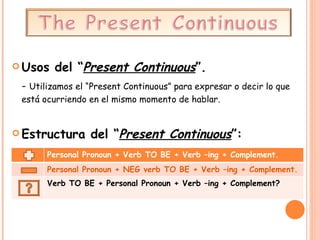
Usos del “ Present Continuous ”. -  Utilizamos el “Present Continuous” para expresar o decir lo que está ocurriendo en el mismo momento de hablar. Estructura del “ Present Continuous ”: Personal Pronoun + Verb TO BE + Verb –ing + Complement. Personal Pronoun + NEG verb TO BE + Verb –ing + Complement.   Verb TO BE + Personal Pronoun + Verb –ing + Complement?
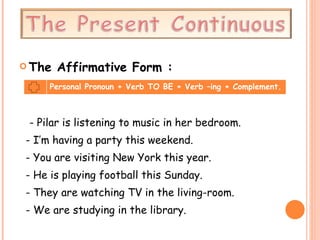
The Affirmative Form : - Pilar is listening to music in her bedroom. - I’m having a party this weekend. - You are visiting New York this year. - He is playing football this Sunday. - They are watching TV in the living-room. - We are studying in the library. Personal Pronoun + Verb TO BE + Verb –ing + Complement.
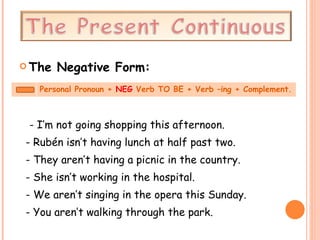
The Negative Form: - I’m not going shopping this afternoon. - Rubén isn’t having lunch at half past two. - They aren’t having a picnic in the country. - She isn’t working in the hospital. - We aren’t singing in the opera this Sunday. - You aren’t walking through the park.  Personal Pronoun +  NEG  Verb TO BE + Verb –ing + Complement.
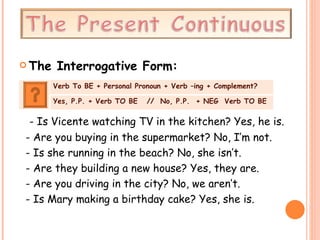
The Interrogative Form: - Is Vicente watching TV in the kitchen? Yes, he is. - Are you buying in the supermarket? No, I’m not. - Is she running in the beach? No, she isn’t. - Are they building a new house? Yes, they are. - Are you driving in the city? No, we aren’t. - Is Mary making a birthday cake? Yes, she is. Verb To BE + Personal Pronoun + Verb –ing + Complement? Yes, P.P. + Verb TO BE  //  No, P.P.  + NEG  Verb TO BE
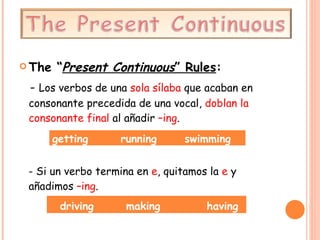
The “ Present Continuous ”  Rules : -  Los verbos de una  sola sílaba  que acaban en consonante precedida de una vocal,  doblan la consonante final  al añadir  –ing .  - Si un verbo termina en  e , quitamos la  e  y añadimos  –ing . getting  running  swimming  driving  making  having
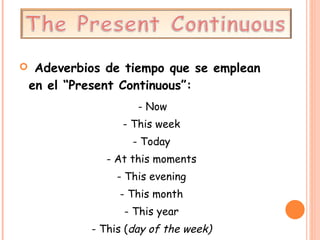
Adeverbios de tiempo que se emplean en el “Present Continuous”: - Now - This week - Today - At this moments - This evening - This month - This year - This ( day of the week)

The present continouos

  • 1.
  • 2.
    Usos del “Present Continuous ”. - Utilizamos el “Present Continuous” para expresar o decir lo que está ocurriendo en el mismo momento de hablar. Estructura del “ Present Continuous ”: Personal Pronoun + Verb TO BE + Verb –ing + Complement. Personal Pronoun + NEG verb TO BE + Verb –ing + Complement. Verb TO BE + Personal Pronoun + Verb –ing + Complement?
  • 3.
    The Affirmative Form: - Pilar is listening to music in her bedroom. - I’m having a party this weekend. - You are visiting New York this year. - He is playing football this Sunday. - They are watching TV in the living-room. - We are studying in the library. Personal Pronoun + Verb TO BE + Verb –ing + Complement.
  • 4.
    The Negative Form:- I’m not going shopping this afternoon. - Rubén isn’t having lunch at half past two. - They aren’t having a picnic in the country. - She isn’t working in the hospital. - We aren’t singing in the opera this Sunday. - You aren’t walking through the park. Personal Pronoun + NEG Verb TO BE + Verb –ing + Complement.
  • 5.
    The Interrogative Form:- Is Vicente watching TV in the kitchen? Yes, he is. - Are you buying in the supermarket? No, I’m not. - Is she running in the beach? No, she isn’t. - Are they building a new house? Yes, they are. - Are you driving in the city? No, we aren’t. - Is Mary making a birthday cake? Yes, she is. Verb To BE + Personal Pronoun + Verb –ing + Complement? Yes, P.P. + Verb TO BE // No, P.P. + NEG Verb TO BE
  • 6.
    The “ PresentContinuous ” Rules : - Los verbos de una sola sílaba que acaban en consonante precedida de una vocal, doblan la consonante final al añadir –ing . - Si un verbo termina en e , quitamos la e y añadimos –ing . getting running swimming driving making having
  • 7.
    Adeverbios de tiempoque se emplean en el “Present Continuous”: - Now - This week - Today - At this moments - This evening - This month - This year - This ( day of the week)