Chapter 6
Event Patterns, Rules, and
Constraints
jwj0831@gmail.com
Topics covered in this Chapter
●
●
●
●
●
●

Familiar kinds of pattern searching
Event patterns
A strawman event pattern language
Event pattern rules
Event pattern constraints
Capturing business rules as event patterns
6.1 Common Kinds of Pattern
Searching 1/4
● We need to be able to describe a pattern of events
that we are interested in and quickly find the sets of
events that match the pattern.
● To do this, we first need a precise method to describe
event patterns.
● One way is to write the pattern in a computer language
called an event pattern language(EPL).
6.1 Common Kinds of Pattern
Searching 2/4
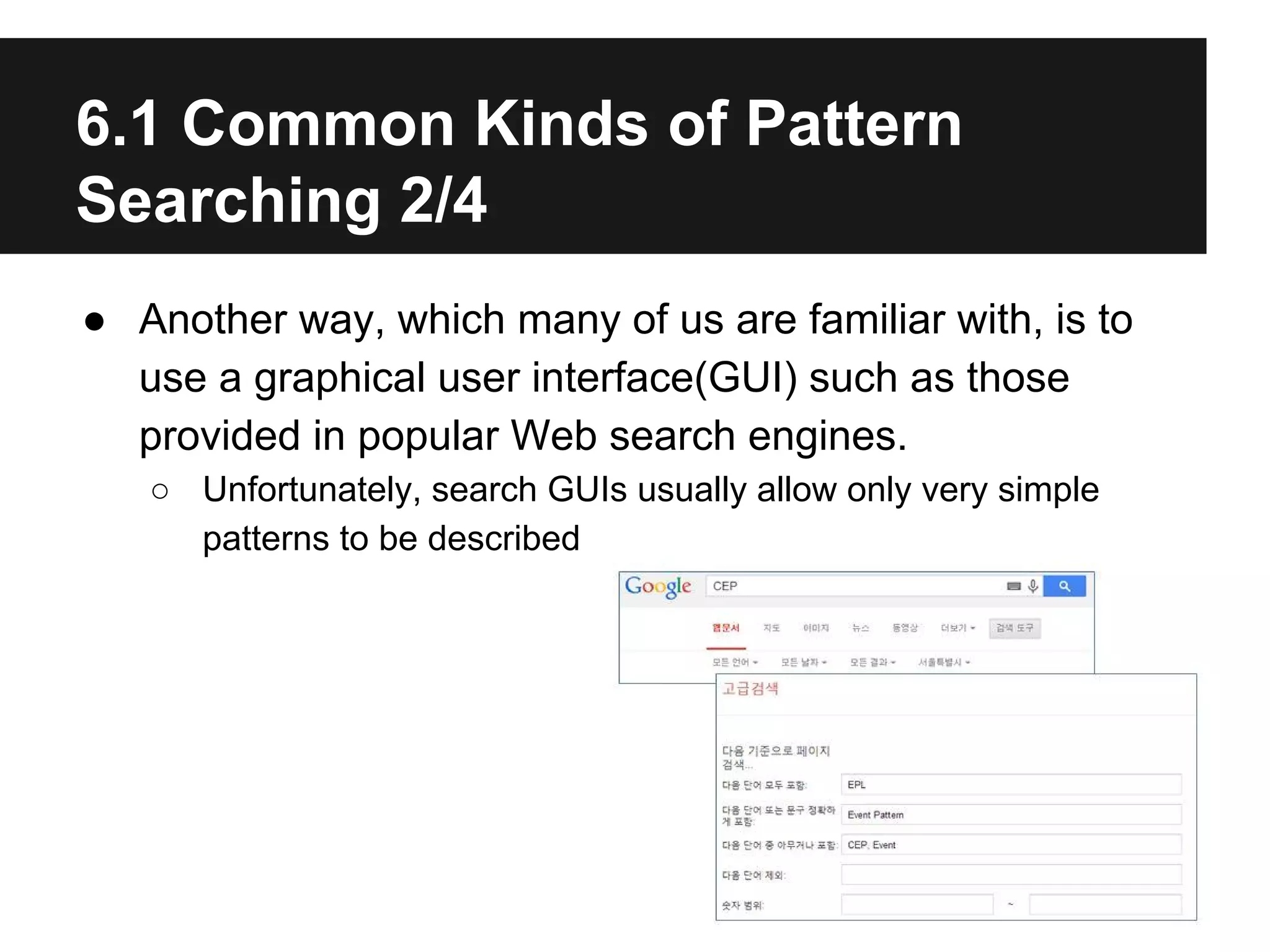
● Another way, which many of us are familiar with, is to
use a graphical user interface(GUI) such as those
provided in popular Web search engines.
○ Unfortunately, search GUIs usually allow only very simple
patterns to be described
6.1 Common Kinds of Pattern
Searching 3/4
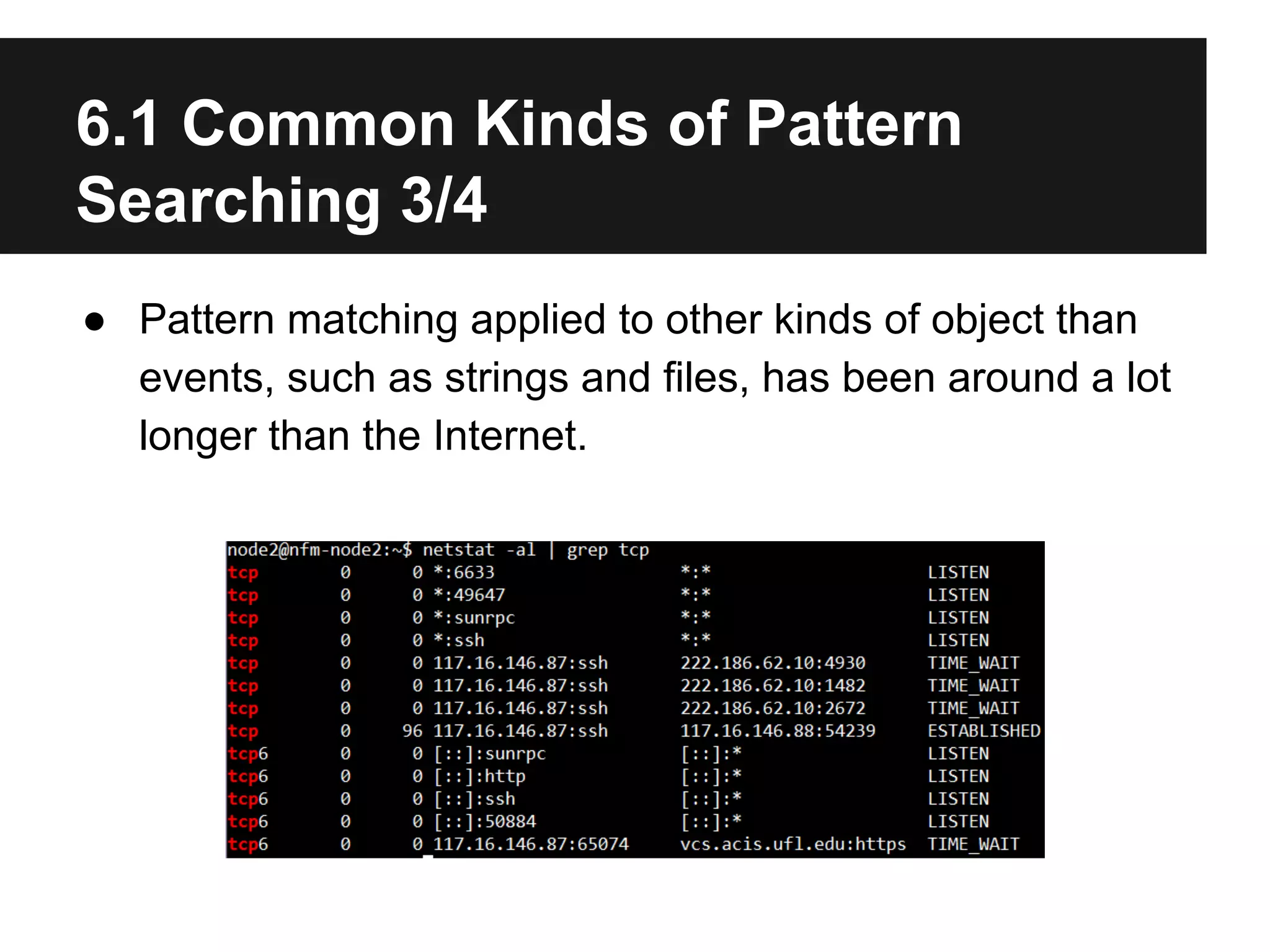
● Pattern matching applied to other kinds of object than
events, such as strings and files, has been around a lot
longer than the Internet.
6.1 Common Kinds of Pattern
Searching 4/4
● In CEP we need to specify sets of events that have
certain common data in some of the events and also
have specific timing, causal, and aggregation
relationships between events.
● The need to specify sets of events that have parts in
common and specific relativities is a step beyond
string searching.
● A pattern language in which we can express such
pattherns will necessarily be more complex than string
searching language.
6.2 Event Patterns
● An event pattern is a template that matches certain
sets of events - the sets you want to find.
● It describes precisely not only the events but also their
causal dependencies, timing, data parameters, and
context.
● So an event pattern is a template for posets.
6.2 Event Patterns Example
Content-Sensitive Pattern
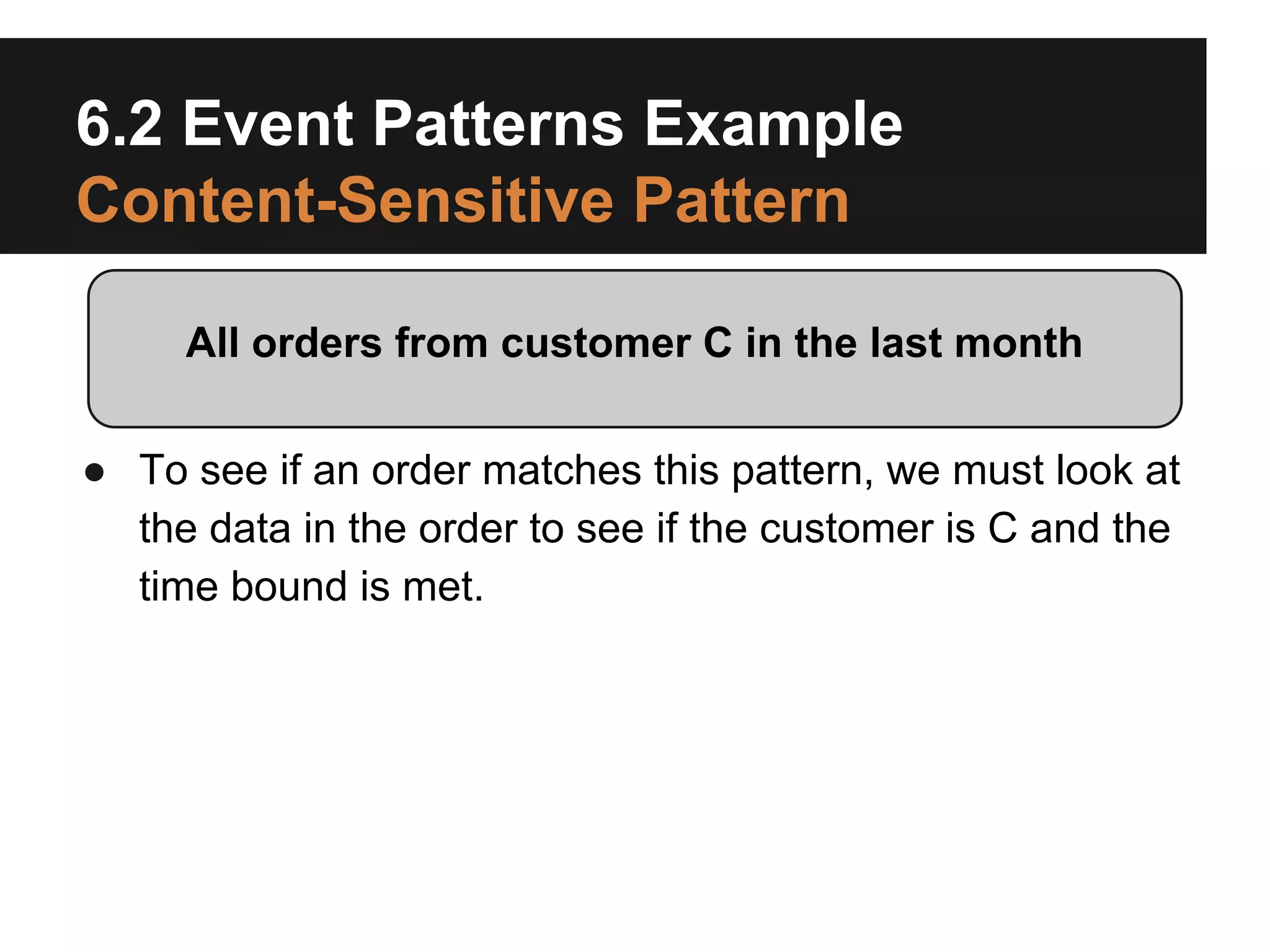
All orders from customer C in the last month
● To see if an order matches this pattern, we must look at
the data in the order to see if the customer is C and the
time bound is met.
6.2 Event Patterns Example
Context-Sensitive Pattern
All orders from frequent customers in the last
month
● The second pattern is similar to the first one, except
that instead of searching the data in an order to see
if the customer is C, we must evaluate the context
of the customer.
● for example, by searching a database to see if the
customer is part of the state in which the matching take
place.
6.2 Event Patterns Example
Filter Pattern 1/2
All orders from customers in response to a discount
announcement
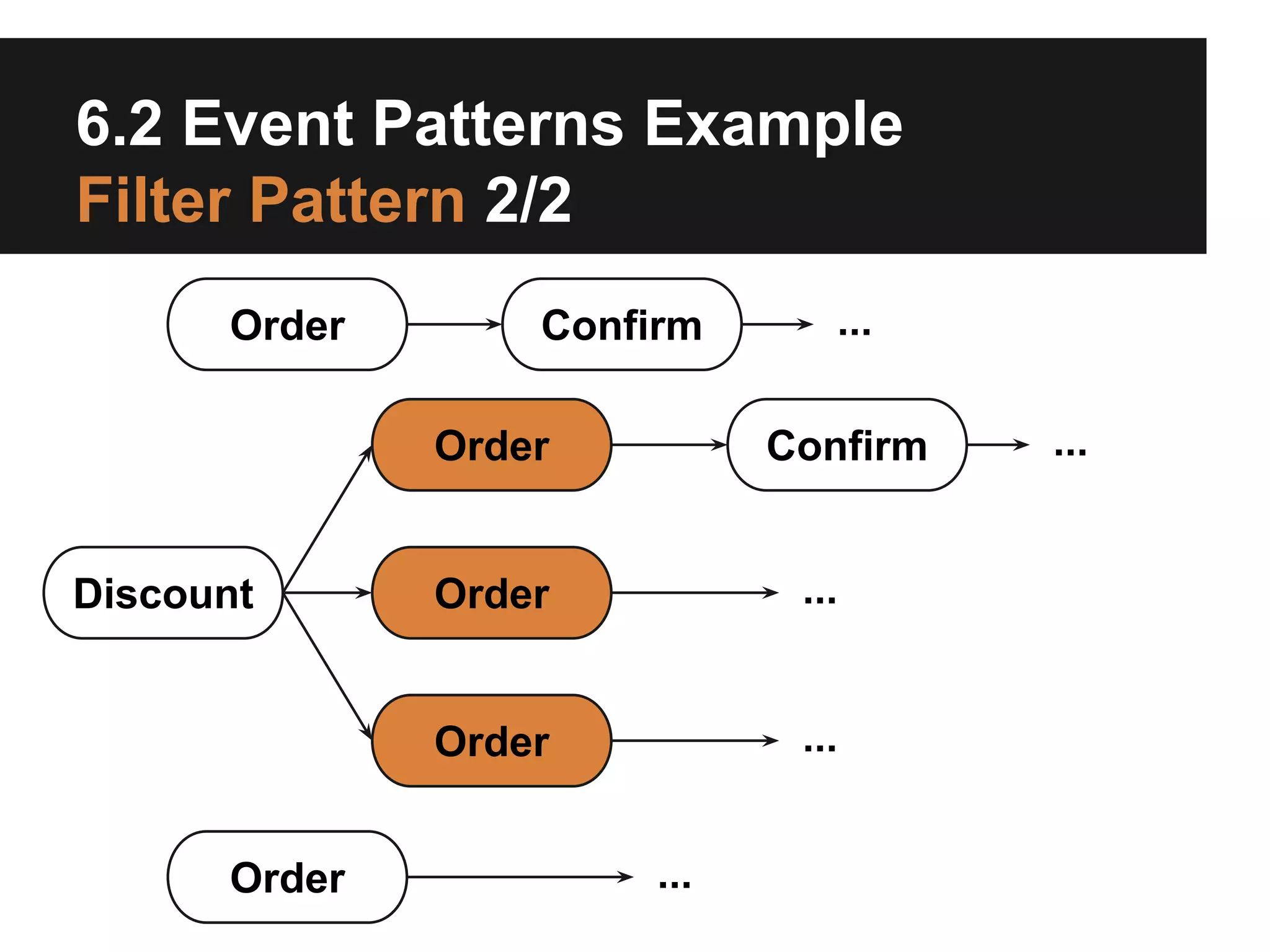
● We interpret “in response to” as a causal relationship.
● The pattern picks out from the set of all order events
those orders that are caused by the announcement.
● It acts as a filter using the causal relationship between
an order event and the announcement event to reduce
the space of events to a small part of the incoming
events.
6.2 Event Patterns Example
Filter Pattern 2/2
Order

Confirm
Order

...
Confirm

Order

Order

...

Order

Discount

...
...

...
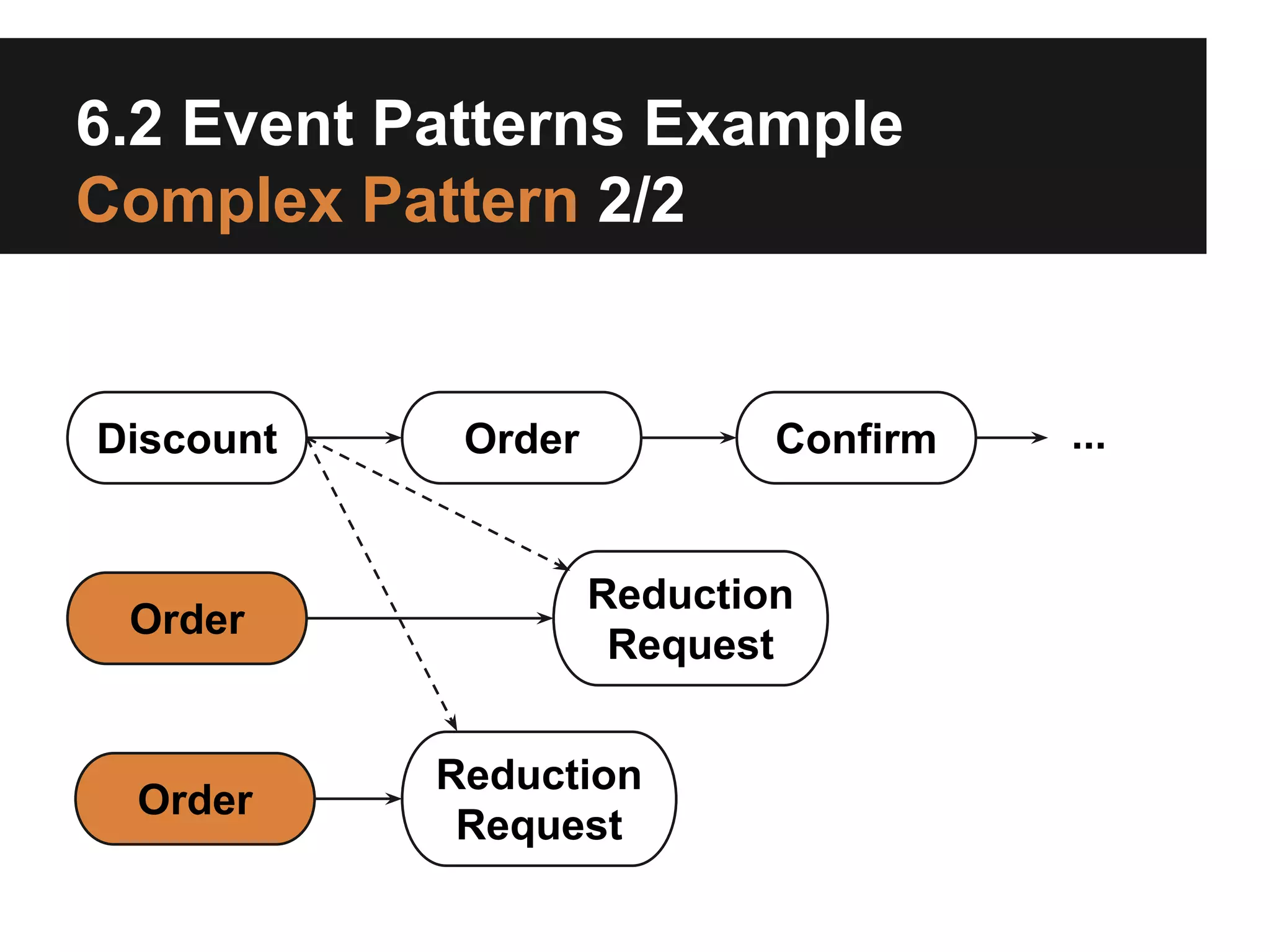
6.2 Event Patterns Example
Complex Pattern 1/2
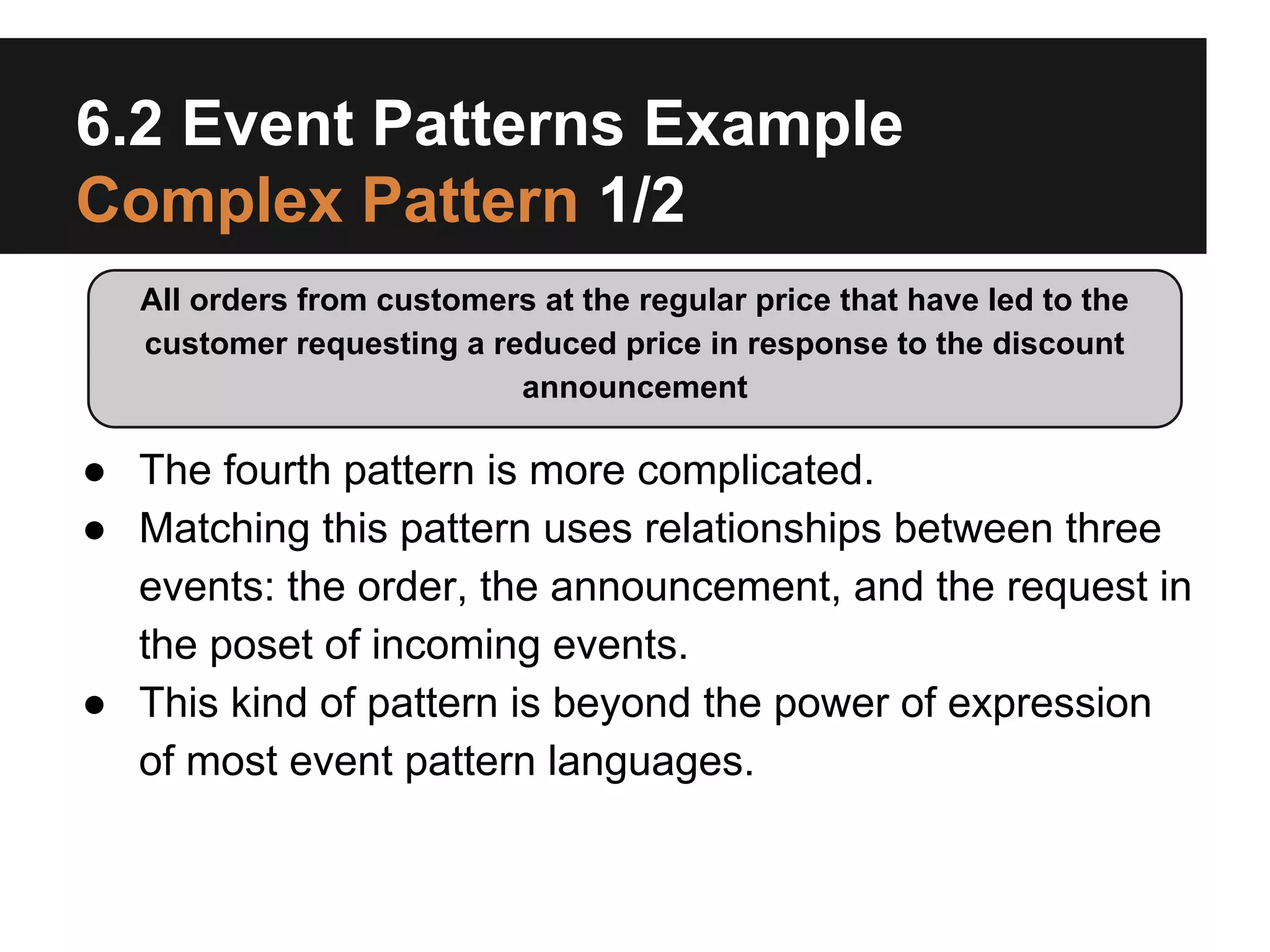
All orders from customers at the regular price that have led to the
customer requesting a reduced price in response to the discount
announcement

● The fourth pattern is more complicated.
● Matching this pattern uses relationships between three
events: the order, the announcement, and the request in
the poset of incoming events.
● This kind of pattern is beyond the power of expression
of most event pattern languages.
6.2 Event Patterns Example
Complex Pattern 2/2

Discount

Order

Order

Order

Confirm

Reduction
Request
Reduction
Request

...
6.3 A Strawman Pattern Language
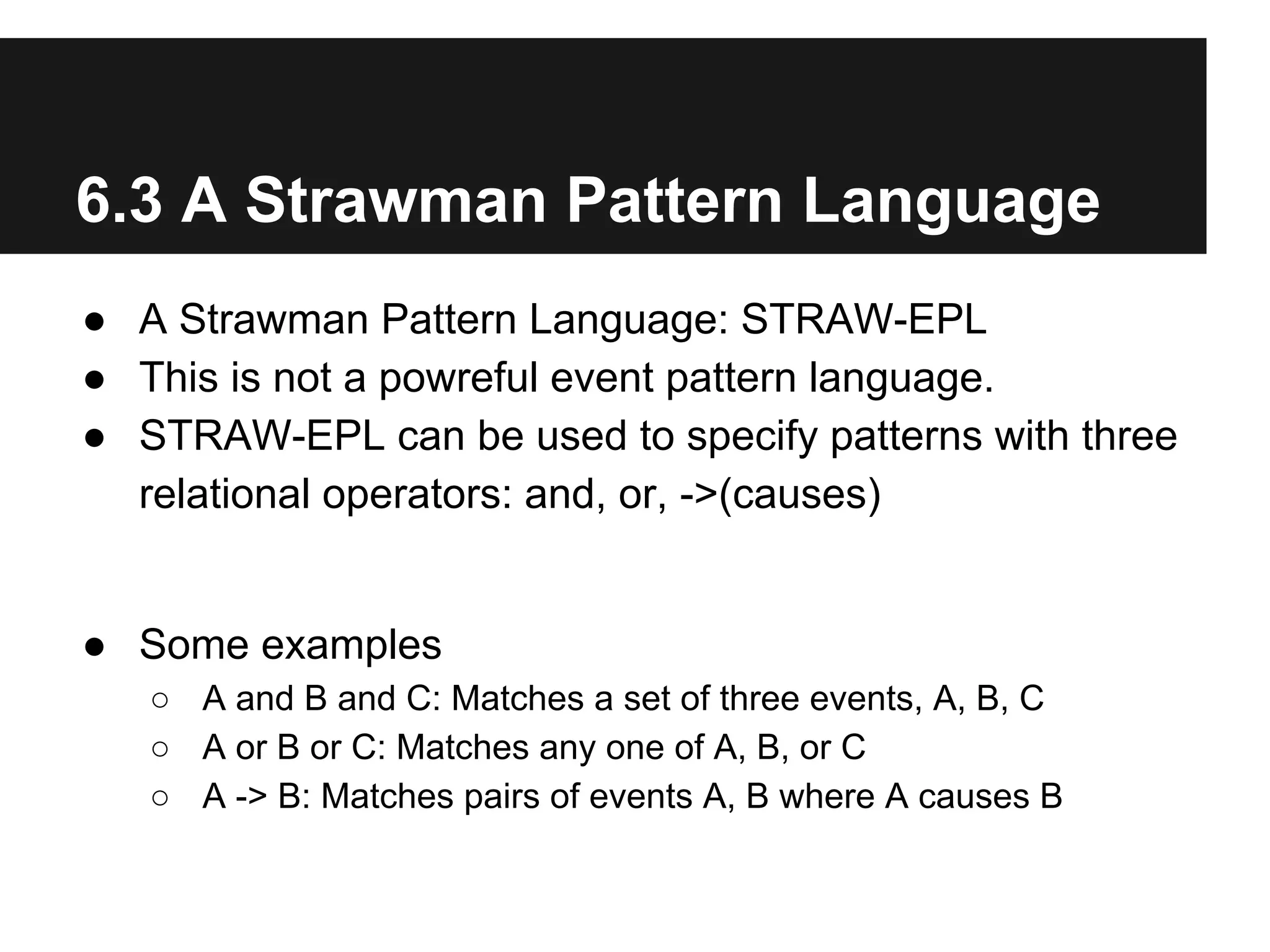
● A Strawman Pattern Language: STRAW-EPL
● This is not a powreful event pattern language.
● STRAW-EPL can be used to specify patterns with three
relational operators: and, or, ->(causes)

● Some examples
○ A and B and C: Matches a set of three events, A, B, C
○ A or B or C: Matches any one of A, B, or C
○ A -> B: Matches pairs of events A, B where A causes B
6.3 A Strawman Pattern Language
Four Elements of STRAW-EPL 1/2
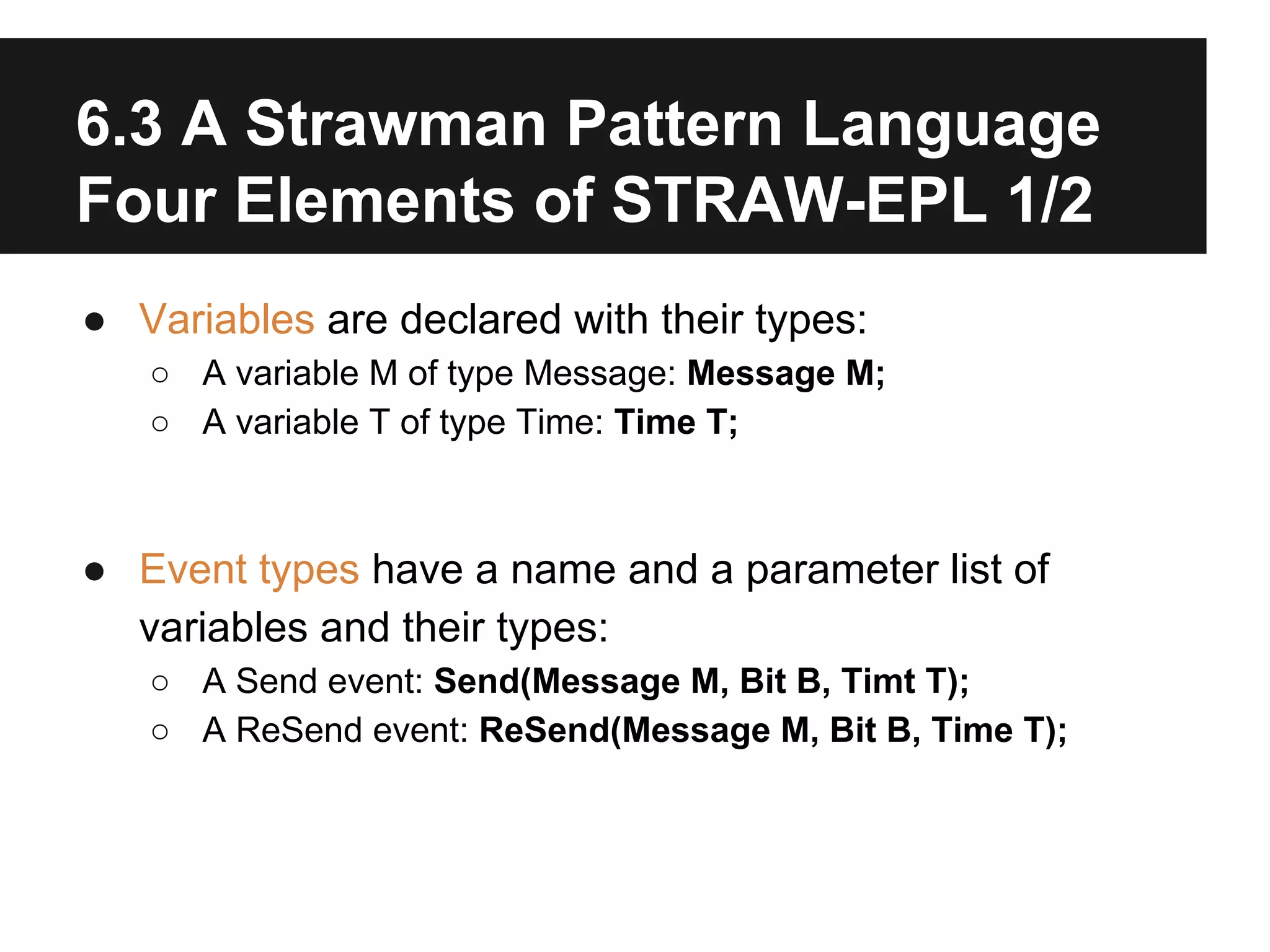
● Variables are declared with their types:
○ A variable M of type Message: Message M;
○ A variable T of type Time: Time T;

● Event types have a name and a parameter list of
variables and their types:
○ A Send event: Send(Message M, Bit B, Timt T);
○ A ReSend event: ReSend(Message M, Bit B, Time T);
6.3 A Strawman Pattern Language
Four Elements of STRAW-EPL 2/2
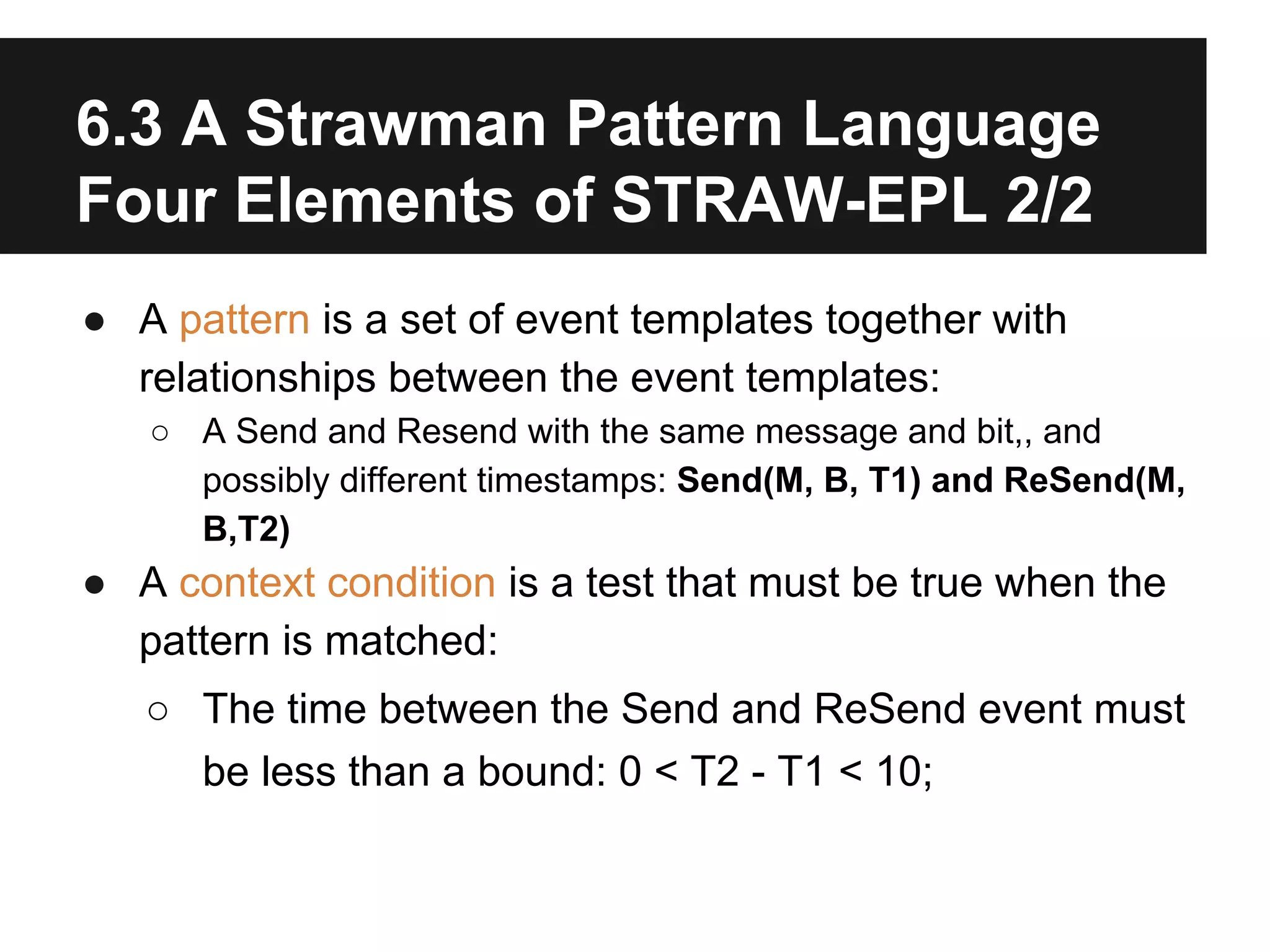
● A pattern is a set of event templates together with
relationships between the event templates:
○ A Send and Resend with the same message and bit,, and
possibly different timestamps: Send(M, B, T1) and ReSend(M,
B,T2)

● A context condition is a test that must be true when the
pattern is matched:
○ The time between the Send and ReSend event must
be less than a bound: 0 < T2 - T1 < 10;
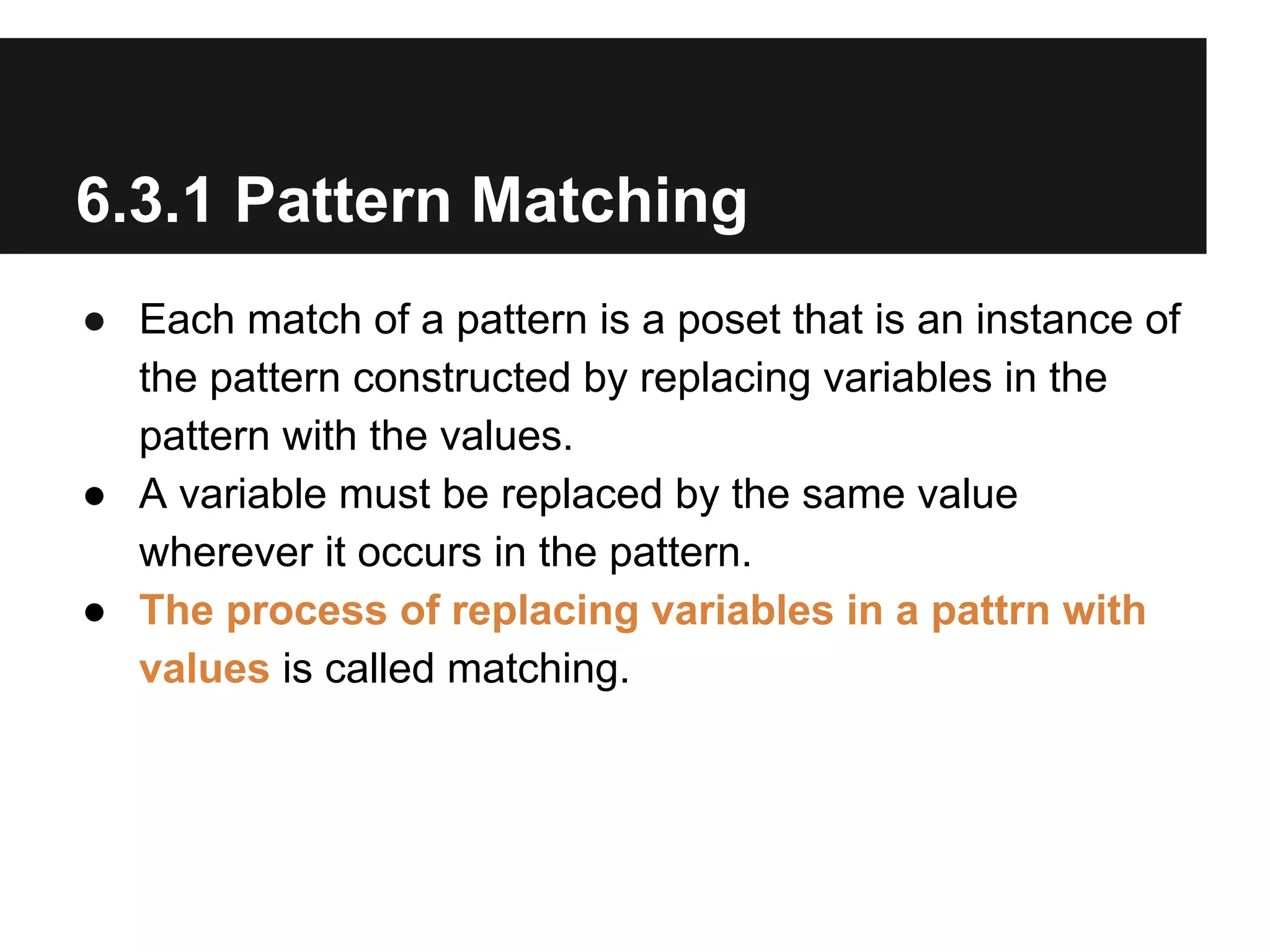
6.3.1 Pattern Matching
● Each match of a pattern is a poset that is an instance of
the pattern constructed by replacing variables in the
pattern with the values.
● A variable must be replaced by the same value
wherever it occurs in the pattern.
● The process of replacing variables in a pattrn with
values is called matching.
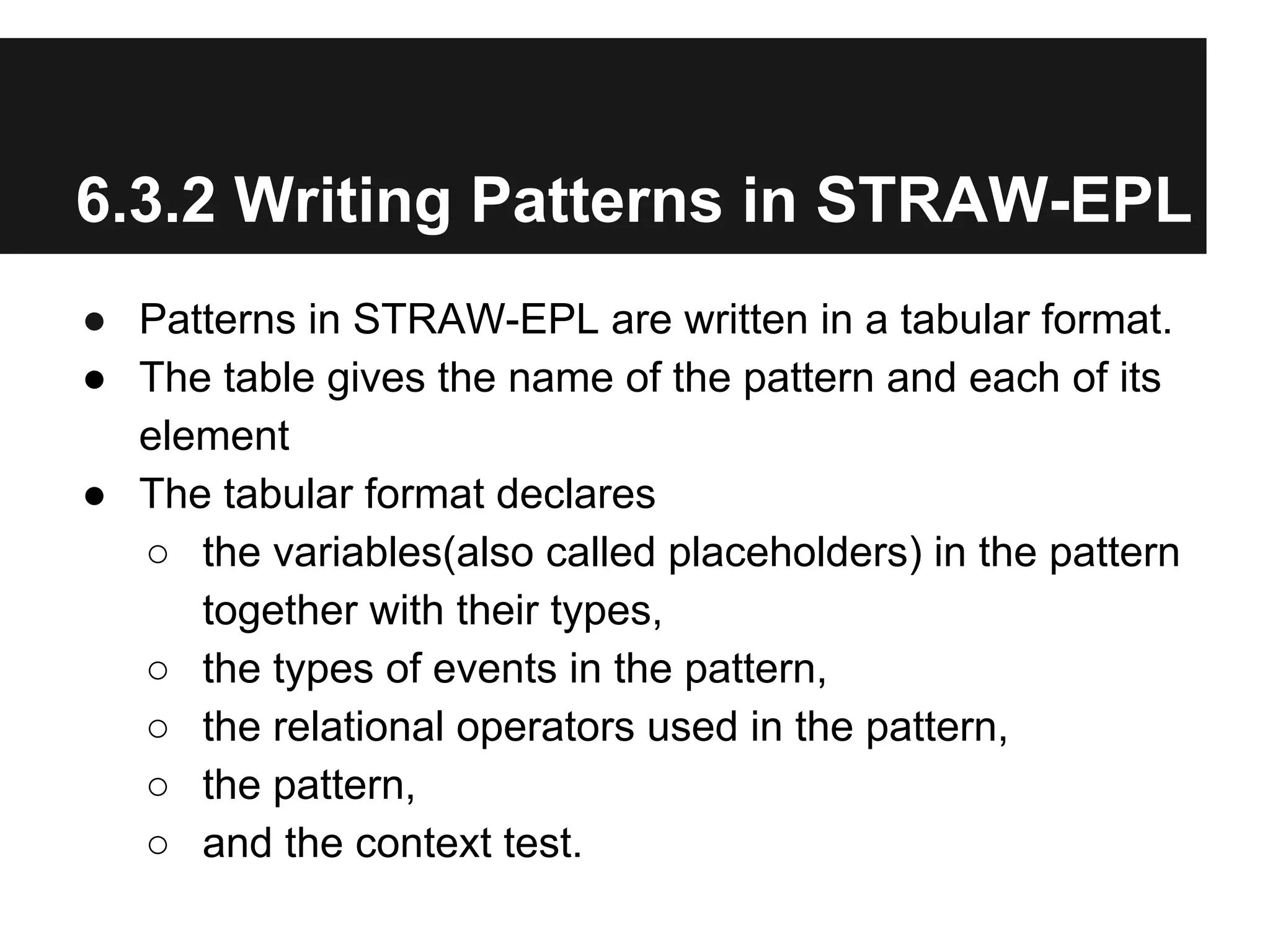
6.3.2 Writing Patterns in STRAW-EPL
● Patterns in STRAW-EPL are written in a tabular format.
● The table gives the name of the pattern and each of its
element
● The tabular format declares
○ the variables(also called placeholders) in the pattern
together with their types,
○ the types of events in the pattern,
○ the relational operators used in the pattern,
○ the pattern,
○ and the context test.
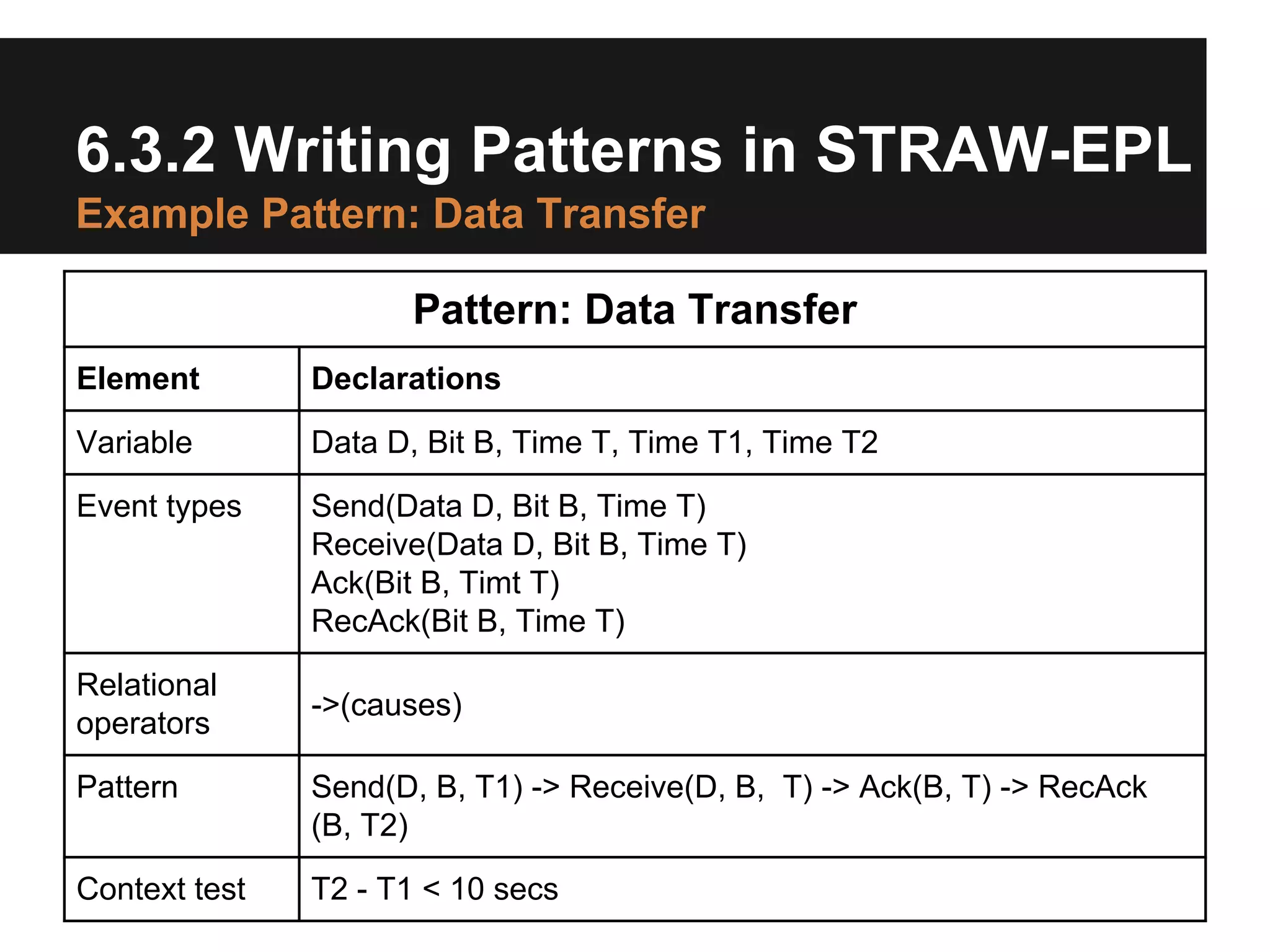
6.3.2 Writing Patterns in STRAW-EPL
Example Pattern: Data Transfer
Pattern: Data Transfer
Element

Declarations

Variable

Data D, Bit B, Time T, Time T1, Time T2

Event types

Send(Data D, Bit B, Time T)
Receive(Data D, Bit B, Time T)
Ack(Bit B, Timt T)
RecAck(Bit B, Time T)

Relational
operators

->(causes)

Pattern

Send(D, B, T1) -> Receive(D, B, T) -> Ack(B, T) -> RecAck
(B, T2)

Context test

T2 - T1 < 10 secs
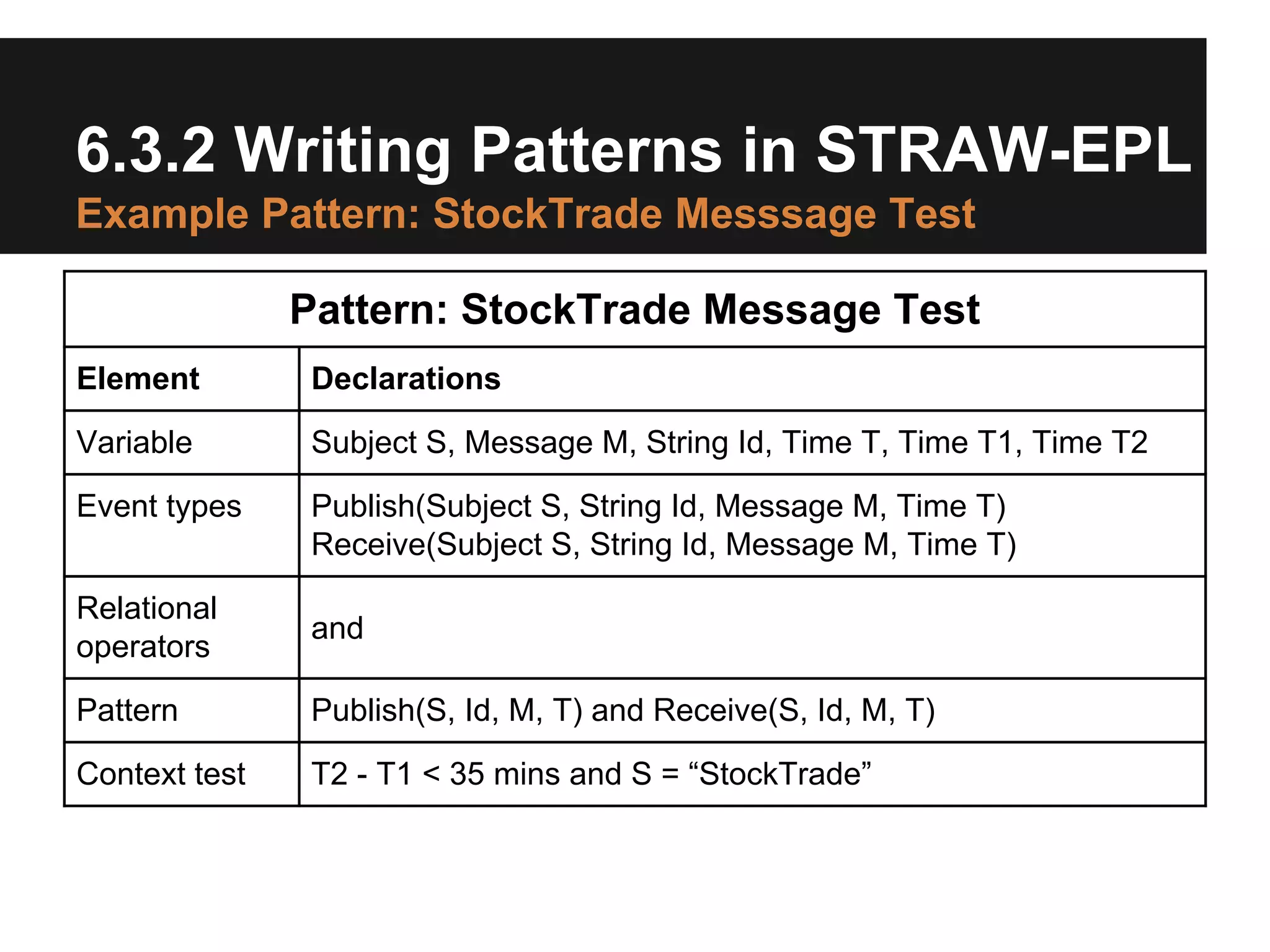
6.3.2 Writing Patterns in STRAW-EPL
Example Pattern: StockTrade Messsage Test
Pattern: StockTrade Message Test
Element

Declarations

Variable

Subject S, Message M, String Id, Time T, Time T1, Time T2

Event types

Publish(Subject S, String Id, Message M, Time T)
Receive(Subject S, String Id, Message M, Time T)

Relational
operators

and

Pattern

Publish(S, Id, M, T) and Receive(S, Id, M, T)

Context test

T2 - T1 < 35 mins and S = “StockTrade”
6.4 Event Pattern Rules 1/3
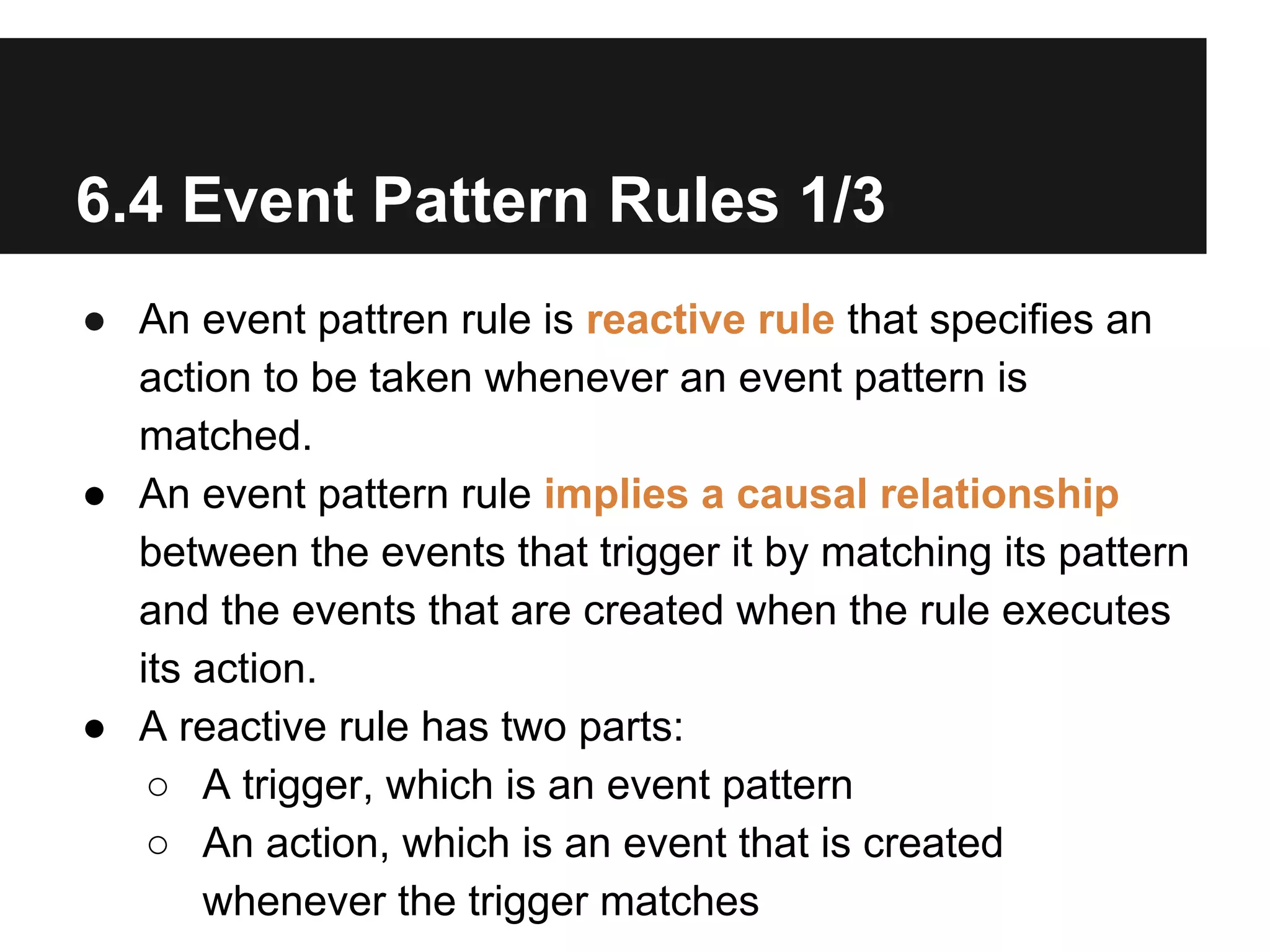
● An event pattren rule is reactive rule that specifies an
action to be taken whenever an event pattern is
matched.
● An event pattern rule implies a causal relationship
between the events that trigger it by matching its pattern
and the events that are created when the rule executes
its action.
● A reactive rule has two parts:
○ A trigger, which is an event pattern
○ An action, which is an event that is created
whenever the trigger matches
6.4 Event Pattern Rules 2/3
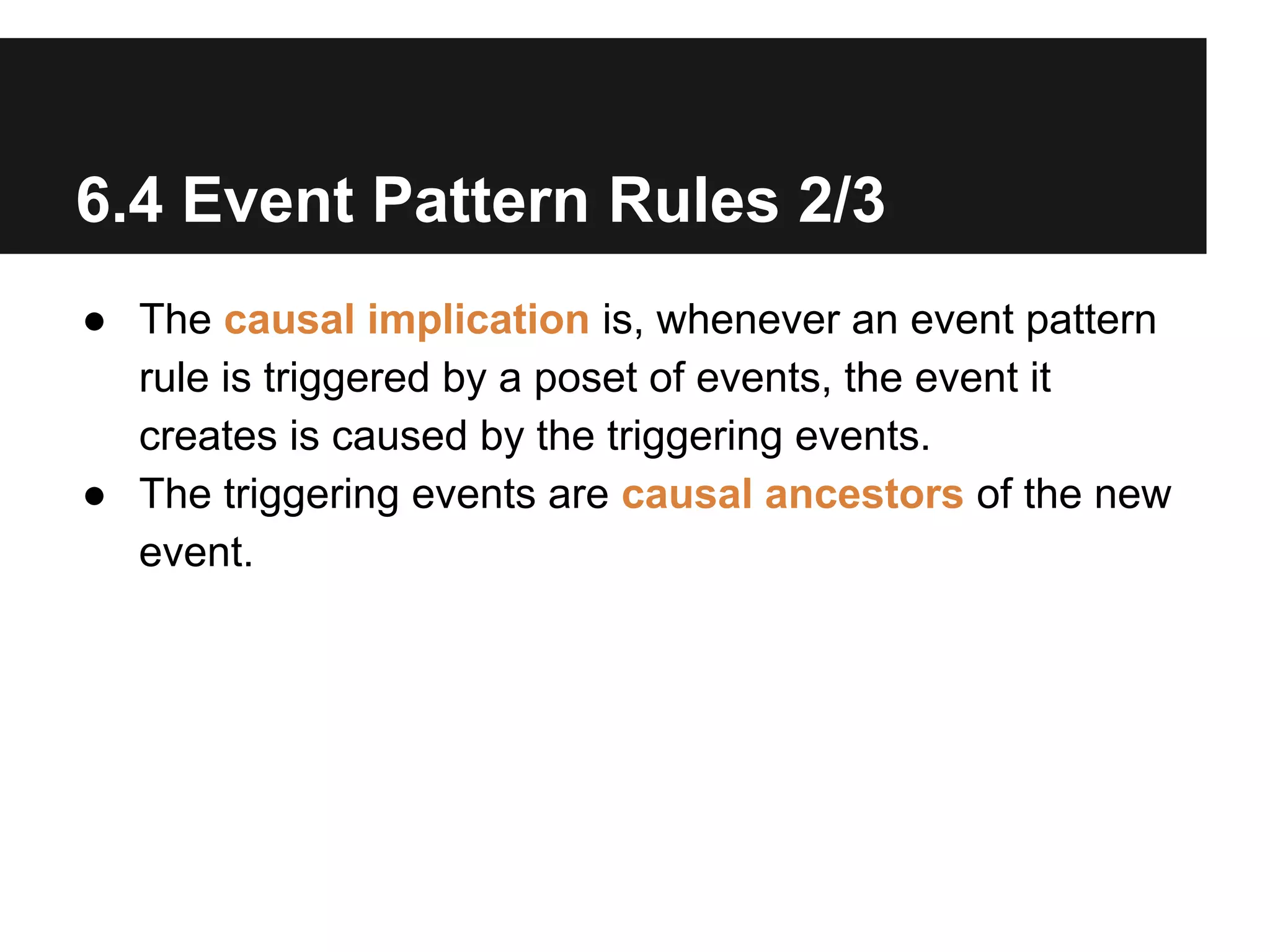
● The causal implication is, whenever an event pattern
rule is triggered by a poset of events, the event it
creates is caused by the triggering events.
● The triggering events are causal ancestors of the new
event.
6.4 Event Pattern Rules 3/3
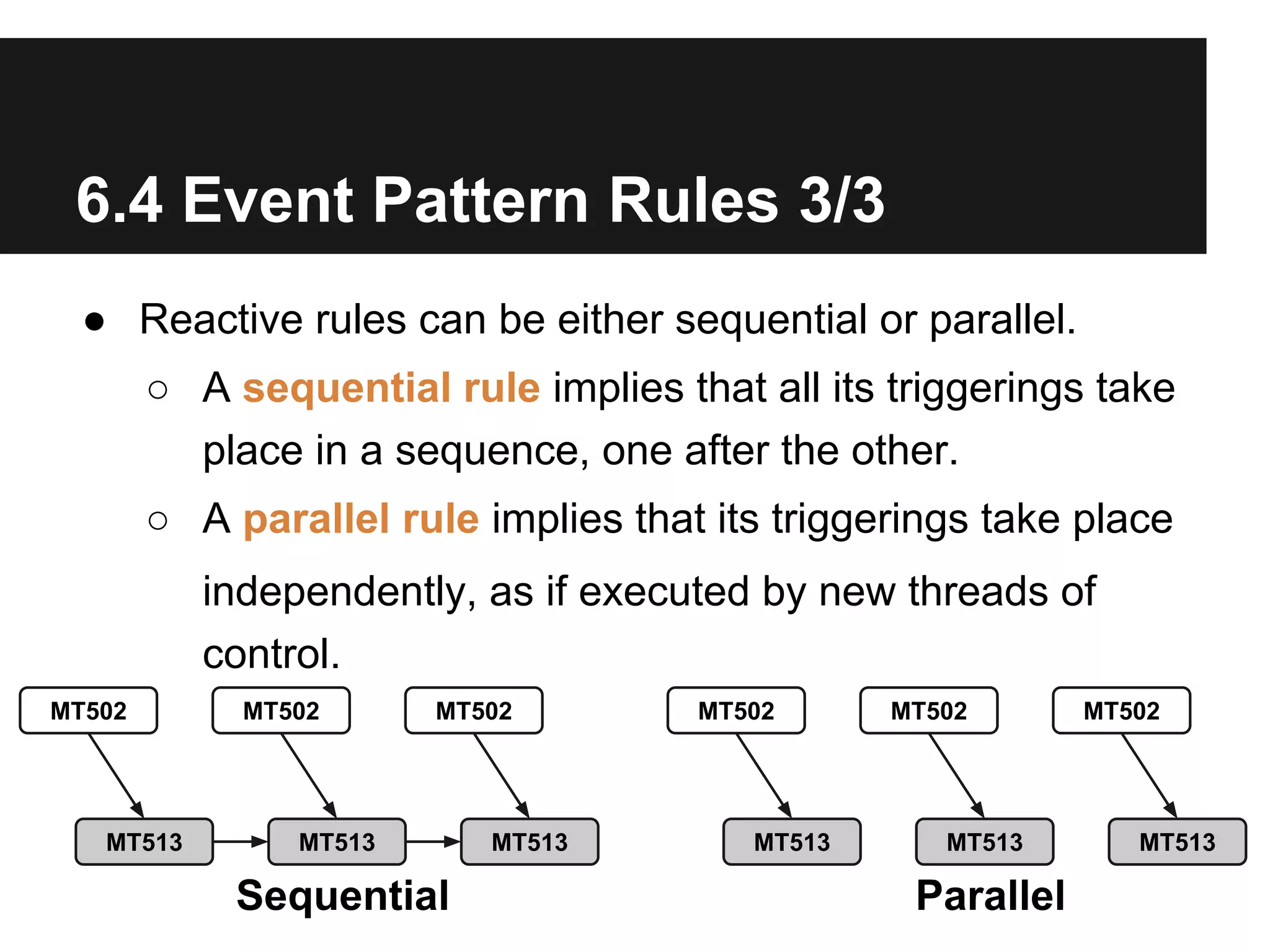
● Reactive rules can be either sequential or parallel.
○ A sequential rule implies that all its triggerings take
place in a sequence, one after the other.
○ A parallel rule implies that its triggerings take place
independently, as if executed by new threads of
control.
MT502

MT513

MT502

MT502

MT513

Sequential

MT513

MT502

MT513

MT502

MT513

Parallel

MT502

MT513
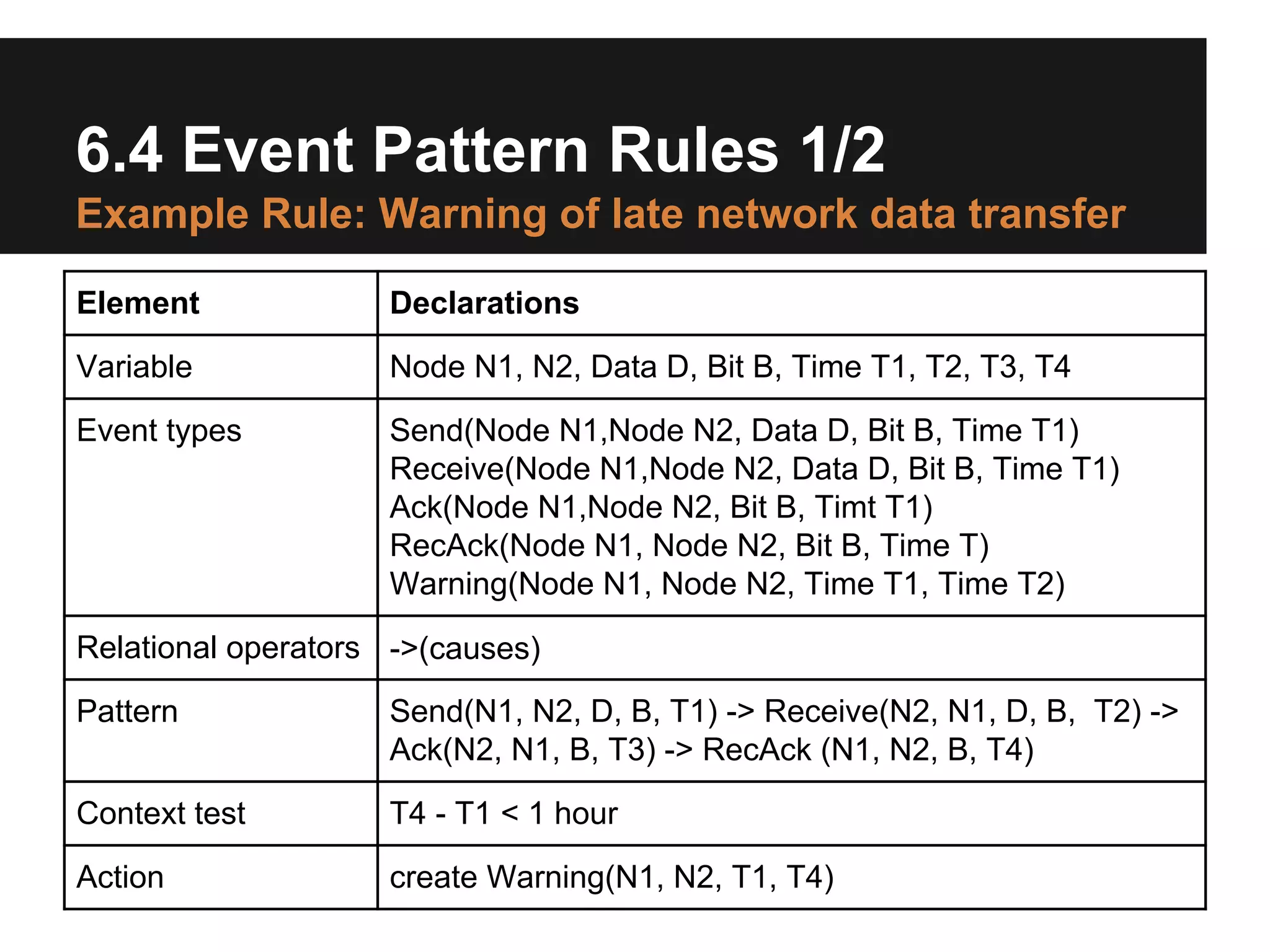
6.4 Event Pattern Rules 1/2
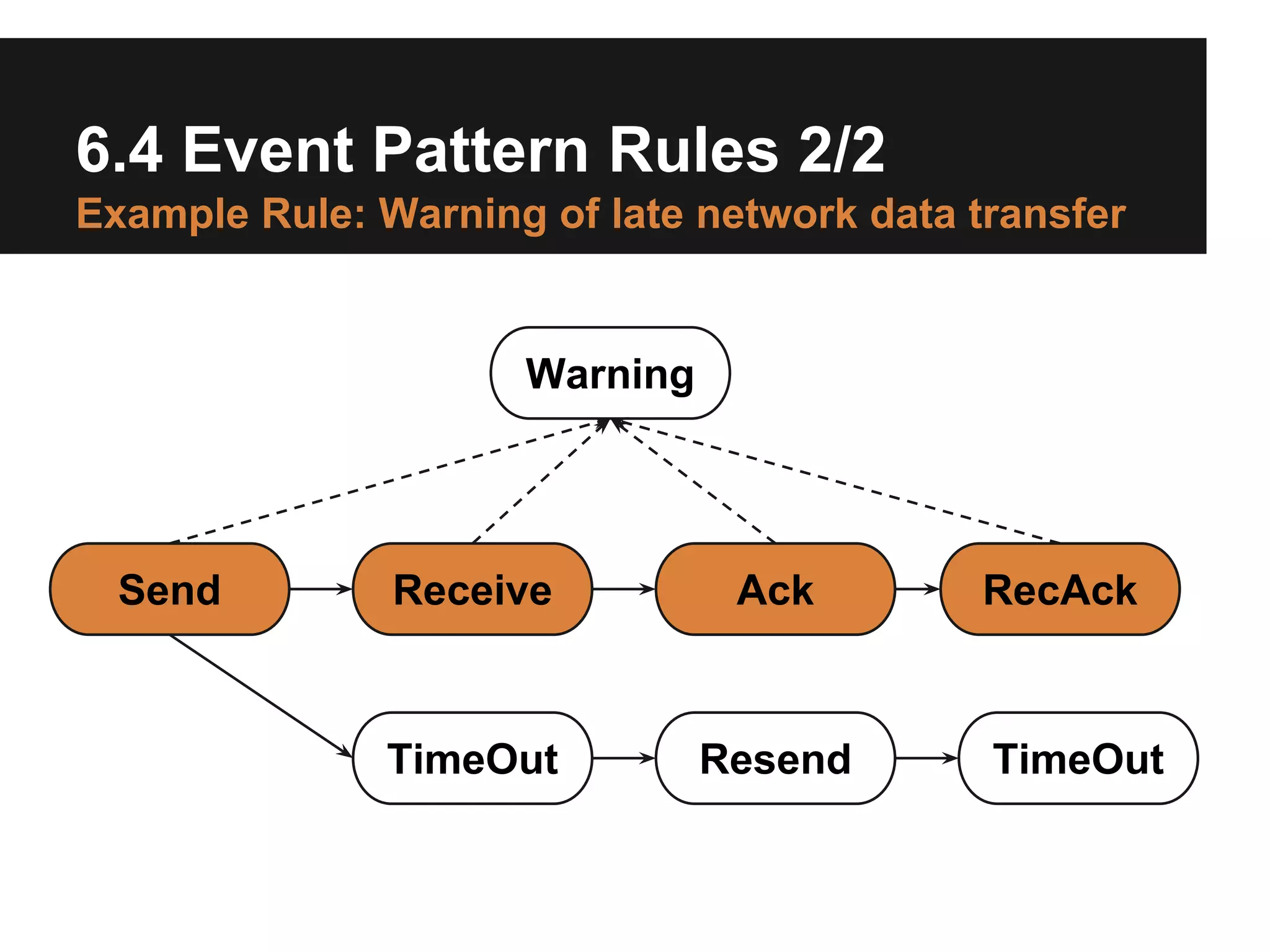
Example Rule: Warning of late network data transfer
Element

Declarations

Variable

Node N1, N2, Data D, Bit B, Time T1, T2, T3, T4

Event types

Send(Node N1,Node N2, Data D, Bit B, Time T1)
Receive(Node N1,Node N2, Data D, Bit B, Time T1)
Ack(Node N1,Node N2, Bit B, Timt T1)
RecAck(Node N1, Node N2, Bit B, Time T)
Warning(Node N1, Node N2, Time T1, Time T2)

Relational operators ->(causes)
Pattern

Send(N1, N2, D, B, T1) -> Receive(N2, N1, D, B, T2) ->
Ack(N2, N1, B, T3) -> RecAck (N1, N2, B, T4)

Context test

T4 - T1 < 1 hour

Action

create Warning(N1, N2, T1, T4)
6.4 Event Pattern Rules 2/2
Example Rule: Warning of late network data transfer

Warning

Send

Receive

Ack

TimeOut

Resend

RecAck

TimeOut
6.5 Constraints 1/3
● A constraints expresses a condition that must be
satisfied by the events observed in a system.
● Constraints can be used to specify not only how a target
system should behave, but also how its user should use
it.
● Our strawman constraints express a very simple of
condition called never constraints.
● A never constraint consists of the following:
○ The temporal operator never
○ A STRAW-EPL pattern
6.5 Constraints 2/3
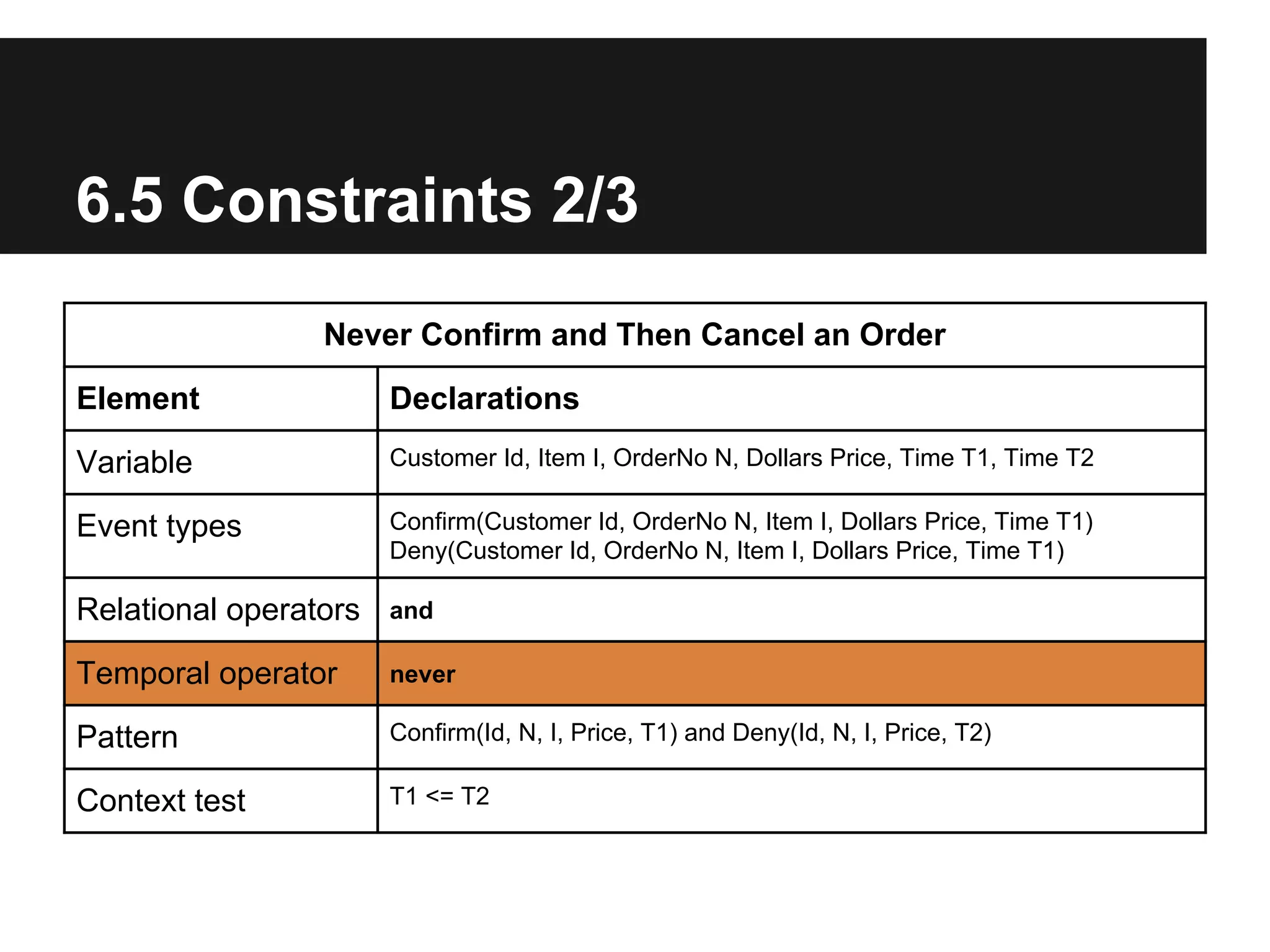
Never Confirm and Then Cancel an Order
Element

Declarations

Variable

Customer Id, Item I, OrderNo N, Dollars Price, Time T1, Time T2

Event types

Confirm(Customer Id, OrderNo N, Item I, Dollars Price, Time T1)
Deny(Customer Id, OrderNo N, Item I, Dollars Price, Time T1)

Relational operators

and

Temporal operator

never

Pattern

Confirm(Id, N, I, Price, T1) and Deny(Id, N, I, Price, T2)

Context test

T1 <= T2
6.5 Constraints 3/3
● The purpose of a rule is to create new events in
response to situations.
● The purpose of a constraints is different, simply to
monitor for a situation.
● Typically, a constraint is used to express a requirement
on system behavior that is not guaranteed by the
system.

The Power Of Event Chapter 6

  • 1.
    Chapter 6 Event Patterns,Rules, and Constraints jwj0831@gmail.com
  • 2.
    Topics covered inthis Chapter ● ● ● ● ● ● Familiar kinds of pattern searching Event patterns A strawman event pattern language Event pattern rules Event pattern constraints Capturing business rules as event patterns
  • 3.
    6.1 Common Kindsof Pattern Searching 1/4 ● We need to be able to describe a pattern of events that we are interested in and quickly find the sets of events that match the pattern. ● To do this, we first need a precise method to describe event patterns. ● One way is to write the pattern in a computer language called an event pattern language(EPL).
  • 4.
    6.1 Common Kindsof Pattern Searching 2/4 ● Another way, which many of us are familiar with, is to use a graphical user interface(GUI) such as those provided in popular Web search engines. ○ Unfortunately, search GUIs usually allow only very simple patterns to be described
  • 5.
    6.1 Common Kindsof Pattern Searching 3/4 ● Pattern matching applied to other kinds of object than events, such as strings and files, has been around a lot longer than the Internet.
  • 6.
    6.1 Common Kindsof Pattern Searching 4/4 ● In CEP we need to specify sets of events that have certain common data in some of the events and also have specific timing, causal, and aggregation relationships between events. ● The need to specify sets of events that have parts in common and specific relativities is a step beyond string searching. ● A pattern language in which we can express such pattherns will necessarily be more complex than string searching language.
  • 7.
    6.2 Event Patterns ●An event pattern is a template that matches certain sets of events - the sets you want to find. ● It describes precisely not only the events but also their causal dependencies, timing, data parameters, and context. ● So an event pattern is a template for posets.
  • 8.
    6.2 Event PatternsExample Content-Sensitive Pattern All orders from customer C in the last month ● To see if an order matches this pattern, we must look at the data in the order to see if the customer is C and the time bound is met.
  • 9.
    6.2 Event PatternsExample Context-Sensitive Pattern All orders from frequent customers in the last month ● The second pattern is similar to the first one, except that instead of searching the data in an order to see if the customer is C, we must evaluate the context of the customer. ● for example, by searching a database to see if the customer is part of the state in which the matching take place.
  • 10.
    6.2 Event PatternsExample Filter Pattern 1/2 All orders from customers in response to a discount announcement ● We interpret “in response to” as a causal relationship. ● The pattern picks out from the set of all order events those orders that are caused by the announcement. ● It acts as a filter using the causal relationship between an order event and the announcement event to reduce the space of events to a small part of the incoming events.
  • 11.
    6.2 Event PatternsExample Filter Pattern 2/2 Order Confirm Order ... Confirm Order Order ... Order Discount ... ... ...
  • 12.
    6.2 Event PatternsExample Complex Pattern 1/2 All orders from customers at the regular price that have led to the customer requesting a reduced price in response to the discount announcement ● The fourth pattern is more complicated. ● Matching this pattern uses relationships between three events: the order, the announcement, and the request in the poset of incoming events. ● This kind of pattern is beyond the power of expression of most event pattern languages.
  • 13.
    6.2 Event PatternsExample Complex Pattern 2/2 Discount Order Order Order Confirm Reduction Request Reduction Request ...
  • 14.
    6.3 A StrawmanPattern Language ● A Strawman Pattern Language: STRAW-EPL ● This is not a powreful event pattern language. ● STRAW-EPL can be used to specify patterns with three relational operators: and, or, ->(causes) ● Some examples ○ A and B and C: Matches a set of three events, A, B, C ○ A or B or C: Matches any one of A, B, or C ○ A -> B: Matches pairs of events A, B where A causes B
  • 15.
    6.3 A StrawmanPattern Language Four Elements of STRAW-EPL 1/2 ● Variables are declared with their types: ○ A variable M of type Message: Message M; ○ A variable T of type Time: Time T; ● Event types have a name and a parameter list of variables and their types: ○ A Send event: Send(Message M, Bit B, Timt T); ○ A ReSend event: ReSend(Message M, Bit B, Time T);
  • 16.
    6.3 A StrawmanPattern Language Four Elements of STRAW-EPL 2/2 ● A pattern is a set of event templates together with relationships between the event templates: ○ A Send and Resend with the same message and bit,, and possibly different timestamps: Send(M, B, T1) and ReSend(M, B,T2) ● A context condition is a test that must be true when the pattern is matched: ○ The time between the Send and ReSend event must be less than a bound: 0 < T2 - T1 < 10;
  • 17.
    6.3.1 Pattern Matching ●Each match of a pattern is a poset that is an instance of the pattern constructed by replacing variables in the pattern with the values. ● A variable must be replaced by the same value wherever it occurs in the pattern. ● The process of replacing variables in a pattrn with values is called matching.
  • 18.
    6.3.2 Writing Patternsin STRAW-EPL ● Patterns in STRAW-EPL are written in a tabular format. ● The table gives the name of the pattern and each of its element ● The tabular format declares ○ the variables(also called placeholders) in the pattern together with their types, ○ the types of events in the pattern, ○ the relational operators used in the pattern, ○ the pattern, ○ and the context test.
  • 19.
    6.3.2 Writing Patternsin STRAW-EPL Example Pattern: Data Transfer Pattern: Data Transfer Element Declarations Variable Data D, Bit B, Time T, Time T1, Time T2 Event types Send(Data D, Bit B, Time T) Receive(Data D, Bit B, Time T) Ack(Bit B, Timt T) RecAck(Bit B, Time T) Relational operators ->(causes) Pattern Send(D, B, T1) -> Receive(D, B, T) -> Ack(B, T) -> RecAck (B, T2) Context test T2 - T1 < 10 secs
  • 20.
    6.3.2 Writing Patternsin STRAW-EPL Example Pattern: StockTrade Messsage Test Pattern: StockTrade Message Test Element Declarations Variable Subject S, Message M, String Id, Time T, Time T1, Time T2 Event types Publish(Subject S, String Id, Message M, Time T) Receive(Subject S, String Id, Message M, Time T) Relational operators and Pattern Publish(S, Id, M, T) and Receive(S, Id, M, T) Context test T2 - T1 < 35 mins and S = “StockTrade”
  • 21.
    6.4 Event PatternRules 1/3 ● An event pattren rule is reactive rule that specifies an action to be taken whenever an event pattern is matched. ● An event pattern rule implies a causal relationship between the events that trigger it by matching its pattern and the events that are created when the rule executes its action. ● A reactive rule has two parts: ○ A trigger, which is an event pattern ○ An action, which is an event that is created whenever the trigger matches
  • 22.
    6.4 Event PatternRules 2/3 ● The causal implication is, whenever an event pattern rule is triggered by a poset of events, the event it creates is caused by the triggering events. ● The triggering events are causal ancestors of the new event.
  • 23.
    6.4 Event PatternRules 3/3 ● Reactive rules can be either sequential or parallel. ○ A sequential rule implies that all its triggerings take place in a sequence, one after the other. ○ A parallel rule implies that its triggerings take place independently, as if executed by new threads of control. MT502 MT513 MT502 MT502 MT513 Sequential MT513 MT502 MT513 MT502 MT513 Parallel MT502 MT513
  • 24.
    6.4 Event PatternRules 1/2 Example Rule: Warning of late network data transfer Element Declarations Variable Node N1, N2, Data D, Bit B, Time T1, T2, T3, T4 Event types Send(Node N1,Node N2, Data D, Bit B, Time T1) Receive(Node N1,Node N2, Data D, Bit B, Time T1) Ack(Node N1,Node N2, Bit B, Timt T1) RecAck(Node N1, Node N2, Bit B, Time T) Warning(Node N1, Node N2, Time T1, Time T2) Relational operators ->(causes) Pattern Send(N1, N2, D, B, T1) -> Receive(N2, N1, D, B, T2) -> Ack(N2, N1, B, T3) -> RecAck (N1, N2, B, T4) Context test T4 - T1 < 1 hour Action create Warning(N1, N2, T1, T4)
  • 25.
    6.4 Event PatternRules 2/2 Example Rule: Warning of late network data transfer Warning Send Receive Ack TimeOut Resend RecAck TimeOut
  • 26.
    6.5 Constraints 1/3 ●A constraints expresses a condition that must be satisfied by the events observed in a system. ● Constraints can be used to specify not only how a target system should behave, but also how its user should use it. ● Our strawman constraints express a very simple of condition called never constraints. ● A never constraint consists of the following: ○ The temporal operator never ○ A STRAW-EPL pattern
  • 27.
    6.5 Constraints 2/3 NeverConfirm and Then Cancel an Order Element Declarations Variable Customer Id, Item I, OrderNo N, Dollars Price, Time T1, Time T2 Event types Confirm(Customer Id, OrderNo N, Item I, Dollars Price, Time T1) Deny(Customer Id, OrderNo N, Item I, Dollars Price, Time T1) Relational operators and Temporal operator never Pattern Confirm(Id, N, I, Price, T1) and Deny(Id, N, I, Price, T2) Context test T1 <= T2
  • 28.
    6.5 Constraints 3/3 ●The purpose of a rule is to create new events in response to situations. ● The purpose of a constraints is different, simply to monitor for a situation. ● Typically, a constraint is used to express a requirement on system behavior that is not guaranteed by the system.