By
The Performance
Management Process
Chapter # 02
Introduction
 Fletcher and Williams (1992) indicated the
majority of organizations that they looked at
were a long way from operating a
sophisticated PMS
 PMS was synonymous with performance
appraisal, or with performance-related pay (PRP)
or both.
Introduction
Fletcher and Williams’s research suggested four
underlying principles of effective performance
management, namely that:
i. it is owned and driven by line management and
not by the HR department;
ii. There is an emphasis on shared corporate goals
and values;
iii. Performance management is not a packaged
solution but something that has to be developed
specifically and individually for each particular
organization;
iv. It should apply to all staff, not just part of the
PERFORMANCE MANAGEMENT
AS A PROCESS
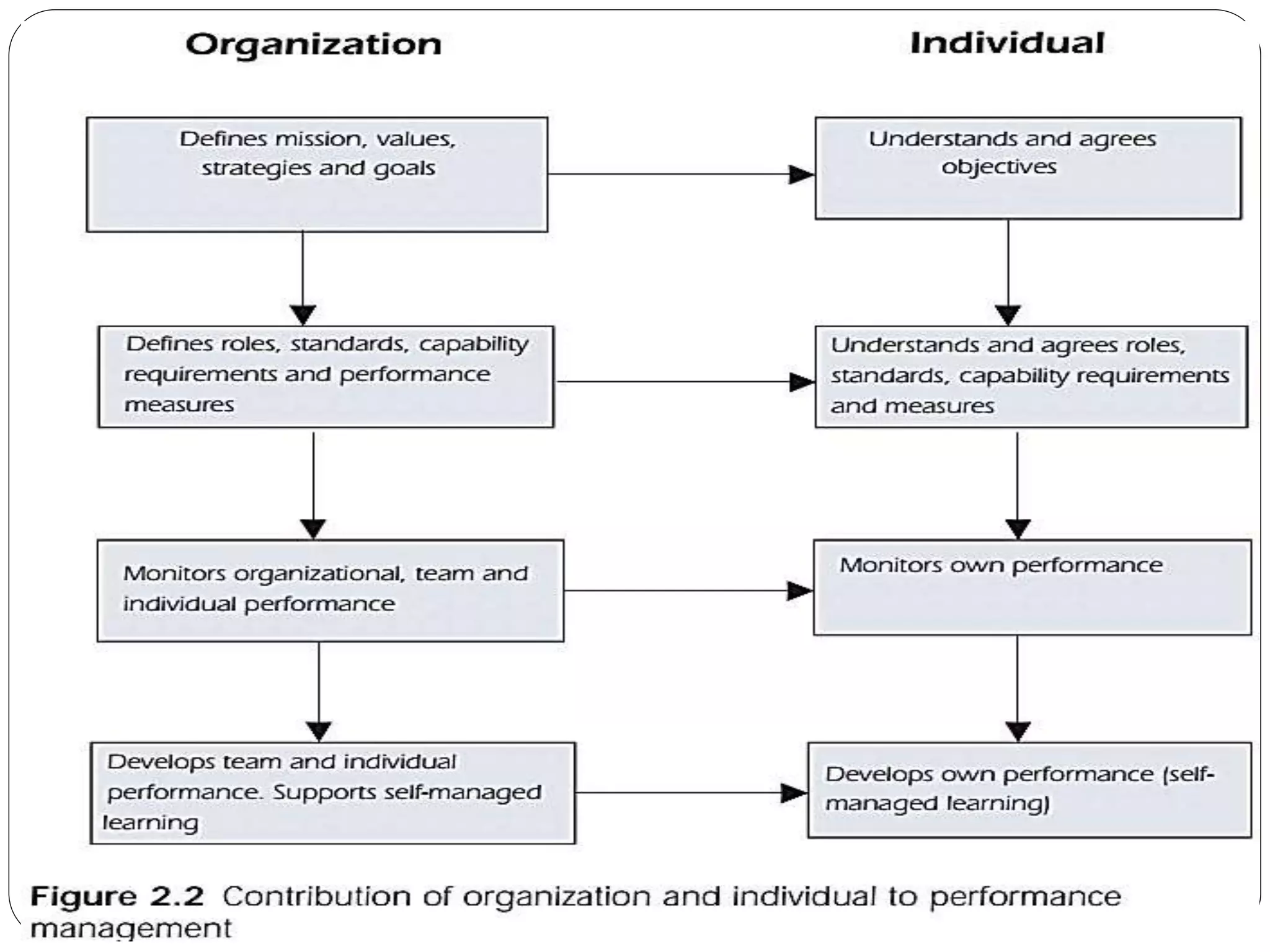
 the main criticism that has rightly been made about
the application of performance management is that
it has been introduced as a top-down, imposed
and rigid system that seeks easy solutions to
complex problems, which it will inevitably fail to
deliver.
 It is much better to concern performance
management as a flexible process, not as a
system.
 The use of the term system implies a inflexible,
standardized and possibly bureaucratic approach
that is inconsistent with the concept of performance
management as a flexible and evolutionary process
applied by managers working with their staff in
Performance Management
Features
Overall, performance management needs to
encourage a balanced approach with the following
features, as described by Vicky Wright and Liz
Brading (1992):
i. Less focus on backward-looking
performance assessment and more
concentration on future performance
planning and improvement;
ii. Identification and recognition of the skills
and capabilities associated with higher
levels of performance;
iii. Identification and recognition of outputs
Performance Management
Features
iv. A freer, upwardly managed process;
v. A more coaching and counselling style of
appraisal, with less emphasis on criticism;
vi. More focus on an individual s contribution to the
success of the team as a whole, with some
objectives defined in these terms;
vii. Concern for improving an individual s performance
as much as assessing it;
viii. No forced distribution of performance ratings (and
so no win lose scenarios);
ix. Possibly no formal ratings given.
The Performance Management
Cycle
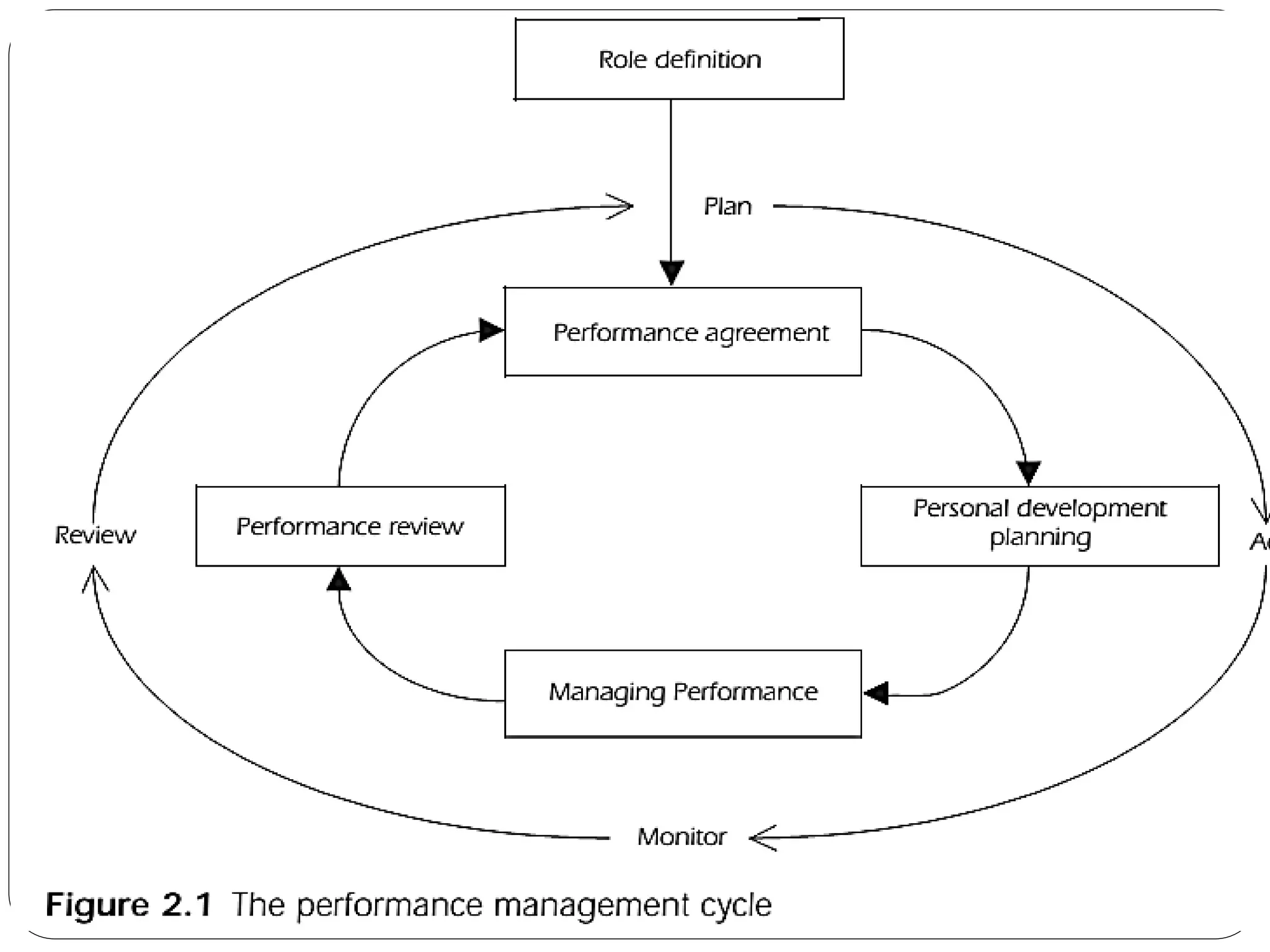
Performance management can be described as a
continuous self-renewing cycle, as illustrated in Figure
2.1.The main activities are:
i. Role definition in which the key result
areas and capability requirements are
agreed.
ii. The performance agreement (or contract)
which defines expectations:
i. what an individual has to achieve in the form of
objectives,
ii. how performance will be measured and the
capabilities needed to deliver the required
results.
iii. The personal development plan which
sets out the actions people intend to take
to develop themselves in order to extend
their knowledge and skills, increase their
levels of capability, and improve their
performance in specified areas. This is
the performance development stage.
The Performance Management
Cycle
iv. Managing performance throughout the
year which is the stage in which action is
taken to implement the performance
agreement and personal development
plan as individuals carry on with their
day-to-day work and their planned
learning activities.
 It includes a continuous process of
providing feedback on performance,
conducting informal progress reviews,
updating objectives and, where necessary,
The Performance Management
Cycle
v. Performance review which is the formal
evaluation stage when a review of
performance over a period takes place,
covering achievements, progress and
problems, as the basis for a revised
performance agreement and personal
development plan. It can also lead to
performance ratings.
The Performance Management
Cycle
1. ROLE DEFINITION
The role definition provides the framework for
performance management. It sets out three things.
i. The first is the purpose of the role, which
summarizes the overall aim namely what the role
holder is expected to do and provides a foundation
for the performance agreement.
ii. The second is the key result areas or principal
accountabilities, which define the main output areas
of the role and provide the headings against which
objectives and performance standards are agreed.
iii. The third aspect is key capabilities, which indicate
what the role holder has to be able to do and the
behaviour required to perform the role effectively
2. Performance Agreements
a. Performance agreements, also known as
performance contracts, define
expectations the results to be achieved
and the capabilities required to attain
these results. Agreements cover the
following points:
b. Objectives and standards of performance
the results to be achieved, defined in
terms of targets and standards;
c. Capability profile the capabilities required
to carry out the role effectively;
2. Performance Agreements
d. Performance measures and indicators to assess
the extent to which objectives and standards of
performance have been achieved;
e. Capability assessment how levels of capability will
be assessed, including discussions to clarify
expectations by reference to the capability profile in
the role definition and agreements on the sort of
evidence that will be useful in assessing capability.
f. Core values or operational requirements the
performance agreement may also refer to the core
values of the organization for quality, customer
service, team working, employee development, etc.
that individuals are expected to uphold in carrying
out their work.
3. Managing Performance
 Perhaps one of the most important
concepts of performance management is
that it is a continuous process that reflects
normal good management practices of
setting direction, monitoring and measuring
performance, and taking action
accordingly.
 Performance management should not be
imposed on managers as something
special they have to do; it should be
treated as a natural process that all good
4. Performance Reviews
 Performance review discussions enable a
perspective to be obtained on past performance
as a basis for making plans for the future.
 An overall view is taken of progress made.
Examples are used to illustrate that overview, and
the analysis of performance concentrates not only
on what has happened but also on why it has
happened, so that data are obtained for planning
purposes.
 Obtaining a historical perspective through analysis
is a necessary part of a performance review, but
reaching agreement about what should be done in
The Performance Management Process

The Performance Management Process

  • 1.
  • 2.
    Introduction  Fletcher andWilliams (1992) indicated the majority of organizations that they looked at were a long way from operating a sophisticated PMS  PMS was synonymous with performance appraisal, or with performance-related pay (PRP) or both.
  • 3.
    Introduction Fletcher and Williams’sresearch suggested four underlying principles of effective performance management, namely that: i. it is owned and driven by line management and not by the HR department; ii. There is an emphasis on shared corporate goals and values; iii. Performance management is not a packaged solution but something that has to be developed specifically and individually for each particular organization; iv. It should apply to all staff, not just part of the
  • 4.
    PERFORMANCE MANAGEMENT AS APROCESS  the main criticism that has rightly been made about the application of performance management is that it has been introduced as a top-down, imposed and rigid system that seeks easy solutions to complex problems, which it will inevitably fail to deliver.  It is much better to concern performance management as a flexible process, not as a system.  The use of the term system implies a inflexible, standardized and possibly bureaucratic approach that is inconsistent with the concept of performance management as a flexible and evolutionary process applied by managers working with their staff in
  • 5.
    Performance Management Features Overall, performancemanagement needs to encourage a balanced approach with the following features, as described by Vicky Wright and Liz Brading (1992): i. Less focus on backward-looking performance assessment and more concentration on future performance planning and improvement; ii. Identification and recognition of the skills and capabilities associated with higher levels of performance; iii. Identification and recognition of outputs
  • 6.
    Performance Management Features iv. Afreer, upwardly managed process; v. A more coaching and counselling style of appraisal, with less emphasis on criticism; vi. More focus on an individual s contribution to the success of the team as a whole, with some objectives defined in these terms; vii. Concern for improving an individual s performance as much as assessing it; viii. No forced distribution of performance ratings (and so no win lose scenarios); ix. Possibly no formal ratings given.
  • 8.
    The Performance Management Cycle Performancemanagement can be described as a continuous self-renewing cycle, as illustrated in Figure 2.1.The main activities are: i. Role definition in which the key result areas and capability requirements are agreed. ii. The performance agreement (or contract) which defines expectations: i. what an individual has to achieve in the form of objectives, ii. how performance will be measured and the capabilities needed to deliver the required results.
  • 9.
    iii. The personaldevelopment plan which sets out the actions people intend to take to develop themselves in order to extend their knowledge and skills, increase their levels of capability, and improve their performance in specified areas. This is the performance development stage. The Performance Management Cycle
  • 10.
    iv. Managing performancethroughout the year which is the stage in which action is taken to implement the performance agreement and personal development plan as individuals carry on with their day-to-day work and their planned learning activities.  It includes a continuous process of providing feedback on performance, conducting informal progress reviews, updating objectives and, where necessary, The Performance Management Cycle
  • 11.
    v. Performance reviewwhich is the formal evaluation stage when a review of performance over a period takes place, covering achievements, progress and problems, as the basis for a revised performance agreement and personal development plan. It can also lead to performance ratings. The Performance Management Cycle
  • 12.
    1. ROLE DEFINITION Therole definition provides the framework for performance management. It sets out three things. i. The first is the purpose of the role, which summarizes the overall aim namely what the role holder is expected to do and provides a foundation for the performance agreement. ii. The second is the key result areas or principal accountabilities, which define the main output areas of the role and provide the headings against which objectives and performance standards are agreed. iii. The third aspect is key capabilities, which indicate what the role holder has to be able to do and the behaviour required to perform the role effectively
  • 13.
    2. Performance Agreements a.Performance agreements, also known as performance contracts, define expectations the results to be achieved and the capabilities required to attain these results. Agreements cover the following points: b. Objectives and standards of performance the results to be achieved, defined in terms of targets and standards; c. Capability profile the capabilities required to carry out the role effectively;
  • 14.
    2. Performance Agreements d.Performance measures and indicators to assess the extent to which objectives and standards of performance have been achieved; e. Capability assessment how levels of capability will be assessed, including discussions to clarify expectations by reference to the capability profile in the role definition and agreements on the sort of evidence that will be useful in assessing capability. f. Core values or operational requirements the performance agreement may also refer to the core values of the organization for quality, customer service, team working, employee development, etc. that individuals are expected to uphold in carrying out their work.
  • 15.
    3. Managing Performance Perhaps one of the most important concepts of performance management is that it is a continuous process that reflects normal good management practices of setting direction, monitoring and measuring performance, and taking action accordingly.  Performance management should not be imposed on managers as something special they have to do; it should be treated as a natural process that all good
  • 16.
    4. Performance Reviews Performance review discussions enable a perspective to be obtained on past performance as a basis for making plans for the future.  An overall view is taken of progress made. Examples are used to illustrate that overview, and the analysis of performance concentrates not only on what has happened but also on why it has happened, so that data are obtained for planning purposes.  Obtaining a historical perspective through analysis is a necessary part of a performance review, but reaching agreement about what should be done in