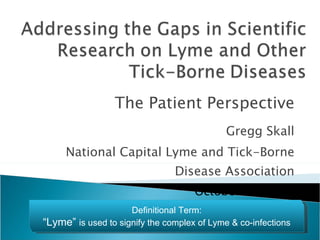
Gregg Skall National Capital Lyme and Tick-Borne Disease Association October 12, 2010 The Patient Perspective Definitional Term: “ Lyme”  is used to signify the complex of Lyme & co-infections
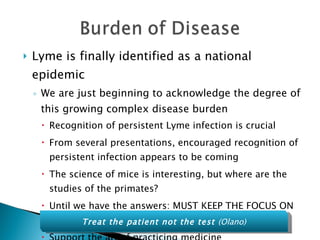
Lyme is finally identified as a national epidemic We are just beginning to acknowledge the degree of this growing complex disease burden Recognition of persistent Lyme infection is crucial From several presentations, encouraged recognition of persistent infection appears to be coming The science of mice is interesting, but where are the studies of the primates? Until we have the answers: MUST KEEP THE FOCUS ON THE PATIENT Support the art of practicing medicine Treat the patient not the test  (Olano)
Livelihood Career Family  Life Savings Burden on Society Children-loss  of childhood Children  are not “little adults” Krause :  Complications of Babesiosis include acute respiratory failure, congestive heart failure and death! [For a child] long term effects last 50-70 years  (Jacobs)
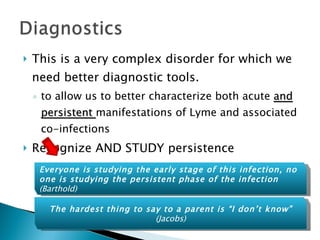
This is a very complex disorder for which we need better diagnostic tools.  to allow us to better characterize both acute  and persistent  manifestations of Lyme and associated co-infections Recognize AND STUDY persistence  The hardest thing to say to a parent is “I don’t know” (Jacobs) Everyone is studying the early stage of this infection, no one is studying the persistent phase of the infection  (Barthold)
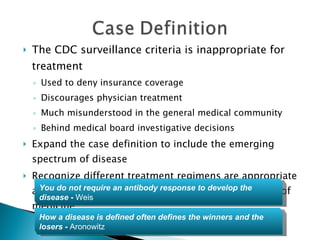
The CDC surveillance criteria is inappropriate for treatment Used to deny insurance coverage Discourages physician treatment Much misunderstood in the general medical community Behind medical board investigative decisions Expand the case definition to include the emerging spectrum of disease Recognize different treatment regimens are appropriate and give the clinician the breadth to practice the art of medicine You do not require an antibody response to develop the disease  -  Weis How a disease is defined often defines the winners and the losers  -  Aronowitz
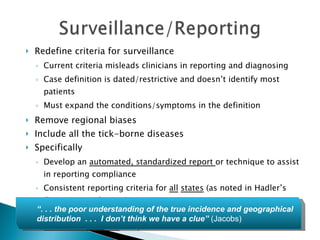
Redefine criteria for surveillance Current criteria misleads clinicians in reporting and diagnosing Case definition is dated/restrictive and doesn’t identify most patients Must expand the conditions/symptoms in the definition Remove regional biases Include all the tick-borne diseases Specifically Develop an  automated, standardized report  or technique to assist in reporting compliance Consistent reporting criteria for  all   states  (as noted in Hadler’s Commissioned paper) Broaden the case definition for surveillance to include advanced  late-manifestations  of Lyme disease and co-infections “ . . . the poor understanding of the true incidence and geographical distribution  . . .  I don’t think we have a clue”  (Jacobs)
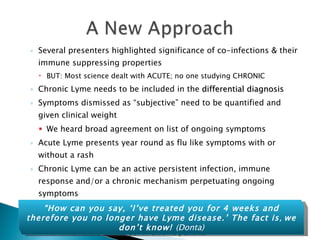
Several presenters highlighted significance of co-infections & their immune suppressing properties BUT: Most science dealt with ACUTE; no one studying CHRONIC Chronic Lyme needs to be included in the  differential diagnosis Symptoms dismissed as “subjective” need to be quantified and given clinical weight We heard broad agreement on list of ongoing symptoms Acute Lyme presents year round as flu like symptoms with or without a rash Chronic Lyme can be an active persistent infection, immune response and/or a chronic mechanism perpetuating ongoing symptoms Banish the term of  Post Lyme Disease syndrome Suggests absence of infection  For which there is no proof in chronic patients “ How can you say, ‘I’ve treated you for 4 weeks and therefore you no longer have Lyme disease.’ The fact is ,  we don’t know!  (Donta)
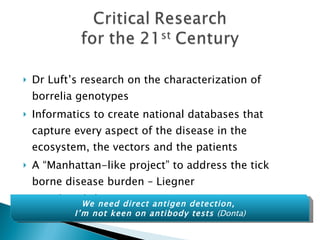
Dr Luft’s research on the characterization of borrelia genotypes Informatics to create national databases that capture every aspect of the disease in the ecosystem, the vectors and the patients A “Manhattan-like project” to address the tick borne disease burden – Liegner Not hyperbole We need direct antigen detection,  I’m not keen on antibody tests  (Donta)
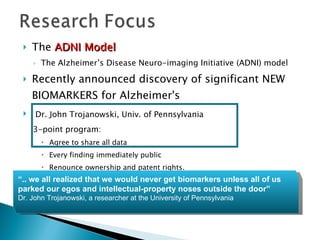
The  ADNI Model The Alzheimer’s Disease Neuro-imaging Initiative (ADNI) model Recently announced discovery of significant NEW BIOMARKERS for Alzheimer's Dr. John Trojanowski, Univ. of Pennsylvania 3-point program: Agree to share all data Every finding immediately public Renounce ownership and patent rights.  “ .. we all realized that we would never get biomarkers unless all of us parked our egos and intellectual-property noses outside the door”  Dr. John Trojanowski, a researcher at the University of Pennsylvania
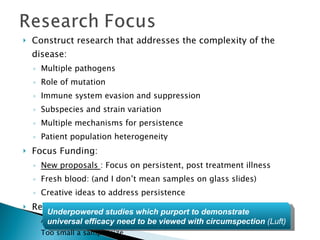
Construct research that addresses the complexity of the disease: Multiple pathogens Role of mutation Immune system evasion and suppression Subspecies and strain variation Multiple mechanisms for persistence Patient population heterogeneity Focus Funding: New proposals  : Focus on persistent, post treatment illness Fresh blood: (and I don’t mean samples on glass slides) Creative ideas to address persistence  Replace the CDC surveillance criteria for study design As an entry criteria it eliminates a vast majority of Lyme patients Too small a sample size Underpowered studies which purport to demonstrate universal efficacy need to be viewed with circumspection  (Luft)
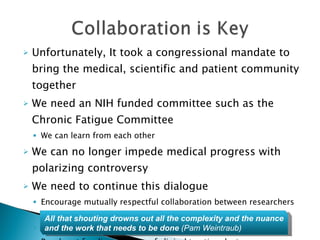
Unfortunately, It took a congressional mandate to bring the medical, scientific and patient community together We need an NIH funded committee such as the Chronic Fatigue Committee We can learn from each other  We can no longer impede medical progress with polarizing controversy We need to continue this dialogue Encourage mutually respectful collaboration between researchers and clinicians Include patient participation Reach out for diverse views of clinical treating doctors All that shouting drowns out all the complexity and the nuance and the work that needs to be done  (Pam Weintraub)
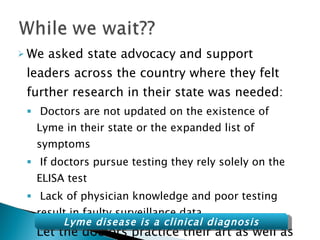
We asked state advocacy and support leaders across the country where they felt further research in their state was needed: Doctors are not updated on the existence of Lyme in their state or the expanded list of symptoms If doctors pursue testing they rely solely on the ELISA test Lack of physician knowledge and poor testing result in faulty surveillance data Let the doctors practice their art as well as the craft Lyme disease is a clinical diagnosis
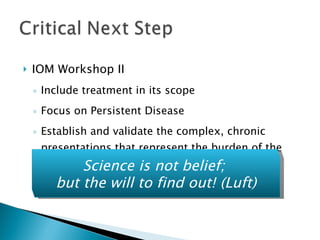
IOM Workshop II  Include treatment in its scope Focus on Persistent Disease Establish and validate the complex, chronic presentations that represent the burden of the disease Science is not belief;  but the will to find out! (Luft)
It’s About the Patient

The patient perspective_v3_final

  • 1.
    Gregg Skall NationalCapital Lyme and Tick-Borne Disease Association October 12, 2010 The Patient Perspective Definitional Term: “ Lyme” is used to signify the complex of Lyme & co-infections
  • 2.
    Lyme is finallyidentified as a national epidemic We are just beginning to acknowledge the degree of this growing complex disease burden Recognition of persistent Lyme infection is crucial From several presentations, encouraged recognition of persistent infection appears to be coming The science of mice is interesting, but where are the studies of the primates? Until we have the answers: MUST KEEP THE FOCUS ON THE PATIENT Support the art of practicing medicine Treat the patient not the test (Olano)
  • 3.
    Livelihood Career Family Life Savings Burden on Society Children-loss of childhood Children are not “little adults” Krause : Complications of Babesiosis include acute respiratory failure, congestive heart failure and death! [For a child] long term effects last 50-70 years (Jacobs)
  • 4.
    This is avery complex disorder for which we need better diagnostic tools. to allow us to better characterize both acute and persistent manifestations of Lyme and associated co-infections Recognize AND STUDY persistence The hardest thing to say to a parent is “I don’t know” (Jacobs) Everyone is studying the early stage of this infection, no one is studying the persistent phase of the infection (Barthold)
  • 5.
    The CDC surveillancecriteria is inappropriate for treatment Used to deny insurance coverage Discourages physician treatment Much misunderstood in the general medical community Behind medical board investigative decisions Expand the case definition to include the emerging spectrum of disease Recognize different treatment regimens are appropriate and give the clinician the breadth to practice the art of medicine You do not require an antibody response to develop the disease - Weis How a disease is defined often defines the winners and the losers - Aronowitz
  • 6.
    Redefine criteria forsurveillance Current criteria misleads clinicians in reporting and diagnosing Case definition is dated/restrictive and doesn’t identify most patients Must expand the conditions/symptoms in the definition Remove regional biases Include all the tick-borne diseases Specifically Develop an automated, standardized report or technique to assist in reporting compliance Consistent reporting criteria for all states (as noted in Hadler’s Commissioned paper) Broaden the case definition for surveillance to include advanced late-manifestations of Lyme disease and co-infections “ . . . the poor understanding of the true incidence and geographical distribution . . . I don’t think we have a clue” (Jacobs)
  • 7.
    Several presenters highlightedsignificance of co-infections & their immune suppressing properties BUT: Most science dealt with ACUTE; no one studying CHRONIC Chronic Lyme needs to be included in the differential diagnosis Symptoms dismissed as “subjective” need to be quantified and given clinical weight We heard broad agreement on list of ongoing symptoms Acute Lyme presents year round as flu like symptoms with or without a rash Chronic Lyme can be an active persistent infection, immune response and/or a chronic mechanism perpetuating ongoing symptoms Banish the term of Post Lyme Disease syndrome Suggests absence of infection For which there is no proof in chronic patients “ How can you say, ‘I’ve treated you for 4 weeks and therefore you no longer have Lyme disease.’ The fact is , we don’t know! (Donta)
  • 8.
    Dr Luft’s researchon the characterization of borrelia genotypes Informatics to create national databases that capture every aspect of the disease in the ecosystem, the vectors and the patients A “Manhattan-like project” to address the tick borne disease burden – Liegner Not hyperbole We need direct antigen detection, I’m not keen on antibody tests (Donta)
  • 9.
    The ADNIModel The Alzheimer’s Disease Neuro-imaging Initiative (ADNI) model Recently announced discovery of significant NEW BIOMARKERS for Alzheimer's Dr. John Trojanowski, Univ. of Pennsylvania 3-point program: Agree to share all data Every finding immediately public Renounce ownership and patent rights. “ .. we all realized that we would never get biomarkers unless all of us parked our egos and intellectual-property noses outside the door” Dr. John Trojanowski, a researcher at the University of Pennsylvania
  • 10.
    Construct research thataddresses the complexity of the disease: Multiple pathogens Role of mutation Immune system evasion and suppression Subspecies and strain variation Multiple mechanisms for persistence Patient population heterogeneity Focus Funding: New proposals : Focus on persistent, post treatment illness Fresh blood: (and I don’t mean samples on glass slides) Creative ideas to address persistence Replace the CDC surveillance criteria for study design As an entry criteria it eliminates a vast majority of Lyme patients Too small a sample size Underpowered studies which purport to demonstrate universal efficacy need to be viewed with circumspection (Luft)
  • 11.
    Unfortunately, It tooka congressional mandate to bring the medical, scientific and patient community together We need an NIH funded committee such as the Chronic Fatigue Committee We can learn from each other We can no longer impede medical progress with polarizing controversy We need to continue this dialogue Encourage mutually respectful collaboration between researchers and clinicians Include patient participation Reach out for diverse views of clinical treating doctors All that shouting drowns out all the complexity and the nuance and the work that needs to be done (Pam Weintraub)
  • 12.
    We asked stateadvocacy and support leaders across the country where they felt further research in their state was needed: Doctors are not updated on the existence of Lyme in their state or the expanded list of symptoms If doctors pursue testing they rely solely on the ELISA test Lack of physician knowledge and poor testing result in faulty surveillance data Let the doctors practice their art as well as the craft Lyme disease is a clinical diagnosis
  • 13.
    IOM Workshop II Include treatment in its scope Focus on Persistent Disease Establish and validate the complex, chronic presentations that represent the burden of the disease Science is not belief; but the will to find out! (Luft)
  • 14.

Editor's Notes

  • #5 DO NOT REQUIRE an antibody response to develop the disease Seen pathenogenesis, debris: do not contain the infectious spirochete