The Paris Effect
how the climate agreement is
REshaping the global economy
EXECUTIVE SUMMARY
December 2020
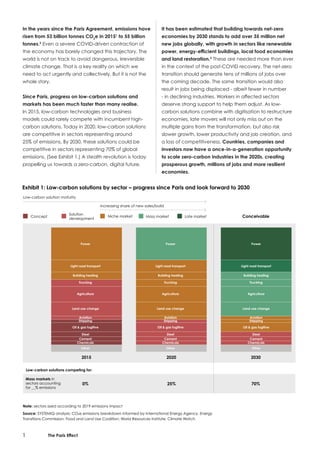
In the years since the Paris Agreement, emissions have
risen from 53 billion tonnes CO2
e in 20151
to 55 billion
tonnes.2
Even a severe COVID-driven contraction of
the economy has barely changed this trajectory. The
world is not on track to avoid dangerous, irreversible
climate change. That is a key reality on which we
need to act urgently and collectively. But it is not the
whole story.
Since Paris, progress on low-carbon solutions and
markets has been much faster than many realise.
In 2015, low-carbon technologies and business
models could rarely compete with incumbent high-
carbon solutions. Today in 2020, low-carbon solutions
are competitive in sectors representing around
25% of emissions. By 2030, these solutions could be
competitive in sectors representing 70% of global
emissions. (See Exhibit 1.) A stealth revolution is today
propelling us towards a zero-carbon, digital future.
Note: sectors sized according to 2019 emissions impact
Source: SYSTEMIQ analysis; CO2e emissions breakdown informed by International Energy Agency, Energy
Transitions Commission; Food and Land Use Coalition; World Resources Institute; Climate Watch.
Exhibit 1: Low-carbon solutions by sector – progress since Paris and look forward to 2030
Low-carbon solution maturity
Increasing share of new sales/build
Concept
Solution
development
Niche market Mass market Late market
2015
Power
Light road transport
Building heating
Trucking
Agriculture
Land use change
Aviation
Shipping
Oil & gas fugitive
Steel
Cement
Chemicals
Other
2020
Power
Light road transport
Building heating
Trucking
Agriculture
Land use change
Aviation
Shipping
Oil & gas fugitive
Steel
Cement
Chemicals
Other
Conceivable
2030
Power
Light road transport
Building heating
Trucking
Agriculture
Land use change
Aviation
Shipping
Oil & gas fugitive
Steel
Cement
Chemicals
Other
Low-carbon solutions competing for:
0% 25% 70%
Mass markets in
sectors accounting
for __% emissions
It has been estimated that building towards net-zero
economies by 2030 stands to add over 35 million net
new jobs globally, with growth in sectors like renewable
power, energy-efficient buildings, local food economies
and land restoration.3
These are needed more than ever
in the context of the post-COVID recovery. The net-zero
transition should generate tens of millions of jobs over
the coming decade. The same transition would also
result in jobs being displaced - albeit fewer in number
- in declining industries. Workers in affected sectors
deserve strong support to help them adjust. As low-
carbon solutions combine with digitisation to restructure
economies, late movers will not only miss out on the
multiple gains from the transformation, but also risk
slower growth, lower productivity and job creation, and
a loss of competitiveness. Countries, companies and
investors now have a once-in-a-generation opportunity
to scale zero-carbon industries in the 2020s, creating
prosperous growth, millions of jobs and more resilient
economies.
1 The Paris Effect
Zero-carbon solutions
and markets are growing
faster than expected
These trends have created the conditions for sectors
to move towards market tipping points where low-
carbon solutions can out-compete legacy, high-
carbon businesses. Once new solutions find an early
market to serve, investment cycles can speed up,
enabling performance improvement; costs often fall
much faster than expected. The faster they improve,
the more investment flows. Once solutions reach
market tipping points – beating incumbents on cost,
quality, convenience, regulatory alignment or social
acceptance – they can take off on an “S-curve”
trajectory. In parallel, legacy businesses often spiral
downwards faster than expected as they lose market
share, economies of scale and regulatory support.
Once markets smell that a sector or technology has
peaked, the dynamics of value destruction can
be brutal.
In 2014, the IEA forecast that average solar prices would
reach $0.05/kWh by 2050, 36 years later.16
In fact, it took
only 6 years.17
Solar and wind are the cheapest form
of new generation in countries covering over 70% of
global GDP;18
this will be the case everywhere by the
late 2020s. These sources of power generation captured
two-thirds of new power capacity added in 2019;
including hydropower, renewables captured a full three-
quarters of new capacity.19
Solar/wind + batteries are
also increasingly competitive as dispatchable power
(for example, India’s “round-the-clock renewables
auction”20
) benefiting from battery price declines
propelled by the electric vehicles market. As solar, wind
and battery costs continue to fall precipitously, this is
creating economic pull for solar/wind + batteries to
serve up to 75-90% of power systems.21
Who would have
believed that Texas would become one of the world
leaders in wind power generation, with wind power
accounting for nearly one-fifth of the state’s electricity
generation in 2019?22
In 2016, industry analysts forecast that internal
combustion cars would still account for 60% of cars
sold in the 2050s.23
Today, it is hard to imagine them
capturing anything beyond a shrinking minority of
sales by the 2030s. Before 2024, electric vehicles
(EVs) will beat internal combustion on cost and
Setting the conditions
for a new economy
to emerge
The dynamics set in train since the Paris Agreement
have created the conditions for dramatic progress
in low-carbon solutions and markets over the last
five years. The agreement – with its in-built ‘ratchet’
mechanism – laid out a clear pathway for 195
countries to steadily cut their reliance on fossil
fuels. This shared direction of travel increased the
confidence of leaders to provide consistent policy
signals. In turn, these have created the conditions
for companies to invest and innovate, and for the
markets for zero-carbon solutions to start scaling
– from electric vehicles to alternative proteins to
sustainable aviation fuels.
Countries, cities and regions accounting for over 50%
of GDP now have net-zero targets (See Box 1).4
Paris-
aligned low-carbon policies are emerging with the
potential for widespread impact. For example, the
realistic possibility of carbon border tax adjustments
by the EU5
, the UK6
, and by US President-elect Joe
Biden7
(in markets which together account for
over 30% of global imports by value8
) is already
nudging behaviour in commodities such as steel
and aluminium. The same is true in soft commodity
markets, where the credible prospect of stricter
requirements on food companies to prove that their
supply chains are deforestation-free is changing
behaviour.
Over 1,500 companies with combined revenues
of $12.5 trillion have set or pledged to set net-
zero targets.9
The finance community has begun
to integrate climate as a meaningful factor into
mainstream investment. The value of global ESG
assets (broadly defined) has almost doubled in four
years, hitting $40.5 trillion this year.10
Institutional
investors representing $5 trillion assets under
management have now committed to align portfolios
with a 1.5°C scenario by 2050 via the Net-Zero Asset
Owner Alliance (launched a year ago).11
In 2020,
the Bank of England announced that it will conduct
climate stress tests on lenders and insurers from 2021.12
France,13
the UK14
and New Zealand15
have either
made climate risk disclosure mandatory or committed
to do so. Others are beginning to follow.
2How the climate agreement is reshaping the global economy
mid-2020s for smaller planes, 2030s for 100+ seaters),
short-haul flights could be cost competitive with jet-
fuelled planes, with better engine efficiency and lower
maintenance.34
This will reshape the industry. Large-
scale pilots are launching in zero-emissions cement
and steel (such as Baowu Group in China).35
The cost
of green hydrogen production (a key technology to
decarbonise these sectors) is set to fall to less than $2/
kg before 2030, supported by the continued dramatic
fall in renewable energy costs.36
At this point, the cost
increase to consumers of products linked to green
shipping and green steel (for example, cars made with
green steel) will be less than 1%.37
Countries already
recognise the opportunity for growth, exports and jobs.
Chile, Morocco, Australia and many other countries
are developing plans and infrastructure to become
green hydrogen super-hubs for the clean energy era.
And across almost every resource-intensive sector,
companies are exploring ways to become more
circular, reducing the demand for primary resources.
Increased recycling rates could mean that virgin
plastic demand growth will fall sharply from 4% a
year before 2020 to below 1% a year between 2020
and 2027, triggering the shift from an investment to a
capital reallocation logic.38
A growing appreciation of the value of nature is giving
rise to new ways of growing food and managing
land. The alternative proteins industry (which includes
plant-based meat, single-cell and insect-based
proteins, and cultured meat) has grown 29% in the
past two years to $5 billion.39
Major fast food chains
are launching meat-free burgers, bringing this trend
into the mainstream. By 2030, the market is projected
to grow more than eighteenfold to $85 billion.40
Both
public and private sectors are increasingly engaging
in schemes and mechanisms to pay for ecosystem
services and public goods. The UK’s Environmental
Land Management scheme will reward farmers for
undertaking environmental measures on their land.41
From 2017 to 2019, the market for forestry and land-
use credits more than doubled in value to $160
million.42
If properly managed with high standards of
governance and environmental integrity, terrestrial
carbon investments could grow to become a $50
billion market by 2030.43
This would bring us closer to
the point where thriving forests are worth more alive
than dead, generating resources for tropical forest
nations to invest in their natural capital, build forest-
positive value chains and improve livelihoods for their
rural and indigenous communities. Rising consumer
almost every other purchase criterion: sticker price
parity24
, a fraction of the maintenance, unparalleled
acceleration, and near-equal range.25
Since 2015,
when the first few fully electric vehicle models were
available, numbers have grown to 230 in 2019 and
we are set to see over 500 models on the market by
2022.26
These not only offer consumers more choice,
but also more affordable, mainstream options. As
more countries roll out charging infrastructure, who
will buy outdated combustion engines? They will likely
go down the road of DVDs, which saw sales decline
by 86% in 13 years (2008-2019) after streaming services
disrupted the market.27
Countries from Norway to
China are building out charging infrastructure
and using EV subsidies to scale the market, boost
domestic manufacturing and ensure their citizens
have cleaner air.
This is the case for public transport fleets, too. Uganda
has committed nearly $39 million to establish an e-bus
plant with initial manufacturing capacity of 5,000
vehicles a year from 2021.28
The government hopes
that 90% of the e-bus parts could eventually be made
in Uganda.29
Further, the emergence of “mobility as
a service” since 2015 will both reduce aggregate
demand for personal vehicles and accelerate the
transition to EVs. Roughly a third of the expected
increase in vehicle sales from urbanisation and macro-
economic growth will likely not happen because of
shared mobility.30
The same market dynamics that delivered advances
in the leading net-zero sectors will likely be replicated
in other sectors, bringing them closer to market
tipping points across the next 5-10 years. Widespread
availability of clean electrons will further accelerate
the change, given the central role that electrification
(either directly or via hydrogen) plays in total system
decarbonisation.
In 2015, it was broadly assumed that heavy industry
(steel, cement, plastics) and heavy transport (shipping,
aviation, trucking) would only partly decarbonize,
even by 2050, and might never reach zero carbon
within their own operations. With net zero by 2050
becoming the new norm, it is now clear that these
sectors will need to get to net zero - and that they
can. Today, there are 66 zero-emission shipping pilots
and demonstrations.31
The production of Sustainable
Aviation Fuels grew twentyfold between 2013-15 and
2016-18.32
200 electric airplanes are in development.33
Once electric aviation is commercial (likely by the
3 The Paris Effect
consciousness of environmental issues, most notably
triggered by the 2017 Blue Planet series in the case of
single-use plastics, has the potential to further reinforce
the shift towards nature-positive value chains.
Underlying forces at work in the macro-economy
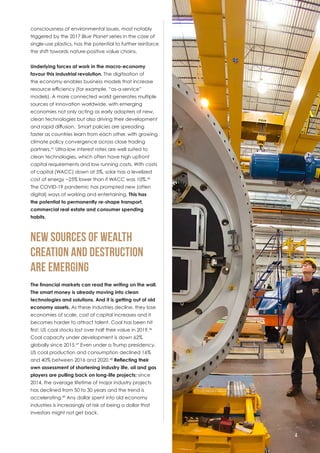
favour this industrial revolution. The digitisation of
the economy enables business models that increase
resource efficiency (for example, “as-a-service”
models). A more connected world generates multiple
sources of innovation worldwide, with emerging
economies not only acting as early adopters of new,
clean technologies but also driving their development
and rapid diffusion. Smart policies are spreading
faster as countries learn from each other, with growing
climate policy convergence across close trading
partners.41
Ultra-low interest rates are well suited to
clean technologies, which often have high upfront
capital requirements and low running costs. With costs
of capital (WACC) down at 5%, solar has a levelized
cost of energy ~25% lower than if WACC was 10%.45
The COVID-19 pandemic has prompted new (often
digital) ways of working and entertaining. This has
the potential to permanently re-shape transport,
commercial real estate and consumer spending
habits.
New sources of wealth
creation and destruction
are emerging
The financial markets can read the writing on the wall.
The smart money is already moving into clean
technologies and solutions. And it is getting out of old
economy assets. As these industries decline, they lose
economies of scale, cost of capital increases and it
becomes harder to attract talent. Coal has been hit
first: US coal stocks lost over half their value in 2019.46
Coal capacity under development is down 62%
globally since 2015.47
Even under a Trump presidency,
US coal production and consumption declined 16%
and 40% between 2016 and 2020.48
Reflecting their
own assessment of shortening industry life, oil and gas
players are pulling back on long-life projects: since
2014, the average lifetime of major industry projects
has declined from 50 to 30 years and the trend is
accelerating.49
Any dollar spent into old economy
industries is increasingly at risk of being a dollar that
investors might not get back.
4
Some incumbents have understood the S-curve and
are pivoting fast to build new renewable energy
businesses. Danish utility company Ørsted A/S has
transformed into a global offshore wind provider
since listing publicly in 2016. Its share price has tripled
in the last two years and market capitalisation now
stands at ~$76 billion.50
Others refused to read the
tea leaves and suffered massive value destruction,
estimated at over $500 billion in European utilities
markets since 2008.51
ExxonMobil’s value is now
rivalled by that of rising US renewables giant NextEra
Energy.52
Big Oil is being replaced with green giants in
the clean energy industry. While those with cheapest
oil or other fossil resources may leave it too late to
adapt, the economic torch is being passed to the
next generation. The window for long-lived fossil fuel
investments is closing very fast.
A narrowing window
of opportunity
However, there is no guarantee that these market
tipping points will be reached fast enough. The balance
sheets and lobbying power of old economy players
enable them to continue investing and influencing
politicians to provide the regulation that keeps them
on life-support. Inconsistent policy support for growing
industries can also create false starts. For example,
retroactive changes to Spain’s solar feed-in tariff in
2013 created massive investor risk and stalled the
industry’s development.53
Given the science, we cannot afford another decade
of delay. In the last five years, emissions have gone up.
The world is not on track to avoid dangerous levels of
global warming and irreversible climate tipping points
are being triggered. On climate, in the words of Bill
McKibben, winning slowly is the same as losing.
Many countries are beginning to move, bolstered
by an electorate that is prioritising climate and the
emergence of industry players lobbying for regulations
to support zero-carbon solutions. Since 2019, elections
in the EU, UK, New Zealand and US were all won by
leaders with strong climate platforms.54
Countries that see the opportunity are taking steps to
harness the power of reinvestment cycles to establish
globally competitive players in new industries. South
Korea’s New Deal directs $95 billion into green and
digital technology investments.55
The UK Government’s
£100 billion national infrastructure strategy outlines plans
to invest in green infrastructure to create a net zero
economy by 2050,56
with up to 68% emission cuts by
2030.57
One third of France’s COVID stimulus package
– around $30 billion – is allocated to green measures
(including $9 billion to green industry).58
These countries
will reap the rewards of millions of good jobs, reduced
fossil imports, scaled-up clean exports, cheaper power
and transport, lower health costs, enhanced resilience,
and greater energy and food security. If enough
countries use their COVID recovery programmes to
scale zero-carbon industries, these shifts will reshape
the economy over the coming 10 years.
However, most countries are not moving fast enough.
Government decisions to support existing industries
– while understandable, given this is where jobs are
today – are ultimately unwise. By failing to predict the
pace of change, countries are making poor policy and
investment decisions and wasting taxpayers’ money.
To capture this opportunity, countries need to deliver
decisive action over the coming year, leading up to
COP26 in Glasgow. Individually, countries can send
unambiguous policy signals into the real economy
through consistent, ambitious targets, regulation and
fiscal incentives. Collectively, greater international
cooperation sector-by-sector will accelerate shifts,
aligning global supply chains and driving cost
and performance improvements. Real economy
actors need to act swiftly to stay relevant, including
corporates (especially in the carbon- and nature-
intensive sectors) and the finance community. The
case for enlightened self-interest has never been
stronger. Those countries, companies and cities that act
decisively today will strengthen their own competitive
prospects and will drive a real economy transformation
that can deliver high-quality, lower-risk growth, jobs
and returns.
CountriesTHATseetheopportunity
aretakingstepstoharnessthe
powerofreinvestmentcyclesto
establishgloballycompetitive
playersinnewindustries.
5 The Paris Effect
Ambition has stepped
up across key actors
-	Countries, cities and regions accounting for
over 50% of GDP now have net-zero targets
in place.59
-	 20 countries and the EU have a net-zero
commitment and more than 100 others are
considering adopting one.60
118 states and
regions are committed to keeping temperature
rise to well below 2 degrees Celsius, with efforts
to reach 1.5 degree Celsius. Many of these are
increasingly setting net-zero targets for 2050 or
earlier.61
-	 China has committed to carbon neutrality by
206062
and US President-elect Joe Biden has
committed to re-engage on climate.63
The two
global superpowers account for around 40% of
global emissions.64
-	The EU65
, U.K.66
and US President-elect Joe Biden67
are considering carbon border tax adjustments,
in jurisdictions which account for 30% of global
imports by value.68
-	Over 1,500 companies with combined revenues
of $12.5 trillion have set net-zero targets.69
-	460 companies have approved science-based
targets and a further ~500 are engaging in the
Science-Based Targets initiative (SBTi).70
-	1,500 organisations (with a market capitalization
of over $12.6 trillion) and financial institutions
with $150 trillion AUM have made clear their
support for implementing the recommendations
of the Task Force on Climate-related Financial
Disclosures (TCFD).71
-	Institutional investors representing $5 trillion assets
under management have now committed to
align portfolios with a 1.5˚C scenario by 2050
via the Net-Zero Asset Owner Alliance
(launched 2019).72
-	 France,73
the UK74
and New Zealand75
have each
either made climate risk disclosure mandatory
or committed to do so. In 2020, the Bank
of England announced that it would be
conducting climate stress tests on lenders
and insurers from 2021.76
-	 34 central banks have joined the Network for
Greening the Financial System, through which
they are working to ensure a smooth transition
to a low-carbon economy.77
Sector leaders are betting
on a zero-emission future
-	 Over ten carmakers (including Volvo, Renault
and Fiat) have committed to EV sales targets for
the period between 2020 and 2025.78
VW Group
alone plans to invest $66 billion by 2024.79
-	Shipping giants Maersk and CMA CGM have
committed to net zero by 2050.80
-	Since 2018, IAG81
, One World Alliance82
and
others representing 15% global air passengers
have issued net-zero commitments.
-	European steel makers representing 13%
of global production have set 2030-50
net-zero targets.83
-	 40 companies representing one-third of global
cement production capacity have committed
to be carbon neutral by 2050, through the
Global Cement and Concrete Association.
Dalmia Cement84
and Heidelberg Cement85
have separately committed to carbon neutrality
by 2040 and 2050, respectively.
-	 General Mills86
, Cargill87
and Walmart have each
committed to regenerative agriculture. Walmart
has pledged to protect, manage or restore 50
million acres by 2030 (an area the size of Ohio
and Indiana).88
-	200 companies, covering 20% of the global
plastics packaging market, have transformative
circularity commitments, up from just one
in 2015.89
Box 1
6How the climate agreement is reshaping the global economy
“	We know that inadequate action translates into
massive and costly climate risk. The Paris Effect
makes it clear that it also puts economies at risk
of falling behind the next wave of the creation of
prosperity. That wave is already gathering pace
and will become a dominant force in growth
and transformation over this decade. Wise policy
makers and investors will aim for the opportunities,
jobs, and resilience that can be delivered only
through a net-zero economy.”
	Pr. Nicholas Stern, Professor of Economics, Chair of the
Grantham Research Institute on Climate Change and
the Environment, London School of Economics
“	The Paris Agreement has inspired net zero
pledges from countries, companies and citizens.
This report shows that we can transform very
quickly and that recovery from economic crisis
must prioritise the delivery of these pledges. The
net zero future is not a far off vision; we are ready
to make the transition now.”
	Christiana Figueres, Former Executive Secretary
of the UNFCCC, now co-founder of Global Optimism
“	As the report shows, the global economy has
seen positive changes since the Paris Agreement:
low-carbon industry is developing rapidly, climate
finance and green finance are becoming
increasingly mainstream. A number of economies,
including China, have set the vision to reach
carbon neutrality by mid-century. China’s 2060
commitment represents a huge green investment
opportunity. Furthermore, achieving carbon
neutrality requires a green finance system which
can provide the incentives and the regulatory
framework to accelerate the low-carbon
transition. A post-COVID world needs to recover
the economy and at the same time, transition
to a green future – these two tasks can never be
separated.”
	Dr. Ma Jun, Director of Center for Finance and
Development at Tsinghua University, Chairman
of China Green Finance Committee
“	It is clear the global long-term goal of Paris - net
zero GHG emissions by midcentury - is now the
reference point for governments and financial
actors. World leaders started a journey in 2015
and now is the time to accelerate. We know
global temperatures and emissions are rising but
this assessment should give us hope that the Paris
Agreement is working.”
	Laurence Tubiana, CEO, European Climate Foundation
“	The Paris Agreement was a watershed
moment for the global economy– and it is
both exhilarating and reassuring to see that
technological and economic trends over the
past five years are indeed propelling us towards
a carbon-emissions free future. This is despite the
fact that a global peaking of carbon emissions
is yet to occur; and suggests that these positive
trends need to be converted into action as soon
as possible, if not sooner.”
	Dr Ajay Mathur, Director General, TERI and a member
of the Prime Minister’s Council on Climate Change
“	This excellent and hopeful paper shows us that
with the astonishing progress being made across
a wide range of clean energy technologies
and business models, we can deliver global
economic transformation at the speed and
scale needed to meet the Paris climate goals
but only if political leaders do their part with the
right kind of policy support. It reaffirms that we
can win the fight of our lives for a safer, cleaner,
more prosperous world. And now the US is about
to be fully back in the fight, where it belongs.”
	Todd Stern, Former United States Special Envoy
for Climate Change
ENDORSEMENTS
7 The Paris Effect
“	The Paris Effect is a timely reminder to us all of the
importance of the Paris Climate Agreement, and
how the scale of multi-stakeholder collaboration
it has helped to trigger across business, finance
and governments is key to delivering a net
zero emissions economy by 2050 or sooner. The
report shows how much has been achieved
since 2015, but also how much there is still to do.
Looking ahead to COP26, the World Economic
Forum will be fully engaged to help business and
government leaders raise ambitions and deliver
the actions required for a net zero, nature-positive
economy, as a key dimension of the post-COVID
global recovery.”
	Prof Klaus Schwab, Founder and Executive Chairman,
World Economic Forum
“	The Paris Effect report reiterates that the move
towards a cleaner, decarbonised economy
has gained unstoppable momentum. The
transition is being pushed along no longer
solely by regulators, but by markets themselves,
as the costs of technologies are falling and
green businesses are beginning to outcompete
incumbents. This means that the move to a net
zero economy is becoming an inevitability, and
will be hastened along by more countries and
companies committing to net zero targets.”
	Hubert Keller, CEO, Lombard Odier
“	Decarbonisation of the global economy is
accelerating despite some of the headwinds we
have seen. With concerted and focussed effort
we can make this the growth story of the century
and create resilient and inclusive societies.”
	Paul Polman, Co-founder and Chair, IMAGINE
“	The Paris Agreement has brought the world
together in increased global ambition for climate
action. Clear political ambition and commitment
to decarbonization is key for the industrial
deployment of renewable energy, and for an
accelerated decarbonization of our societies,
which is now also building speed through green
hydrogen in hard-to-abate sectors. The Paris
Effect highlights that in just 5 years, the transition
to low-carbon solutions has been happening
much faster than many realise, as the costs of
renewable energy continue to fall and more
countries and businesses seize this opportunity.”
	Thomas Thune Andersen, Chairman of the Board,
Orsted
“	Transformational change is possible – and it is
happening. The Paris momentum continues to
be a driving force behind the protection of our
Global Commons. While recognising the scale
of our environmental challenges, I salute the
progress made over the past 5 years and trust
that it will propel Governments into near-term
action for a stronger, healthier and fairer world in
the long term.”
	Naoko Ishii, Executive Vice President and Director,
Center for Global Commons, UTokyo
“	The past 5 years have confirmed the exponential
nature of the transition to a net zero economy.
The right policy signals are coming now. There is a
vast opportunity if we get this right. But those who
join the race too late may never catch up. It is
very hard to chase an exponential curve.”
	Nigel Topping, UK High-Level Climate Action
Champion
8How the climate agreement is reshaping the global economy
“	The last five years have shown that stability in the
climate system is key to avoiding instability in the
financial system. The Paris Effect demonstrates
that investors are already helping drive economy-
wide shifts to net zero as smart capital moves
away from carbon- and resource-intensive
players towards companies whose business
models are based on sustainable value creation.”
	Rhian-Mari Thomas, CEO, Green Finance Institute
“	The climate crisis is developing even faster
than we feared; but as this important and
clearly written report sets out, the zero carbon
technologies we need to limit future damage are
already far more competitive than we expected.
We must now seize the opportunity to accelerate
the energy transition and emissions reductions.”
	Lei Zhang, CEO, Envision
“	The world is not yet on track to avoid potentially
disastrous climate change. But this clear,
compelling and important report sets out a
case for optimism. In the 5 years since the Paris
climate agreement , faster than anticipated
technological progress has given us the tools
to cut emissions rapidly at low cost, and an
ever growing number of countries, companies
and sectors have committed to reduce their
emissions to zero. In this new reality, countries and
companies which fail to grasp the economic
opportunities will be left with stranded assets
and unsustainable jobs.”
	Adair Turner, Chair, Energy Transitions Commission
“	The Paris Effect report underlines the opportunities
to build forward together. The role of the private
sector in attaining transformative tipping points
as we recover from COVID-19 and transition to
a greener more inclusive future is critical. This
transition has to be just and inclusive. Low carbon
technologies, sustainable food security systems
and nature-based solutions are all opportunities
for Africa. Critically, this report recognises that we
need to innovate and upscale financing to build
forward effectively.”
	Vera Songwe, United Nations Under Secretary-General
and Executive Secretary of the Economic Commission
for Africa
“	Over the last 5 years since the Paris Agreement,
progress on low-carbon solutions and markets
has been much faster than many realize, with
rapidly falling costs for wind, solar and batteries.
This is already causing fundamental disruption
in our energy systems, and this disruption will
only accelerate as clean energy costs continue
falling relentlessly. Governments, investors and
other global leaders should review The Paris Effect
to better understand and get ahead of clean
energy cost curves.”
	Jules Kortenhorst, CEO, Rocky Mountain Institute
“	The Paris treaty not only raised global awareness
around the urgency to act; it also set in motion an
unstoppable train. This report makes it clear that
joining the movement to build resilient and clean
economies is not only the right thing to do, it is
the private sector’s best path towards return on
investment.”
	Feike Sijbesma, Honorary Chairman, DSM
ENDORSEMENTS
9 The Paris Effect
“	Financial market participants are beginning to
focus on the serious risk management problem
posed by worsening climate change, but this
report calls attention to the many parallel areas
of opportunity, where cost tipping points and
growing incentives to reduce emissions mean
real economic benefits can be gained through
investing in low carbon sectors and technologies.
There has been a growing embrace of the
concept of a rapid transition to a “net zero”
future since the Paris Agreement came into effect
5 years ago. Countries and investors that turn a
blind eye to that will only worsen the risks they
face while missing the opportunities to benefit
from the low carbon transition.”
	Bob Litterman, Chairman of the Commodity Futures
Trading Commission’s Climate-Related Market Risk
Subcommittee, former head of risk management at
Goldman Sachs
“	The Paris Effect report summarises very well the
momentum generated by the Paris Climate
Agreement across the globe. The understanding
of the climate crisis and commitment to the
Paris Climate Agreement have made countries
aware of the speed and actions needed to
mitigate climate change impact. The desire to
scale up innovations and new decarbonisation
technologies have come to the forefront faster
than expected. The probability of a scaled
and accelerated implementation of new ideas
and technologies motivated Dalmia Cement
to pioneer a carbon negative roadmap and
become net zero by 2040.”
	Mahendra Singhi, MD and CEO, Dalmia Cement
(Bharat) Limited
“	Paris changed the game. It stated the path for a
low-carbon economy and called for the world to
step up to the climate crisis. 5 years later, in some
ways, that promise has not been met. But in more
ways than we realise, it has. The Paris Effect shows
how different nations, institutions and businesses
are transforming parts of our energy, transport,
industry and agriculture systems even faster than
we had anticipated – and with benefits that no
government can afford to turn down.”
	Izabella Teixeira, Former Minister of the Environment,
Brazil
“	Paris brought forth unprecedented alignment
across the world, and a sea change in mindsets
and innovation from finance to boardrooms,
policies to indigenous communities and youth.
We need a shift from ego system to eco system
with net-zero, resource-efficient and nature-
positive economies – which can bring 35 million
direct jobs by 2030. Better business Better World is
worth pursuing now more than ever.”
	Cherie Nursalim, Vice Chairman Giti Group and
International Chamber of Commerce
“	The Paris Agreement promised to leave no one
behind, and an inclusive, just energy transition is
pivotal to deliver this vision. Renewable energy
solutions are now the cheapest and fastest way
to reach vulnerable populations and achieve
universal energy access – all while we accelerate
climate action. Simply put: we cannot achieve
net-zero emissions by 2050 if we do not achieve
sustainable energy for all by 2030.”
	Damilola Ogunbiyi, CEO and Special Representative
of the UN Secretary-General for Sustainable Energy
for All and Co-Chair of UN-Energy
10How the climate agreement is reshaping the global economy
Acknowledgements
The Paris Effect report was produced by SYSTEMIQ.
The team that developed this report comprised: Julia
Turner, Mark Meldrum and Jeremy Oppenheim (Lead
Authors), Marlene Kick and Anne-Caroline Duplat.
We would like to thank the following individuals for
their input and expertise: Meera Atreya, Matthias
Ballweg, Scarlett Benson, Faustine Delasalle, Ben
Dixon, Catharina Dyvik, Douglas Flynn, Danielle
Gent, Henry Gilks, Diletta Giuliani, Alasdair Graham,
Ita Kettleborough, Bertram Kloss, Jörn Kobus, Julia
Koskella, Martin Naughton, Aparajit Pandey, Francisco
Pereira, Milan Petit, Lloyd Pinnell, Elena Pravettoni,
Morten Rosse, Yoni Shiran, Rupert Simons, Eveline
Speelman, Katherine Stodulka, Martin Stuchtey,
Deanna Tallon, Tilmann Vahle, Laëtitia de Villepin,
Andreas Wagner, Felix Phillip, Marco Van Veen, Andrea
Bath, Georges Tijbosch, Jessica Stewart.
SYSTEMIQ would like to thank the Children’s Investment
Fund Foundation for providing financial support for
this work.	
The report team is deeply grateful to a large number
of individuals who have generously contributed
their time and energy to inform the report. We
wish to thank the following people: James Arbib
(RethinkX), Jennifer Austin (High Level Climate Action
Champions), Dorka Bauer, Richard Black (Energy
 Climate Intelligence Unit), Charlie Bloch (Rocky
Mountain Institute), James Cameron (Pollination), John
Elkington (Volans), Owen Gaffney (Potsdam Institute),
Spencer Glendon (Probable Futures), Ed King, Joel
Jaeger (World Resources Institute), Roland Kupers
(Institute for Advanced Studies, Amsterdam), Nicholas
Haan (Singularity University), Tim Jackson (University
of Surrey), Robin Knight (We Mean Business), Mark
Malloch Brown, James Newcomb (Rocky Mountain
Institute), Simon Sharpe (UK Cabinet Office, COP26),
Nick Stern (Grantham Institute, LSE), Adair Turner
(Energy Transitions Commission), Maria Laura Rojas
(Transforma), Zoe Tcholak-Antitch (Mission 2020),
Robert Ward (Grantham Institute, LSE)
Contributors and their respective organisations do not
necessarily endorse all findings or recommendations of
this report. The authors would like to thank Jory  Co.
for designing and producing the report. All remaining
errors and omissions are the responsibility of the
authors.
AUTHORS
11 The Paris Effect
Report design by Jory  Co
Developed by SYSTEMIQ, The Paris Effect: How the
climate agreement is reshaping the global economy,
examines how progress towards a zero-carbon
economy has accelerated in the past five years since
the Paris Agreement, and the opportunities that this
creates for governments that join this transition.
The new assessment shows that although greenhouse
gas emissions and global temperatures are rising,
progress on low-carbon solutions has been faster than
many realise: in 2015, zero-carbon technologies and
business models could rarely compete with legacy
high-carbon businesses. Today, zero-carbon solutions
are competitive in markets representing around one
quarter of emissions. By 2030, these solutions could be
competitive across sectors representing nearly three
quarters of emissions. The report highlights how key
shifts across the general public, corporates, finance
and government are propelling this progress, creating
the opportunity to scale zero-carbon industries in
the 2020s.
The Paris Effect draws on research and analysis from
hundreds of sources to highlight economic, social
and political trends over the past five years. Countries
that create the right enabling policy environments to
harness these trends stand to capture the benefits of
millions of jobs, resilient economies, and simultaneously
reduce emissions. Finance ministers and other
key economic decision-makers can accelerate
investments into low-carbon industries with greater
confidence that this will deliver compelling returns.
The case for enlightened self-interest has never
been stronger.
About SYSTEMIQ
SYSTEMIQ was founded in 2016 to drive the
achievement of the Paris Agreement and the
UN Sustainable Development Goals by transforming
markets and business models in three key economic
systems: regenerative land use, circular materials, and
clean energy. A certified B-Corp, SYSTEMIQ combines
purpose-driven consultancy with high-impact,
on-the-ground work, and partners with business,
finance, policy-makers and civil society to deliver
transformative change. SYSTEMIQ has offices in Brazil,
Germany, Indonesia, the Netherlands and the
United Kingdom.
Learn more at www.systemiq.earth
Contact: communications@systemiq.earth
SYSTEMIQ is not an investment advisor and makes no representation
regarding the advisability of investing in any particular company or
investment fund or other vehicle.

The Paris Effect Executive Summary

  • 1.
    The Paris Effect howthe climate agreement is REshaping the global economy EXECUTIVE SUMMARY December 2020
  • 2.
    In the yearssince the Paris Agreement, emissions have risen from 53 billion tonnes CO2 e in 20151 to 55 billion tonnes.2 Even a severe COVID-driven contraction of the economy has barely changed this trajectory. The world is not on track to avoid dangerous, irreversible climate change. That is a key reality on which we need to act urgently and collectively. But it is not the whole story. Since Paris, progress on low-carbon solutions and markets has been much faster than many realise. In 2015, low-carbon technologies and business models could rarely compete with incumbent high- carbon solutions. Today in 2020, low-carbon solutions are competitive in sectors representing around 25% of emissions. By 2030, these solutions could be competitive in sectors representing 70% of global emissions. (See Exhibit 1.) A stealth revolution is today propelling us towards a zero-carbon, digital future. Note: sectors sized according to 2019 emissions impact Source: SYSTEMIQ analysis; CO2e emissions breakdown informed by International Energy Agency, Energy Transitions Commission; Food and Land Use Coalition; World Resources Institute; Climate Watch. Exhibit 1: Low-carbon solutions by sector – progress since Paris and look forward to 2030 Low-carbon solution maturity Increasing share of new sales/build Concept Solution development Niche market Mass market Late market 2015 Power Light road transport Building heating Trucking Agriculture Land use change Aviation Shipping Oil & gas fugitive Steel Cement Chemicals Other 2020 Power Light road transport Building heating Trucking Agriculture Land use change Aviation Shipping Oil & gas fugitive Steel Cement Chemicals Other Conceivable 2030 Power Light road transport Building heating Trucking Agriculture Land use change Aviation Shipping Oil & gas fugitive Steel Cement Chemicals Other Low-carbon solutions competing for: 0% 25% 70% Mass markets in sectors accounting for __% emissions It has been estimated that building towards net-zero economies by 2030 stands to add over 35 million net new jobs globally, with growth in sectors like renewable power, energy-efficient buildings, local food economies and land restoration.3 These are needed more than ever in the context of the post-COVID recovery. The net-zero transition should generate tens of millions of jobs over the coming decade. The same transition would also result in jobs being displaced - albeit fewer in number - in declining industries. Workers in affected sectors deserve strong support to help them adjust. As low- carbon solutions combine with digitisation to restructure economies, late movers will not only miss out on the multiple gains from the transformation, but also risk slower growth, lower productivity and job creation, and a loss of competitiveness. Countries, companies and investors now have a once-in-a-generation opportunity to scale zero-carbon industries in the 2020s, creating prosperous growth, millions of jobs and more resilient economies. 1 The Paris Effect
  • 3.
    Zero-carbon solutions and marketsare growing faster than expected These trends have created the conditions for sectors to move towards market tipping points where low- carbon solutions can out-compete legacy, high- carbon businesses. Once new solutions find an early market to serve, investment cycles can speed up, enabling performance improvement; costs often fall much faster than expected. The faster they improve, the more investment flows. Once solutions reach market tipping points – beating incumbents on cost, quality, convenience, regulatory alignment or social acceptance – they can take off on an “S-curve” trajectory. In parallel, legacy businesses often spiral downwards faster than expected as they lose market share, economies of scale and regulatory support. Once markets smell that a sector or technology has peaked, the dynamics of value destruction can be brutal. In 2014, the IEA forecast that average solar prices would reach $0.05/kWh by 2050, 36 years later.16 In fact, it took only 6 years.17 Solar and wind are the cheapest form of new generation in countries covering over 70% of global GDP;18 this will be the case everywhere by the late 2020s. These sources of power generation captured two-thirds of new power capacity added in 2019; including hydropower, renewables captured a full three- quarters of new capacity.19 Solar/wind + batteries are also increasingly competitive as dispatchable power (for example, India’s “round-the-clock renewables auction”20 ) benefiting from battery price declines propelled by the electric vehicles market. As solar, wind and battery costs continue to fall precipitously, this is creating economic pull for solar/wind + batteries to serve up to 75-90% of power systems.21 Who would have believed that Texas would become one of the world leaders in wind power generation, with wind power accounting for nearly one-fifth of the state’s electricity generation in 2019?22 In 2016, industry analysts forecast that internal combustion cars would still account for 60% of cars sold in the 2050s.23 Today, it is hard to imagine them capturing anything beyond a shrinking minority of sales by the 2030s. Before 2024, electric vehicles (EVs) will beat internal combustion on cost and Setting the conditions for a new economy to emerge The dynamics set in train since the Paris Agreement have created the conditions for dramatic progress in low-carbon solutions and markets over the last five years. The agreement – with its in-built ‘ratchet’ mechanism – laid out a clear pathway for 195 countries to steadily cut their reliance on fossil fuels. This shared direction of travel increased the confidence of leaders to provide consistent policy signals. In turn, these have created the conditions for companies to invest and innovate, and for the markets for zero-carbon solutions to start scaling – from electric vehicles to alternative proteins to sustainable aviation fuels. Countries, cities and regions accounting for over 50% of GDP now have net-zero targets (See Box 1).4 Paris- aligned low-carbon policies are emerging with the potential for widespread impact. For example, the realistic possibility of carbon border tax adjustments by the EU5 , the UK6 , and by US President-elect Joe Biden7 (in markets which together account for over 30% of global imports by value8 ) is already nudging behaviour in commodities such as steel and aluminium. The same is true in soft commodity markets, where the credible prospect of stricter requirements on food companies to prove that their supply chains are deforestation-free is changing behaviour. Over 1,500 companies with combined revenues of $12.5 trillion have set or pledged to set net- zero targets.9 The finance community has begun to integrate climate as a meaningful factor into mainstream investment. The value of global ESG assets (broadly defined) has almost doubled in four years, hitting $40.5 trillion this year.10 Institutional investors representing $5 trillion assets under management have now committed to align portfolios with a 1.5°C scenario by 2050 via the Net-Zero Asset Owner Alliance (launched a year ago).11 In 2020, the Bank of England announced that it will conduct climate stress tests on lenders and insurers from 2021.12 France,13 the UK14 and New Zealand15 have either made climate risk disclosure mandatory or committed to do so. Others are beginning to follow. 2How the climate agreement is reshaping the global economy
  • 4.
    mid-2020s for smallerplanes, 2030s for 100+ seaters), short-haul flights could be cost competitive with jet- fuelled planes, with better engine efficiency and lower maintenance.34 This will reshape the industry. Large- scale pilots are launching in zero-emissions cement and steel (such as Baowu Group in China).35 The cost of green hydrogen production (a key technology to decarbonise these sectors) is set to fall to less than $2/ kg before 2030, supported by the continued dramatic fall in renewable energy costs.36 At this point, the cost increase to consumers of products linked to green shipping and green steel (for example, cars made with green steel) will be less than 1%.37 Countries already recognise the opportunity for growth, exports and jobs. Chile, Morocco, Australia and many other countries are developing plans and infrastructure to become green hydrogen super-hubs for the clean energy era. And across almost every resource-intensive sector, companies are exploring ways to become more circular, reducing the demand for primary resources. Increased recycling rates could mean that virgin plastic demand growth will fall sharply from 4% a year before 2020 to below 1% a year between 2020 and 2027, triggering the shift from an investment to a capital reallocation logic.38 A growing appreciation of the value of nature is giving rise to new ways of growing food and managing land. The alternative proteins industry (which includes plant-based meat, single-cell and insect-based proteins, and cultured meat) has grown 29% in the past two years to $5 billion.39 Major fast food chains are launching meat-free burgers, bringing this trend into the mainstream. By 2030, the market is projected to grow more than eighteenfold to $85 billion.40 Both public and private sectors are increasingly engaging in schemes and mechanisms to pay for ecosystem services and public goods. The UK’s Environmental Land Management scheme will reward farmers for undertaking environmental measures on their land.41 From 2017 to 2019, the market for forestry and land- use credits more than doubled in value to $160 million.42 If properly managed with high standards of governance and environmental integrity, terrestrial carbon investments could grow to become a $50 billion market by 2030.43 This would bring us closer to the point where thriving forests are worth more alive than dead, generating resources for tropical forest nations to invest in their natural capital, build forest- positive value chains and improve livelihoods for their rural and indigenous communities. Rising consumer almost every other purchase criterion: sticker price parity24 , a fraction of the maintenance, unparalleled acceleration, and near-equal range.25 Since 2015, when the first few fully electric vehicle models were available, numbers have grown to 230 in 2019 and we are set to see over 500 models on the market by 2022.26 These not only offer consumers more choice, but also more affordable, mainstream options. As more countries roll out charging infrastructure, who will buy outdated combustion engines? They will likely go down the road of DVDs, which saw sales decline by 86% in 13 years (2008-2019) after streaming services disrupted the market.27 Countries from Norway to China are building out charging infrastructure and using EV subsidies to scale the market, boost domestic manufacturing and ensure their citizens have cleaner air. This is the case for public transport fleets, too. Uganda has committed nearly $39 million to establish an e-bus plant with initial manufacturing capacity of 5,000 vehicles a year from 2021.28 The government hopes that 90% of the e-bus parts could eventually be made in Uganda.29 Further, the emergence of “mobility as a service” since 2015 will both reduce aggregate demand for personal vehicles and accelerate the transition to EVs. Roughly a third of the expected increase in vehicle sales from urbanisation and macro- economic growth will likely not happen because of shared mobility.30 The same market dynamics that delivered advances in the leading net-zero sectors will likely be replicated in other sectors, bringing them closer to market tipping points across the next 5-10 years. Widespread availability of clean electrons will further accelerate the change, given the central role that electrification (either directly or via hydrogen) plays in total system decarbonisation. In 2015, it was broadly assumed that heavy industry (steel, cement, plastics) and heavy transport (shipping, aviation, trucking) would only partly decarbonize, even by 2050, and might never reach zero carbon within their own operations. With net zero by 2050 becoming the new norm, it is now clear that these sectors will need to get to net zero - and that they can. Today, there are 66 zero-emission shipping pilots and demonstrations.31 The production of Sustainable Aviation Fuels grew twentyfold between 2013-15 and 2016-18.32 200 electric airplanes are in development.33 Once electric aviation is commercial (likely by the 3 The Paris Effect
  • 5.
    consciousness of environmentalissues, most notably triggered by the 2017 Blue Planet series in the case of single-use plastics, has the potential to further reinforce the shift towards nature-positive value chains. Underlying forces at work in the macro-economy favour this industrial revolution. The digitisation of the economy enables business models that increase resource efficiency (for example, “as-a-service” models). A more connected world generates multiple sources of innovation worldwide, with emerging economies not only acting as early adopters of new, clean technologies but also driving their development and rapid diffusion. Smart policies are spreading faster as countries learn from each other, with growing climate policy convergence across close trading partners.41 Ultra-low interest rates are well suited to clean technologies, which often have high upfront capital requirements and low running costs. With costs of capital (WACC) down at 5%, solar has a levelized cost of energy ~25% lower than if WACC was 10%.45 The COVID-19 pandemic has prompted new (often digital) ways of working and entertaining. This has the potential to permanently re-shape transport, commercial real estate and consumer spending habits. New sources of wealth creation and destruction are emerging The financial markets can read the writing on the wall. The smart money is already moving into clean technologies and solutions. And it is getting out of old economy assets. As these industries decline, they lose economies of scale, cost of capital increases and it becomes harder to attract talent. Coal has been hit first: US coal stocks lost over half their value in 2019.46 Coal capacity under development is down 62% globally since 2015.47 Even under a Trump presidency, US coal production and consumption declined 16% and 40% between 2016 and 2020.48 Reflecting their own assessment of shortening industry life, oil and gas players are pulling back on long-life projects: since 2014, the average lifetime of major industry projects has declined from 50 to 30 years and the trend is accelerating.49 Any dollar spent into old economy industries is increasingly at risk of being a dollar that investors might not get back. 4
  • 6.
    Some incumbents haveunderstood the S-curve and are pivoting fast to build new renewable energy businesses. Danish utility company Ørsted A/S has transformed into a global offshore wind provider since listing publicly in 2016. Its share price has tripled in the last two years and market capitalisation now stands at ~$76 billion.50 Others refused to read the tea leaves and suffered massive value destruction, estimated at over $500 billion in European utilities markets since 2008.51 ExxonMobil’s value is now rivalled by that of rising US renewables giant NextEra Energy.52 Big Oil is being replaced with green giants in the clean energy industry. While those with cheapest oil or other fossil resources may leave it too late to adapt, the economic torch is being passed to the next generation. The window for long-lived fossil fuel investments is closing very fast. A narrowing window of opportunity However, there is no guarantee that these market tipping points will be reached fast enough. The balance sheets and lobbying power of old economy players enable them to continue investing and influencing politicians to provide the regulation that keeps them on life-support. Inconsistent policy support for growing industries can also create false starts. For example, retroactive changes to Spain’s solar feed-in tariff in 2013 created massive investor risk and stalled the industry’s development.53 Given the science, we cannot afford another decade of delay. In the last five years, emissions have gone up. The world is not on track to avoid dangerous levels of global warming and irreversible climate tipping points are being triggered. On climate, in the words of Bill McKibben, winning slowly is the same as losing. Many countries are beginning to move, bolstered by an electorate that is prioritising climate and the emergence of industry players lobbying for regulations to support zero-carbon solutions. Since 2019, elections in the EU, UK, New Zealand and US were all won by leaders with strong climate platforms.54 Countries that see the opportunity are taking steps to harness the power of reinvestment cycles to establish globally competitive players in new industries. South Korea’s New Deal directs $95 billion into green and digital technology investments.55 The UK Government’s £100 billion national infrastructure strategy outlines plans to invest in green infrastructure to create a net zero economy by 2050,56 with up to 68% emission cuts by 2030.57 One third of France’s COVID stimulus package – around $30 billion – is allocated to green measures (including $9 billion to green industry).58 These countries will reap the rewards of millions of good jobs, reduced fossil imports, scaled-up clean exports, cheaper power and transport, lower health costs, enhanced resilience, and greater energy and food security. If enough countries use their COVID recovery programmes to scale zero-carbon industries, these shifts will reshape the economy over the coming 10 years. However, most countries are not moving fast enough. Government decisions to support existing industries – while understandable, given this is where jobs are today – are ultimately unwise. By failing to predict the pace of change, countries are making poor policy and investment decisions and wasting taxpayers’ money. To capture this opportunity, countries need to deliver decisive action over the coming year, leading up to COP26 in Glasgow. Individually, countries can send unambiguous policy signals into the real economy through consistent, ambitious targets, regulation and fiscal incentives. Collectively, greater international cooperation sector-by-sector will accelerate shifts, aligning global supply chains and driving cost and performance improvements. Real economy actors need to act swiftly to stay relevant, including corporates (especially in the carbon- and nature- intensive sectors) and the finance community. The case for enlightened self-interest has never been stronger. Those countries, companies and cities that act decisively today will strengthen their own competitive prospects and will drive a real economy transformation that can deliver high-quality, lower-risk growth, jobs and returns. CountriesTHATseetheopportunity aretakingstepstoharnessthe powerofreinvestmentcyclesto establishgloballycompetitive playersinnewindustries. 5 The Paris Effect
  • 7.
    Ambition has stepped upacross key actors - Countries, cities and regions accounting for over 50% of GDP now have net-zero targets in place.59 - 20 countries and the EU have a net-zero commitment and more than 100 others are considering adopting one.60 118 states and regions are committed to keeping temperature rise to well below 2 degrees Celsius, with efforts to reach 1.5 degree Celsius. Many of these are increasingly setting net-zero targets for 2050 or earlier.61 - China has committed to carbon neutrality by 206062 and US President-elect Joe Biden has committed to re-engage on climate.63 The two global superpowers account for around 40% of global emissions.64 - The EU65 , U.K.66 and US President-elect Joe Biden67 are considering carbon border tax adjustments, in jurisdictions which account for 30% of global imports by value.68 - Over 1,500 companies with combined revenues of $12.5 trillion have set net-zero targets.69 - 460 companies have approved science-based targets and a further ~500 are engaging in the Science-Based Targets initiative (SBTi).70 - 1,500 organisations (with a market capitalization of over $12.6 trillion) and financial institutions with $150 trillion AUM have made clear their support for implementing the recommendations of the Task Force on Climate-related Financial Disclosures (TCFD).71 - Institutional investors representing $5 trillion assets under management have now committed to align portfolios with a 1.5˚C scenario by 2050 via the Net-Zero Asset Owner Alliance (launched 2019).72 - France,73 the UK74 and New Zealand75 have each either made climate risk disclosure mandatory or committed to do so. In 2020, the Bank of England announced that it would be conducting climate stress tests on lenders and insurers from 2021.76 - 34 central banks have joined the Network for Greening the Financial System, through which they are working to ensure a smooth transition to a low-carbon economy.77 Sector leaders are betting on a zero-emission future - Over ten carmakers (including Volvo, Renault and Fiat) have committed to EV sales targets for the period between 2020 and 2025.78 VW Group alone plans to invest $66 billion by 2024.79 - Shipping giants Maersk and CMA CGM have committed to net zero by 2050.80 - Since 2018, IAG81 , One World Alliance82 and others representing 15% global air passengers have issued net-zero commitments. - European steel makers representing 13% of global production have set 2030-50 net-zero targets.83 - 40 companies representing one-third of global cement production capacity have committed to be carbon neutral by 2050, through the Global Cement and Concrete Association. Dalmia Cement84 and Heidelberg Cement85 have separately committed to carbon neutrality by 2040 and 2050, respectively. - General Mills86 , Cargill87 and Walmart have each committed to regenerative agriculture. Walmart has pledged to protect, manage or restore 50 million acres by 2030 (an area the size of Ohio and Indiana).88 - 200 companies, covering 20% of the global plastics packaging market, have transformative circularity commitments, up from just one in 2015.89 Box 1 6How the climate agreement is reshaping the global economy
  • 8.
    “ We know thatinadequate action translates into massive and costly climate risk. The Paris Effect makes it clear that it also puts economies at risk of falling behind the next wave of the creation of prosperity. That wave is already gathering pace and will become a dominant force in growth and transformation over this decade. Wise policy makers and investors will aim for the opportunities, jobs, and resilience that can be delivered only through a net-zero economy.” Pr. Nicholas Stern, Professor of Economics, Chair of the Grantham Research Institute on Climate Change and the Environment, London School of Economics “ The Paris Agreement has inspired net zero pledges from countries, companies and citizens. This report shows that we can transform very quickly and that recovery from economic crisis must prioritise the delivery of these pledges. The net zero future is not a far off vision; we are ready to make the transition now.” Christiana Figueres, Former Executive Secretary of the UNFCCC, now co-founder of Global Optimism “ As the report shows, the global economy has seen positive changes since the Paris Agreement: low-carbon industry is developing rapidly, climate finance and green finance are becoming increasingly mainstream. A number of economies, including China, have set the vision to reach carbon neutrality by mid-century. China’s 2060 commitment represents a huge green investment opportunity. Furthermore, achieving carbon neutrality requires a green finance system which can provide the incentives and the regulatory framework to accelerate the low-carbon transition. A post-COVID world needs to recover the economy and at the same time, transition to a green future – these two tasks can never be separated.” Dr. Ma Jun, Director of Center for Finance and Development at Tsinghua University, Chairman of China Green Finance Committee “ It is clear the global long-term goal of Paris - net zero GHG emissions by midcentury - is now the reference point for governments and financial actors. World leaders started a journey in 2015 and now is the time to accelerate. We know global temperatures and emissions are rising but this assessment should give us hope that the Paris Agreement is working.” Laurence Tubiana, CEO, European Climate Foundation “ The Paris Agreement was a watershed moment for the global economy– and it is both exhilarating and reassuring to see that technological and economic trends over the past five years are indeed propelling us towards a carbon-emissions free future. This is despite the fact that a global peaking of carbon emissions is yet to occur; and suggests that these positive trends need to be converted into action as soon as possible, if not sooner.” Dr Ajay Mathur, Director General, TERI and a member of the Prime Minister’s Council on Climate Change “ This excellent and hopeful paper shows us that with the astonishing progress being made across a wide range of clean energy technologies and business models, we can deliver global economic transformation at the speed and scale needed to meet the Paris climate goals but only if political leaders do their part with the right kind of policy support. It reaffirms that we can win the fight of our lives for a safer, cleaner, more prosperous world. And now the US is about to be fully back in the fight, where it belongs.” Todd Stern, Former United States Special Envoy for Climate Change ENDORSEMENTS 7 The Paris Effect
  • 9.
    “ The Paris Effectis a timely reminder to us all of the importance of the Paris Climate Agreement, and how the scale of multi-stakeholder collaboration it has helped to trigger across business, finance and governments is key to delivering a net zero emissions economy by 2050 or sooner. The report shows how much has been achieved since 2015, but also how much there is still to do. Looking ahead to COP26, the World Economic Forum will be fully engaged to help business and government leaders raise ambitions and deliver the actions required for a net zero, nature-positive economy, as a key dimension of the post-COVID global recovery.” Prof Klaus Schwab, Founder and Executive Chairman, World Economic Forum “ The Paris Effect report reiterates that the move towards a cleaner, decarbonised economy has gained unstoppable momentum. The transition is being pushed along no longer solely by regulators, but by markets themselves, as the costs of technologies are falling and green businesses are beginning to outcompete incumbents. This means that the move to a net zero economy is becoming an inevitability, and will be hastened along by more countries and companies committing to net zero targets.” Hubert Keller, CEO, Lombard Odier “ Decarbonisation of the global economy is accelerating despite some of the headwinds we have seen. With concerted and focussed effort we can make this the growth story of the century and create resilient and inclusive societies.” Paul Polman, Co-founder and Chair, IMAGINE “ The Paris Agreement has brought the world together in increased global ambition for climate action. Clear political ambition and commitment to decarbonization is key for the industrial deployment of renewable energy, and for an accelerated decarbonization of our societies, which is now also building speed through green hydrogen in hard-to-abate sectors. The Paris Effect highlights that in just 5 years, the transition to low-carbon solutions has been happening much faster than many realise, as the costs of renewable energy continue to fall and more countries and businesses seize this opportunity.” Thomas Thune Andersen, Chairman of the Board, Orsted “ Transformational change is possible – and it is happening. The Paris momentum continues to be a driving force behind the protection of our Global Commons. While recognising the scale of our environmental challenges, I salute the progress made over the past 5 years and trust that it will propel Governments into near-term action for a stronger, healthier and fairer world in the long term.” Naoko Ishii, Executive Vice President and Director, Center for Global Commons, UTokyo “ The past 5 years have confirmed the exponential nature of the transition to a net zero economy. The right policy signals are coming now. There is a vast opportunity if we get this right. But those who join the race too late may never catch up. It is very hard to chase an exponential curve.” Nigel Topping, UK High-Level Climate Action Champion 8How the climate agreement is reshaping the global economy
  • 10.
    “ The last fiveyears have shown that stability in the climate system is key to avoiding instability in the financial system. The Paris Effect demonstrates that investors are already helping drive economy- wide shifts to net zero as smart capital moves away from carbon- and resource-intensive players towards companies whose business models are based on sustainable value creation.” Rhian-Mari Thomas, CEO, Green Finance Institute “ The climate crisis is developing even faster than we feared; but as this important and clearly written report sets out, the zero carbon technologies we need to limit future damage are already far more competitive than we expected. We must now seize the opportunity to accelerate the energy transition and emissions reductions.” Lei Zhang, CEO, Envision “ The world is not yet on track to avoid potentially disastrous climate change. But this clear, compelling and important report sets out a case for optimism. In the 5 years since the Paris climate agreement , faster than anticipated technological progress has given us the tools to cut emissions rapidly at low cost, and an ever growing number of countries, companies and sectors have committed to reduce their emissions to zero. In this new reality, countries and companies which fail to grasp the economic opportunities will be left with stranded assets and unsustainable jobs.” Adair Turner, Chair, Energy Transitions Commission “ The Paris Effect report underlines the opportunities to build forward together. The role of the private sector in attaining transformative tipping points as we recover from COVID-19 and transition to a greener more inclusive future is critical. This transition has to be just and inclusive. Low carbon technologies, sustainable food security systems and nature-based solutions are all opportunities for Africa. Critically, this report recognises that we need to innovate and upscale financing to build forward effectively.” Vera Songwe, United Nations Under Secretary-General and Executive Secretary of the Economic Commission for Africa “ Over the last 5 years since the Paris Agreement, progress on low-carbon solutions and markets has been much faster than many realize, with rapidly falling costs for wind, solar and batteries. This is already causing fundamental disruption in our energy systems, and this disruption will only accelerate as clean energy costs continue falling relentlessly. Governments, investors and other global leaders should review The Paris Effect to better understand and get ahead of clean energy cost curves.” Jules Kortenhorst, CEO, Rocky Mountain Institute “ The Paris treaty not only raised global awareness around the urgency to act; it also set in motion an unstoppable train. This report makes it clear that joining the movement to build resilient and clean economies is not only the right thing to do, it is the private sector’s best path towards return on investment.” Feike Sijbesma, Honorary Chairman, DSM ENDORSEMENTS 9 The Paris Effect
  • 11.
    “ Financial market participantsare beginning to focus on the serious risk management problem posed by worsening climate change, but this report calls attention to the many parallel areas of opportunity, where cost tipping points and growing incentives to reduce emissions mean real economic benefits can be gained through investing in low carbon sectors and technologies. There has been a growing embrace of the concept of a rapid transition to a “net zero” future since the Paris Agreement came into effect 5 years ago. Countries and investors that turn a blind eye to that will only worsen the risks they face while missing the opportunities to benefit from the low carbon transition.” Bob Litterman, Chairman of the Commodity Futures Trading Commission’s Climate-Related Market Risk Subcommittee, former head of risk management at Goldman Sachs “ The Paris Effect report summarises very well the momentum generated by the Paris Climate Agreement across the globe. The understanding of the climate crisis and commitment to the Paris Climate Agreement have made countries aware of the speed and actions needed to mitigate climate change impact. The desire to scale up innovations and new decarbonisation technologies have come to the forefront faster than expected. The probability of a scaled and accelerated implementation of new ideas and technologies motivated Dalmia Cement to pioneer a carbon negative roadmap and become net zero by 2040.” Mahendra Singhi, MD and CEO, Dalmia Cement (Bharat) Limited “ Paris changed the game. It stated the path for a low-carbon economy and called for the world to step up to the climate crisis. 5 years later, in some ways, that promise has not been met. But in more ways than we realise, it has. The Paris Effect shows how different nations, institutions and businesses are transforming parts of our energy, transport, industry and agriculture systems even faster than we had anticipated – and with benefits that no government can afford to turn down.” Izabella Teixeira, Former Minister of the Environment, Brazil “ Paris brought forth unprecedented alignment across the world, and a sea change in mindsets and innovation from finance to boardrooms, policies to indigenous communities and youth. We need a shift from ego system to eco system with net-zero, resource-efficient and nature- positive economies – which can bring 35 million direct jobs by 2030. Better business Better World is worth pursuing now more than ever.” Cherie Nursalim, Vice Chairman Giti Group and International Chamber of Commerce “ The Paris Agreement promised to leave no one behind, and an inclusive, just energy transition is pivotal to deliver this vision. Renewable energy solutions are now the cheapest and fastest way to reach vulnerable populations and achieve universal energy access – all while we accelerate climate action. Simply put: we cannot achieve net-zero emissions by 2050 if we do not achieve sustainable energy for all by 2030.” Damilola Ogunbiyi, CEO and Special Representative of the UN Secretary-General for Sustainable Energy for All and Co-Chair of UN-Energy 10How the climate agreement is reshaping the global economy
  • 12.
    Acknowledgements The Paris Effectreport was produced by SYSTEMIQ. The team that developed this report comprised: Julia Turner, Mark Meldrum and Jeremy Oppenheim (Lead Authors), Marlene Kick and Anne-Caroline Duplat. We would like to thank the following individuals for their input and expertise: Meera Atreya, Matthias Ballweg, Scarlett Benson, Faustine Delasalle, Ben Dixon, Catharina Dyvik, Douglas Flynn, Danielle Gent, Henry Gilks, Diletta Giuliani, Alasdair Graham, Ita Kettleborough, Bertram Kloss, Jörn Kobus, Julia Koskella, Martin Naughton, Aparajit Pandey, Francisco Pereira, Milan Petit, Lloyd Pinnell, Elena Pravettoni, Morten Rosse, Yoni Shiran, Rupert Simons, Eveline Speelman, Katherine Stodulka, Martin Stuchtey, Deanna Tallon, Tilmann Vahle, Laëtitia de Villepin, Andreas Wagner, Felix Phillip, Marco Van Veen, Andrea Bath, Georges Tijbosch, Jessica Stewart. SYSTEMIQ would like to thank the Children’s Investment Fund Foundation for providing financial support for this work. The report team is deeply grateful to a large number of individuals who have generously contributed their time and energy to inform the report. We wish to thank the following people: James Arbib (RethinkX), Jennifer Austin (High Level Climate Action Champions), Dorka Bauer, Richard Black (Energy Climate Intelligence Unit), Charlie Bloch (Rocky Mountain Institute), James Cameron (Pollination), John Elkington (Volans), Owen Gaffney (Potsdam Institute), Spencer Glendon (Probable Futures), Ed King, Joel Jaeger (World Resources Institute), Roland Kupers (Institute for Advanced Studies, Amsterdam), Nicholas Haan (Singularity University), Tim Jackson (University of Surrey), Robin Knight (We Mean Business), Mark Malloch Brown, James Newcomb (Rocky Mountain Institute), Simon Sharpe (UK Cabinet Office, COP26), Nick Stern (Grantham Institute, LSE), Adair Turner (Energy Transitions Commission), Maria Laura Rojas (Transforma), Zoe Tcholak-Antitch (Mission 2020), Robert Ward (Grantham Institute, LSE) Contributors and their respective organisations do not necessarily endorse all findings or recommendations of this report. The authors would like to thank Jory Co. for designing and producing the report. All remaining errors and omissions are the responsibility of the authors. AUTHORS 11 The Paris Effect
  • 13.
    Report design byJory Co Developed by SYSTEMIQ, The Paris Effect: How the climate agreement is reshaping the global economy, examines how progress towards a zero-carbon economy has accelerated in the past five years since the Paris Agreement, and the opportunities that this creates for governments that join this transition. The new assessment shows that although greenhouse gas emissions and global temperatures are rising, progress on low-carbon solutions has been faster than many realise: in 2015, zero-carbon technologies and business models could rarely compete with legacy high-carbon businesses. Today, zero-carbon solutions are competitive in markets representing around one quarter of emissions. By 2030, these solutions could be competitive across sectors representing nearly three quarters of emissions. The report highlights how key shifts across the general public, corporates, finance and government are propelling this progress, creating the opportunity to scale zero-carbon industries in the 2020s. The Paris Effect draws on research and analysis from hundreds of sources to highlight economic, social and political trends over the past five years. Countries that create the right enabling policy environments to harness these trends stand to capture the benefits of millions of jobs, resilient economies, and simultaneously reduce emissions. Finance ministers and other key economic decision-makers can accelerate investments into low-carbon industries with greater confidence that this will deliver compelling returns. The case for enlightened self-interest has never been stronger. About SYSTEMIQ SYSTEMIQ was founded in 2016 to drive the achievement of the Paris Agreement and the UN Sustainable Development Goals by transforming markets and business models in three key economic systems: regenerative land use, circular materials, and clean energy. A certified B-Corp, SYSTEMIQ combines purpose-driven consultancy with high-impact, on-the-ground work, and partners with business, finance, policy-makers and civil society to deliver transformative change. SYSTEMIQ has offices in Brazil, Germany, Indonesia, the Netherlands and the United Kingdom. Learn more at www.systemiq.earth Contact: communications@systemiq.earth SYSTEMIQ is not an investment advisor and makes no representation regarding the advisability of investing in any particular company or investment fund or other vehicle.