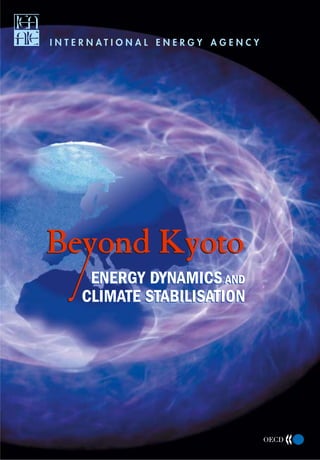
Beyond Kyoto Energy Dynamics And Climate Stabilisation Oecd
Beyond Kyoto Energy Dynamics And Climate Stabilisation Oecd
Beyond Kyoto Energy Dynamics And Climate Stabilisation Oecd
Beyond Kyoto Energy Dynamics And Climate Stabilisation Oecd
Beyond Kyoto Energy Dynamics And Climate Stabilisation Oecd
1.
Beyond Kyoto EnergyDynamics And Climate
Stabilisation Oecd download
https://ebookbell.com/product/beyond-kyoto-energy-dynamics-and-
climate-stabilisation-oecd-6779352
Explore and download more ebooks at ebookbell.com
2.
Here are somerecommended products that we believe you will be
interested in. You can click the link to download.
Economy Energy Environment Simulation Beyond The Kyoto Protocol
Economy Environment 1st Edition Kimio Uno
https://ebookbell.com/product/economy-energy-environment-simulation-
beyond-the-kyoto-protocol-economy-environment-1st-edition-kimio-
uno-2163032
Beyond Kyoto A New Global Climate Certificate System Continuing Kyoto
Commitments Or A Global Cap And Trade Scheme For A Sustainable Climate
Policy 1st Edition Prof Dr Lutz Wicke Auth
https://ebookbell.com/product/beyond-kyoto-a-new-global-climate-
certificate-system-continuing-kyoto-commitments-or-a-global-cap-and-
trade-scheme-for-a-sustainable-climate-policy-1st-edition-prof-dr-
lutz-wicke-auth-4413318
Global Warming Looking Beyond Kyoto Ernesto Zedillo
https://ebookbell.com/product/global-warming-looking-beyond-kyoto-
ernesto-zedillo-1369906
Climate Protection Strategies For The 21st Century Kyoto And Beyond
Special Report German Advisory Council On Global Change Wbgu
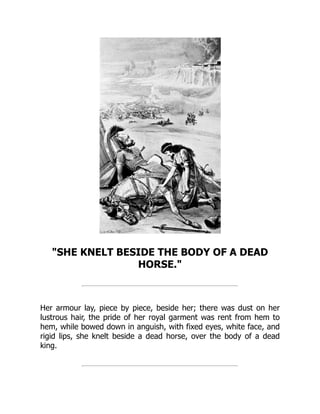
https://ebookbell.com/product/climate-protection-strategies-for-
the-21st-century-kyoto-and-beyond-special-report-german-advisory-
council-on-global-change-wbgu-1772824
3.
Japan Beyond TheKimono Innovation And Tradition In The Kyoto Textile
Industry Jenny Hall
https://ebookbell.com/product/japan-beyond-the-kimono-innovation-and-
tradition-in-the-kyoto-textile-industry-jenny-hall-50223174
Legal Aspects Of Carbon Trading Kyoto Copenhagen And Beyond 1st
Edition David Freestone
https://ebookbell.com/product/legal-aspects-of-carbon-trading-kyoto-
copenhagen-and-beyond-1st-edition-david-freestone-6638868
Awakening Book 02 Beyond
https://ebookbell.com/product/awakening-book-02-beyond-216293636
Awakening Book 03 Beyond
https://ebookbell.com/product/awakening-book-03-beyond-216293650
Awakening Book 01 Beyond
https://ebookbell.com/product/awakening-book-01-beyond-216296374
5.
I N TE R N A T I O N A L E N E R G Y A G E N C Y
ENERGY DYNAMICSAND
CLIMATE STABILISATION
ENERGY DYNAMICSAND
CLIMATE STABILISATION
6.
I N TE R N AT I O N A L E N E R G Y A G E N C Y
ENERGY DYNAMICSAND
CLIMATE STABILISATION
8.
FOREWORD
Climate change remainsan important issue for all governments around
the world. Efforts to reduce its future impacts will have important
consequences for the energy sector.
Actions undertaken thus far are only first steps. Both the shortcomings
and the achievements of current international agreements provide
useful insights into what shape future agreements might take. Two
questions, in particular, require attention:
■ How to cope with the uncertainties that make it difficult to take firm
decisions for the long term, even though near-term action makes sense
only in a longer-term perspective; and
■ How to create a global solution to this global problem in a world in
which countries are at widely differing levels of development.
This book surveys the science and the energy policy choices of climate
change. It assesses current commitments and technical change. It
discusses burden-sharing and possible forms of future commitments,
drawing on work undertaken both with the IEA’s Standing Group on
Long-Term Co-operation and with the Annex I Expert Group to the
UNFCCC.
This book clearly identifies the relevant questions – and proposes
solutions. Without prejudging countries’ positions, it seeks to clarify
the options. We look forward to continuing to provide a sound
analytical foundation to the debate.
Robert Priddle,
Executive Director
3
9.
5
ACKNOWLEDGEMENTS
This book waswritten by Cédric Philibert and Jonathan Pershing, respectively
Administrator at, and Head of the IEA’s Energy & Environment Division. It was
edited by Kathleen Gray. Comments and suggestions from Tom Jones and Jan
Corfee-Morlot at the OECD’s Environment Directorate, Jenny Gell, Martina
Bosi and Richard Baron at the IEA, Erik Haites (Margaree Consultants) and
various delegates to the Standing Group on Long-Term Co-operation and to the
Annex I Expert Group to the UNFCCC are gratefully acknowledged. The
Governments of France (through the French agency for the environment and
energy management – Ademe) and Canada provided the financial resources
needed to undertake this work.
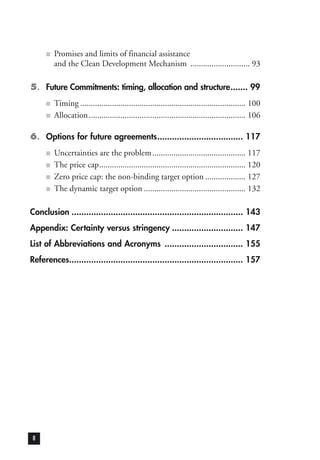
11.
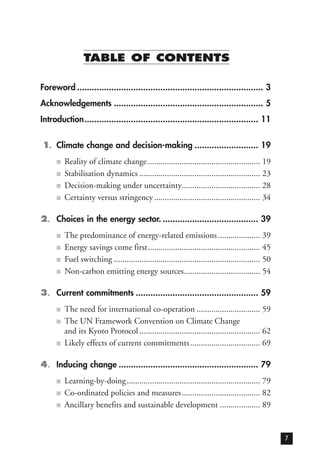
TABLE OF CONTENTS
Foreword............................................................................ 3
Acknowledgements ............................................................. 5
Introduction....................................................................... 11
1. Climate change and decision-making .......................... 19
■ Reality of climate change..................................................... 19
■ Stabilisation dynamics ......................................................... 23
■ Decision-making under uncertainty..................................... 28
■ Certainty versus stringency .................................................. 34
2. Choices in the energy sector. ....................................... 39
■ The predominance of energy-related emissions.................... 39
■ Energy savings come first..................................................... 45
■ Fuel switching ..................................................................... 50
■ Non-carbon emitting energy sources.................................... 54
3. Current commitments .................................................. 59
■ The need for international co-operation .............................. 59
■ The UN Framework Convention on Climate Change
and its Kyoto Protocol ......................................................... 62
■ Likely effects of current commitments................................. 69
4. Inducing change ......................................................... 79
■ Learning-by-doing............................................................... 79
■ Co-ordinated policies and measures..................................... 82
■ Ancillary benefits and sustainable development ................... 89
7
12.
■ Promises andlimits of financial assistance
and the Clean Development Mechanism ............................ 93
5. Future Commitments: timing, allocation and structure....... 99
■ Timing .............................................................................. 100
■ Allocation.......................................................................... 106
6. Options for future agreements................................... 117
■ Uncertainties are the problem............................................ 117
■ The price cap..................................................................... 120
■ Zero price cap: the non-binding target option ................... 127
■ The dynamic target option ................................................ 132
Conclusion ...................................................................... 143
Appendix: Certainty versus stringency ............................. 147
List of Abbreviations and Acronyms ................................ 155
References....................................................................... 157
8
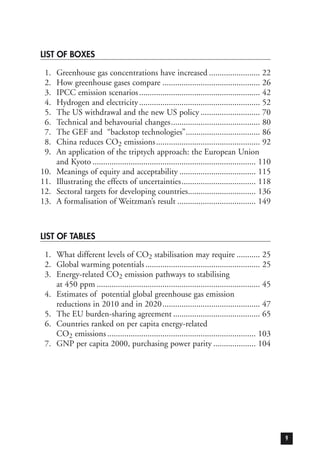
13.
LIST OF BOXES
11.Greenhouse gas concentrations have increased ........................ 22
12. How greenhouse gases compare .............................................. 26
13. IPCC emission scenarios......................................................... 42
14. Hydrogen and electricity......................................................... 52
15. The US withdrawal and the new US policy ............................ 70
16. Technical and behavourial changes.......................................... 80
17. The GEF and “backstop technologies”................................... 86
18. China reduces CO2 emissions................................................. 92
19. An application of the triptych approach: the European Union
and Kyoto ............................................................................. 110
10. Meanings of equity and acceptability .................................... 115
11. Illustrating the effects of uncertainties................................... 118
12. Sectoral targets for developing countries................................ 136
13. A formalisation of Weitzman’s result ..................................... 149
LIST OF TABLES
11. What different levels of CO2 stabilisation may require ........... 25
12. Global warming potentials ...................................................... 25
13. Energy-related CO2 emission pathways to stabilising
at 450 ppm ............................................................................. 45
14. Estimates of potential global greenhouse gas emission
reductions in 2010 and in 2020.............................................. 47
15. The EU burden-sharing agreement ......................................... 65
16. Countries ranked on per capita energy-related
CO2 emissions ...................................................................... 103
17. GNP per capita 2000, purchasing power parity .................... 104
9
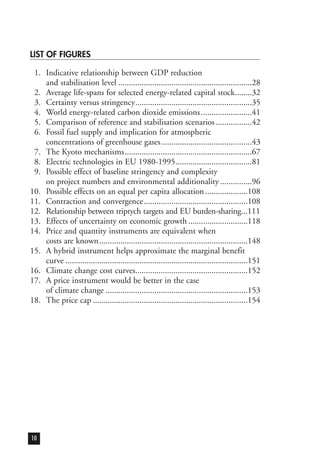
14.
LIST OF FIGURES
11.Indicative relationship between GDP reduction
and stabilisation level ...............................................................28
12. Average life-spans for selected energy-related capital stock........32
13. Certainty versus stringency.......................................................35
14. World energy-related carbon dioxide emissions........................41
15. Comparison of reference and stabilisation scenarios .................42
16. Fossil fuel supply and implication for atmospheric
concentrations of greenhouse gases...........................................43
17. The Kyoto mechanisms............................................................67
18. Electric technologies in EU 1980-1995....................................81
19. Possible effect of baseline stringency and complexity
on project numbers and environmental additionality...............96
10. Possible effects on an equal per capita allocation ....................108
11. Contraction and convergence.................................................108
12. Relationship between triptych targets and EU burden-sharing...111
13. Effects of uncertainty on economic growth ............................118
14. Price and quantity instruments are equivalent when
costs are known......................................................................148
15. A hybrid instrument helps approximate the marginal benefit
curve ......................................................................................151
16. Climate change cost curves.....................................................152
17. A price instrument would be better in the case
of climate change ...................................................................153
18. The price cap .........................................................................154
10
15.
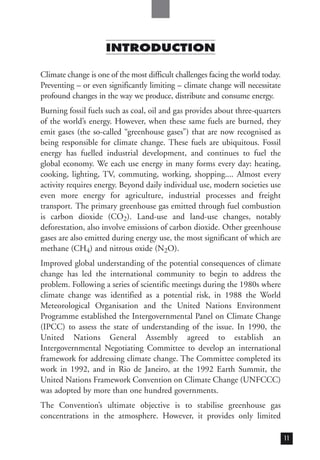
INTRODUCTION
Climate change isone of the most difficult challenges facing the world today.
Preventing – or even significantly limiting – climate change will necessitate
profound changes in the way we produce, distribute and consume energy.
Burning fossil fuels such as coal, oil and gas provides about three-quarters
of the world’s energy. However, when these same fuels are burned, they
emit gases (the so-called “greenhouse gases”) that are now recognised as
being responsible for climate change. These fuels are ubiquitous. Fossil
energy has fuelled industrial development, and continues to fuel the
global economy. We each use energy in many forms every day: heating,
cooking, lighting, TV, commuting, working, shopping.... Almost every
activity requires energy. Beyond daily individual use, modern societies use
even more energy for agriculture, industrial processes and freight
transport. The primary greenhouse gas emitted through fuel combustion
is carbon dioxide (CO2). Land-use and land-use changes, notably
deforestation, also involve emissions of carbon dioxide. Other greenhouse
gases are also emitted during energy use, the most significant of which are
methane (CH4) and nitrous oxide (N2O).
Improved global understanding of the potential consequences of climate
change has led the international community to begin to address the
problem. Following a series of scientific meetings during the 1980s where
climate change was identified as a potential risk, in 1988 the World
Meteorological Organisation and the United Nations Environment
Programme established the Intergovernmental Panel on Climate Change
(IPCC) to assess the state of understanding of the issue. In 1990, the
United Nations General Assembly agreed to establish an
Intergovernmental Negotiating Committee to develop an international
framework for addressing climate change. The Committee completed its
work in 1992, and in Rio de Janeiro, at the 1992 Earth Summit, the
United Nations Framework Convention on Climate Change (UNFCCC)
was adopted by more than one hundred governments.
The Convention’s ultimate objective is to stabilise greenhouse gas
concentrations in the atmosphere. However, it provides only limited
11
16.
guidance as tohow to accomplish this goal – and by 1997, the nations of
the world had decided on a next step. In December 1997, at Kyoto in
Japan, a Protocol to the UNFCCC was adopted that committed
industrialised countries to individually and collectively limit their
emissions, with specific national targets adopted for six of the key
greenhouse gases. Further details on how to interpret the Protocol have
been ironed out since Kyoto, facilitating its entry into force.
However, even with ratification of the Kyoto Protocol, commitments so
far agreed only constitute a first step on a long road ahead. Achieving
stabilisation of greenhouse gas atmospheric concentrations will ultimately
require much deeper cuts in global emissions than those agreed in Kyoto.
And cuts cannot be limited to emissions of industrial countries; to solve
the problem, cuts must be made by all countries in the world. The
difficulty in meeting this global obligation is underscored by the recent
announcement by the United States regarding its intention not to
participate in the Kyoto agreement.
The climate change problem is unique in at least three important ways: it
is global in nature, it has an unusually long-term character, and both
climate change itself and the effects of policies to mitigate it remain
inadequately understood.
The global nature of the climate problem is well known. Emissions of
greenhouse gases mix rapidly in the atmosphere – within weeks, they are
spread around the globe. Furthermore, all countries release emissions;
even the single largest (the United States) accounts for less than a quarter
of the global total. Thus, no single country can address climate change
alone. Even all the industrial countries, acting together, would only be
able to forestall climate change – they could not stop it unless the
developing nations also become engaged. It is thus clear that international
co-operation is required. The need for such co-operation is heightened
when issues of capacity to act are considered: industrial countries currently
possess more advanced technical capacity and the financial resources
needed to combat the problem. While developing nations have relatively
low per capita emissions, few have the technical or institutional ability to
work toward climate mitigation without international assistance.
12
17.
Climate change isalso a long-term issue. Greenhouse gases released into the
atmosphere today will linger for decades (in the case of short-lived gases like
methane) to hundreds of years (for carbon dioxide), to thousands of years
(for long-lived gases like perfluorocarbons). Furthermore, the changes
induced by these emissions are slow to manifest: the IPCC speaks of impacts
such as global average temperature increases and sea level rise that will be
progressive, taking decades or even centuries to show their full effects. Finally,
mitigating climate change will require sustained efforts – that need to begin
immediately but which will only produce results after a long time lag. The
technical challenge for economic analysis is great. The usual analytic tools
suggest that long-term damage has only a limited present value. However, the
long-term nature of climate change presents an even more serious problem
for the policy community: for most elected officials, political horizons are
measured in years rather than in decades or centuries.
Knowledge gaps are also important: the exact rate and extent of climate
change remain unknown, as does its likely regional or local consequences.
Our still limited understanding of how the climate system operates,
combined with the long-term nature of climate change, make it difficult
for the scientific community to offer policy-makers strong
recommendations on how aggressive their action needs to be to mitigate
the problem. In this area, for example, the IPCC has consistently been
unable (and unwilling) to make a recommendation concerning the
appropriate level and timeframe for stabilising atmospheric greenhouse
gas concentrations. Clearly, these questions require not only a scientific
response, but also one based on society’s values, including its attitudes to
risk; ultimately, they remain political decisions.
The Convention on Climate Change essentially represents the world
community’s first effort to synthesise a response to the climate change
problem. Its ultimate objective is relatively clear in intent – although not
adequate for operational detail:
“The ultimate objective of this Convention and any related legal instruments
that the Conference of the Parties may adopt is to achieve, in accordance with
the relevant provisions of the Convention, stabilization of greenhouse gas
concentrations in the atmosphere at a level that would prevent dangerous
13
18.
anthropogenic interference withthe climate system. Such a level should be
achieved within a time-frame sufficient to allow ecosystems to adapt naturally
to climate change, to ensure that food production is not threatened and to
enable economic development to proceed in a sustainable manner.”
Thus, for example, the Convention did not specify the level or the
timeframe. The Convention did, however, set a political direction for the
near term. It committed industrialised country Parties to seek to return
emissions to 1990 levels by 2000. The Kyoto Protocol committed
countries to additional steps; under its binding provisions, industrial
countries undertook, in most cases, to reduce emissions below 1990 levels
by 2012. However, neither agreement provided an indication of how these
near-term actions would fit into the longer-term goal – or even explicitly
defined what that longer-term objective should be.
How might such decisions be taken – and what are the critical inputs into
making them? To arrive at a fully “informed” decision, two completely
different elements are required: information on the consequences of
climate change at various concentration levels, and an assessment of the
costs and benefits of mitigation and adaptation and residual damage at
each level. This is not to say that such decisions could only be taken in the
light of a full cost benefit analysis: such an analysis seems quite difficult,
if not impossible, to perform. However, it is clear that costs cannot be
excluded from the decision on how “dangerous” a greenhouse gas
concentration level might be. Otherwise, the decision would be quite
simple: since any rise in concentration increases the dangers of climate
change, the only logical choice would be to stabilise concentrations at
current levels – or even return to pre-industrial levels!
Unfortunately, such a decision appears impossible (at least in the short-
term): it implies immediately halving global emissions and thus radically
altering (and probably cutting) energy use. No matter how this burden is
shared amongst countries, it is not an option that can be contemplated at
any feasible price. Clearly, the UNFCCC negotiators recognised this. Their
text indicates that mitigation must be rapid enough to avoid climate change
risks, but also slow enough to avoid the economic disruption that could
arise from energy shortages or the huge costs incurred in moving too rapidly
from a fossil-fuel based energy system to a carbon-free energy system.
14
19.
To assess thescope of the cost problem, we must look at some of the
technology paths and potentials. For example, we would like to know
what emission reductions would cost today, or in ten or even fifty years.
Today’s technological choices give us some insights. Nuclear power and
renewable energy sources (such as hydro, wind and solar) could provide
sufficient energy to the global economy with little or no carbon dioxide
emissions. Fossil fuel power generation, if coupled with technologies that
capture and sequester carbon from the waste stream, could also serve.
However, while these technologies exist today, they are not competitive in
most commercial markets when compared to traditional fossil fuel
alternatives. Future costs are uncertain and depend in part on efforts to
invent and deploy new technologies. Technical change arises in part from
focused R&D efforts and, perhaps even more, from entrepreneurs’ efforts
to penetrate competitive markets.
Unfortunately, it may be impossible to put off acting until all the
information is in. Like the climate system, the energy sector and energy
consuming trends are characterised by significant inertia. This inertia
suggests that in the short-term, any major mitigation action might be rather
costly. On the other hand, the nature of the system’s inertia also suggests
that early action is necessary to avoid becoming locked-in to carbon
intensive technologies or consumption patterns, and to foster technical
change and R&D efforts to provide more no-carbon or low-carbon energy
sources at some point in the future. It is also clear that as time passes, if too
little or no action is taken, the range of long-term possibilities will narrow
and climate change risks will increase in an irreversible manner. Balancing
the risks of climate change in the future against costs today is difficult. It is
for these reasons that so little progress has yet been made on a firm
recommendation on a specific concentration level.
Are there ways out of this dilemma?
One alternative might be to aim at the lowest possible GHG
concentration levels, at the same time placing a cap on the price society
would have to pay to meet this level. This price could be reviewed over
time as willingness to pay evolves.
15
20.
An advantage ofthis approach is its compatibility with the least-cost
solutions advocated by economic theory, in particular, with the “cap-and-
trade” regimes that allow emissions reductions to be made in locations
where the lowest cost potential is available. These mechanisms have been
elaborated in the Kyoto Protocol, and there is widespread support for their
continued use in any future regime. Such support is likely to be critical as
efforts are made to broaden the emission mitigation framework beyond the
industrialised world, and to achieve success in mitigating climate change.
A fundamentally different approach to determining the appropriate level
of mitigation effort is to focus on the areas where policy action could
simultaneously fulfil non-climate domestic policy objectives while
reducing greenhouse gas emissions. Removing energy subsidies, cleaning
the air, or improving mass transit systems usually belong to this category.
Developing policy initiatives – without specific climate targets – could be
the focus of such an effort. This policy approach could be attractive for
developed countries as well as for developing countries, which, though
vulnerable to climate change, have more urgent priorities such as poverty
eradication, education challenges, sanitation, health, indoor and local air
quality, and access to energy services.
Policies to address these concerns could have so-called “ancillary benefits”
– that is, domestic policies aimed at achieving sustainable development
might offer some global climate benefits. However, while this approach
may be politically acceptable, it does not seem likely to promote the kind
of radical shift in the energy economy that is needed to decarbonise the
system – and thus, in isolation, may not fully meet the goal of combating
climate change.
Some middle ground could be found between these alternatives. For
example, while developing countries have shown great reluctance to taking
on binding emissions limitation commitments, they have shown a
considerable and growing interest in participating in the Clean
Development Mechanism – a project-based approach to the concept of
emissions trading, and the only Kyoto Protocol mechanism intended to
extend mitigation efforts beyond developed countries. The Clean
Development Mechanism also offers a means to promote technology
16
21.
transfer and investmentsbetween industrialised and developing countries.
Alternatives that can build on this promising political interest may provide
a possible path to a global agreement, where all countries take on some
form of commitment to reduce emissions, and ultimately, participate in a
global regime. Such a regime would also necessitate all developed countries
accepting sufficiently stringent commitments, which could be facilitated if
concerns about uncertain costs were dealt with, as suggested in this book.
Yet another alternative exists: one based on technological improvement
and widespread penetration of alternative energy options. In itself, the
idea of technological change is consistent with the approaches described
above. They seek to promote change through pricing carbon; as the price
increases, market mechanisms provide incentives for carbon producers to
reduce emissions. Technological change as well as behavioural changes can
result. However, a more direct approach may also be considered to induce
more rapid technological change. Direct incentives such as R&D
subsidies, as well as market guarantees for new technologies or public-
private technology partnerships may generate emissions savings directly.
While economic theory suggests that such an approach would be less
comprehensive and efficient than those involving pricing or cap-and-trade
instruments, it may be more politically palatable – and thus, in some
cases, more likely to succeed.
Ultimately, it seems likely that all of these approaches will be needed.
Operating in the uncertain world of future emissions and future costs,
governments and private sector decision-makers need to explore all
options. As the IPCC has put it:
“Climate change decision-making is a sequential decision-making process
under general uncertainty. (....) The literature suggests a step-by-step resolution
aimed at stabilising greenhouse gas concentrations. This will also involve
balancing the risks of either excessive or insufficient action. The relevant
question is not ‘what is the best course for the next 100 years’ but rather ‘what
is the best course for the near term given the expected long-term climate change
and accompanying uncertainties’”.
A successful international mitigation framework for the longer term
(including for the period following the first commitment period outlined
17
men of warseemed as but puny infants contending with this gigantic
foe. Charging against the head of the Armenian phalanx, they drove
its leaders back upon their fellows; and while they hewed and
shouted and smote without remorse, the little band reared about
them a barrier of ghastly mutilated corpses, rising to their very
girths.
But while thus pressing sore against the front of their enemy, they
condensed him into his original formation; and the Great Queen,
always intolerant of shortcomings in discipline, had the mortification
to witness her well-digested plan destroyed, her whole order of
battle put to confusion, by this untoward advance of a force she
intended reserving to the last moment for a purpose of her own.
"And ten more spear-lengths would have sufficed," said she, veiling
her vexation as best she might. "Behold, Assarac! In war, as in
peace, it is better to trust a haltered ass than an unbridled steed!"
24.
CHAPTER LII
LOST ANDWON
Sarchedon, galloping furiously on his mission, yet cast more than
one glance over his shoulder at the battle raging behind him. He too
marked the overwhelming charge of the Anakim, and its effect on
that solid mass against which its might was hurled. Trained in the
subtlest school of war, by the great captain of the age, he perceived
at once that if ever they were to be routed, now was the critical
moment at which the discomfiture of his countrymen must be
achieved. The bay horse reeked with foam and reeled from want of
breath when it reached Thorgon's side; and Sarchedon, deeming not
an instant should be lost, ventured so far to extend the command he
had received as to urge on that old warrior the necessity of putting
his men in motion at a gallop. Thorgon frowned and bit his lip. "Go
to!" said he. "I am not to be taught by an Assyrian youth how to set
the battle in array. Nevertheless, if thou wilt share in a death-ride to-
day with the children of the north, pull that knife of thine out of thy
girdle and come with me."
Thus speaking, he drew his own long heavy sword, and waving it
round his head, placed himself in front of his horsemen, and led
them against the enemy at a rapid pace, which, when within a
bowshot distance, he increased to their utmost speed.
The Anakim had now penetrated so far into the ranks of the
Armenians as to be nearly surrounded, while victorious, by the very
foe they were engaged in defeating. It needed but this charge of
Thorgon and his grim long swords in their rear to complete the circle
that hemmed them in.
25.
Semiramis, from herchariot, marked the crisis and the manner in
which it must be met. "Assarac," said she, in her calm modulated
voice, "I cannot trust the children of the desert. They would not
retire if I bade them, and so weaken the wedge by drawing it after
them in pursuit. We must check these wild cattle of the mountain,
nevertheless. Bring up my spears in solid column of a thousand men
in front, masking the chariots. When I raise my bow, let them open
out and every driver urge his horses to a gallop. I will not give the
signal till I see my opportunity, so watch me like a falcon over a
fawn. Send for my horsemen clothed in blue. Ten squadrons may
serve to bring the Anakim out of peril, and with the rest I will myself
make a dash for the person of this Beautiful King."
Her commands were implicitly obeyed. With a shout that denoted
their courage and unshaken confidence, the chief strength of the
Assyrian army advanced steadily to the attack.
Meantime the Anakim were fighting at considerable disadvantage.
Hemmed in by falling foes, encumbered by dead of their own
slaying, they had no space to turn their horses, scarce elbow-room
to swing their swords. Twice had Ishtar's rein been seized by a
dismounted enemy, and her horse dragged down to its knees; twice
had his veiled queen been rescued by some tall champion, who
pierced her assailant to the heart, or clove him to the chin. But,
nevertheless, the farther these desperate giants fought their way
towards the centre of the Armenians, the more difficult became the
task of extrication, the more hopeless their chances of retreat. It
seemed that all was indeed lost when Thorgon and his long swords
came pouring down upon their rear.
To Ishtar the events passing before her eyes were but as the horrors
of some ghastly dream. Faint, gasping, terrified, stunned with the
din, choked in the dust, blinded by the flash of weapons, sickening
at the smell of blood, she was only sensible she had seen
Sarchedon, as in a vision, and had cried to him for assistance in
vain.
26.
Helpless and bewildered,she must have been slain a score of times
but for the chief of the Anakim, whose weapon kept her assailants at
bay, while his hand guided her horse through the press of battle; but
even this protection failed her when that formidable champion found
himself engaged with Thorgon hand to hand.
Wary and experienced, hardened and toughened by continual toil in
warfare and the chase, the old Armenian knew every wile of the
swordsman, every turn of the horseman, familiarly as he knew the
spring of a panther or the rush of a mountain bull. But he was no
match for the larger frame and lengthier limbs of an opponent who
was a younger, stronger, and quicker man, riding a better horse.
While he waved his long sword round his head to cleave his
adversary to the girdle, the other smote him sharp and true below
the fifth rib, and, with a loud curse on the only god he
acknowledged—the weapon that had failed him—Thorgon fell
headlong from his saddle, dead before he reached the ground.
Men, horses, flashing weapons, reeling banners—all swam before
Ishtar's eyes; and, swaying blindly forward, she was scarcely
conscious that a protecting arm supported her, a careful hand guided
her bridle, towards the outskirts of the fight.
The fall of their leader seemed in no way to discourage the mountain
men; rather they fought with greater fierceness and obstinacy than
before. The children of Anak too, considerably out-numbered, and
disheartened by the helplessness of their Veiled Queen, began to
give way, striking furiously about them indeed, without a thought of
flight, yet obviously bent on effecting a retreat, if possible in good
order, but at any sacrifice a retreat.
In this imminent crisis of battle, the Comely King and the Great
Queen were moved simultaneously with a conviction that now was
the moment at which to throw all the weight attainable into the
scale. If either side could be driven back but a score of spear-
lengths, it might be made to give ground imperceptibly, till wavering
grew to flight, and flight culminated in defeat. For Armenia, it
27.
seemed the onlyhope to push forward the wedge till it penetrated
and divided the queen's solid columns of spearmen; for the sons of
Ashur the sure path to victory lay in a breaking up of that dense
obstinate mass, already weakened and mutilated, while its nucleus
should be annihilated by their chariots, and its component parts cut
to pieces by their horsemen hovering on its flanks.
Therefore Aryas, standing erect in his chariot, encouraged his men
of war, with voice and gesture, in the very fore-front of battle.
Therefore Semiramis, scanning with undisguised approval the ranks
of her body-guard clothed in blue, placed herself joyfully at their
head. The Armenian monarch had resolved to save crown, kingdom,
and friend, or die, like a true mountain man, in his war-harness;
while the Great Queen, thirsting for victory as the drunkard thirsts
for wine, was urged by her longing after Sarchedon and the spur of
a feminine desire to behold Aryas the Beautiful face to face.
They were now scarce ten spear-lengths apart, on the dried-up
river's brink.
The ground was rough and broken, the wheels of her chariot drove
heavily, and Semiramis found herself more than once in danger of
being thrown from her elevated position between the horses that
plunged and laboured over slippery rock or yielding sand.
Against the carved and inlaid panel beside her hung a quiver with its
single arrow—one of those sent to Babylon in return for her
embassy, and which she had sworn by Nisroch to plant in the breast
of Aryas the Beautiful with her own hand. She snatched it from its
case, made a sign to the attendant who led him, leaped on
Merodach, and, looking proudly round, raised her bow aloft to
brandish it over her head.
Then, while spears went down and bridles shook, a shout rose from
the warriors in blue raiment that was caught up by the whole
Assyrian army, and every man called lustily on Baal, swearing a
mighty oath that he would fight to the death for the Great Queen.
28.
Aiming, as washer custom, at the heart of the enemy, Semiramis
broke furiously through the opposing long swords, now deprived of
their leader, with the view of first extricating the Anakim from their
perilous position, and afterwards directing all her force against the
Armenian king in person.
Assarac too had done his part like a practised warrior. The deep
array of spears, a solid column many furlongs in length, strong in its
front of a thousand marching men, was nearing the conflict every
moment, with that smooth and even step, that mechanical regularity
of approach, which seems the very impersonation of discipline and
power. Concealed behind its masses, betrayed only by an unceasing
jar of iron and roll of wheels, came on those formidable war-
chariots, so irresistible by an enemy who had sustained a check that
caused the slightest confusion in its ranks; and wielding the whole
array, governing at once each element of the storm, drove Assarac
the eunuch—he of the cool brain, the steadfast courage, the pitiless
heart, who could be moved but by one sentiment on earth—his mad
infatuation for the queen.
Aryas marked it all, and knew that now the end was very near.
Glancing towards Sarchedon, he beheld his bowbearer, scarce ten
spear-lengths off, in the hottest of the struggle, defending, as it
seemed, from stroke and thrust some object at his side. The Anakim
gathered about him; while the long swords, shouting "Aryas! Aryas!"
were making desperate efforts to approach, believing, no doubt,
they were rallying round their king.
Semiramis neared her object with every stride. Aryas had stooped to
take another arrow from his quiver, and, as he raised his head again
to confront his enemy, looking boldly over his shield, behold! for the
first time, he stood face to face with the Great Queen.
Deceived by the likeness, duped by her own wild heart and reckless
longing, she called on him she loved by the name she had learned to
whisper in her dreams; but the hoarse shriek that cried "Sarchedon,
Sarchedon!" was so different from the full soft tones in which she
29.
was used todoom a culprit or direct a battle, that her guards
pressed fiercely in, thinking their leader must have been stricken
with a death-hurt.
Casting down horse and rider in the fury of her career, she urged
Merodach towards the chariot, every consideration of war and policy,
all care for herself, her army, her people, lost in a fierce thrill of
triumph that the desire of her eyes had not escaped her, and she
had found him even at the last.
Surrounded by the chosen horsemen of Assyria, over-matched, out-
numbered, and now at his sorest need, Aryas shouted to his
bowbearer for help; and Sarchedon, still struggling in the strife as a
swimmer fights and reels amongst the breakers, answered lustily to
the call.
The Great Queen, making, as she believed, for another, was now
within ten paces of Aryas the Beautiful himself.
In that hideous din of battle she neither heard his cry nor the voice
that replied to it; but the white horse with the eyes of fire had a
truer memory and a sharper ear. Recognising his master's accents,
he swerved aside to reach him, but meeting the wrench of the
queen's practised hand on his bridle, reared high with tossing head,
and plunged blindly forward against the king's chariot, struck himself
and his rider heavily to the ground.
As the good horse rolled over a maimed Armenian, the dying
mountain man shortened the sword he grasped fiercely even then,
and buried it in the animal's bowels.
Agile as a panther, Semiramis extricated herself, and was up like
lightning; but when she saw the beast she prized so dearly dead at
her very feet, her heart burned, and her eyes blazed with a fury
wilder, fiercer, madder, than the rage of any beast of prey.
Baffled, stunned, bewildered, she only knew that Merodach lay slain
beneath her; that an armed enemy stood above with shielded face
30.
and javelin raisedto strike; that here across the body of her horse
was the turning-point of battle, and that she held a bow and arrow
in her hand. Unconsciously, she fitted the one to the string, and
drew the other at a venture, as it were, in self-defence.
It was the Armenian arrow, cut in Armenian forests, tipped with
Armenian steel. It had travelled to Babylon and back as a symbol of
dignified remonstrance and royal self-respect; now the white cruel
arm impelled it straight and true, to find its home in the heart of an
Armenian king.
Stricken below the buckler, he felt his life-blood oozing down to wet
its feathers, drop by drop.
"Turn thy hand out of the battle," murmured Aryas to his charioteer,
"since I am hurt even unto death!"
But he never spoke again; for the Great Queen's men of war, making
in to aid their leader, hurled him from his chariot, gashing with
pitiless sword-strokes the comely face so fair even in death, crushing
under trampling hoofs the stately form that, maimed, bruised, and
mangled, was grand and kingly still.
So the horsemen of Assyria triumphed; her spears made victory
secure, her chariots rolled over the slain. The blue mantles smote
and spared not; the Anakim extricating themselves, not without
considerable loss, departed in good order; and the pursuit rolled on
till the sons of Ashur sacked the town of Ardesh—to burn, pillage,
and destroy, even unto the going down of the day.
But men looked in vain for her who had led the attack and achieved
the victory, asking each other with eager looks and anxious faces,
"What tidings of the Great Queen?"
31.
"SHE KNELT BESIDETHE BODY OF A DEAD
HORSE."
Her armour lay, piece by piece, beside her; there was dust on her
lustrous hair, the pride of her royal garment was rent from hem to
hem, while bowed down in anguish, with fixed eyes, white face, and
rigid lips, she knelt beside a dead horse, over the body of a dead
king.
33.
CHAPTER LIII
SHARING THESPOIL
In the palace of Ardesh, where the naked sword stood for men to
worship, they set up a golden image of Baal; where a free monarch
sat amongst his free warriors, the servant of a despotic mistress now
lorded it over a conquered race. Between rise and set of sun a king
had perished, an army had been cut to pieces, and a warlike people
ceased to hold its place among nations.
In the court of that royal dwelling, under the soft evening sky,
Assarac stood in state to receive the captains of the host, take note
of their prisoners, and count the spoil. He had borne him all day like
a warrior of might—cool as the wariest of leaders, bold as the
fiercest of spearmen. None the less was his practised eye scanning
the material results of triumph, his active brain plotting to
consolidate the fruits of victory.
Though himself unwounded, the eunuch's harness was riven and
dented, the linen garment, which, in right of his priestly office, he
affected even in battle, was streaked and spotted with blood. Fed by
the fire within, his look was keen and piercing; there seemed little
more trace of fatigue on his care-worn face than it had worn day
and night since the host marched out from the northern gate of
Babylon; and, conscious he had borne him like a true son of Ashur,
under the eyes of the Great Queen, his aspect, lately so dejected
and morose, was brightened by a passing gleam, as from the light of
hope.
It looked a ghastly task on which his mind was bent. Files of
Assyrian spearmen, passing proudly before him, laid down the heads
of enemies slain in arms or taken prisoners after the combat; so
34.
lavishly and withsuch precision, that a pile of these hideous trophies
had already risen to the height of a man's girdle. Two scribes, tablet
in hand, took note of their exact number; while Assarac, as the
queen's chief counsellor, recorded the names of the successful
warriors, and apportioned the share to which each would be entitled
in dividing the spoil.
Not a murmur rose against his award; for it was still fresh in men's
minds how at the turning-point of battle, when victory hung doubtful
in the balance, all that fierce energy and daring which had rendered
Ninus such a successful leader seemed to have descended on the
priest of Baal whom the old king so mistrusted and reviled.
Man by man the champions of the Assyrian host passed by. One
laden with the spoil he had already gathered, rude in workmanship,
yet precious in its barbaric splendour and intrinsic worth. Another,
dragging some hapless foeman, whom he had bound securely with
his girdle, and whose fate hung on the eunuch's nod; for the
conqueror, with bared arm and naked steel, held himself ready to
pierce, flay, or decapitate at the lightest sign. A third, leading a
comely mountain maid, white and ruddy, with shy blue eyes and
tangled locks of gold, scared, trembling, weeping, yet sometimes
blushing, not without conscious triumph, that she had herself taken
captive the strong fighter in whose power she seemed to be.
For the vanquished, Assarac now showed a clemency unusual in the
traditions of his people, not entirely in accordance with his own
nature, as it had hitherto appeared, hard, practical, uninfluenced by
feeling, and looking only to results. It was observed that he spared
all captives save only such warriors as had been taken fighting
against the bodyguards of the Great Queen; while for the Armenian
women, in this their hour of sorrow, he manifested a pity and
consideration that elicited certain ribald comments from his
countrymen, and no small surprise from the prisoners themselves.
But censure, praise, and ridicule were alike unable to affect him to-
day. With that power of concentration which constitutes the principal
element of success in war, government, or indeed any business of
35.
life, his energieswere engrossed in the important task of so
disposing that great Assyrian army, as to provide for security and
good order in the captured town.
Leader after leader therefore he summoned and dismissed, receiving
their tale of spoil and captives, giving directions for the distribution
of their men. "Where has he learned his skill of warfare," said the
old captains to each other, "this high-priest of our Assyrian god?
Surely Baal comes down to him by night and speaks with him face to
face."
So strongly was national pride and self-confidence imbued with a
religious belief in their gods, that this opinion seemed to the sons of
Ashur extremely probable and well-conceived. It reflected honour on
themselves, their worship, and their triumph; above all, it invested
Assarac with an influence and authority most essential in the
absence of the Great Queen. Not a line of the eunuch's face, not a
turn of his body, was permitted to weaken this impression of
superhuman strength and sagacity, of holiness fresh from the fount
of fire itself. Calm, dignified, imperious, moved by no casualty, equal
to all occasions, he issued his commands with a foresight and
wisdom that elicited order from the very excesses of a victorious
army in a city taken by assault; and yet at Assarac's heart, though
stifled and suppressed by the strong will within, raged a tumult far
more difficult to deal with in its unbridled folly than the wildest
license of warriors drunk with wine and blood.
Where was the queen? Again and again had that question presented
itself in the hour of victory, and now, though the stars were out, he
could not answer it yet.
While driving the Armenians back upon the town of Ardesh, and
entering their capital with a routed enemy, he never doubted but
that Semiramis was performing her part of the battle, and that they
would meet at sunset in the Comely King's palace, where he would
receive from her some acknowledgment of the valour he had shown,
some word of thanks for the service he had done. For a time the
36.
exigencies of sucha success left him not a moment to make
inquiries concerning the mistress of nations, even had it been
prudent to do so. It was necessary to assume supreme authority,
and wield it without scruple; but when a clear head, an undisputed
will, and an unequalled organisation had disposed of their immediate
necessities, and the Assyrian host with its captives was securely
established for the night, Assarac's anxiety became maddening as
hour by hour passed on, but brought no tidings of the Great Queen.
It never entered his head that she could be slain. To him, Ashtaroth
was no more an impersonation of light, beauty, and unearthly power
than Semiramis. That she might have been taken up at the moment
of victory, to join the stars of heaven in a chariot of fire, he was
perhaps the only man of all the host who did not believe; but none
the less was it impossible for him to realise that imperial glory as
shadowed by defeat, that matchless face as pale and fixed in death.
Thus was he spared more than one hideous pang; yet perhaps it is a
question whether the suspense that racked him now, with all its
maddening possibilities, was not fiercer torture than would have
been the certainty that she was gone from him for ever, and he must
grovel before his idol no more.
While the stars shone coldly down on the scene of conflict, while a
new moon shed her gentle light on fire-scathed tower and blackened
wall above—on writhing sufferer and stiffened corpse below—on
riven harness, prostrate horses, chariots broken where they fell—on
the tents of the conquerors, the lines of the vanquished, the
wounded, the sleeping, the dying, and the great banner of Ashur
drooping sullenly over all,—Assarac wrapped himself in a dark-
coloured mantle, and leaving the royal palace of Ardesh, stole down
to the plain below, hoping that on the field of battle, where he had
last seen her, he might recover some traces of the queen.
Already, ere he proceeded half a bowshot, he had disturbed a jackal
at its loathsome feast. The eunuch shuddered and hurried on. Was
this, then, the end and climax of all the pomp of war, the glory of
37.
the host, thethunder of chariots, the shouting of captains, the
sword, the shield, and the battle?
A nation rising in its might at sunrise, going forth to conquer, and at
nightfall—lo, a wild dog mumbling a bone!
His pursuits, his profession, the juggleries that deceived the people,
the pseudo-science that professed to read the stars, had taught him,
perhaps, to ponder and reflect, where others of his nation were
content to act and to enjoy. Looking from the scene of carnage at
his feet to that summer's night so fair and pure above, the great
question thrust itself upon his mind, which his experience, his
reason, all the traditions of Ashur, all the mystic lore of Baal, seemed
unable to answer.
What was this confusion on earth, this order and regularity in
heaven, and why were these things so? Did Nisroch take thought for
that Armenian woman, wailing in the darkness over the body of her
dead lord, or Baal pity the maimed swordsman yonder, trailing his
length like a crushed reptile towards the stream that, in his agony of
thirst, he forgot had been drained and turned aside? Was there
indeed a motive power to govern in heaven? And if so, did it leave
the evils of earth to right themselves as best they might, by force,
fraud, and subtlety, the strong arm and the cunning brain? A thrill of
triumph passed through him, while he murmured,
"It must be so! Let him lord it up yonder who will, man is the god
below; and he who never flinches from his purpose shall not fail in
his desire. Such a one stands here to-night in these my garments.
Conqueror of the north, Assarac the eunuch has to-day taken his
place among the mighty ones of earth, and who shall say him nay?
Hath he not led the hosts of Assyria to victory? Hath he not
adjudged to each triumphant man of war the meed of his deserts;
and shall not he also take his share of the spoil? Costly jewels,
treasures of gold, herds of camels, horses, armour, and cunning
needlework—the common needs of common men—he careth for
none of these; and yet to-night, surely to-night, shall he garner the
38.
harvest that hasbeen sown in fire, and reaped in blood. Ashtaroth,
Ashtaroth, queen of love and light, hast thou ever known a
worshipper who flung before thee all he had to give, taking his heart
out, to lay it at thy feet, and asked only in return for one approving
glance, one soft and kindly smile? Surely she to whom I pray cannot
withhold these from me in such a time as this! Surely there is a
goodly meed in store for him who has to-day placed her crowning
victory on the brows of the Great Queen!"
He had nearly reached the river's bed, where the battle had been
hottest, where the carnage lay thick and reeking in broad swathes of
slaughter; a few more steps brought him to where Merodach lay stiff
and cold, with a vulture feasting on his eyes, and a wild dog tearing
at his flank. The bright stars and the young moon afforded light
enough to distinguish the dead white horse with its ghastly
attendants. Assarac's brain reeled, his blood ran cold, while he
remembered that he had last seen its rider charging furiously
through the battle, on the back of her favourite.
The vulture croaked and flapped its wings, the wild dog growled,
glared, and slunk away. Like a man chained in a nightmare, half
conscious that he is dreaming, yet wholly unable to resist the
petrifying spell, Assarac felt as if some unseen power compelled him
to remain and confront the nameless horror that he so dreaded, yet
was so resolved to disbelieve. He tried to shout, but his tongue clave
to the roof of his mouth; to draw his sword, but his hand hung
powerless, and his flesh crept, so that the very hair rose in the nape
of his neck; for gliding through the gloom, scarce half a bowshot off,
there passed him a ghostly procession, such as the spirits of the
dead might form, in their land of shadows beyond the grave.
Four tall dark figures, moving with solemn gait, bore aloft, on one of
the long wicker shields used by assailants of a fenced city, such a
shrouded burden as denoted the presence of death under the cloak
that veiled its ghastly truth.
39.
Behind them, withdrooping head, clasped hands, and a bearing that
betrayed the utmost abandonment of woe, walked a female
mourner, majestic even in the hour of sorrow that bowed her to the
earth. Assarac started into life now, if indeed that could be called life
which was but restoration to consciousness under the smart of a
deadly stab; for in the folds hanging about the corpse he recognised
a royal mantle—in the drooping and dejected mourner, beheld the
person of the Great Queen.
With fixed and rigid face, with hands clasped tight, with steps that
seemed borne up and guided by some extraneous power,
independent of and even dominating his own will, the eunuch
followed through the darkness, as a sleep-walker follows the
immaterial object of his dreams, never decreasing the space that
intervened, never turning aside from the footprints of those who led,
passing without heed over mailed corpse and broken chariot,
through sand and shingle and shallow pools of blood.
So the procession laboured gravely on, away from the battlefield,
across the vineyards, up the rocky path that led to those mountain
forests in which the dead king of Armenia might have found safety
from his foes.
The bearers neither increased their speed nor halted, nor stinted for
lack of breath, but moved calmly forward with even measured pace,
symbol of a haughty reverence and respect, rather than of pity or
distress; for he whom they bore feet foremost had been a warrior
like themselves, and lay warlike in his riven harness, with a broken
bow in his hand. He had fallen, as was meet for a stout champion, in
the fore-front of battle, and though the horsemen of Assyria slashed
it cruelly with their swords, his comely face had never turned one
hair's-breadth from the foe.
Therefore the sons of Ashur thought no shame to carry him sternly
and proudly to his rest, at the command of their mistress; therefore
in their hearts they told themselves, how at Nisroch's appointed
40.
time, it wouldbe well for them too that they should die in their
armour, and that their last end should be like his.
The frogs clamoured in the marsh, the night wind moaned in the
pines, filmy clouds swept over the crescent moon, and the corpse
went ever upward into the mountain, while the queen followed after
it, weeping, mute, unconscious, and Assarac, giddy and bewildered,
followed blindly after the queen.
41.
CHAPTER LIV
COUNTING THECOST
Ever as their path grew steeper, and they penetrated farther into its
recesses, the forest became more gloomy, while its trees assumed
more hideous and fantastic shapes. The sky was dark and wild, the
air loaded with those murmurs of the night that are to sounds of
waking life as passing shadows to real objects of flesh and blood;
gigantic faces, grim, gray, and indistinct, blinked and peered from
naked crag or gnarled and wrinkled trunk; while here, there,
everywhere around, brooded a presence, no less awful because so
vague and impalpable, that would have curdled and chilled the
boldest human heart. It seemed to Assarac, he was treading the
border-land between here and hereafter; that at every step he might
come face to face with some departed spirit, for which the universal
experience was no longer a problem to be solved, which could tell
him the secret all his life had been but an effort to inquire.
A white owl flitted noiselessly through the darkness, and the
eunuch's heart stood still with something less debasing, yet far more
horrible than fear. Nevertheless, as the shadowy train moved before
him, mechanically he followed on.
In a gorge of the mountain, where night was blackest, a red light
glowed suddenly across the sky. Wheeling round the stem of a
rugged oak, the bearers halted with their burden, in an open space
where four glades met, converging on an indistinct mass, that
seemed, in the fitful glare, some rough rude altar reared of unhewn
stones.
Reverently they laid the dead hero down. Rising erect, when he
touched the earth, Assarac recognised in their lofty frames and
42.
costly armour fourspearmen from the body-guard of the Great
Queen.
Semiramis stood apart, peering eagerly into the gloom, only the
outline of a white face visible in the deep folds of a mantle, that
shrouded her head and figure.
Wild yells and piercing shrieks rose from the forest, while the flash
of many torches danced fitfully among the trees. A score of hideous
figures now came leaping into the open space, and formed
themselves in a circle round the queen, the spearmen and the dead
warrior laid upon his shield.
Interest and curiosity had somewhat mastered the eunuch's over-
powering sense of horror, so that, waking, as it were, from the
oppression of a trance, he seemed to resume his faculties of body
and mind.
He knew the shapes at last, recognising them for those frantic
votaries who, electing to worship Abitur of the Mountains, disowned
all human ties and interests, abjured all other creeds and
professions, that they might serve the great principle of evil in the
wilderness.
These men were naked to the waist, their hair and beards were
matted and tangled in foul disorder, they tossed their lean arms aloft
with frantic vehemence, and their eyes glared in the torchlight with
the fierce cunning of insanity.
They might have been themselves the demons they adored, so
strange and unearthly was their appearance, while dancing,
gibbering, howling, they came and went, now opening out, now
closing in, their circle, now retiring among the trees, now advancing
towards the altar, but still, like vultures about a carrion, converging
gradually round the corpse.
The queen held up her hand; immediately the torches gave a
steadier light, the wavering shapes were still, and prostrated
43.
themselves before herwith mute signs of submission, reverence,
even abject fear.
She had protected the sect, respected their tenets, even joined in
their worship, from motives of policy long ago.
Now, in her great need, she clung to this desperate resource, and
had come to wring from Abitur of the Mountains that which the host
of heaven seemed unable to bestow.
With the increased light afforded by a score of torches, no longer
whirled and brandished in the air, Assarac observed that, in the rock
over against him, was hewn an entrance to some vast cavernous
temple, ornamented with rough symbols and grotesque
representations of the demon worshipped within. This cavity seemed
partly natural, partly hollowed out from the bowels of the earth, by
the same rude labour that had erected the altar in its front.
Four of the wild men raised the burden recently laid down by the
Assyrian warriors, and, preceded by two of their companions with
torches, disappeared in the entrance of the temple or mouth of the
cavern. While they lifted the corpse, Semiramis passed her hand,
with a gesture of exceeding tenderness, over the dead face, and
followed close behind, succeeded by the rest of the torch-bearing
troop, leaving the spearmen without, as if to guard the threshold.
An irresistible impulse drove the eunuch onward in his strange
adventure, yet it seemed that he could not have uttered a word to
save his life. With every faculty strained, every sense painfully
sharpened, speech was alone denied him.
The sons of Ashur crossed their spears to bar his entrance; but
throwing the cloak back from his face, though still without a word,
he caused them to recognise him that stood at the right hand of the
Great Queen, and thus passed unimpeded into the temple of the
fiend.
44.
In a vaultedcavern, so lofty that the glare of twenty torches scarce
illumined the shadowy masses of its roof, stood four unhewn blocks
of granite, supporting, at the height of a man's knee a rough slab of
the same, on a flooring of rock, over which nature had spread a
deep covering of sand. There was here no appearance of shrine or
altar, none of those attempts at ornament, by which even the rudest
of worshippers do honour to their deity with hand and brain. The
walls of this natural temple were of bare bulging stone, its roof was
reared far into the bowels of the mountain; it had but one aperture,
through which a dim thread of light might be seen at noon-day, and
where, if he ever did visit them, the worshippers of Abitur were
taught to expect the appearance of their master.
Buried in the depths of the forest, beneath those wild shaggy hills,
this dwelling of the evil principle was as dark and shadowy
compared with the temple of Baal, as that shrine of the Assyrian
god, glowing in vermilion and gold, seemed poor and paltry to the
starry dome above, of which it professed to be the type.
From behind a jutting boulder of rock, forming, as it were, a natural
buttress of the cavern, Assarac watched in horror. The dew stood on
his brow, damp and chill as the slime on the surface against which
he leaned.
Semiramis snatched a torch from one of the wild figures at her side,
and with its unlighted end described a triangular figure, while
keeping herself carefully within that mystic border, around the broad
flat stone on which the dead man lay.
A wild unreasoning terror then seemed to take possession of the
worshippers, they trembled from head to foot, and cowered back as
far as the limits of the cavern would allow. In the silence that
succeeded this movement, even Assarac expected some tangible
horror to appear.
The Great Queen planted her torch firmly in the sand at the corpse's
head, stripping off at the same time its enshrouding mantle, while
45.
her own cloakfell from her shoulder in the act, revealing at one
stroke her matchless beauty and the glittering splendour of her
attire.
It was a ghastly contrast—the same wavering light that played on
the queen's jewels imparted a flicker of life and motion to the dead
man's face, gashed and seamed with the sword, drawn and distorted
with spasms of mortal pain. He seemed to gasp, to gibber, to be
about to speak, as if the longing eyes that looked down on him were
indeed able to draw his very soul back from those unknown regions
to which it had taken flight, as if the force of a woman's will, the
desire of a woman's love, must needs have power to bridge the gulf
that parts the living and the dead.
Was it indeed Sarchedon who laid there disfigured into so maimed
and unsightly an object? And did she love him so dearly, that now
to-night, in the very hour of her triumph, she could forego her royal
pomp and glory, could stoop her neck and bend her pride for such a
thing as this?
Then Assarac felt at his heart that keen and searching stab to which
every other pain is but as a dull outward bruise to a serpent's
venomed sting.
With dropped jaw, fixed eyes, and rigid limbs, he watched like a man
turned to stone.
She plucked an amulet from her neck, gazing on it for an instant ere
she laid it softly, tenderly, in the dead man's breast. Then she looked
upward, moving lips and hands, like one who pleads hard for life,
though not a sound came forth. This was the second time she had
bartered away her mystic charm. Surely all her resources of peace
and war must stand her in some stead! Surely the dove and the
arrow would not fail her now!
When she turned her eyes again to the body, they gleamed with the
light of hope. On her face was the smile that welcomes some dear
46.
one's home-coming, andshe stretched her arms, as if to invite the
wanderer back to her loving heart.
But while still he moved not, lying there stark and rigid, without
word or sign, it seemed strange to Assarac, that the Great Queen,
whose nature was so imperious, manifested neither anger nor
impatience at this protracted opposition to her will. Sorrow indeed
came down over the beautiful face like a veil; but through it there
shone the exceeding tenderness of a love that owns no limit of time
or place, that acknowledges no barrier, even in the chasm of an
open grave.
Once more her lips and eyes moved wildly, once more she looked
around, as if to plead for that fiendish help she had come here to
implore; then while her bosom heaved, and her throat swelled high,
she burst into a strain of melody that rang through the remotest
corners of the cavern, causing the wild men's senses to thrill with a
strange intoxicating delight, and the eunuch's heart to quiver with a
fierce intolerable pain.
It was the incantation by which, in sight of all the gods of her
people, she protested against her loss, calling on the parted spirit to
return from its place beyond the grave.
Laying her right hand on the dead man's forehead, her left upon his
heart, she raised her head and sang:
"By the power of the Seven
Great tokens of light;
By the Judges of Heaven,
The watchers of night;
By the might of those forces
That govern on high,
The Stars in their courses,
The hosts of the sky;
By Ashur, grim pagan,
Our father in mail;
47.
By Nebo andDagon,
By Nisroch and Baal;
By pale Ishtar contrasting
With Red Merodach,
By the wings everlasting,
I summon thee back!
From the ranks of a legion
That files through the gloom
Of a shadowy region
Disclosed by the tomb;
From the gulf of black sorrow
Of silence and sleep,
Where a night with no morrow
Broods over the deep;
By desire unavailing,
And pleasure that's fled;
By the living bewailing
Her love for the dead;
By the wish that endears thee,
The kisses that burn,
And the passion that sears thee,
I bid thee return!
Thou art cold, and thy face is
So waxen at rest,
In my fiery embraces
Seek warmth on my breast.
Through the lips that caress thee
Draw balm in my breath,
And the arms that compress thee
Shall wrench thee from Death.
Though he boasteth to spare not
For ransom or fee,
Yet he shall not, he dare not,
Take tribute of me.
48.
Then if lovecan restore thee,
Though bound on the track,
From the journey before thee,
Beloved, come back!"
While the last syllables died on her lips in long pathetic tones, she
sank across the dead body, brow to brow, breast to breast, and
mouth to mouth. Surely, if but one spark of life had been left, that
wild embrace must have drawn and kindled it into flame.
But Assarac's brain reeled, and the cavern swam before his eyes.
Staggering, suffocated, he hastened from the place, passing the
men of war at the entrance as he rushed blindly out into the
darkness. Said one spearman to his comrade, "Surely it is a spirit.
Behold how it vanisheth in the night!" To which the other, leaning
thoughtfully on his shield, replied,
"It is the demon who hath entered, and taken possession of the
man, and driven him forth, and fled with him into the wilderness."
49.
CHAPTER LV
THE VOICEOF THE CHARMER
It was not the custom of an Assyrian army to leave its work half
done. The day after the great battle of Ardesh, the Armenians were
scattered to the four winds of heaven. Thorgon and his long swords
indeed lay on the field in regular lines of rank and file, as they had
fallen; but, though resisting bravely while his crest could be seen
above the tumult, when their king went down, the remnant of the
mountain men broke up and fled in confusion to their homes. The
very stratagem that had, as it were, doubled his presence for their
encouragement, served perhaps but to dishearten them the more,
when they no longer beheld the royal form which had hitherto
seemed ubiquitous in the fight. Every portion of his host was
satisfied it had taken its orders directly from the monarch; and when
at last those two mailed figures, each of which was believed to be
Aryas himself, came together in the hottest of the conflict, men lay
so thick about the spot, that few indeed were left to observe the fall
of one and disappearance of the other warrior, either of whom might
have been their king.
Through many a league of mountain pass and tangled brake, fording
the torrent or scouring the wind-swept plain, fled broken bands of
fugitives, panting, scared, disarmed, looking wildly over their
shoulder for the fierce and terrible foe, who spared not where he
conquered, and when he lifted sword or javelin, never failed to drive
it home.
But there was one troop of horsemen, scanty in number, yet
formidable in appearance, that although fighting on the side of
victory had suffered considerable loss. Returning towards the south
in fair and orderly retreat, it yet bore no symptoms of discomfiture
50.
or flight. Thechildren of Anak presented rather the appearance of
assailants proceeding on some promising expedition than of a
solitary force wilfully deserting the cause it had espoused. They
restrained their invincible little horses to a steady regulated pace,
halting at frequent intervals to show a bold front in case of pursuit
from friend or foe. Their arms were bright, and held in readiness;
their bearing was haughty and full of confidence; even the wounded
sat firm and upright in their saddles, and at any moment all seemed
prepared to resume the fray.
In the centre rode their Veiled Queen, accompanied by one in
Armenian armour, who seemed less a prisoner than a guest.
While the battle raged at its fiercest round the white stone which
Semiramis had marked at its turning-point, Ishtar found herself
carried on its tide against the very person of him whom she had
come to seek. It needed but a wave of her arm to rally round her
those champions who believed so simply in her supernatural
attributes, with whom no horsemen in the world could counter
stroke for stroke. Pressing in on their leader, they soon encircled
Ishtar and Sarchedon, soon cut their way to the outskirts of the
battle, and merging alike their compact with Semiramis and their
own love of fighting in blind obedience to their queen, drew off in
perfectly good order, to commence a steady retreat for their
southern home.
The Assyrian had seen Aryas fall in fight, had noted the destruction
of the long swords, the total rout of those hardy warriors who hoped
in vain to make head against his countrymen. What was left him
now, but to drift with the stream of fate in the arms of the woman
he loved?
The Anakim soon recognised him as the companion of their leader,
when first she appeared among their tents and they knew her not.
This was enough to insure their protection and regard. At the first
halt, there was even a question of receiving him as an adopted
brother in the tribe; but he wanted more than a span of the
51.
necessary stature, andthat project was unwillingly abandoned.
Nevertheless, every man felt pledged to do him homage and defend
his person to the death.
It seemed to Sarchedon that he was riding through some unreal
paradise in a dream. He told Ishtar as much, while she related her
trials, her sorrows, and her undeviating constancy since they parted
in the desert after their flight from Ascalon. He feared to wake, he
said, and find himself again in that Egyptian dungeon, from which
escape seemed hopeless as from the tomb.
"Beloved," she answered, "the queen of heaven will not permit us to
be tried yet farther. Behold! twice has she brought you deliverance
through me her servant in your hour of greatest need. It is enough.
We shall be parted no more. We will cast in our lot with these
children of the wilderness: they are brave, generous, faithful; they
will fence us from our enemies with a hedge of steel."
"Be it so," he answered, looking fondly in the dear face that was
unveiled only to him. "Better a goats' hair tent with Ishtar in the
desert than a painted chamber and an empty heart in the palace of
a king. And yet," he added somewhat wistfully, "I would fain see the
inside of great Babylon again before I die."
They were crossing a fair and level plain, the mountains above
Ardesh were already sinking on the horizon, and the children of the
desert welcomed that smooth unvaried surface, as reminding them
of the boundless tract they called their home.
Presently the chief, riding warily in their rear, shouted to halt.
Forming towards the point of danger, they observed a column of
dust rising in the distance, as of an armed party proceeding rapidly
on their track.
To those observant eyes, prompt and reliable information was
afforded by the lightest tokens of earth or sky. While Sarchedon
could detect but a rolling yellow cloud, the sons of Anak told each
other of ten score horsemen and a war-chariot travelling at speed.
52.
They bore down,therefore, in the direction of the approaching party,
forming carefully round Ishtar and her companion in case of conflict.
When within a furlong of each other, both troops somewhat
slackened pace, and a chariot, driven furiously towards the Anakim,
was stopped at a spear-length from their chief.
Standing in it, erect and fearless before drawn bows and levelled
spears, with head bared, shield lowered in token of amity, Assarac
raised his unarmed hands, and cried in a loud voice, "Is it peace, O
my brother?"
"Let there be peace, my brother, between thee and me," answered
the chief of the Anakim; and the eunuch, getting down out of his
chariot, proceeded to explain the reason of his coming and his
absence in the hour of victory from the army of the Great Queen.
"Semiramis," he said, "had been grievously wounded at the very
moment of triumph. If not hurt to the death, she was at least unable
to retain command of the host, or even to provide for the
government of her empire at home. Therefore must he hasten back
to Babylon, that he might rule wisely and in accordance with the
laws of Shinar, while the queen's authority was thus for a space in
abeyance. New times were coming—a new policy, perhaps a new
dominion. Those who were so skilful to rein a steed and wield a
sword must ever be welcome to a warlike government, such as could
alone control the sons of Ashur. He had it in his power to offer the
Anakim a tract of fertile country, a land of corn and wine and oil, in
which to dwell at ease, ruled by their hereditary chief and subject to
their fathers' laws. Would they not hold it of the Great Queen by
service of bow and spear, each man sitting under his own vine and
his own fig-tree, doing that which seemed good in his own eyes?"
The Anakim glanced doubtfully at each other; their chief pointed to
the mare from which he had dismounted, and shook his head.
"I could not breathe Lotus-flower," said he, "in the confines of such a
tract. Like the wild ass, whose speed she laughs to scorn, her limbs
53.
Welcome to ourwebsite – the perfect destination for book lovers and
knowledge seekers. We believe that every book holds a new world,
offering opportunities for learning, discovery, and personal growth.
That’s why we are dedicated to bringing you a diverse collection of
books, ranging from classic literature and specialized publications to
self-development guides and children's books.
More than just a book-buying platform, we strive to be a bridge
connecting you with timeless cultural and intellectual values. With an
elegant, user-friendly interface and a smart search system, you can
quickly find the books that best suit your interests. Additionally,
our special promotions and home delivery services help you save time
and fully enjoy the joy of reading.
Join us on a journey of knowledge exploration, passion nurturing, and
personal growth every day!
ebookbell.com