The Normalization of Deviance
Robert Rosen
8/4/2016
2
Original source
• The Challenger launch decision : risky technology, culture, and deviance
at NASA Diane Vaughan, Professor of Sociology at Boston College, 1996
3
Definition
“The gradual process through which unacceptable practice or standards
become [treated as] acceptable. As the deviant behavior is repeated
without catastrophic results, it becomes the social norm for the
organization.”
Copyright © 2016 Boeing. All rights reserved.
4
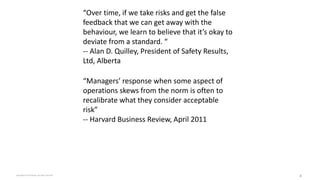
“Over time, if we take risks and get the false
feedback that we can get away with the
behaviour, we learn to believe that it’s okay to
deviate from a standard. “
-- Alan D. Quilley, President of Safety Results,
Ltd, Alberta
“Managers’ response when some aspect of
operations skews from the norm is often to
recalibrate what they consider acceptable
risk”
-- Harvard Business Review, April 2011
Copyright © 2016 Boeing. All rights reserved.
5
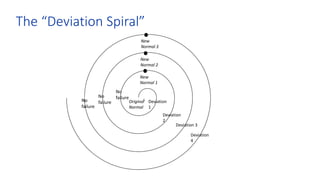
Once you think it becomes acceptable to
deviate from one standard, you can start
thinking it’s acceptable to keep deviating from
it more and more, or start deviating from other
standards.
This can lead to…
6
The “Deviation Spiral”
Deviation
1
Deviation
2
Deviation 3
Deviation
4
Original
Normal
New
Normal 2
New
Normal 1
New
Normal 3
No
failureNo
failureNo
failure
7
Challenger Space Shuttle Disaster, 1986
 Engineers continually observed defects in the rocket booster O-
Rings, but they became treated as an “acceptable risk”, due largely
to schedule pressure, after repeated successful launches
 Launch day was especially cold. Engineers initially issued an
unprecedented “no-launch” recommendation, but were unable to
persuade NASA to cancel the launch
 One component suffered a failure of both primary and backup O-
rings – led to disintegration of the booster rocket and then the
shuttle itself
8
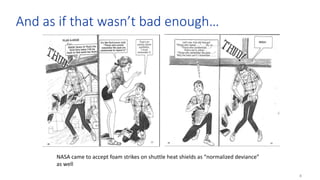
And as if that wasn’t bad enough…
NASA came to accept foam strikes on shuttle heat shields as “normalized deviance”
as well
9
Gulfstream Business Jet crash, 2014
 Jet failed to achieve liftoff, went off the end of the runway
 Gust Lock was engaged
 “the pilots had neglected to perform complete flight control checks
before 98% of their previous 175 takeoffs in the airplane… it is likely
that they decided to skip the [flight control] check at some point in
the past and that doing so had become their accepted practice.” –
NTSB accident report
 One source concluded the pilots likely had adopted a pattern of
neglecting more and more checks over time. None of the standard
checks had been performed prior to takeoff.
Go to model
10
Carbide Industries, 2011
• Manufacturing furnace explosion at Louisville, KY plant –
fatalities resulted
• US Chemical Safety Board incident report included an
entire section on “Normalization of Deviance” as a cause
• “…because Carbide did not thoroughly determine the root
causes of the blows [over-pressure incidents that occurred in
1991 and 2004] and eliminate them, the occurrence became
normalized in the day-to-day operations of the facility…CSB
interviews verified that furnace blows were considered normal”
11
Causes (of Normalization of Deviant Practices)
 A belief that “rules are stupid and inefficient”.
 Belief that work goals are best met by breaking rule(s)
 Imperfect knowledge of standards
 Fear of speaking up
Source: The normalization of deviance in healthcare delivery. Banja, J. 2010
12
What Can We Do About It?
(Mullane)
• Recognize your vulnerability -- “If it can happen to NASA, it can happen
to anyone.”
• “Plan the work and work the plan.”
• Listen to people closest to the issue.
• Archive and periodically review near-misses and disasters so the
corporate “safety” memory never fades.

The Normalization of Deviance

  • 1.
    The Normalization ofDeviance Robert Rosen 8/4/2016
  • 2.
    2 Original source • TheChallenger launch decision : risky technology, culture, and deviance at NASA Diane Vaughan, Professor of Sociology at Boston College, 1996
  • 3.
    3 Definition “The gradual processthrough which unacceptable practice or standards become [treated as] acceptable. As the deviant behavior is repeated without catastrophic results, it becomes the social norm for the organization.”
  • 4.
    Copyright © 2016Boeing. All rights reserved. 4 “Over time, if we take risks and get the false feedback that we can get away with the behaviour, we learn to believe that it’s okay to deviate from a standard. “ -- Alan D. Quilley, President of Safety Results, Ltd, Alberta “Managers’ response when some aspect of operations skews from the norm is often to recalibrate what they consider acceptable risk” -- Harvard Business Review, April 2011
  • 5.
    Copyright © 2016Boeing. All rights reserved. 5 Once you think it becomes acceptable to deviate from one standard, you can start thinking it’s acceptable to keep deviating from it more and more, or start deviating from other standards. This can lead to…
  • 6.
    6 The “Deviation Spiral” Deviation 1 Deviation 2 Deviation3 Deviation 4 Original Normal New Normal 2 New Normal 1 New Normal 3 No failureNo failureNo failure
  • 7.
    7 Challenger Space ShuttleDisaster, 1986  Engineers continually observed defects in the rocket booster O- Rings, but they became treated as an “acceptable risk”, due largely to schedule pressure, after repeated successful launches  Launch day was especially cold. Engineers initially issued an unprecedented “no-launch” recommendation, but were unable to persuade NASA to cancel the launch  One component suffered a failure of both primary and backup O- rings – led to disintegration of the booster rocket and then the shuttle itself
  • 8.
    8 And as ifthat wasn’t bad enough… NASA came to accept foam strikes on shuttle heat shields as “normalized deviance” as well
  • 9.
    9 Gulfstream Business Jetcrash, 2014  Jet failed to achieve liftoff, went off the end of the runway  Gust Lock was engaged  “the pilots had neglected to perform complete flight control checks before 98% of their previous 175 takeoffs in the airplane… it is likely that they decided to skip the [flight control] check at some point in the past and that doing so had become their accepted practice.” – NTSB accident report  One source concluded the pilots likely had adopted a pattern of neglecting more and more checks over time. None of the standard checks had been performed prior to takeoff. Go to model
  • 10.
    10 Carbide Industries, 2011 •Manufacturing furnace explosion at Louisville, KY plant – fatalities resulted • US Chemical Safety Board incident report included an entire section on “Normalization of Deviance” as a cause • “…because Carbide did not thoroughly determine the root causes of the blows [over-pressure incidents that occurred in 1991 and 2004] and eliminate them, the occurrence became normalized in the day-to-day operations of the facility…CSB interviews verified that furnace blows were considered normal”
  • 11.
    11 Causes (of Normalizationof Deviant Practices)  A belief that “rules are stupid and inefficient”.  Belief that work goals are best met by breaking rule(s)  Imperfect knowledge of standards  Fear of speaking up Source: The normalization of deviance in healthcare delivery. Banja, J. 2010
  • 12.
    12 What Can WeDo About It? (Mullane) • Recognize your vulnerability -- “If it can happen to NASA, it can happen to anyone.” • “Plan the work and work the plan.” • Listen to people closest to the issue. • Archive and periodically review near-misses and disasters so the corporate “safety” memory never fades.

Editor's Notes

  • #3 Date and Time
  • #5 The Quilley quote is especially relevant when results can be catastrophic (e.g. major workplace injuries), but such occurrences are rare. i.e. when repeated violations don’t result in catastrophe, the end result becomes redefining success What they may have actually done is made a 1-in-100,000 chance into a 1-in-1,000 or even 1-in-100 chance
  • #7 This graph shows deviation going in the outward direction. Might have been appropriate to show it inward to show a “whirlpool effect” Deviation = deviation from established rules or results If no failure results, then (over time) the “new normal” shifts one level out from the center New Normal 3 appears only a small step from previous normal (New Normal 2) to the perpetrators, but is actually much larger (from center) Key element here is a gradual and continuous drift away from true normal
  • #8 A case of successful outcomes deceiving engineers and NASA into believing that O-ring damage was much less dangerous than it actually was. Because it was new technology and experience, engineers developed a high level of risk tolerance. When shuttle launches were successful in spite of deviations and defects, those deviations and defects became increasingly accepted as normal. Once you go to a new norm, it’s hard to get back to the old one Very similar behavior occurred with the Columbia with regard to damage from foam strikes on heat shield tiles
  • #9 Columbia shuttle disaster 2003 – shuttle broke up on re-entry after a foam strike damaged it during launch
  • #10 A gust lock locks various controls on an aircraft to prevent undesired movements due to wind gusts while the plane is parked. The plane cannot fly if those controls are locked. These were experienced pilots
  • #11 Not quite the model of “gradual and continuous drift away from true normal”
  • #12 Imperfect knowledge may be of the job or of the rules. People may not realize that a common practice is actually a deviation. Even experienced people can get the mistaken belief that they know everything. Thus the “justification” for breaking a rule can be merely apparent. Although in “The Emperor’s New Clothes”, it was the little boy who pointed out that the emperor had nothing on, new/inexperienced workers are more likely to think “Who am I to say that the emperor has nothing on?” For example, the ethics recommitment scene where a new worker in the group was told that it was standard practice in the group to share a badge in the machine login, even through procedure said to use your own badge Video example is also example of “having justifications”
  • #13 Mike Mullane is a retired shuttle astronaut who has become a speaker on safety in hazardous environments. On one of his shuttle missions, the shuttle experienced a “near-miss” where an O-ring failed and allowed fuel leakage but the shuttle was saved by the backup O-ring Mullane himself would probably understand that it isn’t easy for the new kid on the block to speak up -- speaks about one of his own experiences as a trainee on a flight when he realized that the pilot had exceeded the aircraft fuel range, but said nothing because he was sure that the experienced pilot must have known what he was doing. The plane ran out of gas and crashed, and the two pilots survived only by ejecting from the aircraft. “Plan the work and work the plan.” – “Train at the best practice level and make sure leaders maintain best practice standards.” “Listen to people closest to the issue.” – i.e. don’t do what NASA did