The New Distributed
Application Infrastructure
Gordon Haff @ghaff
Technology Evangelist
Red Hat
About	me
• Red	Hat	Technology	Evangelist
• Twitter:	@ghaff
• Google+:	Gordon	Haff
• Flickr:	bitmason
• Email:	ghaff@redhat.com
• Blog:	http://bitmason.blogspot.com
• Author:	Computing	Next
• Formerly:	Illuminata(industry	analyst)Data	
General	(minicomputers/Unix/NUMA/etc.)
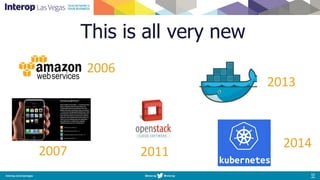
This is all very new
2007 2011
2013
2014
2006
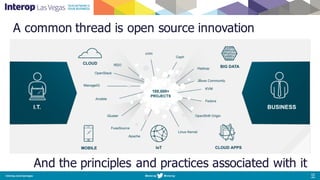
A common thread is open source innovation
And the principles and practices associated with it
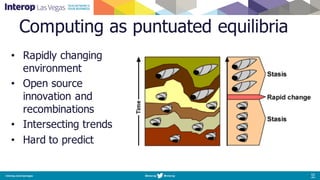
Computing as puntuated equilibria
• Rapidly changing
environment
• Open source
innovation and
recombinations
• Intersecting trends
• Hard to predict
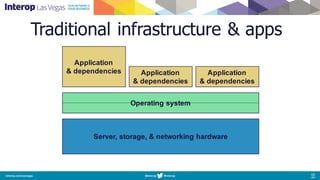
Traditional infrastructure & apps
Server, storage, & networking hardware
Operating system
Application
& dependencies Application
& dependencies
Application
& dependencies
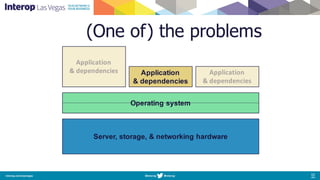
(One of) the problems
Server, storage, & networking hardware
Operating system
Application
&	dependencies Application
& dependencies
Application
&	dependencies
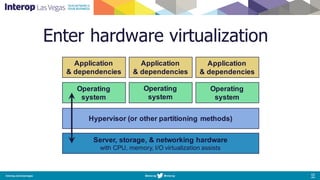
Enter hardware virtualization
Server, storage, & networking hardware
with CPU, memory, I/O virtualization assists
Hypervisor (or other partitioning methods)
Application
& dependencies
Application
& dependencies
Application
& dependencies
Operating
system
Operating
system
Operating
system
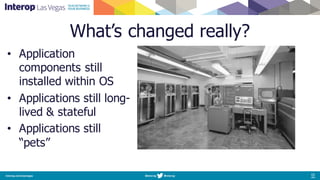
What’s changed really?
• Application
components still
installed within OS
• Applications still long-
lived & stateful
• Applications still
“pets”
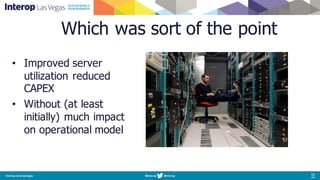
Which was sort of the point
• Improved server
utilization reduced
CAPEX
• Without (at least
initially) much impact
on operational model
2006
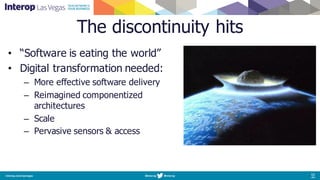
The discontinuity hits
• “Software is eating the world”
• Digital transformation needed:
– More effective software delivery
– Reimagined componentized
architectures
– Scale
– Pervasive sensors & access
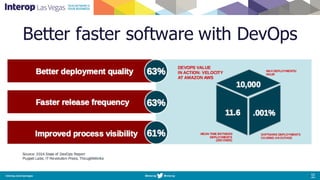
Better faster software with DevOps
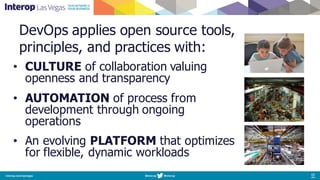
DevOps applies open source tools,
principles, and practices with:
• CULTURE of collaboration valuing
openness and transparency
• AUTOMATION of process from
development through ongoing
operations
• An evolving PLATFORM that optimizes
for flexible, dynamic workloads
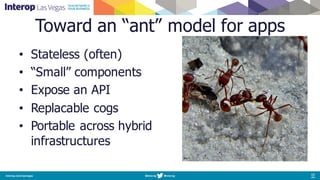
Toward an “ant” model for apps
• Stateless (often)
• “Small” components
• Expose an API
• Replacable cogs
• Portable across hybrid
infrastructures
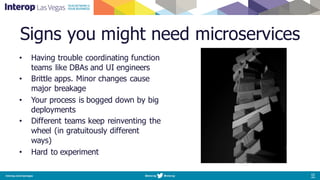
Signs you might need microservices
• Having trouble coordinating function
teams like DBAs and UI engineers
• Brittle apps. Minor changes cause
major breakage
• Your process is bogged down by big
deployments
• Different teams keep reinventing the
wheel (in gratuitously different
ways)
• Hard to experiment
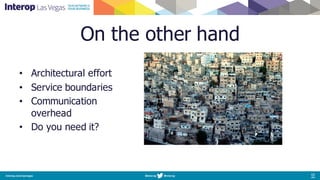
On the other hand
• Architectural effort
• Service boundaries
• Communication
overhead
• Do you need it?
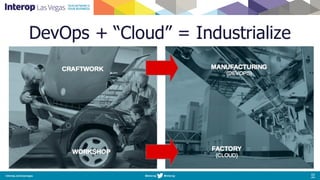
DevOps + “Cloud” = Industrialize
What does this factory
look like?
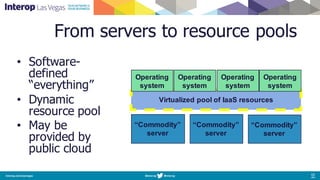
From servers to resource pools
• Software-
defined
“everything”
• Dynamic
resource pool
• May be
provided by
public cloud
Virtualized pool of IaaS resources
“Commodity”
server
“Commodity”
server
“Commodity”
server
Operating
system
Operating
system
Operating
system
Operating
system
Software-defined storage
Software-defined networking/NFV
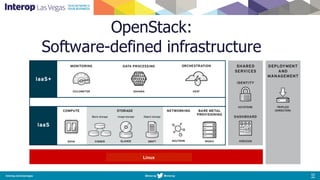
OpenStack:
Software-defined infrastructure
Linux
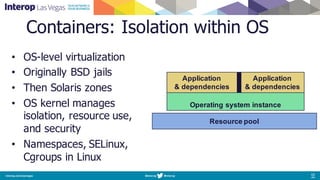
Containers: Isolation within OS
• OS-level virtualization
• Originally BSD jails
• Then Solaris zones
• OS kernel manages
isolation, resource use,
and security
• Namespaces, SELinux,
Cgroups in Linux
Operating system instance
Application
& dependencies
Application
& dependencies
Resource pool
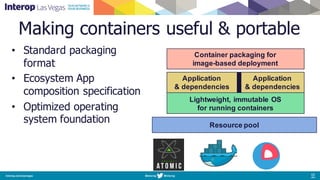
Making containers useful & portable
• Standard packaging
format
• Ecosystem App
composition specification
• Optimized operating
system foundation
Lightweight, immutable OS
for running containers
Application
& dependencies
Application
& dependencies
Resource pool
Container packaging for
image-based deployment
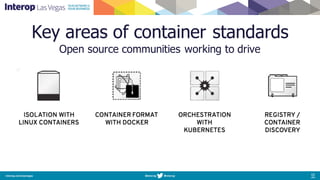
Key areas of container standards
Open source communities working to drive
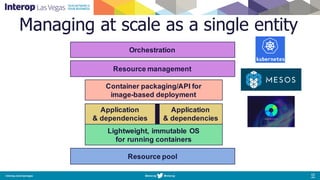
Managing at scale as a single entity
Lightweight, immutable OS
for running containers
Application
& dependencies
Application
& dependencies
Resource pool
Container packaging/API for
image-based deployment
Resource management
Orchestration
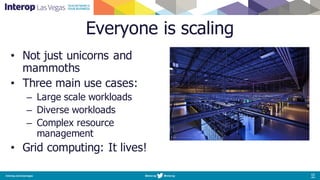
Everyone is scaling
• Not just unicorns and
mammoths
• Three main use cases:
– Large scale workloads
– Diverse workloads
– Complex resource
management
• Grid computing: It lives!
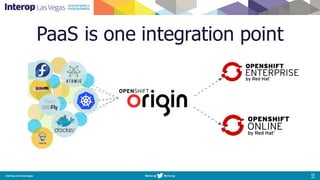
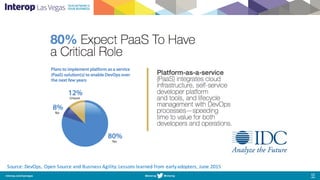
PaaS is one integration point
Source:	DevOps,	Open	Source	and	Business	Agility:	Lessons	learned	from	early	adopters,	June	2015
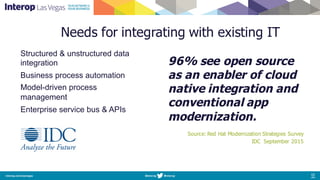
Needs for integrating with existing IT
96% see open source
as an enabler of cloud
native integration and
conventional app
modernization.
Source: Red Hat Modernization Strategies Survey
IDC September 2015
Structured & unstructured data
integration
Business process automation
Model-driven process
management
Enterprise service bus & APIs
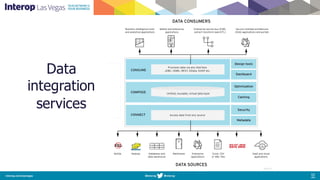
Data
integration
services
Some open questions
• Role of hardware virtualization
• On-premise vs. public cloud trends
• Monoliths vs. Microservices
• The post-NIST service model
• When/where/how is data useful?
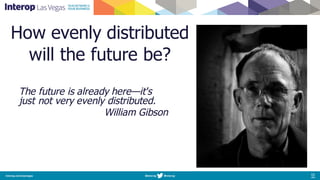
How evenly distributed
will the future be?
The future is already here—it's
just not very evenly distributed.
William Gibson
Credits
Fractal: https://www.flickr.com/photos/fractal_ken/3996156539/Flickr Creative Commons license
Punctuated equilibrium:University of California atBerkeley
Mainframe:"IBM 704 mainframe"by Lawrence Livermore National Laboratory.Licensed under Attribution via Commons
- https://commons.wikimedia.org/wiki/File:IBM_704_mainframe.gif#/media/File:IBM_704_mainframe.gif
Ants: https://www.flickr.com/photos/pondapple/6502194585 Flickr Creative Commons license
Meteor, galaxy: NASA
Datacenter:Google
Dogs: https://www.flickr.com/photos/ulster/3250246355 Flickr Creative Commons license
Aircraft factory: Flickr/cc, https://www.flickr.com/photos/jetstarairways/9130160595Kids programming:Esti Alvarez cc
license
Auto factory: CopyrightTesla
Tower: Daniel Pratts CC/flickr https://flic.kr/p/7RE6yc
Frog: Kathy CC/Flickr https://flic.kr/p/b9fFV
Coupling graphic:PWC
Buildings:CC/Flickr https://www.flickr.com/photos/firstdown/2456119103
Thank	you!

The New Open Distributed Application Architecture

  • 1.
    The New Distributed ApplicationInfrastructure Gordon Haff @ghaff Technology Evangelist Red Hat
  • 2.
    About me • Red Hat Technology Evangelist • Twitter: @ghaff •Google+: Gordon Haff • Flickr: bitmason • Email: ghaff@redhat.com • Blog: http://bitmason.blogspot.com • Author: Computing Next • Formerly: Illuminata(industry analyst)Data General (minicomputers/Unix/NUMA/etc.)
  • 3.
    This is allvery new 2007 2011 2013 2014 2006
  • 4.
    A common threadis open source innovation And the principles and practices associated with it
  • 5.
    Computing as puntuatedequilibria • Rapidly changing environment • Open source innovation and recombinations • Intersecting trends • Hard to predict
  • 6.
    Traditional infrastructure &apps Server, storage, & networking hardware Operating system Application & dependencies Application & dependencies Application & dependencies
  • 7.
    (One of) theproblems Server, storage, & networking hardware Operating system Application & dependencies Application & dependencies Application & dependencies
  • 8.
    Enter hardware virtualization Server,storage, & networking hardware with CPU, memory, I/O virtualization assists Hypervisor (or other partitioning methods) Application & dependencies Application & dependencies Application & dependencies Operating system Operating system Operating system
  • 9.
    What’s changed really? •Application components still installed within OS • Applications still long- lived & stateful • Applications still “pets”
  • 10.
    Which was sortof the point • Improved server utilization reduced CAPEX • Without (at least initially) much impact on operational model 2006
  • 12.
    The discontinuity hits •“Software is eating the world” • Digital transformation needed: – More effective software delivery – Reimagined componentized architectures – Scale – Pervasive sensors & access
  • 13.
  • 14.
    DevOps applies opensource tools, principles, and practices with: • CULTURE of collaboration valuing openness and transparency • AUTOMATION of process from development through ongoing operations • An evolving PLATFORM that optimizes for flexible, dynamic workloads
  • 15.
    Toward an “ant”model for apps • Stateless (often) • “Small” components • Expose an API • Replacable cogs • Portable across hybrid infrastructures
  • 16.
    Signs you mightneed microservices • Having trouble coordinating function teams like DBAs and UI engineers • Brittle apps. Minor changes cause major breakage • Your process is bogged down by big deployments • Different teams keep reinventing the wheel (in gratuitously different ways) • Hard to experiment
  • 17.
    On the otherhand • Architectural effort • Service boundaries • Communication overhead • Do you need it?
  • 18.
    DevOps + “Cloud”= Industrialize
  • 19.
    What does thisfactory look like?
  • 20.
    From servers toresource pools • Software- defined “everything” • Dynamic resource pool • May be provided by public cloud Virtualized pool of IaaS resources “Commodity” server “Commodity” server “Commodity” server Operating system Operating system Operating system Operating system Software-defined storage Software-defined networking/NFV
  • 21.
  • 22.
    Containers: Isolation withinOS • OS-level virtualization • Originally BSD jails • Then Solaris zones • OS kernel manages isolation, resource use, and security • Namespaces, SELinux, Cgroups in Linux Operating system instance Application & dependencies Application & dependencies Resource pool
  • 23.
    Making containers useful& portable • Standard packaging format • Ecosystem App composition specification • Optimized operating system foundation Lightweight, immutable OS for running containers Application & dependencies Application & dependencies Resource pool Container packaging for image-based deployment
  • 24.
    Key areas ofcontainer standards Open source communities working to drive
  • 25.
    Managing at scaleas a single entity Lightweight, immutable OS for running containers Application & dependencies Application & dependencies Resource pool Container packaging/API for image-based deployment Resource management Orchestration
  • 26.
    Everyone is scaling •Not just unicorns and mammoths • Three main use cases: – Large scale workloads – Diverse workloads – Complex resource management • Grid computing: It lives!
  • 27.
    PaaS is oneintegration point
  • 28.
  • 29.
    Needs for integratingwith existing IT 96% see open source as an enabler of cloud native integration and conventional app modernization. Source: Red Hat Modernization Strategies Survey IDC September 2015 Structured & unstructured data integration Business process automation Model-driven process management Enterprise service bus & APIs
  • 30.
  • 31.
    Some open questions •Role of hardware virtualization • On-premise vs. public cloud trends • Monoliths vs. Microservices • The post-NIST service model • When/where/how is data useful?
  • 32.
    How evenly distributed willthe future be? The future is already here—it's just not very evenly distributed. William Gibson
  • 33.
    Credits Fractal: https://www.flickr.com/photos/fractal_ken/3996156539/Flickr CreativeCommons license Punctuated equilibrium:University of California atBerkeley Mainframe:"IBM 704 mainframe"by Lawrence Livermore National Laboratory.Licensed under Attribution via Commons - https://commons.wikimedia.org/wiki/File:IBM_704_mainframe.gif#/media/File:IBM_704_mainframe.gif Ants: https://www.flickr.com/photos/pondapple/6502194585 Flickr Creative Commons license Meteor, galaxy: NASA Datacenter:Google Dogs: https://www.flickr.com/photos/ulster/3250246355 Flickr Creative Commons license Aircraft factory: Flickr/cc, https://www.flickr.com/photos/jetstarairways/9130160595Kids programming:Esti Alvarez cc license Auto factory: CopyrightTesla Tower: Daniel Pratts CC/flickr https://flic.kr/p/7RE6yc Frog: Kathy CC/Flickr https://flic.kr/p/b9fFV Coupling graphic:PWC Buildings:CC/Flickr https://www.flickr.com/photos/firstdown/2456119103
  • 34.