Second Stage 
Cloud 
JAMES STATEN VP & ANALYST | FORRESTER RESEARCH | @Staten7
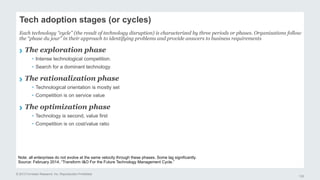
Tech adoption stages (or cycles) 
Each technology “cycle” (the result of technology disruption) is characterized by three periods or phases. Organizations follow 
the “phase du jour” in their approach to identifying problems and provide answers to business requirements 
› The exploration phase 
© 2013 Forrester Research, Inc. Reproduction Prohibited 
122 
• Intense technological competition. 
• Search for a dominant technology 
› The rationalization phase 
• Technological orientation is mostly set 
• Competition is on service value 
› The optimization phase 
• Technology is second, value first 
• Competition is on cost/value ratio 
Note: all enterprises do not evolve at the same velocity through these phases. Some lag significantly. 
Source: February 2014, “Transform I&O For the Future Technology Management Cycle.”
© 2013 Forrester Research, Inc. Reproduction Prohibited 
123 
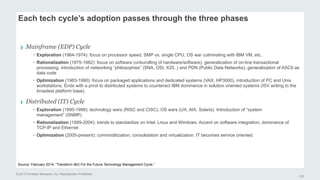
Each tech cycle’s adoption passes through the three phases 
› Mainframe (EDP) Cycle 
• Exploration (1964-1974): focus on processor speed, SMP vs. single CPU, OS war culminating with IBM VM, etc.. 
• Rationalization (1975-1982): focus on software (unbundling of hardware/software), generalization of on-line transactional 
processing, introduction of networking “philosophies” (SNA, OSI, X25..) and PDN (Public Data Networks), generalization of ASCII as 
data code 
• Optimization (1983-1990): focus on packaged applications and dedicated systems (VAX, HP3000), introduction of PC and Unix 
workstations. Ends with a pivot to distributed systems to counteract IBM dominance in solution oriented systems (ISV writing to the 
broadest platform base). 
› Distributed (IT) Cycle 
• Exploration (1990-1998): technology wars (RISC and CISC), OS wars (UX, AIX, Solaris). Introduction of “system 
management” (SNMP) 
• Rationalization (1999-2004): trends to standardize on Intel, Linux and Windows. Accent on software integration, dominance of 
TCP-IP and Ethernet 
• Optimization (2005-present): commoditization, consolidation and virtualization. IT becomes service oriented. 
Source: February 2014, “Transform I&O For the Future Technology Management Cycle.”
© 2013 Forrester Research, Inc. Reproduction Prohibited 
124 
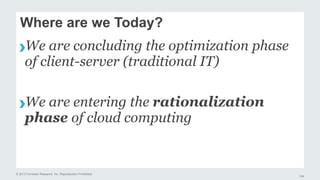
Where are we Today? 
›We are concluding the optimization phase 
of client-server (traditional IT) 
! 
›We are entering the rationalization 
phase of cloud computing
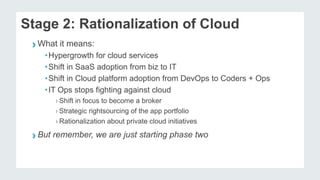
Stage 2: Rationalization of Cloud 
›What it means: 
•Hypergrowth for cloud services 
•Shift in SaaS adoption from biz to IT 
•Shift in Cloud platform adoption from DevOps to Coders + Ops 
•IT Ops stops fighting against cloud 
› Shift in focus to become a broker 
› Strategic rightsourcing of the app portfolio 
› Rationalization about private cloud initiatives 
› But remember, we are just starting phase two
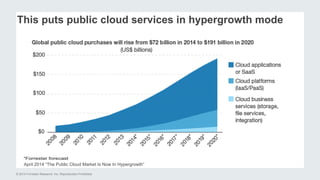
This puts public cloud services in hypergrowth mode 
April 2014 “The Public Cloud Market Is Now In Hypergrowth” 
© 2014 Forrester Research, Inc. Reproduction Prohibited
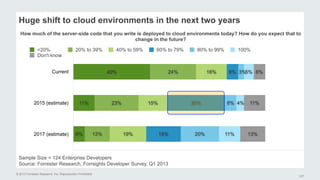
How much of the server-side code that you write is deployed to cloud environments today? How do you expect that to 
<20% 20% to 39% 40% to 59% 60% to 79% 80% to 99% 100% 
Don't know 
Current 
2015 (estimate) 
6% 
11% 
2017 (estimate) 13% 
© 2013 Forrester Research, Inc. Reproduction Prohibited 
127 
Huge shift to cloud environments in the next two years 
change in the future? 
Source: Forrester Research, Forrsights Developer Survey, Q1 2013 
11% 
11% 
4% 
5% 
20% 
6% 
3% 
18% 
30% 
6% 
19% 
15% 
16% 
13% 
23% 
24% 
6% 
40% 
Sample Size = 124 Enterprise Developers
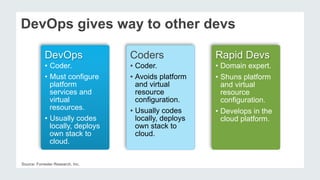
DevOps gives way to other devs 
DevOps 
• Coder. 
• Must configure 
platform 
services and 
virtual 
resources. 
• Usually codes 
locally, deploys 
own stack to 
cloud. 
Source: Forrester Research, Inc. 
Coders 
• Coder. 
• Avoids platform 
and virtual 
resource 
configuration. 
• Usually codes 
locally, deploys 
own stack to 
cloud. 
Rapid Devs 
• Domain expert. 
• Shuns platform 
and virtual 
resource 
configuration. 
• Develops in the 
cloud platform.
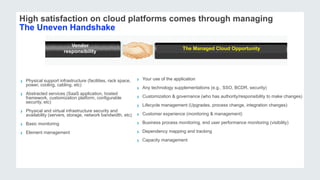
High satisfaction on cloud platforms comes through managing 
The Uneven Handshake 
Vendor 
responsibility 
Customer responsibility 
› Physical support infrastructure (facilities, rack space, 
power, cooling, cabling, etc) 
› Abstracted services (SaaS application, hosted 
framework, customization platform, configurable 
security, etc) 
› Physical and virtual infrastructure security and 
availability (servers, storage, network bandwidth, etc) 
› Basic monitoring 
› Element management 
The Managed Cloud Opportunity 
› Your use of the application 
› Any technology supplementations (e.g., SSO, BCDR, security) 
› Customization & governance (who has authority/responsibility to make changes) 
› Lifecycle management (Upgrades, process change, integration changes) 
› Customer experience (monitoring & management) 
› Business process monitoring, end user performance monitoring (visibility) 
› Dependency mapping and tracking 
› Capacity management
Thank you
Rackspace::Solve NYC - Second Stage Cloud

Rackspace::Solve NYC - Second Stage Cloud

  • 1.
    Second Stage Cloud JAMES STATEN VP & ANALYST | FORRESTER RESEARCH | @Staten7
  • 2.
    Tech adoption stages(or cycles) Each technology “cycle” (the result of technology disruption) is characterized by three periods or phases. Organizations follow the “phase du jour” in their approach to identifying problems and provide answers to business requirements › The exploration phase © 2013 Forrester Research, Inc. Reproduction Prohibited 122 • Intense technological competition. • Search for a dominant technology › The rationalization phase • Technological orientation is mostly set • Competition is on service value › The optimization phase • Technology is second, value first • Competition is on cost/value ratio Note: all enterprises do not evolve at the same velocity through these phases. Some lag significantly. Source: February 2014, “Transform I&O For the Future Technology Management Cycle.”
  • 3.
    © 2013 ForresterResearch, Inc. Reproduction Prohibited 123 Each tech cycle’s adoption passes through the three phases › Mainframe (EDP) Cycle • Exploration (1964-1974): focus on processor speed, SMP vs. single CPU, OS war culminating with IBM VM, etc.. • Rationalization (1975-1982): focus on software (unbundling of hardware/software), generalization of on-line transactional processing, introduction of networking “philosophies” (SNA, OSI, X25..) and PDN (Public Data Networks), generalization of ASCII as data code • Optimization (1983-1990): focus on packaged applications and dedicated systems (VAX, HP3000), introduction of PC and Unix workstations. Ends with a pivot to distributed systems to counteract IBM dominance in solution oriented systems (ISV writing to the broadest platform base). › Distributed (IT) Cycle • Exploration (1990-1998): technology wars (RISC and CISC), OS wars (UX, AIX, Solaris). Introduction of “system management” (SNMP) • Rationalization (1999-2004): trends to standardize on Intel, Linux and Windows. Accent on software integration, dominance of TCP-IP and Ethernet • Optimization (2005-present): commoditization, consolidation and virtualization. IT becomes service oriented. Source: February 2014, “Transform I&O For the Future Technology Management Cycle.”
  • 4.
    © 2013 ForresterResearch, Inc. Reproduction Prohibited 124 Where are we Today? ›We are concluding the optimization phase of client-server (traditional IT) ! ›We are entering the rationalization phase of cloud computing
  • 5.
    Stage 2: Rationalizationof Cloud ›What it means: •Hypergrowth for cloud services •Shift in SaaS adoption from biz to IT •Shift in Cloud platform adoption from DevOps to Coders + Ops •IT Ops stops fighting against cloud › Shift in focus to become a broker › Strategic rightsourcing of the app portfolio › Rationalization about private cloud initiatives › But remember, we are just starting phase two
  • 6.
    This puts publiccloud services in hypergrowth mode April 2014 “The Public Cloud Market Is Now In Hypergrowth” © 2014 Forrester Research, Inc. Reproduction Prohibited
  • 7.
    How much ofthe server-side code that you write is deployed to cloud environments today? How do you expect that to <20% 20% to 39% 40% to 59% 60% to 79% 80% to 99% 100% Don't know Current 2015 (estimate) 6% 11% 2017 (estimate) 13% © 2013 Forrester Research, Inc. Reproduction Prohibited 127 Huge shift to cloud environments in the next two years change in the future? Source: Forrester Research, Forrsights Developer Survey, Q1 2013 11% 11% 4% 5% 20% 6% 3% 18% 30% 6% 19% 15% 16% 13% 23% 24% 6% 40% Sample Size = 124 Enterprise Developers
  • 8.
    DevOps gives wayto other devs DevOps • Coder. • Must configure platform services and virtual resources. • Usually codes locally, deploys own stack to cloud. Source: Forrester Research, Inc. Coders • Coder. • Avoids platform and virtual resource configuration. • Usually codes locally, deploys own stack to cloud. Rapid Devs • Domain expert. • Shuns platform and virtual resource configuration. • Develops in the cloud platform.
  • 9.
    High satisfaction oncloud platforms comes through managing The Uneven Handshake Vendor responsibility Customer responsibility › Physical support infrastructure (facilities, rack space, power, cooling, cabling, etc) › Abstracted services (SaaS application, hosted framework, customization platform, configurable security, etc) › Physical and virtual infrastructure security and availability (servers, storage, network bandwidth, etc) › Basic monitoring › Element management The Managed Cloud Opportunity › Your use of the application › Any technology supplementations (e.g., SSO, BCDR, security) › Customization & governance (who has authority/responsibility to make changes) › Lifecycle management (Upgrades, process change, integration changes) › Customer experience (monitoring & management) › Business process monitoring, end user performance monitoring (visibility) › Dependency mapping and tracking › Capacity management
  • 10.