CONTAINERS:CONTAINERS:
DON'T SKEU THEM UPDON'T SKEU THEM UP
USE MICROSERVICES INSTEADUSE MICROSERVICES INSTEAD
Gordon Haff, Cloud Product Strategy @ghaff
William Henry, DevOps Strategy @ipbabble
7 October 2015
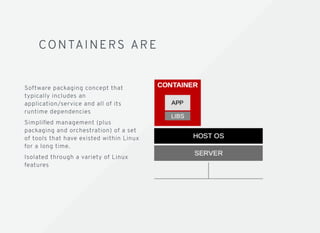
CONTAINERS ARECONTAINERS ARE
Software packaging concept that
typically includes an
application/service and all of its
runtime dependencies
Simplified management (plus
packaging and orchestration) of a set
of tools that have existed within Linux
for a long time.
Isolated through a variety of Linux
features
BUT CONTAINERS ARE NOTBUT CONTAINERS ARE NOT
Server virtualization
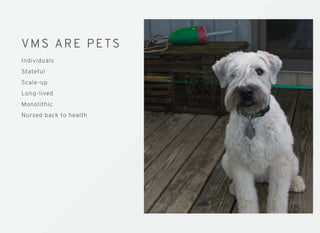
VMS ARE PETSVMS ARE PETS
Individuals
Stateful
Scale-up
Long-lived
Monolithic
Nursed back to health
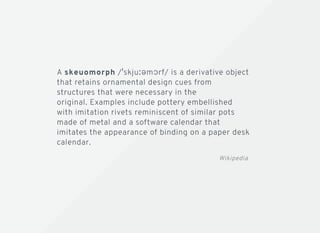
A skeuomorph / skjuːəmɔrf/ is a derivative object
that retains ornamental design cues from
structures that were necessary in the
original. Examples include pottery embellished
with imitation rivets reminiscent of similar pots
made of metal and a software calendar that
imitates the appearance of binding on a paper desk
calendar.
Wikipedia
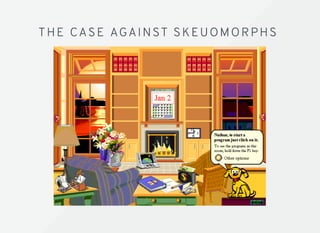
THE CASE AGAINST SKEUOMORPHSTHE CASE AGAINST SKEUOMORPHS
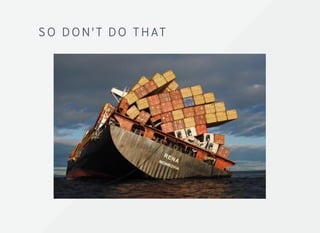
SO DO N'T D O THATSO DO N'T D O THAT
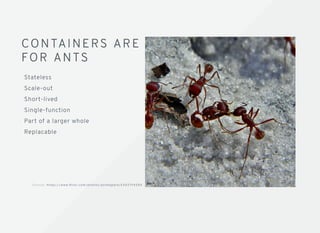
CO NTAINERS AR ECO NTAINERS AR E
FOR ANTSFOR ANTS
Stateless
Scale-out
Short-lived
Single-function
Part of a larger whole
Replacable
S o u rc e : h t t p s : / / w w w. fli c k r .c o m /p h o t o s /p o n d a p p l e/ 6 5 0 2 1 9 4 5 8 5
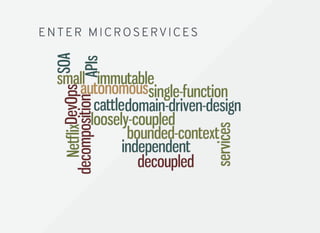
ENTER MICROSERVICESENTER MICROSERVICES
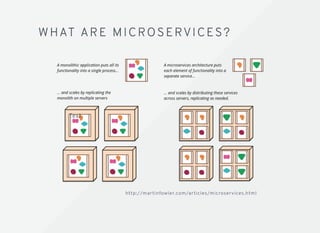
WHAT ARE MICROSERVICES?WHAT ARE MICROSERVICES?
TextText
http://martinfowler.com/articles/microservices.html
IS N'T T HIS J UST...IS N'T T HIS J UST...
S o u rc e : T I B C O
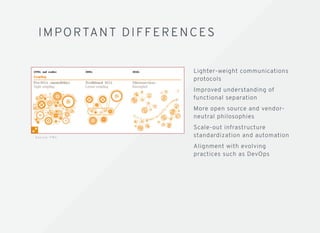
IMPORTAN T DI FF ER ENCESIMPORTAN T DI FF ER ENCES
S o u rc e : P W C
Lighter-weight communications
protocols
Improved understanding of
functional separation
More open source and vendor-
neutral philosophies
Scale-out infrastructure
standardization and automation
Alignment with evolving
practices such as DevOps
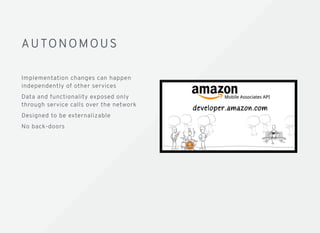
AU TO N O M O U SAU TO N O M O U S
Implementation changes can happen
independently of other services
Data and functionality exposed only
through service calls over the network
Designed to be externalizable
No back-doors
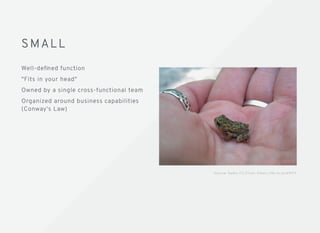
SMALLSMALL
Well-defined function
"Fits in your head"
Owned by a single cross-functional team
Organized around business capabilities
(Conway's Law)
S o u rc e : K a t h y C C / F l i c k r h t t p s : / / fli c . k r /p / b 9 f F V
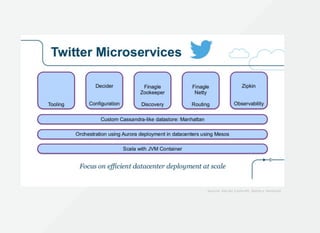
S o u rc e : A d r i a n C o c k ro f t , B a t t e r y Ve n t u re s
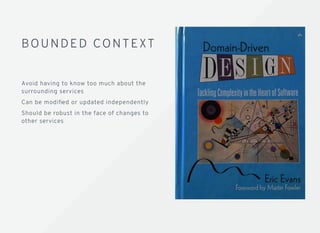
BOUNDED CONTEXTBOUNDED CONTEXT
Avoid having to know too much about the
surrounding services
Can be modified or updated independently
Should be robust in the face of changes to
other services
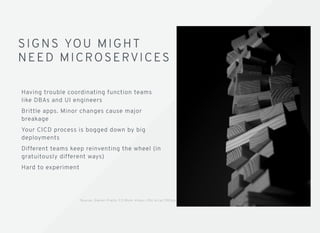
S IGNS YOU MIGHTS IGNS YOU MIGHT
NEED MICROSERVICESNEED MICROSERVICES
Having trouble coordinating function teams
like DBAs and UI engineers
Brittle apps. Minor changes cause major
breakage
Your CICD process is bogged down by big
deployments
Different teams keep reinventing the wheel (in
gratuitously different ways)
Hard to experiment
S o u rc e : D a n i e l P r a t t s C C / fli c k r h t t p s : / / fli c . k r /p / 7 R E 6 y c
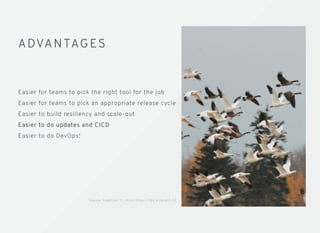
ADVANTAGESADVANTAGES
Easier for teams to pick the right tool for the job
Easier for teams to pick an appropriate release cycle
Easier to build resiliency and scale-out
Easier to do updates and CICD
Easier to do DevOps!
S o u rc e : K e g R i v e r C C / fli c k r h t t p s : / / fli c . k r /p /a t 2 J t 2
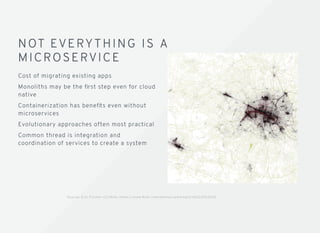
NOT EVERYTHING IS ANOT EVERYTHING IS A
MICROSERVIC EMICROSERVIC E
Cost of migrating existing apps
Monoliths may be the first step even for cloud
native
Containerization has benefits even without
microservices
Evolutionary approaches often most practical
Common thread is integration and
coordination of services to create a system
S o u rc e : E r i c F i s c h e r C C / fli c k r h t t p s : / / w w w. fli c k r .c o m /p h o t o s / w a l k i n g s f / 4 6 2 2 3 76 3 5 6 E
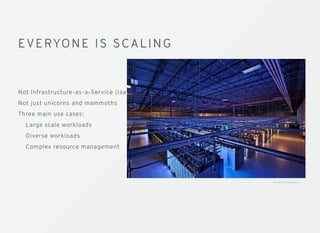
EVERYONE IS SCALINGEVERYONE IS SCALING
Not Infrastructure-as-a-Service (IaaS)
Not just unicorns and mammoths
Three main use cases:
Large scale workloads
Diverse workloads
Complex resource management
S o u rc e : G o o g l e
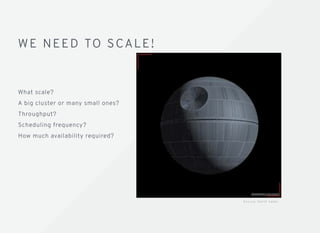
WE NEED TO SCALE!WE NEED TO SCALE!
What scale?
A big cluster or many small ones?
Throughput?
Scheduling frequency?
How much availability required?
S o u rc e : D a r t h Va d e r
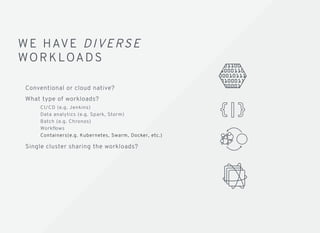
WE HAVEWE HAVE DIVERSEDIVERSE
WORKLOADSWORKLOADS
Conventional or cloud native?
What type of workloads?
CI/CD (e.g. Jenkins)
Data analytics (e.g. Spark, Storm)
Batch (e.g. Chronos)
Workflows
Containers(e.g. Kubernetes, Swarm, Docker, etc.)
Single cluster sharing the workloads?
WE NEED RESOURCEWE NEED RESOURCE
MANAGE M ENTMANAGE M ENT
What policies are needed?
Compliance
Multi-tenancy
Dependency management
Avoiding repeated failures
Persistent volume services
Dynamic reservations
HARD PARTSHARD PARTS
Hardest is political/people
How do you test, deploy and manage?
Untangling existing apps and defining
service boundaries for new ones
Clusters and memory at scale
New availability mechanisms
Emergent behaviors
S o u rc e : K e i t h A l l i s o n C C / fli c k r h t t p s : / / fli c . k r /p /a b G c s9
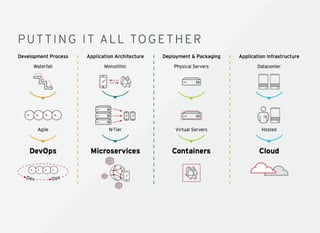
PUTTING IT ALL TOGETHERPUTTING IT ALL TOGETHER
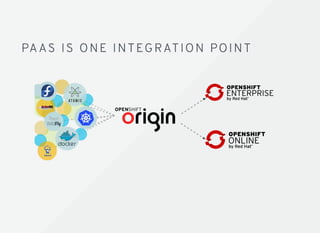
PA AS IS O N E INTEGRAT IO N PO INTPA AS IS O N E INTEGRAT IO N PO INT
TextText
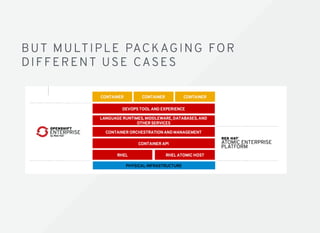
BUT MULTIPLE PACKAGING FORBUT MULTIPLE PACKAGING FOR
DIFFERENT USE CASESDIFFERENT USE CASES
THANK YOU!THANK YOU!

Containers: Don't Skeu Them Up (LinuxCon Dublin)

  • 1.
    CONTAINERS:CONTAINERS: DON'T SKEU THEMUPDON'T SKEU THEM UP USE MICROSERVICES INSTEADUSE MICROSERVICES INSTEAD Gordon Haff, Cloud Product Strategy @ghaff William Henry, DevOps Strategy @ipbabble 7 October 2015
  • 2.
    CONTAINERS ARECONTAINERS ARE Softwarepackaging concept that typically includes an application/service and all of its runtime dependencies Simplified management (plus packaging and orchestration) of a set of tools that have existed within Linux for a long time. Isolated through a variety of Linux features
  • 3.
    BUT CONTAINERS ARENOTBUT CONTAINERS ARE NOT Server virtualization
  • 4.
    VMS ARE PETSVMSARE PETS Individuals Stateful Scale-up Long-lived Monolithic Nursed back to health
  • 5.
    A skeuomorph /skjuːəmɔrf/ is a derivative object that retains ornamental design cues from structures that were necessary in the original. Examples include pottery embellished with imitation rivets reminiscent of similar pots made of metal and a software calendar that imitates the appearance of binding on a paper desk calendar. Wikipedia
  • 6.
    THE CASE AGAINSTSKEUOMORPHSTHE CASE AGAINST SKEUOMORPHS
  • 7.
    SO DO N'TD O THATSO DO N'T D O THAT
  • 8.
    CO NTAINERS ARECO NTAINERS AR E FOR ANTSFOR ANTS Stateless Scale-out Short-lived Single-function Part of a larger whole Replacable S o u rc e : h t t p s : / / w w w. fli c k r .c o m /p h o t o s /p o n d a p p l e/ 6 5 0 2 1 9 4 5 8 5
  • 9.
  • 10.
    WHAT ARE MICROSERVICES?WHATARE MICROSERVICES? TextText http://martinfowler.com/articles/microservices.html
  • 11.
    IS N'T THIS J UST...IS N'T T HIS J UST... S o u rc e : T I B C O
  • 13.
    IMPORTAN T DIFF ER ENCESIMPORTAN T DI FF ER ENCES S o u rc e : P W C Lighter-weight communications protocols Improved understanding of functional separation More open source and vendor- neutral philosophies Scale-out infrastructure standardization and automation Alignment with evolving practices such as DevOps
  • 14.
    AU TO NO M O U SAU TO N O M O U S Implementation changes can happen independently of other services Data and functionality exposed only through service calls over the network Designed to be externalizable No back-doors
  • 15.
    SMALLSMALL Well-defined function "Fits inyour head" Owned by a single cross-functional team Organized around business capabilities (Conway's Law) S o u rc e : K a t h y C C / F l i c k r h t t p s : / / fli c . k r /p / b 9 f F V
  • 16.
    S o urc e : A d r i a n C o c k ro f t , B a t t e r y Ve n t u re s
  • 17.
    BOUNDED CONTEXTBOUNDED CONTEXT Avoidhaving to know too much about the surrounding services Can be modified or updated independently Should be robust in the face of changes to other services
  • 18.
    S IGNS YOUMIGHTS IGNS YOU MIGHT NEED MICROSERVICESNEED MICROSERVICES Having trouble coordinating function teams like DBAs and UI engineers Brittle apps. Minor changes cause major breakage Your CICD process is bogged down by big deployments Different teams keep reinventing the wheel (in gratuitously different ways) Hard to experiment S o u rc e : D a n i e l P r a t t s C C / fli c k r h t t p s : / / fli c . k r /p / 7 R E 6 y c
  • 19.
    ADVANTAGESADVANTAGES Easier for teamsto pick the right tool for the job Easier for teams to pick an appropriate release cycle Easier to build resiliency and scale-out Easier to do updates and CICD Easier to do DevOps! S o u rc e : K e g R i v e r C C / fli c k r h t t p s : / / fli c . k r /p /a t 2 J t 2
  • 20.
    NOT EVERYTHING ISANOT EVERYTHING IS A MICROSERVIC EMICROSERVIC E Cost of migrating existing apps Monoliths may be the first step even for cloud native Containerization has benefits even without microservices Evolutionary approaches often most practical Common thread is integration and coordination of services to create a system S o u rc e : E r i c F i s c h e r C C / fli c k r h t t p s : / / w w w. fli c k r .c o m /p h o t o s / w a l k i n g s f / 4 6 2 2 3 76 3 5 6 E
  • 21.
    EVERYONE IS SCALINGEVERYONEIS SCALING Not Infrastructure-as-a-Service (IaaS) Not just unicorns and mammoths Three main use cases: Large scale workloads Diverse workloads Complex resource management S o u rc e : G o o g l e
  • 22.
    WE NEED TOSCALE!WE NEED TO SCALE! What scale? A big cluster or many small ones? Throughput? Scheduling frequency? How much availability required? S o u rc e : D a r t h Va d e r
  • 23.
    WE HAVEWE HAVEDIVERSEDIVERSE WORKLOADSWORKLOADS Conventional or cloud native? What type of workloads? CI/CD (e.g. Jenkins) Data analytics (e.g. Spark, Storm) Batch (e.g. Chronos) Workflows Containers(e.g. Kubernetes, Swarm, Docker, etc.) Single cluster sharing the workloads?
  • 24.
    WE NEED RESOURCEWENEED RESOURCE MANAGE M ENTMANAGE M ENT What policies are needed? Compliance Multi-tenancy Dependency management Avoiding repeated failures Persistent volume services Dynamic reservations
  • 25.
    HARD PARTSHARD PARTS Hardestis political/people How do you test, deploy and manage? Untangling existing apps and defining service boundaries for new ones Clusters and memory at scale New availability mechanisms Emergent behaviors S o u rc e : K e i t h A l l i s o n C C / fli c k r h t t p s : / / fli c . k r /p /a b G c s9
  • 26.
    PUTTING IT ALLTOGETHERPUTTING IT ALL TOGETHER
  • 27.
    PA AS ISO N E INTEGRAT IO N PO INTPA AS IS O N E INTEGRAT IO N PO INT
  • 28.
    TextText BUT MULTIPLE PACKAGINGFORBUT MULTIPLE PACKAGING FOR DIFFERENT USE CASESDIFFERENT USE CASES
  • 29.