THE NEUROLOGICAL EXAMINATION
By Dr Ayesha Anwer Ali
Mental Status
Language
 Aphasia vs Dysarthria
 Receptive Language
• Command Following
 Expressive Language
• Fluency
• Word Finding
 Repetition
• Screens for Receptive, Expressive, and Conductive Aphasias
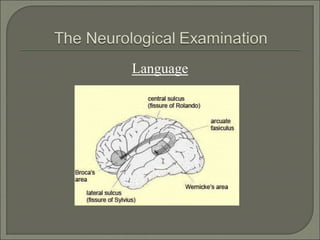
Language
Mental Status
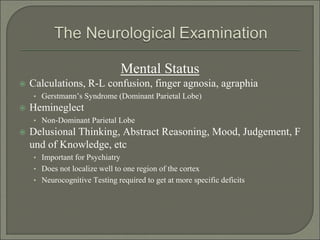
 Calculations, R-L confusion, finger agnosia, agraphia
• Gerstmann’s Syndrome (Dominant Parietal Lobe)
 Hemineglect
• Non-Dominant Parietal Lobe
 Delusional Thinking, Abstract Reasoning, Mood, Judgement, F
und of Knowledge, etc
• Important for Psychiatry
• Does not localize well to one region of the cortex
• Neurocognitive Testing required to get at more specific deficits
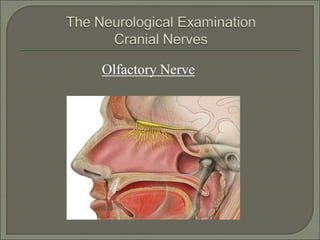
Olfactory Nerve
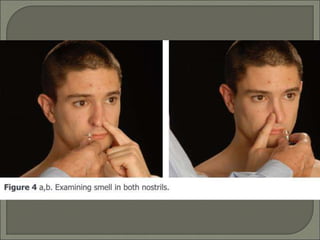
Olfactory Nerve
 Distinguish Coffee from Cinnamon
 Smelling Salts irritate nasal mucosa and test V2 Trige
mminal Sense
 Disorders of Smell result from closed head injuries
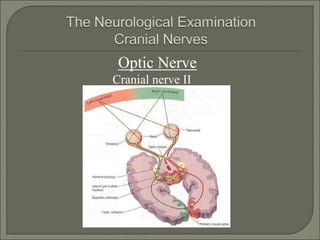
Optic Nerve
Cranial nerve II
Optic Nerve
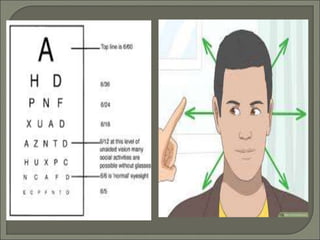
Visual Acuity
Visual Fields
Afferent input to Pupillary Light Reflex
• APD
Look at the Nerve (Fundoscopic Exam)
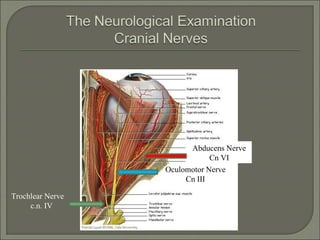
Trochlear Nerve
c.n. IV
Oculomotor Nerve
Cn III
Abducens Nerve
Cn VI
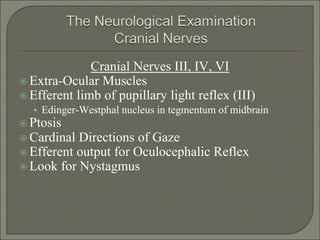
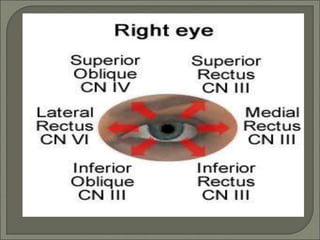
Cranial Nerves III, IV, VI
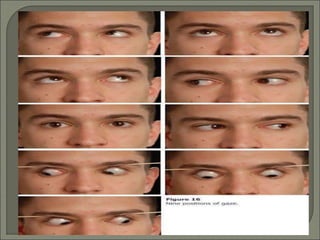
 Extra-Ocular Muscles
 Efferent limb of pupillary light reflex (III)
• Edinger-Westphal nucleus in tegmentum of midbrain
 Ptosis
 Cardinal Directions of Gaze
 Efferent output for Oculocephalic Reflex
 Look for Nystagmus
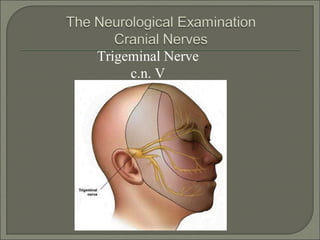
Trigeminal Nerve
c.n. V
Trigeminal Nerve
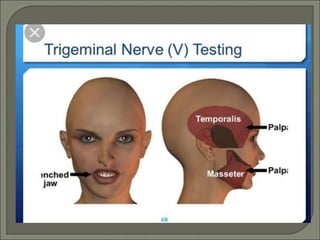
Motor Component
Opthalmic (V1), Maxillary (V2), and Mandibul
ar (V3) Distributions
All modes of Primary Sensation Modalities can
be tested
Afferent input for the Corneal Blink Reflex
“Facial sensation intact in all distributions”
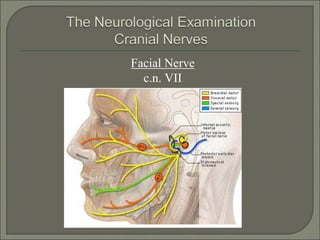
Facial Nerve
c.n. VII
Facial Nerve
Motor innervation to facial muscles
UMN versus LMN Facial Weakness
Efferent output to Corneal Blink Reflex
Other Functions
• Parasympathetic input to lacrimal, sublingual, and sub
mandibular glands, taste to anterior 2/3 of tongue, gener
al sensation to concha of earlobe and small part of scalp
, motor input to stapedius muscle
“Facial motor intact”
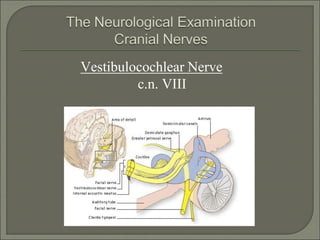
Vestibulocochlear Nerve
c.n. VIII
Vestibulocochlear Nerve
 Hearing and Balance
• Patients will complain of tinnitis, hearing loss, and/or vertig
o
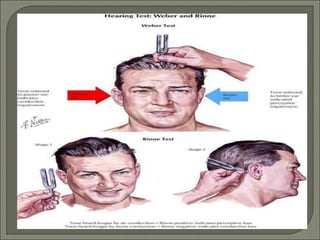
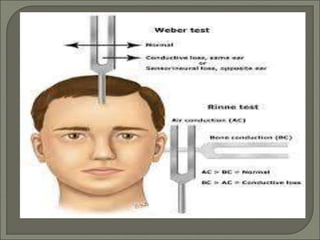
 Weber and Renee Test
• Differentiates Conductive vs Sensorineural hearing loss
 Afferent input to the Oculocephalic Reflex eg:
• Doll’s Eye Maneuver
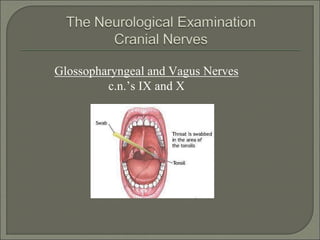
Glossopharyngeal and Vagus Nerves
c.n.’s IX and X
Glossopharyngeal and Vagus Nerves
 Afferent (IX) and Efferent (X) components for the Ga
g Reflex
 Vagus Nerve also does all parasympathetics from the
neck down until the mid-transverse colon
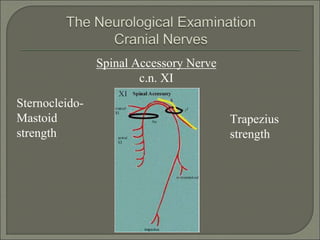
Spinal Accessory Nerve
c.n. XI
Trapezius
strength
Sternocleido-
Mastoid
strength
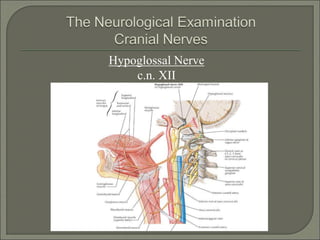
Hypoglossal Nerve
c.n. XII
Hypoglossal Nerve
Protrudes the tongue to the opposite side
Tongue in cheek (strength)
Hemi-atrophy and fasiculations (LMN)
Strength
Tone
DTR’s
Plantar Responses
Involuntary Movements
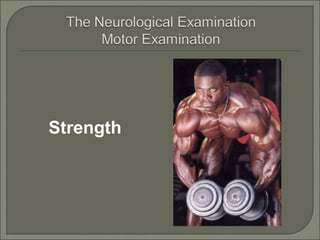
Strength
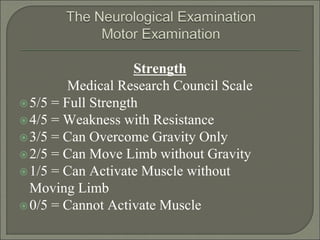
Strength
Medical Research Council Scale
5/5 = Full Strength
4/5 = Weakness with Resistance
3/5 = Can Overcome Gravity Only
2/5 = Can Move Limb without Gravity
1/5 = Can Activate Muscle without
Moving Limb
0/5 = Cannot Activate Muscle
Weakness
Describe the Distribution of Weakness
• Upper Motor Neuron Pattern
• Peripheral neuropathy Pattern
• Myopathic Pattern
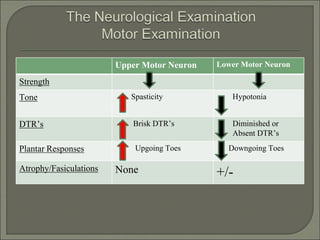
Upper Motor Neuron Lower Motor Neuron
Strength
Tone Spasticity Hypotonia
DTR’s Brisk DTR’s Diminished or
Absent DTR’s
Plantar Responses Upgoing Toes Downgoing Toes
Atrophy/Fasiculations None +/-
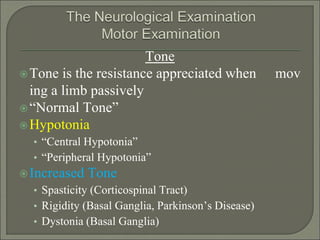
Tone
Tone is the resistance appreciated when mov
ing a limb passively
“Normal Tone”
Hypotonia
• “Central Hypotonia”
• “Peripheral Hypotonia”
Increased Tone
• Spasticity (Corticospinal Tract)
• Rigidity (Basal Ganglia, Parkinson’s Disease)
• Dystonia (Basal Ganglia)
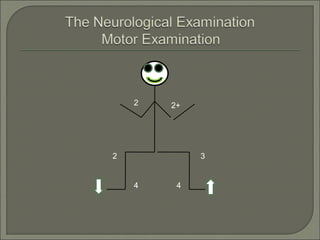
DTR’s
0/4 = Absent
1-2/4 = Normal Range
3/4 = Pathologically Brisk
4/4 = Clonus
2 2+
2 3
4 4
Involuntary Movements
Hyperkinetic Movements
• Chorea
• Athetosis
• Tics
• Myoclonus
Bradykinetic Movements
• Parkinsonism (Bradykinesia, Rigidity, Postural Instabili
ty, Resting Tremor)
• Dystonia
Primary Sensory Modalities
 Light Touch (Multiple Pathways)
 Pain/Temperature Sensation (Spinothalamic Tract)
 Vibration/Position Sensation (Posterior Columns)
Cortical Sensory Modalities
 Stereognosis
 Graphesthesia
 Two-Point Discrimination
 Double Simultaneous Extinction
Pain and Temperature
• Pinprick (One pin per patient!)
• Sensation of Cold
• Look for Sensory Nerve or
Dermatomal Distribution
Vibration Sensation
• C-128 Hz Tuning Fork
Joint Position Sensation
• Check great toe
• Romberg Sign
Higher Cortical Sensory Function
Graphesthesia
Stereognosis
Two-Point Discrimination
Double Simultaneous Extinction
Gerstmann’s Syndrome (acalculia, right-left co
nfusion, finger agnosia, agraphia)
• Usually seen in Dominant Parietal Lobe lesions
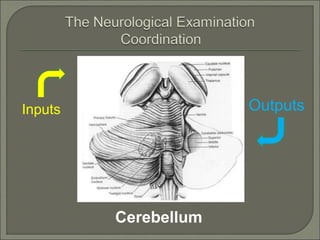
Cerebellum
Inputs Outputs
Hemisphere Dysfunction
 Dysmetria on Finger-Nose-Finger Testing*
 Irregular Tapping Rhythm*
 Dysdiadochokinesis*
 Hypotonia*
 Impaired Heel-Knee-Shin*
 Falls to Side of Lesion*
 Nystagmus (Variable Directions)
* All Deficits are Ipsilateral to the side of the lesion
Midline Dysfunction
Truncal Ataxia
Titubation
Ataxic Speech
Gait Ataxia
• Acute Ataxia (unsteady Gait)
• Chronic Ataxia (wide-based, steady Gait)
A normal Gait requires multiple levels of the n
euroaxis to be intact
• Vision
• Strength
• Balance/Coordination
• Joint Position
Observe Different Aspects of Gait
Arm Swing
Base of Gait
Heel Strike
Time Spent on Each Leg
Posture of Trunk
Toe Walking
Heel Walking
Tandem Walking
Classical Patterns of Abnormal Gait
Parkinsonism Gait
Hemiparetic Gait
Spastic Diplegia Gait
Acute Ataxia Gait
Chronic Ataxia Gait
Waddling Gait (Hip Girdle Weakness)
High Stepping Gait
Questions?

The Neuro Exam.pptx

  • 1.
  • 7.
    Mental Status Language  Aphasiavs Dysarthria  Receptive Language • Command Following  Expressive Language • Fluency • Word Finding  Repetition • Screens for Receptive, Expressive, and Conductive Aphasias
  • 8.
  • 9.
    Mental Status  Calculations,R-L confusion, finger agnosia, agraphia • Gerstmann’s Syndrome (Dominant Parietal Lobe)  Hemineglect • Non-Dominant Parietal Lobe  Delusional Thinking, Abstract Reasoning, Mood, Judgement, F und of Knowledge, etc • Important for Psychiatry • Does not localize well to one region of the cortex • Neurocognitive Testing required to get at more specific deficits
  • 12.
  • 13.
    Olfactory Nerve  DistinguishCoffee from Cinnamon  Smelling Salts irritate nasal mucosa and test V2 Trige mminal Sense  Disorders of Smell result from closed head injuries
  • 15.
  • 16.
    Optic Nerve Visual Acuity VisualFields Afferent input to Pupillary Light Reflex • APD Look at the Nerve (Fundoscopic Exam)
  • 18.
    Trochlear Nerve c.n. IV OculomotorNerve Cn III Abducens Nerve Cn VI
  • 19.
    Cranial Nerves III,IV, VI  Extra-Ocular Muscles  Efferent limb of pupillary light reflex (III) • Edinger-Westphal nucleus in tegmentum of midbrain  Ptosis  Cardinal Directions of Gaze  Efferent output for Oculocephalic Reflex  Look for Nystagmus
  • 22.
  • 23.
    Trigeminal Nerve Motor Component Opthalmic(V1), Maxillary (V2), and Mandibul ar (V3) Distributions All modes of Primary Sensation Modalities can be tested Afferent input for the Corneal Blink Reflex “Facial sensation intact in all distributions”
  • 25.
  • 26.
    Facial Nerve Motor innervationto facial muscles UMN versus LMN Facial Weakness Efferent output to Corneal Blink Reflex Other Functions • Parasympathetic input to lacrimal, sublingual, and sub mandibular glands, taste to anterior 2/3 of tongue, gener al sensation to concha of earlobe and small part of scalp , motor input to stapedius muscle “Facial motor intact”
  • 27.
  • 28.
    Vestibulocochlear Nerve  Hearingand Balance • Patients will complain of tinnitis, hearing loss, and/or vertig o  Weber and Renee Test • Differentiates Conductive vs Sensorineural hearing loss  Afferent input to the Oculocephalic Reflex eg: • Doll’s Eye Maneuver
  • 31.
    Glossopharyngeal and VagusNerves c.n.’s IX and X
  • 32.
    Glossopharyngeal and VagusNerves  Afferent (IX) and Efferent (X) components for the Ga g Reflex  Vagus Nerve also does all parasympathetics from the neck down until the mid-transverse colon
  • 33.
    Spinal Accessory Nerve c.n.XI Trapezius strength Sternocleido- Mastoid strength
  • 34.
  • 35.
    Hypoglossal Nerve Protrudes thetongue to the opposite side Tongue in cheek (strength) Hemi-atrophy and fasiculations (LMN)
  • 36.
  • 37.
  • 38.
    Strength Medical Research CouncilScale 5/5 = Full Strength 4/5 = Weakness with Resistance 3/5 = Can Overcome Gravity Only 2/5 = Can Move Limb without Gravity 1/5 = Can Activate Muscle without Moving Limb 0/5 = Cannot Activate Muscle
  • 39.
    Weakness Describe the Distributionof Weakness • Upper Motor Neuron Pattern • Peripheral neuropathy Pattern • Myopathic Pattern
  • 40.
    Upper Motor NeuronLower Motor Neuron Strength Tone Spasticity Hypotonia DTR’s Brisk DTR’s Diminished or Absent DTR’s Plantar Responses Upgoing Toes Downgoing Toes Atrophy/Fasiculations None +/-
  • 41.
    Tone Tone is theresistance appreciated when mov ing a limb passively “Normal Tone” Hypotonia • “Central Hypotonia” • “Peripheral Hypotonia” Increased Tone • Spasticity (Corticospinal Tract) • Rigidity (Basal Ganglia, Parkinson’s Disease) • Dystonia (Basal Ganglia)
  • 42.
    DTR’s 0/4 = Absent 1-2/4= Normal Range 3/4 = Pathologically Brisk 4/4 = Clonus
  • 43.
  • 44.
    Involuntary Movements Hyperkinetic Movements •Chorea • Athetosis • Tics • Myoclonus Bradykinetic Movements • Parkinsonism (Bradykinesia, Rigidity, Postural Instabili ty, Resting Tremor) • Dystonia
  • 45.
    Primary Sensory Modalities Light Touch (Multiple Pathways)  Pain/Temperature Sensation (Spinothalamic Tract)  Vibration/Position Sensation (Posterior Columns) Cortical Sensory Modalities  Stereognosis  Graphesthesia  Two-Point Discrimination  Double Simultaneous Extinction
  • 46.
    Pain and Temperature •Pinprick (One pin per patient!) • Sensation of Cold • Look for Sensory Nerve or Dermatomal Distribution Vibration Sensation • C-128 Hz Tuning Fork Joint Position Sensation • Check great toe • Romberg Sign
  • 47.
    Higher Cortical SensoryFunction Graphesthesia Stereognosis Two-Point Discrimination Double Simultaneous Extinction Gerstmann’s Syndrome (acalculia, right-left co nfusion, finger agnosia, agraphia) • Usually seen in Dominant Parietal Lobe lesions
  • 48.
  • 49.
    Hemisphere Dysfunction  Dysmetriaon Finger-Nose-Finger Testing*  Irregular Tapping Rhythm*  Dysdiadochokinesis*  Hypotonia*  Impaired Heel-Knee-Shin*  Falls to Side of Lesion*  Nystagmus (Variable Directions) * All Deficits are Ipsilateral to the side of the lesion
  • 50.
    Midline Dysfunction Truncal Ataxia Titubation AtaxicSpeech Gait Ataxia • Acute Ataxia (unsteady Gait) • Chronic Ataxia (wide-based, steady Gait)
  • 51.
    A normal Gaitrequires multiple levels of the n euroaxis to be intact • Vision • Strength • Balance/Coordination • Joint Position
  • 52.
    Observe Different Aspectsof Gait Arm Swing Base of Gait Heel Strike Time Spent on Each Leg Posture of Trunk Toe Walking Heel Walking Tandem Walking
  • 53.
    Classical Patterns ofAbnormal Gait Parkinsonism Gait Hemiparetic Gait Spastic Diplegia Gait Acute Ataxia Gait Chronic Ataxia Gait Waddling Gait (Hip Girdle Weakness) High Stepping Gait
  • 54.