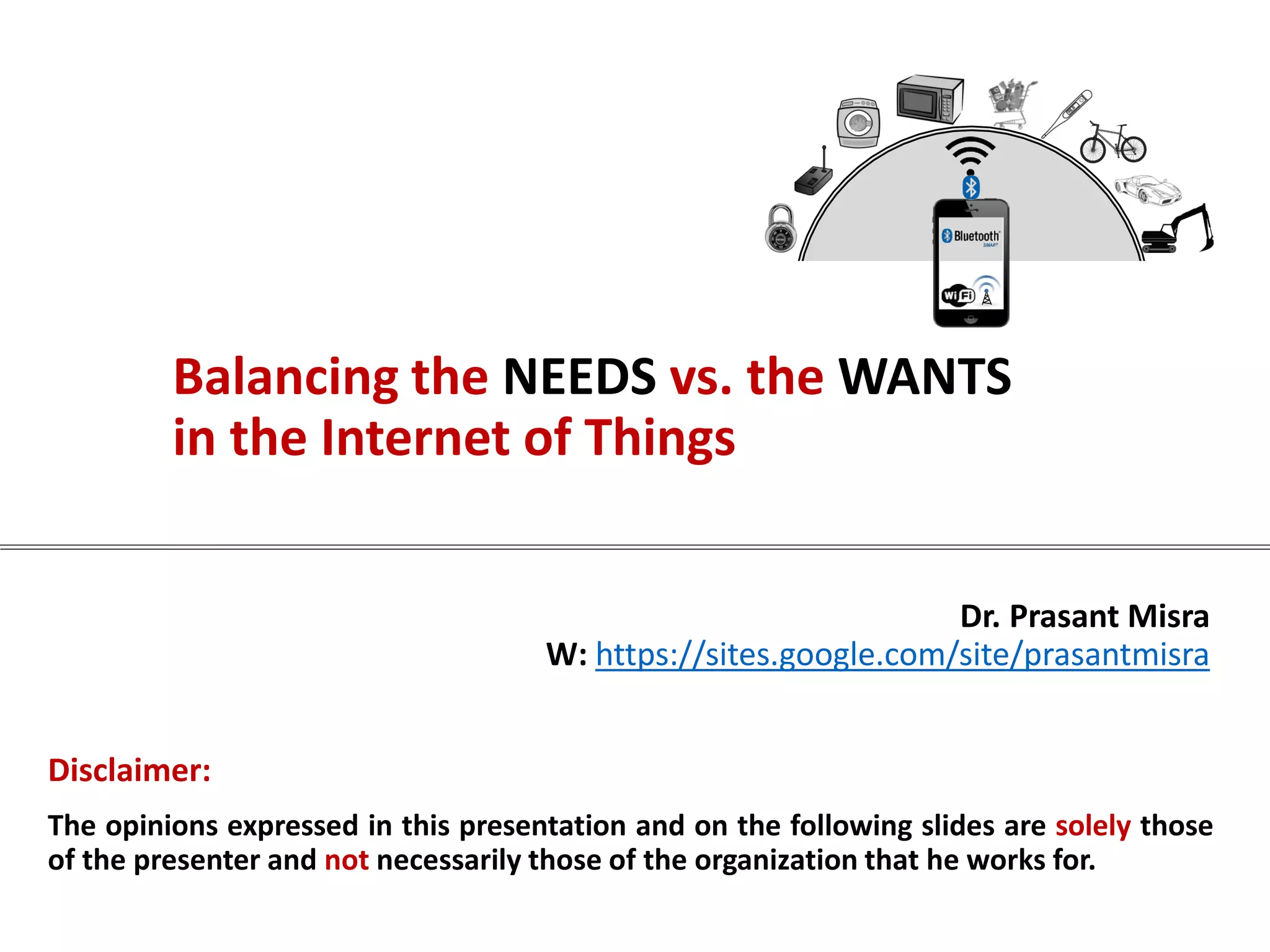

Balancing the NEEDS vs. the WANTS
in the Internet of Things
Dr. Prasant Misra
W: https://sites.google.com/site/prasantmisra
Disclaimer:
The opinions expressed in this presentation and on the following slides are solely those
of the presenter and not necessarily those of the organization that he works for.
IoT 101
8/26/2016 2
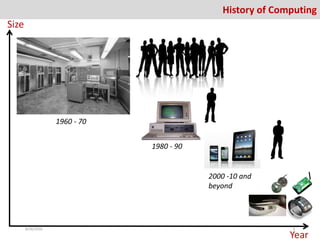
History of Computing
1960 - 70
1980 - 90
2000 -10 and
beyond
Year
Size
8/26/2016 3
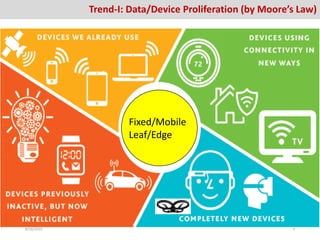
Trend-I: Data/Device Proliferation (by Moore’s Law)
Wireless Sensor Networks (WSN) Medical Devices
Industrial Systems Portable Smart DevicesRFID
http://www.onethatmatters.com/wp-content/uploads/2015/12/Internet-of-Things-why.png
Fixed/Mobile
Leaf/Edge
8/26/2016 4
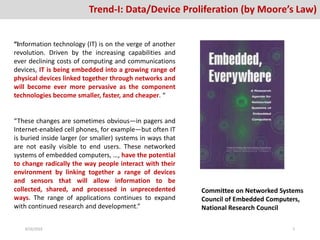
Trend-I: Data/Device Proliferation (by Moore’s Law)
“Information technology (IT) is on the verge of another
revolution. Driven by the increasing capabilities and
ever declining costs of computing and communications
devices, IT is being embedded into a growing range of
physical devices linked together through networks and
will become ever more pervasive as the component
technologies become smaller, faster, and cheaper. “
“These changes are sometimes obvious—in pagers and
Internet-enabled cell phones, for example—but often IT
is buried inside larger (or smaller) systems in ways that
are not easily visible to end users. These networked
systems of embedded computers, …, have the potential
to change radically the way people interact with their
environment by linking together a range of devices
and sensors that will allow information to be
collected, shared, and processed in unprecedented
ways. The range of applications continues to expand
with continued research and development.”
Committee on Networked Systems
Council of Embedded Computers,
National Research Council
8/26/2016 5
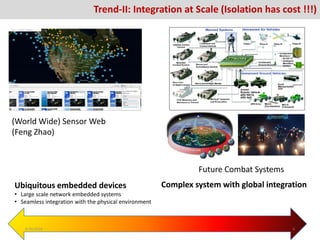
Trend-II: Integration at Scale (Isolation has cost !!!)
(World Wide) Sensor Web
(Feng Zhao)
Future Combat Systems
Ubiquitous embedded devices
• Large scale network embedded systems
• Seamless integration with the physical environment
Complex system with global integration
8/26/2016 6
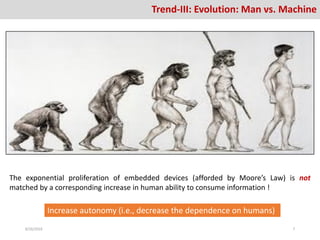
Trend-III: Evolution: Man vs. Machine
The exponential proliferation of embedded devices (afforded by Moore’s Law) is not
matched by a corresponding increase in human ability to consume information !
Increase autonomy (i.e., decrease the dependence on humans)
8/26/2016 7
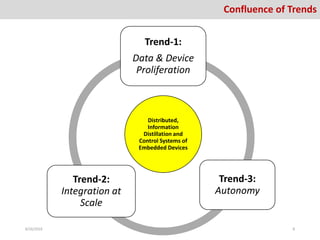
Confluence of Trends
Distributed,
Information
Distillation and
Control Systems of
Embedded Devices
Trend-1:
Data & Device
Proliferation
Trend-3:
Autonomy
Trend-2:
Integration at
Scale
8/26/2016 8
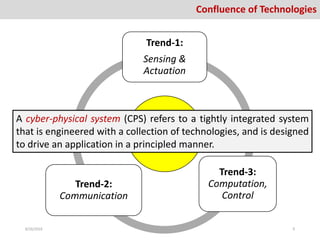
Confluence of Technologies
CPS
Trend-1:
Sensing &
Actuation
Trend-3:
Computation,
Control
Trend-2:
Communication
A cyber-physical system (CPS) refers to a tightly integrated system
that is engineered with a collection of technologies, and is designed
to drive an application in a principled manner.
8/26/2016 9
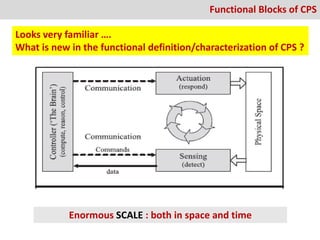
Looks very familiar ….
What is new in the functional definition/characterization of CPS ?
Enormous SCALE : both in space and time
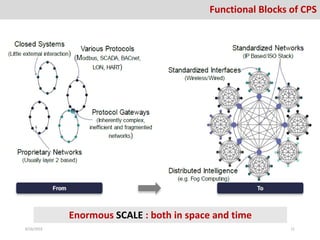
Functional Blocks of CPS
Enormous SCALE : both in space and time
8/26/2016 11
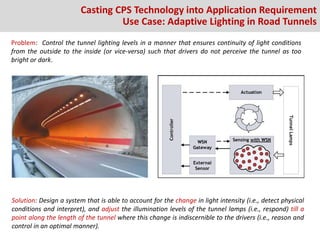
Casting CPS Technology into Application Requirement
Use Case: Adaptive Lighting in Road Tunnels
Problem: Control the tunnel lighting levels in a manner that ensures continuity of light conditions
from the outside to the inside (or vice-versa) such that drivers do not perceive the tunnel as too
bright or dark.
Solution: Design a system that is able to account for the change in light intensity (i.e., detect physical
conditions and interpret), and adjust the illumination levels of the tunnel lamps (i.e., respond) till a
point along the length of the tunnel where this change is indiscernible to the drivers (i.e., reason and
control in an optimal manner).
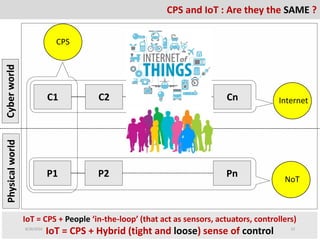
CPS and IoT : Are they the SAME ?
C1 C2 Cn
P1 P2 Pn
CPS
Internet
CyberworldPhysicalworld
NoT
IoT = CPS + People ‘in-the-loop’ (that act as sensors, actuators, controllers)
IoT = CPS + Hybrid (tight and loose) sense of control8/26/2016 13
IoT : Past Mistakes, Future Opportunities
8/26/2016 14
IoT: Vision and Value Proposition
Vision:
Build a ubiquitous society where everyone (“people”) and everything (“systems,
machines, equipment and devices") is immersively connected.
Value Proposition:
 Connected “Things” will provide utility to “People”
 Digital shadow of “People” will provide value to the “Enterprise”
8/26/2016 15
IoT : As of TODAY …
8/26/2016 16
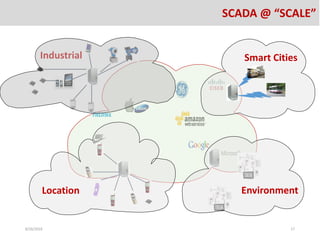
Industrial
EnvironmentLocation
Smart Cities
SCADA @ “SCALE”
8/26/2016 17
Connected Universe
8/26/2016 18
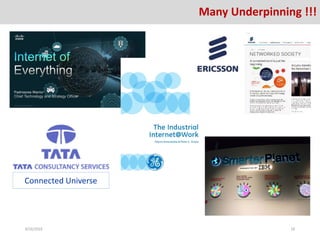
Many Underpinning !!!
8/26/2016 19
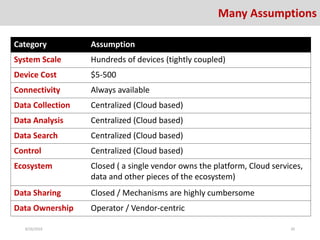
War of Standards
Category Assumption
System Scale Hundreds of devices (tightly coupled)
Device Cost $5-500
Connectivity Always available
Data Collection Centralized (Cloud based)
Data Analysis Centralized (Cloud based)
Data Search Centralized (Cloud based)
Control Centralized (Cloud based)
Ecosystem Closed ( a single vendor owns the platform, Cloud services,
data and other pieces of the ecosystem)
Data Sharing Closed / Mechanisms are highly cumbersome
Data Ownership Operator / Vendor-centric
8/26/2016 20
Many Assumptions
IoT : INTROSPECTION …
8/26/2016 21
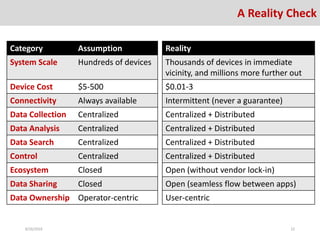
Reality
Thousands of devices in immediate
vicinity, and millions more further out
$0.01-3
Intermittent (never a guarantee)
Centralized + Distributed
Open (without vendor lock-in)
Open (seamless flow between apps)
User-centric
Category Assumption
System Scale Hundreds of devices
Device Cost $5-500
Connectivity Always available
Data Collection Centralized
Data Analysis Centralized
Data Search Centralized
Control Centralized
Ecosystem Closed
Data Sharing Closed
Data Ownership Operator-centric
8/26/2016 22
A Reality Check
8/26/2016 23
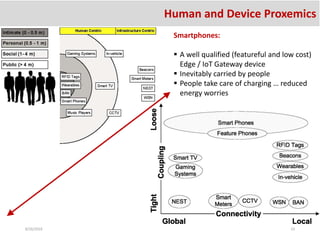
Human and Device Proxemics
Smartphones:
 A well qualified (featureful and low cost)
Edge / IoT Gateway device
 Inevitably carried by people
 People take care of charging … reduced
energy worries
IoT : Design Paradigms
8/26/2016 24
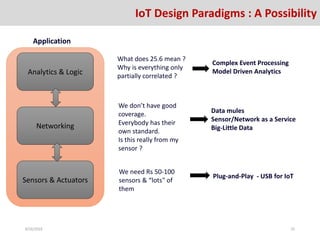
Application
Sensors & Actuators
Analytics & Logic
Networking
We need Rs 50-100
sensors & “lots" of
them
We don’t have good
coverage.
Everybody has their
own standard.
Is this really from my
sensor ?
What does 25.6 mean ?
Why is everything only
partially correlated ?
Data mules
Sensor/Network as a Service
Big-Little Data
Complex Event Processing
Model Driven Analytics
Plug-and-Play - USB for IoT
8/26/2016 25
IoT Design Paradigms : A Possibility
 Human-centric rather than Thing-centric
 People are the Sensor/Network
 Manage an immersive system with more emphasis on locality rather than centrality
 Humans become part of the ecosystem (will acts a data sources/respond to control)
 Human-Things interaction spans Virtual and Physical worlds
 “Big-Little” Data
 Device Cloud vs. Conventional Cloud
 Distributed data and Peer-to-Peer Federation
 Provide information security and ownership
 Identify, locate, authenticate, control access, and audit the data source
 Analytics from the Edge to the Cloud
 Leverage local processing capabilities (in addition to Cloud infra) to minimize
latency, bandwidth, energy
 Bring the Network to the Sensor
 Simplify networking
 Piggyback on existing and widely adopted standards and techniques
8/26/2016 26
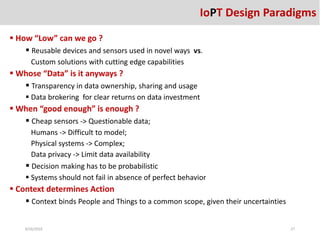
IoPT Design Paradigms
 How “Low” can we go ?
 Reusable devices and sensors used in novel ways vs.
Custom solutions with cutting edge capabilities
 Whose “Data” is it anyways ?
 Transparency in data ownership, sharing and usage
 Data brokering for clear returns on data investment
 When “good enough” is enough ?
 Cheap sensors -> Questionable data;
Humans -> Difficult to model;
Physical systems -> Complex;
Data privacy -> Limit data availability
 Decision making has to be probabilistic
 Systems should not fail in absence of perfect behavior
 Context determines Action
 Context binds People and Things to a common scope, given their uncertainties
8/26/2016 27
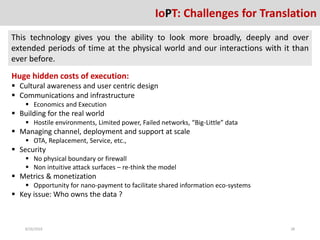
IoPT Design Paradigms
Huge hidden costs of execution:
 Cultural awareness and user centric design
 Communications and infrastructure
 Economics and Execution
 Building for the real world
 Hostile environments, Limited power, Failed networks, “Big-Little” data
 Managing channel, deployment and support at scale
 OTA, Replacement, Service, etc.,
 Security
 No physical boundary or firewall
 Non intuitive attack surfaces – re-think the model
 Metrics & monetization
 Opportunity for nano-payment to facilitate shared information eco-systems
 Key issue: Who owns the data ?
This technology gives you the ability to look more broadly, deeply and over
extended periods of time at the physical world and our interactions with it than
ever before.
8/26/2016 28
IoPT: Challenges for Translation
One Simple Example …
LBS: From Commercial Flop to Pervasive “on-the-go” Service
8/26/2016 29
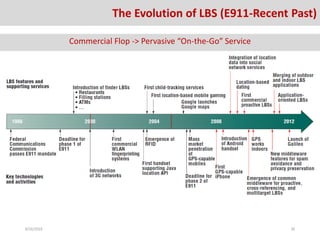
Commercial Flop -> Pervasive “On-the-Go” Service
8/26/2016 30
The Evolution of LBS (E911-Recent Past)
8/26/2016 31
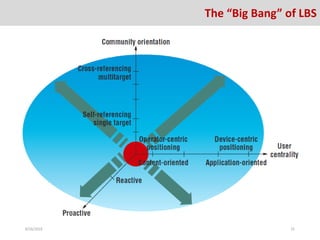
The “Big Bang” of LBS
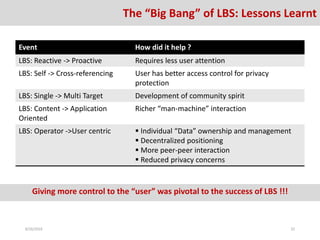
Event How did it help ?
LBS: Reactive -> Proactive Requires less user attention
LBS: Self -> Cross-referencing User has better access control for privacy
protection
LBS: Single -> Multi Target Development of community spirit
LBS: Content -> Application
Oriented
Richer “man-machine” interaction
LBS: Operator ->User centric  Individual “Data” ownership and management
 Decentralized positioning
 More peer-peer interaction
 Reduced privacy concerns
Giving more control to the “user” was pivotal to the success of LBS !!!
8/26/2016 32
The “Big Bang” of LBS: Lessons Learnt
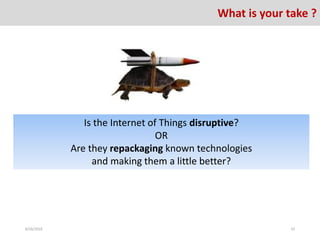
Is the Internet of Things disruptive?
OR
Are they repackaging known technologies
and making them a little better?
8/26/2016 33
What is your take ?
8/26/2016 34
References
 P. Misra, Y. Simmhan, J. Warrior, “Towards a practical architecture for the next
generation Internet of Things” [http://arxiv.org/abs/1502.00797]
 P. Misra, Y. Simmhan, J. Warrior, “Towards a practical architecture for Internet of
Things: An India-centric View”, IEEE IoT Newsletter, Jan 2015
• P. Misra, L. Mottola, S. Raza, S. Duquennoy, N. Tsiftes, J. Hoglund, and T. Voigt,
“Supporting Cyber-Physical Systems with Wireless Sensor Networks: An Outlook
of Software and Services”, Special Issue on Cyber Physical Systems, Journal of the
Indian Institute of Science, 93(3):441-462, Sep. 2013
• P. Bellavista, A. Küpper and S. Helal, "Location-Based Services: Back to the Future"
in IEEE Pervasive Computing, vol. 7, no. 2, pp. 85-89, April-June 2008.
 Other info graphics from the web !!!

The NEEDS vs. the WANTS in IoT

  • 1.
    Balancing the NEEDSvs. the WANTS in the Internet of Things Dr. Prasant Misra W: https://sites.google.com/site/prasantmisra Disclaimer: The opinions expressed in this presentation and on the following slides are solely those of the presenter and not necessarily those of the organization that he works for.
  • 2.
  • 3.
    History of Computing 1960- 70 1980 - 90 2000 -10 and beyond Year Size 8/26/2016 3
  • 4.
    Trend-I: Data/Device Proliferation(by Moore’s Law) Wireless Sensor Networks (WSN) Medical Devices Industrial Systems Portable Smart DevicesRFID http://www.onethatmatters.com/wp-content/uploads/2015/12/Internet-of-Things-why.png Fixed/Mobile Leaf/Edge 8/26/2016 4
  • 5.
    Trend-I: Data/Device Proliferation(by Moore’s Law) “Information technology (IT) is on the verge of another revolution. Driven by the increasing capabilities and ever declining costs of computing and communications devices, IT is being embedded into a growing range of physical devices linked together through networks and will become ever more pervasive as the component technologies become smaller, faster, and cheaper. “ “These changes are sometimes obvious—in pagers and Internet-enabled cell phones, for example—but often IT is buried inside larger (or smaller) systems in ways that are not easily visible to end users. These networked systems of embedded computers, …, have the potential to change radically the way people interact with their environment by linking together a range of devices and sensors that will allow information to be collected, shared, and processed in unprecedented ways. The range of applications continues to expand with continued research and development.” Committee on Networked Systems Council of Embedded Computers, National Research Council 8/26/2016 5
  • 6.
    Trend-II: Integration atScale (Isolation has cost !!!) (World Wide) Sensor Web (Feng Zhao) Future Combat Systems Ubiquitous embedded devices • Large scale network embedded systems • Seamless integration with the physical environment Complex system with global integration 8/26/2016 6
  • 7.
    Trend-III: Evolution: Manvs. Machine The exponential proliferation of embedded devices (afforded by Moore’s Law) is not matched by a corresponding increase in human ability to consume information ! Increase autonomy (i.e., decrease the dependence on humans) 8/26/2016 7
  • 8.
    Confluence of Trends Distributed, Information Distillationand Control Systems of Embedded Devices Trend-1: Data & Device Proliferation Trend-3: Autonomy Trend-2: Integration at Scale 8/26/2016 8
  • 9.
    Confluence of Technologies CPS Trend-1: Sensing& Actuation Trend-3: Computation, Control Trend-2: Communication A cyber-physical system (CPS) refers to a tightly integrated system that is engineered with a collection of technologies, and is designed to drive an application in a principled manner. 8/26/2016 9
  • 10.
    Looks very familiar…. What is new in the functional definition/characterization of CPS ? Enormous SCALE : both in space and time Functional Blocks of CPS
  • 11.
    Functional Blocks ofCPS Enormous SCALE : both in space and time 8/26/2016 11
  • 12.
    Casting CPS Technologyinto Application Requirement Use Case: Adaptive Lighting in Road Tunnels Problem: Control the tunnel lighting levels in a manner that ensures continuity of light conditions from the outside to the inside (or vice-versa) such that drivers do not perceive the tunnel as too bright or dark. Solution: Design a system that is able to account for the change in light intensity (i.e., detect physical conditions and interpret), and adjust the illumination levels of the tunnel lamps (i.e., respond) till a point along the length of the tunnel where this change is indiscernible to the drivers (i.e., reason and control in an optimal manner).
  • 13.
    CPS and IoT: Are they the SAME ? C1 C2 Cn P1 P2 Pn CPS Internet CyberworldPhysicalworld NoT IoT = CPS + People ‘in-the-loop’ (that act as sensors, actuators, controllers) IoT = CPS + Hybrid (tight and loose) sense of control8/26/2016 13
  • 14.
    IoT : PastMistakes, Future Opportunities 8/26/2016 14
  • 15.
    IoT: Vision andValue Proposition Vision: Build a ubiquitous society where everyone (“people”) and everything (“systems, machines, equipment and devices") is immersively connected. Value Proposition:  Connected “Things” will provide utility to “People”  Digital shadow of “People” will provide value to the “Enterprise” 8/26/2016 15
  • 16.
    IoT : Asof TODAY … 8/26/2016 16
  • 17.
  • 18.
  • 19.
  • 20.
    Category Assumption System ScaleHundreds of devices (tightly coupled) Device Cost $5-500 Connectivity Always available Data Collection Centralized (Cloud based) Data Analysis Centralized (Cloud based) Data Search Centralized (Cloud based) Control Centralized (Cloud based) Ecosystem Closed ( a single vendor owns the platform, Cloud services, data and other pieces of the ecosystem) Data Sharing Closed / Mechanisms are highly cumbersome Data Ownership Operator / Vendor-centric 8/26/2016 20 Many Assumptions
  • 21.
    IoT : INTROSPECTION… 8/26/2016 21
  • 22.
    Reality Thousands of devicesin immediate vicinity, and millions more further out $0.01-3 Intermittent (never a guarantee) Centralized + Distributed Centralized + Distributed Centralized + Distributed Centralized + Distributed Open (without vendor lock-in) Open (seamless flow between apps) User-centric Category Assumption System Scale Hundreds of devices Device Cost $5-500 Connectivity Always available Data Collection Centralized Data Analysis Centralized Data Search Centralized Control Centralized Ecosystem Closed Data Sharing Closed Data Ownership Operator-centric 8/26/2016 22 A Reality Check
  • 23.
    8/26/2016 23 Human andDevice Proxemics Smartphones:  A well qualified (featureful and low cost) Edge / IoT Gateway device  Inevitably carried by people  People take care of charging … reduced energy worries
  • 24.
    IoT : DesignParadigms 8/26/2016 24
  • 25.
    Application Sensors & Actuators Analytics& Logic Networking We need Rs 50-100 sensors & “lots" of them We don’t have good coverage. Everybody has their own standard. Is this really from my sensor ? What does 25.6 mean ? Why is everything only partially correlated ? Data mules Sensor/Network as a Service Big-Little Data Complex Event Processing Model Driven Analytics Plug-and-Play - USB for IoT 8/26/2016 25 IoT Design Paradigms : A Possibility
  • 26.
     Human-centric ratherthan Thing-centric  People are the Sensor/Network  Manage an immersive system with more emphasis on locality rather than centrality  Humans become part of the ecosystem (will acts a data sources/respond to control)  Human-Things interaction spans Virtual and Physical worlds  “Big-Little” Data  Device Cloud vs. Conventional Cloud  Distributed data and Peer-to-Peer Federation  Provide information security and ownership  Identify, locate, authenticate, control access, and audit the data source  Analytics from the Edge to the Cloud  Leverage local processing capabilities (in addition to Cloud infra) to minimize latency, bandwidth, energy  Bring the Network to the Sensor  Simplify networking  Piggyback on existing and widely adopted standards and techniques 8/26/2016 26 IoPT Design Paradigms
  • 27.
     How “Low”can we go ?  Reusable devices and sensors used in novel ways vs. Custom solutions with cutting edge capabilities  Whose “Data” is it anyways ?  Transparency in data ownership, sharing and usage  Data brokering for clear returns on data investment  When “good enough” is enough ?  Cheap sensors -> Questionable data; Humans -> Difficult to model; Physical systems -> Complex; Data privacy -> Limit data availability  Decision making has to be probabilistic  Systems should not fail in absence of perfect behavior  Context determines Action  Context binds People and Things to a common scope, given their uncertainties 8/26/2016 27 IoPT Design Paradigms
  • 28.
    Huge hidden costsof execution:  Cultural awareness and user centric design  Communications and infrastructure  Economics and Execution  Building for the real world  Hostile environments, Limited power, Failed networks, “Big-Little” data  Managing channel, deployment and support at scale  OTA, Replacement, Service, etc.,  Security  No physical boundary or firewall  Non intuitive attack surfaces – re-think the model  Metrics & monetization  Opportunity for nano-payment to facilitate shared information eco-systems  Key issue: Who owns the data ? This technology gives you the ability to look more broadly, deeply and over extended periods of time at the physical world and our interactions with it than ever before. 8/26/2016 28 IoPT: Challenges for Translation
  • 29.
    One Simple Example… LBS: From Commercial Flop to Pervasive “on-the-go” Service 8/26/2016 29
  • 30.
    Commercial Flop ->Pervasive “On-the-Go” Service 8/26/2016 30 The Evolution of LBS (E911-Recent Past)
  • 31.
  • 32.
    Event How didit help ? LBS: Reactive -> Proactive Requires less user attention LBS: Self -> Cross-referencing User has better access control for privacy protection LBS: Single -> Multi Target Development of community spirit LBS: Content -> Application Oriented Richer “man-machine” interaction LBS: Operator ->User centric  Individual “Data” ownership and management  Decentralized positioning  More peer-peer interaction  Reduced privacy concerns Giving more control to the “user” was pivotal to the success of LBS !!! 8/26/2016 32 The “Big Bang” of LBS: Lessons Learnt
  • 33.
    Is the Internetof Things disruptive? OR Are they repackaging known technologies and making them a little better? 8/26/2016 33 What is your take ?
  • 34.
    8/26/2016 34 References  P.Misra, Y. Simmhan, J. Warrior, “Towards a practical architecture for the next generation Internet of Things” [http://arxiv.org/abs/1502.00797]  P. Misra, Y. Simmhan, J. Warrior, “Towards a practical architecture for Internet of Things: An India-centric View”, IEEE IoT Newsletter, Jan 2015 • P. Misra, L. Mottola, S. Raza, S. Duquennoy, N. Tsiftes, J. Hoglund, and T. Voigt, “Supporting Cyber-Physical Systems with Wireless Sensor Networks: An Outlook of Software and Services”, Special Issue on Cyber Physical Systems, Journal of the Indian Institute of Science, 93(3):441-462, Sep. 2013 • P. Bellavista, A. Küpper and S. Helal, "Location-Based Services: Back to the Future" in IEEE Pervasive Computing, vol. 7, no. 2, pp. 85-89, April-June 2008.  Other info graphics from the web !!!