Challenges of Big Data Research
Manfred M. Fischer
Vienna University of Economics and Business
Regional Science Academy, Special Academic Session, ERSA conference,
Tue 23 August 2016
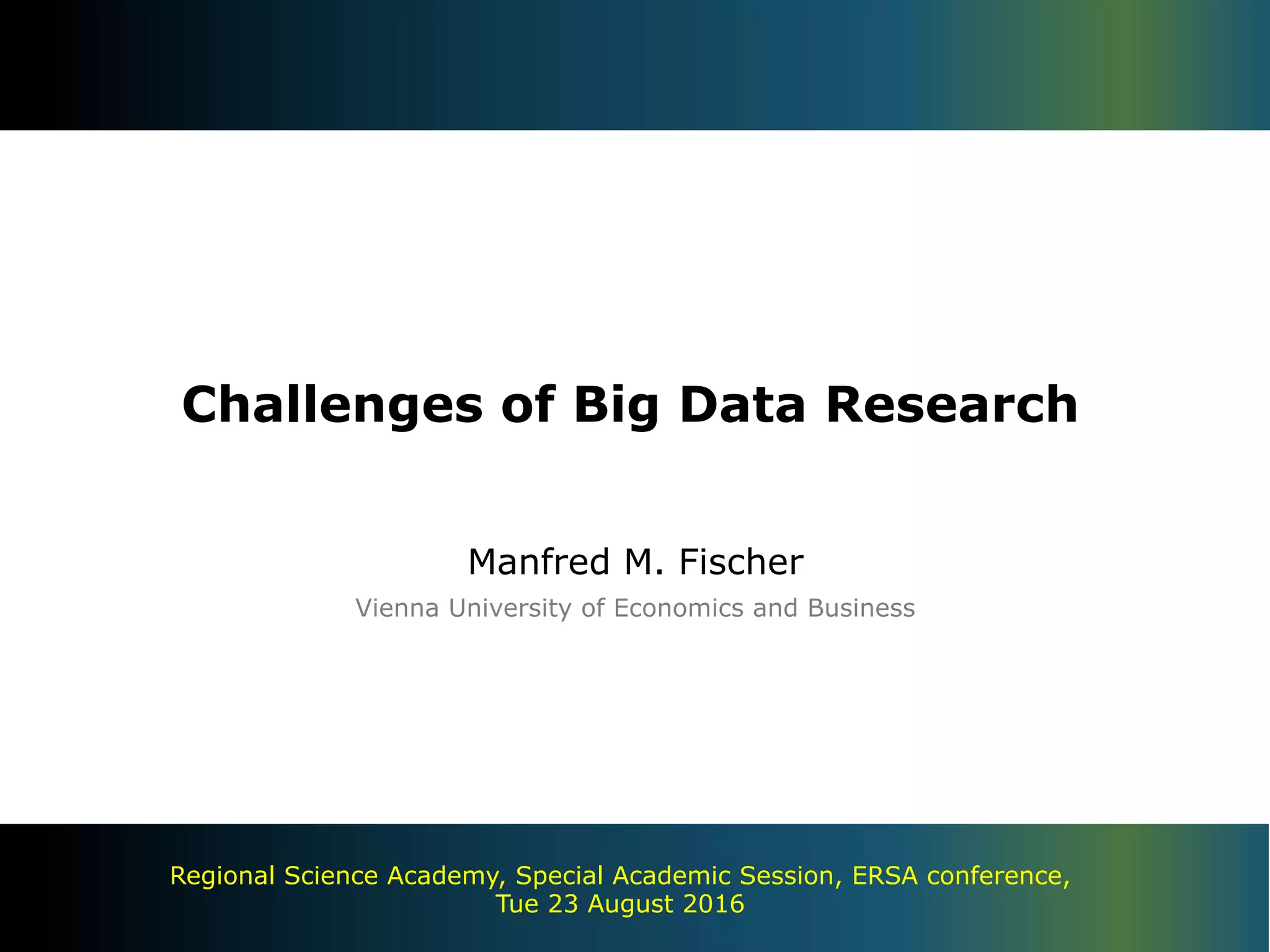
may be characterized in terms of three dimensions of data management challenges:
Ø Volume refers to the size of the data.
Ø Velocity addresses the speed at which data can be received as well as analyzed.
This also refers to the rate of change of data, which is especially relevant in the
area of stream processing.
Ø Variety refers to the issue of disparate and incompatible data formats. Data can
come in from many different sources and take on many different forms, including
text, audio, video, graph, and more.
1
The Big Data Problem
2
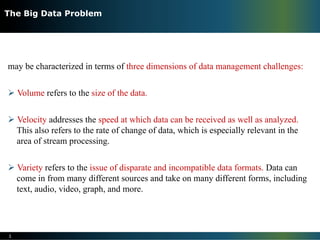
The Big Data Analysis Pipeline
Data Acquisition
and Recording
Information
Extraction and
Cleaning
Data Integration,
Aggregation, and
Representation
Query
Processing, Data
Modelling, and
Analysis
Interpretation
Heterogeneity and
Incompleteness Scale Timeliness Privacy
Human
Collaboration
Major Steps in Analysis of Big Data
Cross-Cutting Challenges
Major steps in analysis of Big Data are shown in the flow at the top. Below it are Big Data needs
that make these tasks challenging.
Overall System
Ø Big Data does not arise out of a vacuum, but is recorded from some data
generating source. Much of this data is of no interest, and can be filtered and
compressed by orders of magnitude.
Ø One challenge is to define these filters in such a way that they do not discard
useful information. We need research in the science of data reduction that can
intelligently process this raw data, and we need on-line techniques that can
process such streaming data on the fly, since we cannot afford to store first and
reduce afterwards.
Ø The second big challenge is to automatically generate the right metadata to
describe what data is recorded and how it is recorded and measured.
3
Data Acquisition and Recording
Ø Frequently the information collected will not be in a format ready for analysis.
Ø We require an information extraction process that pulls out the required
information from the underlying sources and expresses it in a standard form
suitable for analysis.
Ø Doing this correctly and completely is a continuing technical challenge. Note that
this data also includes images and will in the future include video. Such extraction
is often highly application dependent.
Ø Existing work on data cleaning assumes well-recognized constraints on valid data
or well-understood error models. But for many emerging Big Data domains these
do not exist.
4
Information Extraction and Cleaning
Ø Data analysis is considerably more challenging than simply locating, identifying,
understanding, and citing data. For effective large-scale analysis all of this has to
happen in a completely automated manner.
Ø This requires differences in data structuring and semantics to be expressed in
forms that are computer understandable.
Ø There is a strong body of work in data integration that can provide some of the
answers. However, considerable additional work is required to achieve automated
error-free difference resolution.
Ø Even for simpler analyses that depend on only one data set, there remains an
important question of suitable database design.
5
Data Integration, Aggregation, and Representation
Ø Methods for querying and mining Big Data are fundamentally different from
traditional statistical analysis on small samples. Big Data is often noisy, dynamic,
heterogeneous, interrelated and untrustworthy.
Ø Mining requires integrated, cleaned, trustworthy, and efficiently accessible data,
declarative query and mining interfaces, scalable mining algorithms, and Big-Data
computing environments.
Ø In the future, queries towards Big Data will be automatically generated for content
creation on websites, to populate hot-lists or recommendations, and to provide an
ad hoc analysis of the value of a data set to decide whether to store or to discard it.
Ø Scaling complex query processing techniques to terabytes while enabling
interactive response times is a major open research problem today.
Ø Another problem with current Big Data analysis is the lack of coordination
between database systems, which host the data and provide SQL querying, with
analytics packages that perform various forms of non-SQL processing, such as
data mining and statistical analyses.
6
Query Processing, Data Modelling, and Analysis
Ø It is rarely enough to provide just the results. Rather, one must provide
supplementary information [called the provenance of the (result) data] that
explains how each result was derived, and based upon precisely what inputs.
Ø Systems with a rich palette of visualizations become important in conveying to the
users the results of the queries in a way that is best understood in the particular
domain.
Ø Furthermore, with a few clicks the user should be able to drill down into each
piece of data that she sees and understand its provenance, which is a key feature to
understanding the data.
7
Interpretation
Having described the five stages on the Big Data analysis pipeline, we now turn to
some common challenges that underly many, and sometimes all, of these stages.
These are:
Ø Heterogeneity and incompleteness
Ø Scale
Ø Timeliness
Ø Privacy
Ø Human collaboration
8
Common Challenges
Ø When humans consume information, a great deal of heterogeneity is comfortably
tolerated. In fact, the nuance and richness of natural language can provide valuable
depth. However, machine analysis algorithms expect homogeneous data, and
cannot understand nuance. In consequence, data must be carefully structured as a
first step in or prior to data analysis.
Ø Even after data cleaning and error correction, some incompleteness and some
errors in data are likely to remain. This incompleteness and these errors must be
managed during data analysis.
Ø Doing this correctly is a challenge. Recent work on managing probabilistic data
suggests one way to make progress.
9
Heterogeneity and Incompleteness
Ø  Managing large and rapidly increasing volumes of data has been a challenging issue for
many decades. In the past, this challenge was mitigated by processors getting faster.
Ø  Over the last five years the processor technology has made a dramatic shift. Rather than
processors doubling their clock cycle frequency every 18-24 months, now, due to power
constraints, clock speeds have largely stalled and processors are being built with increasing
numbers of cores.
Ø  In the past, large data processing systems had to worry about parallelism across nodes in a
cluster. Now, one has to deal with parallelism within a single node. This requires us to
rethink how we design, build and operate data processing components.
Ø  Another dramatic shift that is underway is the move towards cloud computing, which now
aggregates multiple disparate workloads with varying performance goals into very large
clusters.
Ø  The level of sharing of resources on expensive and large clusters requires new ways of
determining how to run and execute data processing jobs and to deal with system failures.
10
Scale
Ø The design of a system that effectively deals with size is likely also to result in a
system that can process a given size of data set faster. However, it is not just this
speed that is usually meant when one speaks of Velocity in the context of Big
Data. Rather, there is an acquisition rate challenge and a timeliness challenge.
Ø There are many situations in which the result of the analysis is required
immediately. For example, if a fraudulent credit card transaction is suspected, it
should ideally be flagged before the transaction is completed, potentially
preventing the transaction from taking place at all.
Ø Obviously, a full analysis of a user’s purchase history is not likely to be feasible in
real-time. Rather, we need to develop partial results in advance so that a small
amount of incremental computation with new data can be used to arrive at a quick
determination.
11
Timeliness
Ø The privacy of data is another huge concern, and one that increases in the context
of Big Data.
Ø Managing privacy effectively is a technical as well as a sociological problem,
which must be addressed jointly from perspectives to realize the promise of Big
Data.
Ø It is important to rethink security for information sharing in Big Data use cases.
Many online services today require us to share private information, but beyond
record-level access control we do not understand what it means to share data, how
the shared data can be linked, and how to give users fine-grained control over this
sharing.
12
Privacy
Ø  Ideally, analytics for Big Data will be designed to have a human in the loop. The new field
of visual analytics is attempting to do this, at least with respect to the modelling and
analysis phase in the pipeline.
Ø  A popular new method of harnessing human ingenuity to solve problems is through
crowd-sourcing. Wikipedia, the on-line encyclopedia, is perhaps the best known example of
crowd-sourced data.
Ø  We are relying upon information provided by unvetted strangers. While most such errors
will be detected and corrected by others in the crowd, we need technologies to facilitate
this.
Ø  The issues of uncertainty and error become even more pronounced in a specific type of
crowd-sourcing, termed participatory-sensing. In this case, every person with a mobile
phone can act as a multi-modal sensor collecting various types of data instantaneously.
Ø  The extra challenge here is the inherent uncertainty of the data collection devices. The fact
that collected data are probably spatially and temporally correlated can be exploited to
better assess their correctness.
13
Human Collaboration
Ø With Big Data, the use of separate systems becomes prohibitively expensive,
given the large size of the data sets. The expense is due not only to the cost of the
systems themselves, but also the time to load the data into multiple systems.
Ø Big Data has made it necessary to run heterogeneous workloads on a single
infrastructure that is sufficiently flexible to handle all these workloads.
Ø The challenge here is not to build a system that is ideally suited for all processing
tasks. Instead, the need is for the underlying system architecture to be flexible
enough that the components built on top of it, for expressing the various kinds of
processing tasks, can tune it to efficiently run these different workloads.
14
System Architecture
Ø Through better analysis of the large volumes of data, there is the potential for
making faster advances in many scientific disciplines and improving the
profitability and success of many enterprises.
Ø But many technical challenges must be addressed before this potential can be
realized fully.
Ø The challenges include not just the obvious issues of scale, but also heterogeneity,
lack of structure, error-handling, privacy, timeliness, provenance, and
visualization, at all stages of the analysis pipeline from data acquisition to result
interpretation.
Ø These challenges will require transformative solutions, and will not be addressed
naturally by the next generation of industrial products.
Ø Hence, we must support and encourage fundamental research towards addressing
these technical challenges if we are to achieve the promised benefits of Big Data.
15
Closing Remarks
Thank you for your attention
16

Challenges of Big Data Research

  • 1.
    Challenges of BigData Research Manfred M. Fischer Vienna University of Economics and Business Regional Science Academy, Special Academic Session, ERSA conference, Tue 23 August 2016
  • 2.
    may be characterizedin terms of three dimensions of data management challenges: Ø Volume refers to the size of the data. Ø Velocity addresses the speed at which data can be received as well as analyzed. This also refers to the rate of change of data, which is especially relevant in the area of stream processing. Ø Variety refers to the issue of disparate and incompatible data formats. Data can come in from many different sources and take on many different forms, including text, audio, video, graph, and more. 1 The Big Data Problem
  • 3.
    2 The Big DataAnalysis Pipeline Data Acquisition and Recording Information Extraction and Cleaning Data Integration, Aggregation, and Representation Query Processing, Data Modelling, and Analysis Interpretation Heterogeneity and Incompleteness Scale Timeliness Privacy Human Collaboration Major Steps in Analysis of Big Data Cross-Cutting Challenges Major steps in analysis of Big Data are shown in the flow at the top. Below it are Big Data needs that make these tasks challenging. Overall System
  • 4.
    Ø Big Data doesnot arise out of a vacuum, but is recorded from some data generating source. Much of this data is of no interest, and can be filtered and compressed by orders of magnitude. Ø One challenge is to define these filters in such a way that they do not discard useful information. We need research in the science of data reduction that can intelligently process this raw data, and we need on-line techniques that can process such streaming data on the fly, since we cannot afford to store first and reduce afterwards. Ø The second big challenge is to automatically generate the right metadata to describe what data is recorded and how it is recorded and measured. 3 Data Acquisition and Recording
  • 5.
    Ø Frequently the informationcollected will not be in a format ready for analysis. Ø We require an information extraction process that pulls out the required information from the underlying sources and expresses it in a standard form suitable for analysis. Ø Doing this correctly and completely is a continuing technical challenge. Note that this data also includes images and will in the future include video. Such extraction is often highly application dependent. Ø Existing work on data cleaning assumes well-recognized constraints on valid data or well-understood error models. But for many emerging Big Data domains these do not exist. 4 Information Extraction and Cleaning
  • 6.
    Ø Data analysis isconsiderably more challenging than simply locating, identifying, understanding, and citing data. For effective large-scale analysis all of this has to happen in a completely automated manner. Ø This requires differences in data structuring and semantics to be expressed in forms that are computer understandable. Ø There is a strong body of work in data integration that can provide some of the answers. However, considerable additional work is required to achieve automated error-free difference resolution. Ø Even for simpler analyses that depend on only one data set, there remains an important question of suitable database design. 5 Data Integration, Aggregation, and Representation
  • 7.
    Ø Methods for queryingand mining Big Data are fundamentally different from traditional statistical analysis on small samples. Big Data is often noisy, dynamic, heterogeneous, interrelated and untrustworthy. Ø Mining requires integrated, cleaned, trustworthy, and efficiently accessible data, declarative query and mining interfaces, scalable mining algorithms, and Big-Data computing environments. Ø In the future, queries towards Big Data will be automatically generated for content creation on websites, to populate hot-lists or recommendations, and to provide an ad hoc analysis of the value of a data set to decide whether to store or to discard it. Ø Scaling complex query processing techniques to terabytes while enabling interactive response times is a major open research problem today. Ø Another problem with current Big Data analysis is the lack of coordination between database systems, which host the data and provide SQL querying, with analytics packages that perform various forms of non-SQL processing, such as data mining and statistical analyses. 6 Query Processing, Data Modelling, and Analysis
  • 8.
    Ø It is rarelyenough to provide just the results. Rather, one must provide supplementary information [called the provenance of the (result) data] that explains how each result was derived, and based upon precisely what inputs. Ø Systems with a rich palette of visualizations become important in conveying to the users the results of the queries in a way that is best understood in the particular domain. Ø Furthermore, with a few clicks the user should be able to drill down into each piece of data that she sees and understand its provenance, which is a key feature to understanding the data. 7 Interpretation
  • 9.
    Having described thefive stages on the Big Data analysis pipeline, we now turn to some common challenges that underly many, and sometimes all, of these stages. These are: Ø Heterogeneity and incompleteness Ø Scale Ø Timeliness Ø Privacy Ø Human collaboration 8 Common Challenges
  • 10.
    Ø When humans consumeinformation, a great deal of heterogeneity is comfortably tolerated. In fact, the nuance and richness of natural language can provide valuable depth. However, machine analysis algorithms expect homogeneous data, and cannot understand nuance. In consequence, data must be carefully structured as a first step in or prior to data analysis. Ø Even after data cleaning and error correction, some incompleteness and some errors in data are likely to remain. This incompleteness and these errors must be managed during data analysis. Ø Doing this correctly is a challenge. Recent work on managing probabilistic data suggests one way to make progress. 9 Heterogeneity and Incompleteness
  • 11.
    Ø  Managing largeand rapidly increasing volumes of data has been a challenging issue for many decades. In the past, this challenge was mitigated by processors getting faster. Ø  Over the last five years the processor technology has made a dramatic shift. Rather than processors doubling their clock cycle frequency every 18-24 months, now, due to power constraints, clock speeds have largely stalled and processors are being built with increasing numbers of cores. Ø  In the past, large data processing systems had to worry about parallelism across nodes in a cluster. Now, one has to deal with parallelism within a single node. This requires us to rethink how we design, build and operate data processing components. Ø  Another dramatic shift that is underway is the move towards cloud computing, which now aggregates multiple disparate workloads with varying performance goals into very large clusters. Ø  The level of sharing of resources on expensive and large clusters requires new ways of determining how to run and execute data processing jobs and to deal with system failures. 10 Scale
  • 12.
    Ø The design ofa system that effectively deals with size is likely also to result in a system that can process a given size of data set faster. However, it is not just this speed that is usually meant when one speaks of Velocity in the context of Big Data. Rather, there is an acquisition rate challenge and a timeliness challenge. Ø There are many situations in which the result of the analysis is required immediately. For example, if a fraudulent credit card transaction is suspected, it should ideally be flagged before the transaction is completed, potentially preventing the transaction from taking place at all. Ø Obviously, a full analysis of a user’s purchase history is not likely to be feasible in real-time. Rather, we need to develop partial results in advance so that a small amount of incremental computation with new data can be used to arrive at a quick determination. 11 Timeliness
  • 13.
    Ø The privacy ofdata is another huge concern, and one that increases in the context of Big Data. Ø Managing privacy effectively is a technical as well as a sociological problem, which must be addressed jointly from perspectives to realize the promise of Big Data. Ø It is important to rethink security for information sharing in Big Data use cases. Many online services today require us to share private information, but beyond record-level access control we do not understand what it means to share data, how the shared data can be linked, and how to give users fine-grained control over this sharing. 12 Privacy
  • 14.
    Ø  Ideally, analyticsfor Big Data will be designed to have a human in the loop. The new field of visual analytics is attempting to do this, at least with respect to the modelling and analysis phase in the pipeline. Ø  A popular new method of harnessing human ingenuity to solve problems is through crowd-sourcing. Wikipedia, the on-line encyclopedia, is perhaps the best known example of crowd-sourced data. Ø  We are relying upon information provided by unvetted strangers. While most such errors will be detected and corrected by others in the crowd, we need technologies to facilitate this. Ø  The issues of uncertainty and error become even more pronounced in a specific type of crowd-sourcing, termed participatory-sensing. In this case, every person with a mobile phone can act as a multi-modal sensor collecting various types of data instantaneously. Ø  The extra challenge here is the inherent uncertainty of the data collection devices. The fact that collected data are probably spatially and temporally correlated can be exploited to better assess their correctness. 13 Human Collaboration
  • 15.
    Ø With Big Data,the use of separate systems becomes prohibitively expensive, given the large size of the data sets. The expense is due not only to the cost of the systems themselves, but also the time to load the data into multiple systems. Ø Big Data has made it necessary to run heterogeneous workloads on a single infrastructure that is sufficiently flexible to handle all these workloads. Ø The challenge here is not to build a system that is ideally suited for all processing tasks. Instead, the need is for the underlying system architecture to be flexible enough that the components built on top of it, for expressing the various kinds of processing tasks, can tune it to efficiently run these different workloads. 14 System Architecture
  • 16.
    Ø Through better analysisof the large volumes of data, there is the potential for making faster advances in many scientific disciplines and improving the profitability and success of many enterprises. Ø But many technical challenges must be addressed before this potential can be realized fully. Ø The challenges include not just the obvious issues of scale, but also heterogeneity, lack of structure, error-handling, privacy, timeliness, provenance, and visualization, at all stages of the analysis pipeline from data acquisition to result interpretation. Ø These challenges will require transformative solutions, and will not be addressed naturally by the next generation of industrial products. Ø Hence, we must support and encourage fundamental research towards addressing these technical challenges if we are to achieve the promised benefits of Big Data. 15 Closing Remarks
  • 17.
    Thank you foryour attention 16