@ The Monopolies and Restrictive Trade Practices was
adopted by the government in 1969 and the MRTP
Commission was set up in 1970.
@ The act came into force from 1st June 1970 and has
been amended in 1974,1980,1982,1984 and 1991
@ The Act extended to the whole of India excepting
Jammu and Kashmir.
@ The most important in this phase was passing
of the MRTPAct (Monopolies and Restrictive
Trade Practices Act) in 1969 and the setting
up of the MRTP Commission in 1970.
@ Since 1991, the focus has shifted from
controlling monopolies to promoting
competition.
MRTP ACT 1969 :
@ In the pre-1991 period the declared policy of the
government was to
►curb and restrict the growth of monopoly power in
the country.
►f
or this purpose, the government imposed restrictions
on the entry of large business houses in a number of
industries,
►set up a large number of industries in the public
sector,
►and undertook various measures toencourage small
and medium industries.
MONOPOLISTIC TRADE PRACTICE :
3. Increasing unreasonably-
(a) the cost of production of any goods; or
(b) cha.rges for the provision, or maintenance, of any
serv1ces;
4. Increasing unreasonably-
(a) the prices at which goods are or may be, sold or resold
(b) the profits which are, or maybe derived by the
production, supply or distribution of any goods
5. Preventing or lessening competition in the production,
supply, or distribution of any goods(or services)by the
adoption of unfair methods or unfair or deceptive
practices.
OBJECT'IVESOFTHE ACT
Prohibition of
monopolistic and
restrictive and
unfair trade
practices.
MONOPOLISTIC TRADE PRACTICE :
@ Monopolistic Trade Practice Sections 31 and 32 of the
MRTPAct relate to monopolistic trade practices.
'monopolistic trade practice' means a trade practice
which has, or is likely to have, the effect of-
1.Maintaining the price of goods or charges for the
services at an unreasonable level by limiting , reducing
or otherwise controlling, production, supply or
distribution of goods (or services)
2.Unreasonably preventing or lessening competition in
the production, supply or distribution of any of goods
produced, supplied or distributed or any services
rendered in India,;
UNFAIR TRADE PRACTICE :
@A trade practice which, for the purpose of promoting any
sale, use or supply of any goods or services, adopts unfair
method
@ These are categorized as:
•!•False Representation
•!•False Off er or Bargain Price
•!• Free gifts offer and Prize Schemes
•!• Non-compliance of Prescribed Standards
•!•Hoarding, Destruction etc
ENFORCEMENT MACHINERY:
(i) The Monopolies and Restrictive Trade Practice
Commission.
(ii) The Central Government and Supreme court.
AFTER 1991 CHANGES
@ The Industrial policy statement of 1991 bring
drastic changes in MRTPAct. These provisions were
criticized very much because of their negative
impact on growth and competition.
@ This act is not applicable to :
This act is not applicable to
(i) Any undertaking owned or controlled by a
government (central or state)
(ii) Any undertaking the management of which has been
taken over by the government.
(iii) Any undertaking owned by a cooperative society
RESTRICTIVE TRADE PRACTICE :
@ Restrictive Trade Practice According to the MRTPAct, A
trade practice which has, or may have the effect of
preventing, distorting or restricting competition in any
manner
@ Which tends to obstruct the flow of capital or resources
into the stream of production, or
@ Which tends to bring about manipulation of prices or
conditions of delivery or to affect the flow of supplies
in the market relating to goods or services in such
manner as to impose on the consumers unjustified costs
or restrictions.
@ Atrade practice which has or may have the effect of
preventing, distorting or restricting competition in any
manner, is a restrictive trade practice.
INVESTIGATION AND ENQUIRIES
ACTION CAN BE INITIATED BY:
•:• AN INDIVIDUAL CONSUMER
•:• A REGISTERED ASSOCIATION OF CONSUMERS
•:• ATRADE ASSOCIATION
•:• GOVERNMENT( Central and State Government)
•:• MRTP COMMISSION SUO MOTU
COMPETITION LAW :
It is a tool to implement and enforce
competition policy and to prevent and
punish anti-competitive business
practices by firms and unnecessary
Government interference in the market.
COMPETITION ACT, 2002 :
@ Competition Act, 2002 With the economic reforms
program in 1991, MRTPAct lost its relevance in the
new liberalized and global competitive scenario.
There was a shift of focus fram curbing monopolies
to promoting competition.
@ Competition bill, 2001 was introduced in
Parliament and passed in December 2002. This Act
is called Competition Act, 2002.
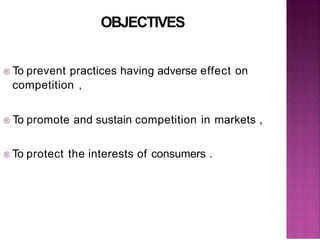
OBJECTIVES
® To prevent practices having adverse effect on
competition ,
® To promote and sustain competition in markets ,
® To protect the interests of consumers .
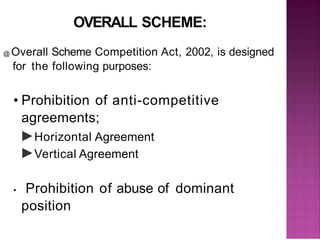
OVERALL SCHEME:
@ Overall Scheme Competition Act, 2002, is designed
for the following purposes:
• Prohibition of anti-competitive
agreements;
►Horizontal Agreement
►Vertical Agreement
• Prohibition of abuse of dominant
position
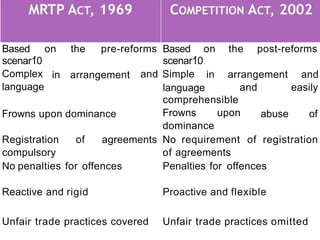
the post-reforms
Based . on
scenar10
Complex
language
the pre-reforms Based . on
in arrangement
Frowns upon dominance
scenar10
and Simple
language
in arrangement
and
and
easily
comprehensible
Frowns upon
dominance
abuse of
Registration of agreements No requirement of registration
compulsory of agreements
No penalties for offences Penalties for offences
Reactive and rigid Proactive and flexible
Unfair trade practices covered Unfair trade practices omitted

1551596202.pptx

  • 2.
    @ The Monopoliesand Restrictive Trade Practices was adopted by the government in 1969 and the MRTP Commission was set up in 1970. @ The act came into force from 1st June 1970 and has been amended in 1974,1980,1982,1984 and 1991 @ The Act extended to the whole of India excepting Jammu and Kashmir.
  • 3.
    @ The mostimportant in this phase was passing of the MRTPAct (Monopolies and Restrictive Trade Practices Act) in 1969 and the setting up of the MRTP Commission in 1970. @ Since 1991, the focus has shifted from controlling monopolies to promoting competition.
  • 4.
    MRTP ACT 1969: @ In the pre-1991 period the declared policy of the government was to ►curb and restrict the growth of monopoly power in the country. ►f or this purpose, the government imposed restrictions on the entry of large business houses in a number of industries, ►set up a large number of industries in the public sector, ►and undertook various measures toencourage small and medium industries.
  • 5.
    MONOPOLISTIC TRADE PRACTICE: 3. Increasing unreasonably- (a) the cost of production of any goods; or (b) cha.rges for the provision, or maintenance, of any serv1ces; 4. Increasing unreasonably- (a) the prices at which goods are or may be, sold or resold (b) the profits which are, or maybe derived by the production, supply or distribution of any goods 5. Preventing or lessening competition in the production, supply, or distribution of any goods(or services)by the adoption of unfair methods or unfair or deceptive practices.
  • 6.
    OBJECT'IVESOFTHE ACT Prohibition of monopolisticand restrictive and unfair trade practices.
  • 7.
    MONOPOLISTIC TRADE PRACTICE: @ Monopolistic Trade Practice Sections 31 and 32 of the MRTPAct relate to monopolistic trade practices. 'monopolistic trade practice' means a trade practice which has, or is likely to have, the effect of- 1.Maintaining the price of goods or charges for the services at an unreasonable level by limiting , reducing or otherwise controlling, production, supply or distribution of goods (or services) 2.Unreasonably preventing or lessening competition in the production, supply or distribution of any of goods produced, supplied or distributed or any services rendered in India,;
  • 8.
    UNFAIR TRADE PRACTICE: @A trade practice which, for the purpose of promoting any sale, use or supply of any goods or services, adopts unfair method @ These are categorized as: •!•False Representation •!•False Off er or Bargain Price •!• Free gifts offer and Prize Schemes •!• Non-compliance of Prescribed Standards •!•Hoarding, Destruction etc
  • 9.
    ENFORCEMENT MACHINERY: (i) TheMonopolies and Restrictive Trade Practice Commission. (ii) The Central Government and Supreme court.
  • 10.
    AFTER 1991 CHANGES @The Industrial policy statement of 1991 bring drastic changes in MRTPAct. These provisions were criticized very much because of their negative impact on growth and competition. @ This act is not applicable to : This act is not applicable to (i) Any undertaking owned or controlled by a government (central or state) (ii) Any undertaking the management of which has been taken over by the government. (iii) Any undertaking owned by a cooperative society
  • 11.
    RESTRICTIVE TRADE PRACTICE: @ Restrictive Trade Practice According to the MRTPAct, A trade practice which has, or may have the effect of preventing, distorting or restricting competition in any manner @ Which tends to obstruct the flow of capital or resources into the stream of production, or @ Which tends to bring about manipulation of prices or conditions of delivery or to affect the flow of supplies in the market relating to goods or services in such manner as to impose on the consumers unjustified costs or restrictions. @ Atrade practice which has or may have the effect of preventing, distorting or restricting competition in any manner, is a restrictive trade practice.
  • 12.
    INVESTIGATION AND ENQUIRIES ACTIONCAN BE INITIATED BY: •:• AN INDIVIDUAL CONSUMER •:• A REGISTERED ASSOCIATION OF CONSUMERS •:• ATRADE ASSOCIATION •:• GOVERNMENT( Central and State Government) •:• MRTP COMMISSION SUO MOTU
  • 13.
    COMPETITION LAW : Itis a tool to implement and enforce competition policy and to prevent and punish anti-competitive business practices by firms and unnecessary Government interference in the market.
  • 14.
    COMPETITION ACT, 2002: @ Competition Act, 2002 With the economic reforms program in 1991, MRTPAct lost its relevance in the new liberalized and global competitive scenario. There was a shift of focus fram curbing monopolies to promoting competition. @ Competition bill, 2001 was introduced in Parliament and passed in December 2002. This Act is called Competition Act, 2002.
  • 15.
    OBJECTIVES ® To preventpractices having adverse effect on competition , ® To promote and sustain competition in markets , ® To protect the interests of consumers .
  • 16.
    OVERALL SCHEME: @ OverallScheme Competition Act, 2002, is designed for the following purposes: • Prohibition of anti-competitive agreements; ►Horizontal Agreement ►Vertical Agreement • Prohibition of abuse of dominant position
  • 17.
    the post-reforms Based .on scenar10 Complex language the pre-reforms Based . on in arrangement Frowns upon dominance scenar10 and Simple language in arrangement and and easily comprehensible Frowns upon dominance abuse of Registration of agreements No requirement of registration compulsory of agreements No penalties for offences Penalties for offences Reactive and rigid Proactive and flexible Unfair trade practices covered Unfair trade practices omitted