GROUP(4) MEMBERS
• SEIDU AYIDA MOHAMMED
• CHARLOTTE KUSI
• ABIGAIL SOWAH
• DANIELSON DELALI FIANU
• CLAUDIA BADGER
• DAISY AGYEIBEA AGYEI-MINTA
• ESTHER NAA ADJELEY ADJEI
• DANIEL TAWIAH
• PRISCILLA OPARE
• NADIA LAMPTEY
• ABIGAIL KAKARI
• LILIAN OFORI
BEHAVIOUR MODIFICATION THERAPY
CONTENTS
PRINCIPLES OF B.M.T
INDICATIONS AND
CONTRAINDICATIONS
WHAT IS B.M.T
USES OF B.M.T
BEHAVIOUR MODIFICATION THERAPY
• Behaviour is the response of an individual to an
action,stimuli or an environment
• Behaviour modification developed from the perspective
called behaviorism,which emerged with the work of John B.
Watson(1913,1930) and B.F.Skinner(1938,1953)
• Behaviour modification is a treatment approach that uses
respondent and operant conditioning to change behaviour
• This is also known as operant conditioning and
reinforcement theory using various motivational techniques
such as negative and positive reinforcement,extinction etc
PRINCIPLES OF BEHAVIOURAL THERAPIES
• Theory of Classical conditioning: this involves learning
by association and is usually the cause of most
phobias.
• Theory of Operant conditioning: involves learning by
reinforcement(rewards) and punishment, and can
explain abnormal behaviour
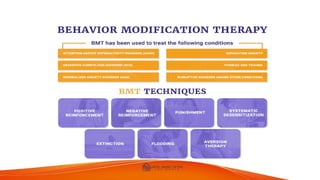
INDICATION OF BEHAVIORAL MODIFICATION THERAPY
• Obsessive-Compulsive Disorder(OCD)
• Attention-Deficit Hyperactivity Disorder(ADHD)
• Generalized Anxiety Disorder(GAD)
• Phobias
• Post-Traumatic Stress Disorder(PTSD)
• Schizophrenia
• Substance abuse
BMT TECHNIQUES
• Positive reinforcement: this involves rewarding a
behaviour to increase the likelihood of it happening
again. This might be anything from giving a child a
treat for doing their homework to praising an
employee for meeting a goal.
• Negative reinforcement: involves removing something
unpleasant to encourage a behaviour. A teenagger
might be more inclined to do the dishes the first time
they’re asked if they know they’ll be nagged otherwise.
• Punishment: involves adding an unpleasant
consequence or taking away something desirable. For
instance,if you recive a costly speeding ticket,you’ll be
more cognizant of how fast you’re driving in the
future.
• Shaping: involves gradually reinforcing behaviours
that are closer and closer to the desired behaviour.
Rewarding small steps along the way can help build
up to a more complex behaviour. For instance a music
student might learn to play piano with
encouragement to learn scales and then longer pieces
• Extinction: a technique where a stop reinforcing a
behaviour,with the aim of encouraging it to reduce
over time. Your child might be less likely to throw a
tantrum if you don’t pay extra attention to that
behaviour
USES OF BEHAVIOURAL MODIFICATION THERAPY
• Can be used to help clients develop healthier habits
and coping stategies for issues such as anxiety.
• Can be used as part of parenting strategies.
• Can be used by teachers to give students praise when
they complete their homework on time or participate
in class.
• Can be used in the workplace by employers by
offering bonuses,promotions or public reognition for
meeting targets or demonstrating excellent teamwork
CONTRAINDICATION OF BMT
• Negative emotional reactions
• Overemphasis on external factors: behavior
modification tends to focus on external factors
influencing behavior, such as rewards, punishments,
or environmental stimuli. This emphasis may neglect
the role of internal factors, emotions, and cognitive
processes in shaping behavior, leading to an
incomplete understanding of the individual’s
experiences.
• Limited scope: behavior modification often focuses on
specific behavioral changes and may not address
broader issues or aspects of an individual’s life. As a
result, the changes achieved through behavior
modification may not be sustainable or may not lead
to more profound personal growth.
• Ethical concerns: some behavior modification
techniques may raise ethical questions, especially
when they involve the use of punishment or aversive
methods. The use of punishment can be particularly
controversial, as it may result in harm or adverse
consequences for the individual.
REFERENCES
• Project Haans
• https://projecthaans.com/the-harmful-effects-of-behaviour-modification/
• National Library of Medicine
• https://www.ncbi.nlm.nih.gov
• https://www.newdirectionsforwomen.org/what-is-behavior-modification-therapy/
• Robbins TW, Vaghi MM, Banca P. Obsessive-Compulsive Disorder: Puzzles and Prospects. Neuron.
2019 Apr 03;102(1):27-47. [PubMed]
Thank you for listening

PSYCHIATRIC NURSING mental illness -1.pptx

  • 1.
    GROUP(4) MEMBERS • SEIDUAYIDA MOHAMMED • CHARLOTTE KUSI • ABIGAIL SOWAH • DANIELSON DELALI FIANU • CLAUDIA BADGER • DAISY AGYEIBEA AGYEI-MINTA • ESTHER NAA ADJELEY ADJEI • DANIEL TAWIAH • PRISCILLA OPARE • NADIA LAMPTEY • ABIGAIL KAKARI • LILIAN OFORI
  • 2.
  • 3.
    CONTENTS PRINCIPLES OF B.M.T INDICATIONSAND CONTRAINDICATIONS WHAT IS B.M.T USES OF B.M.T
  • 4.
    BEHAVIOUR MODIFICATION THERAPY •Behaviour is the response of an individual to an action,stimuli or an environment • Behaviour modification developed from the perspective called behaviorism,which emerged with the work of John B. Watson(1913,1930) and B.F.Skinner(1938,1953) • Behaviour modification is a treatment approach that uses respondent and operant conditioning to change behaviour • This is also known as operant conditioning and reinforcement theory using various motivational techniques such as negative and positive reinforcement,extinction etc
  • 5.
    PRINCIPLES OF BEHAVIOURALTHERAPIES • Theory of Classical conditioning: this involves learning by association and is usually the cause of most phobias. • Theory of Operant conditioning: involves learning by reinforcement(rewards) and punishment, and can explain abnormal behaviour
  • 6.
    INDICATION OF BEHAVIORALMODIFICATION THERAPY • Obsessive-Compulsive Disorder(OCD) • Attention-Deficit Hyperactivity Disorder(ADHD) • Generalized Anxiety Disorder(GAD) • Phobias • Post-Traumatic Stress Disorder(PTSD) • Schizophrenia • Substance abuse
  • 8.
    BMT TECHNIQUES • Positivereinforcement: this involves rewarding a behaviour to increase the likelihood of it happening again. This might be anything from giving a child a treat for doing their homework to praising an employee for meeting a goal. • Negative reinforcement: involves removing something unpleasant to encourage a behaviour. A teenagger might be more inclined to do the dishes the first time they’re asked if they know they’ll be nagged otherwise.
  • 9.
    • Punishment: involvesadding an unpleasant consequence or taking away something desirable. For instance,if you recive a costly speeding ticket,you’ll be more cognizant of how fast you’re driving in the future. • Shaping: involves gradually reinforcing behaviours that are closer and closer to the desired behaviour. Rewarding small steps along the way can help build up to a more complex behaviour. For instance a music student might learn to play piano with encouragement to learn scales and then longer pieces
  • 10.
    • Extinction: atechnique where a stop reinforcing a behaviour,with the aim of encouraging it to reduce over time. Your child might be less likely to throw a tantrum if you don’t pay extra attention to that behaviour
  • 11.
    USES OF BEHAVIOURALMODIFICATION THERAPY • Can be used to help clients develop healthier habits and coping stategies for issues such as anxiety. • Can be used as part of parenting strategies. • Can be used by teachers to give students praise when they complete their homework on time or participate in class. • Can be used in the workplace by employers by offering bonuses,promotions or public reognition for meeting targets or demonstrating excellent teamwork
  • 12.
    CONTRAINDICATION OF BMT •Negative emotional reactions • Overemphasis on external factors: behavior modification tends to focus on external factors influencing behavior, such as rewards, punishments, or environmental stimuli. This emphasis may neglect the role of internal factors, emotions, and cognitive processes in shaping behavior, leading to an incomplete understanding of the individual’s experiences.
  • 13.
    • Limited scope:behavior modification often focuses on specific behavioral changes and may not address broader issues or aspects of an individual’s life. As a result, the changes achieved through behavior modification may not be sustainable or may not lead to more profound personal growth. • Ethical concerns: some behavior modification techniques may raise ethical questions, especially when they involve the use of punishment or aversive methods. The use of punishment can be particularly controversial, as it may result in harm or adverse consequences for the individual.
  • 14.
    REFERENCES • Project Haans •https://projecthaans.com/the-harmful-effects-of-behaviour-modification/ • National Library of Medicine • https://www.ncbi.nlm.nih.gov • https://www.newdirectionsforwomen.org/what-is-behavior-modification-therapy/ • Robbins TW, Vaghi MM, Banca P. Obsessive-Compulsive Disorder: Puzzles and Prospects. Neuron. 2019 Apr 03;102(1):27-47. [PubMed]
  • 15.
    Thank you forlistening