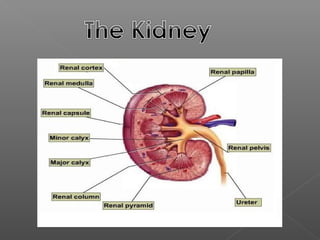
Adrenal gland- An endocrine gland that
  sits on top of the kidney
Renal pelvis- The expanded proximal end
  of the ureter, the renal pelvis receives
  urine from the calyces
Renal Capsule- carries oxygenated blood
  to the kidney.
Renal vein-Carries de- oxygenated blood
  away from the kidney
   Medulla- The middle portion of the
    internal structure of the kidney.
   Ureter- Tubule that drains urine from the
    kidney into the bladder
   Cortex- The outer portion of the internal
    structure of the kidney
   Abdominal Aorta- The renal arteries
    branch off from this large blood vessel.
   Inferior vena cava- The main blood
    vessel that drains blood from the lower
    part of the body.
   Calyx- The cuplike extension of the renal
    pelvis that urine empties into.
 Maintain the balance of water and
  concentration of minerals. Such as
  sodium, potassium, and phosphorus in
  your blood
 Remove waste by products from the
  blood after digestion, muscle activity
  and exposure to chemical or
  medications.
 Produce venin, an enzymes that help
  regulate blood pressure.
 Produces erythropoietin, which
  stimulates red blood cells.
 Produces an active form of vitamin D
 Acute Kidney Injury- Can occur with
  blood loss, the sudden reduction of
  blood loss, the sudden reduction of
  blood flow to the kidney.
 Chronic Kidney disease- means kidneys
  are damaged and cant filter blood as
  they should. This could cause waste to
  build up in your body. Diabetes and high
  blood pressure are the most common
  cause of chronic kidney disease. The
  only option for kidney failure are dialysis
  or kidney transplantation.
 Kidney Stone- Is a solid concretion or
  crystal aggregation formed in the
  kidneys from dietary minerals in the urine
 The risk of stone formation includes low
  fluid intake and high dietary intake of
  animal protein, sodium, refined sugars,
  fructose and high fructose corn syrup.
 They leave the body by passage in the
  urine stream.
 80% is men with kidney stone between
  the ages of 30-40.
 They leave the body by passage in the
  urine stream.
 80% is men with kidney stone between
  the ages of 30-40.

The kidney

  • 3.
    Adrenal gland- Anendocrine gland that sits on top of the kidney Renal pelvis- The expanded proximal end of the ureter, the renal pelvis receives urine from the calyces Renal Capsule- carries oxygenated blood to the kidney. Renal vein-Carries de- oxygenated blood away from the kidney
  • 4.
    Medulla- The middle portion of the internal structure of the kidney.  Ureter- Tubule that drains urine from the kidney into the bladder  Cortex- The outer portion of the internal structure of the kidney  Abdominal Aorta- The renal arteries branch off from this large blood vessel.  Inferior vena cava- The main blood vessel that drains blood from the lower part of the body.  Calyx- The cuplike extension of the renal pelvis that urine empties into.
  • 5.
     Maintain thebalance of water and concentration of minerals. Such as sodium, potassium, and phosphorus in your blood  Remove waste by products from the blood after digestion, muscle activity and exposure to chemical or medications.  Produce venin, an enzymes that help regulate blood pressure.
  • 6.
     Produces erythropoietin,which stimulates red blood cells.  Produces an active form of vitamin D
  • 7.
     Acute KidneyInjury- Can occur with blood loss, the sudden reduction of blood loss, the sudden reduction of blood flow to the kidney.  Chronic Kidney disease- means kidneys are damaged and cant filter blood as they should. This could cause waste to build up in your body. Diabetes and high blood pressure are the most common cause of chronic kidney disease. The only option for kidney failure are dialysis or kidney transplantation.
  • 8.
     Kidney Stone-Is a solid concretion or crystal aggregation formed in the kidneys from dietary minerals in the urine  The risk of stone formation includes low fluid intake and high dietary intake of animal protein, sodium, refined sugars, fructose and high fructose corn syrup.
  • 9.
     They leavethe body by passage in the urine stream.  80% is men with kidney stone between the ages of 30-40.
  • 10.
     They leavethe body by passage in the urine stream.  80% is men with kidney stone between the ages of 30-40.