The Internet of Things
The Next Big Thing on the Planet Earth!


                           iRam Technologies
                           Creating the Future! TM


                   !1
The Problem
Future for the next generations; Comfort for the present

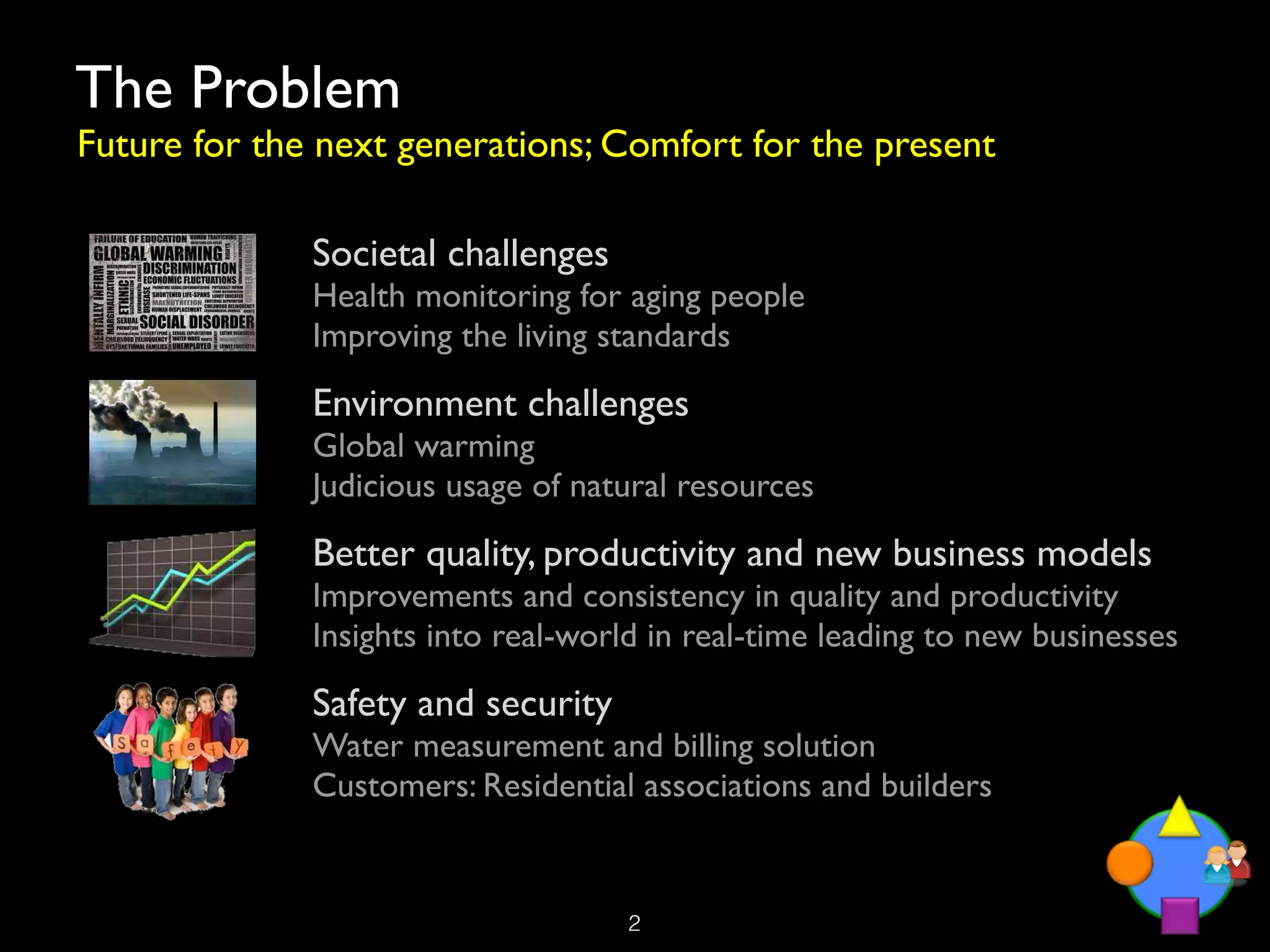
              Societal challenges
              Health monitoring for aging people
              Improving the living standards
              Environment challenges
              Global warming
              Judicious usage of natural resources
              Better quality, productivity and new business models
              Improvements and consistency in quality and productivity
              Insights into real-world in real-time leading to new businesses
              Safety and security
              Dissemination of vital information in real time
              Safety and security of people with privacy


                                     !2
The Solution
Internet of Things to bring the technology closer to the people

                     Internet of Things
                     Internet enabled objects that interacts with the environment
                     Provides insights into the real-world in real-time

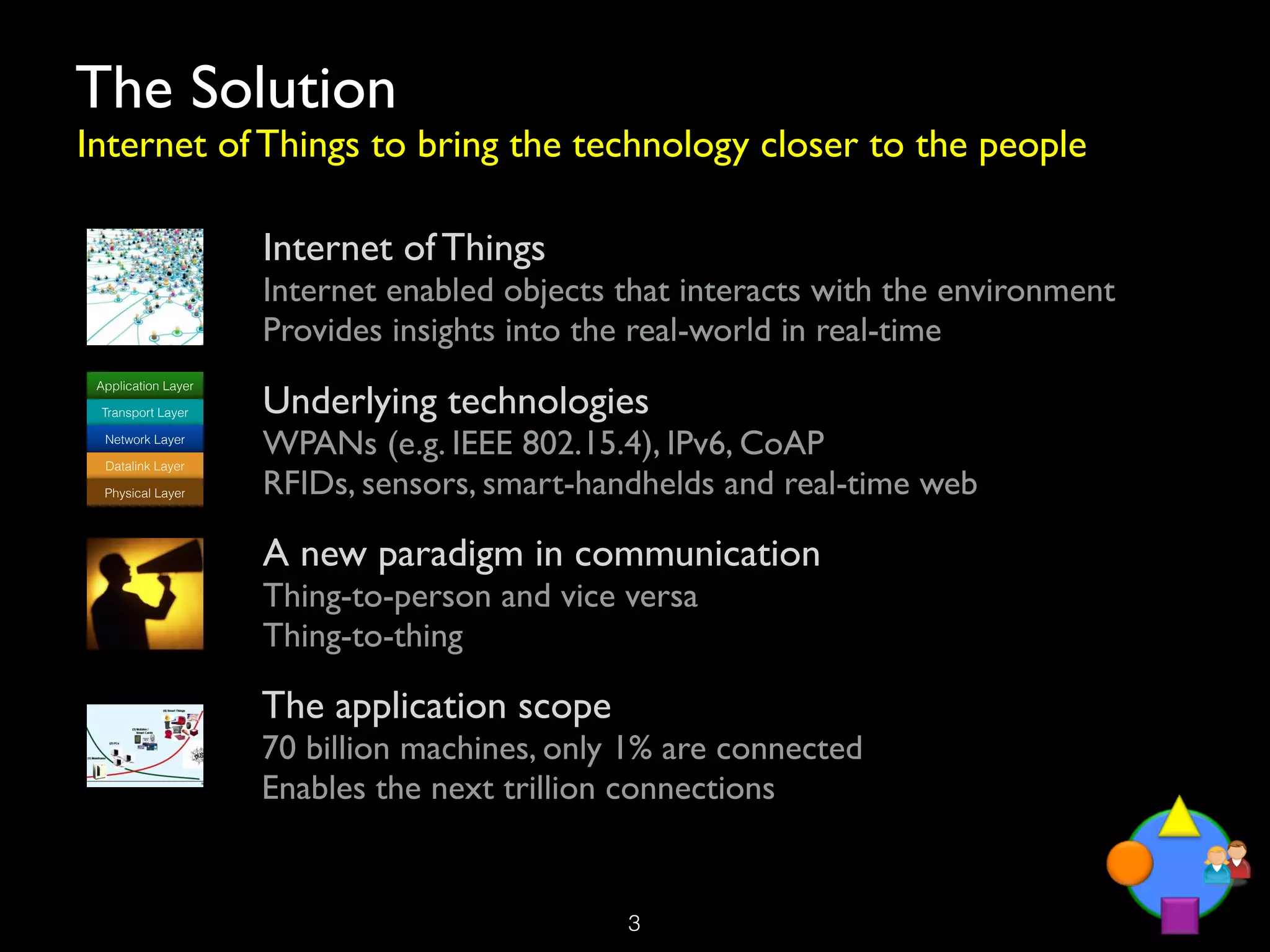
                     Underlying technologies
 Application Layer

 Transport Layer

  Network Layer

  Datalink Layer
                     WPANs (e.g. IEEE 802.15.4), IPv6, CoAP
  Physical Layer     RFIDs, sensors, smart-handhelds and real-time web

                     A new paradigm in communication
                     Thing-to-person and vice versa
                     Thing-to-thing

                     The application scope
                     70 billion machines, only 1% are connected
                     Enables the next trillion connections


                                              !3
System Architecture and Components
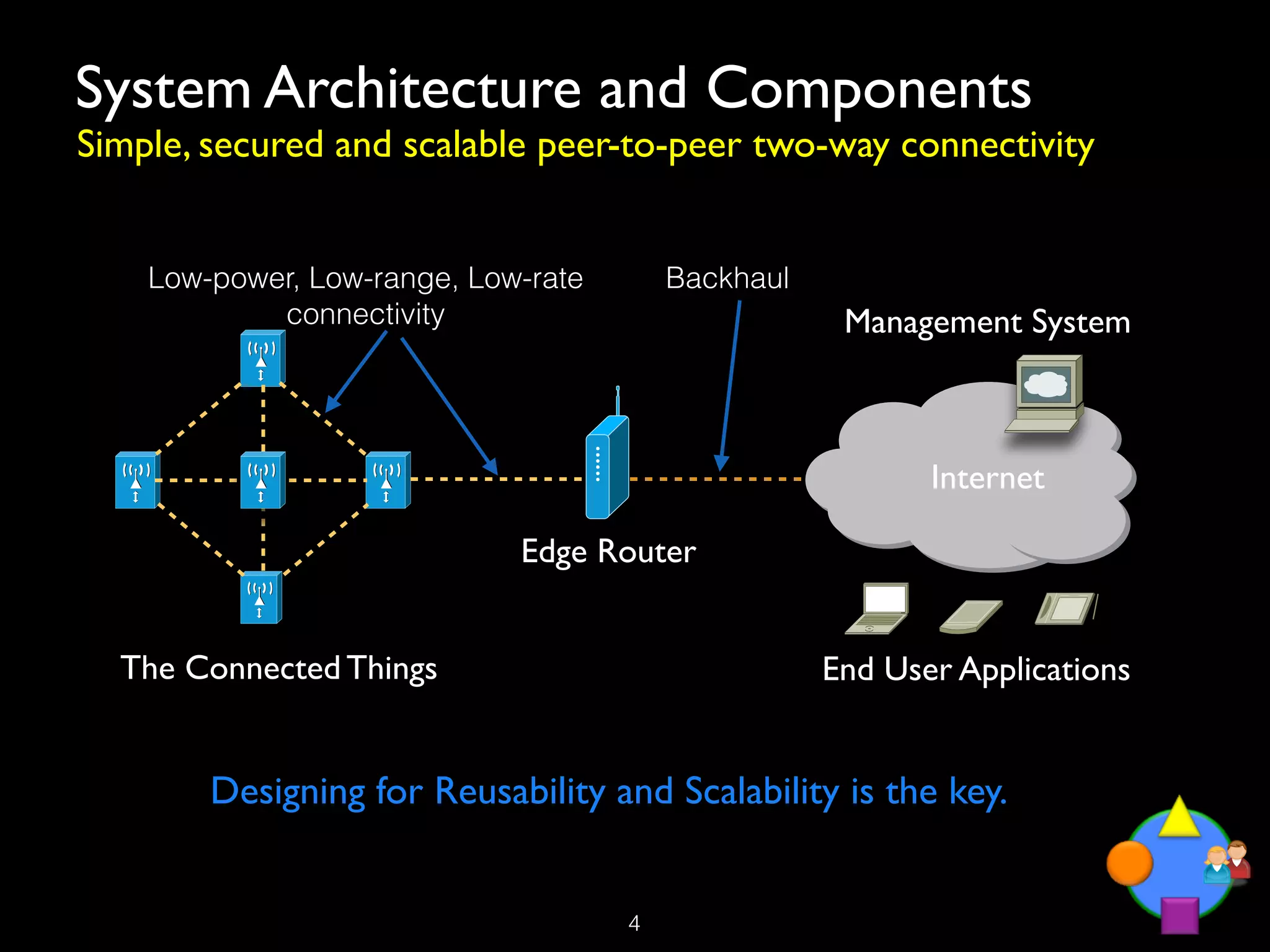
Simple, secured and scalable peer-to-peer two-way connectivity


    Low-power, Low-range, Low-rate        Backhaul
            connectivity                              Management System


                                                            Internet

                             Edge Router


  The Connected Things                               End User Applications


        Designing for Reusability and Scalability is the key.


                                     !4
Typical Characteristics of IoT Nodes
Limited capability; Specific functionality

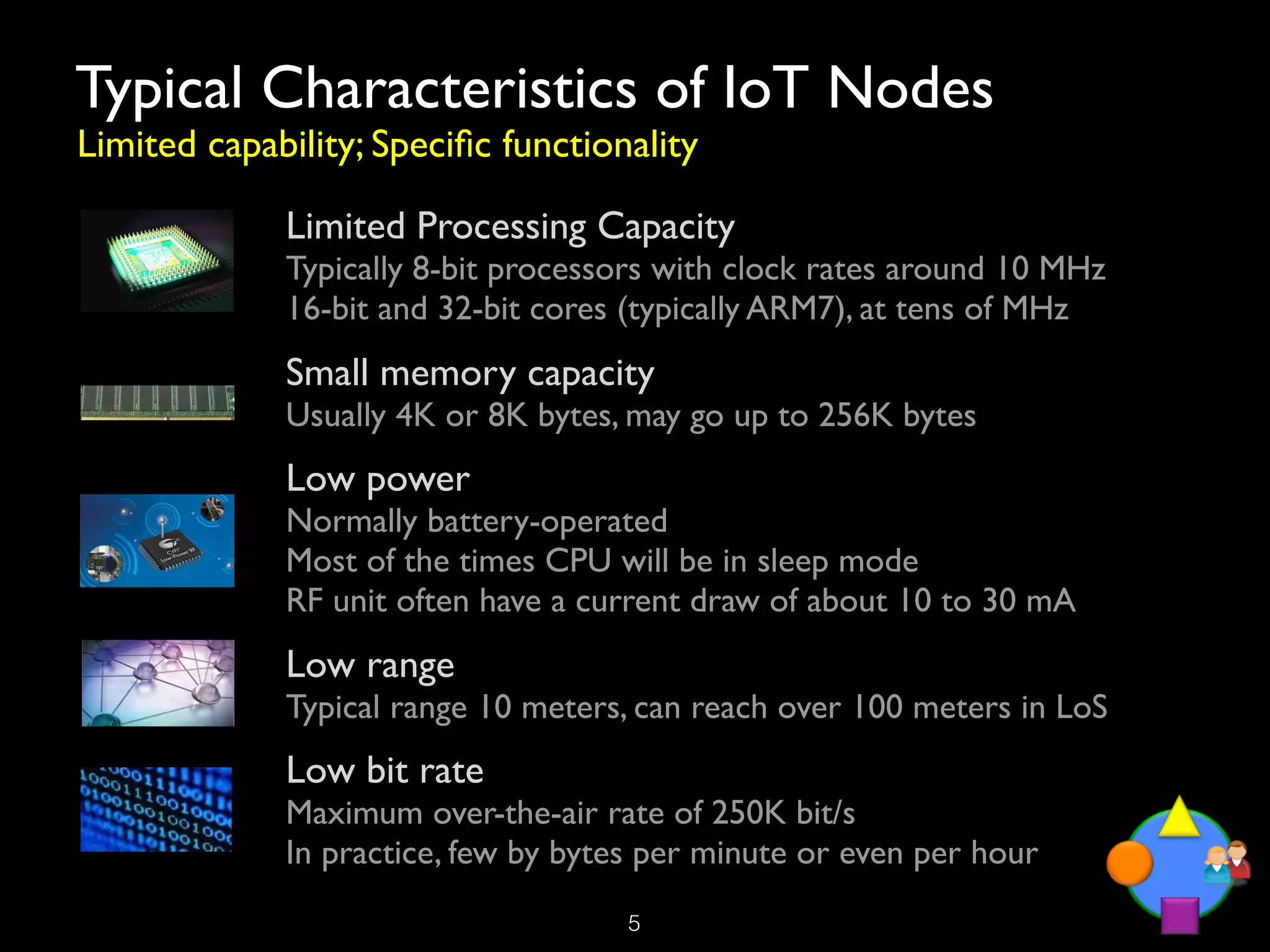
             Limited Processing Capacity
             Typically 8-bit processors with clock rates around 10 MHz
             16-bit and 32-bit cores (typically ARM7), at tens of MHz
             Small memory capacity
             Usually 4K or 8K bytes, may go up to 256K bytes
             Low power
             Normally battery-operated
             Most of the times CPU will be in sleep mode
             RF unit often have a current draw of about 10 to 30 mA
             Low range
             Typical range 10 meters, can reach over 100 meters in LoS
             Low bit rate
             Maximum over-the-air rate of 250K bit/s
             In practice, few by bytes per minute or even per hour
                                     !5
Deployment Considerations ...
Network considerations for the Internet of Things
            Installation
            Nodes can be scattered randomly or organized
            The deployment can occur at once, or as an iterative process

            Network size
            One to thousands of nodes

            Power source
            Battery-powered or mains-powered or Hybrid solutions
            Power harvesting from solar cells or other sources of energy

            Connectivity
            Always connected, intermittent, or sporadic

            Traffic Pattern
            Point-to-multipoint, multipoint-to-point, and point-to-point

                                     !6
Deployment Considerations
Network considerations for the Internet of Things

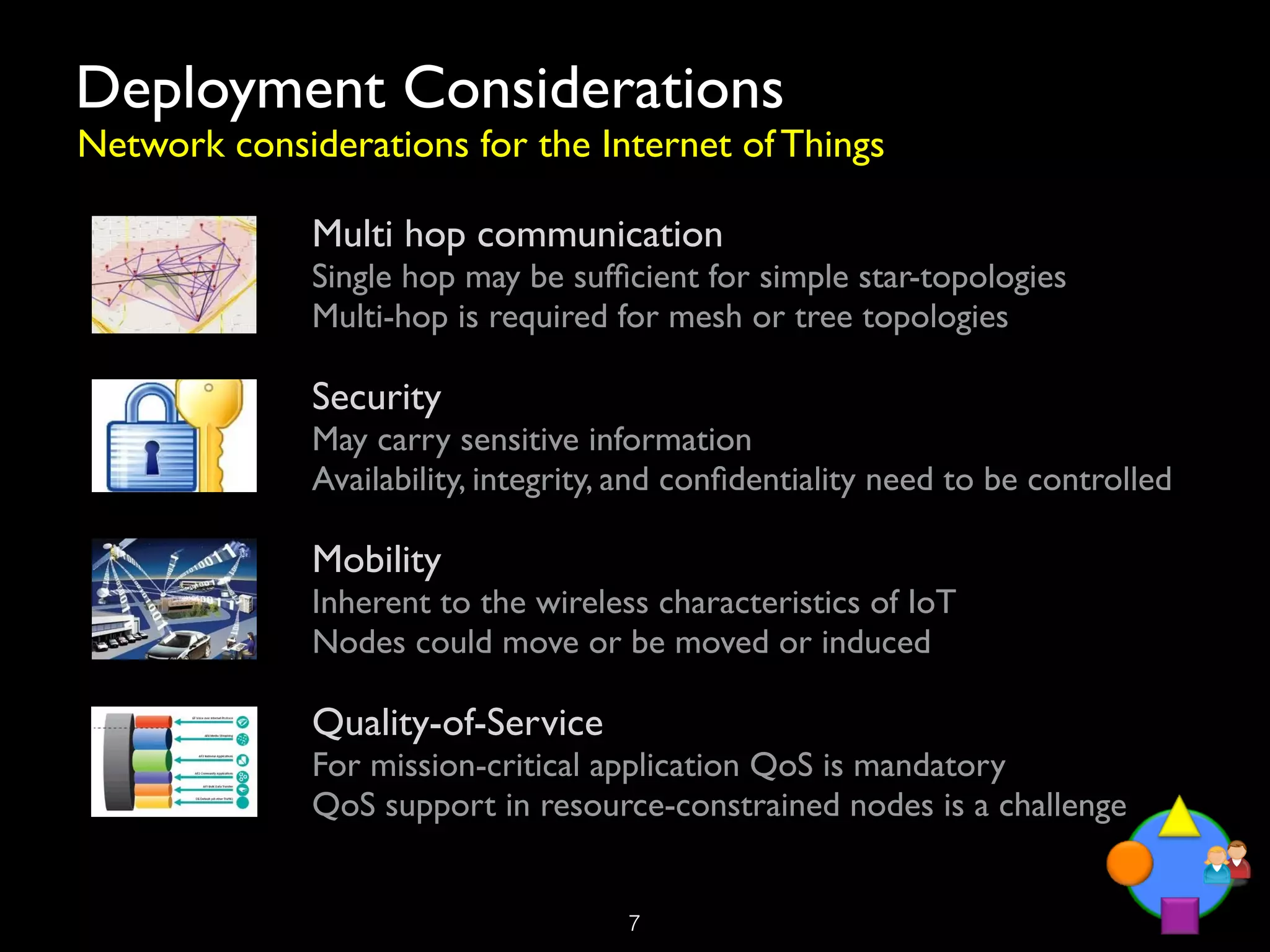
              Multi hop communication
              Single hop may be sufficient for simple star-topologies
              Multi-hop is required for mesh or tree topologies

              Security
              May carry sensitive information
              Availability, integrity, and confidentiality need to be controlled

              Mobility
              Inherent to the wireless characteristics of IoT
              Nodes could move or be moved or induced

              Quality-of-Service
              For mission-critical application QoS is mandatory
              QoS support in resource-constrained nodes is a challenge


                                     !7
The IoT Trends
The top trends being exhibited by the Internet of Things

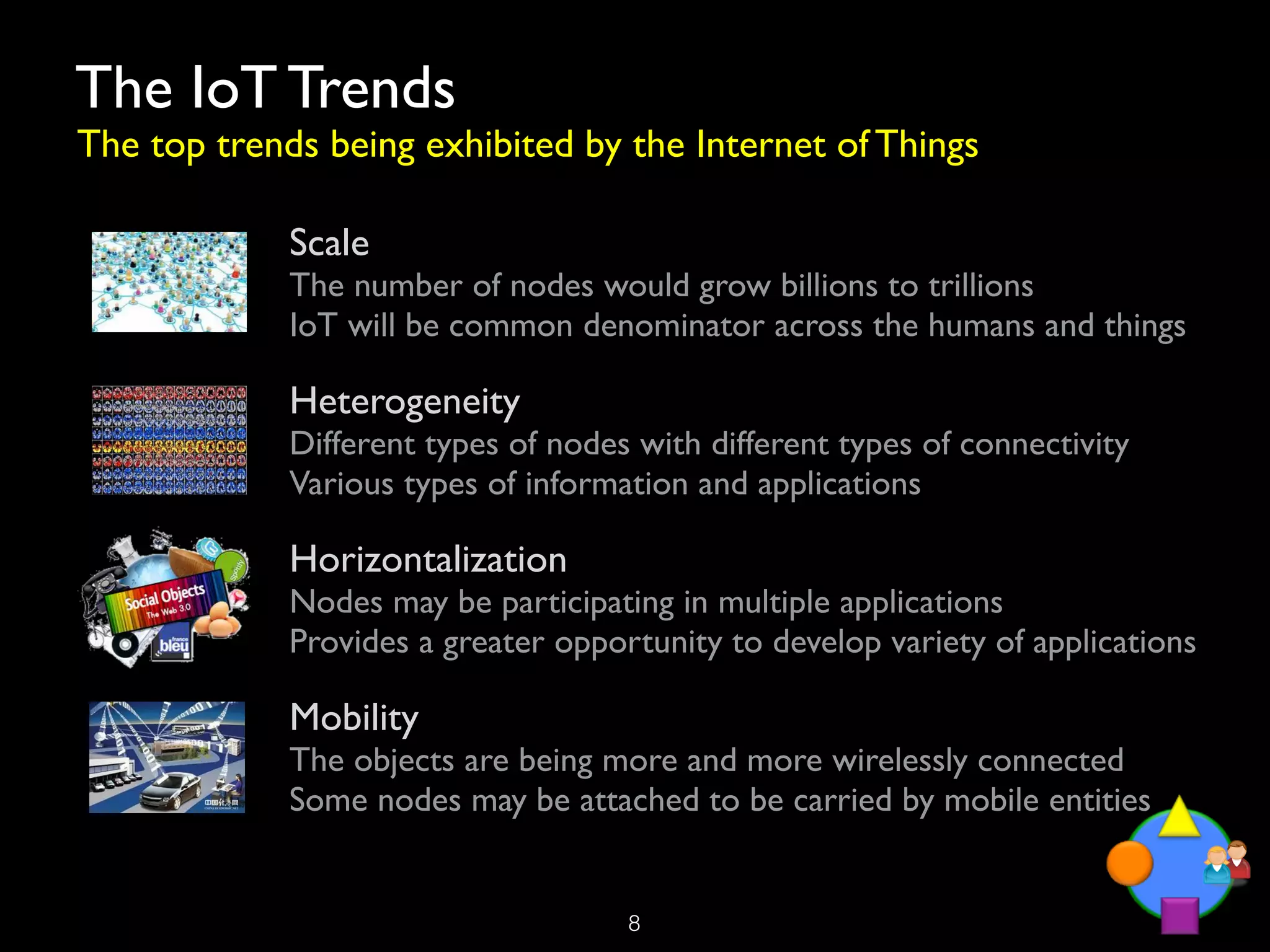
             Scale
             The number of nodes would grow billions to trillions
             IoT will be common denominator across the humans and things

             Heterogeneity
             Different types of nodes with different types of connectivity
             Various types of information and applications

             Horizontalization
             Nodes may be participating in multiple applications 
             Provides a greater opportunity to develop variety of applications

             Mobility
             The objects are being more and more wirelessly connected
             Some nodes may be attached to be carried by mobile entities


                                     !8
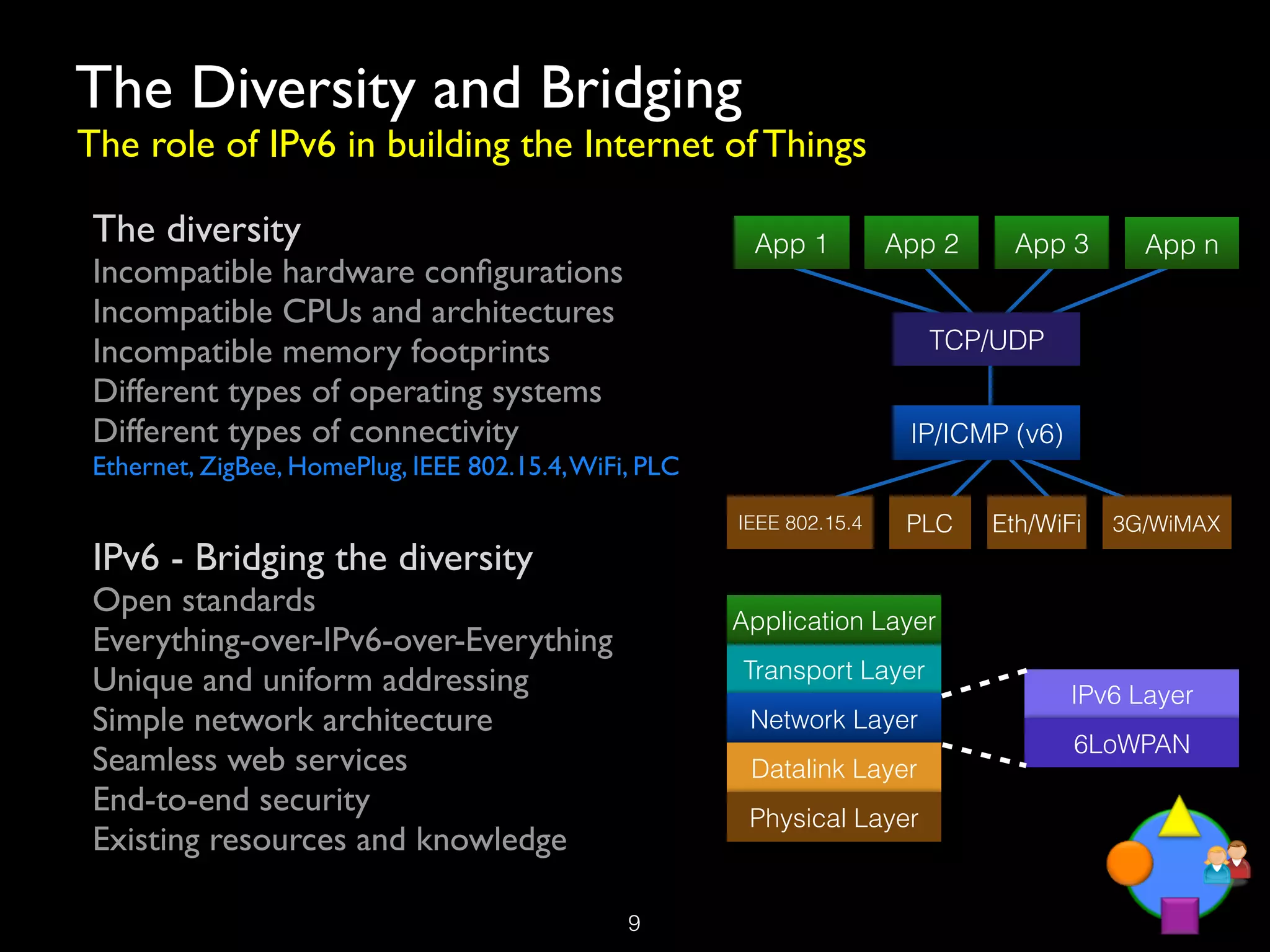
The Diversity and Bridging
The role of IPv6 in building the Internet of Things

 The diversity
                                          App 1          App 2     App 3       App n
 Incompatible hardware configurations
 Incompatible CPUs and architectures
 Incompatible memory footprints
                                           TCP/UDP
 Different types of operating systems
 Different types of connectivity
                                        IP/ICMP (v6)
 Ethernet, ZigBee, HomePlug, IEEE 802.15.4, WiFi, PLC

                                                        IEEE 802.15.4    PLC    Eth/WiFi   3G/WiMAX
 IPv6 - Bridging the diversity
 Open standards
                                                        Application Layer
 Everything-over-IPv6-over-Everything
 Unique and uniform addressing
                         Transport Layer
                                                                                        IPv6 Layer
 Simple network architecture
                            Network Layer
                                                                                        6LoWPAN
 Seamless web services
                                  Datalink Layer
 End-to-end security
                                    Physical Layer
 Existing resources and knowledge

                                                !9
The Applications ...
For creating the future

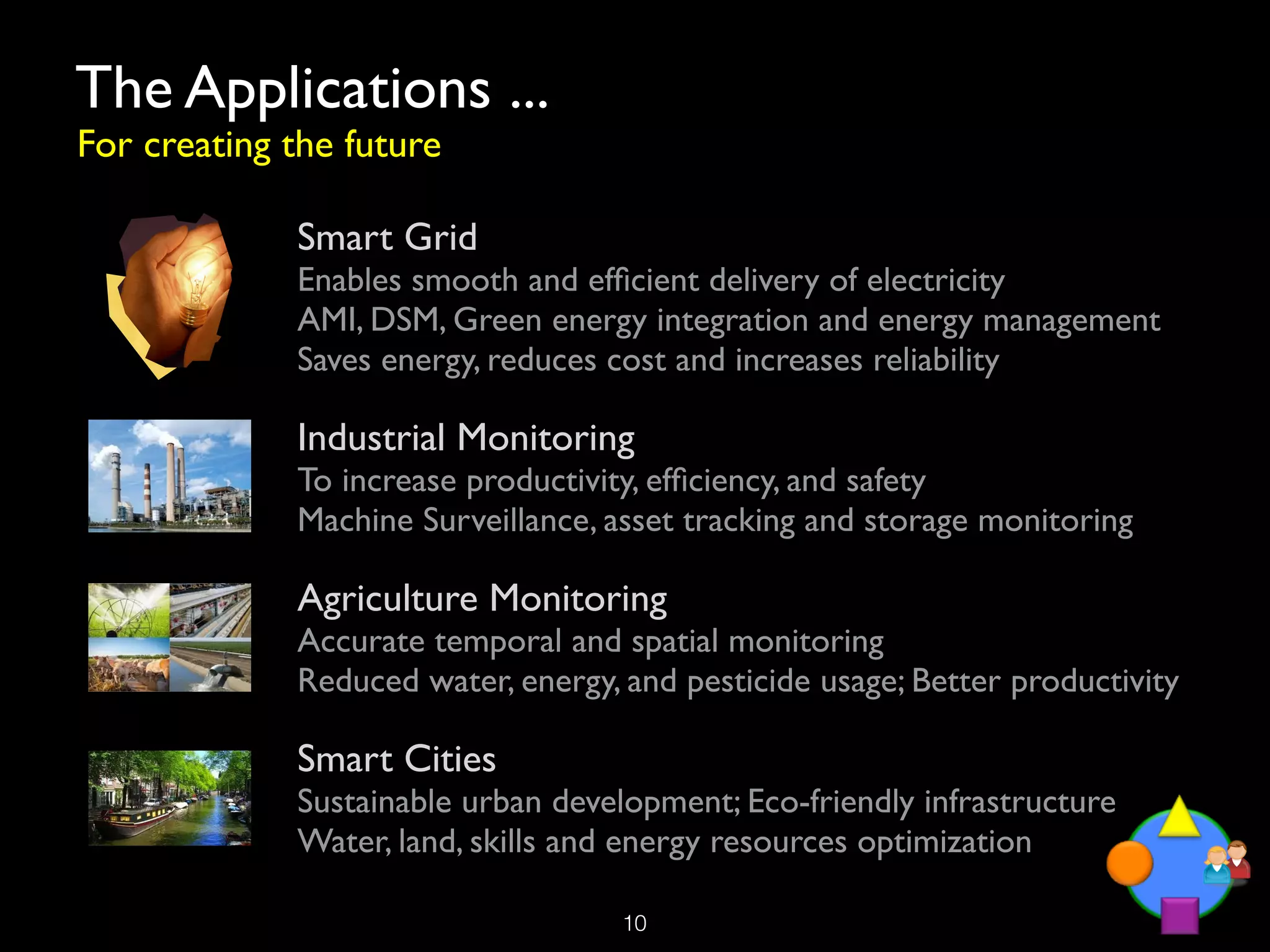
             Smart Grid
             Enables smooth and efficient delivery of electricity 
             AMI, DSM, Green energy integration and energy management
             Saves energy, reduces cost and increases reliability

             Industrial Monitoring
             To increase productivity, efficiency, and safety
             Machine Surveillance, asset tracking and storage monitoring

             Agriculture Monitoring
             Accurate temporal and spatial monitoring
             Reduced water, energy, and pesticide usage; Better productivity

             Smart Cities
             Sustainable urban development; Eco-friendly infrastructure
             Water, land, skills and energy resources optimization

                                    !10
The Applications
To bring technology closer to the people

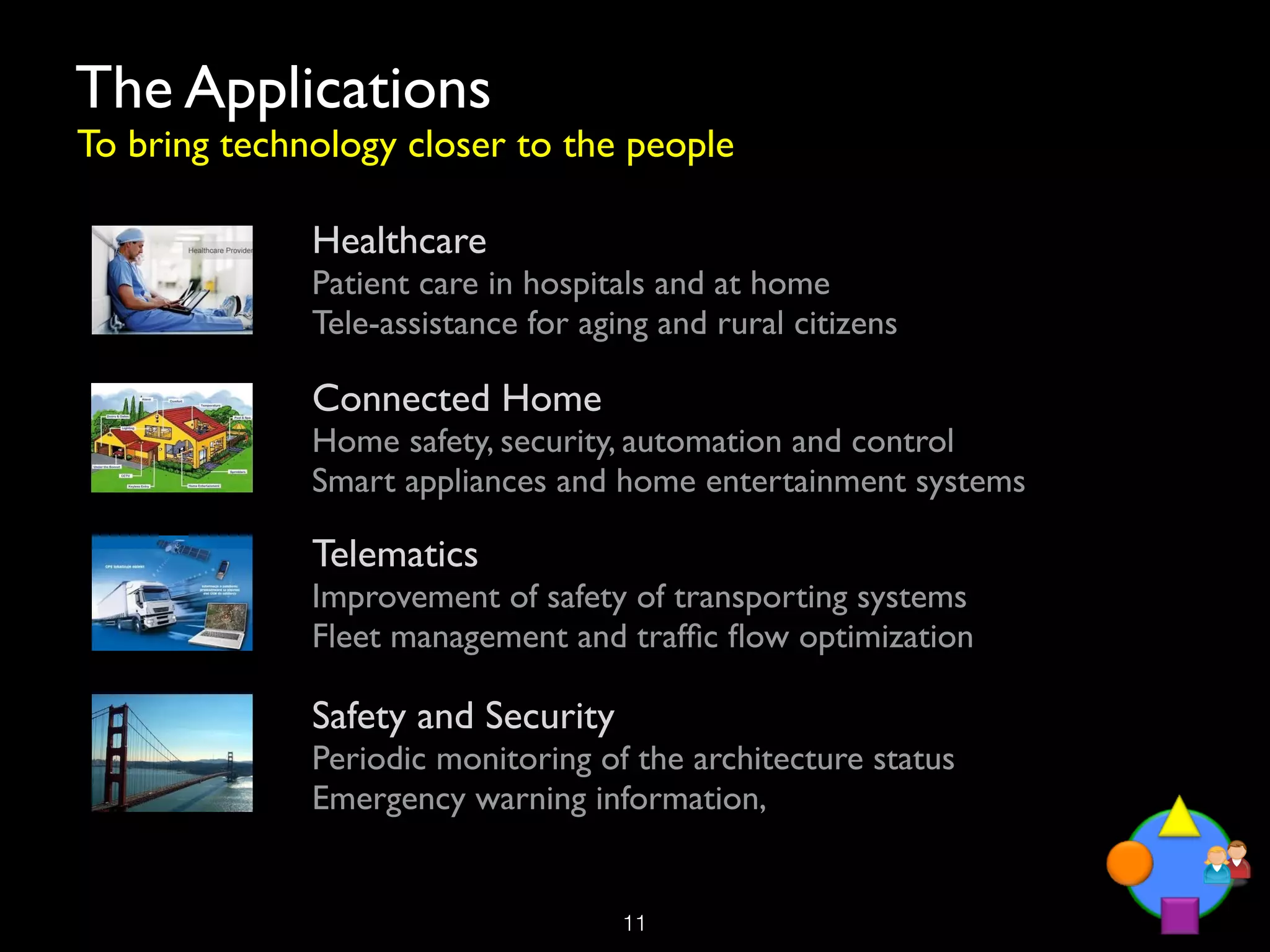
              Healthcare
              Patient care in hospitals and at home
              Tele-assistance for aging and rural citizens

              Connected Home
              Home safety, security, automation and control
              Smart appliances and home entertainment systems

              Telematics
              Improvement of safety of transporting systems
              Fleet management and traffic flow optimization

              Safety and Security
              Periodic monitoring of the architecture status
              Emergency warning information,


                                     !11
The Benefits of Internet of Things
Future for the next generations; Comfort for the present

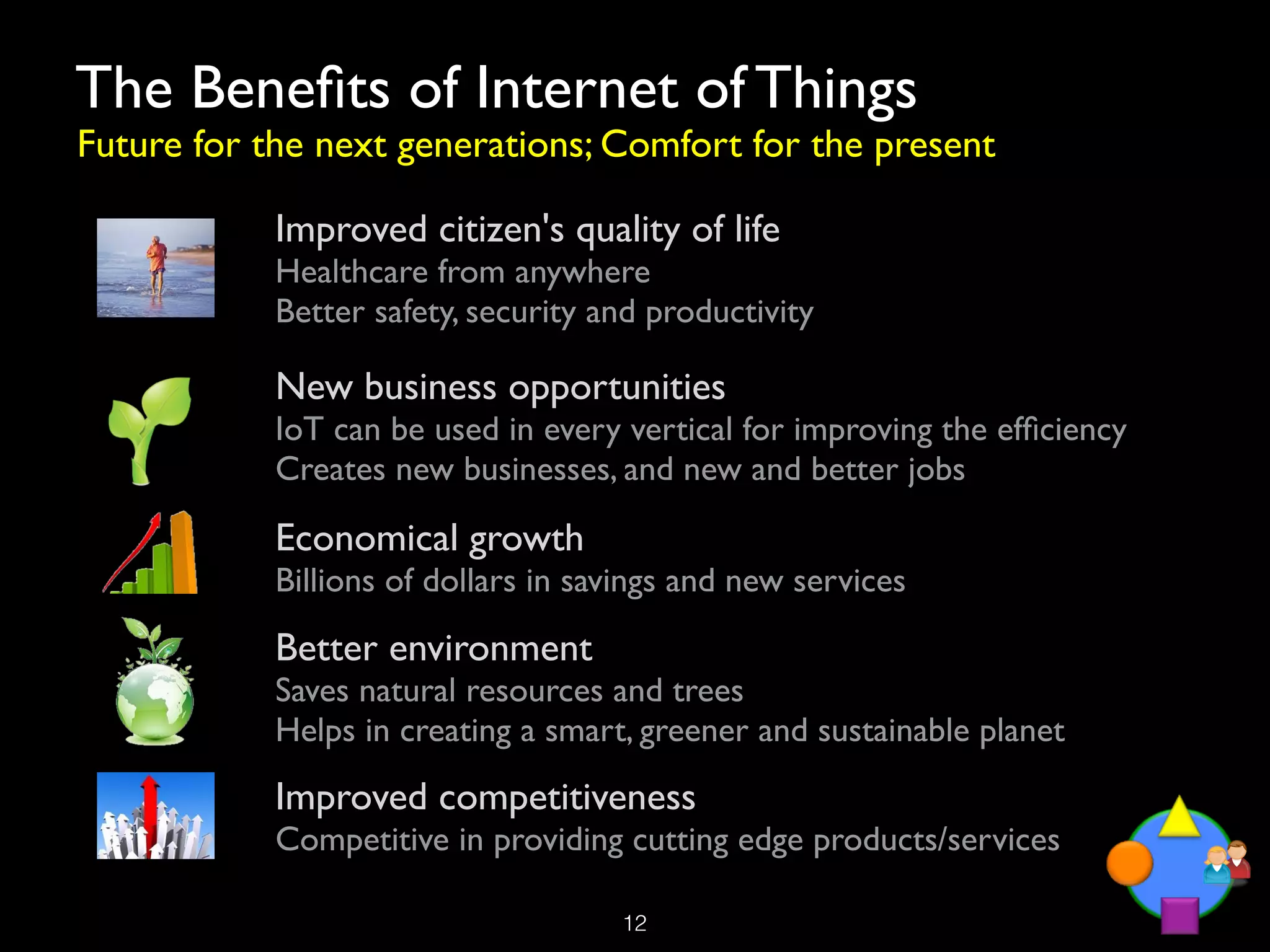
            Improved citizen's quality of life
            Healthcare from anywhere
            Better safety, security and productivity

            New business opportunities
            IoT can be used in every vertical for improving the efficiency
            Creates new businesses, and new and better jobs

            Economical growth
            Billions of dollars in savings and new services
            Better environment
            Saves natural resources and trees
            Helps in creating a smart, greener and sustainable planet
            Improved competitiveness
            Competitive in providing cutting edge products/services

                                     !12
The Role for Public Authorities ...
The governance of the Internet of Things

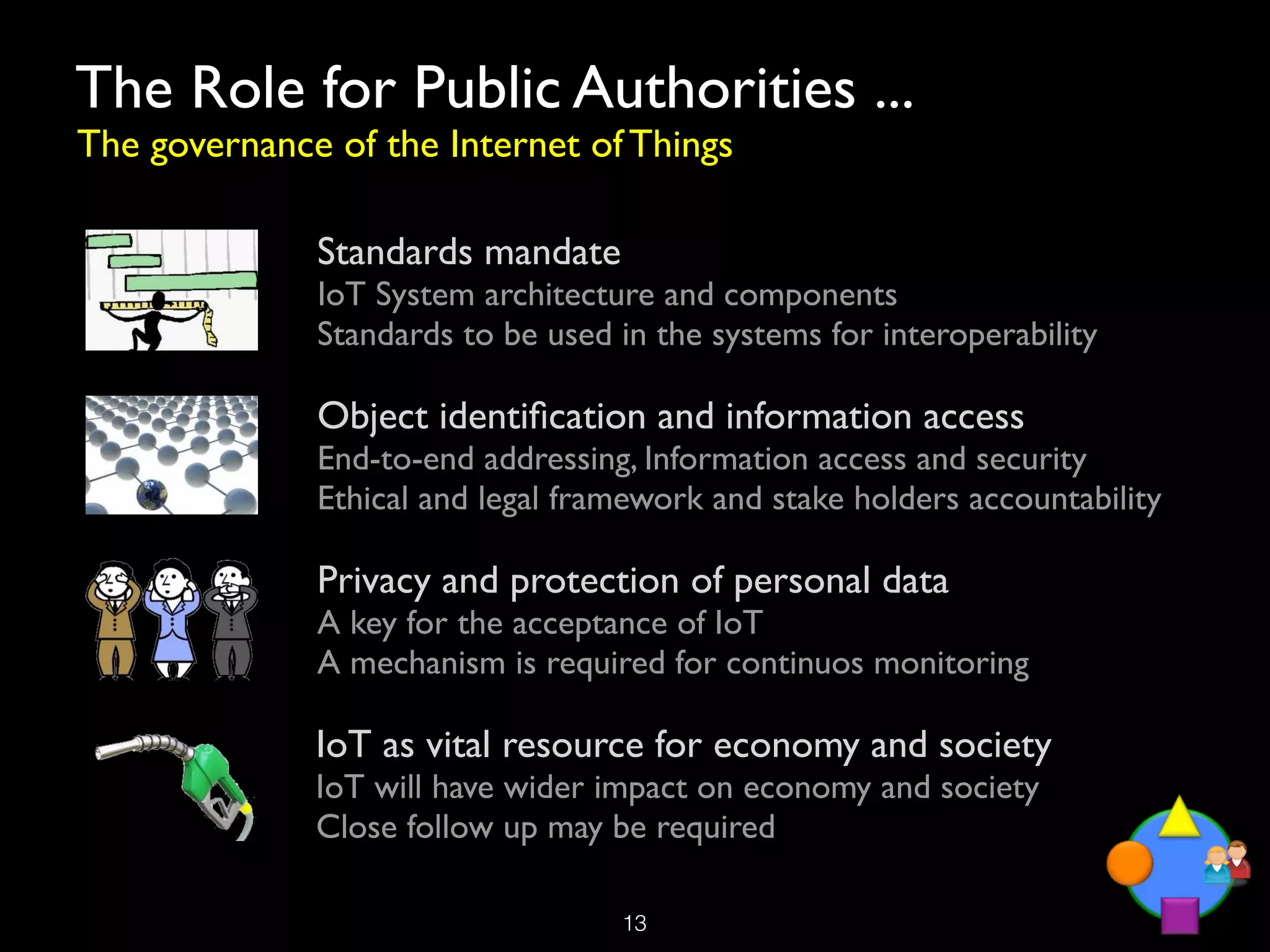
              Standards mandate
              IoT System architecture and components
              Standards to be used in the systems for interoperability

              Object identification and information access
              End-to-end addressing, Information access and security
              Ethical and legal framework and stake holders accountability

              Privacy and protection of personal data
              A key for the acceptance of IoT
              A mechanism is required for continuos monitoring

              IoT as vital resource for economy and society
              IoT will have wider impact on economy and society
              Close follow up may be required

                                   !13
The Role for Public Authorities
The governance of the Internet of Things

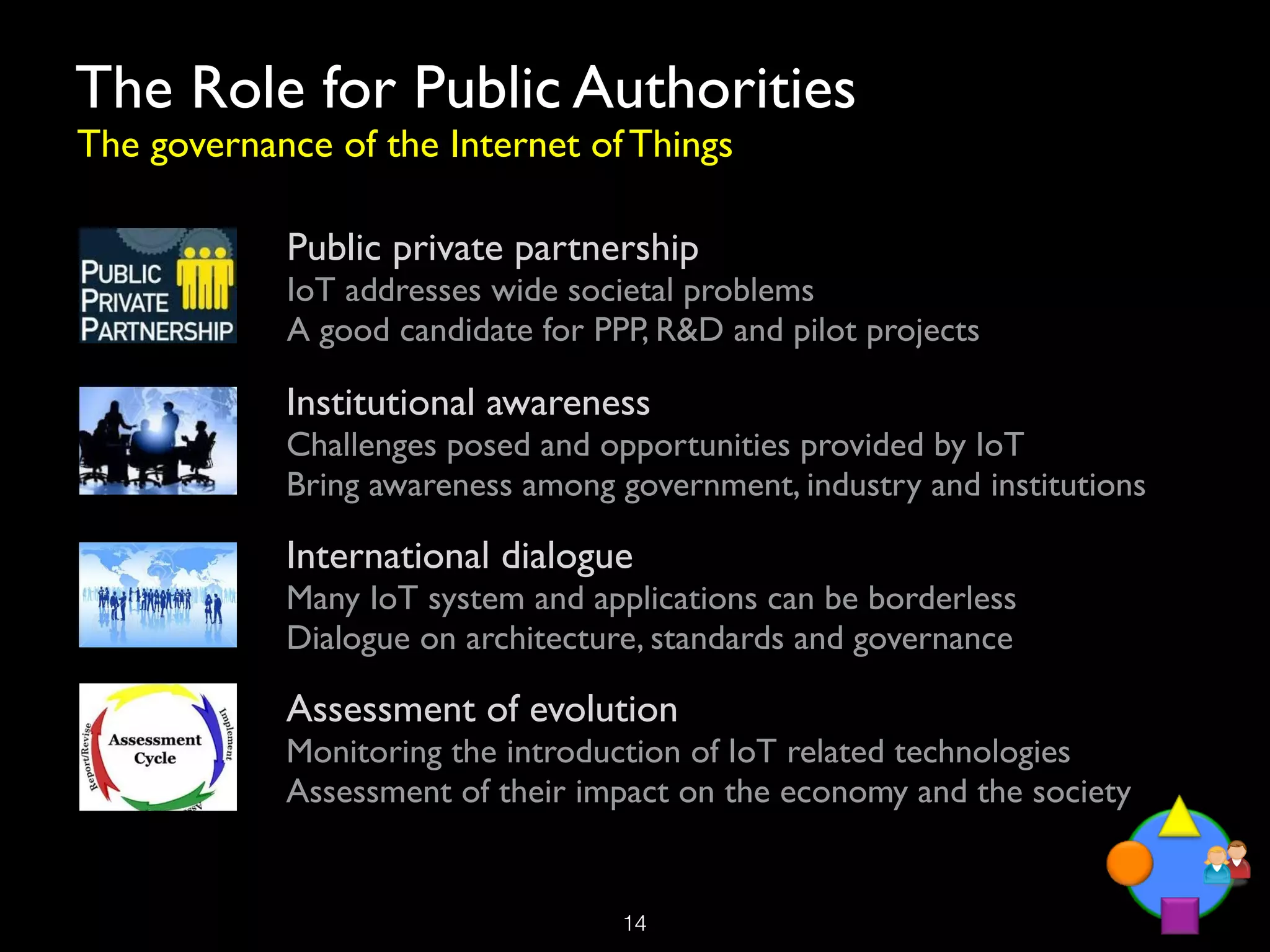
            Public private partnership
            IoT addresses wide societal problems
            A good candidate for PPP, R&D and pilot projects

            Institutional awareness
            Challenges posed and opportunities provided by IoT
            Bring awareness among government, industry and institutions

            International dialogue
            Many IoT system and applications can be borderless
            Dialogue on architecture, standards and governance

            Assessment of evolution
            Monitoring the introduction of IoT related technologies
            Assessment of their impact on the economy and the society


                                   !14
The Challenges
IoT implementation challenges for research & development

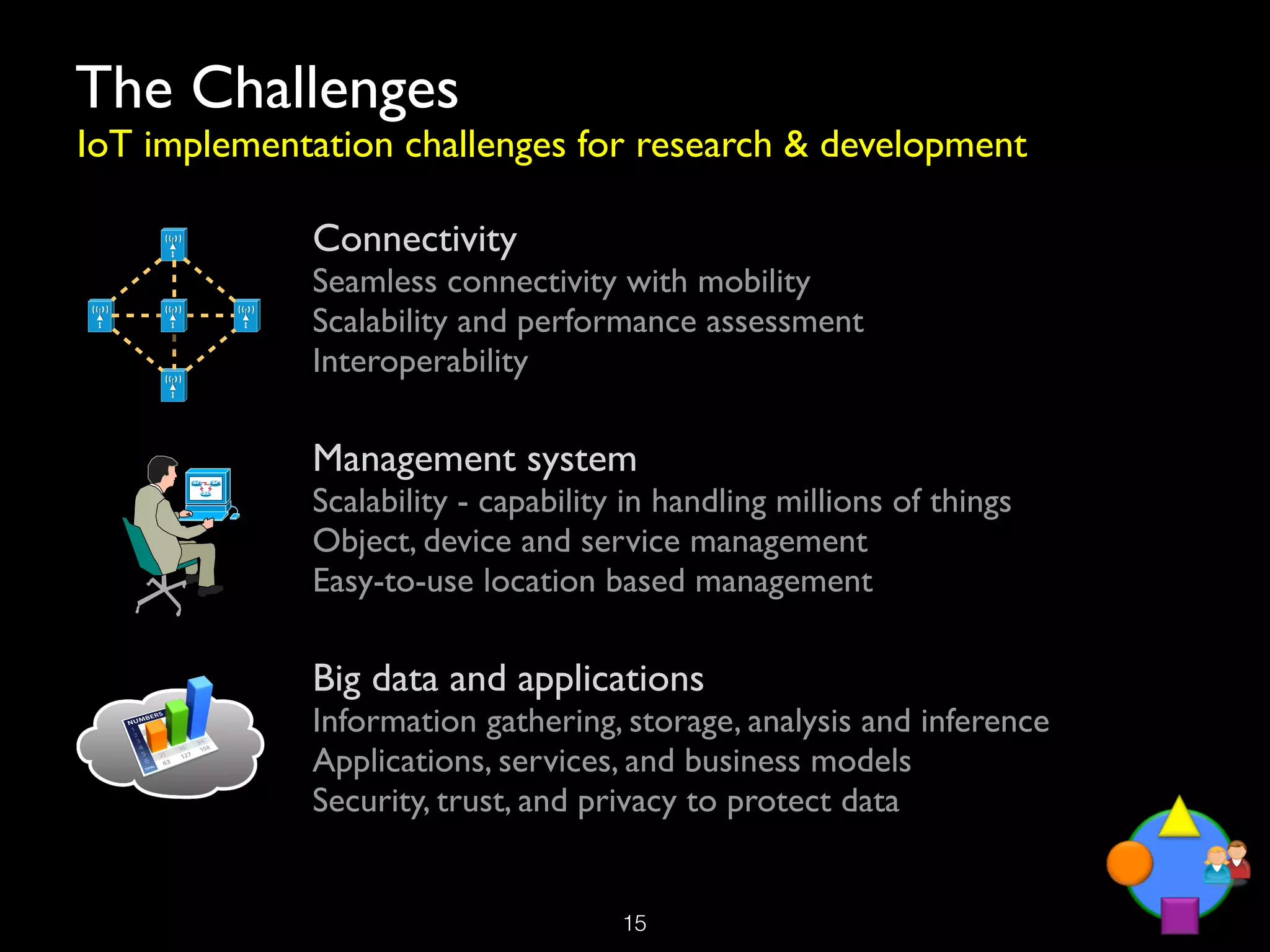
             Connectivity
             Seamless connectivity with mobility
             Scalability and performance assessment
             Interoperability

             Management system
             Scalability - capability in handling millions of things
             Object, device and service management
             Easy-to-use location based management

             Big data and applications
             Information gathering, storage, analysis and inference
             Applications, services, and business models
             Security, trust, and privacy to protect data


                                     !15
Bringing Technology Closer to You!
                                       TM


                               Thank You
                               Syam Madanapalli
                      syam@iramtechnologies.net
                              +91 959 175 7926
                                 Date: 4-May-2012
                !16

The internet of things

  • 1.
    The Internet ofThings The Next Big Thing on the Planet Earth! iRam Technologies Creating the Future! TM !1
  • 2.
    The Problem Future forthe next generations; Comfort for the present Societal challenges Health monitoring for aging people Improving the living standards Environment challenges Global warming Judicious usage of natural resources Better quality, productivity and new business models Improvements and consistency in quality and productivity Insights into real-world in real-time leading to new businesses Safety and security Dissemination of vital information in real time Safety and security of people with privacy !2
  • 3.
    The Solution Internet ofThings to bring the technology closer to the people Internet of Things Internet enabled objects that interacts with the environment Provides insights into the real-world in real-time Underlying technologies Application Layer Transport Layer Network Layer Datalink Layer WPANs (e.g. IEEE 802.15.4), IPv6, CoAP Physical Layer RFIDs, sensors, smart-handhelds and real-time web A new paradigm in communication Thing-to-person and vice versa Thing-to-thing The application scope 70 billion machines, only 1% are connected Enables the next trillion connections !3
  • 4.
    System Architecture andComponents Simple, secured and scalable peer-to-peer two-way connectivity Low-power, Low-range, Low-rate Backhaul connectivity Management System Internet Edge Router The Connected Things End User Applications Designing for Reusability and Scalability is the key. !4
  • 5.
    Typical Characteristics ofIoT Nodes Limited capability; Specific functionality Limited Processing Capacity Typically 8-bit processors with clock rates around 10 MHz 16-bit and 32-bit cores (typically ARM7), at tens of MHz Small memory capacity Usually 4K or 8K bytes, may go up to 256K bytes Low power Normally battery-operated Most of the times CPU will be in sleep mode RF unit often have a current draw of about 10 to 30 mA Low range Typical range 10 meters, can reach over 100 meters in LoS Low bit rate Maximum over-the-air rate of 250K bit/s In practice, few by bytes per minute or even per hour !5
  • 6.
    Deployment Considerations ... Networkconsiderations for the Internet of Things Installation Nodes can be scattered randomly or organized The deployment can occur at once, or as an iterative process Network size One to thousands of nodes Power source Battery-powered or mains-powered or Hybrid solutions Power harvesting from solar cells or other sources of energy Connectivity Always connected, intermittent, or sporadic Traffic Pattern Point-to-multipoint, multipoint-to-point, and point-to-point !6
  • 7.
    Deployment Considerations Network considerationsfor the Internet of Things Multi hop communication Single hop may be sufficient for simple star-topologies Multi-hop is required for mesh or tree topologies Security May carry sensitive information Availability, integrity, and confidentiality need to be controlled Mobility Inherent to the wireless characteristics of IoT Nodes could move or be moved or induced Quality-of-Service For mission-critical application QoS is mandatory QoS support in resource-constrained nodes is a challenge !7
  • 8.
    The IoT Trends Thetop trends being exhibited by the Internet of Things Scale The number of nodes would grow billions to trillions IoT will be common denominator across the humans and things Heterogeneity Different types of nodes with different types of connectivity Various types of information and applications Horizontalization Nodes may be participating in multiple applications Provides a greater opportunity to develop variety of applications Mobility The objects are being more and more wirelessly connected Some nodes may be attached to be carried by mobile entities !8
  • 9.
    The Diversity andBridging The role of IPv6 in building the Internet of Things The diversity App 1 App 2 App 3 App n Incompatible hardware configurations Incompatible CPUs and architectures Incompatible memory footprints TCP/UDP Different types of operating systems Different types of connectivity IP/ICMP (v6) Ethernet, ZigBee, HomePlug, IEEE 802.15.4, WiFi, PLC IEEE 802.15.4 PLC Eth/WiFi 3G/WiMAX IPv6 - Bridging the diversity Open standards Application Layer Everything-over-IPv6-over-Everything Unique and uniform addressing Transport Layer IPv6 Layer Simple network architecture Network Layer 6LoWPAN Seamless web services Datalink Layer End-to-end security Physical Layer Existing resources and knowledge !9
  • 10.
    The Applications ... Forcreating the future Smart Grid Enables smooth and efficient delivery of electricity AMI, DSM, Green energy integration and energy management Saves energy, reduces cost and increases reliability Industrial Monitoring To increase productivity, efficiency, and safety Machine Surveillance, asset tracking and storage monitoring Agriculture Monitoring Accurate temporal and spatial monitoring Reduced water, energy, and pesticide usage; Better productivity Smart Cities Sustainable urban development; Eco-friendly infrastructure Water, land, skills and energy resources optimization !10
  • 11.
    The Applications To bringtechnology closer to the people Healthcare Patient care in hospitals and at home Tele-assistance for aging and rural citizens Connected Home Home safety, security, automation and control Smart appliances and home entertainment systems Telematics Improvement of safety of transporting systems Fleet management and traffic flow optimization Safety and Security Periodic monitoring of the architecture status Emergency warning information, !11
  • 12.
    The Benefits ofInternet of Things Future for the next generations; Comfort for the present Improved citizen's quality of life Healthcare from anywhere Better safety, security and productivity New business opportunities IoT can be used in every vertical for improving the efficiency Creates new businesses, and new and better jobs Economical growth Billions of dollars in savings and new services Better environment Saves natural resources and trees Helps in creating a smart, greener and sustainable planet Improved competitiveness Competitive in providing cutting edge products/services !12
  • 13.
    The Role forPublic Authorities ... The governance of the Internet of Things Standards mandate IoT System architecture and components Standards to be used in the systems for interoperability Object identification and information access End-to-end addressing, Information access and security Ethical and legal framework and stake holders accountability Privacy and protection of personal data A key for the acceptance of IoT A mechanism is required for continuos monitoring IoT as vital resource for economy and society IoT will have wider impact on economy and society Close follow up may be required !13
  • 14.
    The Role forPublic Authorities The governance of the Internet of Things Public private partnership IoT addresses wide societal problems A good candidate for PPP, R&D and pilot projects Institutional awareness Challenges posed and opportunities provided by IoT Bring awareness among government, industry and institutions International dialogue Many IoT system and applications can be borderless Dialogue on architecture, standards and governance Assessment of evolution Monitoring the introduction of IoT related technologies Assessment of their impact on the economy and the society !14
  • 15.
    The Challenges IoT implementationchallenges for research & development Connectivity Seamless connectivity with mobility Scalability and performance assessment Interoperability Management system Scalability - capability in handling millions of things Object, device and service management Easy-to-use location based management Big data and applications Information gathering, storage, analysis and inference Applications, services, and business models Security, trust, and privacy to protect data !15
  • 16.
    Bringing Technology Closerto You! TM Thank You Syam Madanapalli syam@iramtechnologies.net +91 959 175 7926 Date: 4-May-2012 !16