The International Classroom
AULC Conference - 2017
Donata Puntil
Silvia Colaiacomo
Modern Language Centre
King’s College London
The context…..
“The incorporation of an international and
intercultural dimension into the content of
the curriculum, as well as the teaching and
learning arrangements and support services
of a program of study”.
(Leask, B. 2009: 209)
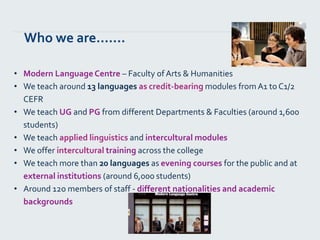
Who we are…....
• Modern LanguageCentre – Faculty of Arts & Humanities
• We teach around 13 languages as credit-bearing modules from A1 to C1/2
CEFR
• We teach UG and PG from different Departments & Faculties (around 1,600
students)
• We teach applied linguistics and intercultural modules
• We offer intercultural training across the college
• We teach more than 20 languages as evening courses for the public and at
external institutions (around 6,000 students)
• Around 12o members of staff - different nationalities and academic
backgrounds
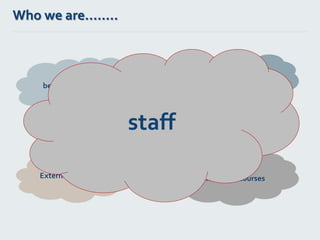
Who we are….....
Credit-
bearing/assessed
modules
External contracts
Evening classes
Tailor-made courses
Internal and external
training
staff
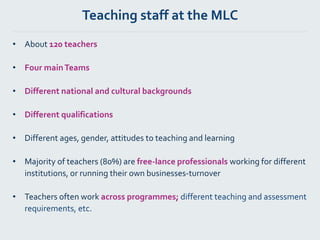
Teaching staff at the MLC
• About 120 teachers
• Four mainTeams
• Different national and cultural backgrounds
• Different qualifications
• Different ages, gender, attitudes to teaching and learning
• Majority of teachers (80%) are free-lance professionals working for different
institutions, or running their own businesses-turnover
• Teachers often work across programmes; different teaching and assessment
requirements, etc.
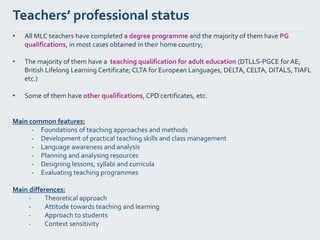
Teachers’ professional status
• All MLC teachers have completed a degree programme and the majority of them have PG
qualifications, in most cases obtained in their home country;
• The majority of them have a teaching qualification for adult education (DTLLS-PGCE for AE;
British Lifelong Learning Certificate; CLTA for European Languages, DELTA, CELTA, DITALS,TIAFL
etc.)
• Some of them have other qualifications, CPD certificates, etc.
Main common features:
- Foundations of teaching approaches and methods
- Development of practical teaching skills and class management
- Language awareness and analysis
- Planning and analysing resources
- Designing lessons, syllabi and curricula
- Evaluating teaching programmes
Main differences:
- Theoretical approach
- Attitude towards teaching and learning
- Approach to students
- Context sensitivity
Modern Language Centre
DIVERSITY
Higher Education Context
The key elements of contemporary education are embedded in three
interrelated policy technologies:
• the market
• managerialism
• performativity
(Ball, 2003: 215)
The marketization of the educational sector is not simply a vehicle for technical
and structural change of organizations but is also a mechanism for reforming
teachers (lecturers and researchers) and for changing what it means to be a
teacher.
(Robertson, 1996)
Higher Education Context
• Two apparently conflicting effects are achieved by such changes: both an
increasing individualization and the construction of new forms of
institutional affiliation and ‘community’ based on corporate culture.This
involves a re-working of the relationship between individual
commitment and action in the organization;
• The work of the manager becomes crucial in this respect as he/she
involves instilling the attitude and culture within which workers feel
themselves accountable and at the same time committed or personally
invested in the organization.These new managers are the ‘technician of
transformation’ (May 1994: 619), or what Foucault calls ‘technicians of
behaviours’;
HE Key Factors:
1. Self-determination (of institutions and professionals);
2. Entrepreneurialism (professionals working for different employers –
negotiating new roles and identities);
3. Cost-sustainability (budget);
4. Market – consumerism will privilege clients and employers in judging the
quality of the education;
5. Importance of building a professional status (individual and institution);
6. Necessity of continuous training to face the challenges of a changing work
setting;
7. Challenges of working as a free-lance in terms of financial security and
adaptation to different institutional policies;
8. Academic context within one teaches.
(Ball, 2003):
King’s International Strategy
• King’s College London is dedicated to the advancement of knowledge, learning and
understanding in the service of global society;
• Through strong partnerships and research and teaching excellence, King’s is recognized
as a thought-leader on interdisciplinary themes of global significance. King’s provides an
internationalized curriculum and student experience which creates global citizens
connected to international networks and employable anywhere in the world;
• King’s International Strategy to 2020 sets out the university’s vision for taking advantage
of the overwhelmingly positive impact thinking globally has on our students, our staff,
our research and the world at large:
1. Attract the best international minds to King’s
2. Provide an internationalized curriculum and student experience
3. Invest in strategic partnerships with world-class institutions
4. Raise King’s profile as a thought-leader in areas of global significance
5. Create an ethical and enabling environment for King’s international activities
http://www.kcl.ac.uk/aboutkings/international-strategy/index.aspx
Internationalization….....
”It is through staff and students engagement in an international
curriculum that the internationalisation agenda of universities
connects with students. As graduates, today’s students will shape the
world of the future as economic beings (professionals) and as social
human beings. Their actions and decisions in the workplace, in their
local community, and in their lives will have an impact on others and
be influenced by the breadth and depth of their knowledge
about the world, their skills in relating to others, and their
values [….] international and intercultural interaction and
collaboration has the potential to develop cultural insight and
exchange that is enriching and enabling for individuals and
through them for local, national and global communities.”
(Leask, B. 2015, p.71-72)
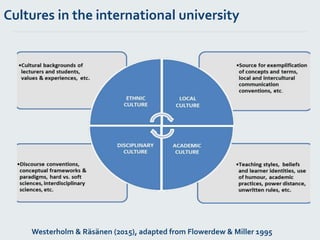
Cultures in the international university
Westerholm & Räsänen (2015), adapted from Flowerdew & Miller 1995
How?
• Internal Staff Development
• Role of the MLC within the College
• Intercultural Learning Module
• Intercultural Training
• International Classroom Project
Internal Staff Development
• Series of internal “advanced “training activities focusing on different
topics/aims for experienced teachers;
• Series of internal “basic” training activities for less experienced teachers;
• HEA Accreditations;
• Involvement of allTeams;
• Involvement of all teachers at different levels;
• Peer-oriented;
• Staff-led;
• MLC Staff Development workshops
• Refreshing yourTeaching Skills
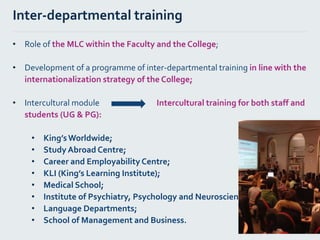
Inter-departmental training
• Role of the MLC within the Faculty and the College;
• Development of a programme of inter-departmental training in line with the
internationalization strategy of the College;
• Intercultural module Intercultural training for both staff and
students (UG & PG):
• King’sWorldwide;
• Study Abroad Centre;
• Career and Employability Centre;
• KLI (King’s Learning Institute);
• Medical School;
• Institute of Psychiatry, Psychology and Neuroscience;
• Language Departments;
• School of Management and Business.
The International Classroom
• Development from the InterculturalTraining;
• In line with King’s international strategy;
• Project led by the Faculty as part of the Peer-Observation Scheme;
• Collaboration with King’s Learning Institute (KLI);
• Series of internal workshops and one conference open to all College;
• External speakers + involvement of internal staff;
• The main aims are:
1. To enhance staff reflection on how to internationalize the curriculum and
work in a way that challenges taken for granted assumptions about our
languages and cultures;
2. To share and create an international professional community based on
reflective practice and intercultural awareness.
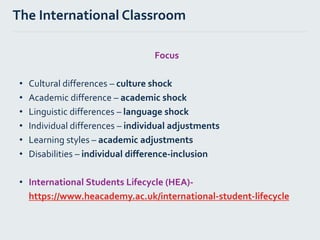
Focus
• Cultural differences – culture shock
• Academic difference – academic shock
• Linguistic differences – language shock
• Individual differences – individual adjustments
• Learning styles – academic adjustments
• Disabilities – individual difference-inclusion
• International Students Lifecycle (HEA)-
https://www.heacademy.ac.uk/international-student-lifecycle
The International Classroom
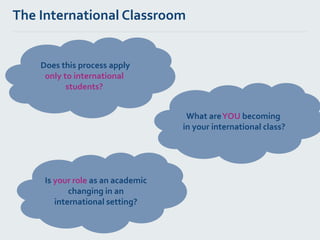
Is your role as an academic
changing in an
international setting?
Does this process apply
only to international
students?
What areYOU becoming
in your international class?
• How do you think students are feeling in your class?
• Do you think their cultural background is relevant?
• Do you think their mother-tongue is relevant?
• Do you think their social class is relevant?
• Do you think their gender is relevant?
• How do you think they perceive you? What do you represent for
them?
• What does the topic you teach represent for them?
The International Classroom
• What is your role in your class?
• What do you do about diversity in your class?
• Is diversity related only to nationality?
• How do you make sure you are not discriminating
students?
• What do you do about all the above-mentioned implicit
meanings related to culture?
The International Classroom
• Critical pedagogy – students/teachers as critical thinkers;
• Implicit teaching theories and practices – make them
explicit;
• Curriculum – reshaping the Syllabus;
• Text-books – adapting them;
• Extra-resources – design new, varied material, diversity;
• Class activities – think of different class activities;
• Teaching styles – problematize/question yourself;
• Induction/familiarization/orientation – help students to
settle down-make familiar the unfamiliar;
• Social events – help them to socialize outside class.
Some ideas we worked on…...
“Show andTell” by MLC teachers…...
• Development of teaching material on greetings in German A1;
• Comparative Lesson on art in Italian B2;
• Intercultural lesson on colours in French B1;
• Intercultural spaghetti in Italian A1;
• Lesson on games in Arabic A2/B1;
• Reading newspapers across cultures in Spanish C1/2;
• Intercultural hobbies and sports in Greek A1/2;
• Etc….. 
Meaning as co-produced
by students and teachers …....
“The students and teachers make meaning of diversity in a
complex manner and are willing to, and do, engage in
negotiating multiple perspectives of knowing which they
encounter in pedagogies within international contexts of higher
education.”
(Welikala 2013: 54)
A state of becoming…....
”Intercultural competence is a state of mutual becoming,
rather than a destination. Hence it is particularly important to
explore pedagogies that will assist students to enter this state
of becoming interculturally competent.”
(Leask 2015: 63)
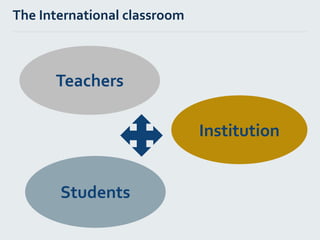
The International classroom
Teachers
Institution
Students
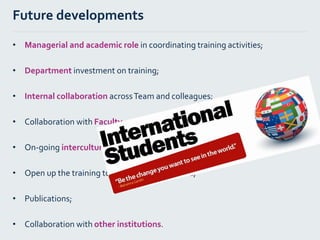
Future developments
• Managerial and academic role in coordinating training activities;
• Department investment on training;
• Internal collaboration acrossTeam and colleagues;
• Collaboration with Faculty and with College;
• On-going intercultural training;
• Open up the training to an external audience;
• Publications;
• Collaboration with other institutions.
THANK YOU!
donata.puntil@kcl.ac.uk
silvia.colaiacomo@kcl.ac.uk
References
Alred, G., Byram, M., Fleming, M. Intercultural Experience and Education, Multilingual Matters, 2003, p.115
Ball, S. (2003), ‘The teacher’s soul and the terrors of performativity’, in Journal of Education Policy, 18:2 (215-228).
Berry, J.,Y. H., Poortinga, S.M. Breugelmans, A. Chasiotis, D.L. Sam (2011), Cross-Cultural psychology. Research and
Applications,Cambridge (CAP)
Byramand, M.; FengA.; Fleming, M. (eds.) (2009), Becoming interculturally competent through education and training,
Bristol: Multilingual Matters.
Coffey, S., “Strangehood and Intercultural Subjectivity”, in Language and Intercultural Communication, 2013, 13:3,p.266-
282.
Dark, S. et al. (1997), “The study visit and cultural learning”, in Byram (ed.2011) (pp.36-60)
Kramsch, C. (2010), Language andCulture, Oxford: Oxford University Press.
Kramsch, C. (2010) The Multilingual Subject, Oxford: Oxford University Press.
Ippolito, K. (2007) “Promoting intercultural learning in a multicultural university: ideals and reality,” Teaching in Higher
Education, 12:5-6, 749-763.
Lang, P. (2011), Intercultural Competence.Concepts,Challenges, Evaluations. Bern: International Academic Publishers.
Leask, B. (2009) Using Formal and Informal Curricula to Improve Interactions between Home and International Students,
Journal of Studies in International Education, 13(2), 205-221.
Leask, B.(2015) Internationalizing the Curriculum, Abingdon: Routledge.
Lo Bianco, J., Liddicoat,A. & Crozet, C. (1999). Striving for the third place: intercultural competence through language
education. Melbourne: LanguageAustralia.
Roberts, C. at al. (2001), Language Learners as Ethnographers, Clevedon: Multilingual Matters.
Robertson, L.S. (1996), ‘Markets and teacher professionalism: A political economy analysis’, in Melbourne Studies in
Education, 37:2 (23-39)
Welikala,T. &Watkins, C. (2008) Improving Intercultural Learning Experiences in Higher Education. Responding to cultural
scripts for learning. Institute of Education, University of London

The International Classroom Project

  • 2.
    The International Classroom AULCConference - 2017 Donata Puntil Silvia Colaiacomo Modern Language Centre King’s College London
  • 3.
    The context….. “The incorporationof an international and intercultural dimension into the content of the curriculum, as well as the teaching and learning arrangements and support services of a program of study”. (Leask, B. 2009: 209)
  • 4.
    Who we are….... •Modern LanguageCentre – Faculty of Arts & Humanities • We teach around 13 languages as credit-bearing modules from A1 to C1/2 CEFR • We teach UG and PG from different Departments & Faculties (around 1,600 students) • We teach applied linguistics and intercultural modules • We offer intercultural training across the college • We teach more than 20 languages as evening courses for the public and at external institutions (around 6,000 students) • Around 12o members of staff - different nationalities and academic backgrounds
  • 5.
    Who we are…..... Credit- bearing/assessed modules Externalcontracts Evening classes Tailor-made courses Internal and external training staff
  • 6.
    Teaching staff atthe MLC • About 120 teachers • Four mainTeams • Different national and cultural backgrounds • Different qualifications • Different ages, gender, attitudes to teaching and learning • Majority of teachers (80%) are free-lance professionals working for different institutions, or running their own businesses-turnover • Teachers often work across programmes; different teaching and assessment requirements, etc.
  • 7.
    Teachers’ professional status •All MLC teachers have completed a degree programme and the majority of them have PG qualifications, in most cases obtained in their home country; • The majority of them have a teaching qualification for adult education (DTLLS-PGCE for AE; British Lifelong Learning Certificate; CLTA for European Languages, DELTA, CELTA, DITALS,TIAFL etc.) • Some of them have other qualifications, CPD certificates, etc. Main common features: - Foundations of teaching approaches and methods - Development of practical teaching skills and class management - Language awareness and analysis - Planning and analysing resources - Designing lessons, syllabi and curricula - Evaluating teaching programmes Main differences: - Theoretical approach - Attitude towards teaching and learning - Approach to students - Context sensitivity
  • 8.
  • 9.
    Higher Education Context Thekey elements of contemporary education are embedded in three interrelated policy technologies: • the market • managerialism • performativity (Ball, 2003: 215) The marketization of the educational sector is not simply a vehicle for technical and structural change of organizations but is also a mechanism for reforming teachers (lecturers and researchers) and for changing what it means to be a teacher. (Robertson, 1996)
  • 10.
    Higher Education Context •Two apparently conflicting effects are achieved by such changes: both an increasing individualization and the construction of new forms of institutional affiliation and ‘community’ based on corporate culture.This involves a re-working of the relationship between individual commitment and action in the organization; • The work of the manager becomes crucial in this respect as he/she involves instilling the attitude and culture within which workers feel themselves accountable and at the same time committed or personally invested in the organization.These new managers are the ‘technician of transformation’ (May 1994: 619), or what Foucault calls ‘technicians of behaviours’;
  • 11.
    HE Key Factors: 1.Self-determination (of institutions and professionals); 2. Entrepreneurialism (professionals working for different employers – negotiating new roles and identities); 3. Cost-sustainability (budget); 4. Market – consumerism will privilege clients and employers in judging the quality of the education; 5. Importance of building a professional status (individual and institution); 6. Necessity of continuous training to face the challenges of a changing work setting; 7. Challenges of working as a free-lance in terms of financial security and adaptation to different institutional policies; 8. Academic context within one teaches. (Ball, 2003):
  • 13.
    King’s International Strategy •King’s College London is dedicated to the advancement of knowledge, learning and understanding in the service of global society; • Through strong partnerships and research and teaching excellence, King’s is recognized as a thought-leader on interdisciplinary themes of global significance. King’s provides an internationalized curriculum and student experience which creates global citizens connected to international networks and employable anywhere in the world; • King’s International Strategy to 2020 sets out the university’s vision for taking advantage of the overwhelmingly positive impact thinking globally has on our students, our staff, our research and the world at large: 1. Attract the best international minds to King’s 2. Provide an internationalized curriculum and student experience 3. Invest in strategic partnerships with world-class institutions 4. Raise King’s profile as a thought-leader in areas of global significance 5. Create an ethical and enabling environment for King’s international activities http://www.kcl.ac.uk/aboutkings/international-strategy/index.aspx
  • 15.
    Internationalization…..... ”It is throughstaff and students engagement in an international curriculum that the internationalisation agenda of universities connects with students. As graduates, today’s students will shape the world of the future as economic beings (professionals) and as social human beings. Their actions and decisions in the workplace, in their local community, and in their lives will have an impact on others and be influenced by the breadth and depth of their knowledge about the world, their skills in relating to others, and their values [….] international and intercultural interaction and collaboration has the potential to develop cultural insight and exchange that is enriching and enabling for individuals and through them for local, national and global communities.” (Leask, B. 2015, p.71-72)
  • 16.
    Cultures in theinternational university Westerholm & Räsänen (2015), adapted from Flowerdew & Miller 1995
  • 17.
    How? • Internal StaffDevelopment • Role of the MLC within the College • Intercultural Learning Module • Intercultural Training • International Classroom Project
  • 18.
    Internal Staff Development •Series of internal “advanced “training activities focusing on different topics/aims for experienced teachers; • Series of internal “basic” training activities for less experienced teachers; • HEA Accreditations; • Involvement of allTeams; • Involvement of all teachers at different levels; • Peer-oriented; • Staff-led; • MLC Staff Development workshops • Refreshing yourTeaching Skills
  • 19.
    Inter-departmental training • Roleof the MLC within the Faculty and the College; • Development of a programme of inter-departmental training in line with the internationalization strategy of the College; • Intercultural module Intercultural training for both staff and students (UG & PG): • King’sWorldwide; • Study Abroad Centre; • Career and Employability Centre; • KLI (King’s Learning Institute); • Medical School; • Institute of Psychiatry, Psychology and Neuroscience; • Language Departments; • School of Management and Business.
  • 20.
    The International Classroom •Development from the InterculturalTraining; • In line with King’s international strategy; • Project led by the Faculty as part of the Peer-Observation Scheme; • Collaboration with King’s Learning Institute (KLI); • Series of internal workshops and one conference open to all College; • External speakers + involvement of internal staff; • The main aims are: 1. To enhance staff reflection on how to internationalize the curriculum and work in a way that challenges taken for granted assumptions about our languages and cultures; 2. To share and create an international professional community based on reflective practice and intercultural awareness.
  • 21.
    Focus • Cultural differences– culture shock • Academic difference – academic shock • Linguistic differences – language shock • Individual differences – individual adjustments • Learning styles – academic adjustments • Disabilities – individual difference-inclusion • International Students Lifecycle (HEA)- https://www.heacademy.ac.uk/international-student-lifecycle The International Classroom
  • 22.
    The International Classroom Isyour role as an academic changing in an international setting? Does this process apply only to international students? What areYOU becoming in your international class?
  • 23.
    • How doyou think students are feeling in your class? • Do you think their cultural background is relevant? • Do you think their mother-tongue is relevant? • Do you think their social class is relevant? • Do you think their gender is relevant? • How do you think they perceive you? What do you represent for them? • What does the topic you teach represent for them? The International Classroom
  • 24.
    • What isyour role in your class? • What do you do about diversity in your class? • Is diversity related only to nationality? • How do you make sure you are not discriminating students? • What do you do about all the above-mentioned implicit meanings related to culture? The International Classroom
  • 25.
    • Critical pedagogy– students/teachers as critical thinkers; • Implicit teaching theories and practices – make them explicit; • Curriculum – reshaping the Syllabus; • Text-books – adapting them; • Extra-resources – design new, varied material, diversity; • Class activities – think of different class activities; • Teaching styles – problematize/question yourself; • Induction/familiarization/orientation – help students to settle down-make familiar the unfamiliar; • Social events – help them to socialize outside class. Some ideas we worked on…...
  • 26.
    “Show andTell” byMLC teachers…... • Development of teaching material on greetings in German A1; • Comparative Lesson on art in Italian B2; • Intercultural lesson on colours in French B1; • Intercultural spaghetti in Italian A1; • Lesson on games in Arabic A2/B1; • Reading newspapers across cultures in Spanish C1/2; • Intercultural hobbies and sports in Greek A1/2; • Etc….. 
  • 27.
    Meaning as co-produced bystudents and teachers ….... “The students and teachers make meaning of diversity in a complex manner and are willing to, and do, engage in negotiating multiple perspectives of knowing which they encounter in pedagogies within international contexts of higher education.” (Welikala 2013: 54)
  • 28.
    A state ofbecoming….... ”Intercultural competence is a state of mutual becoming, rather than a destination. Hence it is particularly important to explore pedagogies that will assist students to enter this state of becoming interculturally competent.” (Leask 2015: 63)
  • 29.
  • 30.
    Future developments • Managerialand academic role in coordinating training activities; • Department investment on training; • Internal collaboration acrossTeam and colleagues; • Collaboration with Faculty and with College; • On-going intercultural training; • Open up the training to an external audience; • Publications; • Collaboration with other institutions.
  • 31.
  • 32.
    References Alred, G., Byram,M., Fleming, M. Intercultural Experience and Education, Multilingual Matters, 2003, p.115 Ball, S. (2003), ‘The teacher’s soul and the terrors of performativity’, in Journal of Education Policy, 18:2 (215-228). Berry, J.,Y. H., Poortinga, S.M. Breugelmans, A. Chasiotis, D.L. Sam (2011), Cross-Cultural psychology. Research and Applications,Cambridge (CAP) Byramand, M.; FengA.; Fleming, M. (eds.) (2009), Becoming interculturally competent through education and training, Bristol: Multilingual Matters. Coffey, S., “Strangehood and Intercultural Subjectivity”, in Language and Intercultural Communication, 2013, 13:3,p.266- 282. Dark, S. et al. (1997), “The study visit and cultural learning”, in Byram (ed.2011) (pp.36-60) Kramsch, C. (2010), Language andCulture, Oxford: Oxford University Press. Kramsch, C. (2010) The Multilingual Subject, Oxford: Oxford University Press. Ippolito, K. (2007) “Promoting intercultural learning in a multicultural university: ideals and reality,” Teaching in Higher Education, 12:5-6, 749-763. Lang, P. (2011), Intercultural Competence.Concepts,Challenges, Evaluations. Bern: International Academic Publishers. Leask, B. (2009) Using Formal and Informal Curricula to Improve Interactions between Home and International Students, Journal of Studies in International Education, 13(2), 205-221. Leask, B.(2015) Internationalizing the Curriculum, Abingdon: Routledge. Lo Bianco, J., Liddicoat,A. & Crozet, C. (1999). Striving for the third place: intercultural competence through language education. Melbourne: LanguageAustralia. Roberts, C. at al. (2001), Language Learners as Ethnographers, Clevedon: Multilingual Matters. Robertson, L.S. (1996), ‘Markets and teacher professionalism: A political economy analysis’, in Melbourne Studies in Education, 37:2 (23-39) Welikala,T. &Watkins, C. (2008) Improving Intercultural Learning Experiences in Higher Education. Responding to cultural scripts for learning. Institute of Education, University of London

Editor's Notes

  • #8 Qui aggiungerei che alcuni programmi hanno l’assessment etc e direi che tu ne hai fatto uno ect.
  • #10 Ho messo la cosa del manager perche spiega i limiti della nostra ricerca... Il fatto che tu sia la manager ha avuto un impatto nelle interviste etc.
  • #29 We find that this diversity has an impact on teachers too. And the impact is not only linguistic but also cultural.