Languages for All (LfA)
AULC – Conference Belfast January 2017
The Multilingual University: Inspiring teachers, transforming learners
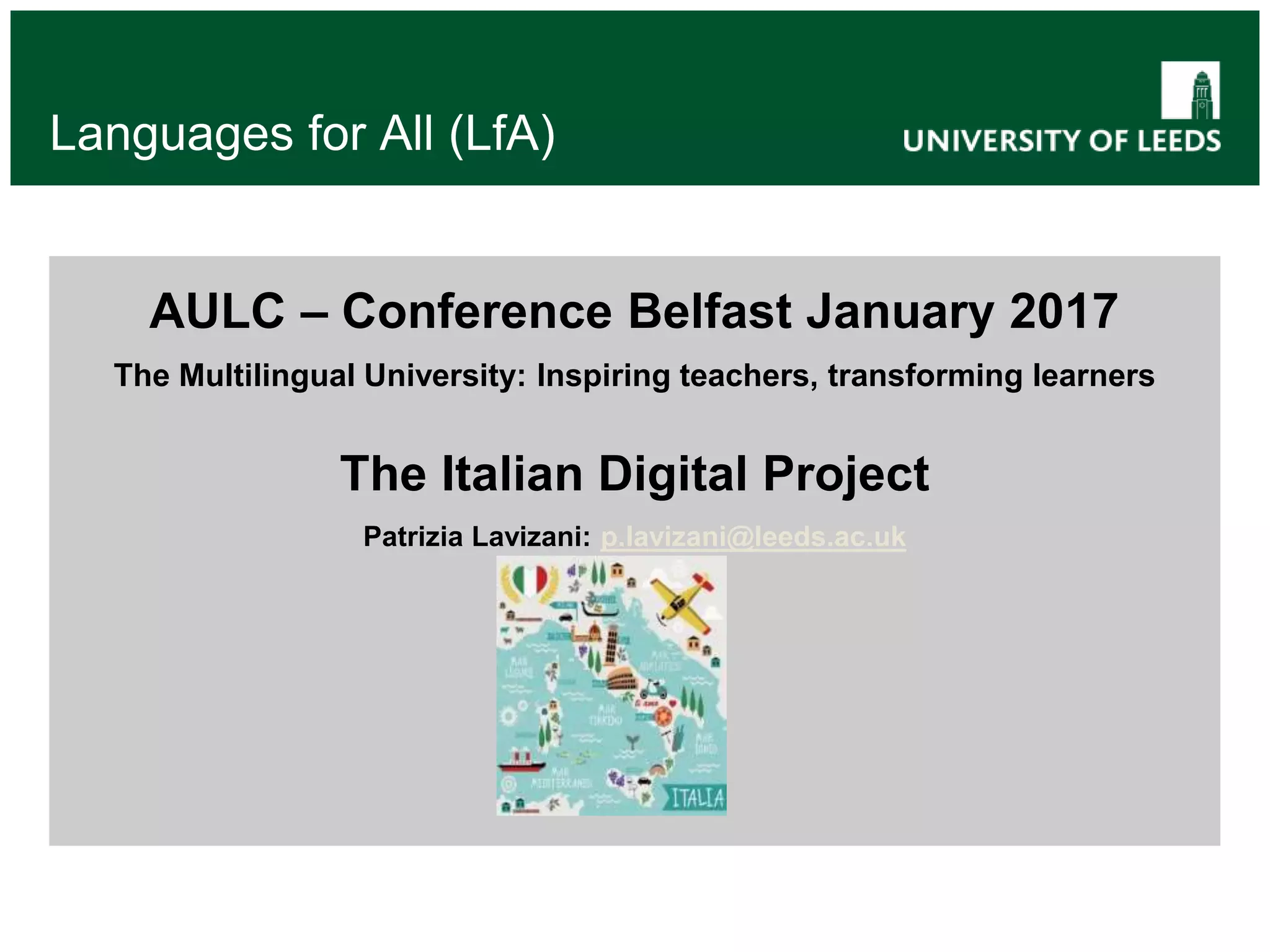
The Italian Digital Project
Patrizia Lavizani: p.lavizani@leeds.ac.uk
2
In this presentation…
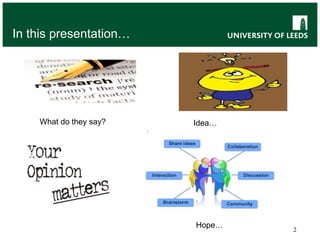
What do they say? Idea…
Hope…
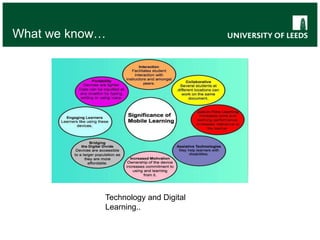
What we know…
Technology and Digital
Learning..
4
Research
- Learning theories (connectivism – fairly recent)
- Technology for interaction and collaborative work as well as a motivational tool
- Inclusive practice: disability and diversity
- Assessment and feedback
- Virtual learning environments supporting mobile learning and accessibility.
Useful readings:
When technology offers an helping hand…
Kate Exely, Andy Fisher, Dragos Ciobanu, (2014). Using Technology to Support Learning and Teaching. Routledge – Taylor
and Francis group- London and New York
Technology benefit those who use it as a pedagogical vehicle of productive tasks…
M. Evans, (2009). Foreign Language Learning with Digital technology. In Elodie Vialleton, Language Learning and
Technology Volume 16, Number 2 pp. 27–30. June 2012. Retrieved on 18.11.16 from:
http://llt.msu.edu/issues/june2012/review1.pdf
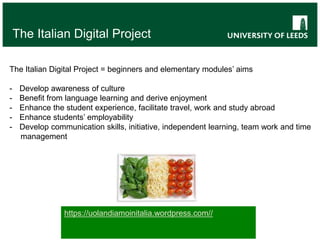
The Italian Digital Project
The Italian Digital Project = beginners and elementary modules’ aims
- Develop awareness of culture
- Benefit from language learning and derive enjoyment
- Enhance the student experience, facilitate travel, work and study abroad
- Enhance students’ employability
- Develop communication skills, initiative, independent learning, team work and time
management
https://uolandiamoinitalia.wordpress.com//
Pros and Cons and students’ opinions
• Pros
• -on-line research materials for cultural awareness and
digital tools to create and present own learning –sharing
information/work
• independence and peer learning
• increased student motivation, creativity
• time management, organisation, team work,
employability
• ‘real life’ situation, using the language for a purpose,
deep learning
• reflections: greater insight into students’ thinking
• positive impact on both teaching and student learning
• possible… more comprehensive approach to assessing:
process and product
• Students opinion: Italian Website Feedback
‘I thought it would be a nice thing to have in the future to
show to employers who might question language skills’
•Cons
• students confused about what its purpose is how
long it should be, how much in depth to go …
• time required to explain it….
• extra tutor time (workshops)
• tutors commitment to engage with digital tools
• lack of interest
• not assessed!
• Student opinion:
‘I think it would have been highly beneficial if we used the
digital project as a form of assessment because it shows a
continuous commitment to work instead of a portfolio which
was a bit synthetic in terms of structure and other things’.
hope: opportunities and
challenges…
• to inspire other tutors to use a digital platform with their students
• to adopt the digital project idea as part of the assessment process
in LfA from beginners to advanced levels
• to collaborate with other tutors in the School of Languages,
Cultures and Societies at Leeds and other Universities interested
• to use the idea for other projects in a variety of fields, i.e. study
abroad students, content related modules, final year projects…
Worthwhile?
Important:
• to discuss and reflect on the experiences of using technology and digital tools
for learning and
• to share ideas across the language teaching community to learn and research
the field further
• to support tutors in using technology and digital tools in their teaching
• to acknowledge the effort and time needed by tutors… in the workload
• University of Leeds strategic plan:
‘Define and implement sustainable support for
digital learning’
9
Languages for All
Any questions ?
Grazie tante !
Thank you !

The Italian Digital Project

  • 1.
    Languages for All(LfA) AULC – Conference Belfast January 2017 The Multilingual University: Inspiring teachers, transforming learners The Italian Digital Project Patrizia Lavizani: p.lavizani@leeds.ac.uk
  • 2.
    2 In this presentation… Whatdo they say? Idea… Hope…
  • 3.
    What we know… Technologyand Digital Learning..
  • 4.
    4 Research - Learning theories(connectivism – fairly recent) - Technology for interaction and collaborative work as well as a motivational tool - Inclusive practice: disability and diversity - Assessment and feedback - Virtual learning environments supporting mobile learning and accessibility. Useful readings: When technology offers an helping hand… Kate Exely, Andy Fisher, Dragos Ciobanu, (2014). Using Technology to Support Learning and Teaching. Routledge – Taylor and Francis group- London and New York Technology benefit those who use it as a pedagogical vehicle of productive tasks… M. Evans, (2009). Foreign Language Learning with Digital technology. In Elodie Vialleton, Language Learning and Technology Volume 16, Number 2 pp. 27–30. June 2012. Retrieved on 18.11.16 from: http://llt.msu.edu/issues/june2012/review1.pdf
  • 5.
    The Italian DigitalProject The Italian Digital Project = beginners and elementary modules’ aims - Develop awareness of culture - Benefit from language learning and derive enjoyment - Enhance the student experience, facilitate travel, work and study abroad - Enhance students’ employability - Develop communication skills, initiative, independent learning, team work and time management https://uolandiamoinitalia.wordpress.com//
  • 6.
    Pros and Consand students’ opinions • Pros • -on-line research materials for cultural awareness and digital tools to create and present own learning –sharing information/work • independence and peer learning • increased student motivation, creativity • time management, organisation, team work, employability • ‘real life’ situation, using the language for a purpose, deep learning • reflections: greater insight into students’ thinking • positive impact on both teaching and student learning • possible… more comprehensive approach to assessing: process and product • Students opinion: Italian Website Feedback ‘I thought it would be a nice thing to have in the future to show to employers who might question language skills’ •Cons • students confused about what its purpose is how long it should be, how much in depth to go … • time required to explain it…. • extra tutor time (workshops) • tutors commitment to engage with digital tools • lack of interest • not assessed! • Student opinion: ‘I think it would have been highly beneficial if we used the digital project as a form of assessment because it shows a continuous commitment to work instead of a portfolio which was a bit synthetic in terms of structure and other things’.
  • 7.
    hope: opportunities and challenges… •to inspire other tutors to use a digital platform with their students • to adopt the digital project idea as part of the assessment process in LfA from beginners to advanced levels • to collaborate with other tutors in the School of Languages, Cultures and Societies at Leeds and other Universities interested • to use the idea for other projects in a variety of fields, i.e. study abroad students, content related modules, final year projects…
  • 8.
    Worthwhile? Important: • to discussand reflect on the experiences of using technology and digital tools for learning and • to share ideas across the language teaching community to learn and research the field further • to support tutors in using technology and digital tools in their teaching • to acknowledge the effort and time needed by tutors… in the workload • University of Leeds strategic plan: ‘Define and implement sustainable support for digital learning’
  • 9.
    9 Languages for All Anyquestions ? Grazie tante ! Thank you !