Sake Jager, ICT and Education & Applied Linguistics
University of Groningen
and 21-23 April 2016
U4 Humanities Cluster Meeting: Structural exchange opportunities in education
Ghent, 5-6 October 2017
1
Virtual Exchange as tool for internationalisation
Past Experiences and current projects in the University of Groningen
European mobility agenda
› The Bologna Mobility Strategy states that, by 2020, 20% of European
higher education graduates should have spent part of their studies
abroad. The European Union adopted this benchmark in November
2011.
http://europa.eu/rapid/press-release_MEMO-13-647_en.htm
› The current percentage is between 5 to 10%.
• EAIE Conference 2017: 5%
• Feasibility study Erasmus Virtual Exchange: 7.5%
http://ec.europa.eu/education/policy/strategic-framework_en (p. 23)
› Even if the European objective of 20% by the year 2020 is achieved,
this will still leave 80% of students without an international,
intercultural experience as part of their university studies.
Global ‘knowledge society’
› Intercultural, international and global competencies are required for
employability in the global ‘knowledge society’. There is also a need for
greater attention to notions such as critical global citizenship and civic
engagement.
› In a changing world, Europe’s graduates need the kind of education that
enables them to engage articulately as committed, active, thinking, global
citizens as well as economic actors in the ethical, sustainable development
of our societies.
High Level Group on the Modernisation of Higher Education -
http://ec.europa.eu/education/library/reports/modernisation_en.pdf
› Higher quality and more innovative education practice through the use of
ICT has become a key priority for the EU.
http://ec.europa.eu/education/policy/strategic-framework/education-
technology.htm
Virtual Exchange
› Form of computer-mediated
learning in which students from
two or more universities work
together online (in pairs or small
groups) on learning tasks which
are part of the course work in each
institution
› Also known as:
• Telecollaboration
• Online Intercultural Exchange
• Collaborative Online
International Learning
• Rooted in foreign language
and culture education
• Main types: class-to-class
exchanges (above), facilitated
exchanges
UG ELC Project (see below)
https://www.soliya.net/
http://www.sharingperspectivesfoundation.com/
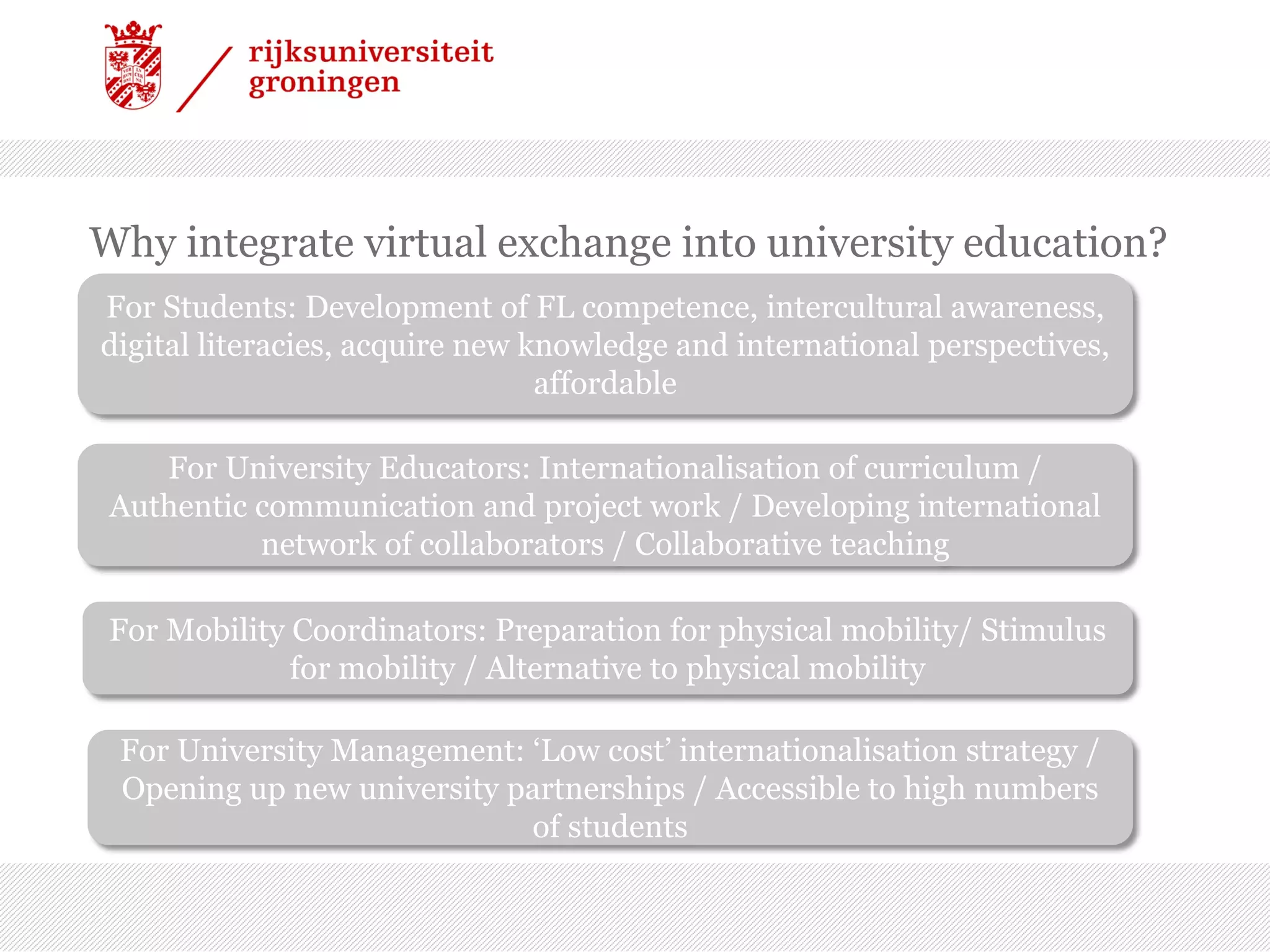
Why integrate virtual exchange into university education?
For Students: Development of FL competence, intercultural awareness,
digital literacies, acquire new knowledge and international perspectives,
affordable
For University Management: ‘Low cost’ internationalisation strategy /
Opening up new university partnerships / Accessible to high numbers
of students
For Mobility Coordinators: Preparation for physical mobility/ Stimulus
for mobility / Alternative to physical mobility
For University Educators: Internationalisation of curriculum /
Authentic communication and project work / Developing international
network of collaborators / Collaborative teaching
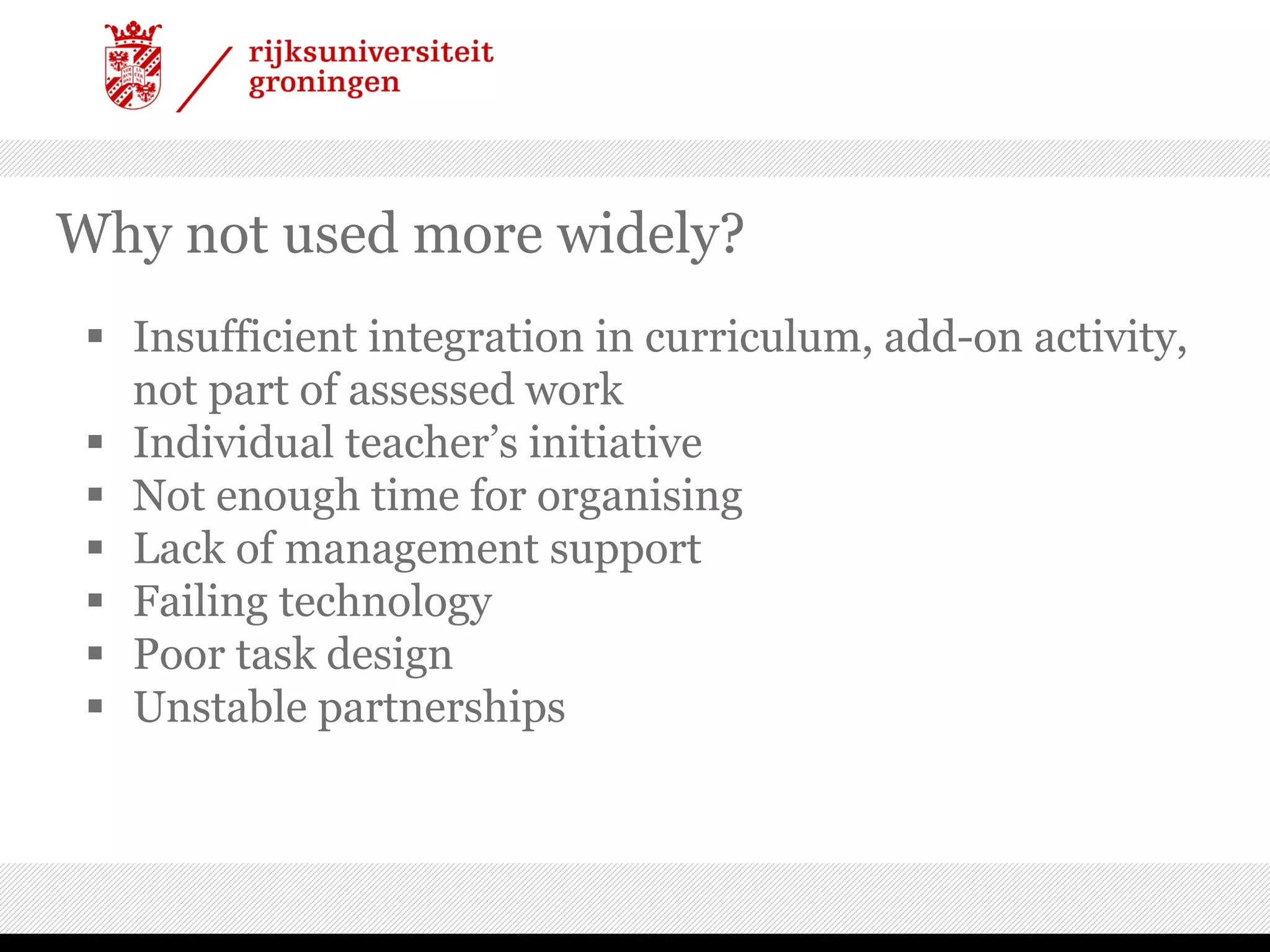
Why not used more widely?
 Insufficient integration in curriculum, add-on activity,
not part of assessed work
 Individual teacher’s initiative
 Not enough time for organising
 Lack of management support
 Failing technology
 Poor task design
 Unstable partnerships
ELC Project: Introduction
› Telecollaboration project in European Languages and Cultures (ELC),
University of Groningen
› ELC: recently established BA programme, replacing separate Language
and Culture programmes (German Language and Culture, Romance
Languages and Cultures, Russian Language and Culture, etc.)
› Project should:
• Increase language proficiency and intercultural competence
• Prepare for study abroad
• Establish VE as structural element in ELC programme
› Implemented for Italian, French, Spanish
› Project from 2013 t0 2017
European Languages and Cultures
Spanish French Italian
Partner: Universitat de Barcelona Partner: Université de Strasbourg Partner: Università degli Studi di
Padova
Teacher education
UB: pre-service, UG: Spanish
Tandem
US: Dutch, UG: French
Tandem
UP: Dutch, UG: Italian
c. 25 students each c. 15 students each c. 10 students each
Teacher designed tasks:
• Introducing themselves and
PLE
• Erasmus Survival Guide
• Whatsapp for daily life and
culture exchange
Teacher-trainee designed:
• TC projects involving range of
web 2.0 technologies
Tasks:
• Introducing themselves, city
and student life
• Analysing and comparing
national traditions and work of
art/movie/book
• Co-constructing a bilingual
journal
Tasks:
• Italian and Dutch movies ( 6 full
movies for each language)
• Language and culture tasks
• Translation tasks
Blackboard (VLE, journals, email,
etc)
Blackboard Collaborate
Web 2.0 tools
Skype, Skype recorder
Facebook, Google Drive
Online movies
Blackboard (VLE, journals, email,
etc)
Google Hangouts/Skype
7-10-2017 | 11
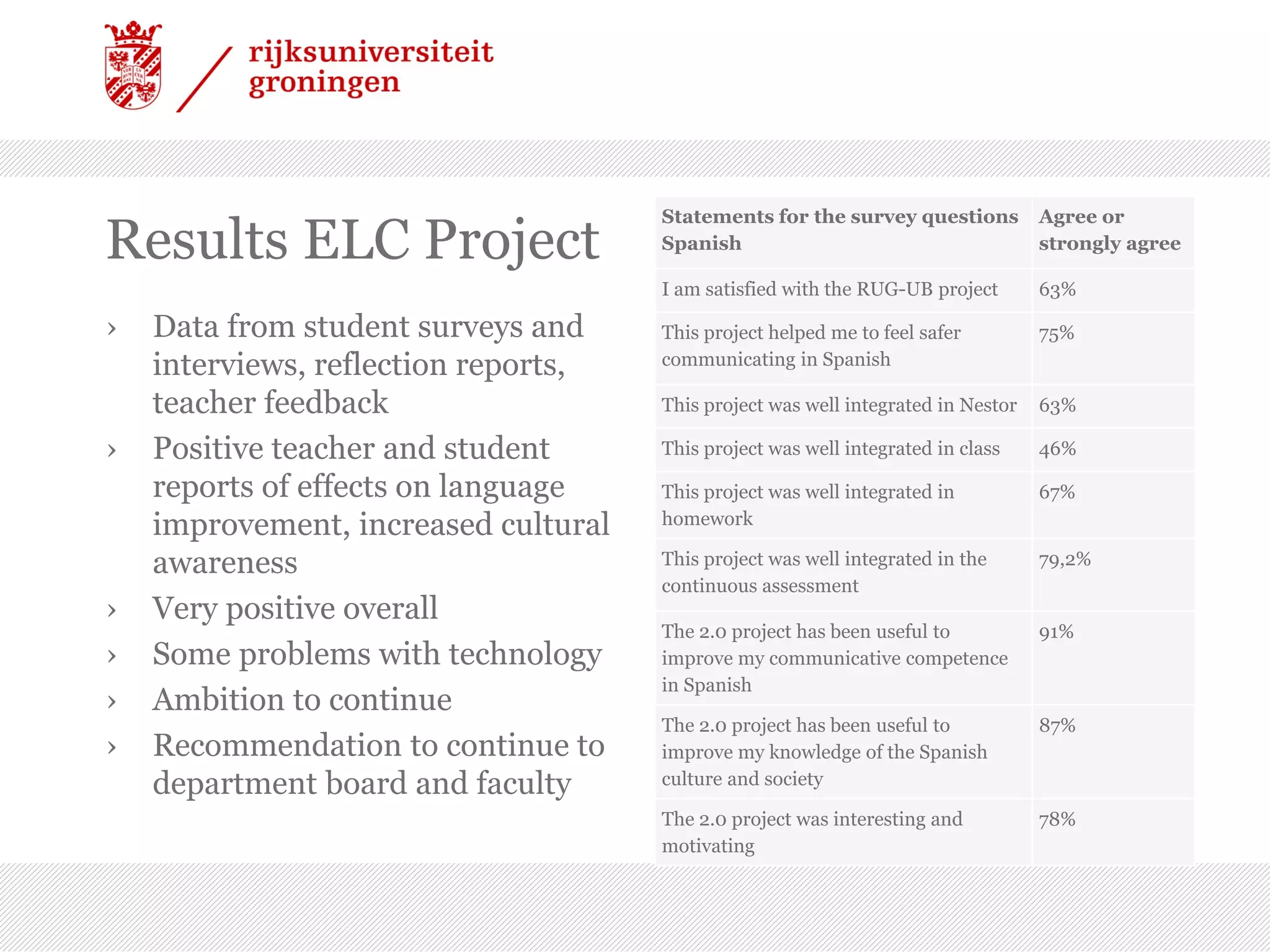
Results ELC Project
› Data from student surveys and
interviews, reflection reports,
teacher feedback
› Positive teacher and student
reports of effects on language
improvement, increased cultural
awareness
› Very positive overall
› Some problems with technology
› Ambition to continue
› Recommendation to continue to
department board and faculty
Statements for the survey questions
Spanish
Agree or
strongly agree
I am satisfied with the RUG-UB project 63%
This project helped me to feel safer
communicating in Spanish
75%
This project was well integrated in Nestor 63%
This project was well integrated in class 46%
This project was well integrated in
homework
67%
This project was well integrated in the
continuous assessment
79,2%
The 2.0 project has been useful to
improve my communicative competence
in Spanish
91%
The 2.0 project has been useful to
improve my knowledge of the Spanish
culture and society
87%
The 2.0 project was interesting and
motivating
78%
› Appreciation
Appreciation:
• Unusual, new experience
• ‘Scary’ at first
• Affective: rapport building,
establishing friendships
• Cognitive: Language learning,
learning about culture
High appreciation overall
Specific aspects appreciated
• Tasks, topic, person or
object talked about
Problems (problème, etc):
• Technical issues
• Linguistic (word finding)
À l’avance, j’avais peur que il serait dur de parler avec une
inconnue qui parle une autre langue pendant une heure,
mais en réalité, ma interlocutrice était très sympathique et
j’ai appris de parler un peu plus librement. Bref, c’était
une bonne expérience. [UG4_1415]
Au départ, je trouvais cette
expérience assez étrange, je n'avais
jamais eu l'occasion de faire de la
télécollaboration. Mais maintenant
que le premier contact a été pris, je
me sens plus à l'aise et j'ai le
sentiment que nous allons faire du
bon travail. XX est très sympa et
c'était assez facile de discuter avec
elle. [US8_1415]
Il y a 4 ans que j’ai participé dans un autre échange où je
suis vraiment allée à Lyon pour une semaine, c’était une
expérience inoubliable. C’est la raison pour laquelle je peux
dire par ma propre expérience que c’est énormément
instructif de parler avec un locuteur natif. J’espère
d’apprendre à parles plus librement. Par ailleurs, je
voudrais augmenter mon vocabulaire. La première
conversation était un peu embarrassante, mais je pense
que cela va bientôt changer. Je me réjouis d’entretien
suivant.
[UG10_1516]
J’aimais l’idée de cet expérience. Des exercices
intéressant en utilisant des modernes formes de la
communication, c’est super. C’était la première fois
que j’ai fait quelque chose comme ça, et je le
trouvais très agréable. [UG6_1516]
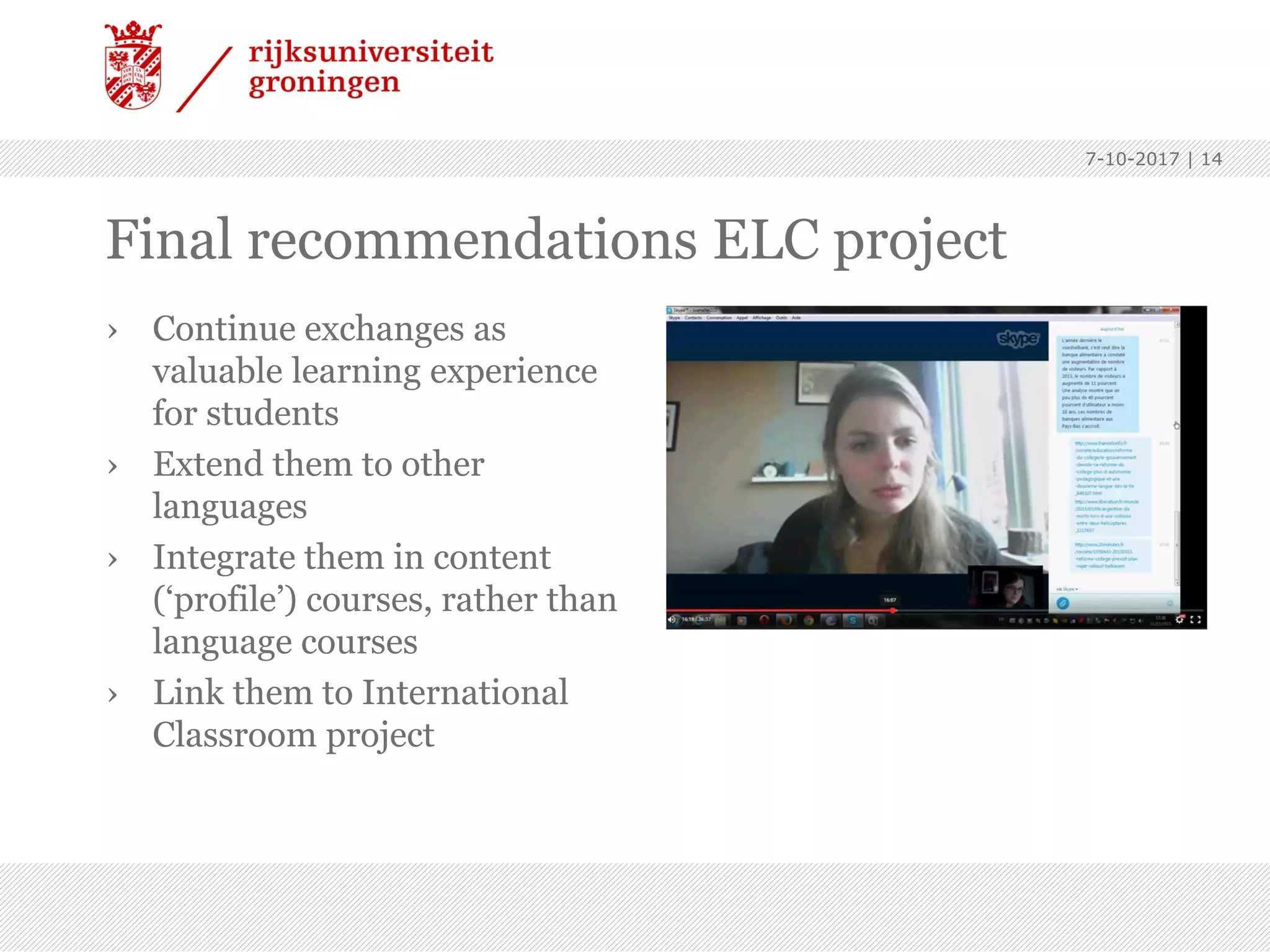
Final recommendations ELC project
› Continue exchanges as
valuable learning experience
for students
› Extend them to other
languages
› Integrate them in content
(‘profile’) courses, rather than
language courses
› Link them to International
Classroom project
7-10-2017 | 14
ENVOIE: Enabling Virtual Online International Exchange
› UG project, 6 faculties, 10 disciplines (exchanges), started Sept 2017
› Objective: Kick start VE / OIE across disciplines in UG
› Aligns with: International Classroom project, Active Learning, eLearning
strategies UG
› Multidisciplinary support: Didactic/professional development experts, ICC
trainers, eLearning/edutech experts, internationalisaton officers, careers
service officers
› Includes U4 partners:
1. Subproject “Things that Matter” (ReMA)
• Raingard Esser (Groningen), Mikael Alm (Uppsala), Dario Tessicini (Durham)
• Students design virtual library collections as preparation for summer school
2. Subproject “World Literature and Cultural Transfer”
• Petra Broomans (Groningen/Ghent), Andreas Hedberg (Uppsala), Duan Fen
(Sichuan University, China)
Short intro to the project here (website available soon)
EVOLVE:
Evidence-Validated Online Learning through Virtual Exchange
› KA3 Forward-Looking Policy Project, 2018-2020
› Similar to ENVOIE, at European level, 12 partners
› Creates VE’s (class-to-class and facilitated) in Coimbra &
Santander networks institutions, with participation of other
partners
› Innovative features:
• Online training (Co-laboratory)
• Open badges for certification
• Research into effectiveness
• Engagement with policy makers
› U4 partners invited to participate! OpenBadges.org
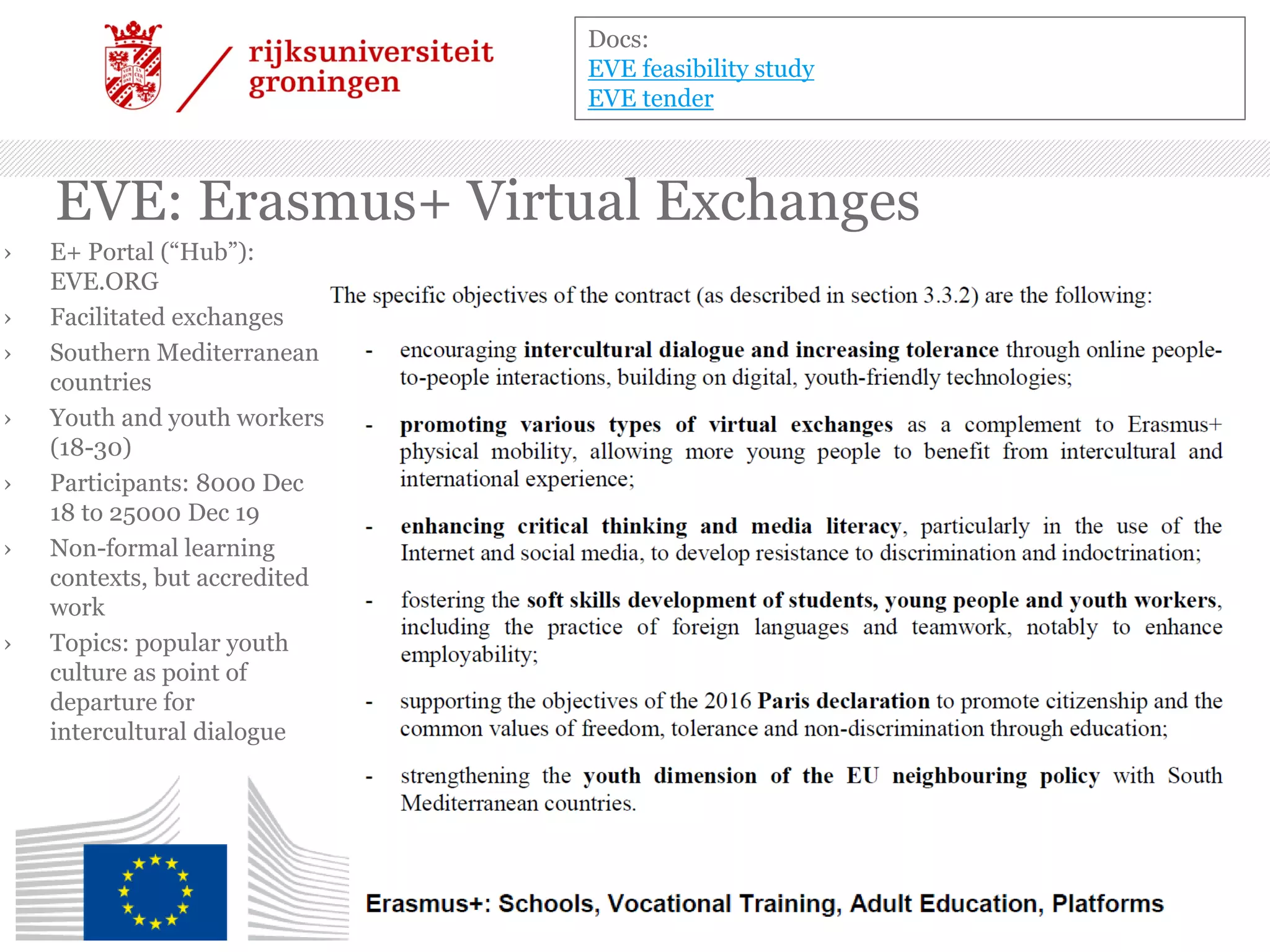
EVE: Erasmus+ Virtual Exchanges
› E+ Portal (“Hub”):
EVE.ORG
› Facilitated exchanges
› Southern Mediterranean
countries
› Youth and youth workers
(18-30)
› Participants: 8000 Dec
18 to 25000 Dec 19
› Non-formal learning
contexts, but accredited
work
› Topics: popular youth
culture as point of
departure for
intercultural dialogue
Docs:
EVE feasibility study
EVE tender
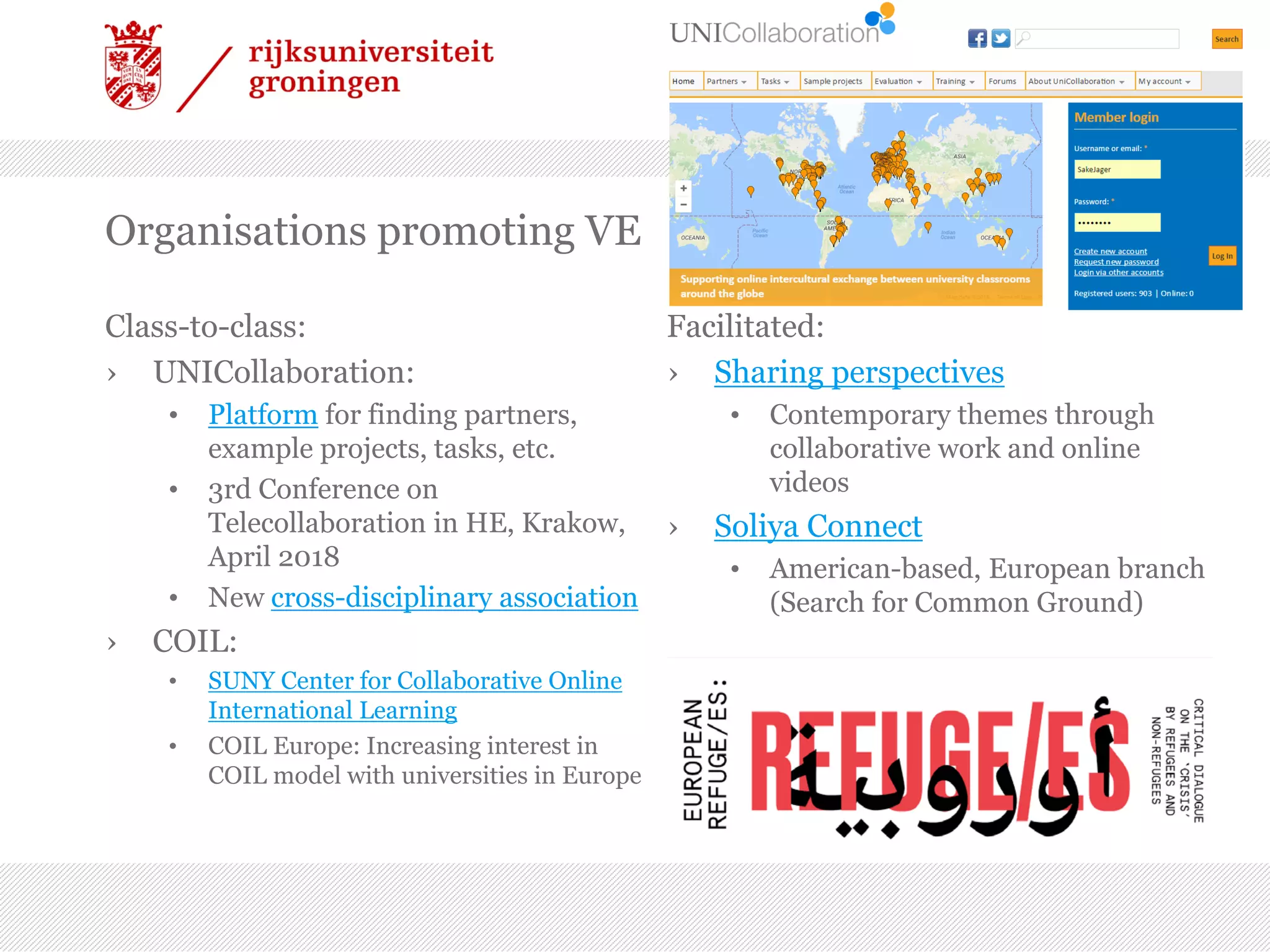
Organisations promoting VE
Class-to-class:
› UNICollaboration:
• Platform for finding partners,
example projects, tasks, etc.
• 3rd Conference on
Telecollaboration in HE, Krakow,
April 2018
• New cross-disciplinary association
› COIL:
• SUNY Center for Collaborative Online
International Learning
• COIL Europe: Increasing interest in
COIL model with universities in Europe
Facilitated:
› Sharing perspectives
• Contemporary themes through
collaborative work and online
videos
› Soliya Connect
• American-based, European branch
(Search for Common Ground)
Thank you for your attention!
Contact:
s.jager@rug.nl
www.rug.nl/staff/s.jager
@sakejgr

Virtual Exchange as tool for Internationalisation

  • 1.
    Sake Jager, ICTand Education & Applied Linguistics University of Groningen and 21-23 April 2016 U4 Humanities Cluster Meeting: Structural exchange opportunities in education Ghent, 5-6 October 2017 1 Virtual Exchange as tool for internationalisation Past Experiences and current projects in the University of Groningen
  • 2.
    European mobility agenda ›The Bologna Mobility Strategy states that, by 2020, 20% of European higher education graduates should have spent part of their studies abroad. The European Union adopted this benchmark in November 2011. http://europa.eu/rapid/press-release_MEMO-13-647_en.htm › The current percentage is between 5 to 10%. • EAIE Conference 2017: 5% • Feasibility study Erasmus Virtual Exchange: 7.5% http://ec.europa.eu/education/policy/strategic-framework_en (p. 23) › Even if the European objective of 20% by the year 2020 is achieved, this will still leave 80% of students without an international, intercultural experience as part of their university studies.
  • 3.
    Global ‘knowledge society’ ›Intercultural, international and global competencies are required for employability in the global ‘knowledge society’. There is also a need for greater attention to notions such as critical global citizenship and civic engagement. › In a changing world, Europe’s graduates need the kind of education that enables them to engage articulately as committed, active, thinking, global citizens as well as economic actors in the ethical, sustainable development of our societies. High Level Group on the Modernisation of Higher Education - http://ec.europa.eu/education/library/reports/modernisation_en.pdf › Higher quality and more innovative education practice through the use of ICT has become a key priority for the EU. http://ec.europa.eu/education/policy/strategic-framework/education- technology.htm
  • 4.
    Virtual Exchange › Formof computer-mediated learning in which students from two or more universities work together online (in pairs or small groups) on learning tasks which are part of the course work in each institution › Also known as: • Telecollaboration • Online Intercultural Exchange • Collaborative Online International Learning • Rooted in foreign language and culture education • Main types: class-to-class exchanges (above), facilitated exchanges
  • 5.
    UG ELC Project(see below)
  • 6.
  • 7.
  • 8.
    Why integrate virtualexchange into university education? For Students: Development of FL competence, intercultural awareness, digital literacies, acquire new knowledge and international perspectives, affordable For University Management: ‘Low cost’ internationalisation strategy / Opening up new university partnerships / Accessible to high numbers of students For Mobility Coordinators: Preparation for physical mobility/ Stimulus for mobility / Alternative to physical mobility For University Educators: Internationalisation of curriculum / Authentic communication and project work / Developing international network of collaborators / Collaborative teaching
  • 9.
    Why not usedmore widely?  Insufficient integration in curriculum, add-on activity, not part of assessed work  Individual teacher’s initiative  Not enough time for organising  Lack of management support  Failing technology  Poor task design  Unstable partnerships
  • 10.
    ELC Project: Introduction ›Telecollaboration project in European Languages and Cultures (ELC), University of Groningen › ELC: recently established BA programme, replacing separate Language and Culture programmes (German Language and Culture, Romance Languages and Cultures, Russian Language and Culture, etc.) › Project should: • Increase language proficiency and intercultural competence • Prepare for study abroad • Establish VE as structural element in ELC programme › Implemented for Italian, French, Spanish › Project from 2013 t0 2017
  • 11.
    European Languages andCultures Spanish French Italian Partner: Universitat de Barcelona Partner: Université de Strasbourg Partner: Università degli Studi di Padova Teacher education UB: pre-service, UG: Spanish Tandem US: Dutch, UG: French Tandem UP: Dutch, UG: Italian c. 25 students each c. 15 students each c. 10 students each Teacher designed tasks: • Introducing themselves and PLE • Erasmus Survival Guide • Whatsapp for daily life and culture exchange Teacher-trainee designed: • TC projects involving range of web 2.0 technologies Tasks: • Introducing themselves, city and student life • Analysing and comparing national traditions and work of art/movie/book • Co-constructing a bilingual journal Tasks: • Italian and Dutch movies ( 6 full movies for each language) • Language and culture tasks • Translation tasks Blackboard (VLE, journals, email, etc) Blackboard Collaborate Web 2.0 tools Skype, Skype recorder Facebook, Google Drive Online movies Blackboard (VLE, journals, email, etc) Google Hangouts/Skype 7-10-2017 | 11
  • 12.
    Results ELC Project ›Data from student surveys and interviews, reflection reports, teacher feedback › Positive teacher and student reports of effects on language improvement, increased cultural awareness › Very positive overall › Some problems with technology › Ambition to continue › Recommendation to continue to department board and faculty Statements for the survey questions Spanish Agree or strongly agree I am satisfied with the RUG-UB project 63% This project helped me to feel safer communicating in Spanish 75% This project was well integrated in Nestor 63% This project was well integrated in class 46% This project was well integrated in homework 67% This project was well integrated in the continuous assessment 79,2% The 2.0 project has been useful to improve my communicative competence in Spanish 91% The 2.0 project has been useful to improve my knowledge of the Spanish culture and society 87% The 2.0 project was interesting and motivating 78%
  • 13.
    › Appreciation Appreciation: • Unusual,new experience • ‘Scary’ at first • Affective: rapport building, establishing friendships • Cognitive: Language learning, learning about culture High appreciation overall Specific aspects appreciated • Tasks, topic, person or object talked about Problems (problème, etc): • Technical issues • Linguistic (word finding) À l’avance, j’avais peur que il serait dur de parler avec une inconnue qui parle une autre langue pendant une heure, mais en réalité, ma interlocutrice était très sympathique et j’ai appris de parler un peu plus librement. Bref, c’était une bonne expérience. [UG4_1415] Au départ, je trouvais cette expérience assez étrange, je n'avais jamais eu l'occasion de faire de la télécollaboration. Mais maintenant que le premier contact a été pris, je me sens plus à l'aise et j'ai le sentiment que nous allons faire du bon travail. XX est très sympa et c'était assez facile de discuter avec elle. [US8_1415] Il y a 4 ans que j’ai participé dans un autre échange où je suis vraiment allée à Lyon pour une semaine, c’était une expérience inoubliable. C’est la raison pour laquelle je peux dire par ma propre expérience que c’est énormément instructif de parler avec un locuteur natif. J’espère d’apprendre à parles plus librement. Par ailleurs, je voudrais augmenter mon vocabulaire. La première conversation était un peu embarrassante, mais je pense que cela va bientôt changer. Je me réjouis d’entretien suivant. [UG10_1516] J’aimais l’idée de cet expérience. Des exercices intéressant en utilisant des modernes formes de la communication, c’est super. C’était la première fois que j’ai fait quelque chose comme ça, et je le trouvais très agréable. [UG6_1516]
  • 14.
    Final recommendations ELCproject › Continue exchanges as valuable learning experience for students › Extend them to other languages › Integrate them in content (‘profile’) courses, rather than language courses › Link them to International Classroom project 7-10-2017 | 14
  • 15.
    ENVOIE: Enabling VirtualOnline International Exchange › UG project, 6 faculties, 10 disciplines (exchanges), started Sept 2017 › Objective: Kick start VE / OIE across disciplines in UG › Aligns with: International Classroom project, Active Learning, eLearning strategies UG › Multidisciplinary support: Didactic/professional development experts, ICC trainers, eLearning/edutech experts, internationalisaton officers, careers service officers › Includes U4 partners: 1. Subproject “Things that Matter” (ReMA) • Raingard Esser (Groningen), Mikael Alm (Uppsala), Dario Tessicini (Durham) • Students design virtual library collections as preparation for summer school 2. Subproject “World Literature and Cultural Transfer” • Petra Broomans (Groningen/Ghent), Andreas Hedberg (Uppsala), Duan Fen (Sichuan University, China) Short intro to the project here (website available soon)
  • 16.
    EVOLVE: Evidence-Validated Online Learningthrough Virtual Exchange › KA3 Forward-Looking Policy Project, 2018-2020 › Similar to ENVOIE, at European level, 12 partners › Creates VE’s (class-to-class and facilitated) in Coimbra & Santander networks institutions, with participation of other partners › Innovative features: • Online training (Co-laboratory) • Open badges for certification • Research into effectiveness • Engagement with policy makers › U4 partners invited to participate! OpenBadges.org
  • 17.
    EVE: Erasmus+ VirtualExchanges › E+ Portal (“Hub”): EVE.ORG › Facilitated exchanges › Southern Mediterranean countries › Youth and youth workers (18-30) › Participants: 8000 Dec 18 to 25000 Dec 19 › Non-formal learning contexts, but accredited work › Topics: popular youth culture as point of departure for intercultural dialogue Docs: EVE feasibility study EVE tender
  • 18.
    Organisations promoting VE Class-to-class: ›UNICollaboration: • Platform for finding partners, example projects, tasks, etc. • 3rd Conference on Telecollaboration in HE, Krakow, April 2018 • New cross-disciplinary association › COIL: • SUNY Center for Collaborative Online International Learning • COIL Europe: Increasing interest in COIL model with universities in Europe Facilitated: › Sharing perspectives • Contemporary themes through collaborative work and online videos › Soliya Connect • American-based, European branch (Search for Common Ground)
  • 19.
    Thank you foryour attention! Contact: s.jager@rug.nl www.rug.nl/staff/s.jager @sakejgr