Innovative Models for Collaboration
and Student Mobility in Europe
Results of EADTU’s Task Force and Peer Learning Activity on
Virtual Mobility
Brussels, 30th April 2019
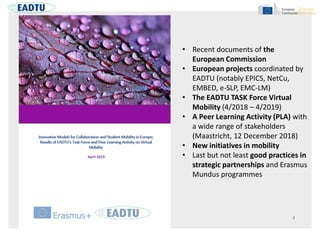
• Recent documents of the
European Commission
• European projects coordinated by
EADTU (notably EPICS, NetCu,
EMBED, e-SLP, EMC-LM)
• The EADTU TASK Force Virtual
Mobility (4/2018 – 4/2019)
• A Peer Learning Activity (PLA) with
a wide range of stakeholders
(Maastricht, 12 December 2018)
• New initiatives in mobility
• Last but not least good practices in
strategic partnerships and Erasmus
Mundus programmes
April 2019
Task Force
Virtual
Mobility
• George Ubachs (EADTU, Chair)
• Piet Henderikx (EADTU)
• Ingrid Thaler (FernUni)
• Esther Souto (UNED)
• Carme Anguera Iglesias (UOC)
• Jukka Lerkkanen (University of Jyvaskyla)
• Katrien Vanelven (KU Leuven)
• Susanne Koch (Norgesuniversitetet)
• Sabine Bottin-Rouseau (FIED-UPMC)
• Marinke Sussenbach (TU-Delft)
• Sarah Guth, Erasmus+ Virtual Exchange
consortium
• Barbara Moser Mercer, InZone |Université de
Genève
LERU and the Coimbra Group are represented by
some of the TF-members
Task Force
Virtual
Mobility
EADTU Task force Virtual mobility
The main task of the Task force was the exploration of:
1. Good practices within and outside the EADTU
membership of virtual mobility
• making an inventory of current good practices
concerning virtual mobility VM models
• making an inventory of cooperation models for
virtual exchange programs
2. New developments in the field of virtual
mobility
• Sharing of current institutional and curriculum-
level plans for the development of VM
• Identifying opportunities and obstacles in VM
at institutional and student level
3. How virtual mobility can stimulate European
university networks
• exploring the potential of VM within European
university networks
• generating (political) support for VM becoming
a mainstream mobility scheme
PLA
participants
Higher Education Institutions
• Maastricht University
• KU Leuven
• TU Delft
• Open Universiteit Nederland
• Open University UK
• Beuth Hochschule für Technik Berlin
• Sorbonne University
• Università Telematica Internazionale Uninettuno
• University of Jyväskylä/Open University
• University of Warsaw
• UOC Universitat Oberta de Catalunya
• KIT Royal Tropical Institute
University network organisations
• Coimbra Group
• Kiron Open Higher Education
• European Students Union
Public authorities
• European Commission
• Ministry of Education and Research, Norway
Agencies
• Academic Cooperation Association (ACA)
• DAAD
• Diku
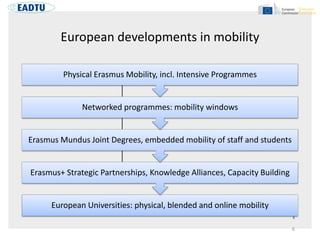
European developments in mobility
6
European Universities: physical, blended and online mobility
Erasmus+ Strategic Partnerships, Knowledge Alliances, Capacity Building
Erasmus Mundus Joint Degrees, embedded mobility of staff and students
Networked programmes: mobility windows
Physical Erasmus Mobility, incl. Intensive Programmes
Definition
Virtual
mobility
European
Commission
In the Erasmus+ 2019 call, virtual mobility is
defined as
“a set of activities supported by Information and
Communication Technologies, including e-
learning, that realise or facilitate international,
collaborative experiences in a context of
teaching, training or learning”.
Core
concept
of mobility
The core goal of any mobility is
providing an international
academic experience for
students
• related to a formal course or
curriculum
• based on a bilateral or
network/consortium
collaboration and agreement
• guaranteeing the rights of
the student
Basic
Principle
Education can be organised in
a face to face, online or
blended mode.
So can international education
and mobility
- Short term, long term,
intermittent
- Synchronous, asynchronous
- Multi-campus
Three types
of mobility
International collaboration
and mobility can be physical,
blended or completely online:
• Physical mobility with immersion
• Online/virtual mobility along
online courses and collaborative
learning activities
• Blended mobility combining both
(online supporting physical;
physical supporting online)
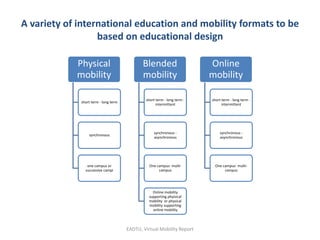
A variety of international education and mobility formats to be
based on educational design
Physical
mobility
short term - long term
synchronous
one campus or
successive campi
Blended
mobility
short term - long term -
intermittent
synchronous -
asynchronous
One campus- multi-
campus
Online mobility
supporting phyisical
mobility or physical
mobility supporting
online mobility
Online
mobility
short term - long term -
intermittent
synchronous -
asynchronous
One campus- multi-
campus
EADTU, Virtual Mobility Report
Mobility
and the
curriculum
• Embedded mobility within a course
• Exchange mobility for individual
students
• Networked mobility in networked
curricula and courses with mobility
windows
• Integrated mobility in joint curricula
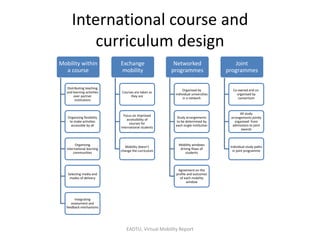
International course and
curriculum design
Mobility within
a course
Distributing teaching
and learning activities
over partner
institutions
Organising flexibility
to make activities
accessible by all
Organising
international learning
communities
Selecting media and
modes of delivery
Integrating
assessment and
feedback mechanisms
Exchange
mobility
Courses are taken as
they are
Focus on Improved
accessibility of
courses for
international students
Mobility doesn’t
change the curriculum
Networked
programmes
Organised by
indiividual universities
in a network
Study arrangements
to be determined by
each single institution
Mobility windows
driving flows of
students
Agreement on the
profile and outcomes
of each mobility
window
Joint
programmes
Co-owned and co-
organised by
consortium
All study
arrangements jointly
organised: from
admissions to joint
awards
Individual study paths
in joint programme
EADTU, Virtual Mobility Report
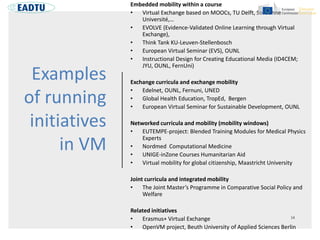
Examples
of running
initiatives
in VM
Embedded mobility within a course
• Virtual Exchange based on MOOCs, TU Delft, Sorbonne
Université,…
• EVOLVE (Evidence-Validated Online Learning through Virtual
Exchange),
• Think Tank KU-Leuven-Stellenbosch
• European Virtual Seminar (EVS), OUNL
• Instructional Design for Creating Educational Media (ID4CEM;
JYU, OUNL, FernUni)
Exchange curricula and exchange mobility
• Edelnet, OUNL, Fernuni, UNED
• Global Health Education, TropEd, Bergen
• European Virtual Seminar for Sustainable Development, OUNL
Networked curricula and mobility (mobility windows)
• EUTEMPE-project: Blended Training Modules for Medical Physics
Experts
• Nordmed Computational Medicine
• UNIGE-inZone Courses Humanitarian Aid
• Virtual mobility for global citizenship, Maastricht University
Joint curricula and integrated mobility
• The Joint Master’s Programme in Comparative Social Policy and
Welfare
Related initiatives
• Erasmus+ Virtual Exchange
• OpenVM project, Beuth University of Applied Sciences Berlin
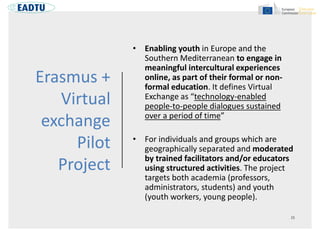
Erasmus +
Virtual
exchange
Pilot
Project
• Enabling youth in Europe and the
Southern Mediterranean to engage in
meaningful intercultural experiences
online, as part of their formal or non-
formal education. It defines Virtual
Exchange as “technology-enabled
people-to-people dialogues sustained
over a period of time”
• For individuals and groups which are
geographically separated and moderated
by trained facilitators and/or educators
using structured activities. The project
targets both academia (professors,
administrators, students) and youth
(youth workers, young people).
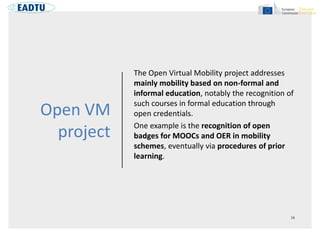
Open VM
project
The Open Virtual Mobility project addresses
mainly mobility based on non-formal and
informal education, notably the recognition of
such courses in formal education through
open credentials.
One example is the recognition of open
badges for MOOCs and OER in mobility
schemes, eventually via procedures of prior
learning.
Skills
involved in
Virtual
Mobility
(OpenVM)
• Intercultural skills and attitudes: gaining cultural knowledge;
understanding cultural perspectives; enhancing own cultural
identity; enhancing and demonstrating cultural understanding;
applying intercultural awareness in culturally challenging
circumstances
• Networked learning skills: learning to work and cooperate in an
international setting with the use of ICT and social platforms;
learning about dealing with complex situations; learning about
dealing with ambiguity;
• Active self-regulated learner skills: being able to self-regulate
learning process; being able to self-reflection on learning
experiences; demonstrating ownership and self-discipline in
learning;
• Media and digital literacy: being proficient in using online learning
technologies; being proficient in assessing quality in courses and
resources found online; being digitally literate; being proficient in
using digital platforms
• Autonomy-driven learning: : demonstrating self-directedness in
decision-making on own learning; demonstrating independent
learning
• Interactive and collaborative learning in authentic international
environments: enhancing teamwork skills; collaborating with peers
from different discipline; collaborating with peers within the context
of an international learning experience; Interacting with authentic
international resources in a foreign language;
• Open-mindedness: being open- minded and tolerant; demonstrating
self- confidence in interaction with peers and teaching staff;
showing willingness to improve proficiency in foreign languages
Opportunities for
students
• Flexibility, accessibility for potentially
all students
• Individual portfolio development
throughout the study career: more
opportunities for mobility and for
integrating an international learning
experience, a new field of study and
new ways of learning, virtual
internships
• Competence building: intercultural
competences, linguistic skills,
collaborative learning, media and
digital literacy skills, open mindedness,
team work, critical thinking,
networking
• Long-term and intermittent mobility
• Improving employability 18
Opportunities for
staff
• Enhancement of the quality of a
course or curriculum: content,
collaborative, active learning
• Connecting educational networking
with research networking
• Continuous professional
development, learning from
international colleagues (sharing
good practices, new methods...)
• Enhancing teaching skills and
teaching quality
• Career development
19
Opportunities for
institutions
• To expand the university’s academic offer in an
international context at scale,
internationalisation of the curriculum, global
teaching, transnational education,
development collaboration
• Innovative pedagogies creating an international
experience for students
• Enhancing the quality of courses and curricula
• Networking with other universities in education
and research, sharing teaching capacity
• Enhancing the attractiveness and
competitiveness of the university
• New approaches concerning alumni activities,
continuous education and lifelong learning
• Reaching out to disadvantaged groups, e.g.
migrants, refugees
20
Barriers
• Offerings in digital education
slow in large parts of Europe
• Lack of awareness, experience
and expertise
• Administrative issues
• Time zones and course tables
• Learner control and structure
• Linguistic barriers
• Digital maturity
21
Universities should (Micro Level):
• Benefit from the opportunities of networked and joint
educational initiatives by digital education, involving multiple
campuses simultaneously, e.g. in virtual seminars and think tanks, or in
joint curricula in the framework of the “European universities” initiative.
• Benefit from specific features of digital education which add to
the quality and intensity of education, e.g. inquiry learning activities
on the internet, communication with staff ad peers, learning communities ,
e-assessment and feedback.
• Benefit from the flexibility of digital education in international
education: next to synchronous, also asynchronous formats, taking into
account different time zones and conflicting course tables; adaptiveness to
different prior knowledge levels.
• Benefit of the opportunities with regard to the granularity of
digital education. Collaboration and mobility is possible for all
organisational units: learning activities/modules, courses, MOOCs and short
courses, degree programs (networked, joint) and for all qualification levels:
foundation, bachelor, master and doctorate.
• Benefit from the scale and cost-effectiveness of digital modes of
teaching and learning in international education. The larger the
number of students, the lower the cost per head (lower variable cost). As a
consequence, transnational (blended and) online education enables
universities to multiply international student numbers while keeping quality
under control.
22
RESULTS PLA-VM
At institutional policy level (Meso level):
• Universities should develop leadership with regard to the
internationalisation of education. International education
should be part of mainstream curriculum development.
• Support and incentives should be given to programme
coordinators and teaching staff to develop an international
dimension in education, facilitating collaboration in broader
networks and consortia.
• Select blended/online internationalisation pedagogies,
depending on educational design, taking into account the needs
for flexibility and scalability and the quality requirements for
international education.
• International relations offices should extend their activities to
international curriculum and course development in connection
with teaching and learning support services. Especially, they
should focus on international collaborative pedagogies and
innovative mobility formats.
• Organise on site staff training, bringing in external expertise and
stimulate staff to experiment with blended education, online
short degrees and MOOCs along their research interests.
• Create subject area communities and share online course
materials as a source for international collaboration and mobility
(OER). 23
RESULTS PLA-VM
• University networks should develop and support the
institutional leadership of their members with regard to
blended/online transnational education and online/blended
collaboration and mobility.
• University networks should stimulate members to organise
networked/joint collaborations, e.g. virtual seminars, think
tanks, student exchange with MOOCs and online courses, networked
programmes, joint programmes.
• Networks/agencies/governments should create subject
area/programme communities and share online course
materials, taking into account their international use.
24
RESULTS PLA-VM
• National strategies should build a framework to promote,
stimulate and activate international blended/online
collaboration and mobility between universities. Virtual
mobility as a complement to physical mobility will support this
process and intensify the international learning experience for all
students.
• Internationalisation policies and strategies for higher
education at national level should strengthen the policies
of the European Commission with regard to “European
Universities” as alliances to enhance the quality of higher education
and harness students with an international awareness and with
international competences.
• National governments should support the digital
dimension in international collaboration and mobility in
the European Higher education Area (BFUG).
25
RESULTS PLA-VM
Conclusions
• Education can be organized in face to face, blended
or by online modes. This is also the case for mobility
which always goes together with it. It can be short
and long term, synchronous and asynchronous. ICT
modes of teaching and learning amplify the potential
of education and the mobility related to it.
• None of the forms of mobility is an alternative for
replacing the other. Each form is adding to the
enrichment of education, offering students the
opportunity to learn international competences and
skills.
• All forms of mobility can be offered separately or in
a combination.
• The sequence of physical, blended and online
mobility will be based on principles of international
curriculum and course design
• The European Universities Initiative and the
EU.University hub will extend international
education and international mobility.

European report on virtual mobility

  • 1.
    Innovative Models forCollaboration and Student Mobility in Europe Results of EADTU’s Task Force and Peer Learning Activity on Virtual Mobility Brussels, 30th April 2019
  • 2.
    • Recent documentsof the European Commission • European projects coordinated by EADTU (notably EPICS, NetCu, EMBED, e-SLP, EMC-LM) • The EADTU TASK Force Virtual Mobility (4/2018 – 4/2019) • A Peer Learning Activity (PLA) with a wide range of stakeholders (Maastricht, 12 December 2018) • New initiatives in mobility • Last but not least good practices in strategic partnerships and Erasmus Mundus programmes April 2019
  • 3.
    Task Force Virtual Mobility • GeorgeUbachs (EADTU, Chair) • Piet Henderikx (EADTU) • Ingrid Thaler (FernUni) • Esther Souto (UNED) • Carme Anguera Iglesias (UOC) • Jukka Lerkkanen (University of Jyvaskyla) • Katrien Vanelven (KU Leuven) • Susanne Koch (Norgesuniversitetet) • Sabine Bottin-Rouseau (FIED-UPMC) • Marinke Sussenbach (TU-Delft) • Sarah Guth, Erasmus+ Virtual Exchange consortium • Barbara Moser Mercer, InZone |Université de Genève LERU and the Coimbra Group are represented by some of the TF-members
  • 4.
    Task Force Virtual Mobility EADTU Taskforce Virtual mobility The main task of the Task force was the exploration of: 1. Good practices within and outside the EADTU membership of virtual mobility • making an inventory of current good practices concerning virtual mobility VM models • making an inventory of cooperation models for virtual exchange programs 2. New developments in the field of virtual mobility • Sharing of current institutional and curriculum- level plans for the development of VM • Identifying opportunities and obstacles in VM at institutional and student level 3. How virtual mobility can stimulate European university networks • exploring the potential of VM within European university networks • generating (political) support for VM becoming a mainstream mobility scheme
  • 5.
    PLA participants Higher Education Institutions •Maastricht University • KU Leuven • TU Delft • Open Universiteit Nederland • Open University UK • Beuth Hochschule für Technik Berlin • Sorbonne University • Università Telematica Internazionale Uninettuno • University of Jyväskylä/Open University • University of Warsaw • UOC Universitat Oberta de Catalunya • KIT Royal Tropical Institute University network organisations • Coimbra Group • Kiron Open Higher Education • European Students Union Public authorities • European Commission • Ministry of Education and Research, Norway Agencies • Academic Cooperation Association (ACA) • DAAD • Diku
  • 6.
    European developments inmobility 6 European Universities: physical, blended and online mobility Erasmus+ Strategic Partnerships, Knowledge Alliances, Capacity Building Erasmus Mundus Joint Degrees, embedded mobility of staff and students Networked programmes: mobility windows Physical Erasmus Mobility, incl. Intensive Programmes
  • 7.
    Definition Virtual mobility European Commission In the Erasmus+2019 call, virtual mobility is defined as “a set of activities supported by Information and Communication Technologies, including e- learning, that realise or facilitate international, collaborative experiences in a context of teaching, training or learning”.
  • 8.
    Core concept of mobility The coregoal of any mobility is providing an international academic experience for students • related to a formal course or curriculum • based on a bilateral or network/consortium collaboration and agreement • guaranteeing the rights of the student
  • 9.
    Basic Principle Education can beorganised in a face to face, online or blended mode. So can international education and mobility - Short term, long term, intermittent - Synchronous, asynchronous - Multi-campus
  • 10.
    Three types of mobility Internationalcollaboration and mobility can be physical, blended or completely online: • Physical mobility with immersion • Online/virtual mobility along online courses and collaborative learning activities • Blended mobility combining both (online supporting physical; physical supporting online)
  • 11.
    A variety ofinternational education and mobility formats to be based on educational design Physical mobility short term - long term synchronous one campus or successive campi Blended mobility short term - long term - intermittent synchronous - asynchronous One campus- multi- campus Online mobility supporting phyisical mobility or physical mobility supporting online mobility Online mobility short term - long term - intermittent synchronous - asynchronous One campus- multi- campus EADTU, Virtual Mobility Report
  • 12.
    Mobility and the curriculum • Embeddedmobility within a course • Exchange mobility for individual students • Networked mobility in networked curricula and courses with mobility windows • Integrated mobility in joint curricula
  • 13.
    International course and curriculumdesign Mobility within a course Distributing teaching and learning activities over partner institutions Organising flexibility to make activities accessible by all Organising international learning communities Selecting media and modes of delivery Integrating assessment and feedback mechanisms Exchange mobility Courses are taken as they are Focus on Improved accessibility of courses for international students Mobility doesn’t change the curriculum Networked programmes Organised by indiividual universities in a network Study arrangements to be determined by each single institution Mobility windows driving flows of students Agreement on the profile and outcomes of each mobility window Joint programmes Co-owned and co- organised by consortium All study arrangements jointly organised: from admissions to joint awards Individual study paths in joint programme EADTU, Virtual Mobility Report
  • 14.
    Examples of running initiatives in VM Embeddedmobility within a course • Virtual Exchange based on MOOCs, TU Delft, Sorbonne Université,… • EVOLVE (Evidence-Validated Online Learning through Virtual Exchange), • Think Tank KU-Leuven-Stellenbosch • European Virtual Seminar (EVS), OUNL • Instructional Design for Creating Educational Media (ID4CEM; JYU, OUNL, FernUni) Exchange curricula and exchange mobility • Edelnet, OUNL, Fernuni, UNED • Global Health Education, TropEd, Bergen • European Virtual Seminar for Sustainable Development, OUNL Networked curricula and mobility (mobility windows) • EUTEMPE-project: Blended Training Modules for Medical Physics Experts • Nordmed Computational Medicine • UNIGE-inZone Courses Humanitarian Aid • Virtual mobility for global citizenship, Maastricht University Joint curricula and integrated mobility • The Joint Master’s Programme in Comparative Social Policy and Welfare Related initiatives • Erasmus+ Virtual Exchange • OpenVM project, Beuth University of Applied Sciences Berlin
  • 15.
    Erasmus + Virtual exchange Pilot Project • Enablingyouth in Europe and the Southern Mediterranean to engage in meaningful intercultural experiences online, as part of their formal or non- formal education. It defines Virtual Exchange as “technology-enabled people-to-people dialogues sustained over a period of time” • For individuals and groups which are geographically separated and moderated by trained facilitators and/or educators using structured activities. The project targets both academia (professors, administrators, students) and youth (youth workers, young people).
  • 16.
    Open VM project The OpenVirtual Mobility project addresses mainly mobility based on non-formal and informal education, notably the recognition of such courses in formal education through open credentials. One example is the recognition of open badges for MOOCs and OER in mobility schemes, eventually via procedures of prior learning.
  • 17.
    Skills involved in Virtual Mobility (OpenVM) • Interculturalskills and attitudes: gaining cultural knowledge; understanding cultural perspectives; enhancing own cultural identity; enhancing and demonstrating cultural understanding; applying intercultural awareness in culturally challenging circumstances • Networked learning skills: learning to work and cooperate in an international setting with the use of ICT and social platforms; learning about dealing with complex situations; learning about dealing with ambiguity; • Active self-regulated learner skills: being able to self-regulate learning process; being able to self-reflection on learning experiences; demonstrating ownership and self-discipline in learning; • Media and digital literacy: being proficient in using online learning technologies; being proficient in assessing quality in courses and resources found online; being digitally literate; being proficient in using digital platforms • Autonomy-driven learning: : demonstrating self-directedness in decision-making on own learning; demonstrating independent learning • Interactive and collaborative learning in authentic international environments: enhancing teamwork skills; collaborating with peers from different discipline; collaborating with peers within the context of an international learning experience; Interacting with authentic international resources in a foreign language; • Open-mindedness: being open- minded and tolerant; demonstrating self- confidence in interaction with peers and teaching staff; showing willingness to improve proficiency in foreign languages
  • 18.
    Opportunities for students • Flexibility,accessibility for potentially all students • Individual portfolio development throughout the study career: more opportunities for mobility and for integrating an international learning experience, a new field of study and new ways of learning, virtual internships • Competence building: intercultural competences, linguistic skills, collaborative learning, media and digital literacy skills, open mindedness, team work, critical thinking, networking • Long-term and intermittent mobility • Improving employability 18
  • 19.
    Opportunities for staff • Enhancementof the quality of a course or curriculum: content, collaborative, active learning • Connecting educational networking with research networking • Continuous professional development, learning from international colleagues (sharing good practices, new methods...) • Enhancing teaching skills and teaching quality • Career development 19
  • 20.
    Opportunities for institutions • Toexpand the university’s academic offer in an international context at scale, internationalisation of the curriculum, global teaching, transnational education, development collaboration • Innovative pedagogies creating an international experience for students • Enhancing the quality of courses and curricula • Networking with other universities in education and research, sharing teaching capacity • Enhancing the attractiveness and competitiveness of the university • New approaches concerning alumni activities, continuous education and lifelong learning • Reaching out to disadvantaged groups, e.g. migrants, refugees 20
  • 21.
    Barriers • Offerings indigital education slow in large parts of Europe • Lack of awareness, experience and expertise • Administrative issues • Time zones and course tables • Learner control and structure • Linguistic barriers • Digital maturity 21
  • 22.
    Universities should (MicroLevel): • Benefit from the opportunities of networked and joint educational initiatives by digital education, involving multiple campuses simultaneously, e.g. in virtual seminars and think tanks, or in joint curricula in the framework of the “European universities” initiative. • Benefit from specific features of digital education which add to the quality and intensity of education, e.g. inquiry learning activities on the internet, communication with staff ad peers, learning communities , e-assessment and feedback. • Benefit from the flexibility of digital education in international education: next to synchronous, also asynchronous formats, taking into account different time zones and conflicting course tables; adaptiveness to different prior knowledge levels. • Benefit of the opportunities with regard to the granularity of digital education. Collaboration and mobility is possible for all organisational units: learning activities/modules, courses, MOOCs and short courses, degree programs (networked, joint) and for all qualification levels: foundation, bachelor, master and doctorate. • Benefit from the scale and cost-effectiveness of digital modes of teaching and learning in international education. The larger the number of students, the lower the cost per head (lower variable cost). As a consequence, transnational (blended and) online education enables universities to multiply international student numbers while keeping quality under control. 22 RESULTS PLA-VM
  • 23.
    At institutional policylevel (Meso level): • Universities should develop leadership with regard to the internationalisation of education. International education should be part of mainstream curriculum development. • Support and incentives should be given to programme coordinators and teaching staff to develop an international dimension in education, facilitating collaboration in broader networks and consortia. • Select blended/online internationalisation pedagogies, depending on educational design, taking into account the needs for flexibility and scalability and the quality requirements for international education. • International relations offices should extend their activities to international curriculum and course development in connection with teaching and learning support services. Especially, they should focus on international collaborative pedagogies and innovative mobility formats. • Organise on site staff training, bringing in external expertise and stimulate staff to experiment with blended education, online short degrees and MOOCs along their research interests. • Create subject area communities and share online course materials as a source for international collaboration and mobility (OER). 23 RESULTS PLA-VM
  • 24.
    • University networksshould develop and support the institutional leadership of their members with regard to blended/online transnational education and online/blended collaboration and mobility. • University networks should stimulate members to organise networked/joint collaborations, e.g. virtual seminars, think tanks, student exchange with MOOCs and online courses, networked programmes, joint programmes. • Networks/agencies/governments should create subject area/programme communities and share online course materials, taking into account their international use. 24 RESULTS PLA-VM
  • 25.
    • National strategiesshould build a framework to promote, stimulate and activate international blended/online collaboration and mobility between universities. Virtual mobility as a complement to physical mobility will support this process and intensify the international learning experience for all students. • Internationalisation policies and strategies for higher education at national level should strengthen the policies of the European Commission with regard to “European Universities” as alliances to enhance the quality of higher education and harness students with an international awareness and with international competences. • National governments should support the digital dimension in international collaboration and mobility in the European Higher education Area (BFUG). 25 RESULTS PLA-VM
  • 26.
    Conclusions • Education canbe organized in face to face, blended or by online modes. This is also the case for mobility which always goes together with it. It can be short and long term, synchronous and asynchronous. ICT modes of teaching and learning amplify the potential of education and the mobility related to it. • None of the forms of mobility is an alternative for replacing the other. Each form is adding to the enrichment of education, offering students the opportunity to learn international competences and skills. • All forms of mobility can be offered separately or in a combination. • The sequence of physical, blended and online mobility will be based on principles of international curriculum and course design • The European Universities Initiative and the EU.University hub will extend international education and international mobility.