Lamar Soutter Library
University of Massachusetts Medical
School
2013
Sally Gore, MS, MS LIS
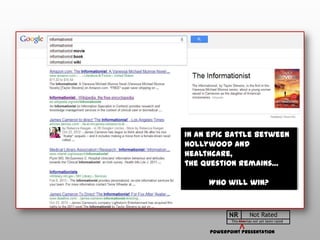
In an epic battle between
Hollywood and
healthcare,
the question remains…
Who will win?
^PowerPoint presentation
These new professionals might be called
informationists (not a graceful term, but one
that parallels such terms as gastroenterologists
or hospitalists), or clinical knowledge workers
(in parallel with social workers).
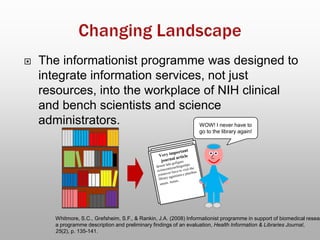
 The informationist programme was designed to
integrate information services, not just
resources, into the workplace of NIH clinical
and bench scientists and science
administrators.
Whitmore, S.C., Grefsheim, S.F., & Rankin, J.A. (2008) Informationist programme in support of biomedical resear
a programme description and preliminary findings of an evaluation, Health Information & Libraries Journal,
25(2), p. 135-141.
WOW! I never have to
go to the library again!
How’s that
working out
for you?
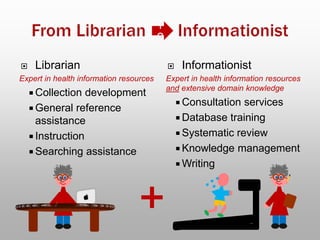
 Librarian
Expert in health information resources
 Collection development
 General reference
assistance
 Instruction
 Searching assistance
 Informationist
Expert in health information resources
and extensive domain knowledge
 Consultation services
 Database training
 Systematic review
 Knowledge management
 Writing
T
O
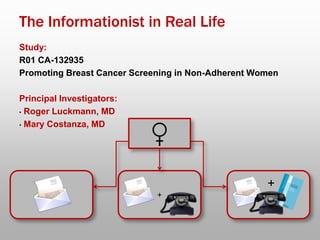
The Informationist in Real Life
Study:
R01 CA-132935
Promoting Breast Cancer Screening in Non-Adherent Women
Principal Investigators:
• Roger Luckmann, MD
• Mary Costanza, MD
+
+
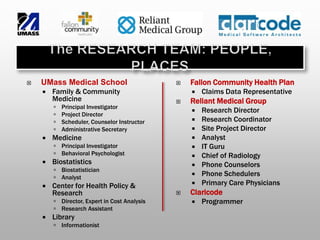
 UMass Medical School
 Family & Community
Medicine
 Principal Investigator
 Project Director
 Scheduler, Counselor Instructor
 Administrative Secretary
 Medicine
 Principal Investigator
 Behavioral Psychologist
 Biostatistics
 Biostatistician
 Analyst
 Center for Health Policy &
Research
 Director, Expert in Cost Analysis
 Research Assistant
 Library
 Informationist
 Fallon Community Health Plan
 Claims Data Representative
 Reliant Medical Group
 Research Director
 Research Coordinator
 Site Project Director
 Analyst
 IT Guru
 Chief of Radiology
 Phone Counselors
 Phone Schedulers
 Primary Care Physicians
 Claricode
 Programmer
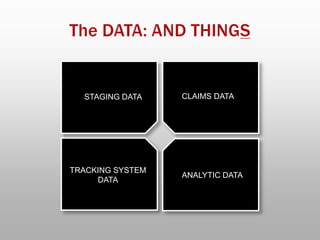
STAGING DATA CLAIMS DATA
TRACKING SYSTEM
DATA
ANALYTIC DATA
 AIM 1: Improve effectiveness and efficiency of
communication w/in team regarding data
 AIM 2: Articulate technology issues related to
implementation of the study
 AIM 3: Enhance information
organization, management, utilization, and
access skills of team members
 AIM 4: Assess value of an informationist to the
research team
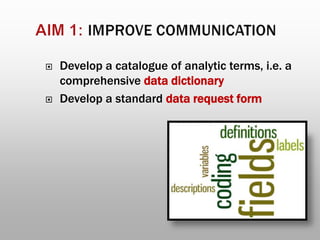
 Develop a catalogue of analytic terms, i.e. a
comprehensive data dictionary
 Develop a standard data request form
 Define the issues encountered during
development of the tracking system /
database
 Discover literature related to the topic
 Identify the gaps in existing literature
 Develop an electronic catalog of relevant
publications and resources
 Write and publish a paper on the topic
 Assist in systematic review of telephone outreach
interventions to increase adherence to mammograms
 Develop system for collection, distribution, and review of articles
 Prepare and maintain timeline for project
 Develop catalog of relevant resources on development
and evaluation of screening / preventive interventions
 Establish and/or define rules
 Set criteria
 Create maintenance features
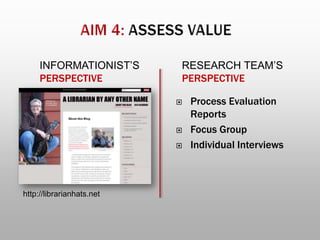
INFORMATIONIST’S
PERSPECTIVE
RESEARCH TEAM’S
PERSPECTIVE
 Process Evaluation
Reports
 Focus Group
 Individual Interviews
http://librarianhats.net
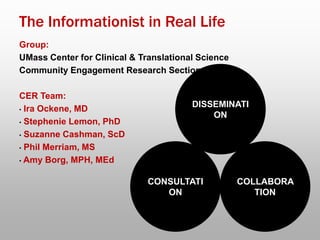
The Informationist in Real Life
Group:
UMass Center for Clinical & Translational Science
Community Engagement Research Section
CER Team:
• Ira Ockene, MD
• Stephenie Lemon, PhD
• Suzanne Cashman, ScD
• Phil Merriam, MS
• Amy Borg, MPH, MEd
DISSEMINATI
ON
CONSULTATI
ON
COLLABORA
TION
 Perform extensive literature
review
 Develop a catalog of best
practices
 Develop a collection of
resources
 Build tools for disseminating
research
 Build tools for collecting and
archiving growing knowledge
base
 Measure impact of CER
DISSEMINATI
ON
 Provide knowledge
management services
 Literature reviews
 Bibliographic management
 Data management
 Information organization
 Database design
 Knowledge mapping
 Provide education on
information organization and
management
 Provide assistance with all
aspects related to NIH Public
Access Policy
CONSULTATI
ON
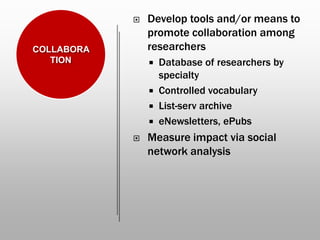
 Develop tools and/or means to
promote collaboration among
researchers
 Database of researchers by
specialty
 Controlled vocabulary
 List-serv archive
 eNewsletters, ePubs
 Measure impact via social
network analysis
COLLABORA
TION
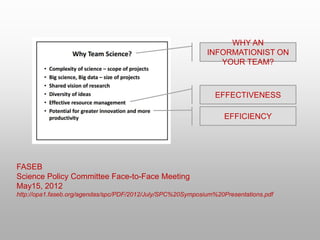
FASEB
Science Policy Committee Face-to-Face Meeting
May15, 2012
http://opa1.faseb.org/agendas/spc/PDF/2012/July/SPC%20Symposium%20Presentations.pdf
EFFECTIVENESS
EFFICIENCY
WHY AN
INFORMATIONIST ON
YOUR TEAM?
The informationist in team science

The informationist in team science

  • 1.
    Lamar Soutter Library Universityof Massachusetts Medical School 2013 Sally Gore, MS, MS LIS
  • 2.
    In an epicbattle between Hollywood and healthcare, the question remains… Who will win? ^PowerPoint presentation
  • 3.
    These new professionalsmight be called informationists (not a graceful term, but one that parallels such terms as gastroenterologists or hospitalists), or clinical knowledge workers (in parallel with social workers).
  • 4.
     The informationistprogramme was designed to integrate information services, not just resources, into the workplace of NIH clinical and bench scientists and science administrators. Whitmore, S.C., Grefsheim, S.F., & Rankin, J.A. (2008) Informationist programme in support of biomedical resear a programme description and preliminary findings of an evaluation, Health Information & Libraries Journal, 25(2), p. 135-141. WOW! I never have to go to the library again!
  • 5.
  • 6.
     Librarian Expert inhealth information resources  Collection development  General reference assistance  Instruction  Searching assistance  Informationist Expert in health information resources and extensive domain knowledge  Consultation services  Database training  Systematic review  Knowledge management  Writing T O
  • 7.
    The Informationist inReal Life Study: R01 CA-132935 Promoting Breast Cancer Screening in Non-Adherent Women Principal Investigators: • Roger Luckmann, MD • Mary Costanza, MD + +
  • 8.
     UMass MedicalSchool  Family & Community Medicine  Principal Investigator  Project Director  Scheduler, Counselor Instructor  Administrative Secretary  Medicine  Principal Investigator  Behavioral Psychologist  Biostatistics  Biostatistician  Analyst  Center for Health Policy & Research  Director, Expert in Cost Analysis  Research Assistant  Library  Informationist  Fallon Community Health Plan  Claims Data Representative  Reliant Medical Group  Research Director  Research Coordinator  Site Project Director  Analyst  IT Guru  Chief of Radiology  Phone Counselors  Phone Schedulers  Primary Care Physicians  Claricode  Programmer
  • 9.
    STAGING DATA CLAIMSDATA TRACKING SYSTEM DATA ANALYTIC DATA
  • 10.
     AIM 1:Improve effectiveness and efficiency of communication w/in team regarding data  AIM 2: Articulate technology issues related to implementation of the study  AIM 3: Enhance information organization, management, utilization, and access skills of team members  AIM 4: Assess value of an informationist to the research team
  • 11.
     Develop acatalogue of analytic terms, i.e. a comprehensive data dictionary  Develop a standard data request form
  • 12.
     Define theissues encountered during development of the tracking system / database  Discover literature related to the topic  Identify the gaps in existing literature  Develop an electronic catalog of relevant publications and resources  Write and publish a paper on the topic
  • 13.
     Assist insystematic review of telephone outreach interventions to increase adherence to mammograms  Develop system for collection, distribution, and review of articles  Prepare and maintain timeline for project  Develop catalog of relevant resources on development and evaluation of screening / preventive interventions  Establish and/or define rules  Set criteria  Create maintenance features
  • 14.
    INFORMATIONIST’S PERSPECTIVE RESEARCH TEAM’S PERSPECTIVE  ProcessEvaluation Reports  Focus Group  Individual Interviews http://librarianhats.net
  • 15.
    The Informationist inReal Life Group: UMass Center for Clinical & Translational Science Community Engagement Research Section CER Team: • Ira Ockene, MD • Stephenie Lemon, PhD • Suzanne Cashman, ScD • Phil Merriam, MS • Amy Borg, MPH, MEd DISSEMINATI ON CONSULTATI ON COLLABORA TION
  • 16.
     Perform extensiveliterature review  Develop a catalog of best practices  Develop a collection of resources  Build tools for disseminating research  Build tools for collecting and archiving growing knowledge base  Measure impact of CER DISSEMINATI ON
  • 17.
     Provide knowledge managementservices  Literature reviews  Bibliographic management  Data management  Information organization  Database design  Knowledge mapping  Provide education on information organization and management  Provide assistance with all aspects related to NIH Public Access Policy CONSULTATI ON
  • 18.
     Develop toolsand/or means to promote collaboration among researchers  Database of researchers by specialty  Controlled vocabulary  List-serv archive  eNewsletters, ePubs  Measure impact via social network analysis COLLABORA TION
  • 19.
    FASEB Science Policy CommitteeFace-to-Face Meeting May15, 2012 http://opa1.faseb.org/agendas/spc/PDF/2012/July/SPC%20Symposium%20Presentations.pdf EFFECTIVENESS EFFICIENCY WHY AN INFORMATIONIST ON YOUR TEAM?

Editor's Notes

  • #7 A little of my own story
  • #9 Research Team Makeup:25+ individuals involved, not counting primary care physicians who must approve eligibility of patients – one check-pointLocated in basically 4 geographic locations – UMMS, Reliant Medical Group (healthcare providers), FCHP (insurer), Claricode (computer program consultants, Cambridge)
  • #10 Data, likewise, is generated and/or collected via four sources:STAGING DATA – Captures Reliant EMR data – things such as office visits; historical data on labs, prescriptions, procedures; updates demographic and insurance enrollment coverageCLAIMS DATA – Historical data of FCHP captured claims from 1997 forward; Patients with a Reliant Medical Group PCP, claims on services utilized by Reliant patientsTRACKING SYSTEM DATA – Patient responses from counseling and scheduling interviews, including the baseline survey; counselor/scheduler call log entries and call outcomes - ~ 350 variablesANALYTIC DATA – Draws from other three sources, but also adds a number of new variables related to the specific outcomes soughtSummary – 4 sources, four locations, multiple people collecting/entering, 1000+ variables, etc.
  • #11 So, why did the research team feel like an informationist would benefit them?During conversations, 4 aims developed
  • #12 Give some specifics for each of these, so that you have an idea of what I’m expected to do and/or produce in my role.Improveeffectiveness and efficiency of communication w/in team regarding dataEXPANDED to information in general – email / history / database
  • #13 Articulate technology issues related to implementation of the study Took well over a year – much longer than originally anticipated when the researchers wrote the grant – to develop the tracking system that would be used in the interventions, i.e. the schedulers and counselor calls. Why is this? What’s been written on it? Anything? What can the experience of this study share with future studies?
  • #14 Enhance information organization, management, utilization, and access skills of team membersMore “traditional” librarian skills; teaching information literacy, information management, biblographic software tools, etc. Systematic review – Something librarians have done for awhile, but new to me.
  • #15 Assess value of an informationist to the research teamProgress evaluation – taking minutes from meetings, writing reports, sharing notes, etc. – not very good at it, decided instead to use a blog to track, reflect upon my experiences. It’s been really fun and, admittedly, kind of cool to see the number of people who are reading it regularly – approximately 600/week, including members of the team.Eventually, we’ll begin to meet and discuss my thoughts – me, the two PIs, the project director, and other key members on the team.Towards the end of the supplement time, we’ll have focus groups for members of the research team, as well as individual interviews – gather qualitative data for analysis; answer question of how much value I brought to the study; how, why, etc.